REVIEW 4 major objections 5 minor 57 references
Why We Feel What We Feel: Joint Detection of Emotions and Their Opinion Triggers in E-commerce
T0 review · 4 major / 5 minor · reviewed 2026-08-06 · deepseek-v4-flash
Pith's one-line read The paper introduces a joint task, EOT, in which a model must both identify which of eight primary emotions a customer review expresses and extract the exact verbatim spans that caused each emotion.
desk verdict The EOT-X dataset is a real contribution; the EOT-DETECT superiority claim is not supported by the paper's own tables and may be an artifact of the evaluation protocol. read the letter →
The pith
A machine-rendered reading of the paper's core claim, the machinery that carries it, and where it could break.
The reading
What carries the argument
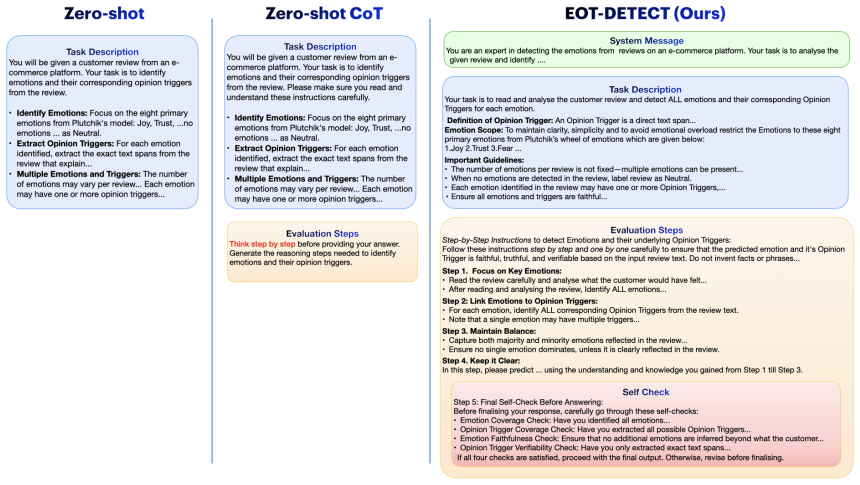
The mechanism is the structured prompt plus a final verification loop: the instructions direct the model to focus on key emotions, link each emotion to one or more contiguous substrings, preserve minority emotions, enforce extractive output, and then run a self-check confirming emotion coverage, trigger coverage, emotion faithfulness, and trigger verifiability. This five-step sequence is the component the paper credits for the gains, and it works by turning the LLM's generation into a constrained extractive pass rather than an open-ended labeling exercise.
What would settle it
Re-run the 23-model comparison with strict exact-span matching on a majority-vote gold standard, and choose temperature and top-p on a separate development split; if EOT-DETECT no longer beats zero-shot and chain-of-thought, the claimed advantage is an evaluation or tuning artifact.
Extended reading notes
Core claim
EOT-DETECT is defined as a prompt tuple $P=\langle S, T, I, R\rangle$: a system message that sets an expert persona, a task description that restricts emotions to the eight Plutchik categories plus Neutral and insists triggers be exact substrings, five instructions that move from emotion identification through trigger linking, balance, clarity, and a final self-check, and the input review. The self-check explicitly asks the model to verify emotion coverage, trigger coverage, emotion faithfulness, and trigger verifiability before answering. On EOT-X, with a gold standard aggregated from three expert raters by majority vote for emotions and union-with-longest-overlap for triggers, the paper reports that EOT-DETECT beats zero-shot and chain-of-thought baselines for several strong models, including Mistral-7B-Instruct-v0.2 at emotion F1 0.86 and Claude Sonnet 3.5 at 0.81, and that the fine-tuned EOT-Llama outperforms models up to seven times larger. The central discovery is that a structured, self-verifying prompt makes modern LLMs more faithful at explaining why a review expresses an emotion.
Load-bearing premise
The reported gains depend on the aggregated gold standard being a fair target and on the prompts and decoding settings not being tuned on the test reviews.
Editorial extensions
If this is right
- The EOT-X dataset gives future work a fixed, human-verified target for comparing emotion-and-trigger systems across Amazon, TripAdvisor, and Yelp.
- A 1-billion-parameter fine-tuned model can serve as an on-device analyzer, reducing the need for API calls in e-commerce feedback processing.
- Adding the self-check step is a model-agnostic intervention that lifts several open- and closed-source models above their zero-shot and chain-of-thought baselines.
- Because triggers are verbatim spans, model outputs can be audited against the original review, making the analysis interpretable for product and customer-experience teams.
- Closed-source models lead on absolute scores, but the best open-source models with EOT-DETECT are competitive, narrowing the practical gap.
Reading between the lines
- Editorial inference: the reported trigger metrics (partial match and ROUGE) plus the gold-standard rule that keeps every unique trigger span and the longest overlap may reward models that emit long or numerous spans, so an exact-span-only evaluation could reorder the leaderboard.
- Editorial inference: the decoding configuration was empirically tuned and validated without a clearly specified development split, so part of the EOT-DETECT advantage could come from matching the test distribution; a validation-split replication is a natural check.
- Editorial inference: the same joint formulation could transfer to app-store reviews, support tickets, or survey comments, where the verbatim span that caused an emotion is the actionable unit.
- Editorial inference: the self-check instruction is a soft form of constrained decoding; a testable extension is whether forcing spans through constrained generation gives the same gain without prompt-based self-verification.
Editorial analysis
A structured set of objections, weighed in public.
Referee Report
Summary. The paper proposes a joint task, Emotion detection and Opinion Trigger extraction (EOT), for e-commerce reviews, and introduces EOT-X, a human-annotated dataset of 2,400 reviews from Amazon, Yelp, and TripAdvisor with Plutchik's eight primary emotions and extractive opinion triggers. The authors evaluate 23–26 LLMs with zero-shot, zero-shot Chain-of-Thought, and their structured prompting framework EOT-DETECT, which contains five instruction steps including a final self-check. The paper's central claim is that EOT-DETECT outperforms zero-shot and CoT across e-commerce domains, and it also contributes an edge-deployable fine-tuned model (EOT-Llama). The dataset and annotation effort are substantial, but the reported results and evaluation protocol raise serious concerns about the validity of the headline comparison.
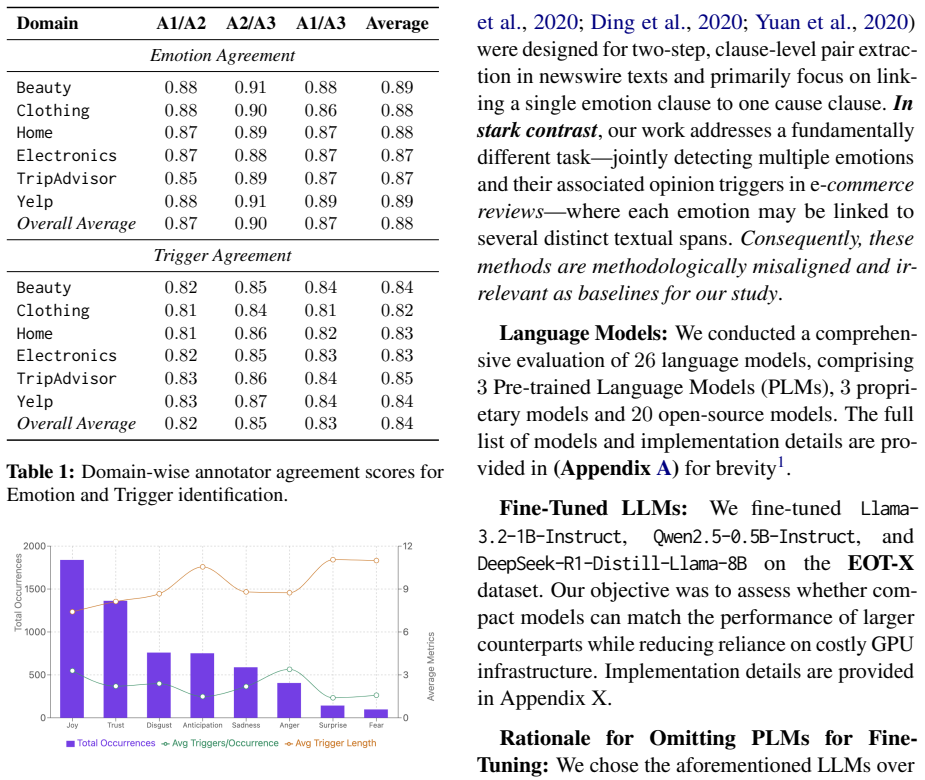
Significance. If the main comparison claim were sustained, the paper would provide a reusable benchmark for emotion-opinion trigger analysis and a prompt framework that reliably improves LLM extraction. The strengths are real: the dataset is multi-domain, the annotations involve three expert raters with high inter-annotator agreement (average κ=0.89 for emotions, 0.84 for triggers), the evaluation spans many open and closed models, and the authors commit to releasing data and models. However, the paper's own tables do not support the central claim: EOT-DETECT degrades performance on several strong models, no significance tests are provided, and the evaluation protocol may systematically favor the framework's verbose output style. The significance can only be assessed after these issues are resolved.
major comments (4)
- [Section 7, Tables 2 and 3] The central claim that EOT-DETECT 'consistently outperforms' zero-shot and chain-of-thought is contradicted by the paper's own numbers. For GPT-4o, emotion F1 drops from 0.75 (ZS) to 0.53 (EOT); for Llama-3.1-8B-Instruct, it drops from 0.51 to 0.17; Gemma-2-27B drops from 0.43 to 0.31; and Qwen2.5-7B is flat (0.56 vs. 0.55). Several trigger scores also decline. No significance tests, confidence intervals, or per-domain breakdowns are reported. The authors need to either revise the claim to specify the models and domains where EOT-DETECT helps, or report a proper statistical comparison (e.g., paired bootstrap or McNemar's test) over reviews.
- [Section 7 (Evaluation on Aggregated Gold Standard)] The aggregated trigger gold standard retains all unique trigger spans from the three annotators and, on overlap, keeps the longest span; the trigger metrics include Partial Match and Rouge-1/Rouge-L, which give partial credit for long or overlapping spans. EOT-DETECT's instructions (I3 'Maintain Balance' and I5 'Final Self-Check') explicitly direct the model to include more emotions and more triggers. This scoring setup systematically favors verbose, multi-span outputs, independent of whether the extracted spans are the ones a single careful reader would endorse. The paper should provide a majority-vote or intersection-based trigger gold standard, an exact-match-only trigger F1 analysis, and a comparison of output lengths across methods to rule out this artifact.
- [Appendix B.1] The inference configuration (temperature=0.2, top_p=0.95, top_k=25, max_tokens=2500) is stated to have been 'empirically determined' and 'validated through extensive testing across our evaluation suite,' but no held-out development split is described. If prompts or decoding hyperparameters were tuned on the test set, the reported superiority of EOT-DETECT would be inflated. The authors should specify a fixed development split, describe any tuning on it, and report results on the test set only after that tuning is frozen.
- [Table 3 (open-source models)] Several rows in Table 3 contain identical metric values for different models or prompts, which raises data-integrity concerns. For example, Phi-3.5-mini-instruct's three rows (ZS, ZS-CoT, EOT) exactly match o1-mini's three rows in Table 2, and Qwen2.5-0.5B-Instruct_zs matches Mistral-7B-Instruct-v0.3_zs Cot. These exact duplicates across distinct models are implausible and need to be checked and corrected; if they are formatting errors, the corrected table must be provided before the experimental claims can be evaluated.
minor comments (5)
- [Abstract and Section 6] The abstract says 23 LLMs were evaluated, while Section 6 says three PLMs, three proprietary models, and 20 open-source models (26 total); Appendix A lists a different set of models. These numbers should be reconciled and the model list made complete.
- [Section 5.2, Table 1] The text reports an average emotion agreement of 0.89, but Table 1's Overall Average row shows 0.88; also, the text references 'Table X' rather than an actual table number. Please correct these inconsistencies and resolve the placeholder references (including 'Appendix X' in Section 1).
- [Section 7, Tables 2 and 3] The trigger-level metric 'Partial Match (PM)' is never formally defined. Please state the exact matching criterion (e.g., token-level overlap threshold) and consider reporting trigger-level F1 alongside R1/RL.
- [Table 2] The model name 'claude sonet 3.5' is a typo for 'Claude Sonnet 3.5'; please also use consistent lowercase/uppercase naming across tables.
- [Section 2 (Related Work)] The claim that EOT-X is 'the first human-annotated benchmark dataset' for emotion-opinion trigger extraction in e-commerce should be made more precise, since EMOTRIGGER (Singh et al., 2024) and other emotion-cause datasets exist in adjacent domains; the novelty should be positioned against those works explicitly.
Circularity Check
No circularity: the paper's claims are empirical, the benchmark is externally annotated, and no predicted quantity is defined in terms of its inputs.
full rationale
The paper contains no derivation chain in which a predicted quantity reduces to a fitted input or to a self-citation. The central claims — the EOT-X dataset and the EOT-DETECT prompting gains — are evaluated against human annotations, which are independent of the model outputs. The EOT-DETECT prompt instructions (I3 'Maintain Balance' and I5 'Final Self-Check') do push for broader emotion and trigger coverage, and the gold-standard aggregation in Section 7 preserves all unique triggers and the longest overlapping spans, with Partial Match and Rouge metrics that tolerate partial or long spans. This raises a legitimate evaluation-validity concern: the protocol may reward exactly the verbose output distribution the framework requests. However, the gold standard is not constructed from the model outputs, and no parameter of the framework is fit to the test labels, so the reported advantage is not forced by definition. Appendix B.1 states that the decoding configuration was 'empirically determined' and 'validated through extensive testing across our evaluation suite' without naming a held-out development split; this is a methodological risk of test-set tuning, not a circular step. The single coauthor citation (Singh et al., 2021) appears only as related-work background and is not load-bearing. The 'consistently outperforms' claim is also contradicted by several rows in Tables 2-3 (e.g., GPT-4o emotion F1 falls from 0.75 under ZS to 0.53 under EOT, and Llama-3.1-8B falls from 0.51 to 0.17), but that is a factual/correctness concern, not circularity. Honest finding: no significant circularity.
Assumptions & free parameters
free parameters (1)
- Inference decoding configuration =
temperature=0.2, top_p=0.95, top_k=25, max_tokens=2500
assumptions (5)
- domain assumption Plutchik's 8 primary emotions plus Neutral is an adequate emotion taxonomy for e-commerce reviews
- domain assumption Expert raters' aggregated annotations are ground truth
- domain assumption Extractive contiguous spans can represent opinion triggers
- ad hoc to paper The aggregated gold standard's longest-span overlap rule is a fair evaluation target
- ad hoc to paper Prompts and decoding settings were not tuned on the held-out test split
Cite this review
Pith. "Pith review of Why We Feel What We Feel: Joint Detection of Emotions and Their Opinion Triggers in E-commerce." pith.science (2026). https://pith.science/paper/TGIXBFHE
@misc{pith2026250704708,
  author       = {Pith},
  title        = {Pith review of: Why We Feel What We Feel: Joint Detection of Emotions and Their Opinion Triggers in E-commerce},
  year         = {2026},
  howpublished = {\url{https://pith.science/paper/TGIXBFHE}},
  note         = {Machine review of arXiv:2507.04708}
}
read the original abstract
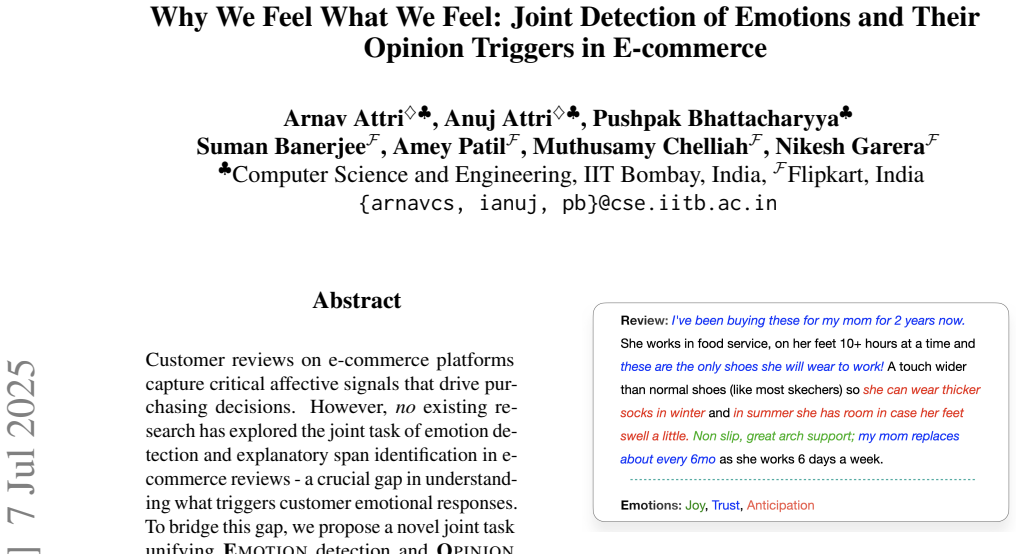
Customer reviews on e-commerce platforms capture critical affective signals that drive purchasing decisions. However, no existing research has explored the joint task of emotion detection and explanatory span identification in e-commerce reviews - a crucial gap in understanding what triggers customer emotional responses. To bridge this gap, we propose a novel joint task unifying Emotion detection and Opinion Trigger extraction (EOT), which explicitly models the relationship between causal text spans (opinion triggers) and affective dimensions (emotion categories) grounded in Plutchik's theory of 8 primary emotions. In the absence of labeled data, we introduce EOT-X, a human-annotated collection of 2,400 reviews with fine-grained emotions and opinion triggers. We evaluate 23 Large Language Models (LLMs) and present EOT-DETECT, a structured prompting framework with systematic reasoning and self-reflection. Our framework surpasses zero-shot and chain-of-thought techniques, across e-commerce domains.
Figures
Reference graph
Works this paper leans on
-
[1]
Francisca Adoma Acheampong, Henry Nunoo-Mensah, and Wei Chen. 2023. https://doi.org/10.1002/eng2.12549 Text-based emotion detection: Advances, challenges, and opportunities . Engineering Reports, 5(4):e12549
-
[2]
AI@Meta. 2024. https://github.com/meta-llama/llama3/blob/main/MODEL_CARD.md Llama 3 model card
2024
-
[4]
Weijun Bian and Gong Yan. 2022. https://doi.org/10.3389/fpsyg.2022.884673 Analyzing intention to purchase brand extension via brand attribute associations: The mediating and moderating role of emotional consumer-brand relationship and brand commitment . Frontiers in Psychology, 13:884673
-
[5]
Corrado Bonferroni. 1936. Teoria statistica delle classi e calcolo delle probabilità. Pubblicazioni del R Istituto Superiore di Scienze Economiche e Commerciali di Firenze, 8:3--62
work page 1936
-
[6]
Tom B. Brown, Benjamin Mann, Nick Ryder, Melanie Subbiah, Jared Kaplan, Prafulla Dhariwal, Arvind Neelakantan, Pranav Shyam, Girish Sastry, Amanda Askell, Sandhini Agarwal, Ariel Herbert-Voss, Gretchen Krueger, Tom Henighan, Rewon Child, Aditya Ramesh, Daniel M. Ziegler, Jeffrey Wu, Clemens Winter, Christopher Hesse, Mark Chen, Eric Sigler, Mateusz Litwin...
work page 2020
-
[7]
Tao Chen, Premaratne Samaranayake, XiongYing Cen, Meng Qi, and Yi-Chen Lan. 2022. The impact of online reviews on consumers’ purchasing decisions: Evidence from an eye-tracking study. Frontiers in Psychology, 13:865702
work page 2022
-
[8]
William G. Cochran. 1977. Sampling Techniques, 3rd edition. Wiley
work page 1977
-
[9]
Bart de Langhe, Philip M. Fernbach, and Donald R. Lichtenstein. 2015. https://doi.org/10.1093/jcr/ucv047 Navigating by the Stars: Investigating the Actual and Perceived Validity of Online User Ratings . Journal of Consumer Research, 42(6):817--833
Show all 57 references
-
[10]
Dorottya Demszky, Dana Movshovitz-Attias, Jeongwoo Ko, Alan Cowen, Gaurav Nemade, and Sujith Ravi. 2020. https://doi.org/10.18653/v1/2020.acl-main.372 G o E motions: A dataset of fine-grained emotions . In Proceedings of the 58th Annual Meeting of the Association for Computati...
2020 doi
-
[11]
Weihua Deng, Ming Yi, and Yingying Lu. 2020. Vote or not? how various information cues affect helpfulness voting of online reviews. Online Inf. Rev., 44(4):787--803
2020
-
[12]
Zixiang Ding, Rui Xia, and Jianfei Yu. 2020. Ecpe-2d: Emotion-cause pair extraction based on joint two-dimensional representation, interaction and prediction. In Proceedings of the 58th Annual Meeting of the Association for Computational Linguistics, pages 3161--3170
2020
-
[13]
Paul Ekman. 1992. https://doi.org/10.1080/02699939208411068 An argument for basic emotions . Cognition and Emotion, 6(3-4):169--200
1992 doi
-
[14]
Wenqian Fan, Pengfei Li, Wei Li, Rui Yan, and Lide Wu. 2021. https://doi.org/10.18653/v1/2021.acl-long.62 Joint constrained learning with boundary-adjusting for emotion-cause pair extraction . In Proceedings of the 59th Annual Meeting of the Association for Computational Lingu...
2021 doi
-
[15]
Fiske and Shelley E
Susan T. Fiske and Shelley E. Taylor. 1991. Social Cognition, 2nd edition. McGraw-Hill, New York
1991
-
[16]
Jerome L. Fleiss. 1971. Measuring Nominal Scale Agreement Among Many Raters, volume 76. American Psychological Association
1971
-
[17]
Rainer Greifeneder, Herbert Bless, and Thorsten Kuschmann. 2007. Extending the brand image on new products: The facilitative effect of happy mood states. Journal of Consumer Behaviour: An International Research Review, 6(1):19--31
2007
-
[18]
Lin Gui, Dongyin Wu, Ruifeng Xu, Qin Lu, and Yu Zhou. 2016. https://doi.org/10.18653/v1/D16-1170 Event-driven emotion cause extraction with corpus construction . In Proceedings of the 2016 Conference on Empirical Methods in Natural Language Processing, pages 1639--1649, Austin...
2016 doi
-
[19]
Junpeng Guo, Xiaopan Wang, and Yi Wu. 2020. Positive emotion bias: Role of emotional content from online customer reviews in purchase decisions. J. Retail. Consum. Serv., 52(101891):101891
2020
-
[20]
Carolina Herrando and Efthymios Constantinides. 2021. Emotional contagion: A brief overview and future directions. Front. Psychol., 12:712606
2021
-
[21]
Yupeng Hou, Jiacheng Li, Zhankui He, An Yan, Xiusi Chen, and Julian McAuley. 2024. https://arxiv.org/abs/2403.03952 Bridging language and items for retrieval and recommendation . arXiv preprint arXiv:2403.03952
2024 arXiv
-
[22]
Hu, Yelong Shen, Phillip Wallis, Zeyuan Allen-Zhu, Yuanzhi Li, Shean Wang, Lu Wang, and Weizhu Chen
Edward J. Hu, Yelong Shen, Phillip Wallis, Zeyuan Allen-Zhu, Yuanzhi Li, Shean Wang, Lu Wang, and Weizhu Chen. 2021. https://arxiv.org/abs/2106.09685 Lora: Low-rank adaptation of large language models . arXiv preprint arXiv:2106.09685
2021 arXiv
-
[23]
Ming-Hui Huang and Roland T. Rust. 2024. https://doi.org/10.1177/00222429231224748 Feeling ai for customer care . Journal of Marketing, 88(1):23--44
2024 doi
-
[24]
Albert Q. Jiang, Alexandre Sablayrolles, Arthur Mensch, Chris Bamford, Devendra Singh Chaplot, Diego de las Casas, Florian Bressand, Gianna Lengyel, Guillaume Lample, Lucile Saulnier, Lélio Renard Lavaud, Marie-Anne Lachaux, Pierre Stock, Teven Le Scao, Thibaut Lavril, Thomas ...
2023 arXiv
-
[25]
Albert Q. Jiang, Alexandre Sablayrolles, Antoine Roux, Arthur Mensch, Blanche Savary, Chris Bamford, Devendra Singh Chaplot, Diego de las Casas, Emma Bou Hanna, Florian Bressand, Gianna Lengyel, Guillaume Bour, Guillaume Lample, Lélio Renard Lavaud, Lucile Saulnier, Marie-Anne...
2024 arXiv
-
[26]
Sang-Hyun Kim, Kyung Hoon Park, and Jiyoung Park. 2019. https://doi.org/10.1108/INTR-09-2018-0415 Emotion as a signal of product quality: Its effect on purchase decision . Internet Research, 29(5):1103--1124
2019 doi
-
[27]
Youn-Kyung Kim and Pauline Sullivan. 2019. Emotional branding speaks to consumers' heart: the case of fashion brands. Fashion Text., 6(1)
2019
-
[28]
Takeshi Kojima, Shixiang Shane Gu, Machel Reid, Yutaka Matsuo, and Yusuke Iwasawa. 2022. https://arxiv.org/abs/2205.11916 Large language models are zero-shot reasoners . arXiv preprint arXiv:2205.11916
2022 arXiv
-
[29]
Theodoros Lappas, Gaurav Sabnis, and Georgios Valkanas. 2016. The impact of fake reviews on online visibility: A vulnerability assessment of the hotel industry. Inf. Syst. Res., 27(4):940--961
2016
-
[30]
Sophia Yat Mei Lee, Ying Chen, and Chu-Ren Huang. 2010. https://aclanthology.org/W10-0206 A text-driven rule-based system for emotion cause detection . In Proceedings of the NAACL HLT 2010 Workshop on Computational Approaches to Analysis and Generation of Emotion in Text , pag...
2010
-
[31]
Jiwei Li, Myle Ott, Claire Cardie, and Eduard Hovy. 2014. https://doi.org/10.3115/v1/P14-1147 Towards a general rule for identifying deceptive opinion spam . In Proceedings of the 52nd Annual Meeting of the Association for Computational Linguistics (Volume 1: Long Papers), pag...
2014 doi
-
[32]
Xiangju Li, Shi Feng, Daling Wang, and Yifei Zhang. 2019. https://doi.org/10.1016/j.knosys.2019.03.008 Context-aware emotion cause analysis with multi-attention-based neural network . Knowledge-Based Systems, 174:205--218
2019 doi
-
[33]
Nadia Malik and Muhammad Bilal. 2024. https://doi.org/10.7717/peerj-cs.2203 Natural language processing for analyzing online customer reviews: a survey, taxonomy, and open research challenges . PeerJ Computer Science, 10:e2203
2024 doi
-
[34]
Dina Mayzlin, Yaniv Dover, and Judith A Chevalier. 2012. Promotional reviews: An empirical investigation of online review manipulation. SSRN Electron. J
2012
-
[35]
Mohammad and Peter D
Saif M. Mohammad and Peter D. Turney. 2013. https://doi.org/10.1111/j.1467-8640.2012.00460.x Crowdsourcing a word--emotion association lexicon . Computational Intelligence, 29(3):436--465
2013
-
[36]
Alena Neviarouskaya, Helmut Prendinger, and Mitsuru Ishizuka. 2009. https://www.aaai.org/ocs/index.php/ICWSM/09/paper/view/154 Compositionality principle in recognition of fine-grained emotions from text . In Proceedings of the International Conference on Weblogs and Social Me...
2009
-
[37]
OpenAI. 2023. https://arxiv.org/abs/2303.08774 Gpt-4 technical report . ArXiv, abs/2303.08774
2023 arXiv
-
[38]
Long Ouyang, Jeff Wu, Xu Jiang, Diogo Almeida, Carroll L. Wainwright, Pamela Mishkin, Chong Zhang, Sandhini Agarwal, Katarina Slama, Alex Ray, John Schulman, Jacob Hilton, Fraser Kelton, Luke Miller, Maddie Simens, Amanda Askell, Peter Welinder, Paul Christiano, Jan Leike, and...
2022
-
[39]
Michel Tuan Pham. 2007. Emotion and rationality: A critical review and interpretation of empirical evidence. Review of general psychology, 11(2):155--178
2007
-
[40]
Robert Plutchik. 1980. Emotion: A Psychoevolutionary Synthesis. Harper & Row, New York
1980
-
[41]
Robert Plutchik. 2001. https://doi.org/10.1511/2001.4.344 The nature of emotions . American Scientist, 89(4):344--350
2001 doi
-
[42]
Ana Babić Rosario, Francesca Sotgiu, Kristine De Valck, and Tammo H.A. Bijmolt. 2016. https://doi.org/10.1509/jmr.14.0380 The effect of electronic word of mouth on sales: A meta-analytic review of platform, product, and metric factors . Journal of Marketing Research, 53(3):297--318
2016 doi
-
[43]
James A. Russell. 1980. https://doi.org/10.1037/h0077714 A circumplex model of affect . Journal of Personality and Social Psychology, 39(6):1161--1178
1980 doi
-
[44]
Scherer and Harald G
Klaus R. Scherer and Harald G. Wallbott. 1994. https://www.unige.ch/cisa/research/materials-and-online-research/research-material/ The ISEAR dataset: International survey on emotion antecedents and reactions . Technical Report
1994
-
[45]
Aaditya Singh, Aditya Joshi, Sachin Pawar, Soumen Chakrabarti, and Pushpak Bhattacharyya. 2021. https://doi.org/10.18653/v1/2021.eacl-main.125 An end-to-end network for emotion-cause pair extraction . In Proceedings of the 16th Conference of the European Chapter of the Associa...
2021 doi
-
[46]
Smriti Singh, Cornelia Caragea, and Junyi Jessy Li. 2024. https://doi.org/10.18653/v1/2024.naacl-short.51 Language models (mostly) do not consider emotion triggers when predicting emotion . In Proceedings of the 2024 Conference of the North American Chapter of the Association ...
2024 doi
-
[47]
Tiberiu Sosea and Cornelia Caragea. 2020. https://doi.org/10.18653/v1/2020.emnlp-main.715 C ancer E mo: A dataset for fine-grained emotion detection . In Proceedings of the 2020 Conference on Empirical Methods in Natural Language Processing (EMNLP), pages 8892--8904, Online. A...
2020 doi
-
[48]
Carlo Strapparava and Rada Mihalcea. 2007. https://aclanthology.org/S07-1013 S em E val-2007 task 14: Affective text . In Proceedings of the Fourth International Workshop on Semantic Evaluations ( S em E val-2007) , pages 70--74, Prague, Czech Republic. Association for Computa...
2007
-
[49]
Gemma Team, Thomas Mesnard, Cassidy Hardin, Robert Dadashi, Surya Bhupatiraju, Shreya Pathak, Laurent Sifre, Morgane Rivière, Mihir Sanjay Kale, Juliette Love, Pouya Tafti, Léonard Hussenot, Pier Giuseppe Sessa, Aakanksha Chowdhery, Adam Roberts, Aditya Barua, Alex Botev, Alex...
2024 arXiv
-
[50]
Shanshan Wang, Lingling Zhan, and Rui Liu. 2022. https://doi.org/10.2139/ssrn.4054080 Emotional responses in online reviews: The role of emotional clarity and intensity . SSRN Electronic Journal
2022 doi
-
[51]
Zhongyu Wei, Jiangxia Li, Yaojie Zhang, Zhendong Mao, Yulan He, and Bingquan Wang. 2020. https://doi.org/10.18653/v1/2020.coling-main.18 A unified sequence labeling model for emotion cause pair extraction . In Proceedings of the 28th International Conference on Computational L...
2020 doi
-
[52]
Thomas Wolf, Lysandre Debut, Victor Sanh, Julien Chaumond, Clement Delangue, Anthony Moi, Pierric Cistac, Tim Rault, Remi Louf, Morgan Funtowicz, Joe Davison, Sam Shleifer, Patrick von Platen, Clara Ma, Yacine Jernite, Julien Plu, Canwen Xu, Teven Le Scao, Sylvain Gugger, Mari...
2020 doi
-
[53]
Rui Xia and Zixiang Ding. 2019. https://doi.org/10.18653/v1/P19-1096 Emotion-cause pair extraction: A new task to emotion analysis in texts . In Proceedings of the 57th Annual Meeting of the Association for Computational Linguistics, pages 1003--1012, Florence, Italy. Associat...
2019 doi
-
[54]
Chunchang Xie, Junxi Jin, and Xiaoling Guo. 2022. Impact of the critical factors of customer experience on well-being: Joy and customer satisfaction as mediators. Front. Psychol., 13:955130
2022
-
[55]
An Yang, Baosong Yang, Binyuan Hui, Bo Zheng, Bowen Yu, Chang Zhou, Chengpeng Li, Chengyuan Li, Dayiheng Liu, Fei Huang, Guanting Dong, Haoran Wei, Huan Lin, Jialong Tang, Jialin Wang, Jian Yang, Jianhong Tu, Jianwei Zhang, Jianxin Ma, Jianxin Yang, Jin Xu, Jingren Zhou, Jinze...
2024 arXiv
-
[56]
Yelp. 2025. https://business.yelp.com/data/resources/open-dataset/ Yelp open dataset . Accessed: 2025-02-16
2025
-
[57]
Bond, and Han Zhang
Dezhi Yin, Samuel D. Bond, and Han Zhang. 2014. https://doi.org/10.25300/MISQ/2014/38.2.10 Anxious or angry? effects of discrete emotions on the perceived helpfulness of online reviews . MIS Q., 38(2):539–560
2014 doi
-
[58]
Yujie Yuan, Min Zhang, and Yang Liu. 2020. https://doi.org/10.18653/v1/2020.acl-main.91 Emotion-cause pair extraction with graph convolutional networks . In Proceedings of the 58th Annual Meeting of the Association for Computational Linguistics, pages 1010--1020, Online. Assoc...
2020 doi
Reviewed August 6, 2026 · model on record in the stance chip above.
Discussion (0). Continue with ORCID to comment.