REVIEW 1 major objections 2 minor 80 references
JWST and Gemini Observations of the Active Centaur 450P/LONEOS: Nucleus and Coma Characterizations
T0 review · 1 major / 2 minor · reviewed 2026-06-30 · grok-4.3
Pith's one-line read A thermal model of 450P's orbit since 1500 CE aligns with the onset of its CO2 outgassing from amorphous ice crystallization at 140-160 K.
desk verdict New JWST and Gemini data on 450P gives useful numbers on nucleus and gases, but the thermal model tying activity to 1500 CE orbit history looks shaky without dynamical uncertainty checks. read the letter →
The pith
A machine-rendered reading of the paper's core claim, the machinery that carries it, and where it could break.
The reading
What carries the argument
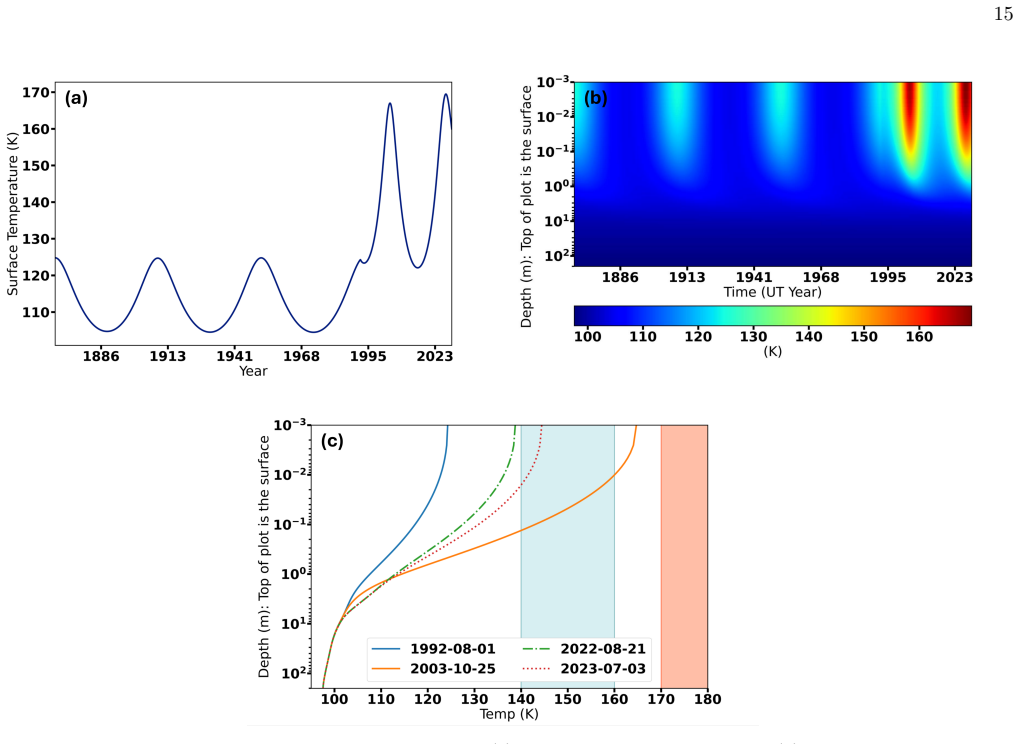
The thermal model of nucleus temperature evolution based on orbital integration since 1500 CE, which predicts when temperatures reach 140-160 K to trigger CO2 release via amorphous ice crystallization.
What would settle it
A measurement showing that activity begins at a heliocentric distance where the thermal model predicts temperatures outside the 140-160 K range for ice crystallization would falsify the alignment.
Extended reading notes
Core claim
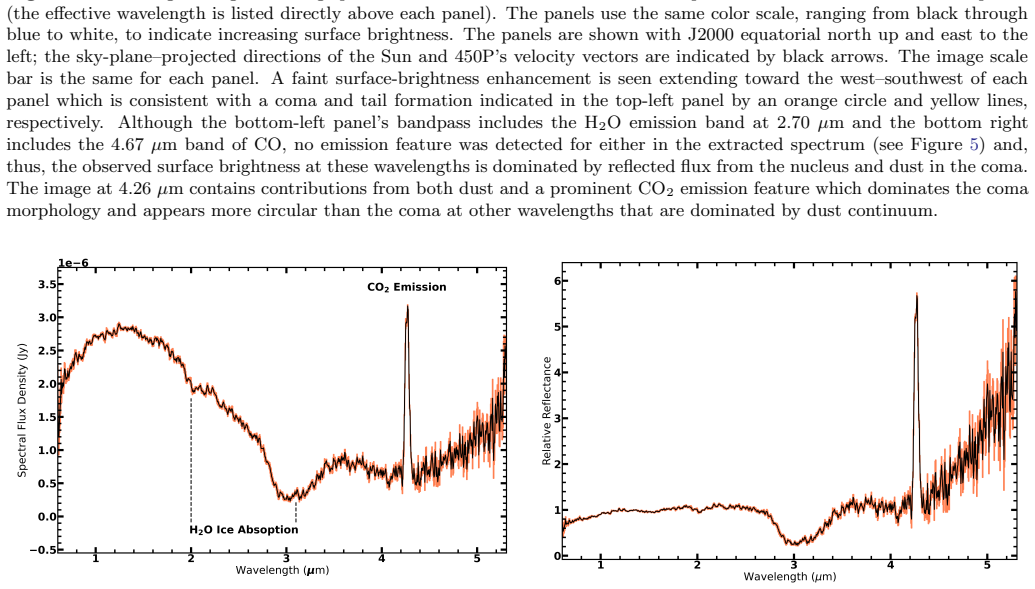
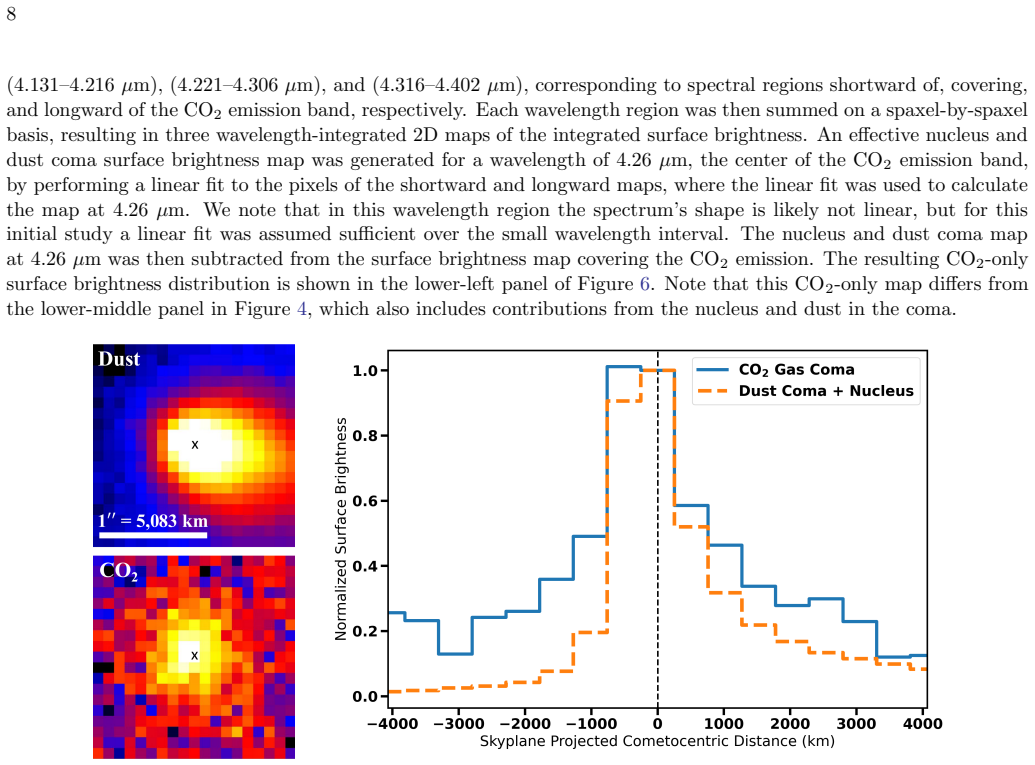
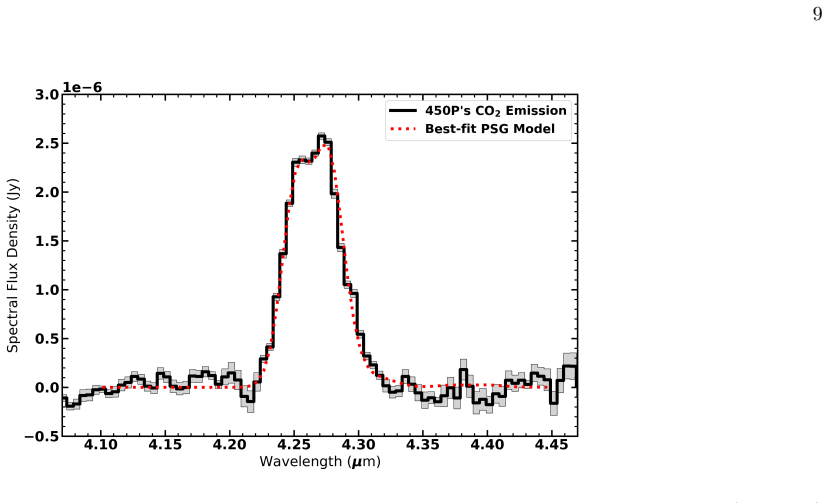
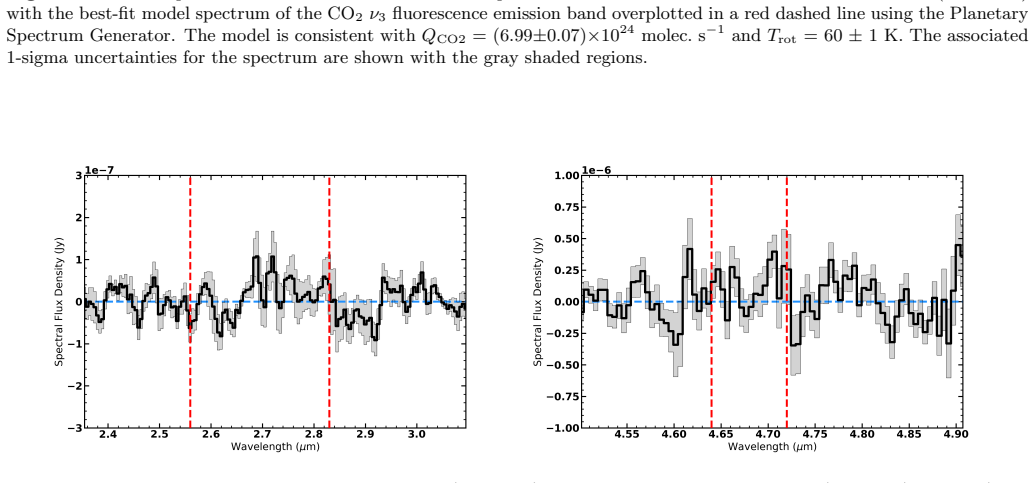
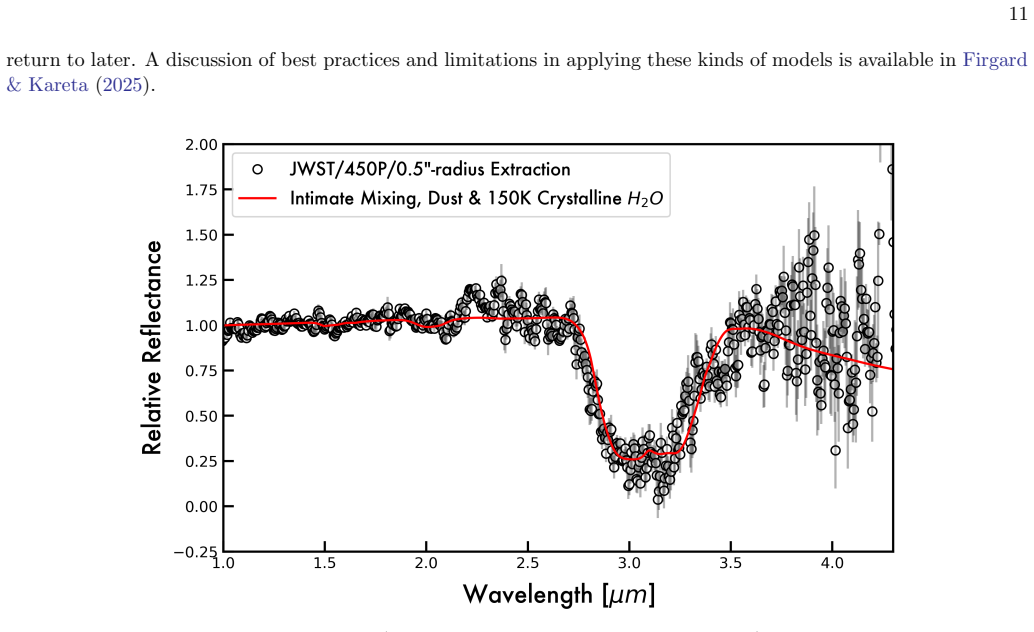
The central claim is that a thermal model incorporating 450P's orbital history since ~1500 CE aligns with the observed onset of activity driven by CO2 outgassing from amorphous water ice crystallization between 140-160 K. The nucleus radius is 1.8 km with red color, the coma has low dust production of 4-8 kg per second, and JWST spectra show CO2 at 7e24 molecules per second with water ice features but upper limits on H2O and CO.
Load-bearing premise
That the observed activity onset is driven specifically by CO2 outgassing from amorphous water ice crystallization at 140-160 K, which depends on the accuracy of the thermal model and the orbital history integration.
Editorial extensions
If this is right
- Activity in 450P is driven by CO2 release rather than H2O or CO sublimation.
- The coma contains water ice in grains with effective diameter of 5.9 micrometers and 33 percent volumetric ice fraction.
- The nucleus color places 450P on the red end of neutral Centaurs, suggesting limited surface processing.
- Dust production remains low at 4-8 kg per second even as the object moves inward from 7.83 to 7.24 au.
Reading between the lines
- The same approach of integrating orbital history into thermal models could be applied to other Centaurs that experienced planetary encounters to test if crystallization thresholds explain their activity onsets.
- If confirmed, this mechanism implies that some distant objects activate without needing water ice sublimation, affecting models of volatile retention in the outer solar system.
- Repeated observations of 450P at different orbital positions could directly test whether activity ceases or changes when temperatures drop below the crystallization range.
Signed reviews
Editorial analysis
A structured set of objections, weighed in public.
Referee Report
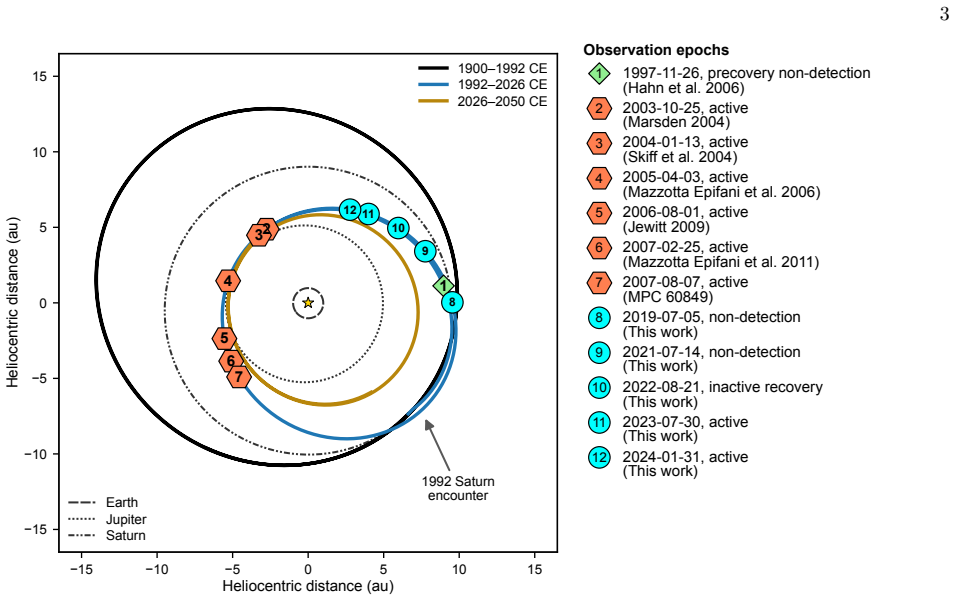
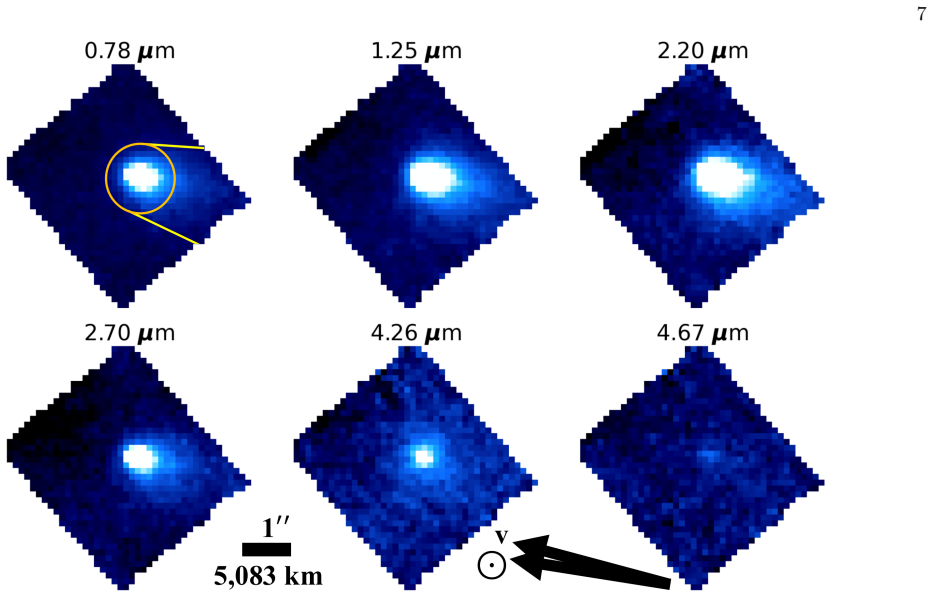
Summary. The paper presents Gemini-N and JWST observations of active Centaur 450P/LONEOS, reporting a nucleus radius of 1.8±0.5 km, surface color g'-i'=1.15±0.09, low dust production of ~4-8 kg s^{-1}, CO2 production rate Q_CO2=(6.99±0.07)×10^{24} molec s^{-1} with upper limits on H2O and CO, spectral absorption features indicating water ice (including a 3.1 μm crystalline feature), a Hapke model fit with effective grain diameter 5.9 μm and volumetric ice fraction 33%, and a thermal model using the object's orbital history since ~1500 CE that aligns the onset of activity with CO2 outgassing triggered by amorphous water ice crystallization at 140-160 K.
Significance. If the thermal model result holds, the work provides a well-constrained case study of nucleus and coma properties for an active Centaur whose orbit was perturbed by a 1992 Saturn encounter, with direct spectral and imaging derivations supporting the production rates and ice signatures. The linkage of dynamical history to volatile-driven activity offers a testable framework for Centaur activation mechanisms.
major comments (1)
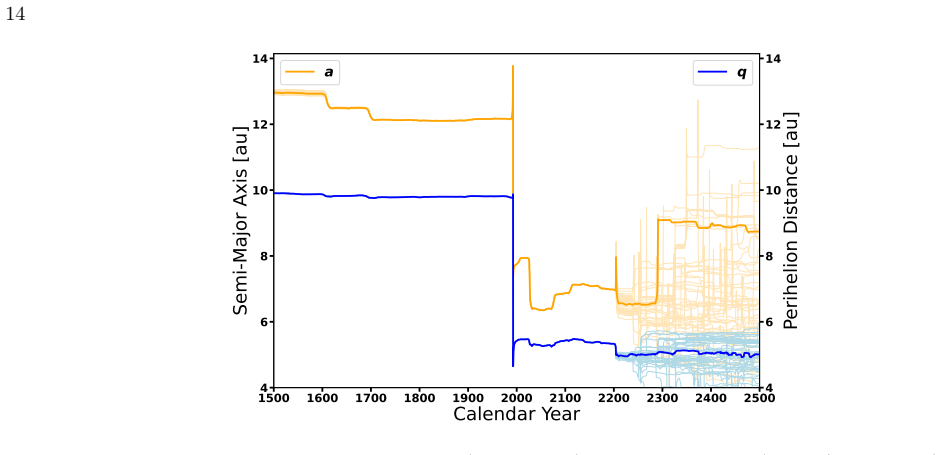
- [thermal model section] Thermal model incorporating orbital history since ~1500 CE (abstract and corresponding modeling section): The reported alignment between the thermal evolution and the observed activity onset at 140-160 K is based on a single nominal backward integration. Centaur orbits are chaotic, and the documented 1992 Saturn encounter implies that small changes in initial conditions or non-gravitational forces can produce divergent trajectories; the manuscript does not report clone integrations, covariance propagation, or sensitivity tests, so the temperature alignment may not be robust.
minor comments (2)
- [methods] The abstract and methods description of JWST NIRSpec IFU data reduction should include explicit details on background subtraction, flux calibration, and error budget propagation to support reproducibility of the reported production rates and spectral fits.
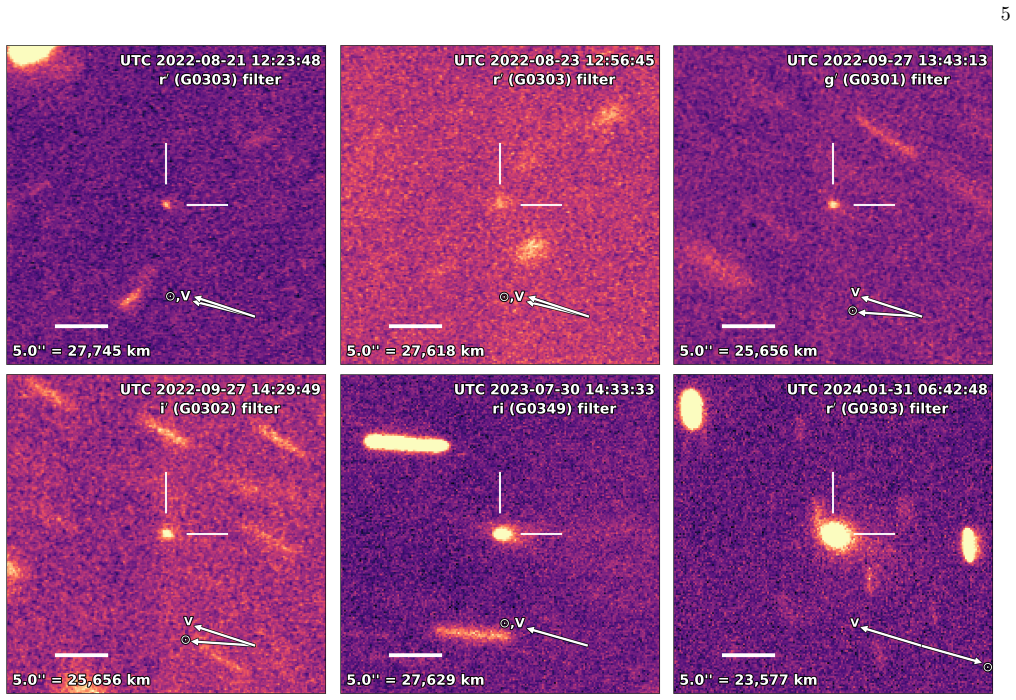
- [observations] Figure captions and text should clarify the exact epochs of the Gemini and JWST observations relative to the heliocentric distance change from 7.83 to 7.24 au to strengthen the timeline of activity onset.
Simulated Author's Rebuttal
We thank the referee for their constructive comments on our manuscript. Below we provide a point-by-point response to the major comment.
read point-by-point responses
-
Referee: [thermal model section] Thermal model incorporating orbital history since ~1500 CE (abstract and corresponding modeling section): The reported alignment between the thermal evolution and the observed activity onset at 140-160 K is based on a single nominal backward integration. Centaur orbits are chaotic, and the documented 1992 Saturn encounter implies that small changes in initial conditions or non-gravitational forces can produce divergent trajectories; the manuscript does not report clone integrations, covariance propagation, or sensitivity tests, so the temperature alignment may not be robust.
Authors: We agree that Centaur orbits are chaotic and that the 1992 Saturn encounter introduces significant uncertainties in the long-term dynamical history. The thermal model in the manuscript was based on a single nominal backward integration, without clone integrations, covariance propagation, or sensitivity tests. We will revise the modeling section (and abstract if needed) to explicitly note that the reported temperature alignment corresponds to the nominal orbit only and to discuss the limitations arising from orbital chaos. This revision will clarify the robustness of the result for readers. revision: yes
Circularity Check
No significant circularity detected
full rationale
All reported quantities (nucleus radius, colors, production rates Q_CO2/Q_H2O/Q_CO, ice fraction, grain sizes) are obtained from direct Gemini imaging and JWST NIRSpec spectra via standard reduction and modeling pipelines. The thermal-model alignment statement compares an independent orbital integration against a literature temperature threshold for CO2 release; no equation in the provided text reduces this alignment to a fitted parameter or self-defined input. No self-citation load-bearing steps, ansatzes smuggled via citation, or fitted-input-called-prediction patterns are present.
Assumptions & free parameters
free parameters (2)
- effective grain diameter =
5.9 um
- volumetric ice fraction =
33%
assumptions (2)
- domain assumption Standard assumptions of cometary thermal models relating surface temperature to outgassing triggers
- domain assumption Hapke reflectance model applicability to mixed ice-dust surfaces at these wavelengths
Cite this review
Pith. "Pith review of JWST and Gemini Observations of the Active Centaur 450P/LONEOS: Nucleus and Coma Characterizations." pith.science (2026). https://pith.science/paper/TGX6UTN3
@misc{pith2026260524260,
  author       = {Pith},
  title        = {Pith review of: JWST and Gemini Observations of the Active Centaur 450P/LONEOS: Nucleus and Coma Characterizations},
  year         = {2026},
  howpublished = {\url{https://pith.science/paper/TGX6UTN3}},
  note         = {Machine review of arXiv:2605.24260}
}
abstract
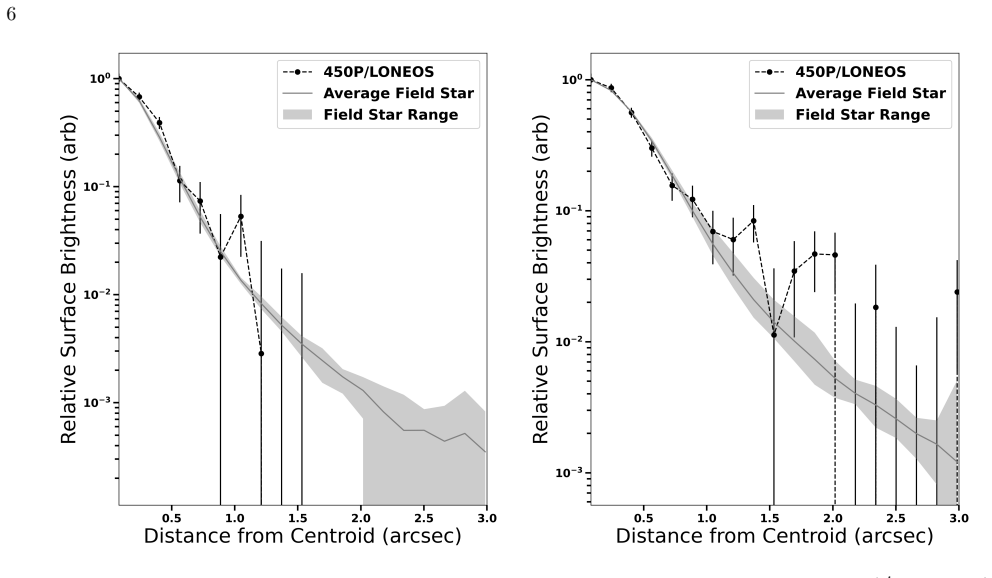
Between 2019 and 2024, we used the Gemini-N and JWST observatories to conduct a detailed case study of the active Centaur 450P/LONEOS, whose orbit was significantly altered by a close Saturn encounter in 1992. Gemini-N GMOS optical images likely captured the first views of 450P's inactive nucleus, indicating a relatively small radius of $R_N = 1.8\pm0.5$ km and a surface color of $g' - i' = 1.15\pm0.09$. This places 450P on the red end of the neutral/gray Centaur population and may indicate comparatively limited solar-driven surface processing relative to other known active Centaurs. A coma developed as 450P changed its heliocentric distance, $R_H$, from 7.83 au to 7.24 au, with an estimated low dust production rate of $\sim$4-8 kg s$^{-1}$. JWST NIRSpec IFU Prism-mode spectra revealed an elongated dust morphology and a symmetric $CO_2$ gas distribution in the coma but no $H_2O$ or CO emission features, with production rates of $Q_{CO_2} = (6.99\pm0.07)\times10^{24}$ molec. s$^{-1}$, $Q_{H_2O} \leq 1.2\times10^{24}$ molec. s$^{-1}$, and $Q_{CO} \leq 5.2\times10^{24}$ molec. s$^{-1}$. Absorption features at 2.0 and 3.0 $\mu$m indicate the presence of water ice, and a subtle 3.1 $\mu$m feature is consistent with crystalline water ice in larger grains. A Hapke-style model dominated by large ($D_{eff.} = 5.9$ $\mu$m) dust grains with a volumetric ice fraction of $f_{ice} = 33\%$ fits the spectrum. A thermal model incorporating 450P's orbital history since $\sim$1500 CE aligns with the observed onset of activity driven by $CO_2$ outgassing from amorphous water ice crystallization between 140-160 K.
Figures
Figures from the paper (8 more)
Reference graph
Works this paper leans on
-
[1]
A’Hearn, M. F., Schleicher, D. G., Millis, R. L., Feldman, P. D., & Thompson, D. T. 1984, AJ, 89, 579, doi: 10.1086/113552 Astropy Collaboration, Robitaille, T. P., Tollerud, E. J., et al. 2013, A&A, 558, A33, doi: 10.1051/0004-6361/201322068
-
[2]
Bauer, J., Ivanova, O., McKay, A., & Sarid, G. 2025, in Centaurs, ed. K. Volk, M. Womack, & J. Steckloff (Bristol: IOP Publishing), 8.1–8.26, doi: 10.1088/2514-3433/ada267ch8
-
[3]
M., Grav, T., Blauvelt, E., et al
Bauer, J. M., Grav, T., Blauvelt, E., et al. 2013, ApJ, 773, 22, doi: 10.1088/0004-637X/773/1/22
-
[4]
Beck, A., Schambeau, C., Walker, S., & Fernandez, Y. 2025
work page 2025
-
[5]
H., Podolak, M., & Prialnik, D
Beer, E. H., Podolak, M., & Prialnik, D. 2006, Icarus, 180, 473, doi: 10.1016/j.icarus.2005.10.018
-
[6]
Bergin, E., Alexander, C., Drozdovskaya, M., et al. 2024, Interstellar Heritage and the Birth Environment of the Solar System (University of Arizona Press), 3–32. http://www.jstor.org/stable/jj.21819446.7
work page 2024
-
[7]
2014, in Protostars and Planets VI, ed
Biver, N., Dello Russo, N., Opitom, C., & Rubin, M. 2024, in Comets III, ed. K. J. Meech, M. R. Combi, D. Bockel´ ee-Morvan, S. N. Raymond, & M. E. Zolensky (Tucson, AZ: University of Arizona Press), 459–498, doi: 10.2458/azu uapress 9780816553631-ch015 Bockel´ ee-Morvan, D., Crovisier, J., Mumma, M. J., &
work page doi:10.2458/azu 2024
-
[8]
Weaver, H. A. 2004, in Comets II, ed. M. C. Festou, H. U. Keller, & H. A. Weaver (Tucson, AZ: University of Arizona Press), 391–423 Bockel´ ee-Morvan, D., Rinaldi, G., Erard, S., et al. 2017, MNRAS, 469, S842, doi: 10.1093/mnras/sty533 Bockel´ ee-Morvan, D., Biver, N., Schambeau, C. A., et al. 2022, A&A, 664, A95, doi: 10.1051/0004-6361/202243241 B¨ oker,...
Show all 80 references
-
[9]
T., Fernandez, Y
Bolin, B. T., Fernandez, Y. R., Lisse, C. M., et al. 2021, AJ, 161, 116, doi: 10.3847/1538-3881/abd94b 19
2021 doi
-
[10]
2024, astropy/photutils: 2.0.2, Zenodo, doi: 10.5281/zenodo.13989456
Bradley, L., Sip˝ ocz, B., Robitaille, T., Tollerud, E., et al. 2024, astropy/photutils: 2.0.2, Zenodo, doi: 10.5281/zenodo.13989456
2024 doi
-
[11]
2025, JWST Calibration Pipeline, Zenodo, doi: 10.5281/zenodo.16280965
Bushouse, H., Eisenhamer, J., Dencheva, N., et al. 2025, JWST Calibration Pipeline, Zenodo, doi: 10.5281/zenodo.16280965
2025 doi
-
[12]
2009, A&A, 504, 249, doi: 10.1051/0004-6361/20078106
Epifani, E., & Palumbo, P. 2009, A&A, 504, 249, doi: 10.1051/0004-6361/20078106
2009 doi
-
[13]
2017, astropy/ccdproc: v1.3.0.post1, doi: 10.5281/zenodo.1069648
Craig, M., Crawford, S., Seifert, M., et al. 2017, astropy/ccdproc: v1.3.0.post1, doi: 10.5281/zenodo.1069648
2017 doi
-
[14]
Davidsson, B. J. R. 2021, MNRAS, 505, 5654, doi: 10.1093/mnras/stab1593 de la Fuente Marcos, C., de la Fuente Marcos, R., Licandro, J., et al. 2021, A&A, 649, A85, doi: 10.1051/0004-6361/202039117
2021 doi
-
[15]
Delsemme, A. H. 1982, in IAU Colloq. 61: Comet
1982
-
[16]
M., Schwamb, M
Dobson, M. M., Schwamb, M. E., Fitzsimmons, A., et al. 2024, PSJ, 5, 165, doi: 10.3847/PSJ/ad543c
2024 doi
-
[17]
L., McKay, A., et al
Faggi, S., Villanueva, G. L., McKay, A., et al. 2024, Nature Astronomy, doi: 10.1038/s41550-024-02319-3
2024 doi
-
[18]
2006, Survey of Ensemble Physical Properties of Cometary Nuclei, Spitzer Proposal ID 30908 Fern´ andez, Y
Fernandez, Y., A’Hearn, M., Bauer, J., et al. 2006, Survey of Ensemble Physical Properties of Cometary Nuclei, Spitzer Proposal ID 30908 Fern´ andez, Y. R. 2025, Observing Circumstances of Active Centaurs, https://physics.ucf.edu/∼yfernandez/actcentobs.html Fern´ andez, Y. R.,...
2006 doi
-
[19]
2012, Icarus, 221, 721, doi: 10.1016/j.icarus.2012.09.001
Fink, U., & Rubin, M. 2012, Icarus, 221, 721, doi: 10.1016/j.icarus.2012.09.001
2012 doi
-
[20]
2025, PSJ, 6, 184, doi: 10.3847/PSJ/ade672
Firgard, M., & Kareta, T. 2025, PSJ, 6, 184, doi: 10.3847/PSJ/ade672
2025 doi
-
[21]
W., Lang, D., & Goodman, J
Foreman-Mackey, D., Hogg, D. W., Lang, D., & Goodman, J. 2013a, PASP, 125, 306, doi: 10.1086/670067 —. 2013b, PASP, 125, 306, doi: 10.1086/670067
-
[22]
C., Dones, L., Volk, K., et al
Fraser, W. C., Dones, L., Volk, K., et al. 2024, The Transition from the Kuiper Belt to the Jupiter-Family Comets (University of Arizona Press), 121–152. http://www.jstor.org/stable/jj.21819446.11
2024
-
[23]
E., et al
Fukugita, M., Ichikawa, T., Gunn, J. E., et al. 1996, AJ, 111, 1748, doi: 10.1086/117915 Gemini Observatory. 2025, GMOS — Components: Filters, https://www.gemini.edu/instrumentation/gmos/ components#Filters
1996 doi
-
[24]
M., Brasseur, C
Ginsburg, A., Sip˝ ocz, B. M., Brasseur, C. E., et al. 2019, AJ, 157, 98, doi: 10.3847/1538-3881/aafc33
2019 doi
-
[25]
2022, ApJ, 928, 43, doi: 10.3847/1538-4357/ac54ac
Nesvorny, D. 2022, ApJ, 928, 43, doi: 10.3847/1538-4357/ac54ac
2022 doi
-
[26]
2023, ApJ, 942, 92, doi: 10.3847/1538-4357/acaa3a
Nesvorny, D. 2023, ApJ, 942, 92, doi: 10.3847/1538-4357/acaa3a
2023 doi
-
[27]
I., Karlsson, O., Oja, T., & Stoss, R
Hahn, G., Lagerkvist, C. I., Karlsson, O., Oja, T., & Stoss, R. M. 2006, Astronomische Nachrichten, 327, 17, doi: 10.1002/asna.200510484
2006 doi
-
[28]
S., Gehrz, R
Hanner, M. S., Gehrz, R. D., Harker, D. E., et al. 1997, Earth Moon and Planets, 79, 247, doi: 10.1023/A:1006201820477
1997 doi
-
[29]
2012, Theory of Reflectance and Emittance Spectroscopy (Cambridge: Cambridge University Press), doi: 10.1017/CBO9781139025683 Harrington Pinto, O., Womack, M., Fernandez, Y., &
Hapke, B. 2012, Theory of Reflectance and Emittance Spectroscopy (Cambridge: Cambridge University Press), doi: 10.1017/CBO9781139025683 Harrington Pinto, O., Womack, M., Fernandez, Y., &
2012 doi
-
[30]
2022, PSJ, 3, 247, doi: 10.3847/PSJ/ac960d
Bauer, J. 2022, PSJ, 3, 247, doi: 10.3847/PSJ/ac960d
2022 doi
-
[31]
M., Jørgensen, I., Allington-Smith, J
Hook, I. M., Jørgensen, I., Allington-Smith, J. R., et al. 2004, PASP, 116, 425, doi: 10.1086/383624
2004 doi
-
[32]
F., Benkhoff, J., Capria, M.-T., et al
Huebner, W. F., Benkhoff, J., Capria, M.-T., et al. 2006, Heat and Gas Diffusion in Comet Nuclei (Bern: International Space Science Institute)
2006
-
[33]
2022, A&A, 661, A80, doi: 10.1051/0004-6361/202142663
Jakobsen, P., Ferruit, P., Alves de Oliveira, C., et al. 2022, A&A, 661, A80, doi: 10.1051/0004-6361/202142663
2022 doi
-
[34]
2009, AJ, 137, 4296, doi: 10.1088/0004-6256/137/5/4296
Jewitt, D. 2009, AJ, 137, 4296, doi: 10.1088/0004-6256/137/5/4296
2009 doi
-
[35]
T., Dones, L., et al
Johansen, A., Bannister, M. T., Dones, L., et al. 2025, in Centaurs, ed. K. Volk, M. Womack, & J. Steckloff (IOP Publishing), 2–1, doi: 10.1088/2514-3433/ada267ch2
2025 doi
-
[36]
W., Harris, W
Kareta, T., Noonan, J. W., Harris, W. M., & Springmann, A. 2023, PSJ, 4, 85, doi: 10.3847/PSJ/accc28
2023 doi
-
[37]
2025, in Centaurs, ed
Kareta, T., Schambeau, C., & Wierzchos, K. 2025, in Centaurs, ed. K. Volk, M. Womack, & J. Steckloff (IOP Publishing), 10–1, doi: 10.1088/2514-3433/ada267ch10
2025 doi
-
[38]
M., Schambeau, C., et al
Kareta, T., Woodney, L. M., Schambeau, C., et al. 2021, PSJ, 2, 48, doi: 10.3847/PSJ/abe23d
2021 doi
-
[39]
S., Fern´ andez, Y
Kelley, M. S., Fern´ andez, Y. R., Licand ro, J., et al. 2013, Icarus, 225, 475, doi: 10.1016/j.icarus.2013.04.012
2013 doi
-
[40]
2024, Physical and Surface Properties of Comet Nuclei from Remote Observations (University of Arizona Press), 361–404
Dotson, R. 2024, Physical and Surface Properties of Comet Nuclei from Remote Observations (University of Arizona Press), 361–404. http://www.jstor.org/stable/jj.21819446.18 20
2024
-
[41]
2025, in Centaurs, ed
Vincent, J.-B. 2025, in Centaurs, ed. K. Volk, M. Womack, & J. Steckloff (IOP Publishing), 7–1, doi: 10.1088/2514-3433/ada267ch7
2025 doi
-
[42]
Turner, J. E. H. 2019, in Astronomical Society of the Pacific Conference Series, Vol. 523, Astronomical Data Analysis Software and Systems XXVII, ed. P. J. Teuben, M. W. Pound, B. A. Thomas, & E. M. Warner, 321
2019
-
[43]
2013, A&A, 557, A60, doi: 10.1051/0004-6361/201322047
Lellouch, E., Santos-Sanz, P., Lacerda, P., et al. 2013, A&A, 557, A60, doi: 10.1051/0004-6361/201322047
2013 doi
-
[44]
A., Thirouin, A., et al
Lilly, E., Schambeau, C. A., Thirouin, A., et al. 2025, Research Notes of the American Astronomical Society, 9, 67, doi: 10.3847/2515-5172/adc453
2025 doi
-
[45]
2024, ApJL, 960, L8, doi: 10.3847/2041-8213/ad1606
Lilly, E., Jevˇ c´ ak, P., Schambeau, C., et al. 2024, ApJL, 960, L8, doi: 10.3847/2041-8213/ad1606
2024 doi
-
[46]
M., Steckloff, J
Lisse, C. M., Steckloff, J. K., Prialnik, D., et al. 2022, PSJ, 3, 251, doi: 10.3847/PSJ/ac9468
2022 doi
-
[47]
R., & de Oliveira, C
Luetzgendorf, N., Birkmann, S., Boeker, T., Proffitt, C. R., & de Oliveira, C. A. 2019, Spectrophotometric Sensitivity and Absolute Flux Calibration, JWST Proposal. Cycle 0, ID. #1128
2019
-
[48]
A., Schlafly, E., Finkbeiner, D., et al
Magnier, E. A., Schlafly, E., Finkbeiner, D., et al. 2013, ApJS, 205, 20, doi: 10.1088/0067-0049/205/2/20
2013 doi
-
[49]
Seligman, D. Z. 2025, in Centaurs, ed. K. Volk, M. Womack, & J. Steckloff (IOP Publishing), 6–1, doi: 10.1088/2514-3433/ada267ch6
2025 doi
-
[50]
M., Bernstein, M
Mastrapa, R. M., Bernstein, M. P., Sandford, S. A., et al. 2008, Icarus, 197, 307, doi: 10.1016/j.icarus.2008.04.008
2008 doi
-
[51]
P., & Dalle Ore, C
Cruikshank, D. P., & Dalle Ore, C. M. 2009, ApJ, 701, 1347, doi: 10.1088/0004-637X/701/2/1347 Mazzotta Epifani, E., Dall’Ora, M., Perna, D., Palumbo, P., & Colangeli, L. 2011, MNRAS, 415, 3097, doi: 10.1111/j.1365-2966.2011.18919.x Mazzotta Epifani, E., Dotto, E., Ieva, S., et...
2009 doi
-
[52]
J., & Svoren, J
Meech, K. J., & Svoren, J. 2004, in Comets II, ed. M. C
2004
-
[53]
2012, ApJ, 752, 15, doi: 10.1088/0004-637X/752/1/15
Ootsubo, T., Kawakita, H., Hamada, S., et al. 2012, ApJ, 752, 15, doi: 10.1088/0004-637X/752/1/15
2012 doi
-
[54]
2025, in Centaurs, ed
Peixinho, N., Licandro, J., Lilly, E., et al. 2025, in Centaurs, ed. K. Volk, M. Womack, & J. Steckloff (IOP Publishing), 5–1, doi: 10.1088/2514-3433/ada267ch5
2025 doi
-
[55]
2024, A&A, 692, L11, doi: 10.1051/0004-6361/202450124
Pinilla-Alonso, N., Licandro, J., Brunetto, R., et al. 2024, A&A, 692, L11, doi: 10.1051/0004-6361/202450124
2024 doi
-
[56]
H., Kelley, M
Pinto, O. H., Kelley, M. S. P., Villanueva, G. L., et al. 2023, The Planetary Science Journal, 4, 208, doi: 10.3847/PSJ/acf928
2023 doi
-
[57]
2004, in Comets II, ed
Prialnik, D., Benkhoff, J., & Podolak, M. 2004, in Comets II, ed. M. C. Festou, H. U. Keller, & H. A. Weaver (Tucson, AZ: University of Arizona Press), 359–387
2004
-
[58]
2024, Amorphous Ice in Comets: Evidence and Consequences (University of Arizona Press), 823–844
Prialnik, D., Jewitt, D., & Dotson, R. 2024, Amorphous Ice in Comets: Evidence and Consequences (University of Arizona Press), 823–844. http://www.jstor.org/stable/jj.21819446.31
2024
-
[59]
Protopapa, S., Kelley, M. S. P., Woodward, C. E., & Yang, B. 2021, PSJ, 2, 176, doi: 10.3847/PSJ/ac135a
2021 doi
-
[60]
Rein, H., & Liu, S. F. 2012, A&A, 537, A128, doi: 10.1051/0004-6361/201118085
2012 doi
-
[61]
Romanishin, W., & Tegler, S. C. 2018, AJ, 156, 19, doi: 10.3847/1538-3881/aac210
2018 doi
-
[62]
Rouleau, F., & Martin, P. G. 1991, ApJ, 377, 526, doi: 10.1086/170382
1991 doi
-
[63]
A., Micheli, M., & Nakano, S
Rudenko, M., Schambeau, C. A., Micheli, M., & Nakano, S. 2022, Central Bureau Electronic Telegrams, 5178, 1
2022
- [64]
-
[65]
2024, Comets and Planetesimal Formation (University of Arizona Press), 63–94
Dotson, R. 2024, Comets and Planetesimal Formation (University of Arizona Press), 63–94. http://www.jstor.org/stable/jj.21819446.9
2024
-
[66]
A., Miller, H
Skiff, B. A., Miller, H. R., & Young, J. 2004, IAUC, 8267, 1
2004
-
[67]
E., Kelley, M
Snodgrass, C., Holt, C. E., Kelley, M. S. P., et al. 2025, MNRAS, 541, L8, doi: 10.1093/mnrasl/slaf046
2025 doi
-
[68]
2008, in The Solar System Beyond Neptune, ed
Stansberry, J., Grundy, W., Brown, M., et al. 2008, in The Solar System Beyond Neptune, ed. M. A. Barucci, H. Boehnhardt, D. P. Cruikshank, A. Morbidelli, & R. Dotson (Tucson, AZ: University of Arizona Press), 161–179
2008
-
[69]
L., Stubbs, C
Tonry, J. L., Stubbs, C. W., Lykke, K. R., et al. 2012, ApJ, 750, 99, doi: 10.1088/0004-637X/750/2/99 van Dokkum, P. G. 2001, PASP, 113, 1420, doi: 10.1086/323894
2012 doi
-
[70]
L., Mumma, M
Villanueva, G. L., Mumma, M. J., DiSanti, M. A., et al. 2011, Icarus, 216, 227, doi: 10.1016/j.icarus.2011.08.024
2011 doi
-
[71]
Mandell, A. M. 2018, JQSRT, 217, 86, doi: 10.1016/j.jqsrt.2018.05.023
2018 doi
-
[72]
E., et al
Virtanen, P., Gommers, R., Oliphant, T. E., et al. 2020, Nature Methods, 17, 261, doi: 10.1038/s41592-019-0686-2
2020 doi
-
[73]
Weidenschilling, S. J. 1997, Icarus, 127, 290, doi: 10.1006/icar.1997.5712
1997 doi
-
[74]
2017, AJ, 153, doi: 10.3847/1538-3881/aa689c 21
Wierzchos, K., Womack, M., & Sarid, G. 2017, AJ, 153, doi: 10.3847/1538-3881/aa689c 21
2017 doi
-
[75]
2017, PASP, 129, 031001, doi: 10.1088/1538-3873/129/973/031001
Womack, M., Sarid, G., & Wierzchos, K. 2017, PASP, 129, 031001, doi: 10.1088/1538-3873/129/973/031001
2017 doi
-
[76]
Womack, M., & Stern, S. A. 1999, Solar System Research, 33, 187
1999
-
[77]
Wong, I., Mishra, A., & Brown, M. E. 2019, AJ, 157, 225, doi: 10.3847/1538-3881/ab1b22
2019 doi
-
[78]
E., Bock´ elee-Morvan, D., Harker, D
Woodward, C. E., Bock´ elee-Morvan, D., Harker, D. E., et al. 2025, PSJ, 6, 139, doi: 10.3847/PSJ/add1d5
2025 doi
-
[79]
2014, ApJL, 784, L23, doi: 10.1088/2041-8205/784/2/L23
Yang, B., Keane, J., Meech, K., Owen, T., & Wainscoat, R. 2014, ApJL, 784, L23, doi: 10.1088/2041-8205/784/2/L23
2014 doi
-
[80]
2024, Reviews in Mineralogy and Geochemistry, 90, 27, doi: 10.2138/rmg.2024.90.02
Zhang, K. 2024, Reviews in Mineralogy and Geochemistry, 90, 27, doi: 10.2138/rmg.2024.90.02
2024 doi
Reviewed June 30, 2026 · model on record in the stance chip above.
Discussion (0). Continue with ORCID to comment.