REVIEW 2 major objections 6 minor 4 cited by
Spectral-siren gravitational-wave pipelines can process the Einstein Telescope's expected one-year event volume, and a blinded test shows three independent code implementations recover the same hidden cosmology.
Reviewed by Pith at T0; open to challenge. T0 means a machine referee read the full paper against a public rubric. the ladder, T0–T4 →
T0 review · deepseek-v4-flash
2026-08-02 22:07 UTC pith:THJYB6NN
load-bearing objection A serious blinded mock challenge: three independent spectral-siren pipelines agree at 3G scale, but the GPU-scalability claim is extrapolated for pymcpop-gw. the 2 major comments →
Pushing spectral siren cosmology into the third-generation era: a blinded mock data challenge
The pith
A machine-rendered reading of the paper's core claim, the machinery that carries it, and where it could break.
Core claim
The central claim is that spectral-siren cosmology is computationally and statistically feasible in the third-generation era. Using a blinded mock catalog built from a flat ΛCDM fiducial model with a power-law-plus-peak mass distribution and a Madau–Dickinson merger-rate evolution, the three pipelines — each computing the same hierarchical likelihood in a different way — produce fully consistent posteriors and recover nearly all fiducial parameters within 68% credible intervals. The key quantitative results are that a single GPU can process up to roughly 10^5 events with thousands of posterior samples each in one or two weeks, with likelihood evaluation time scaling linearly in event number,
What carries the argument
The central object is the hierarchical spectral-siren likelihood, which jointly constrains cosmology and population parameters from gravitational-wave data alone by reweighting per-event posterior samples with a population model that depends on redshift through the assumed cosmology. The three public pipelines implement this likelihood with distinct numerical strategies: a Monte Carlo sum over posterior samples (icarogw), a weighted kernel-density estimate of the per-event gravitational-wave kernel (chimera), and a latent-variable Hamiltonian Monte Carlo that avoids per-event Monte Carlo marginalization (pymcpop-gw). The machinery that carries the performance claim is GPU acceleration combin
Load-bearing premise
The mock population is assumed to have a source-frame black-hole mass distribution that does not evolve with redshift; if the real BBH mass spectrum changes with cosmic time, the clean separation between cosmological and population parameters that the spectral-siren method relies on breaks down, and the forecast precision and cross-code agreement could be optimistic.
What would settle it
Rerun the same blinded mock challenge with an injected mass distribution whose peak position or power-law slope evolves with redshift (for example, a 20% shift in peak position between z=0 and z=3). If the recovered H0 or Ωm,0 then moves by more than the quoted ~10% and ~26% uncertainties, or if the three pipelines diverge, the validation demonstrated here does not generalize to real third-generation data. A direct observational alternative would be an electromagnetic counterpart to an Einstein Telescope merger at z≈1.5, whose independent redshift would test the 2.4% H(z) prediction.
If this is right
- With roughly 12,000 high-S/N mergers from one year of Einstein Telescope data, flat-ΛCDM spectral siren analysis measures the expansion rate H(z) at z≈1.5 to 2.4%, and to a mean 2.8% across 0.7<z<1.8.
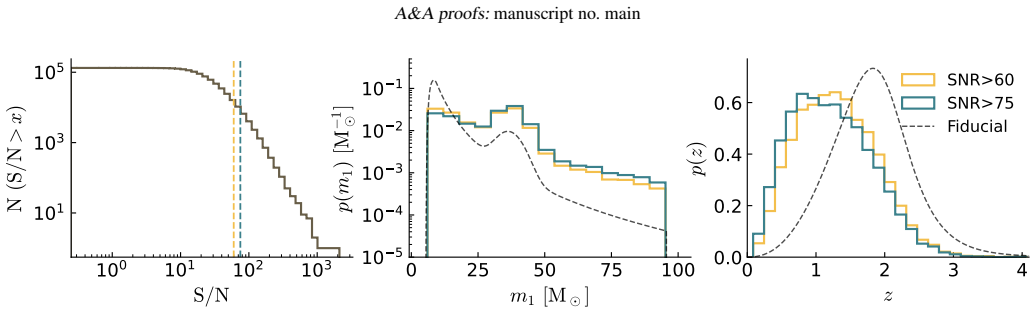
- Lowering the S/N threshold from 75 to 60 adds about 5,000 events and improves the H0–Ωm,0 figure of merit by 43%, consistent with the expected √N statistical gain.
- Single-GPU profiling shows likelihood evaluation time scales linearly with the number of events, so the full one-year Einstein Telescope volume of about 10^5 events falls within one to two weeks of compute; the per-event factorization permits distributed multi-GPU processing for even larger catalogs.
- Fixing Ωm,0 to its fiducial value sharpens the H0 constraint from 12% to 3% on the S/N>75 catalog, indicating that percent-level H0 from spectral sirens will likely require external information on Ωm,0 from probes such as baryon acoustic oscillations.
- Events at low luminosity distance near mass-spectrum features drive constraints on H0, Ωm,0, and the peak position; events beyond about 6 Gpc mainly constrain Ωm,0 and the rate-evolution slope.
- The three pipelines' agreement demonstrates that the spectral-siren hierarchical likelihood is not tied to one numerical implementation, since Monte Carlo, kernel-density, and latent-variable approaches reach the same inferred cosmology.
Where Pith is reading between the lines
- The same blinded protocol could be extended to test redshift-evolving mass models; a natural stress test is injecting a population whose mass-spectrum peak shifts with redshift and asking whether the three pipelines' agreement and unbiased recovery survive.
- Because the strongest constraint lands at 0.7<z<1.8, where cosmic-chronometer measurements of H(z) also operate, spectral sirens and chronometers could be cross-checked in the same redshift window; the paper notes the overlap but does not quantify a combined constraint.
- The memory saturation of the kernel-density pipeline near 10^5 events suggests a hybrid analysis strategy: use that pipeline for catalogs up to the size tested, and the Monte Carlo or Hamiltonian pipeline for larger volumes, or split the event set across GPUs to beat the memory limit.
- If the 2.4% H(z) forecast survives with real data, spectral sirens would become a competitive probe of the expansion history in a regime currently dominated by model-dependent distance measurements; reaching percent-level H0 will likely require extra mass scales, such as neutron-star mergers, or external Ωm,0 priors.
Editorial analysis
A structured set of objections, weighed in public.
Referee Report
Summary. The paper presents a blinded mock data challenge (MDC) for spectral-siren cosmology at third-generation (3G) detector volume. The authors simulate one year of Einstein Telescope observations, producing catalogs of ~68,000 and ~119,000 events above S/N thresholds of 75 and 60, respectively, from a population with Madau–Dickinson merger-rate evolution and a power-law-plus-peak mass distribution. Fiducial hyperparameters are drawn from a GWTC-3-inspired posterior and hidden externally. Three public pipelines with different numerical implementations of the hierarchical likelihood — ICAROGW, CHIMERA, and pymcpop-gw — are used to infer cosmological and population parameters. The paper reports that all pipelines recover the injected values within credible intervals, that GPU-accelerated likelihoods scale roughly linearly to ~10^5 events, and that the S/N>60 catalog yields ~10.5% precision on H0, ~26% on Omega_m,0, and ~2.4% precision on H(z) near z~1.5. It also analyzes which events drive cosmological constraints, finding that low-distance events near mass-population features dominate.
Significance. If the results hold, this is a valuable community resource: a blinded, externally validated test of three independent spectral-siren codes at 3G data volume, with a large injection campaign (5e7 injections), quantitative effective-sample-size checks, and consistent recovery of all injected parameters. The cross-code agreement is a genuine strength, as it tests numerical implementation rather than a single code's internal consistency. The computational benchmarks, while informative, are not uniform across the three codes: the GPU scalability claim is demonstrated for ICAROGW and CHIMERA but only extrapolated for pymcpop-gw. The cosmological forecasts are explicitly conditional on a non-evolving mass distribution, a limitation the paper acknowledges. Overall, the paper provides a useful stress test and a path toward 3G spectral-siren analyses, but its headline performance claim needs to be scoped more carefully.
major comments (2)
- [Sec. 4.1, Fig. 2, abstract] The abstract and conclusion claim that 'these pipelines can process the events expected from ET' thanks to GPU acceleration. For pymcpop-gw this statement is not supported by the evidence presented. The paper states that pymcpop-gw is 'unable to produce fully converged chains on GPU for the full data volumes considered in this work'; the converged posterior samples used in the blinded comparison were obtained via CPU runs; and the GPU timing numbers used for the 'linear fit' come from 'two short chains of 30 iterations.' The forecast for 8e4–1.3e5 events is therefore a linear extrapolation of two non-converged points, justified by the scaling of other codes rather than by converged pymcpop-gw runs. This is load-bearing for the central performance claim. I recommend revising the claim to state that GPU-scalability is demonstrated for ICAROGW and CHIMERA, while pymcpop-gw currently require
- [Sec. 4.2, Eq. (3)] The cosmological forecasts assume a source-frame mass distribution p(m1,m2|lambda_m) with no redshift evolution. The spectral-siren method relies on population features as rulers; if the real BBH mass spectrum evolves with redshift, as argued in several cited works (Mukherjee 2022; Karathanasis et al. 2023; Pierra et al. 2024; Agarwal et al. 2025), the clean separation between cosmology and population parameters is compromised. The paper flags this as 'a central physical problem beyond the scope of this work', which is honest, but the abstract's forecast precision (e.g., 2.4% on H(z)) is conditional on this static-population assumption. Since the manuscript is a forecast for ET, I recommend either adding a quantitative robustness test with a redshift-evolving mass model (even a simple parametrized shift) or stating more prominently in the abstract and conclusions that the quoted precisio
minor comments (6)
- [Sec. 4.1] The wording is contradictory: the text says 'We do not forecast timings for pymcpop-gw but instead plot the linear fit of the two measured points.' Plotting a linear fit of the two measured points is itself a forecast. Please rephrase to clarify what is measured and what is extrapolated.
- [Sec. 4.1] 'However, we warrant that more complex astrophysical models...' should read 'we warn' or 'we caution'.
- [Eq. (14)] The equation uses 'N_PEP' in the summation index and denominator; this appears to be a typo for 'N_PE'. Please unify notation.
- [Fig. 6 caption] In the caption, 'such curves are calculate d for' has a spacing typo ('calculate d').
- [Sec. 2.1, Eq. (6)] The derivation of the Monte Carlo sum would benefit from explicitly defining the proposal/prior pi(theta) used for the PE samples; currently the notation is introduced in text but the relation to the single-event prior is not stated in one place.
- [Table 1] The units for H0 are written as 'km s−1 Mpc−3'; this should be 'km s−1 Mpc−1'.
Circularity Check
No circular derivation: blinded forward simulation, independent cross-checks, and no parameter fitted to the target result.
full rationale
The paper's central claims are a blinded mock data challenge: it simulates ET catalogs from fiducial population/cosmology parameters that are withheld from the analysts, then runs three independently implemented hierarchical-likelihood codes on the simulated events. The 'predictions' (recovered H0, Omega_m, H(z) precision) are outputs of Bayesian inference on those forward-simulated data, not inputs to the generative model; the fiducial values are hidden by an external-safekeeping blinding procedure. No equation defines a target quantity in terms of itself: Eq. (1) is the standard hierarchical likelihood, Eq. (3) is the assumed population model, and the mock generation uses the same model family but this is the intended closed-box test, not a circle. The self-citations to ICAROGW, CHIMERA, and pymcpop-gw describe the codes being benchmarked; their validity rests on the shown agreement of three distinct numerical strategies with the injected truth, which is independent evidence. No authors' uniqueness theorem or ansatz is imported as a load-bearing premise. The main caveats — FIM-based PE, no redshift-evolving mass spectrum, and the pymcpop-gw GPU chains not being fully converged at the largest volumes — are explicitly acknowledged by the paper and are modeling/robustness limitations, not circular reductions of a result to its inputs. Therefore no step satisfying the quoted-reduction criterion is present.
Axiom & Free-Parameter Ledger
free parameters (4)
- Fiducial hyperparameter vector (H0, Ωm,0, α, β, δ_m, m_low, m_high, μ_g, σ_g, λ_g, γ, κ, z_p, R_0) =
H0=64.81 km/s/Mpc, Ωm=0.23, μ_g=36.44 M☉, etc. (Fig. 3 inset)
- S/N thresholds (60, 75) =
60, 75
- Number of PE samples per event (N_PE=5000) =
5000
- Injection scaling factor N_inj = N_obs × 390 =
390
axioms (6)
- standard math The hierarchical spectral-siren likelihood of Eq. (1), including selection effects via N_exp, is the correct statistical model
- domain assumption Single-event posterior distributions are well described by the Fisher-matrix Gaussian approximation computed with GWFAST
- domain assumption The BBH mass distribution is redshift-independent (power-law + peak, no evolution)
- domain assumption ET nominal sensitivity curve (two L-shaped 15-km interferometers, Hild et al. 2011) is the correct detector configuration
- domain assumption Madau–Dickinson star-formation history describes the merger rate evolution ψ(z)
- domain assumption Blinding procedure was effective (fiducial values deleted from origin server)
read the original abstract
Gravitational wave (GW) spectral sirens offer a promising method for measuring cosmological parameters using GW data only - without relying on external redshift information such as electromagnetic counterparts or galaxy catalogs - by exploiting distributional features in the population of GW sources. The advent of third-generation detectors like the Einstein Telescope (ET) will provide catalogs three orders of magnitudes larger than current ones, raising questions about the scalability and robustness of existing inference pipelines. We present a blinded mock data challenge that tests three public pipelines with distinct numerical implementations, namely, $\texttt{ICAROGW}$, $\texttt{CHIMERA}$, and $\texttt{pymcpop-gw}$, on simulated ET observations containing the best $\mathcal{O}(10^4)$ binary black hole mergers that can be observed in 1 year. We assess their computational performance, validate their agreement in a blinded setting, and forecast cosmological constraints. We find that, thanks to GPU acceleration, these pipelines can process the events expected from ET within a manageable timeframe. All pipelines recover consistent cosmological and population parameters. Assuming a flat $\Lambda$CDM model, we measure $H(z)$ at $z\sim1.5$ with 2.4% precision, and achieve a mean precision on $H(z)$ of 2.8% across $0.7<z<1.8$ with a catalog of $\sim 12,000$ high-S/N events. This corresponds to joint constraints of $\sim 10%$ on $H_0$ and $\sim 26%$ on $\Omega_{\rm m,0}$. We also identify the events that contribute mostly to constraining cosmological parameters, showing that low-distance sources near population features drive the constraining power on all cosmological parameters, while higher-distance events primarily constrain $\Omega_{\rm m,0}$. Our results establish a validated, performance-tested framework for spectral siren cosmology in the era of third-generation GW observatories.
Figures


Forward citations
Cited by 4 Pith papers
-
Assessing the Impact of Instrumental Requirements on the Scientific Performance of the Einstein Telescope
Degrading the Einstein Telescope's sensitivity in specific frequency bands hurts different science goals in predictable ways, but the mission remains scientifically strong even in the worst modelled cases.
-
Radio sirens: inferring $H_0$ with binary black holes and neutral hydrogen in the era of the Einstein Telescope and the SKA Observatory
Using simulated binary black hole mergers and neutral hydrogen maps, the radio sirens method constrains H0 to 8% precision with 3000 high-SNR events, offering a 90% improvement over standard dark siren analyses.
-
Gravitational-wave constraints on $H_0$ are robust to (putative) redshift evolution in the binary black hole mass spectrum at current sensitivity
Spectral-siren H0 constraints from GWTC-4.0 binary black holes remain robust when the mass spectrum is permitted to evolve with redshift at current detector sensitivity.
-
Recovering cosmological parameters from the mock gravitational wave data of the Einstein Telescope
Mock Einstein Telescope data recovers the Hubble constant to 1% or matter density to 4% in one year via the intrinsic chirp mass spectrum of stellar-mass black hole binaries.
Reference graph
Works this paper leans on
-
[1]
Abac, A. et al. 2025a, [arXiv: 2503.12263]
-
[2]
Abac, A. G. et al. 2025b, [arXiv: 2509.04348]
-
[3]
Abac, A. G. et al. 2025c, [arXiv: 2508.18083]
-
[4]
Abac, A. G. et al. 2025d, [arXiv: 2508.18082]
-
[5]
2016, Physical Review Let- ters, 116
Abbott, B., Abbott, R., Abbott, T., & Abernathy, M. 2016, Physical Review Let- ters, 116
2016
-
[6]
P., Abbott, R., Abbott, T
Abbott, B. P., Abbott, R., Abbott, T. D., et al. 2019, Phys. Rev. X, 9, 031040
2019
-
[7]
Adame, A. G. et al. 2025, JCAP, 02, 021
2025
-
[8]
Agarwal, A. et al. 2025, Astrophys. J., 987, 47
2025
-
[9]
& Rasio, F
Antonini, F. & Rasio, F. A. 2016, Astrophys. J., 831, 187
2016
-
[10]
2022, Phys
Belfiglio, A., Luongo, O., & Mancini, S. 2022, Phys. Rev. D, 105, 123523
2022
-
[11]
2024, ApJ, 964, 191
Borghi, N., Mancarella, M., Moresco, M., et al. 2024, ApJ, 964, 191
2024
-
[12]
2018,http://github.com/ jax-ml/jax
Bradbury, J., Frostig, R., Hawkins, P., et al. 2018,http://github.com/ jax-ml/jax
2018
-
[13]
Branchesi, M. et al. 2023, JCAP, 07, 068
2023
-
[14]
2025, Phys
Califano, M., De Martino, I., & Vernieri, D. 2025, Phys. Rev. D, 111, 123535
2025
-
[15]
M., & Gupta, I
Chen, H.-Y ., Ezquiaga, J. M., & Gupta, I. 2024, CQG, 41, 125004
2024
-
[16]
Chen, H.-Y ., Fishbach, M., & Holz, D. E. 2018, Nature, 562, 545–547 Del Pozzo, W. 2012, Physical Review D, 86
2018
-
[17]
Evans, M. et al. 2021, [arXiv: 2109.09882]
Pith/arXiv arXiv 2021
-
[18]
Ezquiaga, J. M. & Holz, D. E. 2022, PRL, 129, 061102
2022
-
[19]
M., Callister, T
Farah, A. M., Callister, T. A., Ezquiaga, J. M., Zevin, M., & Holz, D. E. 2025, ApJ, 978, 153
2025
-
[20]
Farr, W. M. 2019, Research Notes of the AAS, 3, 66
2019
-
[21]
2021, JCAP, 2021, 026
Finke, A., Foffa, S., Iacovelli, F., Maggiore, M., & Mancarella, M. 2021, JCAP, 2021, 026
2021
-
[22]
2025, Class
Fishbach, M. 2025, Class. Quant. Grav., 42, 055009
2025
-
[23]
Fishbach, M., Gray, R., & Hernandez, I. M. 2019, ApJL, 871, L13
2019
-
[24]
Ford, K. E. S. & McKernan, B. 2022, Mon. Not. Roy. Astron. Soc., 517, 5827
2022
-
[25]
W., Lang, D., & Goodman, J
Foreman-Mackey, D., Hogg, D. W., Lang, D., & Goodman, J. 2013, Publ. Astron. Soc. Pac., 125, 306
2013
-
[26]
R., Ghosh, A., Gray, R., et al
Gair, J. R., Ghosh, A., Gray, R., et al. 2023, ApJ, 166, 22
2023
-
[27]
& Fishbach, M
Gerosa, D. & Fishbach, M. 2021, Nature Astron., 5, 749
2021
-
[28]
M., Qi, H., et al
Gray, R., Hernandez, I. M., Qi, H., et al. 2020, Phys. Rev. D, 101
2020
-
[29]
2022, MNRAS, 512, 1127
Gray, R., Messenger, C., & Veitch, J. 2022, MNRAS, 512, 1127
2022
-
[30]
Gray, R. et al. 2023, JCAP, 12, 023
2023
-
[31]
2025, Phys
Heinzel, J., Mould, M., & Vitale, S. 2025, Phys. Rev. D, 111, L061305
2025
- [32]
-
[33]
Hild, S. et al. 2011, CQG, 28, 094013
2011
-
[34]
Holz, D. E. & Hughes, S. A. 2005, The Astrophysical Journal, 629, 15–22
2005
-
[35]
2026, Sci
Jin, S.-J., Song, J.-Y ., Sun, T.-Y ., et al. 2026, Sci. China Phys. Mech. Astron., 69, 220401
2026
-
[36]
2023, Mon
Karathanasis, C., Mukherjee, S., & Mastrogiovanni, S. 2023, Mon. Not. Roy. Astron. Soc., 523, 4539
2023
-
[37]
2018, PRL, 120, 161102
London, L., Khan, S., Fauchon-Jones, E., et al. 2018, PRL, 120, 161102
2018
-
[38]
& Dickinson, M
Madau, P. & Dickinson, M. 2014, Ann. Rev. Astron. Astrophys., 52, 415
2014
-
[39]
Maggiore, M., Broeck, C. V . D., Bartolo, N., et al. 2020, JCAP, 2020, 050–050
2020
-
[40]
2022, PRD, 105, 064030
Mancarella, M., Genoud-Prachex, E., & Maggiore, M. 2022, PRD, 105, 064030
2022
-
[41]
& Gerosa, D
Mancarella, M. & Gerosa, D. 2025, Phys. Rev. D, 111, 103012
2025
-
[42]
M., & Gair, J
Mandel, I., Farr, W. M., & Gair, J. R. 2019, MNRAS, 486, 1086
2019
-
[43]
A., & Artale, M
Mapelli, M., Bouffanais, Y ., Santoliquido, F., Sedda, M. A., & Artale, M. C. 2022, Mon. Not. Roy. Astron. Soc., 511, 5797
2022
-
[44]
2023, PRD, 108, 042002
Mastrogiovanni, S., Laghi, D., Gray, R., et al. 2023, PRD, 108, 042002
2023
-
[45]
2021, Phys
Mastrogiovanni, S., Leyde, K., Karathanasis, C., et al. 2021, Phys. Rev. D, 104
2021
-
[46]
2024, A&A, 682, A167
Mastrogiovanni, S., Pierra, G., Perriès, S., et al. 2024, A&A, 682, A167
2024
-
[47]
2016, JCAP, 05, 014
Moresco, M., Pozzetti, L., Cimatti, A., et al. 2016, JCAP, 05, 014
2016
-
[48]
Moresco, M. et al. 2022, Living Rev. Relativ., 25, 6
2022
-
[49]
2022, Mon
Mukherjee, S. 2022, Mon. Not. Roy. Astron. Soc., 515, 5495
2022
-
[50]
Pierra, G., Colombo, A., & Mastrogiovanni, S. 2025, [arXiv: 2511.11795]
arXiv 2025
-
[51]
2024, PRD, 109, 083504
Pierra, G., Mastrogiovanni, S., Perriès, S., & Mapelli, M. 2024, PRD, 109, 083504
2024
- [52]
-
[53]
2010, CQG, 27, 194002
Punturo, M., Abernathy, M., Acernese, F., et al. 2010, CQG, 27, 194002
2010
-
[54]
Reitze, D. et al. 2019, Bull. Am. Astron. Soc., 51, 035
2019
-
[55]
Riess, A. G. et al. 2022, Astrophys. J. Lett., 934, L7
2022
-
[56]
2024, Astron
Rinaldi, S., Del Pozzo, W., Mapelli, M., Lorenzo-Medina, A., & Dent, T. 2024, Astron. Astrophys., 684, A204
2024
-
[57]
2025, Phys
Sadiq, J., Dent, T., & Lorenzo-Medina, A. 2025, Phys. Rev. D, 112, 083028
2025
-
[58]
Schutz, B. F. 1986, Nature, 323, 310
1986
-
[59]
Tagliazucchi, M., Moresco, M., Borghi, N., & Ciapetti, C. 2026, [arXiv: 2601.03347]
Pith/arXiv arXiv 2026
-
[60]
2025, A&A, 702, A244
Tagliazucchi, M., Moresco, M., Borghi, N., & Fiebig, M. 2025, A&A, 702, A244
2025
-
[61]
& Golomb, J
Talbot, C. & Golomb, J. 2023, MNRAS, 526, 3495
2023
-
[62]
R., Gair, J
Taylor, S. R., Gair, J. R., & Mandel, I. 2012, PRD, 85, 023535
2012
-
[63]
2018, Class
Tiwari, V . 2018, Class. Quant. Grav., 35, 145009
2018
- [64]
-
[65]
2024, Astron
Torniamenti, S., Mapelli, M., Périgois, C., et al. 2024, Astron. Astrophys., 688, A148 van Son, L. A. C., de Mink, S. E., Callister, T., et al. 2022, Astrophys. J., 931, 17
2024
-
[66]
& Evans, M
Vitale, S. & Evans, M. 2017, Phys. Rev. D, 95, 064052
2017
-
[67]
M., & Taylor, S
Vitale, S., Gerosa, D., Farr, W. M., & Taylor, S. R. 2020, in Handbook of Gravi- tational Wave Astronomy
2020
-
[68]
Wong, K. W. K., Breivik, K., Kremer, K., & Callister, T. 2021, Phys. Rev. D, 103, 083021
2021
-
[69]
Woosley, S. E. & Heger, A. 2021, Astrophys. J. Lett., 912, L31
2021
-
[70]
& Fishbach, M
Ye, C. & Fishbach, M. 2021, Phys. Rev. D, 104, 043507
2021
-
[71]
Ye, C. S. & Fishbach, M. 2024, Astrophys. J., 967, 62
2024
-
[72]
& Holz, D
Zevin, M. & Holz, D. E. 2022, Astrophys. J. Lett., 935, L20 Article number, page 11 A&A proofs:manuscript no. main Appendix A: Results withΩ m.0 fixed In this appendix, we present and discuss the results obtained un- der the assumption thatΩ m,0 is held fixed at its fiducial value. In Fig. A.1, we compare the constraints derived from the S/N >75 catalog u...
2022
discussion (0)
Sign in with ORCID, Apple, or X to comment. Anyone can read and Pith papers without signing in.