REVIEW 4 major objections 4 minor 41 references
Auditing Fairness-Privacy Trade-offs: Subpopulation-Level Effects of Fairness-Enhancing Algorithms
T0 review · 4 major / 4 minor · reviewed 2026-08-02 · deepseek-v4-flash
Pith's one-line read This paper shows that fairness-enhancing algorithms do not uniformly raise membership-inference privacy risk; the direction and size of the effect depend on subgroup size, model architecture, and the chosen mitigation strategy.
desk verdict A broad, useful LiRA-based audit of fairness mitigators vs. subgroup MIA risk, but the OQTA/OTA robustness evidence is invalid as written due to in-sample threshold tuning and a mis-defined TNR; the core findings are plausible but need fixes. read the letter →
The pith
A machine-rendered reading of the paper's core claim, the machinery that carries it, and where it could break.
The reading
What carries the argument
The central mechanism is a subgroup-conditioned Likelihood Ratio Attack (LiRA): instead of drawing in- and out-distributions uniformly, the attack restricts both the target sample and the shadow-model distributions to a single demographic subgroup, producing subgroup-specific likelihood ratios and privacy-risk estimates. The theoretical explanation for the empirical pattern is an influence-function argument: the membership signal Δ_i scales as O(1/n_g), so a sample from a group of size n_g represents a fraction 1/n_g of that group's information, making members of small groups more easily detected; DP adds independent noise that lowers the signal-to-noise ratio, and the same reasoning explain
What would settle it
Re-run the OTA and OQTA audits with thresholds chosen on a separate held-out population set—never on the target data—and compare subgroup privacy-risk orderings; if the disparities between small and large subgroups largely vanish, the paper's central claim about persistent structural exposure after fairness mitigation would fail.
Extended reading notes
Core claim
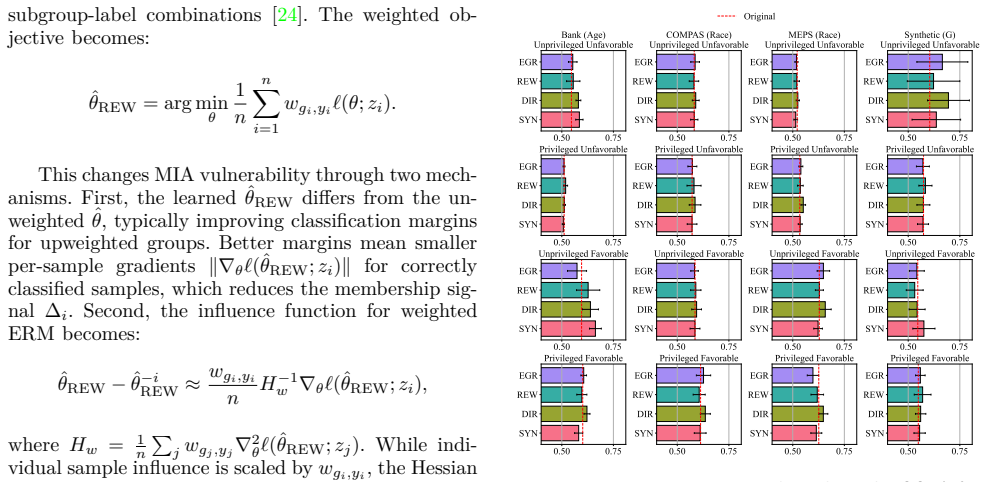
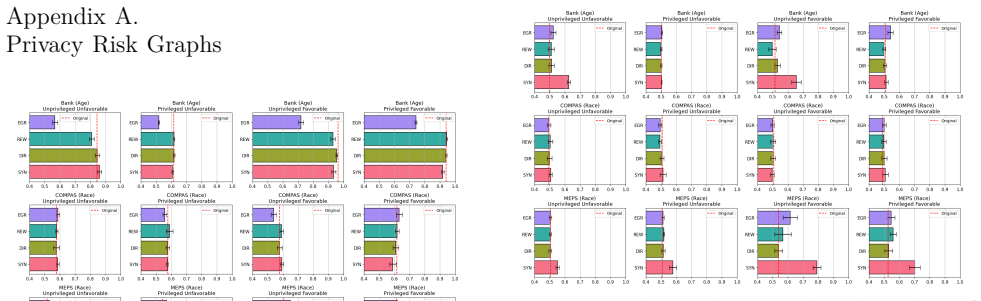
The central claim is that fairness interventions do not uniformly increase privacy risk; their effect on membership inference is mediated by model architecture, subgroup size, and mitigation strategy. Adapting LiRA to subgroup-conditioned attack distributions, the authors report that the smallest subpopulations consistently carry the highest membership-inference risk across datasets and attack families, and that this structural disadvantage persists after fairness mitigation. They further report that differential privacy (via DP random forests and DP-SGD) drives subgroup privacy risk toward the random-guessing baseline, but does so at a heavily uneven utility price: privileged and underrepre
Load-bearing premise
The reported subgroup privacy gaps rest on attack thresholds that are tuned on the target data being scored, which makes the attacks optimistic upper bounds; for OTA the non-member rate is also computed from outside the subgroup, so the subgroup risk numbers are not clean subpopulation metrics.
Editorial extensions
If this is right
- Aggregate privacy metrics are insufficient: membership-inference risk must be reported per subpopulation to see who is actually exposed.
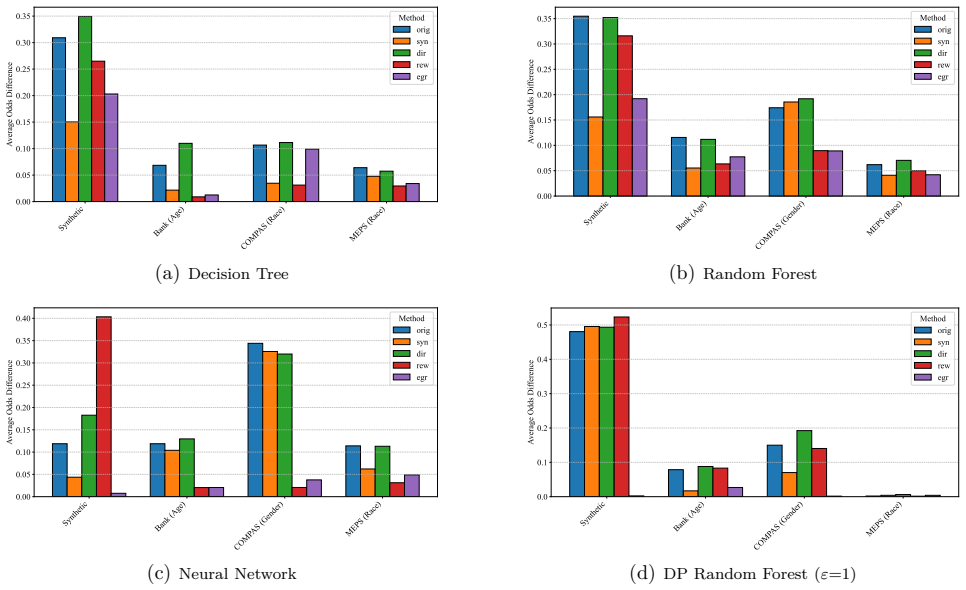
- Fairness mitigators do not have a universal privacy effect; EGR can strengthen privacy for random forests but worsen it for simpler models, while REW gives modest but stable improvements and DIR behaves inconsistently.
- Differential privacy reduces subgroup privacy risk to near-random-guessing levels under every tested mitigator, but its utility cost can be catastrophic for specific subgroups, with accuracy sometimes falling below 5%.
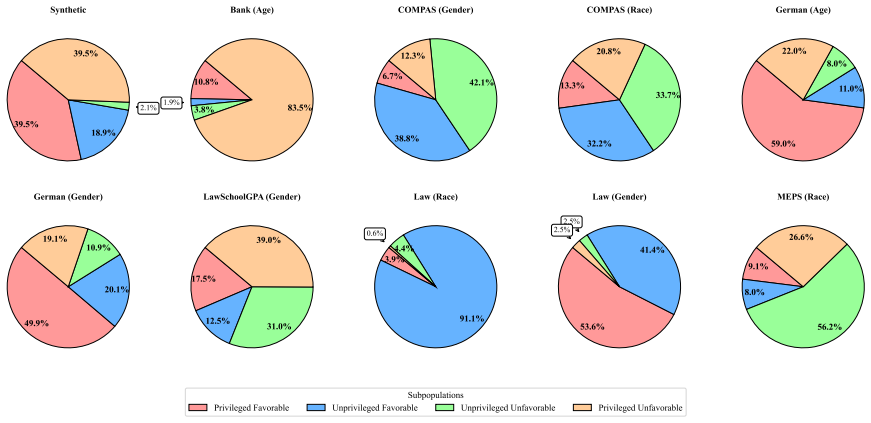
- Subpopulation size remains a persistent driver of privacy vulnerability: smaller subgroups stay the most exposed even after fairness interventions.
- Practitioners should select strategies by priority—DP with lower-complexity models and conservative mitigators like REW if privacy is paramount—but must verify subgroup-level utility in every case.
Reading between the lines
- If the O(1/n_g) influence scaling is the driver, then interventions that increase a subgroup's effective sample size—beyond naive oversampling—should measurably reduce its membership-inference risk; this is a testable extension the paper does not run.
- The same logic suggests a per-group privacy budget: allocating DP noise unevenly, with more protection for groups whose accuracy collapses, could rebalance the fairness–privacy–utility trilemma without giving up formal guarantees.
- Because OQTA and OTA select thresholds on the target data they later score, the reported risk gaps are optimistic upper bounds; re-running the audit with thresholds fixed on a separate population set is a direct check on whether the group-level disparities persist.
- The finding that apparent fairness improvements under DP often reflect uniform accuracy loss warns that fairness metrics computed on degraded models can be misleading; a meaningful audit should report utility alongside fairness, as the paper does.
Editorial analysis
A structured set of objections, weighed in public.
Referee Report
Summary. The paper presents a broad empirical audit of how five fairness-enhancing algorithms (SYN, DIR, REW, EGR, CPP) affect membership-inference privacy risk at the subpopulation level, across six tabular datasets, five model families, and three attack paradigms (LiRA, OQTA, OTA). It introduces a subgroup-conditioned variant of LiRA and reports that fairness interventions do not uniformly increase privacy risk; the effects depend on model architecture, subgroup size, and mitigation strategy. The paper also studies DP-fairness interactions, reporting that DP suppresses membership-inference risk but imposes uneven utility losses across subgroups. A theoretical section attempts to explain the observed size-vulnerability pattern via influence functions.
Significance. If the empirical claims survive scrutiny, this would be a useful contribution to the fairness-privacy auditing literature: it broadens the evidence base to multiple fairness-intervention families, multiple model classes, and subpopulation-level metrics, and it ships code and experimental details. The paper also correctly identifies that aggregate privacy metrics can mask subgroup disparities. However, the two non-parametric attacks used as cross-validation of LiRA contain protocol errors that bias the reported subgroup risks and undermine the paper's claim that the size-vulnerability pattern is robust 'across all attacks.' The LiRA-based results may still be meaningful, but the manuscript's current cross-attack consistency argument is not valid, so the central claims require revision and re-analysis.
major comments (4)
- [Section 4.2, Algorithm 36] OQTA selects per-subgroup thresholds by maximizing accuracy on the target dataset itself: lines 16-22 evaluate candidate thresholds on LD(target)_{g,y}, and lines 30-32 compute the reported accuracy on the same TARGET_MEMBER ∪ TARGET_NON_MEMBER split. This is an in-sample, label-dependent selection of the attack's only parameter, producing an optimistic upper bound on attack success. The bias is stronger for smaller subgroups because the target split has fewer samples, so the reported pattern that smaller subgroups are more exposed can be amplified. Thresholds should be selected on a disjoint held-out set (or via cross-validation) and then evaluated on the target split.
- [Section 4.3, Eq. (16)] The OTA subgroup metric is not correctly defined. Definition (9) requires TNR_Gj = Pr(Attack says 'non-member' | x in Gj ∩ test), but Eq. (16) defines TNR_Gj as the average over x' in non-Gj. Thus PrivacyRisk(Gj) mixes the subgroup's TPR with the complement's TNR and is not a subpopulation-level risk. For a small subgroup, the TNR term is dominated by the large complement, so the reported OTA subgroup values do not measure the subgroup. This affects all OTA-based tables and figures, including Tables 6 and 10 and Figures 12-14.
- [Section 4.1 and Section 7.1] The manuscript explicitly uses OQTA and OTA as the non-parametric cross-validation of LiRA ('Robustness for Small Subpopulations'). Because both attacks have the protocol errors above, the consistency argument does not hold. The claim in Section 7.1 that the size-vulnerability pattern is 'robust across all attacks' and in Section 7.4 that it holds 'regardless of the mitigator or attack applied' is not supported by the current experiments. The LiRA-based results may still stand, but the paper needs to re-run corrected non-parametric attacks and re-evaluate the ordering of mitigators and the size-vulnerability claim.
- [Section 6, Eq. (17)] The theoretical characterization relies on the approximation H^{-1} ≈ (n/n_g) H_g^{-1}, stated to hold if groups have distinct feature distributions or group-specific parameters. Distinct feature distributions alone do not block-diagonalize the Hessian for a shared-parameter model such as logistic regression; cross-group Hessian blocks remain. The listed conditions are therefore not sufficient for the claimed O(1/n_g) scaling. Since Section 6 is presented as a 'theoretical explanation' of the empirical findings, it should either be proved under precise conditions or explicitly labeled a heuristic/intuition, not a derivation. This is not the main empirical claim, but it is a stated contribution and should be corrected.
minor comments (4)
- [Tables 2-3] The 'Privacy' columns contain values such as -0.75% and 6.10%, which are inconsistent with the definition of PrivacyRisk as a proper accuracy score in [0,1] and with the caption's statement that ✓ means 'privacy risk goes down to 50±2%'. Please clarify whether these entries are risk differences, raw risks, or something else, and ensure the table headers and captions match the displayed numbers.
- [Algorithm 36, line 17] The pseudocode says 'Compute accuracy on LD(target)' while Section 4.2 says the threshold maximizes balanced accuracy. Align the pseudocode with the prose, and specify whether 'accuracy' means balanced accuracy or plain accuracy.
- [Section 6 and Appendix text] Several passages contain unreadable font artifacts (e.g., '/uni00000032/...' sequences) in the full text, particularly in Section 6 and figure captions. These artifacts must be fixed in the source so that equations and captions are legible.
- [Section 5, Models] The text says neural networks use 'two hidden layers for the Law dataset,' but Section 5 lists both Law School Admissions and Law School GPA. Specify which dataset or clarify the architecture by dataset.
Circularity Check
OQTA/OTA thresholds are fit on the data they score and OTA's TNR_Gj is computed over non-Gj, invalidating the cross-attack confirmation; the LiRA-based audit is independent, so circularity is partial.
-
fitted input called prediction
[Section 4.2, Algorithm 36, lines 16–22 and 30–32; cf. Eq. (14)]
"for all τ∈ τ g,y do Compute accuracy on LD(target) g,y if accuracy > best_accuracy then best_accuracy← accuracy τ (g,y)← τ end if end for ▷ Threshold derived from population data, selected via target data's best accuracy ... Compute Accuracy and privacy risk (PR) for Gy g"
The OQTA threshold τ(g,y) is selected by maximizing balanced accuracy on the target split (TARGET_MEMBER ∪ TARGET_NON_MEMBER), and the same split is then used to compute the reported PrivacyRisk. The reported attack success is therefore an in-sample optimum, not an independent measurement. For smaller subgroups, optimizing over fewer samples yields a larger expected maximum, so the reported small-subgroup vulnerability gap can be inflated by construction. OTA's Eq. (14) uses the same in-sample threshold selection on training and test losses.
-
other
[Section 4.3, Eq. (16); cf. Definition (9) in Section 3.3]
"TNRGj = P x′∈non-Gj 1{ℓx′ > c j}/|non-Gj| (16) ... Definition (9): TNRGj = Pr(Attack says “non-member” | x∈ Gj∩ test)"
Definition (9) defines the subgroup-specific TNR as the non-member rate over Gj∩test, but Eq. (16) computes TNR_Gj using x′∈non-Gj. Hence the PrivacyRisk(Gj) reported for OTA is not a subgroup metric at all: it mixes in the complement subgroup's non-member rate. The OTA-based confirmation of subgroup-level vulnerability is therefore not a valid cross-check because the quantity being measured is not the defined subpopulation risk.
full rationale
The empirical core of the paper is not circular: the LiRA subgroup audit trains shadow models on disjoint data and computes a likelihood ratio with no threshold fit on the target examples; the size-vulnerability claim is also independently grounded in prior work (e.g., Kulynych et al.). However, the paper's non-parametric cross-checks are not independent. OQTA selects per-subgroup thresholds by maximizing balanced accuracy on the target split and then reports accuracy/privacy risk on that same split; OTA does the same for c in Eq. (14). Additionally, OTA's Eq. (16) defines TNR_Gj over non-Gj, contradicting Definition (9). These flaws invalidate the cross-attack consistency argument and can amplify the reported small-group disadvantage, but they do not reduce the LiRA-based central claim to a fit. Section 6 candidly states it is a post-hoc explanation ('Before presenting our full empirical analysis, we provide a concise theoretical explanation for the main phenomena observed'); because it is conditional on explicitly stated assumptions and is not used to generate the empirical findings, it does not constitute circularity. No load-bearing self-citations were found. Score 4 reflects partial circularity in the auxiliary attacks while the central audit retains independent content.
Assumptions & free parameters
free parameters (2)
- OQTA/OTA per-subgroup thresholds tau(g,y) =
Selected by maximizing balanced accuracy on target member/non-member sets
- Synthetic-data Gaussian parameters (mu, Sigma per group-label) =
Four means/covariance matrices specified in Section 5
assumptions (4)
- standard math Influence-function approximation: leave-one-out parameter difference ≈ (1/n) H^{-1} grad(loss) under standard M-estimation regularity
- ad hoc to paper Group-specific Hessian decomposition: H^{-1} ≈ (n/n_g) H_g^{-1} when groups occupy distinct feature regions or parameters specialize
- domain assumption DP parameter noise modeled as independent additive Gaussian eta ~ N(0, sigma^2 I) on final weights
- domain assumption The MIA test statistic is correlated with the per-sample score difference Delta_i between the model trained with and without the sample
Cite this review
Pith. "Pith review of Auditing Fairness-Privacy Trade-offs: Subpopulation-Level Effects of Fairness-Enhancing Algorithms." pith.science (2026). https://pith.science/paper/THKJXZ35
@misc{pith2026260714607,
  author       = {Pith},
  title        = {Pith review of: Auditing Fairness-Privacy Trade-offs: Subpopulation-Level Effects of Fairness-Enhancing Algorithms},
  year         = {2026},
  howpublished = {\url{https://pith.science/paper/THKJXZ35}},
  note         = {Machine review of arXiv:2607.14607}
}
read the original abstract
Machine learning (ML) models deployed in sensitive domains such as healthcare, law enforcement, and finance must satisfy not only utility requirements but also fairness and privacy guarantees. While prior work has largely examined how privacy-preserving techniques affect fairness, the inverse question-how fairness-enhancing algorithms influence privacy leakage-remains underexplored. We present the first comprehensive study of how fairness interventions affect membership inference privacy risks at the subpopulation level. By adapting the Likelihood Ratio Attack (LiRA) for subgroup auditing, we uncover privacy disparities that aggregate evaluations obscure. We further analyze how Differential Privacy (DP) interacts with fairness-enhancing methods across different categories, showing that DP's privacy benefits and utility costs are unevenly distributed across subpopulations. Our results demonstrate that fairness interventions do not uniformly increase privacy risk; their impact depends on model architecture, subgroup size, and mitigation strategy. These findings reveal that fairness, privacy, and utility must be jointly evaluated at the subpopulation level, and we introduce the first unified empirical framework to support such auditing in practice.
Figures


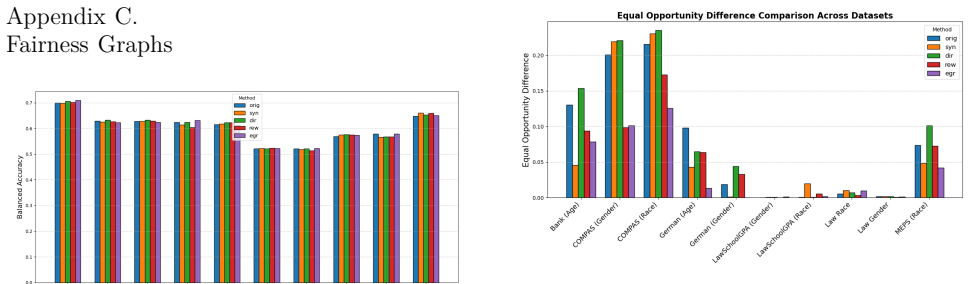
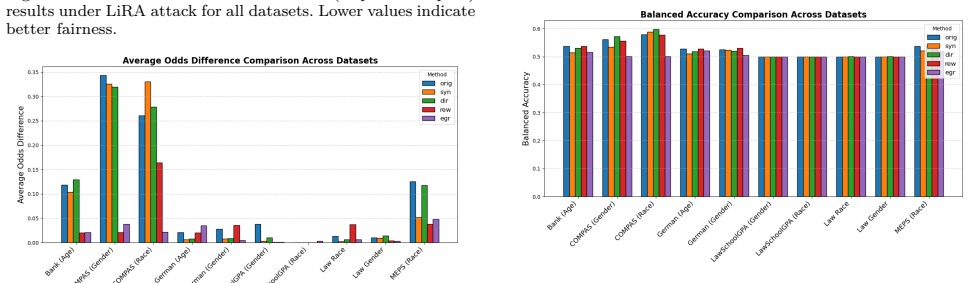
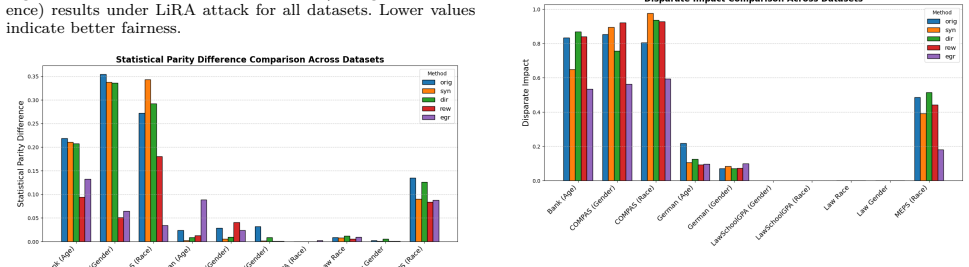
Figures from the paper (20 more)







Reference graph
Works this paper leans on
-
[1]
Brendan McMahan, Ilya Mironov, Kunal Talwar, and Li Zhang
Martin Abadi, Andy Chu, Ian Goodfellow, H. Brendan McMahan, Ilya Mironov, Kunal Talwar, and Li Zhang. Deep learning with differential privacy. In Proceedings of the2016ACMSIGSACConferenceonComputerandCom- munications Security, CCS ’16, page 308–318, New York, NY, USA, 2016. Association for Computing Machinery
2016
-
[2]
A reductions approach to fair classification
Alekh Agarwal, Alina Beygelzimer, Miroslav Dudik, John Langford, and Hanna Wallach. A reductions approach to fair classification. In Proceedings of the 35th International Conference on Machine Learning, volume 80 of Proceedings of Machine Learning Research, pages 60–69. PMLR, 2018
2018
-
[3]
Aithal and R
V. Aithal and R. D. Jathanna. Credit risk assessment using machine learning techniques. InternationalJournal of Inno- vative Technology and Exploring Engineering, 9(1):3482– 3486, 2019
2019
-
[4]
Evaluating marketing campaigns of banking using neural networks
Qeethara Al-Shayea. Evaluating marketing campaigns of banking using neural networks. Lecture Notes in Engineer- ing and Computer Science, 2:759–761, 07 2013
2013
-
[5]
Differential privacy has disparate impact on model accuracy
Eugene Bagdasaryan, Omid Poursaeed, and Vitaly Shmatikov. Differential privacy has disparate impact on model accuracy. In Advances in Neural Information Pro- cessing Systems, volume 32, 2019
2019
-
[6]
R. K. E. Bellamy, K. Dey, M. Hind, S. C. Hoff- man, S. Houde, K. Kannan, P. Lohia, J. Martino, S. Mehta, A. Mojsilović, S. Nagar, K. Natesan Rama- murthy, J. Richards, D. Saha, P. Sattigeri, M. Singh, K. R. Varshney, and Y. Zhang. Ai fairness 360: An extensible toolkit for detecting and mitigating algorithmic bias. IBM Journal of Research and Development,...
2019
-
[7]
Evaluating the fairness impact of differentially private synthetic data
Blake Bullwinkel, Chris Waites, Stephen Ranshous, Daniel Kifer, and Michael Hay. Evaluating the fairness impact of differentially private synthetic data. arXiv preprint arXiv:2205.04321, 2022
arXiv 2022
-
[8]
Membership inference attacks from first principles
Nicholas Carlini, Steve Chien, Milad Nasr, Shuang Song, Andreas Terzis, and Florian Tramer. Membership inference attacks from first principles. In Proceedings of the 2022 IEEE Symposium on Security and Privacy (SP), pages 1897–1914. IEEE, 2022
2022
Show all 41 references
-
[9]
On the privacy risks of algorithmic fairness
Hongyan Chang and Reza Shokri. On the privacy risks of algorithmic fairness. arXiv preprint arXiv:2011.03731, 2021
2011 arXiv
-
[10]
Chawla, Kevin W
Nitesh V. Chawla, Kevin W. Bowyer, Lawrence O. Hall, and W. Philip Kegelmeyer. Smote: synthetic minority over- sampling technique. J. Artif. Int. Res., 16(1):321–357, June 2002
2002
-
[11]
Residuals and influence in regression
R Dennis Cook and Sanford Weisberg. Residuals and influence in regression. New York: Chapman and Hall, 1982
1982
-
[12]
The accuracy, fairness, and limits of predicting recidivism
Julia Dressel and Hany Farid. The accuracy, fairness, and limits of predicting recidivism. Science Advances, 4(1):eaao5580, 2018
2018
-
[13]
Fairness via representation neutralization
Mengnan Du, Subhabrata Mukherjee, Guanhong Wang, Raphael Tang, Ahmed Hassan Awadallah, and Xia Hu. Fairness via representation neutralization. arXiv preprint arXiv:2106.12674, 2021
2021 arXiv
-
[14]
Friedler, John Moeller, Carlos Scheidegger, and Suresh Venkatasubramanian
Michael Feldman, Sorelle A. Friedler, John Moeller, Carlos Scheidegger, and Suresh Venkatasubramanian. Certifying and removing disparate impact. In Proceedings of the 21st ACM SIGKDD International Conference on Knowledge Discovery and Data Mining, pages 259–268. ACM, 2015
2015
-
[15]
Does learning require memorization? a short tale about a long tail, 2021
Vitaly Feldman. Does learning require memorization? a short tale about a long tail, 2021
2021
-
[16]
Whatneuralnetworks memorize and why: Discovering the long tail via influence estimation
VitalyFeldmanandChiyuanZhang. Whatneuralnetworks memorize and why: Discovering the long tail via influence estimation. In H. Larochelle, M. Ranzato, R. Hadsell, M.F. Balcan, and H. Lin, editors, Advances in Neural Information Processing Systems, volume 33, pages 2881–
-
[17]
Differential privacy and fairness in deci- sions and learning tasks: A survey
Ferdinando Fioretto, Chi Tran, Pascal Van Hentenryck, and Kai Zhu. Differential privacy and fairness in deci- sions and learning tasks: A survey. In Proceedings of the Thirty-First International Joint Conference on Artificial Intelligence (IJCAI), pages 5470–5477, July 2022
2022
-
[18]
Decision making with differential privacy under a fairness lens, 2024
Ferdinando Fioretto, Cuong Tran, and Pascal Van Hen- tenryck. Decision making with differential privacy under a fairness lens, 2024
2024
-
[19]
Why do tree-based models still outperform deep learning on typical tabular data? In Advances in Neural Information Processing Systems, volume 35, pages 507–520, 2022
Léo Grinsztajn, Edouard Borchi, and Gaël Varoquaux. Why do tree-based models still outperform deep learning on typical tabular data? In Advances in Neural Information Processing Systems, volume 35, pages 507–520, 2022
2022
-
[20]
Robuststatistics:theapproachbased on influence functions
Frank R Hampel, Elvezio M Ronchetti, Peter J Rousseeuw, andWernerAStahel. Robuststatistics:theapproachbased on influence functions. John Wiley & Sons, 1986
1986
-
[21]
The impact of differential privacy on group disparity mitigation
Victor Hansen, Atula Neerkaje, Ramit Sawhney, Lucie Flek, and Anders Søgaard. The impact of differential privacy on group disparity mitigation. In Kevin Duh, Helena Gomez, and Steven Bethard, editors, Findings of the Association for Computational Linguistics: NAACL 2024, pages...
2024
-
[22]
Diffprivlib: The ibm differential privacy library
Naoise Holohan, Stefano Braghin, Pól Mac Aonghusa, and Siobhán Levacher. Diffprivlib: The ibm differential privacy library. arXiv preprint arXiv:1907.02444, 2019
1907 arXiv
-
[23]
Differentially private fair learning
Matthew Jagielski, Michael Kearns, Jieming Mao, Alina Oprea, Aaron Roth, Saeed Sharifi Malvajerdi, and Jonathan Ullman. Differentially private fair learning. In Kamalika Chaudhuri and Ruslan Salakhutdinov, editors, Proceedings of the 36th International Conference on Ma- chine ...
2019
-
[24]
Datapreprocessingtech- niques for classification without discrimination
FaisalKamiranandToonCalders. Datapreprocessingtech- niques for classification without discrimination. Knowledge and Information Systems, 33(1):1–33, 2012
2012
-
[25]
Understanding black- box predictions via influence functions
Pang Wei Koh and Percy Liang. Understanding black- box predictions via influence functions. In International Conference on Machine Learning (ICML), pages 1885–
-
[26]
Disparate vulnerability to membership inference attacks
Bogdan Kulynych, Mohammad Yaghini, Giovanni Cheru- bin, Michael Veale, and Carmela Troncoso. Disparate vulnerability to membership inference attacks. Proceedings onPrivacyEnhancingTechnologies,2022(1):460–480,2022
2022
-
[27]
Arcolezi, and Catuscia Palamidessi
Karima Makhlouf, Tamara Stefanovic, Heber H. Arcolezi, and Catuscia Palamidessi. A systematic and formal study of the impact of local differential privacy on fairness: Preliminary results, 2024
2024
-
[28]
Differential privacy has bounded impact on fairness in classification, 2023
Paul Mangold, Michaël Perrot, Aurélien Bellet, and Marc Tommasi. Differential privacy has bounded impact on fairness in classification, 2023
2023
-
[29]
Ml pri- vacy meter: Aiding regulatory compliance by quantifying the privacy risks of machine learning
Sasi Kumar Murakonda and Reza Shokri. Ml pri- vacy meter: Aiding regulatory compliance by quantifying the privacy risks of machine learning. arXiv preprint arXiv:2007.09339, 2020
2007 arXiv
-
[30]
Increasing the views and reducing the depth in random forest
Abolfazl Nadi and Hadi Moradi. Increasing the views and reducing the depth in random forest. Expert Systems with Applications, 138:112801, 2019
2019
-
[31]
A comprehensive sustainable framework for machine learning and artificial intelligence, 2024
Roberto Pagliari, Peter Hill, Po-Yu Chen, Maciej Dabrowny, Tingsheng Tan, and Francois Buet-Golfouse. A comprehensive sustainable framework for machine learning and artificial intelligence, 2024
2024
-
[32]
Weinberger
Geoff Pleiss, Manish Raghavan, Felix Wu, Jon Kleinberg, and Kilian Q. Weinberger. On fairness and calibration. In Advances in Neural Information Processing Systems, volume 30, 2017
2017
-
[33]
Understanding MachineLearning:FromTheorytoAlgorithms
Shai Shalev-Shwartz and Shai Ben-David. Understanding MachineLearning:FromTheorytoAlgorithms. Cambridge University Press, USA, 2014
2014
-
[34]
When fairness meets pri- vacy: Exploring privacy threats in fair binary classifiers via membership inference attacks
Huan Tian, Guangsheng Zhang, Bo Liu, Tianqing Zhu, Ming Ding, and Wanlei Zhou. When fairness meets pri- vacy: Exploring privacy threats in fair binary classifiers via membership inference attacks. pages 512–520, 08 2024
2024
-
[35]
Dinh, and Ferdinando Fioretto
Cuong Tran, My H. Dinh, and Ferdinando Fioretto. Dif- ferentially empirical risk minimization under the fairness lens, 2022
2022
-
[36]
Effectsofdifferentialprivacyanddataskewness on membership inference vulnerability
Stacey Truex, Ling Liu, Mehmet Emre Gursoy, Wenqi Wei, andLeiYu. Effectsofdifferentialprivacyanddataskewness on membership inference vulnerability. In Proceedings of the 2019 IEEE International Conference on Trust, Privacy and Security in Intelligent Systems and Applications (...
2019
-
[37]
Disparate vulnerability: on the unfairness of privacy attacks against machine learning
Mohammad Yaghini, Bogdan Kulynych, and Carmela Troncoso. Disparate vulnerability: on the unfairness of privacy attacks against machine learning. arXiv preprint arXiv:1906.00389, 2019
1906 arXiv
-
[38]
Privacy risk in machine learning: Analyzing the connection to overfitting
Samuel Yeom, Irene Giacomelli, Matt Fredrikson, and Somesh Jha. Privacy risk in machine learning: Analyzing the connection to overfitting. In Proceedings of the 2018 IEEE 31st Computer Security Foundations Symposium (CSF), pages 268–282. IEEE, 2018
2018
-
[39]
Understanding disparate effects of membership inference attacks and their countermeasures
Da Zhong, Haipei Sun, Jun Xu, Neil Zhenqiang Gong, and Wendy Hui Wang. Understanding disparate effects of membership inference attacks and their countermeasures. In Proceedings of the 2022 ACM on Asia Conference on Computer and Communications Security, pages 62–75, 2022
2022
-
[40]
On Improving Fairness of AI Models with Synthetic Minority Oversampling Techniques, pages 874–882
Yan Zhou, Murat Kantarcioglu, and Chris Clifton. On Improving Fairness of AI Models with Synthetic Minority Oversampling Techniques, pages 874–882. SIAM, 2023. Appendix A. Privacy Risk Graphs Figure 7.Decision Tree privacy risk results under LiRA attack for: Bank (Age), COMPAS...
2023
-
[2891]
Curran Associates, Inc., 2020
2020
Reviewed August 2, 2026 · model on record in the stance chip above.
Discussion (0). Sign in to comment.