REVIEW 5 major objections 4 minor 55 references
Continuous Habitable Zone Metric for Prioritizing Habitable Worlds Observatory Targets
T0 review · 5 major / 4 minor · reviewed 2026-08-07 · deepseek-v4-flash
Pith's one-line read For a future direct-imaging telescope hunting Earth-like worlds, the best targets are late-F and early-G dwarfs around 3-4 Gyr old, while hotter stars rarely keep any orbit continuously habitable for 2 Gyr.
desk verdict A useful, clearly written application paper that packages a Bayesian continuous-habitable-zone calculation into a target-ranking metric for all 164 EMSL stars; the headline peak and cutoff are plausible but not stress-tested, and the missing uncertainties and sensitivity analysis are the real soft spots. read the letter →
The pith
A machine-rendered reading of the paper's core claim, the machinery that carries it, and where it could break.
The reading
What carries the argument
The load-bearing object is the CHZ2 metric, defined as $\int_{\mathrm{IWA}}^{\infty} P(\mathrm{CHZ}_2)\,dr$, where $P(\mathrm{CHZ}_2)$ is the Bayesian posterior probability that an orbit at radius $r$ lies within the 2 Gyr continuous habitable zone. The CHZ2 itself comes from the fixed-duration definition: an orbit is counted only if it stays inside the evolving habitable zone for 2 Gyr, using the runaway-greenhouse inner edge, the maximum-greenhouse outer edge, and a water-condensation inner limit. Posterior probabilities are generated by Markov-chain Monte Carlo sampling over a grid of stellar evolution tracks, with effective temperature, radius, and metallicity as observed inputs, so stellar age and the CHZ2 boundaries are inferred together rather than separately.
What would settle it
Find a star hotter than about 6600 K with an age near 3-4 Gyr whose Bayesian CHZ2 posterior, computed with the same pipeline, gives a high probability of a wide continuous habitable zone at its current age; that single counterexample would directly contradict the claimed hot-star cut-off. Alternatively, rerunning the pipeline with a 3D GCM-based habitable-zone prescription and seeing whether the 3-4 Gyr peak and the F3/6600 K boundary persist would test whether the result is an artifact of the adopted 1D habitable-zone prescriptions.
Extended reading notes
Core claim
The paper's central claim is that continuous habitability, measured by the fixed-duration 2 Gyr continuous habitable zone (CHZ2), is not uniformly distributed across the target list: late-F and early-G dwarfs with ages near 3-4 Gyr carry the widest and most likely CHZ2 zones, with metric values around 0.7-0.9, while stars earlier than about F3, hotter than about 6600 K, or more massive than about 1.3 solar masses appear unlikely to have any CHZ2 at the present epoch. This is established by simultaneously sampling each star's age, mass, and CHZ2 boundaries from stellar evolution tracks, converting the sampled boundaries into a likelihood curve for each orbital radius, and integrating that curve outside a fixed 83 mas inner working angle to define the CHZ2 metric. The paper also reports that the metric is lower for subgiants and the oldest stars, and that K dwarfs, though long-lived, score lower because their habitable zones are physically narrow.
Load-bearing premise
The whole ranking rests on the assumption that staying in the habitable zone for 2 billion years, the time Earth took to oxygenate its atmosphere, is a good proxy for a planet being able to produce detectable life.
Editorial extensions
If this is right
- Target selection for HWO can be ranked by CHZ2 metric, with late-F and early-G dwarfs near 3-4 Gyr receiving the highest priority.
- Stars earlier than roughly F3 or hotter than roughly 6600 K can be deprioritized, since the analysis suggests they will not host a 2 Gyr continuous habitable zone today.
- The metric can be folded into an existing target list as a complement to exposure-time or brightness criteria, distinguishing between systems with similar observational cost.
- The open-source implementation allows the same calculation to be rerun with other stellar model grids or other habitable-zone prescriptions, so the ranking can be tested against model choices.
- For stars younger than 2 Gyr, the metric is zero by construction, and for very old stars it contracts, so the peak near solar age is a direct prediction of stellar evolution plus the 2 Gyr requirement.
Reading between the lines
- A natural extension would replace the fixed 83 mas inner working angle with per-star brightness and contrast limits, which would likely shift rankings toward cooler stars because F-star habitable zones are dimmer and farther out.
- If the 3-4 Gyr peak holds for a larger sample, it implies that the expected yield of biosignature-detection surveys is maximized by weighting targets by age, not just by spectral type or proximity.
- The same Bayesian machinery could incorporate a planet-occurrence prior, turning the CHZ2 metric into an expected-yield estimate rather than a geometric prioritization.
- Because the cut-off near 6600 K is based on about ten stars, the sharpest test of this paper's thesis is simply to apply the pipeline to the larger HWO Tier 2 and Tier 3 catalogs.
Editorial analysis
A structured set of objections, weighed in public.
Referee Report
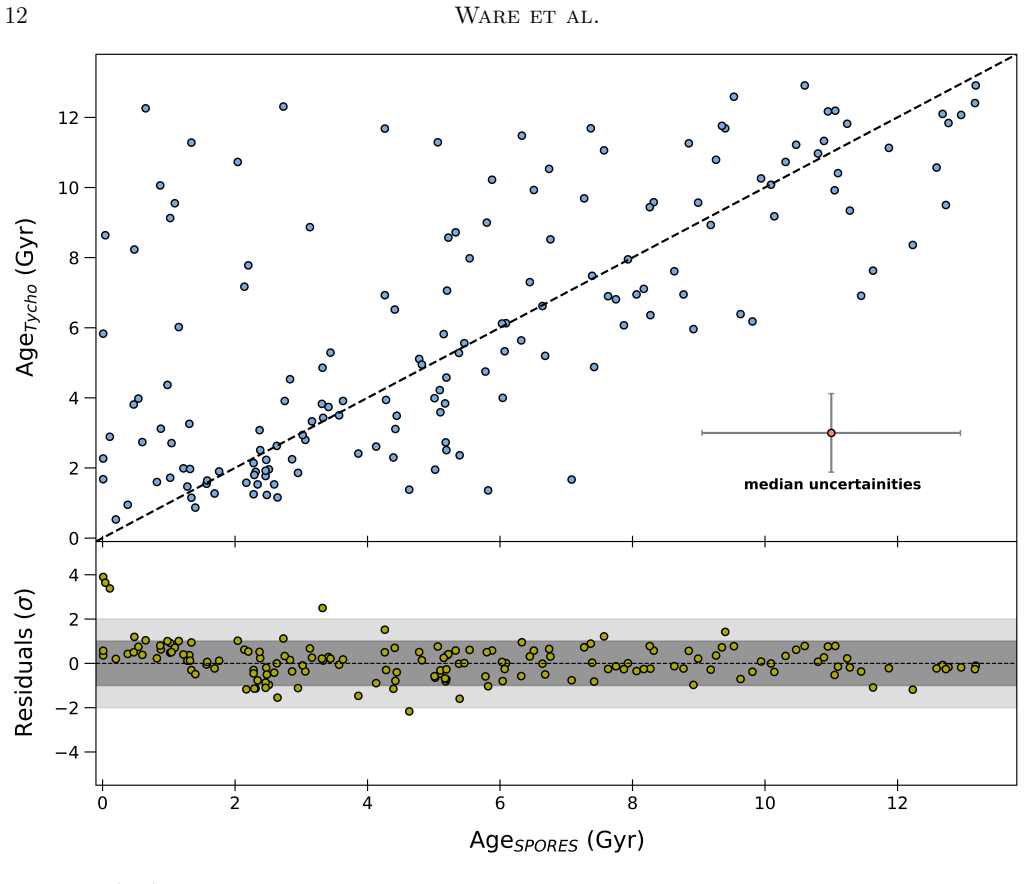
Summary. The paper develops a Bayesian method for computing the likelihood that a given orbital radius around a star lies in the 2 Gyr continuous habitable zone (CHZ2), then integrates this likelihood outside a fixed inner working angle to define a single 'CHZ2 metric' for HWO target prioritization. The method is applied to the 164 stars in the EMSL using Tycho stellar evolution tracks interpolated with kiauhoku, SPORES input properties, and Kopparapu et al. (2014) plus Turbet et al. (2023) habitable zone prescriptions. The headline result is that the CHZ2 metric peaks at 3–4 Gyr for late-F and early-G dwarfs, and that stars earlier than roughly F3 or hotter than roughly 6600 K are unlikely to have a CHZ2 at the time of observation. The paper also reports MCMC-derived masses and ages for the sample, compares them with the SPORES catalog, and releases an open-source module for computing CHZ2 posteriors on arbitrary stellar grids.
Significance. If the central claims are robust, this paper provides a practical, physically motivated ranking tool for the most observationally expensive decision facing HWO: which ~25 systems to observe for biosignatures. The application to the actual EMSL sample, the detailed MCMC setup with convergence diagnostics, the comparison of derived masses and ages with SPORES, and the release of reproducible code within kiauhoku are genuine strengths. The paper is also honest about several limitations, notably modeling difficulties for low-mass K/M dwarfs and the need for future comparisons across stellar grids and HZ prescriptions. However, the headline quantitative claims rest on untested assumptions (fixed 2 Gyr CHZ duration, fixed 83 mas IWA, OWA set to infinity) and on metric values reported without uncertainties. Because the 3–4 Gyr peak and the F3/6600 K cutoff are the paper's main new results, the lack of robustness and uncertainty quantification is load-bearing rather than cosmetic. The stress-test concern lands: the manuscript does not demonstrate that the ranking and the claimed peak are stable to plausible changes in the adopted CHZ duration or IWA.
major comments (5)
- [§2.5, Eq. (3); Table 2; Figure 5] The CHZ2 metric is reported in Table 2 as a bare point estimate with no uncertainty, even though it is an integral of a posterior distribution. The headline claims about a 3–4 Gyr peak and a drop near 6600 K are made by visual inspection of Figure 5, and without per-star metric uncertainties or a statistical comparison of temperature/age bins, the reader cannot tell whether these features are significant or are scatter. Please provide metric uncertainties (e.g., by propagating the MCMC posterior) and a quantitative test of the peak and cutoff.
- [§2.5, Eq. (3)] The metric's lower integration limit is fixed by assuming IWA = 83 mas for all stars, converted to a physical radius using distance, but no sensitivity test is presented. The IWA directly controls which part of the CHZ2 is counted: for a nearby star the physical IWA radius may lie well inside the CHZ2, while for a more distant star it may exclude a substantial fraction of the CHZ2. A sensitivity test over a plausible IWA range (e.g., 60–100 mas) is needed to show that the target ranking and the claimed age/Teff trends are stable.
- [§2.5] The outer working angle is set to infinity, with the text stating the OWA is 'likely to be well beyond the OHZ in all cases,' but this assumption is never tested. For early-F dwarfs, which have wide HZs extending to larger orbital radii, an unlimited outer integration limit may preferentially inflate their CHZ2 metrics relative to later-type stars, potentially biasing the very peak the paper claims. The authors should either adopt a plausible finite OWA or quantify how much of the CHZ2 metric lies beyond a realistic outer working angle.
- [§1 and §2.3] The choice of a 2 Gyr continuous-habitable-zone duration, taken from Truitt et al. (2020) and tied to the Great Oxidation Event timescale, is the biological pivot of the entire prioritization metric, yet no alternative CHZ durations are explored. Given that the paper's own age uncertainties frequently exceed 1 Gyr (e.g., HD 72905: 2.25+0.79−2.21 Gyr in Table 2), it is plausible that a 1 Gyr or 4 Gyr CHZ duration would shift the age at which the metric peaks and possibly the spectral-type cutoff. A sensitivity analysis varying the CHZ duration is essential to support the central claim.
- [Abstract and §4.1] The abstract states without qualification that stars earlier than ~F3 or hotter than ~6600 K are unlikely to have a CHZ2, while Section 4.1 itself labels this result 'tentative' and notes it is based on only ~10 stars with a median metric of 0.053. The abstract should carry the same qualification, and the paper should quantify how many of these stars have metric values consistent with zero once uncertainties are included, which again requires the uncertainty estimates missing from Table 2.
minor comments (4)
- [§2.3] In the sentence describing the Turbet et al. (2023) prescription, 'compliment' should be 'complement'.
- [Table 2] The caption and table would benefit from stating the units of the CHZ2 metric; the text describes it as a proxy for the width of the CHZ2, so specifying that it is an effective AU width would aid the reader.
- [Figure 5] The color scale for Teff is not described in the caption; please state the range of the color bar and how the colors map to temperature.
- [§2.4, Eq. (1)] The age prior in Equation (1) is written with a generic Age variable, but Table 1 reports ages in Log yr; please clarify whether the prior is applied in linear or logarithmic units.
Circularity Check
No circular derivation: the CHZ2 metric trends are outputs of stellar-evolution and habitable-zone models, not restatements of fitted inputs.
full rationale
The paper's derivation chain is self-contained in the required sense. It adopts the fixed-duration 2 Gyr CHZ2 definition from Truitt et al. (2020) as an explicit external assumption (Section 1), uses the Tycho stellar evolution grid (Young & Arnett 2005), the Kopparapu et al. (2014) and Turbet et al. (2023) habitable-zone prescriptions, and SPORES Teff, R*, and [Fe/H] as inputs (Sections 2.1-2.4). The CHZ2 metric is defined by Eq. (3) as the integral of the sampled CHZ2 posterior outside a stated IWA = 83 mas; this is a definition rather than a concealed equivalence. The headline results — zero metric below 2 Gyr, peak near 3-4 Gyr for late-F/early-G dwarfs, and decline for Teff > 6600 K — emerge from the stellar models' luminosity evolution and the habitable-zone prescriptions, and no parameter is fitted to reproduce them. The paper explicitly labels the early-F cutoff as tentative and derives the model cutoff from evolution models. Self-citations to Ware et al. (2022), Truitt et al. (2020), and Young & Arnett (2005) supply the method, CHZ2 definition, and stellar code, respectively, but these are published, externally assessable building blocks, not uniqueness theorems or fitted parameters; the paper also cross-checks its derived masses and ages against the independent SPORES/MIST catalog. The only statement that follows by construction is that stars younger than 2 Gyr cannot have a 2 Gyr CHZ, and the paper acknowledges this explicitly rather than presenting it as a discovery. I therefore find no circular step.
Assumptions & free parameters
free parameters (2)
- CHZ duration =
2 Gyr
- Inner working angle (IWA) =
83 mas
assumptions (5)
- domain assumption Tycho stellar evolution models accurately predict luminosity, effective temperature, and isochrone ages for F, G, K, and M dwarfs.
- domain assumption Kopparapu et al. (2014) runaway greenhouse and maximum greenhouse limits define the habitable zone.
- domain assumption Turbet et al. (2023) water condensation limit sets the initial inner habitable zone at the zero-age main sequence.
- domain assumption Continuous residence in the habitable zone for 2 Gyr is a valid timescale for detectable life.
- domain assumption Chabrier IMF prior on stellar mass is appropriate for sampling the EMSL stars.
Cite this review
Pith. "Pith review of Continuous Habitable Zone Metric for Prioritizing Habitable Worlds Observatory Targets." pith.science (2026). https://pith.science/paper/TI2Q6MW7
@misc{pith2026250520558,
  author       = {Pith},
  title        = {Pith review of: Continuous Habitable Zone Metric for Prioritizing Habitable Worlds Observatory Targets},
  year         = {2026},
  howpublished = {\url{https://pith.science/paper/TI2Q6MW7}},
  note         = {Machine review of arXiv:2505.20558}
}
abstract
Future direct imaging space telescopes, such as NASA's Habitable Worlds Observatory (HWO), will be the first capable of both detecting and characterizing terrestrial exoplanets in the habitable zones (HZ) of nearby Sun-like stars. Since this will require a significant amount of time and resources for even a single system or exoplanet, the likelihood that a system will host detectable life should be considered when prioritizing observations. One method of prioritization is to estimate the likelihood that an exoplanet has remained continuously within the HZ long enough for life to emerge and make a detectable impact on the atmosphere. We utilize a Bayesian method to calculate the likelihood that a given orbital radius around a star is currently in the 2 Gyr continuous habitable zone (CHZ$_2$), the approximate time it took life on Earth to significantly oxygenate the atmosphere. We apply this method to the 164 stars in the NASA Exoplanet Exploration Program Mission Star List (EMSL) for HWO, representing a preliminary sample of Sun-like stars with HZs most accessible to a future direct imaging mission. By considering the CHZ$_2$ likelihood at all orbital radii outside a hypothetical inner working angle for HWO, we define a metric for prioritizing targets according to the accessibility and total extent of the CHZ$_2$. We find that the CHZ$_2$ metric peaks between $3-4$ Gyr for late-F and early-G dwarfs, but tentatively determine that stars earlier than $\sim {F3}$ or hotter than $\sim 6600$ K are unlikely to have a CHZ$_2$ at the time of observation.
Figures


Figures from the paper (3 more)


Reference graph
Works this paper leans on
-
[1]
Arnett, D., Meakin, C., & Young, P. A. 2009, The Astrophysical Journal, 690, 1715, doi: 10.1088/0004-637X/690/2/1715 —. 2010, The Astrophysical Journal, 710, 1619, doi: 10.1088/0004-637X/710/2/1619 21
-
[2]
Arnett, W. D., & Meakin, C. 2011, The Astrophysical Journal, 733, 78, doi: 10.1088/0004-637X/733/2/78
-
[3]
Asplund, M., Amarsi, A. M., & Grevesse, N. 2021, Astronomy & Astrophysics, 653, A141, doi: 10.1051/0004-6361/202140445
-
[4]
Asplund, M., Grevesse, N., Sauval, A. J., & Scott, P. 2009, Annual Review of Astronomy and Astrophysics, 47, 481, doi: 10.1146/annurev.astro.46.060407.145222
arXiv 2009
-
[5]
Barnes, S. A., & Kim, Y.-C. 2010, The Astrophysical Journal, 721, 675, doi: 10.1088/0004-637X/721/1/675
-
[6]
S., von Braun, K., van Belle, G., et al
Boyajian, T. S., von Braun, K., van Belle, G., et al. 2012, The Astrophysical Journal, 757, 112, doi: 10.1088/0004-637X/757/2/112
-
[7]
2003, Publications of the Astronomical Society of the Pacific, 115, 763, doi: 10.1086/376392
Chabrier, G. 2003, Publications of the Astronomical Society of the Pacific, 115, 763, doi: 10.1086/376392
doi:10.1086/376392 2003
-
[8]
Claytor, Z. R., van Saders, J. L., Santos, ˆA. R. G., et al. 2020, The Astrophysical Journal, 888, 43, doi: 10.3847/1538-4357/ab5c24
Show all 55 references
-
[9]
P., Magee, N
Colgan, J., Kilcrease, D. P., Magee, N. H., et al. 2016, The Astrophysical Journal, 817, 116, doi: 10.3847/0004-637X/817/2/116
2016 doi
-
[10]
H., Amthor, A
Cyburt, R. H., Amthor, A. M., Ferguson, R., et al. 2010, The Astrophysical Journal Supplement, 189, 240, doi: 10.1088/0067-0049/189/1/240
2010 doi
-
[11]
O., S´ egransan, D., Forveille, T., et al
Demory, B. O., S´ egransan, D., Forveille, T., et al. 2009, Astronomy & Astrophysics, 505, 205, doi: 10.1051/0004-6361/200911976
2009 doi
-
[12]
2016, The Astrophysical Journal Supplement, 222, 8, doi: 10.3847/0067-0049/222/1/8
Dotter, A. 2016, The Astrophysical Journal Supplement, 222, 8, doi: 10.3847/0067-0049/222/1/8
2016 doi
-
[13]
2013, Publications of the Astronomical Society of the Pacific, 125, 306, doi: 10.1086/670067
Goodman, J. 2013, Publications of the Astronomical Society of the Pacific, 125, 306, doi: 10.1086/670067
2013 doi
-
[14]
2019, The Journal of Open Source Software, 4, 1864, doi: 10.21105/joss.01864
Foreman-Mackey, D., Farr, W., Sinha, M., et al. 2019, The Journal of Open Source Software, 4, 1864, doi: 10.21105/joss.01864
2019 doi
-
[15]
2018, Astrobiology, 18, 739, doi: 10.1089/ast.2017.1733
Fujii, Y., Angerhausen, D., Deitrick, R., et al. 2018, Astrobiology, 18, 739, doi: 10.1089/ast.2017.1733
2018
-
[16]
S., Seager, S., Mennesson, B., et al
Gaudi, B. S., Seager, S., Mennesson, B., et al. 2020, arXiv e-prints, arXiv:2001.06683. https://arxiv.org/abs/2001.06683
2020 arXiv
-
[17]
C., Dewitt, H
Graboske, H. C., Dewitt, H. E., Grossman, A. S., & Cooper, M. S. 1973, The Astrophysical Journal, 181, 457, doi: 10.1086/152062
1973 doi
-
[18]
O., Corbally, C
Gray, R. O., Corbally, C. J., Garrison, R. F., et al. 2006, The Astronomical Journal, 132, 161, doi: 10.1086/504637
2006 doi
-
[19]
T., & Robinson, P
McFadden, M. T., & Robinson, P. E. 2003, The Astronomical Journal, 126, 2048, doi: 10.1086/378365
2003 doi
-
[20]
O., Napier, M
Gray, R. O., Napier, M. G., & Winkler, L. I. 2001, AJ, 121, 2148, doi: 10.1086/319956
2001 doi
-
[21]
Ardestani, B. A. 2024, The Astrophysical Journal Supplement, 272, 30, doi: 10.3847/1538-4365/ad3e81
2024 doi
-
[22]
D., & Turnbull, M
Pagano, M. D., & Turnbull, M. C. 2014, The Astronomical Journal, 148, 54, doi: 10.1088/0004-6256/148/3/54
2014 doi
-
[23]
Holland, H. D. 2006, Philosophical Transactions of the Royal Society B: Biological Sciences, 361, 903, doi: 10.1098/rstb.2006.1838
2006
-
[24]
R., Metcalfe, T
Huber, D., White, T. R., Metcalfe, T. S., et al. 2022, The Astrophysical Journal, 163, 79, doi: 10.3847/1538-3881/ac3000
2022 doi
-
[25]
F., Whitmire, D
Kasting, J. F., Whitmire, D. P., & Reynolds, R. T. 1993, Icarus, 101, 108, doi: 10.1006/icar.1993.1010
1993
- [26]
-
[27]
K., Ramirez, R
Kopparapu, R. K., Ramirez, R. M., SchottelKotte, J., et al. 2014, The Astrophysical Journal Letters, 787, L29, doi: 10.1088/2041-8205/787/2/L29
2014 doi
-
[28]
K., Ramirez, R., Kasting, J
Kopparapu, R. K., Ramirez, R., Kasting, J. F., et al. 2013, The Astrophysical Journal, 765, 131, doi: 10.1088/0004-637X/765/2/131
2013 doi
-
[29]
2000, Nuclear Physics A, 673, 481, doi: 10.1016/S0375-9474(00)00131-7
Langanke, K., & Mart ´ ınez-Pinedo, G. 2000, Nuclear Physics A, 673, 481, doi: 10.1016/S0375-9474(00)00131-7
2000 doi
-
[30]
C., Mel´ endez, J., et al
Lorenzo-Oliveira, D., Freitas, F. C., Mel´ endez, J., et al. 2018, Astronomy & Astrophysics, 619, A73, doi: 10.1051/0004-6361/201629294
2018 doi
- [31]
-
[32]
2022, The Astrophysical Journal, 940, 129, doi: 10.3847/1538-4357/ac9b40
Marigo, P., Aringer, B., Girardi, L., & Bressan, A. 2022, The Astrophysical Journal, 940, 129, doi: 10.3847/1538-4357/ac9b40
2022 doi
-
[33]
A., & Arnett, D
Meakin, C. A., & Arnett, D. 2007, The Astrophysical Journal, 667, 448, doi: 10.1086/520318 22 W are et al
2007 doi
-
[34]
Mello, F. d. S., & Fria¸ ca, A. C. S. 2023, International Journal of Astrobiology, 22, 272, doi: 10.1017/S1473550423000083
2023 doi
-
[35]
C., Ribas, I., & Jordi, C
Morales, J. C., Ribas, I., & Jordi, C. 2008, Astronomy & Astrophysics, 478, 507, doi: 10.1051/0004-6361:20078324
2008 doi
-
[36]
Nissen, P. E. 2015, Astronomy & Astrophysics, 579, A52, doi: 10.1051/0004-6361/201526269 Planck Collaboration, Aghanim, N., Akrami, Y., et al. 2020, Astronomy & Astrophysics, 641, A6, doi: 10.1051/0004-6361/201833910
2015 doi
-
[37]
J., & Nayfonov, A
Rogers, F. J., & Nayfonov, A. 2002, The Astrophysical Journal, 576, 1064, doi: 10.1086/341894
2002 doi
-
[38]
2013, Astrobiology, 13, 251, doi: 10.1089/ast.2012.0888
Rugheimer, S., Kaltenegger, L., Zsom, A., Segura, A., & Sasselov, D. 2013, Astrobiology, 13, 251, doi: 10.1089/ast.2012.0888
2013
-
[39]
2015, The Astrophysical Journal, 806, 137, doi: 10.1088/0004-637X/806/1/137
Sasselov, D. 2015, The Astrophysical Journal, 806, 137, doi: 10.1088/0004-637X/806/1/137
2015 doi
-
[40]
2016, Journal of Astronomical Telescopes, Instruments, and Systems, 2, 011006, doi: 10.1117/1.JATIS.2.1.011006
Savransky, D., & Garrett, D. 2016, Journal of Astronomical Telescopes, Instruments, and Systems, 2, 011006, doi: 10.1117/1.JATIS.2.1.011006
2016 doi
-
[41]
L., Meadows, V
Shields, A. L., Meadows, V. S., Bitz, C. M., et al. 2013, Astrobiology, 13, 715, doi: 10.1089/ast.2012.0961
2013
-
[42]
Somers, G., Cao, L., & Pinsonneault, M. H. 2020, The Astrophysical Journal, 891, 29, doi: 10.3847/1538-4357/ab722e
2020 doi
-
[43]
Robinson, T. D. 2014, ApJ, 795, 122, doi: 10.1088/0004-637X/795/2/122
2014 doi
-
[44]
2022, The Astrophysical Journal, 927, 31, doi: 10.3847/1538-4357/ac4bbc The LUVOIR Team
Saders, J. 2022, The Astrophysical Journal, 927, 31, doi: 10.3847/1538-4357/ac4bbc The LUVOIR Team. 2019, arXiv e-prints, arXiv:1912.06219. https://arxiv.org/abs/1912.06219
2022 arXiv
-
[45]
A., Bahcall, J
Thoul, A. A., Bahcall, J. N., & Loeb, A. 1994, The Astrophysical Journal, 421, 828, doi: 10.1086/173695
1994 doi
-
[46]
X., & Arnett, D
Timmes, F. X., & Arnett, D. 1999, The Astrophysical Journal Supplement, 125, 277, doi: 10.1086/313271
1999 doi
-
[47]
2020, The Astronomical Journal, 159, 55, doi: 10.3847/1538-3881/ab4e93
Spacek, A. 2020, The Astronomical Journal, 159, 55, doi: 10.3847/1538-3881/ab4e93
2020 doi
-
[48]
W., Stark, C
Tuchow, N. W., Stark, C. C., & Mamajek, E. 2024, AJ, 167, 139, doi: 10.3847/1538-3881/ad25ec
2024 doi
-
[49]
W., & Wright, J
Tuchow, N. W., & Wright, J. T. 2020, ApJ, 905, 108, doi: 10.3847/1538-4357/abc556
2020 doi
-
[50]
2021, Nature, 598, 276, doi: 10.1038/s41586-021-03873-w
Turbet, M., Bolmont, E., Chaverot, G., et al. 2021, Nature, 598, 276, doi: 10.1038/s41586-021-03873-w
2021 doi
-
[51]
J., Leconte, J., et al
Turbet, M., Fauchez, T. J., Leconte, J., et al. 2023, Astronomy & Astrophysics, 679, A126, doi: 10.1051/0004-6361/202347539 Vilovi´ c, I., Schulze-Makuch, D., & Heller, R. 2024, International Journal of Astrobiology, 23, e18, doi: 10.1017/S1473550424000132
2023 doi
-
[52]
I., & Jenkins, J
Vines, J. I., & Jenkins, J. S. 2022, MNRAS, 513, 2719, doi: 10.1093/mnras/stac956
2022 doi
-
[53]
2022, The Astrophysical Journal, 929, 143, doi: 10.3847/1538-4357/ac5c4e
Ware, A., Young, P., Truitt, A., & Spacek, A. 2022, The Astrophysical Journal, 929, 143, doi: 10.3847/1538-4357/ac5c4e
2022 doi
-
[54]
Haqq-Misra, J., & Toon, O. B. 2017, The Astrophysical Journal, 837, 107, doi: 10.3847/1538-4357/aa5ffc
2017 doi
-
[55]
A., & Arnett, D
Young, P. A., & Arnett, D. 2005, The Astrophysical Journal, 618, 908, doi: 10.1086/426131
2005 doi
Reviewed August 7, 2026 · model on record in the stance chip above.
Discussion (0). Sign in to comment.