Exact Leg-Cut Influence Functional and Emergence of Gaussian Entanglement Theory in a Statistical-Dressing Ladder Model
Pith reviewed 2026-06-25 21:04 UTC · model grok-4.3
The pith
An exact influence-functional representation shows non-Gaussian hard-core ladder states evolve to Gaussian continuum theories under coarse-graining.
A machine-rendered reading of the paper's core claim, the machinery that carries it, and where it could break.
Core claim
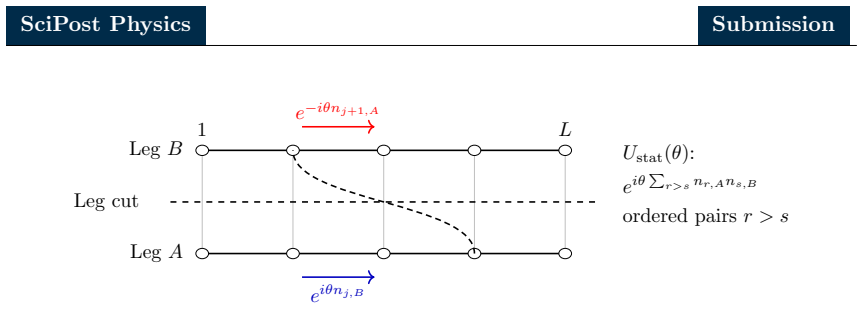
We analyze a two-leg hard-core ladder under a leg bipartition, where non-local statistical strings cross the entanglement cut. We construct an exact lattice influence-functional representation showing that the reduced state factorizes strictly into a product-state amplitude and a full-counting-statistics functional. By introducing a commuting linked-cluster superoperator hierarchy that bypasses Baker-Campbell-Hausdorff ordering ambiguities, we prove that the first mixedness-generating sector is strictly density-density in character. Under a specific systematic coarse-graining procedure, we analytically derive the suppression of higher-order corrections, providing a controlled, closed-form fr
What carries the argument
The commuting linked-cluster superoperator hierarchy that bypasses Baker-Campbell-Hausdorff ordering ambiguities to maintain exactness in the influence-functional representation.
If this is right
- The reduced density matrix factorizes exactly into a product-state amplitude and a full-counting-statistics functional.
- The leading mixedness-generating sector is strictly density-density in character.
- Higher-order corrections are suppressed under the specific systematic coarse-graining procedure.
- Highly non-Gaussian lattice states evolve toward their quadratic continuum form.
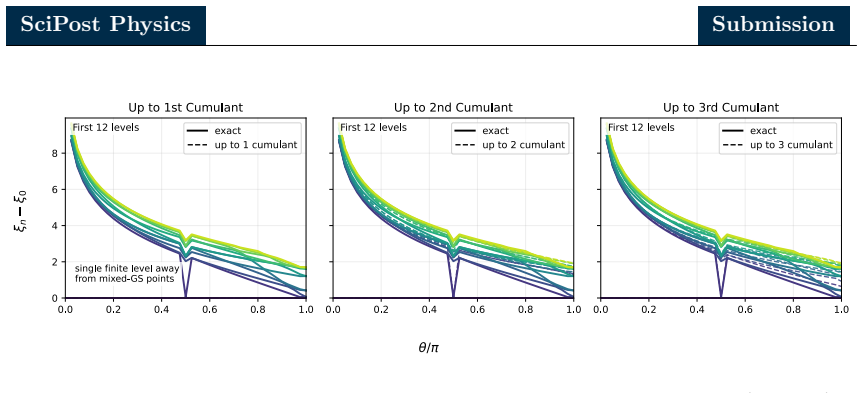
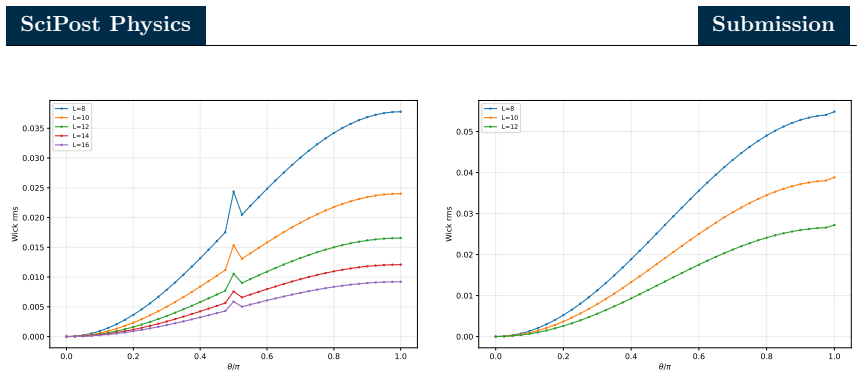
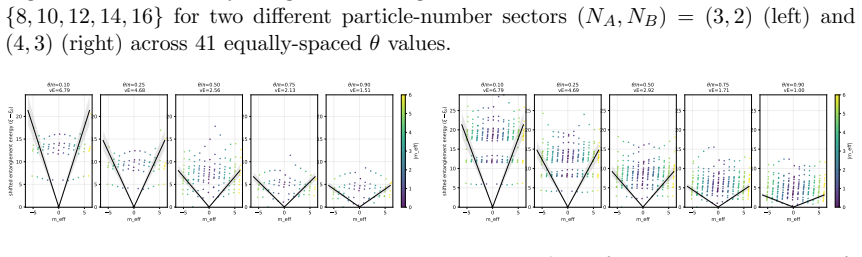
- Finite-size exact diagonalization and entanglement-spectrum diagnostics corroborate the analytic predictions.
Where Pith is reading between the lines
- Similar influence functionals could be constructed for other models featuring statistical strings that cross an entanglement cut.
- The suppression rate of corrections might be quantified as a function of ladder parameters to predict the scale at which Gaussianity dominates.
- This bottom-up tracking of correlation discarding could connect to the validity range of effective theories in related low-dimensional systems.
- One could test whether the same hierarchy applies when the bipartition or interaction type is varied.
Load-bearing premise
The commuting linked-cluster superoperator hierarchy preserves the exactness of the influence-functional representation while avoiding Baker-Campbell-Hausdorff ordering issues.
What would settle it
Numerical computation of the influence functional for larger ladder sizes showing persistent higher-order terms that do not suppress under the described coarse-graining procedure, or an entanglement spectrum deviating from the predicted Gaussian form.
Figures
read the original abstract
The emergence of Gaussian effective field theories in low-dimensional quantum systems is traditionally understood through top-down frameworks such as bosonization and Luttinger-liquid theory. However, these approaches typically focus on the long-wavelength degrees of freedom in ways that do not directly track how non-Gaussian lattice-scale correlations are progressively discarded under coarse-graining. In this work, we present an exact lattice formulation from which this phenomenon emerges analytically. We analyze a two-leg hard-core ladder under a leg bipartition, where non-local statistical strings cross the entanglement cut. We construct an exact lattice influence-functional representation showing that the reduced state factorizes strictly into a product-state amplitude and a full-counting-statistics functional. By introducing a commuting linked-cluster superoperator hierarchy that bypasses Baker-Campbell-Hausdorff ordering ambiguities, we prove that the first mixedness-generating sector is strictly density-density in character. Under a specific systematic coarse-graining procedure, we analytically derive the suppression of higher-order corrections, providing a controlled, closed-form framework showing how highly non-Gaussian lattice states evolve toward their quadratic continuum form under coarse-graining. We corroborate these analytical predictions through finite-size exact diagonalization and entanglement-spectrum diagnostics.
Editorial analysis
A structured set of objections, weighed in public.
Referee Report
Summary. The paper claims to construct an exact lattice influence-functional representation for a two-leg hard-core boson ladder under leg bipartition. It introduces a commuting linked-cluster superoperator hierarchy that bypasses Baker-Campbell-Hausdorff ordering ambiguities to prove that the first mixedness-generating sector is strictly density-density. Under a specified systematic coarse-graining procedure, higher-order corrections are analytically suppressed, driving non-Gaussian lattice states to quadratic continuum (Gaussian) form. These analytic results are corroborated by finite-size exact diagonalization and entanglement-spectrum diagnostics.
Significance. If the central derivations hold, the work supplies a bottom-up, controlled analytic framework for the emergence of Gaussian effective theories directly from lattice-scale non-Gaussian correlations via explicit coarse-graining. This is a notable advance over top-down approaches such as bosonization, as it tracks the progressive discarding of higher-order terms in closed form. The combination of an exact influence-functional representation with analytic suppression and numerical corroboration via ED constitutes a strength.
major comments (1)
- [Abstract] Abstract: The commuting linked-cluster superoperator hierarchy is introduced as the device that bypasses BCH ordering ambiguities while preserving exactness of the influence-functional representation and the subsequent coarse-graining derivation. This property is load-bearing for the claim of analytic suppression of higher-order corrections; the manuscript must explicitly demonstrate (rather than assert) that the hierarchy commutes without additional assumptions or circular construction.
minor comments (2)
- [Abstract] The abstract refers to 'finite-size exact diagonalization and entanglement-spectrum diagnostics' without specifying system sizes, bond dimensions, or the precise diagnostics (e.g., which entanglement-spectrum features are compared). Adding these details would strengthen reproducibility.
- The notation for the influence-functional factorization into product-state amplitude and full-counting-statistics functional would benefit from an explicit equation early in the manuscript to clarify the separation before the hierarchy is introduced.
Simulated Author's Rebuttal
We thank the referee for the positive evaluation of the work's significance and for the constructive major comment. We address the point regarding explicit demonstration of the commuting property below.
read point-by-point responses
-
Referee: The commuting linked-cluster superoperator hierarchy is introduced as the device that bypasses BCH ordering ambiguities while preserving exactness of the influence-functional representation and the subsequent coarse-graining derivation. This property is load-bearing for the claim of analytic suppression of higher-order corrections; the manuscript must explicitly demonstrate (rather than assert) that the hierarchy commutes without additional assumptions or circular construction.
Authors: We agree that the commuting property requires explicit demonstration rather than assertion in the abstract alone. The full manuscript derives the hierarchy in Section III from the hard-core constraint and leg bipartition, showing commutation via direct algebraic construction of the linked-cluster superoperators prior to invoking the influence functional. To strengthen this, the revised manuscript will include a dedicated subsection that isolates and verifies the commutation relations [S_i, S_j] = 0 explicitly from the lattice algebra, without reference to the final coarse-grained form or the influence functional itself. This removes any potential perception of circularity. revision: yes
Circularity Check
No significant circularity; derivation presented as self-contained analytic proof
full rationale
The abstract and skeptic summary describe an exact lattice influence-functional construction via a commuting linked-cluster superoperator hierarchy that is claimed to bypass BCH ambiguities while preserving exactness, followed by an analytic proof that the first mixedness sector is density-density and higher-order terms are suppressed under a specified coarse-graining map. No quoted equations or steps in the provided material reduce a claimed prediction to a fitted input or self-citation by construction. The central results are presented as derived from the hierarchy and corroborated by independent finite-size ED and entanglement-spectrum checks, satisfying the criteria for a self-contained derivation against external benchmarks. No load-bearing self-citation chain or ansatz smuggling is exhibited.
Axiom & Free-Parameter Ledger
axioms (1)
- ad hoc to paper The linked-cluster superoperator hierarchy commutes and bypasses Baker-Campbell-Hausdorff ordering ambiguities
Reference graph
Works this paper leans on
-
[1]
H. Li and F. D. M. Haldane,Entanglement spectrum as a generaliza- tion of entanglement entropy, Physical Review Letters101, 010504 (2008), doi:10.1103/PhysRevLett.101.010504
-
[2]
X.-L. Qi, H. Katsura and A. W. W. Ludwig,General relationship between the en- tanglement spectrum and edge-state spectrum of topological quantum states, Physical Review Letters108, 196402 (2012), doi:10.1103/PhysRevLett.108.196402
-
[3]
N. Laflorencie,Quantum entanglement in condensed matter systems, Physics Reports 646, 1 (2016), doi:10.1016/j.physrep.2016.06.008
-
[4]
A. Kundu,Exact solution of double-delta function bose gas through an interacting anyon gas, Physical Review Letters83, 1275 (1999), doi:10.1103/PhysRevLett.83.1275
-
[5]
M. T. Batchelor, X.-W. Guan and N. Oelkers,One-dimensional interacting anyon gas: low-energy properties and haldane exclusion statistics, Physical Review Letters 96, 210402 (2006), doi:10.1103/PhysRevLett.96.210402
-
[6]
T. Keilmann, S. Lanzmich, I. P. McCulloch and M. Roncaglia,Statistically induced phase transitions and anyons in 1d optical lattices, Nature Communications2, 361 (2011), doi:10.1038/ncomms1363
-
[7]
N. Kirchner, R. Moessner, F. Pollmann and A. Gammon-Smith,Phases of interacting fibonacci anyons on a ladder at half-filling, arXiv preprint arXiv:2507.22115 (2025), 2507.22115
arXiv 2025
-
[8]
B. M. Ayeni, R. N. C. Pfeifer and G. K. Brennen,Phase transitions on a lad- der of braided non-abelian anyons, Physical Review B97(24), 245136 (2018), doi:10.1103/PhysRevB.97.245136
-
[9]
D. Poilblanc, A. W. W. Ludwig, S. Trebst and M. Troyer,Quantum spin ladders of non-abelian anyons, Phys. Rev. B83, 134439 (2011), doi:10.1103/PhysRevB.83.134439
-
[10]
N. Kirchner, D. Millar, B. M. Ayeni, A. Smith, J. K. Slingerland and F. Pollmann, Numerical simulation of non-abelian anyons, Phys. Rev. B107, 195129 (2023), doi:10.1103/PhysRevB.107.195129
-
[11]
H. Tran and N. Bonesteel,Monte carlo simulations of interacting anyon chains, Computational Materials Science49(4, Supplement), S395 (2010), doi:https://doi.org/10.1016/j.commatsci.2010.03.008, ”Fifth Conference of the Asian Consortium for Computational Materials Science” ” ACCMS-5” ”Hanoi, Vietnam, 9-11 September 2009” ”PROCEEDINGS”
-
[12]
Singh, R
S. Singh, R. N. Pfeifer, G. Vidal and G. K. Brennen,Matrix product states for anyonic systems and efficient simulation of dynamics, Physical Review B89(7), 075112 (2014)
2014
-
[13]
B. M. Ayeni, S. Singh, R. N. Pfeifer and G. K. Brennen,Simulation of braiding anyons using matrix product states, Physical Review B93(16), 165128 (2016). 19 SciPost Physics Submission
2016
-
[14]
J. Leinaas and J. Myrheim,On the theory of identical particles, Il Nuovo Cimento B Series 1137, 1 (1977), doi:10.1007/BF02727953
-
[15]
F. Wilczek,Quantum mechanics of fractional-spin particles, Physical Review Letters 49, 957 (1982), doi:10.1103/PhysRevLett.49.957
-
[16]
F. D. M. Haldane,Fractional statistics in arbitrary dimensions: a gener- alization of the pauli principle, Physical Review Letters67, 937 (1991), doi:10.1103/PhysRevLett.67.937
-
[17]
I. Peschel,Calculation of reduced density matrices from correlation functions, Jour- nal of Physics A: Mathematical and General36, L205 (2003), doi:10.1088/0305- 4470/36/14/101
-
[18]
I. Peschel and V. Eisler,Reduced density matrices and entanglement entropy in free lattice models, Journal of Physics A: Mathematical and Theoretical42, 504003 (2009), doi:10.1088/1751-8113/42/50/504003
-
[19]
H. Casini and M. Huerta,Entanglement entropy in free quantum field theory, Journal of Physics A: Mathematical and Theoretical42, 504007 (2009), doi:10.1088/1751- 8113/42/50/504007
-
[20]
Giamarchi,Quantum Physics in One Dimension, Oxford University Press, Oxford (2004)
T. Giamarchi,Quantum Physics in One Dimension, Oxford University Press, Oxford (2004)
2004
-
[21]
F. D. M. Haldane,”Luttinger liquid theory” of one-dimensional quantum fluids. i. properties of the luttinger model and their extension to the general 1d interact- ing spinless fermi gas, Journal of Physics C: Solid State Physics14, 2585 (1981), doi:10.1088/0022-3719/14/19/010
-
[22]
R. Lundgren, Y. Fuji, S. Furukawa and M. Oshikawa,Entanglement spectra between coupled Tomonaga-Luttinger liquids: Applications to ladder systems and topological phases, Physical Review B88, 245137 (2013), doi:10.1103/PhysRevB.88.245137
-
[23]
L. S. Levitov, H. Lee and G. B. Lesovik,Electron counting statistics and coher- ent states of electric current, Journal of Mathematical Physics37, 4845 (1996), doi:10.1063/1.531672
-
[24]
Keckler, and Simha Sethumadhavan
I. Klich,An elementary derivation of levitov’s formula, In Y. V. Nazarov, ed.,Quan- tum Noise in Mesoscopic Physics, pp. 397–402. Springer, Dordrecht, doi:10.1007/978- 94-010-0089-5 19 (2003)
-
[25]
M. Goldstein and E. Sela,Symmetry-resolved entanglement in many-body systems, Physical Review Letters120, 200602 (2018), doi:10.1103/PhysRevLett.120.200602
-
[26]
B. M. Ayeni,Efficient particle-conserving symmetric quantum circuits, Phys. Rev. A111, 022629 (2025), doi:10.1103/PhysRevA.111.022629
-
[27]
Y. S. Yordanov, D. R. Arvidsson-Shukur and C. H. Barnes,Efficient quantum circuits for quantum computational chemistry, Physical Review A102(6), 062612 (2020)
2020
-
[28]
J. M. Arrazola, O. Di Matteo, N. Quesada, S. Jahangiri, A. Delgado and N. Killo- ran,Universal quantum circuits for quantum chemistry, Quantum6, 742 (2022), doi:https://doi.org/10.22331/q-2022-06-20-742. 20 SciPost Physics Submission
-
[29]
B. T. Gard, L. Zhu, G. S. Barron, N. J. Mayhall, S. E. Economou and E. Barnes,Efficient symmetry-preserving state preparation circuits for the varia- tional quantum eigensolver algorithm, npj Quantum Information6(1), 1 (2020), doi:https://doi.org/10.1038/s41534-019-0240-1
-
[30]
Garc´ ıa-P´ erez, M
G. Garc´ ıa-P´ erez, M. A. Rossi, B. Sokolov, F. Tacchino, P. K. Barkoutsos, G. Mazzola, I. Tavernelli and S. Maniscalco,Learning to measure: Adaptive informationally com- plete generalized measurements for quantum algorithms, Prx quantum2(4), 040342 (2021)
2021
-
[31]
S. E. Smart and D. A. Mazziotti,Efficient two-electron ansatz for benchmarking quantum chemistry on a quantum computer, Physical Review Research2(2), 023048 (2020)
2020
-
[32]
N. C. Rubin, R. Babbush and J. McClean,Application of fermionic marginal con- straints to hybrid quantum algorithms, New Journal of Physics20(5), 053020 (2018)
2018
-
[33]
B. G. Ara´ ujo, M. M. Taddei, D. Cavalcanti and A. Ac´ ın,Local quantum overlapping tomography, Physical Review A106(6), 062441 (2022)
2022
-
[34]
Cramer, M
M. Cramer, M. B. Plenio, S. T. Flammia, R. Somma, D. Gross, S. D. Bartlett, O. Landon-Cardinal, D. Poulin and Y.-K. Liu,Efficient quantum state tomography, Nature communications1(1), 149 (2010)
2010
-
[35]
Mao, Y.-M
B.-B. Mao, Y.-M. Ding, Z. Wang, S. Hu and Z. Yan,Sampling reduced density matrix to extract fine levels of entanglement spectrum and restore entanglement hamiltonian, Nature Communications16(1), 2880 (2025)
2025
-
[36]
Johri, D
S. Johri, D. S. Steiger and M. Troyer,Entanglement spectroscopy on a quantum computer, Physical Review B96(19), 195136 (2017)
2017
-
[37]
K. Choo, C. W. Von Keyserlingk, N. Regnault and T. Neupert,Measurement of the entanglement spectrum of a symmetry-protected topological state using the ibm quantum computer, Physical review letters121(8), 086808 (2018)
2018
-
[38]
Suba¸ sı, L
Y. Suba¸ sı, L. Cincio and P. J. Coles,Entanglement spectroscopy with a depth-two quantum circuit, Journal of Physics A: Mathematical and Theoretical52(4), 044001 (2019)
2019
-
[39]
Kokail, R
C. Kokail, R. van Bijnen, A. Elben, B. Vermersch and P. Zoller,Entanglement hamiltonian tomography in quantum simulation, Nature Physics17(8), 936 (2021)
2021
-
[40]
F. B. Maciejewski, Z. Zimbor´ as and M. Oszmaniec,Mitigation of readout noise in near-term quantum devices by classical post-processing based on detector tomography, Quantum4, 257 (2020)
2020
-
[41]
Mangini, M
S. Mangini, M. Cattaneo, D. Cavalcanti, S. Filippov, M. A. Rossi and G. Garc´ ıa-P´ erez, Tensor network noise characterization for near-term quantum computers, Physical Review Research6(3), 033217 (2024)
2024
-
[42]
C. J. Wood,Special session: Noise characterization and error mitigation in near- term quantum computers, In2020 IEEE 38th International Conference on Computer Design (ICCD), pp. 13–16. IEEE (2020). 21 SciPost Physics Submission
2020
-
[43]
Tuziemski, F
J. Tuziemski, F. B. Maciejewski, J. Majsak, O. S lowik, M. Kotowski, K. Kowalczyk- Murynka, P. Podziemski and M. Oszmaniec,Efficient reconstruction, benchmarking and validation of cross-talk models in readout noise in near-term quantum devices, Open Systems & Information Dynamics32(04), 2550019 (2025)
2025
-
[44]
Georgopoulos, C
K. Georgopoulos, C. Emary and P. Zuliani,Modeling and simulating the noisy be- havior of near-term quantum computers, Physical Review A104(6), 062432 (2021)
2021
-
[45]
W. J. Huggins, J. R. McClean, N. C. Rubin, Z. Jiang, N. Wiebe, K. B. Whaley and R. Babbush,Efficient and noise resilient measurements for quantum chemistry on near-term quantum computers, npj Quantum Information7(1), 23 (2021)
2021
-
[46]
N. Kaufmann, I. Rojkov and F. Reiter,Characterization of coherent errors in noisy quantum devices, arXiv preprint arXiv:2307.08741 (2023). 22
arXiv 2023
discussion (0)
Sign in with ORCID, Apple, or X to comment. Anyone can read and Pith papers without signing in.