REVIEW 4 major objections 5 minor 14 references
Technical Report for Argoverse2 Scenario Mining Challenges on Iterative Error Correction and Spatially-Aware Prompting
T0 review · 4 major / 5 minor · reviewed 2026-08-07 · deepseek-v4-flash
Pith's one-line read The paper claims that re-prompting an LLM with runtime error messages and clarifying spatial-relation arguments lifts the reliability and semantic accuracy of generated scenario-mining code, reaching a HOTA-Temporal of 52.37 on the…
desk verdict The FT-ICG/EP-SRF results on Argoverse 2 are plausible, but the paper's own methods section contradicts its central claim of 'without manual intervention,' which sinks the result as reported. read the letter →
The pith
A machine-rendered reading of the paper's core claim, the machinery that carries it, and where it could break.
The reading
What carries the argument
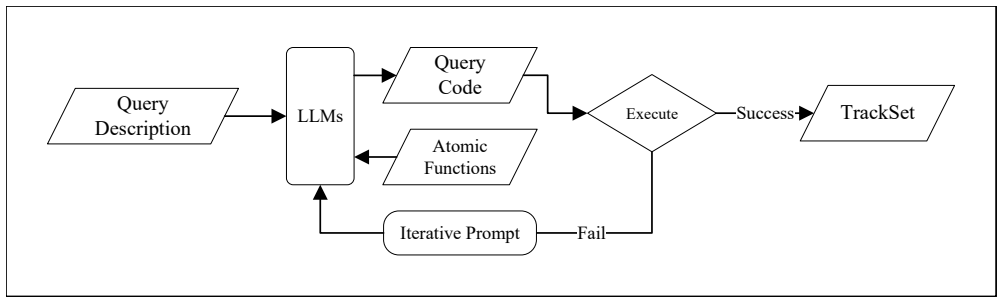
The load-bearing machinery is a generate-execute-catch loop paired with a clarification block. In FT-ICG, the LLM receives the natural-language query plus a description of the atomic function library, its generated code is executed inside a try/except, and whenever Python raises a runtime error the error message is appended to the prompt with a request to avoid runtime errors, driving a fresh generation attempt up to K=5 iterations; when five automatic retries are exceeded, the authors report that they manually edit the generated code. EP-SRF supplies a separate instruction: for functions such as `has objects in relative direction()`, the direction parameter specifies the orientation of the related candidates relative to the track candidates, while `facing toward()` and `heading toward()` mean the track candidates are oriented toward the related candidates. These two mechanisms do different work — the loop restores syntactic and runtime validity, and the prompt block restores semantic role assignment — which is why the paper frames them as complementary.
What would settle it
Re-run the pipeline on a fixed sample of Argoverse 2 queries many times with different random seeds and sampling temperatures, and count how many queries exceed K=5 and get manually edited; if the spread of HOTA-Temporal across runs is comparable to the roughly 1-to-3-point gains attributed to each mechanism, or if a nontrivial share of the reported test score comes from manually edited outputs, the attribution of the gain to FT-ICG and EP-SRF collapses.
Extended reading notes
Core claim
The central finding is that an error-correcting loop and a spatial-semantics prompt both move the metrics, and the two effects stack. Across three LLMs (Qwen2.5-VL-7B, Gemini 2.5 Flash, and Gemini 2.5 Pro), adding FT-ICG to the RefAV baseline raises HOTA-Temporal on the validation set, and adding EP-SRF on top raises it further, with the full Gemini 2.5 Pro configuration reaching 46.71 HOTA-Temporal on validation and 52.37 on the official test set, alongside HOTA 51.53, Timestamp F1 77.48, and Log F1 65.82. The authors interpret the higher test number as generalization, and their conclusion asserts that the methods 'deliver state-of-the-art HOTA-Temporal scores without manual intervention.'
Load-bearing premise
The result stands on the assumption that the measured differences come from the two mechanisms and not from random variation between runs or from the human code edits that the method says happen when automatic retries exceed five; the report gives one score per configuration and does not report seeds, repeated runs, or how many queries were edited by hand.
Editorial extensions
If this is right
- The error-feedback loop should transfer to any LLM-code task where an executor can return an error message, including other scientific computing and domain-query settings.
- The spatial-role clarification block should generalize to other function libraries where LLMs are prone to swapping the subject and reference arguments, such as geometric or database APIs.
- Because Gemini 2.5 Pro still gains from both additions, the benefit is not limited to small or weak models; prompt-level scaffolding is complementary to model scale.
- If the test-set result holds, LLM-based scenario mining shifts from a research demo to a practical tool for mining safety-critical driving scenes at scale.
Reading between the lines
- The paper leaves implicit that its 'without manual intervention' claim is conditional: Algorithm 1 caps automatic retries at K=5, and the implementation details say the authors then edit the code by hand; reporting the fraction of queries that hit this limit would make the automation claim measurable.
- The validation-to-test jump of roughly 5.7 HOTA-Temporal points is attributed to distribution shift, but the report does not isolate an alternative explanation: test queries may have been more likely to receive manual edits because the escape hatch is documented, and a per-query manual-edit log would settle which explanation is right.
- Because no temperature, seed, or repeated-run statistics are given, a direct next experiment is to rerun the best configuration several times and report mean and standard deviation; if the standard deviation is comparable to the single-mechanism gains, the ablation ordering is best read as provisional.
Editorial analysis
A structured set of objections, weighed in public.
Referee Report
Summary. This technical report proposes two enhancements to the RefAV LLM-based scenario-mining pipeline: (1) a fault-tolerant iterative code-generation mechanism (FT-ICG) that re-prompts the LLM with runtime error feedback up to K=5 times, and (2) an enhanced prompting strategy for spatial relational functions (EP-SRF) that clarifies the argument semantics of functions such as has_objects_in_relative_direction() and facing_toward(). The authors evaluate these enhancements on the Argoverse 2 validation set with Qwen2.5-VL-7B, Gemini 2.5 Flash, and Gemini 2.5 Pro, reporting consistent improvements in HOTA-Temporal, HOTA, Timestamp F1, and Log F1 over the RefAV baseline. The combined method with Gemini 2.5 Pro is reported to achieve a test-set HOTA-Temporal score of 52.37. The conclusion states that the methods 'deliver state-of-the-art HOTA-Temporal scores without manual intervention.'
Significance. The problem addressed is practical, and the proposed heuristics are simple, model-agnostic, and mechanistically plausible; the use of an external benchmark and the inclusion of ablations across three LLMs are clear strengths of the work. If the reported gains were robust and reproducible, the contribution would be a useful incremental improvement for LLM-based scenario mining. However, the claims as stated are undermined by a direct contradiction in the implementation description—manual editing is allowed as a fallback when automatic retries fail—and by the absence of statistical variability, code release, or comparisons to other challenge submissions. The current evidence does not support the stated 'without manual intervention' or 'state-of-the-art' conclusions.
major comments (4)
- [Section 3.1 (Implementation Details) vs. Section 4 (Conclusion)] The conclusion in Section 4 claims the methods 'deliver state-of-the-art HOTA-Temporal scores without manual intervention,' but Section 3.1 states that 'if the number of iterations of the fault tolerance mechanism exceeds the K value, we manually edit the generated code, manually modify the reported errors, and fill in the correct track candidates, related candidates, and direction parameters.' The reported test-set score of 52.37 (Table 1) is obtained from this full pipeline, so the paper must disclose the fraction of queries that required manual fallback and provide results with and without manual edits. Without this disclosure, the central automation claim is not supported by the reported experiments.
- [Section 3.2 (Ablation Studies), Table 1] The manual fallback described in Section 3.1 includes 'fill in the correct track candidates, related candidates, and direction parameters,' which is precisely the class of semantic errors that EP-SRF is intended to prevent. The ablation comparison between '+ FT-ICG' and '+ FT-ICG + EP-SRF' is therefore confounded: the gains attributed to EP-SRF could partly reflect manual corrections made during the evaluation of the FT-ICG-only configuration. Please report the frequency of manual fallback in each ablation condition, or disable the fallback in the ablation runs.
- [Section 3.1, Table 1] The paper reports a single score per configuration with no statement of the number of independent runs, the sampling temperature, or any variance measure. LLM-based code generation is generally stochastic, and the reported improvements (e.g., HOTA-Temporal gains of 1.44 for Qwen2.5-VL-7B and 2.13 for Gemini 2.5 Pro) could be within run-to-run noise. Please provide multiple runs with mean and standard deviation, or at minimum a determinism setting (e.g., temperature=0) and a clear statement of how many executions were averaged.
- [Section 4 (Conclusion)] The claim of 'state-of-the-art' HOTA-Temporal scores is not substantiated because the paper compares only against the RefAV baseline; no comparison is made to other entries in the Argoverse 2 Scenario Mining Challenge or to other published methods. To support this claim, the authors should either cite and compare with the challenge leaderboard or qualifying their conclusion to 'improvement over the RefAV baseline.'
minor comments (5)
- [Abstract] The phrase 'HOTA -Temporal' has a spurious space; it should read 'HOTA-Temporal.'
- [Section 2.2, Figure 1] Figure 1 (the FT-ICG flowchart) is not referenced anywhere in the text; please add an in-text citation.
- [Section 3.1] The capitalization of 'ArgoVerse2' is inconsistent; the standard name is 'Argoverse 2'.
- [Section 3.2] The phrase 'This performance is significantly higher than the validation set results' uses 'significantly' without a statistical test; please rephrase to avoid implying statistical significance.
- [General] No code, prompts, or configuration files are released, which limits reproducibility; even a minimal public repository with the prompt templates would be helpful.
Circularity Check
No circularity: the paper is an empirical benchmark evaluation with hand-crafted heuristics, and the reported HOTA-Temporal scores are not derived from or fitted to the inputs.
full rationale
This technical report presents an empirical evaluation on the external Argoverse 2 scenario-mining benchmark. The two proposed techniques—FT-ICG (iterative re-prompting with runtime-error feedback) and EP-SRF (prompt instructions clarifying spatial-relation function parameters)—are described as procedural/system-level modifications to an LLM code-generation pipeline. There is no mathematical derivation, no fitted equation, and no parameter estimated from the HOTA-Temporal score itself. The reported 52.37 test-set score is an externally evaluated benchmark result, not a quantity manufactured from the method's definitions. The paper does cite prior work, including RefAV [2] as the baseline and one prior paper by co-author Greer [4], but those citations are not load-bearing for the numerical results; [4] appears only as a pointer to 'alternative latent representations' in the future-work paragraph. The most serious concern is not circularity but attribution: Section 3.1 states that when automatic retries exceed K=5, 'we manually edit the generated code, manually modify the reported errors, and fill in the correct track candidates, related candidates, and direction parameters,' which conflicts with the Conclusion's claim of results 'without manual intervention.' That is a reproducibility and validity concern about whether the reported gains come from the described automated system or from human engineering, and it is not disclosed how often the fallback was used. However, this is not a circularity pattern enumerated in the review criteria: the manual edits are external human intervention, not a hidden reuse of the target metric inside the method's definition. No equation or algorithm step is defined in terms of the benchmark outcome, no fitted parameter is renamed as a prediction, and no self-citation chain is used to force the result. Therefore the appropriate circularity score is 0, with the manual-fallback issue flagged as a separate experimental-validity risk rather than a circularity.
Assumptions & free parameters
free parameters (1)
- Maximum iterations K for FT-ICG =
5
assumptions (3)
- domain assumption HOTA-Temporal is the appropriate primary metric for scenario mining on Argoverse 2.
- domain assumption The Le3DE2D tracks obtained from the official LT3D method are accurate enough for the reported evaluations.
- domain assumption The RefAV baseline and its atomic function library are correct and available as described in the cited work.
Cite this review
Pith. "Pith review of Technical Report for Argoverse2 Scenario Mining Challenges on Iterative Error Correction and Spatially-Aware Prompting." pith.science (2026). https://pith.science/paper/TIRT2I24
@misc{pith2026250611124,
  author       = {Pith},
  title        = {Pith review of: Technical Report for Argoverse2 Scenario Mining Challenges on Iterative Error Correction and Spatially-Aware Prompting},
  year         = {2026},
  howpublished = {\url{https://pith.science/paper/TIRT2I24}},
  note         = {Machine review of arXiv:2506.11124}
}
read the original abstract
Scenario mining from extensive autonomous driving datasets, such as Argoverse 2, is crucial for the development and validation of self-driving systems. The RefAV framework represents a promising approach by employing Large Language Models (LLMs) to translate natural-language queries into executable code for identifying relevant scenarios. However, this method faces challenges, including runtime errors stemming from LLM-generated code and inaccuracies in interpreting parameters for functions that describe complex multi-object spatial relationships. This technical report introduces two key enhancements to address these limitations: (1) a fault-tolerant iterative code-generation mechanism that refines code by re-prompting the LLM with error feedback, and (2) specialized prompt engineering that improves the LLM's comprehension and correct application of spatial-relationship functions. Experiments on the Argoverse 2 validation set with diverse LLMs-Qwen2.5-VL-7B, Gemini 2.5 Flash, and Gemini 2.5 Pro-show consistent gains across multiple metrics; most notably, the proposed system achieves a HOTA-Temporal score of 52.37 on the official test set using Gemini 2.5 Pro. These results underline the efficacy of the proposed techniques for reliable, high-precision scenario mining.
Figures
Reference graph
Works this paper leans on
-
[1]
Qwen2.5- vl technical report, 2025
Shuai Bai, Keqin Chen, Xuejing Liu, Jialin Wang, Wenbin Ge, Sibo Song, Kai Dang, Peng Wang, Shijie Wang, Jun Tang, Humen Zhong, Yuanzhi Zhu, Mingkun Yang, Zhaohai Li, Jianqiang Wan, Pengfei Wang, Wei Ding, Zheren Fu, Yiheng Xu, Jiabo Ye, Xi Zhang, Tianbao Xie, Zesen Cheng, Hang Zhang, Zhibo Yang, Haiyang Xu, and Junyang Lin. Qwen2.5- vl technical report, 2025. 3
work page 2025
-
[2]
Refav: Towards planning-centric scenario mining
Cainan Davidson, Deva Ramanan, and Neehar Peri. Refav: Towards planning-centric scenario mining. arXiv preprint arXiv:2505.20981, 2025. 1
arXiv 2025
-
[3]
Real-world scenario mining for the assessment of automated vehicles
Erwin de Gelder, Jeroen Manders, Corrado Grappiolo, Jan- Pieter Paardekooper, Olaf Op den Camp, and Bart De Schutter. Real-world scenario mining for the assessment of automated vehicles. In 2020 IEEE 23rd International Conference on Intelligent Transportation Systems (ITSC), page 1–8. IEEE,
work page 2020
-
[4]
Ross Greer and Mohan Trivedi. Towards explainable, safe autonomous driving with language embeddings for novelty identification and active learning: Framework and experi- mental analysis with real-world data sets. arXiv preprint arXiv:2402.07320, 2024. 4
arXiv 2024
-
[5]
Language-driven active learning for diverse open-set 3d object detection
Ross Greer, Bjørk Antoniussen, Andreas Møgelmose, and Mohan Trivedi. Language-driven active learning for diverse open-set 3d object detection. In Proceedings of the Winter Conference on Applications of Computer Vision, pages 980– 988, 2025. 1
work page 2025
-
[6]
Scal- able active learning for object detection
Elmar Haussmann, Michele Fenzi, Kashyap Chitta, Jan Iva- necky, Hanson Xu, Donna Roy, Akshita Mittel, Nicolas Koumchatzky, Clement Farabet, and Jose M Alvarez. Scal- able active learning for object detection. In 2020 IEEE intelli- gent vehicles symposium (iv), pages 1430–1435. IEEE, 2020. 1
work page 2020
-
[7]
Aryan Keskar, Srinivasa Perisetla, and Ross Greer. Evaluating multimodal vision-language model prompting strategies for visual question answering in road scene understanding. In Proceedings of the Winter Conference on Applications of Computer Vision, pages 1027–1036, 2025. 1
work page 2025
-
[8]
The dawn after the dark: An empirical study on factuality hallucination in large lan- guage models
Junyi Li, Jie Chen, Ruiyang Ren, Xiaoxue Cheng, Xin Zhao, Jian-Yun Nie, and Ji-Rong Wen. The dawn after the dark: An empirical study on factuality hallucination in large lan- guage models. In Proceedings of the 62nd Annual Meeting of the Association for Computational Linguistics (Volume 1: Long Papers), pages 10879–10899, Bangkok, Thailand, 2024. Associat...
work page 2024
Show all 14 references
-
[9]
Hota: A higher order metric for evaluating multi-object tracking
Jonathon Luiten, Aljoša Ošep, Patrick Dendorfer, Philip Torr, Andreas Geiger, Laura Leal-Taixé, and Bastian Leibe. Hota: A higher order metric for evaluating multi-object tracking. International Journal of Computer Vision, 129(2):548–578,
-
[10]
Towards long-tailed 3d detection, 2023
Neehar Peri, Achal Dave, Deva Ramanan, and Shu Kong. Towards long-tailed 3d detection, 2023. 3
2023
-
[11]
A survey of hallucination in large foundation models, 2023
Vipula Rawte, Amit Sheth, and Amitava Das. A survey of hallucination in large foundation models, 2023. 2
2023
-
[12]
Gemini Team, Rohan Anil, Sebastian Borgeaud, Jean- Baptiste Alayrac, Jiahui Yu, Radu Soricut, Johan Schalkwyk, Andrew M. Dai, Anja Hauth, Katie Millican, David Silver, Melvin Johnson, Ioannis Antonoglou, Julian Schrittwieser, Amelia Glaese, Jilin Chen, Emily Pitler, Timothy Li...
2025
-
[13]
Scenario mining for development of predictive safety functions
Hiroki Watanabe, Lukas Tobisch, Julia Rost, Johannes Wall- ner, and Günther Prokop. Scenario mining for development of predictive safety functions. In 2019 IEEE International Con- ference on Vehicular Electronics and Safety (ICVES), pages 1–7, 2019. 1
2019
-
[14]
Argoverse 2: Next generation datasets for self-driving perception and fore- casting, 2023
Benjamin Wilson, William Qi, Tanmay Agarwal, John Lam- bert, Jagjeet Singh, Siddhesh Khandelwal, Bowen Pan, Rat- nesh Kumar, Andrew Hartnett, Jhony Kaesemodel Pontes, Deva Ramanan, Peter Carr, and James Hays. Argoverse 2: Next generation datasets for self-driving perception an...
2023
Reviewed August 7, 2026 · model on record in the stance chip above.
Discussion (0). Sign in to comment.