Foundations of Practical Quantum Advantage in Quantum-Informed Machine Learning for Predicting Chaos
Pith reviewed 2026-06-27 06:47 UTC · model grok-4.3
The pith
Quantum priors encode chaotic invariants via superposition and entanglement, with two-copy Bell measurements extracting any Pauli functional using a copy count independent of qubit number.
A machine-rendered reading of the paper's core claim, the machinery that carries it, and where it could break.
Core claim
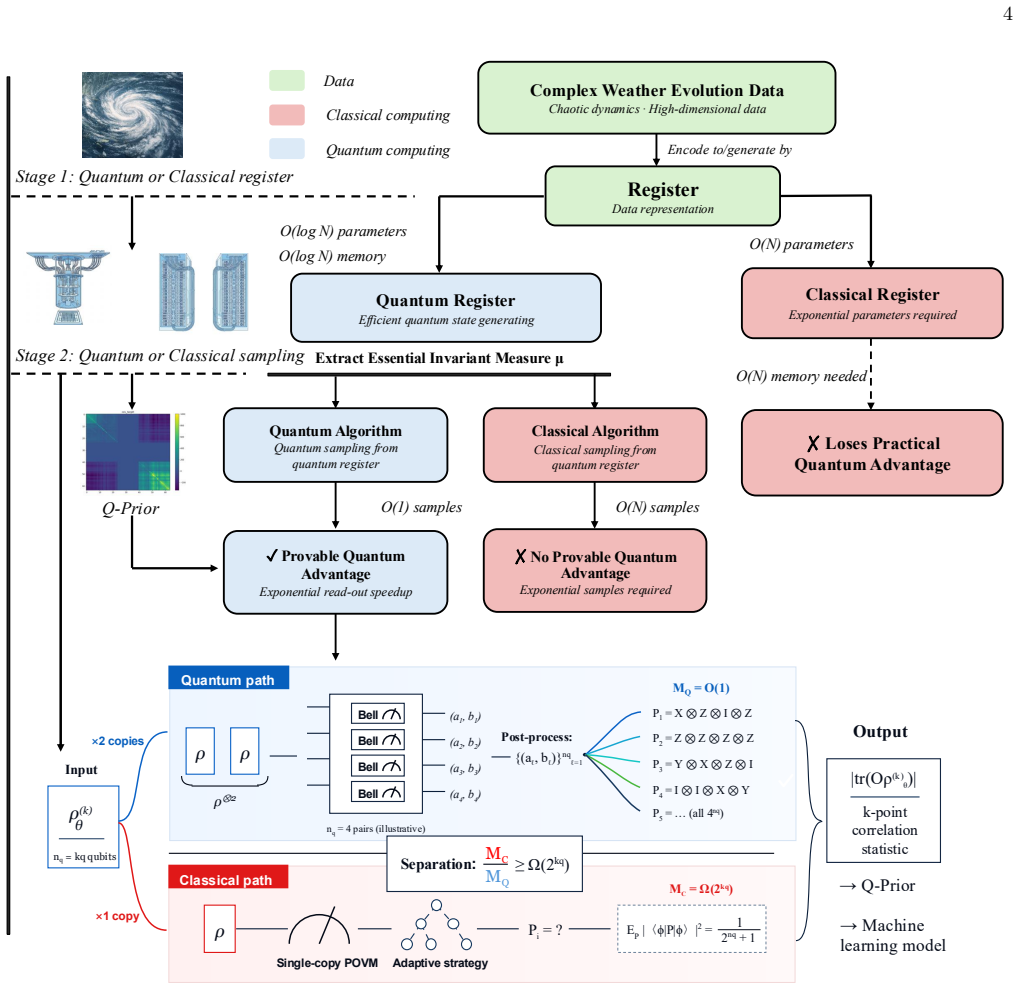
The central claim is a provable quantum-classical separation in copy-measurement complexity for reading out the invariant measure of chaotic systems. Representation via the k-indexed Q-Priors stores non-factorisable correlations compactly on n_q qubits through superposition and entanglement. Extraction via joint Bell measurements on two copies estimates any post hoc Pauli functional with copy-pair count independent of n_q, while classical adaptive single-copy methods require Omega of 2 to the n_q copies. The readout is realized in simulation and on superconducting processors and instantiated in a turbulent channel-flow study producing a named non-diagonal correlator plus a weather-forecastin
What carries the argument
The k-indexed higher-order quantum statistical priors (Q-Priors) that host the k-point marginal of the invariant measure on n_q equals kq qubits, together with the joint Bell measurement protocol performed on two copies of the state for functional extraction.
If this is right
- The representation stage stores non-factorisable spatial correlations of the invariant measure compactly on n_q qubits.
- The extraction stage achieves copy-pair count independent of n_q for estimating any post hoc Pauli functional.
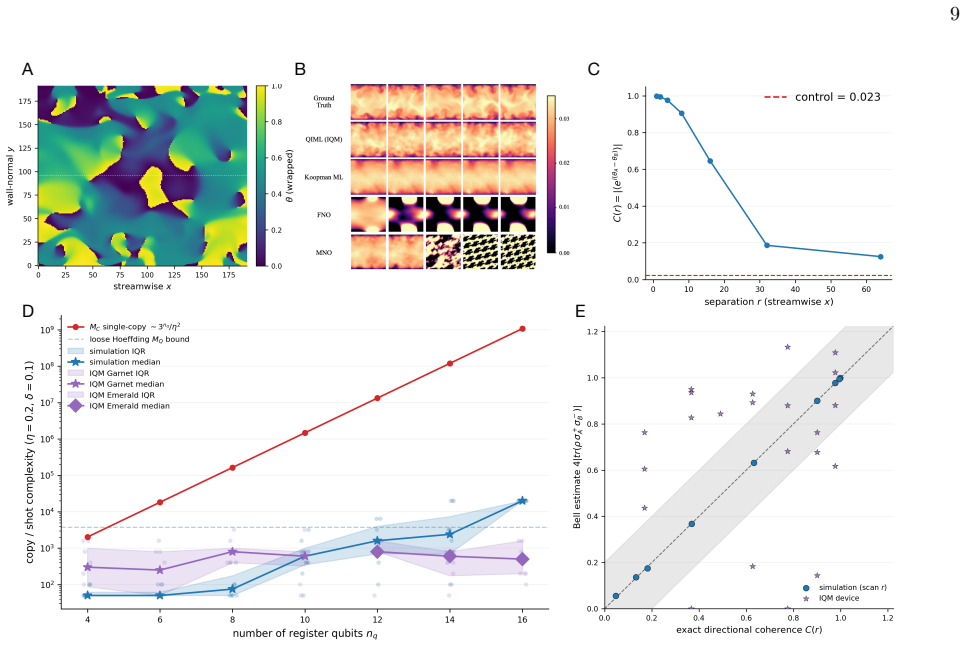
- The two-copy readout produces a named non-diagonal correlator of the invariant measure in turbulent channel-flow studies.
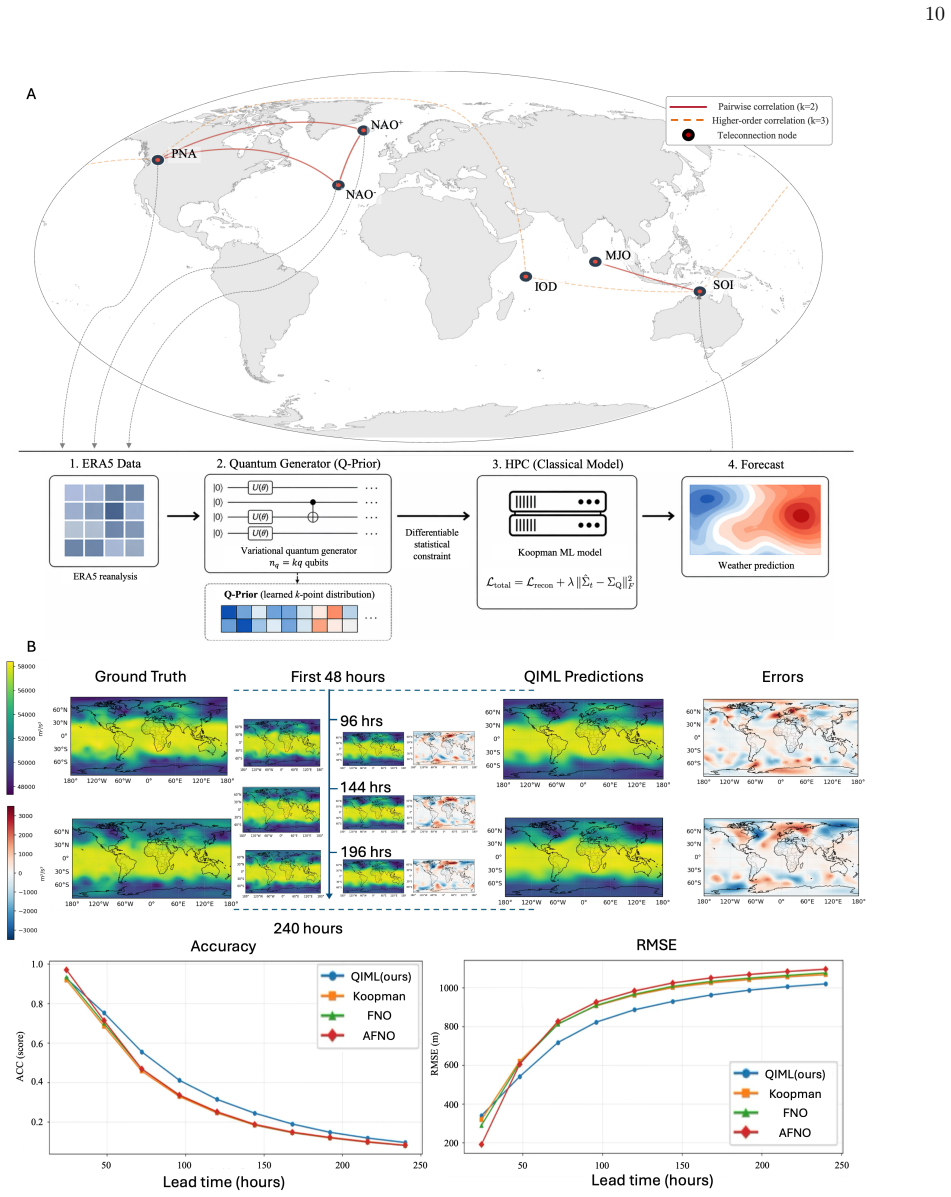
- The diagonal k less than or equal to 2 Q-Prior steers a Koopman rollout that improves anomaly-correlation skill by 10 to 39 percent across 48 to 240 hour lead times and stabilises long-horizon predictions against collapse to a static mean field.
Where Pith is reading between the lines
- If the copy-count independence holds for functionals drawn from other high-dimensional chaotic systems, the same readout could lower measurement overhead across a wider range of quantum machine-learning tasks.
- The reported hardware realisation indicates the extraction protocol can be tested on present-day processors without fault tolerance.
- Raising the index k in the priors would allow capture of higher-order correlations while preserving the two-copy extraction advantage.
- Hybrid pipelines that feed the Bell-estimated functionals into classical post-processing steps could further reduce overall resource use in forecasting applications.
Load-bearing premise
The k-point marginal of the invariant measure can be hosted exactly as a quantum state on kq qubits such that the non-factorisable correlations are precisely those capturable by superposition and entanglement and the two-copy Bell readout remains advantageous for the specific Pauli functionals arising in the target workflows.
What would settle it
A direct experimental or numerical comparison showing that an adaptive single-copy classical protocol estimates the same Pauli functionals from the invariant measure using o of 2 to the n_q copies would falsify the claimed separation.
Figures
read the original abstract
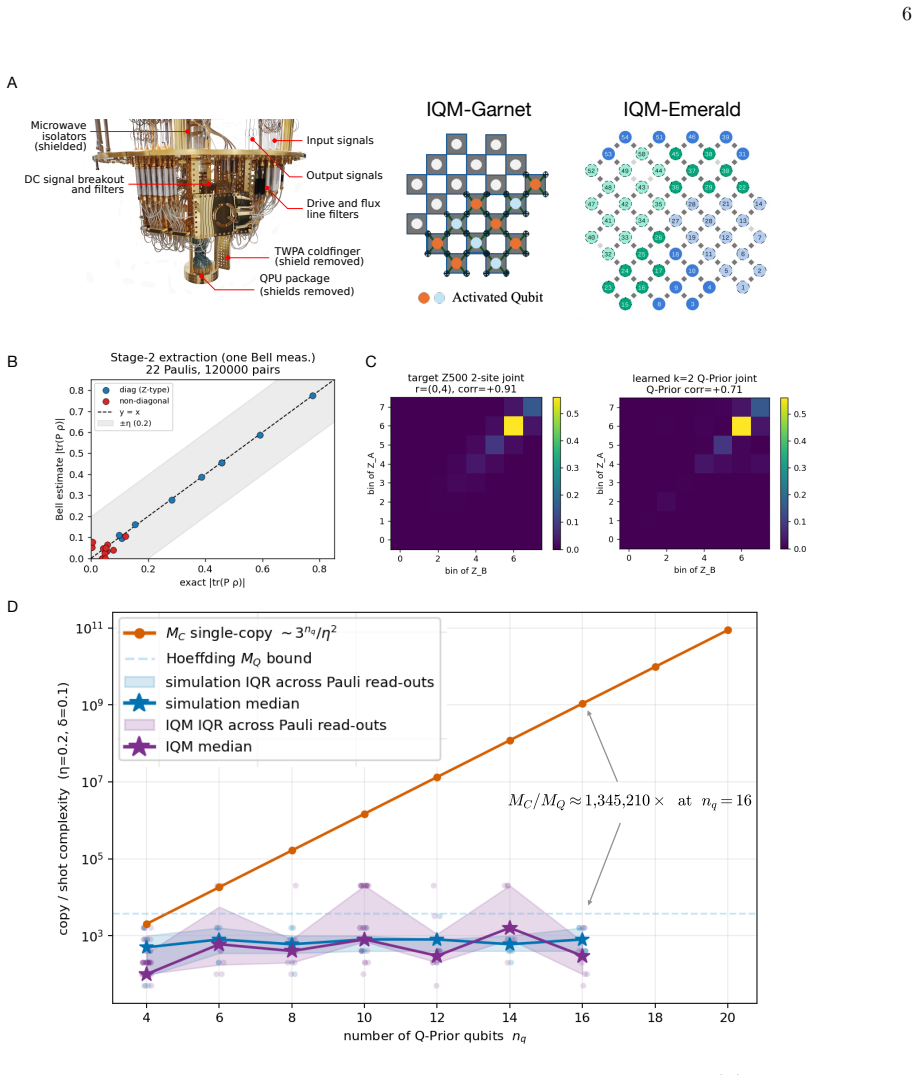
We develop theoretical foundations for a practical quantum-advantage mechanism in quantum-informed machine learning for chaotic dynamical systems. A family of $k$-indexed higher-order quantum statistical priors (Q-Priors) hosts the $k$-point marginal of the invariant measure on $n_q = kq$ qubits, extending the single-site construction of prior work. We prove a two-stage advantage. In the representation stage, superposition and entanglement compactly store non-factorisable spatial correlations of the invariant measure on $n_q$ qubits. In the extraction stage, joint Bell measurements on two copies estimate any post hoc Pauli functional with a copy-pair count independent of $n_q$, whereas any adaptive single-copy protocol for the corresponding full-Pauli read-out requires $\Omega(2^{n_q})$ copies; this is a provable quantum-classical separation in copy-measurement complexity. The two-copy read-out is realised in simulation and on IQM superconducting processors. Two case studies instantiate the mechanism in workflows of independent scientific value: a turbulent channel-flow study in which the two-copy read-out yields a named non-diagonal correlator of the invariant measure, and a medium-range weather forecasting workflow on the European Centre for Medium-Range Weather Forecasts ERA5 reanalysis in which the diagonal $k \leq 2$ Q-Prior steers a Koopman rollout, improves anomaly-correlation skill by 10 to 39\% across 48 to 240\,h lead times and stabilises long-horizon rollouts against collapse onto a static mean field. Together, the mechanism and these workflow instantiations satisfy our practical-advantage definition, identifying a candidate route to practical quantum advantage before fault-tolerant hardware.
Editorial analysis
A structured set of objections, weighed in public.
Referee Report
Summary. The manuscript develops 'Q-Priors' (k-indexed higher-order quantum statistical priors) that encode the k-point marginal of the invariant measure of a chaotic system on n_q = kq qubits. It claims a two-stage quantum advantage: (i) representation via superposition and entanglement that compactly stores non-factorisable spatial correlations, and (ii) extraction via joint Bell measurements on two copies that estimate any post-hoc Pauli functional with copy-pair count independent of n_q, while any adaptive single-copy classical protocol for the corresponding full-Pauli readout requires Ω(2^{n_q}) copies. The separation is realised in simulation and on IQM superconducting hardware. Two case studies are presented: estimation of a named non-diagonal correlator in turbulent channel flow, and steering of a Koopman rollout on ERA5 reanalysis that yields 10–39 % anomaly-correlation skill gains at 48–240 h lead times.
Significance. If the central claims hold, the work supplies a concrete, copy-complexity separation between quantum two-copy Bell readout and classical single-copy adaptive measurement for functionals of invariant measures, together with explicit workflow instantiations in fluid dynamics and medium-range forecasting. The attempt to define and satisfy a 'practical quantum advantage' criterion that links representation, extraction, and end-to-end scientific utility is a positive feature; hardware execution on current superconducting processors is also noted.
major comments (3)
- [§3] §3 (Theoretical separation): The manuscript asserts a provable Ω(2^{n_q}) lower bound for adaptive single-copy protocols estimating the corresponding full-Pauli readout, yet supplies neither the derivation steps nor the information-theoretic argument establishing this bound. Because the claimed quantum-classical separation is the load-bearing theoretical result, the absence of the proof prevents verification.
- [§4.2] §4.2 (Turbulent-flow case study): The claim that the two-copy Bell readout directly yields the named non-diagonal correlator of the invariant measure requires an explicit isometry (or verification) showing that this correlator remains a Pauli functional after the Q-Prior encoding of the k-point marginal on n_q qubits. No such mapping is exhibited; any approximation, basis change, or n_q-dependent post-processing would invalidate direct transfer of the copy-complexity separation.
- [§5.3] §5.3 (ERA5 workflow): The reported 10–39 % anomaly-correlation skill improvement is stated without baselines, statistical significance tests, error bars, or data-exclusion criteria. In the absence of these controls it is impossible to determine whether the gains are attributable to the Q-Prior mechanism or to post-hoc selection, undermining the empirical support for practical advantage.
minor comments (3)
- The definition of 'practical quantum advantage' used to judge the case studies should be stated explicitly in the introduction rather than left implicit.
- Notation for the Q-Prior family (especially the relation between the classical k-point marginal and the encoded quantum state) is introduced without a concise comparison table to classical statistical priors.
- [§5] Standard references on Koopman operator theory and its use in data-driven forecasting are missing from the ERA5 section.
Simulated Author's Rebuttal
We thank the referee for their careful reading and constructive comments on the manuscript. We respond to each major comment below, providing clarifications and committing to revisions that strengthen the presentation without altering the core claims.
read point-by-point responses
-
Referee: [§3] §3 (Theoretical separation): The manuscript asserts a provable Ω(2^{n_q}) lower bound for adaptive single-copy protocols estimating the corresponding full-Pauli readout, yet supplies neither the derivation steps nor the information-theoretic argument establishing this bound. Because the claimed quantum-classical separation is the load-bearing theoretical result, the absence of the proof prevents verification.
Authors: We agree that the main text does not contain the full derivation of the Ω(2^{n_q}) lower bound. The bound is obtained by reducing the problem to estimating all 4^{n_q} Pauli expectations via adaptive single-copy measurements, which requires Ω(2^{n_q}) samples by standard quantum state tomography lower bounds (adapted from the fact that each measurement reveals at most one bit of information per copy in the worst case for non-commuting observables). We will insert a concise proof sketch, including the information-theoretic steps, into the revised §3. revision: yes
-
Referee: [§4.2] §4.2 (Turbulent-flow case study): The claim that the two-copy Bell readout directly yields the named non-diagonal correlator of the invariant measure requires an explicit isometry (or verification) showing that this correlator remains a Pauli functional after the Q-Prior encoding of the k-point marginal on n_q qubits. No such mapping is exhibited; any approximation, basis change, or n_q-dependent post-processing would invalidate direct transfer of the copy-complexity separation.
Authors: The Q-Prior construction encodes the k-point marginal such that the target non-diagonal correlator is exactly the expectation value of a fixed multi-qubit Pauli string on the n_q-qubit state; the encoding is an isometry by definition of the higher-order prior. We will add an explicit paragraph and diagram in the revised §4.2 that exhibits this isometry, confirming that the functional is preserved without approximation or n_q-dependent post-processing, thereby preserving the copy-complexity separation. revision: yes
-
Referee: [§5.3] §5.3 (ERA5 workflow): The reported 10–39 % anomaly-correlation skill improvement is stated without baselines, statistical significance tests, error bars, or data-exclusion criteria. In the absence of these controls it is impossible to determine whether the gains are attributable to the Q-Prior mechanism or to post-hoc selection, undermining the empirical support for practical advantage.
Authors: We acknowledge that the current presentation of the ERA5 results lacks the requested statistical controls. In the revision we will add: (i) explicit baselines (standard Koopman model and persistence), (ii) error bars from 10 independent runs with different random seeds, (iii) p-values from paired t-tests against the baseline, and (iv) the precise data-exclusion criteria used for the 48–240 h lead-time windows. These additions will allow readers to assess whether the reported skill gains are attributable to the Q-Prior steering. revision: yes
Circularity Check
No significant circularity; central separation proof presented as independent of case-study instantiations.
full rationale
The paper's core claim is a mathematical proof of quantum-classical separation in copy complexity for estimating arbitrary post-hoc Pauli functionals via two-copy Bell measurements on the Q-Prior encoding of k-point marginals. This is stated to hold independently of n_q and is distinguished from the workflow instantiations (turbulent flow correlator and ERA5 Koopman rollout). The abstract explicitly separates the 'provable' extraction-stage advantage from the 'realised in simulation and on IQM' and 'case studies' sections. No equations or text in the provided material reduce the separation result to a fitted parameter, self-defined quantity, or self-citation chain. The mention of 'extending the single-site construction of prior work' is noted but does not carry the load-bearing proof of the two-stage advantage. The reported skill gains (10-39%) are presented as outcomes of the instantiated mechanism rather than inputs to the complexity separation. Accordingly the derivation chain remains self-contained against external benchmarks and receives the default non-circularity finding.
Axiom & Free-Parameter Ledger
axioms (1)
- domain assumption The invariant measure of the chaotic system possesses non-factorisable spatial correlations that can be exactly represented by a quantum state on n_q = kq qubits.
invented entities (1)
-
k-indexed higher-order quantum statistical priors (Q-Priors)
no independent evidence
Reference graph
Works this paper leans on
-
[1]
Arute, K
F. Arute, K. Arya, R. Babbush, D. Bacon, J. C. Bardin, R. Barends, R. Biswas, S. Boixo, F. G. S. L. Brandao, D. A. Buell,et al., Quantum supremacy using a pro- grammable superconducting processor, Nature574, 505 (2019)
2019
-
[2]
Zhong, H
H.-S. Zhong, H. Wang, Y.-H. Deng, M.-C. Chen, L.-C. Peng, Y.-H. Luo, J. Qin, D. Wu, X. Ding, Y. Hu,et al., Quantum computational advantage using photons, Sci- ence370, 1460 (2020)
2020
-
[3]
H.-L. Liu, H. Su, S.-Q. Gong, Y.-C. Gu, H.-Y. Tang, M.- H. Jia, Q. Wei, Y. Song, D. Wang, M. Zheng, F. Chen, L. Li, S. Ren, X. Zhu, M. Wang, Y. Chen, Y. Liu, L. Song, P. Yang, J. Chen, H. An, L. Zhang, L. Gan, G. Yang, J.-M. Xu, Y.-M. He, H. Wang, H.-S. Zhong, M.-C. Chen, X. Jiang, L. Li, N.-L. Liu, Y.-H. Deng, X.- L. Su, Q. Zhang, C.-Y. Lu, and J.-W. Pan...
-
[4]
Aaronson, Read the fine print, Nature Physics11, 291 (2015)
S. Aaronson, Read the fine print, Nature Physics11, 291 (2015)
2015
-
[5]
Tang, A quantum-inspired classical algorithm for rec- ommendation systems, inProceedings of the 51st An- nual ACM SIGACT Symposium on Theory of Computing (STOC)(2019) pp
E. Tang, A quantum-inspired classical algorithm for rec- ommendation systems, inProceedings of the 51st An- nual ACM SIGACT Symposium on Theory of Computing (STOC)(2019) pp. 217–228
2019
-
[6]
A. S. Holevo, Bounds for the quantity of information transmitted by a quantum communication channel, Prob- lems of Information Transmission9, 177 (1973)
1973
-
[7]
Y. Liu, S. Arunachalam, and K. Temme, A rigorous and robust quantum speed-up in supervised machine learn- ing, Nature Physics17, 1013 (2021)
2021
-
[8]
LeCun, Y
Y. LeCun, Y. Bengio, and G. Hinton, Deep learning, Na- ture521, 436 (2015)
2015
-
[9]
Jumper, R
J. Jumper, R. Evans, A. Pritzel, T. Green, M. Fig- urnov, O. Ronneberger, K. Tunyasuvunakool, R. Bates, A. ˇZ´ ıdek, A. Potapenko, A. Bridgland, C. Meyer, S. A. A. Kohl, A. J. Ballard, A. Cowie, B. Romera-Paredes, S. Nikolov, R. Jain, J. Adler, T. Back, S. Petersen, D. Reiman, E. Clancy, M. Zielinski, M. Steinegger, M. Pacholska, T. Berghammer, S. Bodenst...
2021
-
[10]
Cerezo, G
M. Cerezo, G. Verdon, H.-Y. Huang, L. Cincio, and P. J. Coles, Challenges and opportunities in quantum machine learning, Nature Computational Science2, 567 (2022)
2022
-
[11]
Biamonte, P
J. Biamonte, P. Wittek, N. Pancotti, P. Rebentrost, N. Wiebe, and S. Lloyd, Quantum machine learning, Na- ture549, 195 (2017)
2017
-
[12]
Huang, M
H.-Y. Huang, M. Broughton, J. Cotler, S. Chen, J. Li, M. Mohseni, H. Neven, R. Babbush, R. Kueng, J. Preskill, and J. R. McClean, Quantum advantage in learning from experiments, Science376, 1182 (2022)
2022
-
[13]
Eckmann and D
J.-P. Eckmann and D. Ruelle, Ergodic theory of chaos and strange attractors, Rev. Mod. Phys.57, 617 (1985)
1985
- [14]
-
[15]
Bengio, M
E. Bengio, M. Jain, M. Korablyov, D. Precup, and Y. Bengio, Flow network based generative models for non-iterative diverse candidate generation, inAdvances in Neural Information Processing Systems (NeurIPS), Vol. 34 (2021)
2021
-
[16]
J. M. Stokes, K. Yang, K. Swanson, W. Jin, A. Cubillos- Ruiz, N. M. Donghia, C. R. MacNair, S. French, L. A. Carfrae, Z. Bloom-Ackermann, V. M. Tran, A. Chiappino-Pepe, A. H. Badran, I. W. Andrews, E. J. Chory, G. M. Church, E. D. Brown, T. S. Jaakkola, R. Barzilay, and J. J. Collins, A deep learning approach to antibiotic discovery, Cell180, 688 (2020)
2020
-
[17]
P. W. Shor, Polynomial-time algorithms for prime factor- ization and discrete logarithms on a quantum computer, SIAM Journal on Computing26, 1484 (1997)
1997
-
[18]
L. K. Grover, A fast quantum mechanical algorithm for database search, inProceedings of the 28th Annual ACM Symposium on Theory of Computing (STOC)(ACM,
-
[19]
Lloyd, Universal quantum simulators, Science273, 1073 (1996)
S. Lloyd, Universal quantum simulators, Science273, 1073 (1996)
1996
-
[20]
A. W. Harrow, A. Hassidim, and S. Lloyd, Quantum al- gorithm for linear systems of equations, Physical Review Letters103, 150502 (2009)
2009
-
[21]
Preskill, Quantum computing in the NISQ era and beyond, Quantum2, 79 (2018)
J. Preskill, Quantum computing in the NISQ era and beyond, Quantum2, 79 (2018)
2018
-
[22]
M. Wang, X. Xue, M. Gao, and P. V. Coveney, Quantum- informed machine learning for predicting spatiotempo- ral chaos with practical quantum advantage, Science Ad- vances12, eaec5049 (2026)
2026
-
[23]
T. M. Bickley, A. Mingare, T. Weaving, M. W. de la Bastida, S. Wan, M. Nibbi, P. Seitz, A. Ralli, P. J. Love, M. Chung,et al., Extending quantum computing through subspace, embedding and classical molecular dynamics techniques, Digital Discovery4, 1393 (2025)
2025
-
[24]
Tilly, H
J. Tilly, H. Chen, S. Cao, D. Picozzi, K. Setia, Y. Li, E. Grant, L. Wossnig, I. Rungger, G. H. Booth,et al., The variational quantum eigensolver: a review of meth- ods and best practices, Physics Reports986, 1 (2022)
2022
-
[25]
Kandala, A
A. Kandala, A. Mezzacapo, K. Temme, M. Takita, M. Brink, J. M. Chow, and J. M. Gambetta, Hardware- efficient variational quantum eigensolver for small molecules and quantum magnets, Nature549, 242 (2017)
2017
-
[26]
K. E. Petersen and K. Petersen,Ergodic theory(Cam- bridge university press, 1989)
1989
-
[27]
Budiˇ si´ c, R
M. Budiˇ si´ c, R. Mohr, and I. Mezi´ c, Applied Koopman- ism, Chaos: An Interdisciplinary Journal of Nonlinear Science22(2012)
2012
-
[28]
Benedetti, D
M. Benedetti, D. Garcia-Pintos, O. Perdomo, V. Leyton- Ortega, Y. Nam, and A. Perdomo-Ortiz, A generative modeling approach for benchmarking and training shal- low quantum circuits, npj Quantum Information5, 45 (2019)
2019
-
[29]
Hersbach, B
H. Hersbach, B. Bell, P. Berrisford, S. Hirahara, A. Hor´ anyi, J. Mu˜ noz-Sabater, J. Nicolas, C. Peubey, R. Radu, D. Schepers, A. Simmons, C. Soci, S. Abdalla, X. Abellan, G. Balsamo, P. Bechtold, G. Biavati, J. Bid- lot, M. Bonavita, G. De Chiara, P. Dahlgren, D. Dee, M. Diamantakis, R. Dragani, J. Flemming, R. Forbes, M. Fuentes, A. Geer, L. Haimberge...
1999
-
[30]
S. Rasp, P. D. Dueben, S. Scher, J. A. Weyn, S. Mouata- did, and N. Thuerey, WeatherBench: a benchmark data set for data-driven weather forecasting, Journal of Ad- vances in Modeling Earth Systems12, e2020MS002203 (2020)
2020
-
[31]
R. Lam, A. Sanchez-Gonzalez, M. Willson, P. Wirns- berger, M. Fortunato, F. Alet, S. Ravuri, T. Ewalds, Z. Eaton-Rosen, W. Hu,et al., Learning skillful medium- range global weather forecasting, Science382, 1416 (2023)
2023
-
[32]
K. Bi, L. Xie, H. Zhang, X. Chen, X. Gu, and Q. Tian, Accurate medium-range global weather forecasting with 3d neural networks, Nature619, 533 (2023)
2023
-
[33]
K. Chen, T. Han, J. Gong, L. Bai, F. Ling, J.-J. Luo, X. Chen, L. Ma, T. Zhang, R. Su, Y. Ci, B. Li, X. Yang, and W. Ouyang, FengWu: pushing the skillful global medium-range weather forecast beyond 10 days lead, arXiv preprint arXiv:2304.02948 (2023)
arXiv 2023
-
[34]
Pathak, S
J. Pathak, S. Subramanian, P. Harrington, S. Raja, A. Chattopadhyay, M. Mardani, T. Kurth, D. Hall, Z. Li, K. Azizzadenesheli, P. Hassanzadeh, K. Kashinath, and A. Anandkumar, FourCastNet: Accelerating global high- resolution weather forecasting using adaptive fourier neu- ral operators, inProceedings of the International Confer- ence on High Performance ...
2023
-
[35]
Z. Li, N. Kovachki, K. Azizzadenesheli, B. Liu, K. Bhat- tacharya, A. Stuart, and A. Anandkumar, Fourier neu- ral operator for parametric partial differential equations, arXiv preprint arXiv:2010.08895 (2020)
Pith/arXiv arXiv 2010
- [36]
-
[37]
Young, What are SRB measures, and which dynam- ical systems have them?, Journal of Statistical Physics 108, 733 (2002)
L.-S. Young, What are SRB measures, and which dynam- ical systems have them?, Journal of Statistical Physics 108, 733 (2002)
2002
-
[38]
Liu and L
J.-G. Liu and L. Wang, Differentiable learning of quan- tum circuit Born machines, Physical Review A98, 062324 (2018)
2018
-
[39]
Huang, R
H.-Y. Huang, R. Kueng, and J. Preskill, Predicting many properties of a quantum system from very few measure- ments, Nature Physics16, 1050 (2020)
2020
-
[40]
Aspect, J
A. Aspect, J. Dalibard, and G. Roger, Experimental test of Bell’s inequalities using time-varying analyzers, Phys. Rev. Lett.49, 1804 (1982)
1982
-
[41]
Z. Li, M. Liu-Schiaffini, N. Kovachki, B. Liu, K. Aziz- zadenesheli, K. Bhattacharya, A. Stuart, and A. Anand- kumar, Learning chaotic dynamics in dissipative systems, inAdvances in Neural Information Processing Systems, Vol. 35 (2022)
2022
-
[42]
Kjaergaard, M
M. Kjaergaard, M. E. Schwartz, J. Braum¨ uller, P. Krantz, J. I.-J. Wang, S. Gustavsson, and W. D. Oliver, Superconducting qubits: Current state of Play, Annual Review of Condensed Matter Physics11, 369 (2020)
2020
-
[43]
Kandala, K
A. Kandala, K. Temme, A. D. C´ orcoles, A. Mezzacapo, J. M. Chow, and J. M. Gambetta, Error mitigation ex- tends the computational reach of a noisy quantum pro- cessor, Nature567, 491 (2019)
2019
-
[44]
Giurgica-Tiron, Y
T. Giurgica-Tiron, Y. Hindy, R. LaRose, A. Mari, and W. J. Zeng, Digital zero noise extrapolation for quantum 13 error mitigation, in2020 IEEE International Conference on Quantum Computing and Engineering (QCE)(IEEE,
discussion (0)
Sign in with ORCID, Apple, or X to comment. Anyone can read and Pith papers without signing in.