REVIEW 3 major objections 4 minor 69 references
Quantum Measurement, Entanglement and the Warping Mechanism of Human Perception
T0 review · 3 major / 4 minor · reviewed 2026-08-16 · deepseek-v4-flash
Pith's one-line read A quantum measurement intrinsically contains the warping mechanism of categorical perception.
desk verdict Careful math, but the advertised theorem is false: the warping is location-dependent, not category-dependent, so the paper proves a smaller and less interesting statement than it claims. read the letter →
The pith
A machine-rendered reading of the paper's core claim, the machinery that carries it, and where it could break.
The reading
What carries the argument
The load-bearing mechanism is the extended Bloch model of quantum measurement, in which a measurement is an elastic stretched between two diametrically opposite outcome states and the state of the system is a ball on the Bloch sphere. The first stage of measurement, decoherence, projects the ball orthogonally onto the elastic, turning a pure state on the surface into a mixed density state in the interior; the second stage, collapse, breaks the elastic and sends the ball to one of the two outcomes. The warping appears in the metric change between these two stages: pure states are measured by the Fubini–Study arc length on the sphere's surface, while the decohered percept states are measured by the trace-class distance inside the sphere, which for a qubit is half the Euclidean distance. The same decohered states also arise as the partial trace of the entangled state of the measured system and the measurement device, so the warping is tied to entanglement with the measuring context.
What would settle it
Take the three light/dark stimuli at polar angles $0$, $\pi/3$, and $2\pi/3$ on a perceptual continuum, collect human similarity ratings after a categorization response, and compare the two pairs. The paper's geometry predicts that the same-category pair $0$–$\pi/3$ shrinks from $1/3$ to $1/4$ of maximal distance while the cross-category pair $\pi/3$–$2\pi/3$ grows from $1/3$ to $1/2$; observing roughly equal perceived distances for the two pairs (a ratio near $1$ instead of $2$) would rule out the claimed mechanism.
Extended reading notes
Core claim
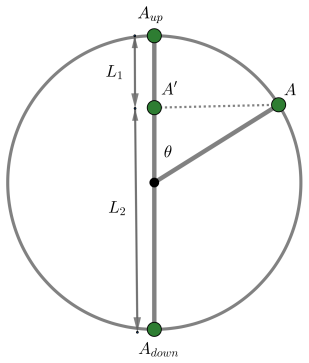
The central claim is that a quantum measurement, described in the extended Bloch model, warps distances in exactly the manner of categorical perception. The measurement is represented by an elastic stretched between two antipodal eigenstates, here the Light and Dark outcomes; the initial pure state falls orthogonally onto the elastic and decoheres to a mixed state on the axis, and only then does the elastic break and select an outcome. The paper identifies the proper distance for pure states as the Fubini–Study arc distance $\gamma(\psi_1,\psi_2)=\arccos|\langle\psi_1|\psi_2\rangle|$ and the proper distance for the decohered density states as the trace distance. For the qubit with polar angles $0$, $\pi/3$, and $2\pi/3$, the stimulus distances between the pairs $0$–$\pi/3$ and $\pi/3$–$2\pi/3$ are both $1/3$ of the maximum; after decoherence the same-category pair $0$–$\pi/3$ sits at distance $1/4$ (contraction), while the cross-category pair $\pi/3$–$2\pi/3$ sits at distance $1/2$ (dilation). The paper concludes that the warping mechanism of categorical perception is structurally present in quantum collapse.
Load-bearing premise
The argument stands or falls on treating the decohered mixed state that exists just before the final collapse as the percept, and on measuring perceptual similarity by the trace distance between those mixed states. If what a person consciously perceives is instead the final collapsed pure state, the contraction and dilation are not there to observe.
Editorial extensions
If this is right
- Any model that represents a decision as a quantum measurement will automatically include categorical-perception-like distortion: stimuli closer to a category center are pulled together, and stimuli on opposite sides of a boundary are pushed apart, without adding a separate psychological parameter.
- The light/dark qubit yields sharp quantitative predictions: at polar angles $0$, $\pi/3$, and $2\pi/3$, the perceived distance ratio for same-category versus cross-category pairs is $3/4$ versus $3/2$ of the original stimulus spacing, a testable signature.
- Because the percept states are the partial traces of the entangled system-plus-device state, the warping is present before the final collapse; category structure is not created by the outcome selection but by the coupling to the measurement context.
- Changing the measurement axis changes which pairs contract and dilate, so the same physical stimulus can fall into different categories when measured along a different axis; categories are contextual rather than intrinsic to the stimulus.
Reading between the lines
- The metric choice is doing the heavy lifting: if one measured stimulus distances with the trace distance on the sphere instead of the Fubini–Study arc, the contraction and dilation would disappear. A fair empirical test should first establish which metric human similarity follows.
- The same geometry suggests a general rule: for any pair of pure states whose shortest arc crosses the measurement equator, decoherence dilates the distance, while pairs entirely on one side contract. This implies category boundaries are properties of the measurement question, not of the stimuli alone, and could be probed by reorienting the categorization task.
- The paper's example could be turned into an experiment on a synthetic color continuum: collect pairwise similarity ratings before and after a Light/Dark naming task and check whether the ratio of within- to across-category distances approaches the predicted $3/4$ versus $3/2$; such an experiment is not reported in the paper.
Signed reviews
Editorial analysis
A structured set of objections, weighed in public.
Referee Report
Summary. The paper argues that the quantum measurement process, understood through the extended Bloch model, contains the warping mechanism of categorical perception. Pure states on the Bloch sphere play the role of stimuli, fully decohered pre-collapse density states play the role of percepts, and the passage from the Fubini–Study metric on pure states (Eq. 41) to the trace distance on decohered density states (Eq. 44) is claimed to contract within-category distances and dilate between-category distances. The manuscript develops the qubit measurement in detail, derives the Born probabilities and the partial-trace decoherence state A′, and illustrates the claimed effect with three states at polar angles π/3, 2π/3, and 0, with Light and Dark at the poles and the category boundary at the equator.
Significance. The individual mathematical steps are mostly correct and clearly presented: the Bloch-sphere derivation of the Born rule, the partial-trace calculation, and the numerical values in Figure 4 are accurate. The paper is also transparent in not fitting parameters to psychological data. However, the central claim—that the model reproduces the defining signature of categorical perception, with within-category distances contracted and between-category distances dilated—is false under the paper's own metrics. The warping is a location-dependent distortion, not a category-dependent one. A corrected version of the result would be a much weaker statement about the geometry of the Bloch sphere, rather than a proof that quantum measurement contains categorical perception.
major comments (3)
- [Section 4, Eqs. (41) and (44)] The claimed universal contraction/dilation is false. For two pure states with polar angles θ1 and θ2, the ratio of percept distance to stimulus distance under the paper's own metrics is R(θ1,θ2)=(π/2)|cosθ1−cosθ2|/|θ1−θ2|. This ratio depends on the location of the pair on the sphere, not on whether the pair crosses the category boundary at θ=π/2. For close pairs, R→(π/2)sinθ, which exceeds 1 for θ>arcsin(2/π)≈39.5°. Thus two states both in Light near the equator, for example θ1=0.4π and θ2=0.45π, have R≈1.53, so the percepts are more different than the stimuli, directly contradicting the abstract's statement that 'stimuli belonging to the same category are perceived as more similar.' Conversely, the between-category pair θ1=0 and θ2=π/2 has R=1, so it is not dilated at all. Section 4 therefore provides hand-picked examples, not the claimed general mechanism.
- [Section 4, Eq. (44)] The identification of the fully decohered pre-collapse mixed state A′ as the percept is an additional modeling assumption, not a consequence of quantum mechanics. If percepts are instead identified with the final collapsed pure states Aup and Adown, the trace distance between any two percepts is either 0 or 1, and no graded contraction or dilation occurs. Since the warping claim depends entirely on this identification, the paper needs either an empirical argument for the mixed-state percept or a derivation from a concrete psychological measurement scheme; neither is provided.
- [Section 3, decoherence and collapse discussion] The manuscript correctly distinguishes decoherence from collapse, noting that 'the collapse part of the measurement must still occur after the decoherence process.' Yet the categorical-perception analysis stops at the decohered state A′ and never uses the collapse. This means the claimed warping is produced by the first half of the measurement process only, so the title's and abstract's claim that the quantum measurement process (with its collapse) contains the warping mechanism is not supported by the derivation given.
minor comments (4)
- [Figure 4 caption and surrounding text] The caption says 'categorical reception' instead of 'categorical perception,' and the text contains typos such as 'respectiveky' after Eq. (47), 'asimuthal' in Section 4, and the heading 'Summery' before the summary of Section 3.
- [Eq. (35)] The displayed partial-trace calculation mixes tensor-product notation with matrix elements in a confusing way; for example, expressions such as ⟨up|up⟩⊗|0,φ⟩⟨0,φ| should be simplified to |0,φ⟩⟨0,φ| after tracing out the device. Please rewrite the formula with unambiguous matrix notation.
- [References] The reference list contains repeated typographical errors in author names, such as 'Collier at al.' and 'Medin at al.', and the entries for Rosch are inconsistent between 'Rosch' and 'Rosch Heider'; these should be standardized.
- [Eq. (42)] The quantity γ(ψ1,ψ2)=arccos|⟨ψ1|ψ2⟩| is the Fubini–Study angle, and the normalization by 1/π in Eq. (41) is an additional convention; please state explicitly that the normalized distance is the convention used throughout.
Circularity Check
No significant circularity: the warping is computed from standard Fubini-Study and trace metrics, and the extended-Bloch self-citations are not load-bearing for the central derivation.
full rationale
The claimed derivation is self-contained at the level of equations. Section 3 computes the decohered pre-collapse density state from the entangled measurement state via the partial trace (Eqs. (31), (34), (36)); no categorical-perception datum enters this calculation. Section 4 then defines stimulus distance by the Fubini-Study arc distance (Eqs. (41)-(42)) and percept distance by the normalized trace distance between the diagonal density matrices (Eq. (44)), both standard, independently motivated metrics. The contraction/dilation ratios in the Light/Dark example follow by direct substitution of theta = 0, pi/3, 2pi/3; no fitted parameters are used, and no quantity of the target phenomenon is inserted into the formulas. The self-citations to the extended Bloch model (Aerts 1986; Aerts & Sassoli de Bianchi 2014) and to the authors' earlier quantization proposal (Aerts and Aerts Arguelles 2022) motivate the framework, but the mathematical steps needed for the warping are re-derived in the paper and do not reduce to those citations. A scientific weakness remains: the claimed categorical warping is illustrated by two selected pairs, and the model's ratio R = (pi/2)|cos(theta1)-cos(theta2)|/|theta1-theta2| is location-dependent rather than category-dependent, so within-category pairs near the equator can be dilated rather than contracted. That is a correctness or overstatement concern, not a circularity, because the equations are not constructed to force the categorical conclusion. Hence the score reflects only minor, non-load-bearing self-citation.
Assumptions & free parameters
free parameters (2)
- Angles of the three example states =
θ_A=π/3, θ_B=2π/3, θ_C=0
- Normalisation constants of the two distance metrics =
1/π and 1/2
assumptions (4)
- domain assumption The extended Bloch model with a uniformly breaking elastic reproduces the Born probabilities of quantum mechanics
- ad hoc to paper Pure states represent stimuli and decohered mixed states represent percepts in a measurement
- ad hoc to paper The category boundary between Light and Dark sits at the equator of the Bloch sphere
- domain assumption Fubini-Study is the natural metric for pure states and trace distance for density states
Cite this review
Pith. "Pith review of Quantum Measurement, Entanglement and the Warping Mechanism of Human Perception." pith.science (2026). https://pith.science/paper/TJZTU7TT
@misc{pith2026250500777,
  author       = {Pith},
  title        = {Pith review of: Quantum Measurement, Entanglement and the Warping Mechanism of Human Perception},
  year         = {2026},
  howpublished = {\url{https://pith.science/paper/TJZTU7TT}},
  note         = {Machine review of arXiv:2505.00777}
}
read the original abstract
We prove that the quantum measurement process contains the same warping mechanism that occurs in categorical perception, a phenomenon ubiquitous in human perception. This warping causes stimuli belonging to the same category to be perceived as more similar, while stimuli belonging to different categories are perceived as more different. As a result of a detailed study of the quantum measurement using the Bloch representation, we identify the natural metric for pure states, namely the Fubini Study metric, and the natural metric for density states, namely the trace class metric. The warping mechanism of categorical perception is then manifested, when the distances between pure states, playing the role of stimuli for the quantum measurement, are warped into the distances between density states, playing the role of percepts for quantum measurement. We work out the example of a two-dimensional quantum model, a qubit, with 'light' and 'dark' as the two eigenstates, and show how the typical contraction and dilation warping of human perception manifest themselves in this example of the quantum measurement model of light and dark.
Figures


Figures from the paper (1 more)

Reference graph
Works this paper leans on
-
[1]
Aerts, D. (1982). Description of many physical entities without the paradoxes encountered in quantum mechanics. Foundations of Physics 12 , pp. 1131-1170. doi: 10.1007/BF00729621
-
[2]
Aerts, D. (1986). A possible explanation of the probabilities of quantum mechanics. Journal of Mathematical Physics 27 , pp. 202-210. doi: 10.1063/1.527362
-
[3]
Aerts, D. (1992). The construction of reality and its influence on the understanding of quantum structures. International Journal of Theoretical Physics 31 , pp. 1815-1837. doi: 10.1007/BF00678294
-
[4]
Aerts, D. (2009). Quantum structure in cognition. Journal of Mathematical Psychology 53 , pp. 314-348. doi: 10.1016/j.jmp.2009.04.005
-
[5]
Aerts, D. (2009). Quantum particles as conceptual entities: A possible explanatory framework for quantum theory. Foundations of Science 14 , pp. 361-411. doi: 10.1007/s10699-009-9166-y
-
[6]
Aerts, D. and Aerts, S. (1995). Applications of quantum statistics in psychological studies of decision processes. Foundations of Science 1 , pp. 85-97. doi: 10.1007/BF00208726
-
[7]
Aerts, D. and Aerts Argu\"elles, J. (2022). Human perception as a phenomenon of quantization. Entropy 24, 1207. doi: 10.3390/e24091207
-
[8]
Aerts, D. and Beltran, L. (2020). Quantum Structure in Cognition: Human Language as a Boson Gas of Entangled Words. Foundations of Science 25 , pp. 755-802. doi: 10.1007/s10699-019-09633-4
Show all 69 references
-
[9]
and Beltran, L
Aerts, D. and Beltran, L. (2022a). Are words the quanta of human language? Extending the domain of quantum cognition. Entropy 24 , 6. doi: 10.3390/e24010006
2022 doi
-
[10]
and Beltran, L
Aerts, D. and Beltran, L. (2022b). A Planck Radiation and Quantization Scheme for Human Cognition and Language. Frontiers in Psychology 13, 850725. doi: 10.3389/fpsyg.2022.850725
2022
-
[11]
and Veloz, T
Aerts, D., Broekaert, J., Gabora, L. and Veloz, T. (2012). The guppy effect as interference. Quantum Interaction. Lecture Notes in Computer Science 7620 , pp 36-47. doi: 10.1007/978-3-642-35659-9_4
2012 doi
-
[12]
Aerts, D and Gabora, L. (2005a). A theory of concepts and their combinations I: The structure of the sets of contexts and properties. Kybernetes 34 , pp. 167-191. doi: 10.1108/03684920510575799
2005 doi
-
[13]
Aerts, D and Gabora, L. (2005b). A theory of concepts and their combinations II: A Hilbert space representation. Kybernetes 34 , pp. 192-221. doi: 10.1108/03684920510575807
2005 doi
-
[14]
and Sassoli de Bianchi, M
Aerts, D. and Sassoli de Bianchi, M. (2014). The extended Bloch representation of quantum mechanics and the hidden-measurement solution to the measurement problem. Annals of Physics 351 , pp. 975-1025. doi: 10.1016/j.aop.2014.09.020. See also the Erratum: Annals of Physics 366...
2014 doi
-
[15]
and Sassoli de Bianchi, M
Aerts, D. and Sassoli de Bianchi, M. (2015). The unreasonable success of quantum probability II: Quantum measurements as universal measurements. Journal of Mathematical Psychology 67 , pp. 76-90. doi: 10.1016/j.jmp.2015.05.001
2015 doi
-
[16]
and Sassoli de Bianchi, M
Aerts, D. and Sassoli de Bianchi, M. (2016). The extended Bloch representation of quantum mechanics: Explaining superposition, interference, and entanglement. Journal of Mathematical Physics 57 . 122110. doi: 10.1063/1.4973356
2016 doi
-
[17]
and Sassoli de Bianchi, M
Aerts, D. and Sassoli de Bianchi, M. (2017). Universal Measurements: How to Free Three Birds in One Move . Singapore: World Scientific
2017
-
[18]
and Veloz, T
Aerts, D., Sassoli de Bianchi, M., Sozzo, S. and Veloz, T. (2020). On the conceptuality interpretation of quantum and relativity theories. Foundations of Science 25 , pp. 5–54. doi: 10.1007/s10699-018-9557-z
2020 doi
-
[19]
and Sozzo, S
Aerts, D. and Sozzo, S. (2011). Quantum structure in cognition: Why and how concepts are entangled. Quantum Interaction QI2011. Lecture Notes in Computer Science 7052 , pp. 116-127. doi: 10.1007/978-3-642-24971-6\_12
2011 doi
-
[20]
and Sozzo, S
Aerts, D. and Sozzo, S. (2014). Quantum entanglement in concept combinations. International Journal of Theoretical Physics 53 , pp. 3587–3603. doi: 10.1007/s10773-013-1946-z
2014 doi
-
[21]
Aerts Argu\"elles, J. (2018). The heart of an image: Quantum superposition and entanglement in visual perception. Foundations of Science 23 , pp. 757-778. doi: 10.1007/s10699-018-9547-1
2018 doi
-
[22]
and Sozzo, S
Aerts Argu\"elles, J. and Sozzo, S. (2020). How images combine meaning. Quantum entanglement in visual perception. Soft Computing 24 , pp. 10277-10286. doi: 10.1007/s00500-020-04692-3
2020 doi
-
[23]
Aerts Argu\"elles, J. (2025). Are colors quanta of light for human vision? A quantum cognition study of visual perception. arXiv:2403.18850 (q-bio)
2025 arXiv
-
[24]
and Kay, P
Berlin, B. and Kay, P. (1969). Basic Color Terms: Their Universality and Evolution . Berkeley: University of California Press
1969
-
[25]
and beim Graben, P
Blutner, R. and beim Graben, P. (2016). Quantum cognition and bounded rationality. Synthese 193 , pp. 3239-3291. doi: 10.1007/s11229-015-0928-5
2016 doi
-
[26]
Bruner, J. S. and Postman, L. (1949). On the perception of incongruity: A paradigm. Journal of Personality 18 , pp. 206-223. doi: 10.1111/j.1467-6494.1949.tb01241.x
1949
-
[27]
and Gabora, L
Bruza, P. and Gabora, L. (Eds.) (2009). Special Issue: Quantum Cognition. Journal of Mathematical Psychology 53 , pp. 303-452. doi: 10.1016/j.jmp.2009.06.002
2009 doi
-
[28]
and Bruza, P
Busemeyer, J. and Bruza, P. (2012). Quantum Models of Cognition and Decision . Cambridge: Cambridge University Press
2012
-
[29]
and Pleskac, T
Busemeyer, J., Kvam, P. and Pleskac, T. (2019). Markov versus quantum dynamic models of belief change during evidence monitoring. Scientific Reports 9 , 18025. doi: 10.1038/s41598-019-54383-9
2019 doi
-
[30]
R., Wang, Z
Busemeyer, J. R., Wang, Z. and Townsend, J. T. (2006). Quantum dynamics of human decision making. Journal of Mathematical Psychology 50 , pp. 220-241. doi: 10.1016/j.jmp.2006.01.003
2006 doi
-
[31]
A., Berlin, B
Collier, G. A., Berlin, B. and Kay, P. (1973). Basic color terms: Their universality and evolution. Language 49 , pp. 245-248. doi: 10.2307/412128. ISSN 0097-8507
1973 doi
-
[32]
L., Giuntini, R., Leporini, R., Negri, E
Dalla Chiara, M. L., Giuntini, R., Leporini, R., Negri, E. and Sergioli, G. (2015). Quantum information, cognition, and music. Frontiers in Psychology 6 , 1583. doi: 10.3389/fpsyg.2015.01583
2015
-
[33]
Davidoff, J. (2001). Language and perceptual categorisation. Trends in Cognitive Sciences 5 pp. 382-387. doi: 10.1016/s1364-6613(00)01726-5
2001 doi
-
[34]
Davies, I. R. L., Sowden, P. T., Jerrett, D. T., Jerrett, T. and Corbett, G. G. (1998). A cross-cultural study of English and Setswana speakers on a colour triads task: A test of the Sapir-Whorf hypothesis. British Journal of Psychology. 89 , pp. 1-15. doi: 10.1111/j.2044-8295...
1998
-
[35]
Dirac, P. A. M. (1939). A new notation for quantum mechanics. Mathematical Proceedings of the Cambridge Philosophical Society 35 pp. 416-418. doi: 10.1017/S0305004100021162
1939 doi
-
[36]
and Haun, D
Disa, S., LeGuen, O. and Haun, D. (2011). Categorical perception of emotional facial expressions does not require lexical categories. Emotion 11 , pp. 1479-1483. doi: 10.1037/a0025336
2011 doi
-
[37]
D., Siqueland, E
Eimas, P. D., Siqueland, E. R., Jusczyk, P. W. and Vigorito, J. (1971). Speech perception in infants. Science 171 , pp. 303-306. doi: 10.1126/science.171.3968.303
1971 doi
-
[38]
Sulle metriche definite da una forma Hermitiana
Fubini, G., (1904). Sulle metriche definite da una forma Hermitiana. Atti del Reale Istituto Veneto di Scienze, Lettere ed Arti 63 pp. 501–513
1904
-
[39]
Geeraerts, D., Dirven, R., Taylor, J. R. and Langacker, R. W. (Eds.), (2001). Applied Cognitive Linguistics, II, Language Pedagogy . doi: 10.1515/9783110866254
2001 doi
-
[40]
and Hendrickson, A.T
Goldstone, R.L. and Hendrickson, A.T. (2010). Categorical perception. Wires Cognitive Science 1 , pp. 69–78. doi: 10.1002/wcs.26
2010 doi
-
[41]
Probability models
Gudder, S., Zanghí, N. Probability models. Nuovo Cimento B 79 , pp. 291-301. doi: 10.1007/BF02748978
-
[42]
Harnad, S. (Ed.). (1987). Categorical Perception: The Groundwork of Cognition . Cambridge, UK: Cambridge University Press
1987
-
[43]
and Khrennikov, A
Haven, E. and Khrennikov, A. (2013). Quantum Social Science . Cambridge: Cambridge University Press
2013
-
[44]
S., Yearsley, J
Huang, J., Epping, G., Trueblood, J. S., Yearsley, J. M., Busemeyer, J. M. and Pothos, E. M. (2025). An overview of the quantum cognition research programme. Psychonomic Bulletin & Review. In press
2025
-
[45]
Johansen, M. K. and Kruschke, J. K. (2005). Category representation for classification and feature inference. Journal of Experimental Psychology: Learning, Memory, and Cognition 31 , pp. 1433-1458. doi: 10.1037/0278-7393.31.6.1433
2005 doi
-
[46]
and Waxman, S
Havy, M. and Waxman, S. R. (2016). Naming influences 9-month-olds’ identification of discrete categories along a perceptual continuum. Cognition 156 , pp. 41-51. doi: 10.1016/j.cognition.2016.07.011
2016 doi
-
[47]
and Kleck, R (2009)
Hess, U., Adams, R. and Kleck, R (2009). The categorical perception of emotions and traits. Social Cognition 27 , pp. 320-326. doi: 10.1521/soco.2009.27.2.320
2009 doi
-
[48]
Khrennikov, A. (2014). Ubiquitous Quantum Structure . Berlin: Springer
2014
-
[49]
Lane, H. (1965). The motor theory of speech perception: A critical review. Psychological Review 72 , pp. 275-309. doi: 10.1037/h0021986
1965 doi
-
[50]
Lawrence, D. H. (1949). Acquired distinctiveness of cues: I. Transfer between discriminations on the basis of familiarity with the stimulus. Journal of Experimental Psychology 39 , pp. 770-784. doi: 10.1037/h0058097
1949 doi
-
[51]
M., Cooper, F
Liberman, A. M., Cooper, F. S., Shankweiler, D. P., Studdert-Kennedy, M. (1967). Perception of the speech code. Psychological Review 74 pp. 431-461. doi:10.1037/h0020279
1967 doi
-
[52]
M., Harris, K
Liberman, A. M., Harris, K. S., Hoffman, H. S. and Griffith, B. C. (1957). The discrimination of speech sounds within and across phoneme boundaries. Journal of Experimental Psychology 54 , pp. 358-368. doi:10.1037/h0044417
1957 doi
-
[53]
L., Altom, M
Medin, D. L., Altom, M. W. and Murphy, T. D. (1984). Given versus induced category representations: Use of prototype and exemplar information in classification. Journal of Experimental Psychology: Learning, Memory, and Cognition 10 , pp. 333-352. doi: 10.1037/0278-7393.10.3.333
1984 doi
-
[54]
C., Catlin, J
Mervis, B. C., Catlin, J. and Rosch, E. (1975). Development of the structure of color categories. Developmental Psychology 2 , pp. 54-60. doi: 10.1037/h0076118
1975 doi
-
[55]
and Wichert, A
Moreira, C. and Wichert, A. (2016). Quantum probabilistic models revisited: the case of disjunction effects in cognition. Frontiers in Physics 4 . 26. doi: 10.3389/fphy.2016.00026
2016
-
[56]
Osherson, D. N. and Smith, E. E. (1981). On the adequacy of prototype theory as a theory of concepts. Cognition 9 pp. 35-58. doi:10.1016/0010-0277(81)90013-5
1981 doi
-
[57]
M., Barque-Duran, A., Yearsley, J
Pothos, E. M., Barque-Duran, A., Yearsley, J. M., Trueblood, J. S., Busemeyer, J. R. and Hampton, J. A. (2015). Progress and current challenges with the quantum similarity model. Frontiers in Psychology 6 , 205. doi: 10.3389/fpsyg.2015.00205
2015
-
[58]
and Kay, P
Regier, T. and Kay, P. (2009). Language, thought, and color: Whorf was half right. Trends in Cognitive Sciences 13 , pp. 439-447. doi: 10.1016/j.tics.2009.07.001
2009 doi
-
[59]
Rosch, E. H. (1973). Natural categories. Cognitive Psychology 4 , pp. 328-350. doi: 10.1016/0010-0285(73)90017-0
1973 doi
-
[60]
Rosch Heider, E. (1971). ``Focal'' Color areas and the development of color names. Developmental Psychology 4 , pp. 447-455. doi: 10.1037/h0030955
1971 doi
-
[61]
Rosch Heider, E. (1972). Universals in color naming and memory. Journal of Experimental Psychology 93 , pp. 10-20. doi: 10.1037/h0032606
1972 doi
-
[62]
Cognitive representations of semantic categories
Rosch, Eleanor (1975). Cognitive representations of semantic categories. Journal of Experimental Psychology: General 104 , pp. 192-233. doi: 10.1037//0096-3445.104.3.192. doi: 10.1037/h0032606
1975 doi
-
[63]
B, Gray, W
Rosch, E., Mervis, C. B, Gray, W. D, Johnson, D. M and Boyes-Braem, P. (1976). Basic objects in natural categories. Cognitive Psychology. 8 , pp. 382-439. doi: 10.1016/0010-0285(76)90013-X
1976 doi
-
[64]
J., Reichmuth, C
Schusterman, R. J., Reichmuth, C. J. and Kastak, D. (2000). How animals classify friends and foes. Current Directions in Psychological Science 9 , pp. 1-6. doi: 10.1111/1467-8721.00047
2000
-
[65]
Sidman M. (1994). Equivalence Relations and Behavior: A Research Story . Boston, MA: Authors Cooperative
1994
-
[66]
Smith, E. E. and Medin, D. L. (1981). Categories and Concepts . Cambridge MA: Harvard University Press
1981
-
[67]
Study, E. (1905). K\"urzeste Wege im komplexen Gebiet. Mathematische Annalen 60 , pp. 321-378
1905
-
[68]
A., Pilkevich, S
Surov, I. A., Pilkevich, S. V., Alodjants, A. P. and Khmelevsky, S. V. (2019). Quantum phase stability in human cognition. Frontiers in Psychology 10 , 929. doi: 10.3389/fpsyg.2019.00929
2019
-
[69]
Yearsley, JM. (2017). Advanced tools and concepts for quantum cognition: a tutorial. Journal of Mathematical Psychology 78 , pp. 24-39. doi: 10.1016/j.jmp.2016.07.005
2017 doi
Reviewed August 16, 2026 · model on record in the stance chip above.
Discussion (0). Continue with ORCID to comment.