REVIEW 3 major objections 5 minor 58 references
Balancing Privacy and Utility in Correlated Data: A Study of Bayesian Differential Privacy
T0 review · 3 major / 5 minor · reviewed 2026-08-06 · deepseek-v4-flash
Pith's one-line read This paper proves that standard differentially private mechanisms can be recalibrated to satisfy Bayesian differential privacy under Gaussian and Markov correlations, with bounded utility loss.
desk verdict Solid theory, overclaimed Markov experiments: the new DP-to-BDP bounds are worth refereeing, but the stationarity assumption in the empirical section is asserted, not established. read the letter →
The pith
A machine-rendered reading of the paper's core claim, the machinery that carries it, and where it could break.
The reading
What carries the argument
The central object is the Bayesian differential privacy leakage (BDPL), defined as the supremum over adversaries, target values, known records, and output sets of the log-ratio of posterior output probabilities; BDP is the requirement $\mathrm{BDPL} \le \varepsilon$. The argument is carried by three mechanisms. The general bound uses the observation that conditioning on known records, the target's correlated block can be replaced by a full block of unknowns, reducing the worst case to $m$-record DP. The Gaussian bound works through metric privacy: it first proves a Bayesian metric privacy bound (Lemma 5.5) using the fact that conditioning a multivariate Gaussian yields a translated density, with the shift vector $\gamma = \Sigma_{U;T} \Sigma_T^{-1} e_{k+1}$; Gershgorin's circle theorem keeps the inverse covariance entries controlled when $\rho(m-2)<1$. The Markov bound rests on a generalized Markov property (Lemma 6.3) and Lemma 6.4, which shows that under positivity and stationarity the conditional density ratio for the unknown block is at most $\gamma^4$; combining this with $\varepsilon$-DP of the mechanism yields $\varepsilon + 4\ln\gamma$. Clipping (Definition 5.7) is what makes the Gaussian reasoning finite, since it bounds the $\ell_1$ distance between any two databases by $M$.
What would settle it
Take a real binary time series, estimate its transition matrix $P$, and split it into a burn-in segment and a test segment; if the empirical initial distribution of the test segment differs substantially from the stationary vector $w$ of $P$, then feed the test segment through a Laplace mechanism calibrated as $\varepsilon' = \varepsilon - 4\ln\gamma$ and measure the worst-case log-ratio $\log \frac{\Pr[Y \in S \mid X_K,X_i=x_i]}{\Pr[Y \in S \mid X_K,X_i=x_i']}$; an observed BDPL exceeding $\varepsilon + 4\ln\gamma$ would falsify the Markov-chain claim outside stationarity. For the Gaussian claim, construct data with $\rho(m-2)<1$ but $\rho$ chosen so that the bound $hM\varepsilon$ is just below $m\varepsilon$; if the empirical BDPL of the clipped Laplace mechanism exceeds the predicted $hM\varepsilon$, Theorem 5.9 fails.
Extended reading notes
Core claim
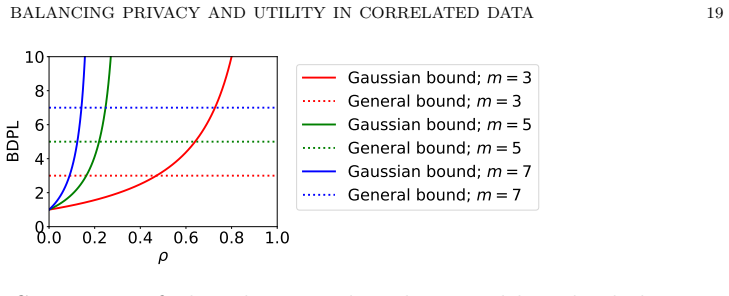
The paper's central discovery is a set of three transfer theorems connecting DP to BDP. Theorem 4.3 proves that an $\varepsilon$-DP mechanism applied to data whose records form blocks of at most $m$ mutually correlated variables is $m\varepsilon$-BDP, and Example 4.4 shows the bound is tight even when the Pearson correlation coefficient is arbitrarily small. Theorem 5.9 improves this for data drawn from a multivariate Gaussian with bounded pairwise correlation $\rho$: a clipped $\varepsilon\ell_1$-private mechanism has BDPL at most $\left(\frac{m^2}{4(1/\rho - m + 2)} + 1\right) M \varepsilon$, provided $\rho(m-2)<1$, where $M$ is the clipping interval's length; this is smaller than the general bound whenever $\rho$ is of order $1/m$. Theorem 6.5 handles Markov chains with positive transition probabilities and a stationary initial distribution: any $\varepsilon$-DP mechanism is $(\varepsilon + 4\ln \gamma)$-BDP, with $\gamma$ the ratio of the largest to the smallest transition probability, so the leakage no longer grows with the number of records. Corollaries 4.5, 5.10, and 6.6 turn these bounds into accuracy statements for Laplace-based mechanisms: the error $\alpha$ inflates by factor $m$, $h = \frac{m^2}{4(1/\rho - m + 2)} + 1$, and $\frac{\varepsilon}{\varepsilon - 4\ln\gamma}$, respectively. The experiments on Galton height, IQ, activity, and electricity data show that the correlation-specific mechanisms achieve substantially lower error than the general-bound mechanism and prior work.
Load-bearing premise
The Markov-chain bound requires the time series to actually start in the stationary distribution of its transition matrix; the paper infers this from irreducibility and aperiodicity, but those properties only guarantee that such a distribution exists, not that the observed process is drawn from it.
Editorial extensions
If this is right
- An analyst who already has an $\varepsilon$-DP Laplace mechanism can obtain an $\varepsilon$-BDP mechanism for data with at most $m$ correlated records by using privacy budget $\varepsilon/m$; the accuracy guarantee degrades by the same factor $m$ (Corollary 4.5).
- For weakly correlated Gaussian data with $\rho(m-2)<1$, the same recalibration costs only a factor $h = \frac{m^2}{4(1/\rho - m + 2)} + 1$, which is less than $m$ whenever $\rho \le \frac{m-1}{(5/4)m^2 - 3m + 2}$ (Theorem 5.9 and Corollary 5.10).
- For Markov chains with stationary initial distribution and transition ratio $\gamma$, a DP mechanism with budget $\varepsilon - 4\ln\gamma$ becomes $\varepsilon$-BDP, and this bound is independent of the chain length $n$; it improves on the general bound whenever $\gamma < \exp\left(\frac{n-1}{4}\varepsilon\right)$ (Theorem 6.5 and Corollary 6.6).
- The Markov-chain bound carries a minimum achievable privacy level: because $\varepsilon - 4\ln\gamma$ must be positive, no mechanism built this way can reach $\varepsilon$ below $4\ln\gamma$ for a given transition matrix.
- On Galton height, FamilyIQ, SyntheticIQ, Activity, and Electricity datasets, the Gaussian- and Markov-calibrated mechanisms reduce error by orders of magnitude compared to the general bound at the same BDPL, with empirical 95% confidence intervals matching the theoretical $\alpha$.
Reading between the lines
- The stationarity caveat implies that applying Theorem 6.5 to real time series requires checking whether the observed process actually starts in the stationary distribution; irreducibility and aperiodicity alone do not license the bound, so a practical deployment would need a burn-in discard or a transient-state analysis.
- The tightness example in Section 4 suggests that no universal bound can beat linear scaling in the correlated block size, so the practical route to BDP is model identification: if the correlation structure is unknown, the $m\varepsilon$ penalty is unavoidable.
- The Markov-chain result being independent of $n$ points to a scalable privacy accounting method for long streams and sensor data, where event-level BDP budgets could depend only on the transition-ratio $\gamma$ and not on the trace length, provided mixing is fast enough.
- A natural testable extension is to relax the stationarity assumption to approximate stationarity and measure how the $\gamma^4$ density-ratio bound degrades as the initial distribution moves away from the stationary vector; the paper's convergence remark suggests a quantitative version involving the mixing time, which is not derived.
Editorial analysis
A structured set of objections, weighed in public.
Referee Report
Summary. The paper studies Bayesian differential privacy (BDP) for correlated data and asks whether BDP mechanisms can be built from standard DP mechanisms without prohibitive utility loss. The authors prove a general bound (Theorem 4.3): any ε-DP mechanism on data with at most m correlated records satisfies mε-BDP, and they give a tightness example. They then derive two correlation-specific improvements: for multivariate Gaussian data with bounded pairwise Pearson correlation ρ and at most m correlated variables, a clipped εℓ1-private mechanism satisfies hMε-BDP with h = m²/(4(1/ρ − m + 2)) + 1 when ρ(m−2) < 1 (Theorem 5.9); for Markov-chain data with positive transition probabilities and a stationary initial distribution, an ε-DP mechanism satisfies (ε + 4 ln γ)-BDP, where γ is the ratio of the largest to smallest transition probability (Theorem 6.5). Accuracy corollaries give the corresponding Laplace-mechanism error inflation factors. The paper also reports experiments on Galton height, FamilyIQ, Activity, and Electricity data, claiming that the correlation-specific bounds substantially improve utility over the general bound and over prior work.
Significance. If the results hold, they give a practical recipe for recalibrating standard Laplace mechanisms to satisfy BDP under Gaussian and Markov correlation models, improving on the Gaussian Markov random field bound of Yang et al. and on the binary Markov-chain randomized-response mechanism of Chakrabarti et al. The theoretical core is a clear contribution: Theorems 4.3, 5.9, and 6.5 are stated formally and proved with explicit arguments, the tightness of the general bound is demonstrated by a concrete construction, reproducible code is provided, and the accuracy corollaries give directly usable noise-calibration formulas. The main caveat is empirical: the Markov-chain experiments rely on a stationarity assumption that is asserted but not verified, and the Gaussian experiments do not check the block-independence and constant-variance conditions of the model. These issues do not invalidate the theoretical theorems, but they do undermine the paper's claim of demonstrating practical applicability on real-world data as currently written.
major comments (3)
- [Section 7.1.2] The inference from irreducibility and aperiodicity to the stationarity assumption H2 is a logical error. The text states that the Activity and Electricity chains are irreducible, aperiodic, and have positive transition probabilities, 'hence there exists a stationary initial distribution [11]. Therefore, we conclude that the databases fulfill the conditions.' Existence of a stationary distribution does not imply that the observed time series starts in that distribution. Lemma 6.4 and Theorem 6.5 explicitly require H2 (wP = w) to conclude Pr[Xi = x] = wx for every time step and to derive the γ⁴ density-ratio bound. Without H2, the privacy levels in Eq. (7.1) and the utility comparisons in Section 7.4 for Activity and Electricity are unsupported. The authors need to verify stationarity empirically (for example, by testing whether the estimated initial distribution satisfies wP ≈ w), discard a burn-in period and restate the guarantee for the post-burn-in process, or clearly label the experiments as conditional on an unverified H2 assumption.
- [Section 6.1, after Theorem 6.5] The paper itself repeats the same conflation in the discussion following Theorem 6.5: condition (H1) is said to imply irreducibility and aperiodicity, 'which in turn guarantees the existence of a unique stationary distribution w [32], thereby satisfying (H2).' Convergence to a stationary distribution is not the same as being initialized in it. This sentence should be corrected to state that H2 is an additional modeling assumption that must be justified for the data at hand, not a consequence of H1.
- [Section 5 and Section 7.1.1] The Gaussian theorems are stated for a 'limited covariance matrix' with constant diagonal and pairwise correlations bounded by ρ, but the proof of Theorem 5.6 also uses the block-independence structure of Definition 4.2, i.e., that the covariance matrix is block diagonal with blocks of size at most m and zeros between independent blocks. This block structure is not stated in Theorem 5.6 or Theorem 5.9. Moreover, Section 7.1.1 claims that all explored datasets fulfill the conditions of Theorem 5.9, but it only reports the Pearson correlation ρ and the condition ρ(m−2)<1; it does not verify the constant-variance requirement or the block-independence of the Galton and FamilyIQ records. The empirical support for the Gaussian bound would be strengthened by explicitly stating and checking these assumptions, or by acknowledging them as additional unverified modeling choices.
minor comments (5)
- [Section 4.1, proof of Proposition 4.1] The chain of equalities contains an algebraic error: e^{-ε}(1−β) is not equal to 1/(e^ε+1). The conclusion β > 1/(e^ε+1) follows from the assumption β < 1/(e^ε+1) via the inequality e^{-ε}(1−β) > β, so the equality signs should be replaced by an inequality or the intermediate expression should be corrected.
- [Section 6.1, proof of Theorem 6.5] In the case U = ∅, the text says 'ε ≤ ε + 4γ', but the bound should read 'ε ≤ ε + 4 ln γ'. This is a typographical error, but it appears in a proof and should be fixed.
- [Section 5.1, Lemma 5.5] The notation in the proof is inconsistent: 'x'_H = (x_K, x'_m)' should be 'x'_R = (x_K, x'_m)', and the shift vector γ is written with different signs at different points in the proof. The final norm is unaffected by the sign, but the derivation should be aligned to avoid confusion.
- [Section 5.2, Theorem 5.9] The symbol M is overloaded: it denotes both a mechanism and the diameter of the clipping interval. Using a different symbol, such as L = |b−a|, would improve readability.
- [Section 4.1, Example 4.4] The example shows that BDPL is arbitrarily close to 2ε as r → ∞, not exactly equal to 2ε for any finite r. Since the bound is an upper bound, the limit argument is sufficient for tightness, but the wording 'we have BDPL = 2ε' should be softened to 'BDPL can be made arbitrarily close to 2ε' to be precise.
Circularity Check
No significant circularity: all privacy bounds are proved from explicit hypotheses; the Markov stationarity gap in Section 7.1.2 is an assumption-verification issue, not circularity.
full rationale
The paper's core derivations (Theorem 4.3, Theorem 5.9/Corollary 5.10, Theorem 6.5/Corollary 6.6) are self-contained proofs from the definitions of DP, metric privacy, BDP, and the stated Gaussian/Markov hypotheses. No mechanism parameter is fitted to the quantity it later 'predicts': rho and gamma are estimated from the datasets and then substituted into the proved bounds to calibrate Laplace noise, and the reported empirical errors are measured independently from mechanism outputs, so the utility evaluation is not forced by construction. The only self-citation ([39], a SoK on trajectory data) appears in the related-work context and is not load-bearing for any theorem. The paper's own passage in Section 7.1.2, inferring the stationary-initial-distribution hypothesis H2 from irreducibility and aperiodicity, is a genuine logical gap, since those properties guarantee existence of a stationary distribution but not that the observed single trajectory starts in it; however, Theorem 6.5 explicitly lists H2 as an assumption rather than deriving it, so this is a correctness/validation risk for the empirical Markov claims, not circularity. The same holds for the acknowledged minimum-epsilon limitation of Eq. (7.1). Accordingly, no circular step meeting the required evidentiary bar was found.
Assumptions & free parameters
free parameters (4)
- rho (maximum Pearson correlation coefficient) =
0.275 (Galton), 0.4483 (FamilyIQ), 0.45 (SyntheticIQ)
- m (maximum correlated records per group) =
3 (Galton), 2 (FamilyIQ and SyntheticIQ)
- gamma (transition probability ratio) =
7.54 (Activity), 4.7, 6.03, 8.54 (Electricity thresholds), from Table 3 and Eq. 7.1
- clipping interval width M =
254 cm (Galton), 120 (IQ), 1 (binary Markov)
assumptions (6)
- domain assumption BDP under arbitrary correlation implies free-lunch indistinguishability
- domain assumption For Gaussian data, each correlated group has constant diagonal covariance and pairwise correlations bounded by rho, with independent blocks outside the group
- domain assumption Markov chain transition matrix is strictly positive and the initial distribution is stationary (H1 and H2)
- standard math Standard Laplace mechanism accuracy and sensitivity properties
- standard math Gershgorin circle theorem and Gaussian conditioning formulas
- domain assumption The real-world datasets are well modeled by the assumed Gaussian or Markov correlation model
invented entities (1)
-
Bayesian metric privacy with target-dependent BDPL
Cite this review
Pith. "Pith review of Balancing Privacy and Utility in Correlated Data: A Study of Bayesian Differential Privacy." pith.science (2026). https://pith.science/paper/TKK4MVV4
@misc{pith2026250621308,
  author       = {Pith},
  title        = {Pith review of: Balancing Privacy and Utility in Correlated Data: A Study of Bayesian Differential Privacy},
  year         = {2026},
  howpublished = {\url{https://pith.science/paper/TKK4MVV4}},
  note         = {Machine review of arXiv:2506.21308}
}
read the original abstract
Privacy risks in differentially private (DP) systems increase significantly when data is correlated, as standard DP metrics often underestimate the resulting privacy leakage, leaving sensitive information vulnerable. Given the ubiquity of dependencies in real-world databases, this oversight poses a critical challenge for privacy protections. Bayesian differential privacy (BDP) extends DP to account for these correlations, yet current BDP mechanisms indicate notable utility loss, limiting its adoption. In this work, we address whether BDP can be realistically implemented in common data structures without sacrificing utility -- a key factor for its applicability. By analyzing arbitrary and structured correlation models, including Gaussian multivariate distributions and Markov chains, we derive practical utility guarantees for BDP. Our contributions include theoretical links between DP and BDP and a novel methodology for adapting DP mechanisms to meet the BDP requirements. Through evaluations on real-world databases, we demonstrate that our novel theorems enable the design of BDP mechanisms that maintain competitive utility, paving the way for practical privacy-preserving data practices in correlated settings.
Figures


Figures from the paper (7 more)


Reference graph
Works this paper leans on
-
[11]
W.-K. Ching and M. K. Ng. Markov chains: models, algorithms and applications . Boston, USA: Springer, 2006. doi: 10.1007/0-387-29337-X_7
-
[32]
D. A. Levin and Y. Peres. Markov chains and mixing times . Vol. 107. USA: American Mathematical Soc., 2017. doi: 10.1090/mbk/107
doi:10.1090/mbk/107 2017
-
[1]
Differential privacy under dependent tuples—the case of genomic privacy
N. Almadhoun, E. Ayday, and ¨O. Ulusoy. “Differential privacy under dependent tuples—the case of genomic privacy”. In: Bioinformatics 36 (2020), pp. 1696–1703. doi: 10.1093/bio informatics/btz837
work page doi:10.1093/bio 2020
-
[2]
Geoindistinguish- ability: differential privacy for location-based systems
M. E. Andr´ es, N. E. Bordenabe, K. Chatzikokolakis, and C. Palamidessi. “Geoindistinguish- ability: differential privacy for location-based systems”. In: ACM SIGSAC Conference on Computer & Communications Security (CCS). New York, USA, 2013, pp. 901–914. doi: 10.1145/2508859.2516735
arXiv 2013
-
[3]
Markovian models for home electricity consumption
O. Ardakanian, S. Keshav, and C. Rosenberg. “Markovian models for home electricity consumption”. In: Proceedings of the 2nd ACM SIGCOMM workshop on Green networking . New York, USA, 2011, pp. 31–36. doi: 10.1145/2018536.2018544
-
[4]
E. Behrends. Introduction to Markov Chains . Wiesbaden, Germany: Vieweg+Teubner Verlag, 2000. doi: 10.1007/978-3-322-90157-6
-
[5]
A learning theory approach to noninteractive database privacy
A. Blum, K. Ligett, and A. Roth. “A learning theory approach to noninteractive database privacy”. In: Journal of the ACM 60.2 (2013), pp. 1–25. doi: 10.1145/2450142.2450148
-
[6]
Bivariate Distributions for Height and Weight of Men and Women in the United States
J. Brainard and D. E. Burmaster. “Bivariate Distributions for Height and Weight of Men and Women in the United States”. In: Risk Analysis 12.2 (1992), pp. 267–275. doi: 10.1111/j.1539-6924.1992.tb00674.x. 36 REFERENCES
Show all 58 references
-
[7]
Membership Inference Attacks From First Principles
N. Carlini, S. Chien, M. Nasr, S. Song, A. Terzis, and F. Tram` er. “Membership Inference Attacks From First Principles”. In: IEEE Symposium on Security and Privacy (SP) . San Francisco, CA: IEEE, 2022, pp. 1897–1914. doi: 10.1109/sp46214.2022.9833649
2022
-
[8]
Chakrabarti, J
D. Chakrabarti, J. Gao, A. Saraf, G. Schoenebeck, and F. -Y. Yu. Optimal Local Bayesian Differential Privacy over Markov Chains . 2022. arXiv: 2206.11402 [cs.CR]. url: https: //arxiv.org/abs/2206.11402
2022 arXiv
-
[9]
Broadening the scope of differential privacy using metrics
K. Chatzikokolakis, M. E. Andr´ es, N. E. Bordenabe, and C. Palamidessi. “Broadening the scope of differential privacy using metrics”. In: Proceedings on Privacy Enhancing Technologies Symposium. loomington, United States.: Springer, 2013, pp. 82–102. doi: 10.1007/978-3-642-39077-7_5
2013 doi
-
[10]
Correlated network data publication via differential privacy
R. Chen, B. C. Fung, P. S. Yu, and B. C. Desai. “Correlated network data publication via differential privacy”. In: The VLDB Journal 23.4 (2014), pp. 653–676. doi: 10.1007/s007 78-013-0344-8
2014 doi
-
[12]
May the privacy be with us: Correlated differential privacy in location data for ITS
K. M. Chong and A. Malip. “May the privacy be with us: Correlated differential privacy in location data for ITS”. In: Computer Networks 241 (2024), p. 110214. doi: 10.1016/j .comnet.2024.110214
2024
-
[13]
Differential Privacy as a Mutual Information Constraint
P. Cuff and L. Yu. “Differential Privacy as a Mutual Information Constraint”. In:Proceedings of the 2016 ACM SIGSAC Conference on Computer and Communications Security . CCS ’16. New York, NY, USA, 2016, pp. 43–54. doi: 10.1145/2976749.2978308
2016
-
[14]
Modelling electricity consumption forecasting using the markov process and hybrid features selection
H. Dalkani, M. Mojarad, and H. Arfaeinia. “Modelling electricity consumption forecasting using the markov process and hybrid features selection”. In: International Journal of Intelligent Systems and Applications 10.5 (2021), p. 14. doi: 10.5815/ijisa.2021.05.02
2021 doi
-
[15]
SoK: Differential privacies
D. Desfontaines and B. Pej´ o. “SoK: Differential privacies”. In: Proceedings on Privacy Enhancing Technologies 2020 (2020), pp. 288–313. doi: 10.2478/popets-2020-0028
2020 doi
-
[16]
Activity Recognition and Abnormality Detection with the Switching Hidden Semi-Markov Model
T. V. Duong, H. H. Bui, D. Q. Phung, and S. Venkatesh. “Activity Recognition and Abnormality Detection with the Switching Hidden Semi-Markov Model”. In: Proceedings of the 2005 IEEE Computer Society Conference on Computer Vision and Pattern Recognition (CVPR’05). USA, 2005, pp...
2005 doi
-
[17]
Calibrating Noise to Sensitivity in Private Data Analysis
C. Dwork, F. McSherry, K. Nissim, and A. Smith. “Calibrating Noise to Sensitivity in Private Data Analysis”. In: Theory of Cryptography. Berlin, Heidelberg: Springer, 2006, pp. 265–284. doi: 10.1007/11681878_14
2006 doi
-
[18]
Dwork and A
C. Dwork and A. Roth. The Algorithmic Foundations of Differential Privacy . Foundations and Trends in Theoretical Computer Science. Hanover, USA: Now Publishers, Inc., 2014. doi: 10.1561/0400000042
2014 doi
-
[19]
F. Galton. Galton height data . 2017. doi: 10.7910/DVN/T0HSJ1
2017 doi
-
[20]
Next place prediction using mobility Markov chains
S. Gambs, M. -O. Killijian, and M. N. del Prado Cortez. “Next place prediction using mobility Markov chains”. In: Proceedings of the First Workshop on Measurement, Privacy, and Mobility. MPM ’12. Bern, Switzerland, 2012. doi: 10.1145/2181196.2181199
2012
-
[21]
¨Uber die Abgrenzung der Eigenwerte einer Matrix
S. A. Gershgorin. “ ¨Uber die Abgrenzung der Eigenwerte einer Matrix”. In: Izvestija Rossijskoj akademii nauk. Serija matematiˇ ceskaja1.6 (1931), pp. 749–754
1931
-
[22]
F. A. Graybill and H. K. Iyer. 1994. url: https://www.kaggle.com/datasets/jacopof erretti/child-vs-mother-iq/data?select=gifted.csv
1994
-
[23]
Cauchy and the spectral theory of matrices
T. Hawkins. “Cauchy and the spectral theory of matrices”. In: Historia Mathematica 2.1 (1975), pp. 1–29. doi: 10.1016/0315-0860(75)90032-4
1975 doi
-
[24]
Blowfish privacy: tuning privacy-utility trade-offs using policies
X. He, A. Machanavajjhala, and B. Ding. “Blowfish privacy: tuning privacy-utility trade-offs using policies”. In: Proceedings of the 2014 ACM SIGMOD International Conference on Management of Data . SIGMOD ’14. Snowbird, USA, 2014, pp. 1447–1458. doi: 10.1145 /2588555.2588581
2014
-
[25]
Hidden Markov models for monitoring circadian rhythmicity in telemetric activity data
Q. Huang, D. Cohen, S. Komarzynski, X.-M. Li, P. Innominato, F. L´ evi, and B. Finkenst¨ adt. “Hidden Markov models for monitoring circadian rhythmicity in telemetric activity data”. In: Journal of The Royal Society Interface 15.139 (2018), p. 20170885. REFERENCES 37
2018
-
[26]
Investigating Membership Inference Attacks under Data Dependencies
T. Humphries, S. Oya, L. Tulloch, M. Rafuse, I. Goldberg, U. Hengartner, and F. Ker- schbaum. “Investigating Membership Inference Attacks under Data Dependencies”. In: IEEE Computer Security Foundations Symposium (CSF) . Dubrovnik, Croatia, 2023, pp. 473–488. doi: 10.1109/csf5...
2023
-
[28]
No free lunch in data privacy
D. Kifer and A. Machanavajjhala. “No free lunch in data privacy”. In: Proceedings of the 2011 ACM SIGMOD International Conference on Management of data . SIGMOD ’11. New York, USA: Association for Computing Machinery, 2011, pp. 193–204. doi: 10.1145/1989323.1989345
2011
-
[29]
Pufferfish: A framework for mathematical privacy definitions
D. Kifer and A. Machanavajjhala. “Pufferfish: A framework for mathematical privacy definitions”. In: ACM Trans. Database Syst. 39.1 (2014), 3:1–3:36. doi: 10.1145/2514689
2014 doi
-
[30]
Alternatives to P value: confidence interval and effect size
D. K. Lee. “Alternatives to P value: confidence interval and effect size”. In: Korean Journal of Anesthesiology 69.6 (2016), pp. 555–562. doi: 10.4097/kjae.2016.69.6.555
2016 doi
-
[31]
How Much Is Enough? Choosing Epsilon for Differential Privacy
J. Lee and C. Clifton. “How Much Is Enough? Choosing Epsilon for Differential Privacy”. In: Information Security. Berlin, Heidelberg: Springer, 2011, pp. 325–340. doi: 10.1007/9 78-3-642-24861-0_22
2011 doi
-
[33]
Impact of prior knowledge and data correlation on privacy leakage: A unified analysis
Y. Li, X. Ren, S. Yang, and X. Yang. “Impact of prior knowledge and data correlation on privacy leakage: A unified analysis”. In: IEEE Transactions on Information Forensics and Security 14.9 (2019), pp. 2342–2357. doi: 10.1109/TIFS.2019.2895970
2019
-
[34]
The link prediction problem for social networks
D. Liben-Nowell and J. Kleinberg. “The link prediction problem for social networks”. In: Proceedings of the Twelfth International Conference on Information and Knowledge Management. CIKM ’03. New York, USA, 2003, pp. 556–559. doi: 10.1145/956863.9569 72
2003
-
[35]
Dependence Makes You Vulnerable: Differential Privacy Under Dependent Tuples
C. Liu, S. Chakraborty, and P. Mittal. “Dependence Makes You Vulnerable: Differential Privacy Under Dependent Tuples”. In: 23rd Annual Network and Distributed System Security Symposium, NDSS 2016 . Vol. 16. San Diego, USA: The Internet Society, 2016, pp. 21–24. doi: 10.14722/n...
2016
-
[36]
Target Height as Predicted by Parental Heights in a Population-Based Study
Z. C. Luo, K. Albertsson-Wikland, and J. Karlberg. “Target Height as Predicted by Parental Heights in a Population-Based Study”. In: Pediatric Research 44(4) (1998), pp. 563–571. doi: 10.1203/00006450-199810000-00016
1998 doi
-
[37]
Electricity, water, and natural gas consumption of a residential house in Canada from 2012 to 2014
S. Makonin, B. Ellert, I. V. Baji´ c, and F. Popowich. “Electricity, water, and natural gas consumption of a residential house in Canada from 2012 to 2014”. In: Scientific data 3.1 (2016), pp. 1–12. doi: 10.1038/sdata.2016.37
2016 doi
-
[38]
S. Malik. Activity Data. Accessed: 2024-06-17. 2020. url: https://www.kaggle.com/dat asets/shambhavimalik/activity-data/data
2024
-
[39]
SoK: differentially private publication of trajectory data
`A. Miranda-Pascual, P. Guerra-Balboa, J. Parra-Arnau, J. Forn´ e, and T. Strufe. “SoK: differentially private publication of trajectory data”. In: Proceedings on Privacy Enhancing Technologies 2023 (2023), pp. 496–516. doi: 10.56553/popets-2023-0065
2023 doi
-
[40]
Very short term load forecasting of residential electricity consumption using the Markov-chain mixture distribution (MCM) model
J. Munkhammar, D. van der Meer, and J. Wid´ en. “Very short term load forecasting of residential electricity consumption using the Markov-chain mixture distribution (MCM) model”. In: Applied Energy 282 (2021), p. 116180. doi: 10.1016/j.apenergy.2020.1161 80
2021
-
[41]
Near and D
J. Near and D. Darais. Differential Privacy: Future Work & Open Challenges . https://w ww.nist.gov/blogs/cybersecurity-insights/differential-privacy-future-work- open-challenges. Accessed: 2024-06-11. 2022
2024
-
[42]
Pufferfish Privacy: An Information-Theoretic Study
T. Nuradha and Z. Goldfeld. “Pufferfish Privacy: An Information-Theoretic Study”. In: IEEE Transactions on Information Theory 69.11 (2023), pp. 7336–7356. doi: 10.1109 /TIT.2023.3296288
2023
-
[43]
V. M. Panaretos. Statistics for Mathematicians . Switzerland: Springer International Pub- lishing, 2016. doi: 10.1007/978-3-319-28341-8 . 38 REFERENCES
2016 doi
-
[44]
The matrix cookbook
K. B. Petersen, M. S. Pedersen, et al. “The matrix cookbook”. In: Technical University of Denmark 7.15 (2008), p. 510
2008
-
[45]
Plomin, J
R. Plomin, J. C. DeFries, V. S. Knopik, and J. M. Neiderhiser. Behavioral genetics: a primer. Sixth edition. New York: Worth Publishers, 2013
2013
-
[46]
Rue and L
H. Rue and L. Held. Gaussian Markov random fields: theory and applications . New York, USA: Chapman and Hall/CRC, 2005. doi: 10.1201/9780203492024
2005 doi
-
[47]
J. Shao. Mathematical Statistics. New York, USA: Springer, 2003. doi: 10.1007/b97553
2003 doi
-
[48]
J. Shurman. Calculus and Analysis in Euclidean Space . Springer International Publishing,
-
[49]
Pufferfish Privacy Mechanisms for Correlated Data
S. Song, Y. Wang, and K. Chaudhuri. “Pufferfish Privacy Mechanisms for Correlated Data”. In: Proceedings of the 2017 ACM International Conference on Management of Data SIGMOD. New York, USA, 2017, pp. 1291–1306. doi: 10.1145/3035918.3064025
2017
-
[50]
Model extension and model selection
M. Sunn˚ aker and J. Stelling. “Model extension and model selection”. In:Uncertainty in Biology: A Computational Modeling Approach . Vol. 17. Cham, Switzerland: Springer, 2015, pp. 213–241. doi: 10.1007/978-3-319-21296-8_9
2015 doi
-
[51]
Topics in Sparse Approximation
J. A. Trop. “Topics in Sparse Approximation”. PhD thesis. University of Texas, 2004
2004
-
[52]
S. Vadhan. The complexity of differential privacy . Cham, Switzerland: Springer, 2017, pp. 347–450. doi: 10.1007/978-3-319-57048-8_7
2017 doi
-
[53]
Why current differential privacy schemes are inapplicable for correlated data publishing?
H. Wang, Z. Xu, S. Jia, Y. Xia, and X. Zhang. “Why current differential privacy schemes are inapplicable for correlated data publishing?” In: World Wide Web 24 (2021), pp. 1–23. doi: 10.1007/s11280-020-00825-8
2021 doi
-
[54]
Locally Differentially Private Protocols for Frequency Estimation
T. Wang, J. Blocki, N. Li, and S. Jha. “Locally Differentially Private Protocols for Frequency Estimation”. In: 26th USENIX Security Symposium . Vancouver, BC, 2017, pp. 729–745. doi: 10.5555/3241189.3241247
2017
-
[55]
Randomized response: A survey technique for eliminating evasive answer bias
S. L. Warner. “Randomized response: A survey technique for eliminating evasive answer bias”. In: Journal of the American statistical association 60.309 (1965), pp. 63–69. doi: 10.2307/2283137
1965 doi
-
[56]
A statistical framework for differential privacy
L. Wasserman and S. Zhou. “A statistical framework for differential privacy”. In: Journal of the American Statistical Association 105.489 (2010), pp. 375–389. doi: 10.1198/jasa.2 009.tm08651
2010 doi
-
[57]
D. S. Wilks. Statistical methods in the atmospheric sciences . Vol. 100. Oxford, UK.: Academic Press, 2011. doi: 10.1016/C2017-0-03921-6
2011 doi
-
[58]
Bayesian Differential Privacy on Correlated Data
B. Yang, I. Sato, and H. Nakagawa. “Bayesian Differential Privacy on Correlated Data”. In: Proceedings of the 2015 ACM SIGMOD International Conference on Management of Data . SIGMOD ’15. Melbourne, Australia, 2015, pp. 747–762. doi: 10.1145/2723372.2747643
2015
-
[2016]
doi: 10.1007/978-3-319-49314-5
Reviewed August 6, 2026 · model on record in the stance chip above.
Discussion (0). Continue with ORCID to comment.