Test of a partly instrumented highly compact and granular electromagnetic calorimeter in an electron beam of 1 to 6 GeV
Pith reviewed 2026-06-30 03:30 UTC · model grok-4.3
The pith
A partially instrumented silicon-tungsten calorimeter prototype has been tested with 1 to 6 GeV electrons, yielding initial calibration and shower data.
A machine-rendered reading of the paper's core claim, the machinery that carries it, and where it could break.
Core claim
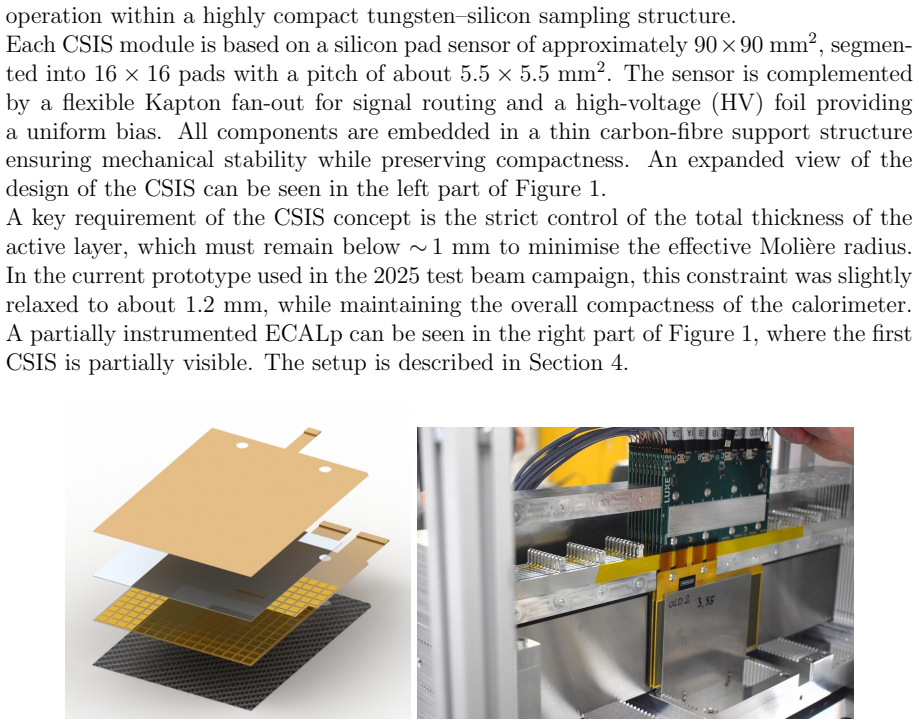
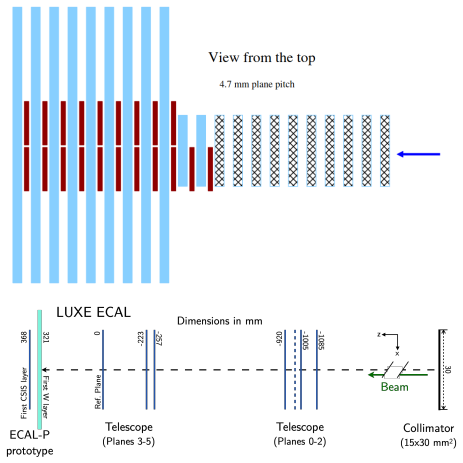
Highly compact and finely segmented silicon-tungsten electromagnetic calorimeters are being developed within the FCAL collaboration for applications in the LUXE experiment at DESY and future electron-positron collider facilities. These detectors combine tungsten absorber plates with thin silicon pad sensors, providing a small effective Molière radius and high spatial granularity. The fundamental active unit is the Compact Silicon Sandwich (CSIS), integrating a silicon pad sensor together with signal routing, high-voltage distribution and mechanical support in a highly compact structure. A partially instrumented prototype of such a calorimeter has been tested in an electron beam with energies
What carries the argument
The Compact Silicon Sandwich (CSIS) module, which integrates a silicon pad sensor with signal routing, high-voltage distribution and mechanical support in a highly compact structure.
If this is right
- The CSIS modules can be assembled into larger calorimeters using the dedicated silicon detector integration infrastructure.
- High spatial granularity enables resolution of nearby electromagnetic showers in high-occupancy environments.
- The small effective Molière radius supports use in future electron-positron collider experiments.
- These test beam results form a foundation for full instrumentation and operation in the LUXE experiment.
Where Pith is reading between the lines
- If the observed MIP calibration holds, the design could support luminosity measurements at LUXE by providing precise shower position data.
- The modular CSIS approach might extend to other high-energy physics detectors requiring compact granularity beyond LUXE.
- Additional tests varying beam intensity or adding hadronic components could further test scaling assumptions.
Load-bearing premise
The performance observed with the partial instrumentation and test beam conditions will scale to and validate the fully instrumented calorimeter under the operating conditions of the LUXE experiment.
What would settle it
Inconsistent minimum-ionizing particle signals across channels or event displays that fail to show expected electromagnetic shower shapes for 1-6 GeV electrons would indicate the prototype does not support the validation claim.
Figures
read the original abstract
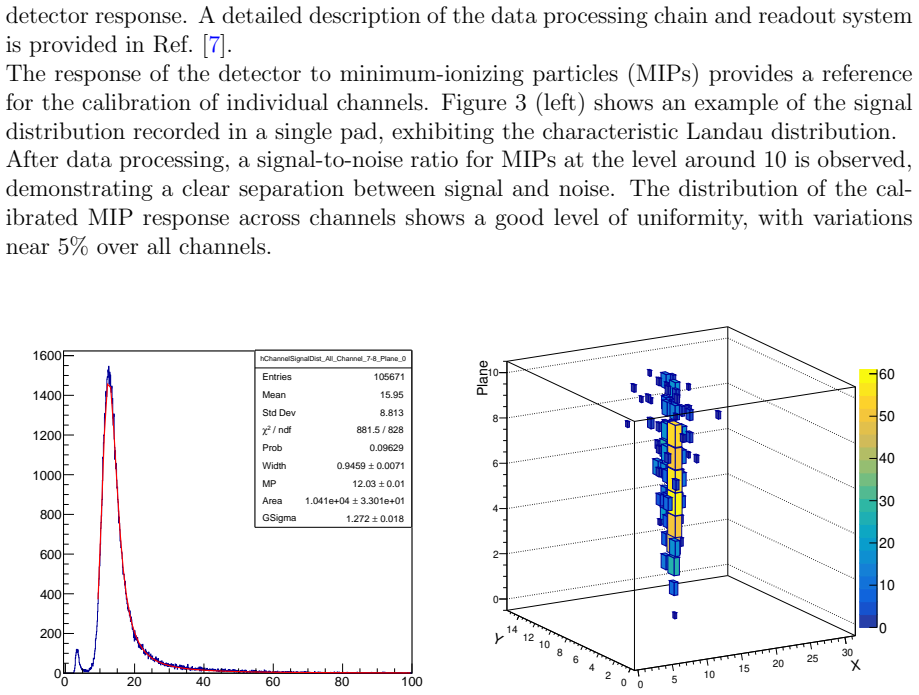
Highly compact and finely segmented silicon-tungsten electromagnetic calorimeters are being developed within the FCAL collaboration for applications in the LUXE experiment at DESY and future electron-positron collider facilities. These detectors combine tungsten absorber plates with thin silicon pad sensors, providing a small effective Moli\`ere radius and high spatial granularity, which are essential for resolving nearby electromagnetic showers in high-occupancy environments. The fundamental active unit of this calorimeter concept is the Compact Silicon Sandwich (CSIS), integrating a silicon pad sensor together with signal routing, high-voltage distribution and mechanical support in a highly compact structure. The assembly of these CSIS modules is performed within a dedicated infrastructure for silicon detector integration. A partially instrumented prototype of such a calorimeter has been tested in an electron beam with energies between 1 and 6~GeV. First results from the 2025 test beam campaign are presented, including minimum-ionizing particle calibration and preliminary event displays illustrating the shower development in the highly granular detector. These results constitute an important step towards the validation of this technology for LUXE and future collider experiments.
Editorial analysis
A structured set of objections, weighed in public.
Referee Report
Summary. The manuscript reports the development of compact silicon-tungsten electromagnetic calorimeters using CSIS modules for the LUXE experiment and presents first results from a 2025 test-beam campaign of a partially instrumented prototype exposed to 1-6 GeV electrons. It includes minimum-ionizing-particle calibration and preliminary event displays of shower development, framing these as an important validation step for LUXE and future colliders.
Significance. If expanded with quantitative performance metrics, the work could provide an initial demonstration of the CSIS integration approach and high-granularity response in a test-beam environment. The current preliminary presentation, however, offers limited new information beyond the existence of the test.
major comments (2)
- [Abstract] Abstract (final paragraph): the claim that the MIP calibration and event displays 'constitute an important step towards the validation of this technology for LUXE' is not supported by any reported quantitative figures of merit (energy resolution, linearity, position resolution, or shower containment) or by comparison to full-geometry simulation.
- [Abstract] Abstract: no discussion is provided of how the partial instrumentation (missing layers or channels) affects electromagnetic shower development relative to the complete multilayer stack, nor of the representativeness of 1-6 GeV test-beam conditions for LUXE occupancies and backgrounds.
minor comments (1)
- [Abstract] The abstract would benefit from a brief statement of the number of instrumented layers or channels in the prototype.
Simulated Author's Rebuttal
We thank the referee for the careful review and constructive comments. We agree that the abstract overstates the significance of the preliminary results and will revise it to better reflect the scope of the presented data. We address the points below.
read point-by-point responses
-
Referee: [Abstract] Abstract (final paragraph): the claim that the MIP calibration and event displays 'constitute an important step towards the validation of this technology for LUXE' is not supported by any reported quantitative figures of merit (energy resolution, linearity, position resolution, or shower containment) or by comparison to full-geometry simulation.
Authors: We agree that the manuscript does not report quantitative figures of merit or simulation comparisons, as the results are preliminary. We will revise the final paragraph of the abstract to remove the unsupported claim and instead describe the MIP calibration and event displays as initial results from the test-beam campaign. revision: yes
-
Referee: [Abstract] Abstract: no discussion is provided of how the partial instrumentation (missing layers or channels) affects electromagnetic shower development relative to the complete multilayer stack, nor of the representativeness of 1-6 GeV test-beam conditions for LUXE occupancies and backgrounds.
Authors: The current manuscript focuses on the first results from the partially instrumented prototype without addressing these aspects. We will add a brief discussion in the abstract (and introduction if space permits) noting the limitations of partial instrumentation and the beam energy range relative to LUXE conditions, with the understanding that fuller studies are planned. revision: yes
Circularity Check
No circularity: purely experimental test-beam report with no derivations or models
full rationale
The manuscript is an experimental report describing a 2025 test-beam campaign on a partially instrumented CSIS prototype. It presents MIP calibration data and qualitative event displays from 1-6 GeV electrons. No equations, parameter fits, predictions, or theoretical derivations appear anywhere in the text. The central claim is simply that the observed data constitute a step toward validation; this is a direct empirical statement, not a reduction of any output to fitted inputs or self-citations. All load-bearing content is external measurement, so no circularity patterns apply.
Axiom & Free-Parameter Ledger
Reference graph
Works this paper leans on
-
[1]
FLAME a readout ASIC for a compact electromagnetic calorimeter
Firlej, Miros aw and Fiutowski, Tomasz and Idzik, Marek and Moro \'n , Jakub and Pietruch, Dawid and Skocze \'n , Andrzej and \'S wientek, Krzysztof. FLAME a readout ASIC for a compact electromagnetic calorimeter. JINST. 2026. doi:10.1088/1748-0221/21/03/P03005
-
[2]
TARDIS Lab: Infrastructure for Characterization and Assembly of Highly Granular Silicon Calorimeter Modules for LUXE and Future Higgs Factories
Almanza-Soto, M and others. TARDIS Lab: Infrastructure for Characterization and Assembly of Highly Granular Silicon Calorimeter Modules for LUXE and Future Higgs Factories. to appear in this collection
-
[3]
The DESY II Test Beam Facility
Sven Ackermann and Ralf Diener and Adrian Herkert and Marcel Stanitzki. The DESY II Test Beam Facility
-
[4]
and Zarnecki, Aleksander Filip and others
Grzelak, G. and Zarnecki, Aleksander Filip and others. Proceeding on ECALp precision mechanics. to appear in this collection
-
[5]
and Pietruch, D
Moron, J. and Pietruch, D. and Rudy, A. Dedicated readout electronics and data pre-processing for a granular electromagnetic calorimeter. to appear in this collection
-
[6]
Abramowicz, H. and others. Technical Design Report for the LUXE experiment. Eur. Phys. J. ST. 2024. doi:10.1140/epjs/s11734-024-01164-9. arXiv:2308.00515
-
[7]
The International Linear Collider Technical Design Report - Volume 1: Executive Summary. 2013. arXiv:1306.6327
work page internal anchor Pith review Pith/arXiv arXiv 2013
-
[8]
The International Linear Collider Technical Design Report - Volume 2: Physics. 2013. arXiv:1306.6352
work page internal anchor Pith review Pith/arXiv arXiv 2013
-
[9]
The International Linear Collider Technical Design Report - Volume 3.I: Accelerator & in the Technical Design Phase. 2013. doi:10.2172/1347941. arXiv:1306.6353
work page internal anchor Pith review Pith/arXiv arXiv doi:10.2172/1347941 2013
-
[10]
The International Linear Collider Technical Design Report - Volume 3.II: Accelerator Baseline Design. 2013. doi:10.2172/1347940. arXiv:1306.6328
work page internal anchor Pith review Pith/arXiv arXiv doi:10.2172/1347940 2013
-
[11]
The International Linear Collider Technical Design Report - Volume 4: Detectors
Abramowicz, Halina and others. The International Linear Collider Technical Design Report - Volume 4: Detectors. 2013. arXiv:1306.6329
work page internal anchor Pith review Pith/arXiv arXiv 2013
-
[12]
Future Circular Collider Feasibility Study Report: Volume 1, Physics, Experiments, Detectors
Benedikt, M. and others. Future Circular Collider Feasibility Study Report: Volume 1, Physics, Experiments, Detectors. Eur. Phys. J. C. 2025. doi:10.1140/epjc/s10052-025-15077-x. arXiv:2505.00272
work page internal anchor Pith review Pith/arXiv arXiv doi:10.1140/epjc/s10052-025-15077-x 2025
-
[13]
Benedikt, M. and others. Future Circular Collider Feasibility Study Report: Volume 2, Accelerators, Technical Infrastructure and Safety. Eur. Phys. J. ST. 2025. doi:10.1140/epjs/s11734-025-01967-4. arXiv:2505.00274
-
[14]
Benedikt, M. and others. Future Circular Collider Feasibility Study Report : Volume 3 Civil Engineering, Implementation and Sustainability. Eur. Phys. J. ST. 2025. doi:10.1140/epjs/s11734-025-01958-5. arXiv:2505.00273
-
[15]
Abramowicz, H. and others. The Linear Collider Facility (LCF) at CERN. 2025. arXiv:2503.24049
-
[16]
A linear collider vision for the future of particle physics,
Abramowicz, H. and others. A Linear Collider Vision for the Future of Particle Physics. 2025. arXiv:2503.19983
-
[17]
CEPC Technical Design Report: Accelerator
Abdallah, Waleed and others. CEPC Technical Design Report: Accelerator. Radiat. Detect. Technol. Methods. 2024. doi:10.1007/s41605-024-00463-y. arXiv:2312.14363
-
[18]
CEPC Technical Design Report - Reference Detector
Adhya, Souvik Priyam and others. CEPC Technical Design Report - Reference Detector. 2025. arXiv:2510.05260
-
[19]
Thomson, M. A. Particle Flow Calorimetry and the PandoraPFA Algorithm. Nucl. Instrum. Meth. A. 2009. doi:10.1016/j.nima.2009.09.009. arXiv:0907.3577
work page internal anchor Pith review Pith/arXiv arXiv doi:10.1016/j.nima.2009.09.009 2009
-
[20]
Experimental Tests of Particle Flow Calorimetry
Sefkow, Felix and White, Andy and Kawagoe, Kiyotomo and P. Experimental Tests of Particle Flow Calorimetry. Rev. Mod. Phys. 2016. doi:10.1103/RevModPhys.88.015003. arXiv:1507.05893
work page internal anchor Pith review Pith/arXiv arXiv doi:10.1103/revmodphys.88.015003 2016
-
[21]
CALICE Collaboration website , year =
-
[22]
FCAL Collaboration website , year =
-
[23]
Detector R&D Collaboration for Calorimetry (DRD Calo) , year =
-
[24]
DRD Calorimetry Collaboration Roadmap , year =
-
[25]
Kawagoe, K. and others. Beam test performance of the highly granular SiW-ECAL technological prototype for the ILC. Nucl. Instrum. Meth. A. 2020. doi:10.1016/j.nima.2019.162969. arXiv:1902.00110
-
[26]
Abramowicz and others , title =
H. Abramowicz and others , title =. JINST , volume =. 2010 , pages =
2010
-
[27]
Abramowicz and others , title =
H. Abramowicz and others , title =. IEEE Transactions on Nuclear Science , volume =. 2010 , pages =
2010
-
[28]
A study of silicon sensor for ILD ECAL
Tomita, Tatsuhiko and others. A study of silicon sensor for ILD ECAL. International Workshop on Future Linear Colliders. 2014. arXiv:1403.7953
work page internal anchor Pith review Pith/arXiv arXiv 2014
-
[29]
Abramowicz, H. and others. Novel silicon and GaAs sensors for compact sampling calorimeters. Eur. Phys. J. C. 2025. doi:10.1140/epjc/s10052-025-14341-4. arXiv:2501.07431
-
[30]
Layout optimization for the LUXE-NPOD experiment
Soto, Melissa Almanza and others. Layout optimization for the LUXE-NPOD experiment. Phys. Rev. D. 2025. doi:10.1103/n2nh-7v5b. arXiv:2507.17716
-
[31]
1963 , howpublished =
Doctor Who , author =. 1963 , howpublished =
1963
-
[32]
EPO-TEK H20E Electrically Conductive Epoxy , year =
-
[33]
Almanza-Soto , title =
M. Almanza-Soto , title =. 2024 , howpublished =
2024
-
[34]
8331S Silver Conductive Epoxy Adhesive Technical Datasheet , year =
-
[35]
9410 One-Part Conductive Epoxy Adhesive Technical Datasheet , year =
-
[36]
PreciFluid Volumetric Dispenser for Precision Adhesive Deposition , year =
-
[37]
PDS 400-3 Programmable Dispensing System , year =
-
[38]
Boudry , title =
V. Boudry , title =. 2025 , howpublished =
2025
-
[39]
Conductive Epoxy Preparation and Mixing Procedure for Silicon Calorimeter Module Assembly , year =
-
[40]
Ultra-thin Silicon Calorimeter Module Assembly Procedure , year =
-
[41]
Sensor Quality-Control Datasheet Template for Calorimeter Module Assembly , year =
-
[42]
FLAME SoC readout ASIC for electromagnetic calorimeter , Place =
Jakub Moron. FLAME SoC readout ASIC for electromagnetic calorimeter , Place =. September 19-23, 2022
2022
-
[43]
The FLAME and FLAXE ASICs , Place =
Marek Idzik. The FLAME and FLAXE ASICs , Place =. 2023
2023
discussion (0)
Sign in with ORCID, Apple, or X to comment. Anyone can read and Pith papers without signing in.