REVIEW 2 major objections 20 references
LK Jam: System Architecture and Implementation of a Real-Time Human-AI Interactive Music Generation System using Role-Aware GRU
T0 review · 2 major / 0 minor · reviewed 2026-06-26 · grok-4.3
Pith's one-line read A role-aware GRU with sparse event streams locks real-time music generation at constant O(1) cost.
desk verdict This is a system description of a real-time music AI setup whose O(1) latency claim rests on architecture alone with no measurements or data. read the letter →
The pith
A machine-rendered reading of the paper's core claim, the machinery that carries it, and where it could break.
The reading
What carries the argument
The multi-dimensional sparse event stream that integrates time-shifts, continuous harmonic embeddings, and role-aware encoding to support single-step capture of interactive music logic.
What would settle it
A timing measurement that shows inference latency growing with the number of events or a DAW session that produces audio dropouts under sustained interaction would disprove the O(1) overhead claim.
Extended reading notes
Core claim
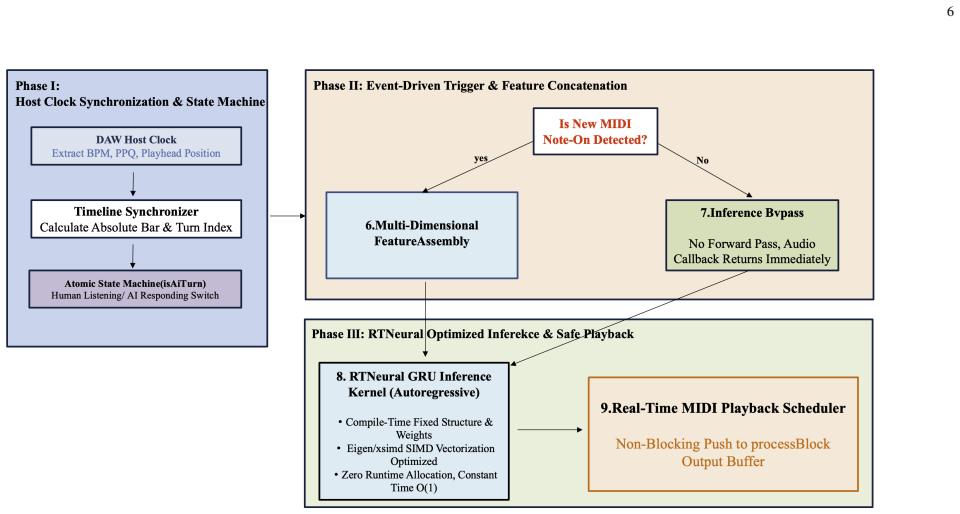
The paper claims that a multi-dimensional sparse event stream integrating time-shifts, continuous harmonic embeddings, and role-aware encoding allows a GRU model to perform accurate turn-taking and micro-timing decisions in a single inference step, while a C++ multithreaded architecture with compile-time network solidification and zero-allocation mechanisms locks end-to-end autoregressive decoding overhead at O(1) complexity, thereby eliminating audio thread dropout risk in DAW plugin environments.
Load-bearing premise
The multi-dimensional sparse event stream with time-shifts, harmonic embeddings, and role-aware encoding enables accurate capture of turn-taking logic and micro-timing in single-step inference.
Editorial extensions
If this is right
- The system can run as a low-latency plugin inside existing digital audio workstations without interrupting the audio thread.
- Interactive role-play between human and AI becomes feasible at the micro-timing level required for live performance.
- The three-stage training sequence produces models that progress from basic chord following to coordinated expert-level exchanges.
- Musical coherence is preserved while the architecture meets extreme real-time engineering limits.
Reading between the lines
- The same sparse encoding approach could be tested in other real-time creative domains such as collaborative drawing or live coding.
- If the role-aware component generalizes, the system might support multi-player human-AI ensembles rather than one-to-one duets.
- Deployment on embedded hardware would require checking whether the zero-allocation guarantee survives reduced memory budgets.
- User studies measuring perceived musical responsiveness could quantify whether single-step inference actually produces convincing turn-taking.
Signed reviews
Editorial analysis
A structured set of objections, weighed in public.
Referee Report
Summary. The manuscript presents LK_Jam, a real-time bidirectional human-AI music generation system built around a lightweight role-aware GRU. It replaces fixed time-grids with a multi-dimensional sparse event stream (time-shifts, continuous harmonic embeddings, role-aware encoding) to enable single-step inference of turn-taking and micro-timing. The engineering layer uses C++/JUCE with RTNeural, compile-time topology solidification, and zero-allocation to claim strictly O(1) end-to-end overhead for autoregressive decoding, thereby eliminating audio-thread dropout risk in DAW plugins. A three-stage progressive training strategy is said to progress from basic chord harmonization to expert-level interaction, supported only by preliminary observations and architectural analysis.
Significance. If the O(1) latency guarantee and the event-stream representation of interactive roles were empirically validated, the work would supply a concrete, deployable architecture for low-latency AI co-performance in live music. The combination of sparse event encoding with lock-free real-time inference addresses a recognized engineering bottleneck; explicit credit is due for the emphasis on allocation-free design and compile-time specialization, which are concrete strengths even if currently unmeasured.
major comments (2)
- [Abstract / engineering implementation layer] Abstract, engineering implementation layer: the claim that 'the end-to-end overhead of autoregressive decoding is strictly locked at O(1) complexity' is presented as a structural guarantee arising from compile-time solidification and zero-allocation, yet the text supplies no timing measurements, per-event latency figures, buffer-size data, or worst-case analysis under variable event density. This is load-bearing for the central assertion that the architecture 'structurally mitigating the risk of audio thread dropouts'.
- [Abstract] Abstract: the three-stage progressive training strategy is stated to achieve 'a leap from basic chord harmonization to expert-level interaction', but no description of the stages, training data, loss terms, or any quantitative metrics (coherence, interaction accuracy, latency) is provided; only 'preliminary observations' are referenced. This leaves the performance claims unsupported.
Simulated Author's Rebuttal
We thank the referee for the constructive feedback and for recognizing the engineering contributions of the LK_Jam architecture. We address each major comment below with clarifications and planned revisions to strengthen the manuscript.
read point-by-point responses
-
Referee: [Abstract / engineering implementation layer] Abstract, engineering implementation layer: the claim that 'the end-to-end overhead of autoregressive decoding is strictly locked at O(1) complexity' is presented as a structural guarantee arising from compile-time solidification and zero-allocation, yet the text supplies no timing measurements, per-event latency figures, buffer-size data, or worst-case analysis under variable event density. This is load-bearing for the central assertion that the architecture 'structurally mitigating the risk of audio thread dropouts'.
Authors: The O(1) claim follows directly from the design: fixed compile-time topology eliminates dynamic branching or resizing, while zero-allocation and lock-free buffers ensure per-inference cost is independent of sequence length or event density. We agree, however, that the manuscript would benefit from explicit empirical support. In revision we will add a dedicated complexity-and-timing subsection containing per-event latency figures, buffer-size sweeps, and worst-case analysis under varying event densities to substantiate the dropout-mitigation guarantee. revision: yes
-
Referee: [Abstract] Abstract: the three-stage progressive training strategy is stated to achieve 'a leap from basic chord harmonization to expert-level interaction', but no description of the stages, training data, loss terms, or any quantitative metrics (coherence, interaction accuracy, latency) is provided; only 'preliminary observations' are referenced. This leaves the performance claims unsupported.
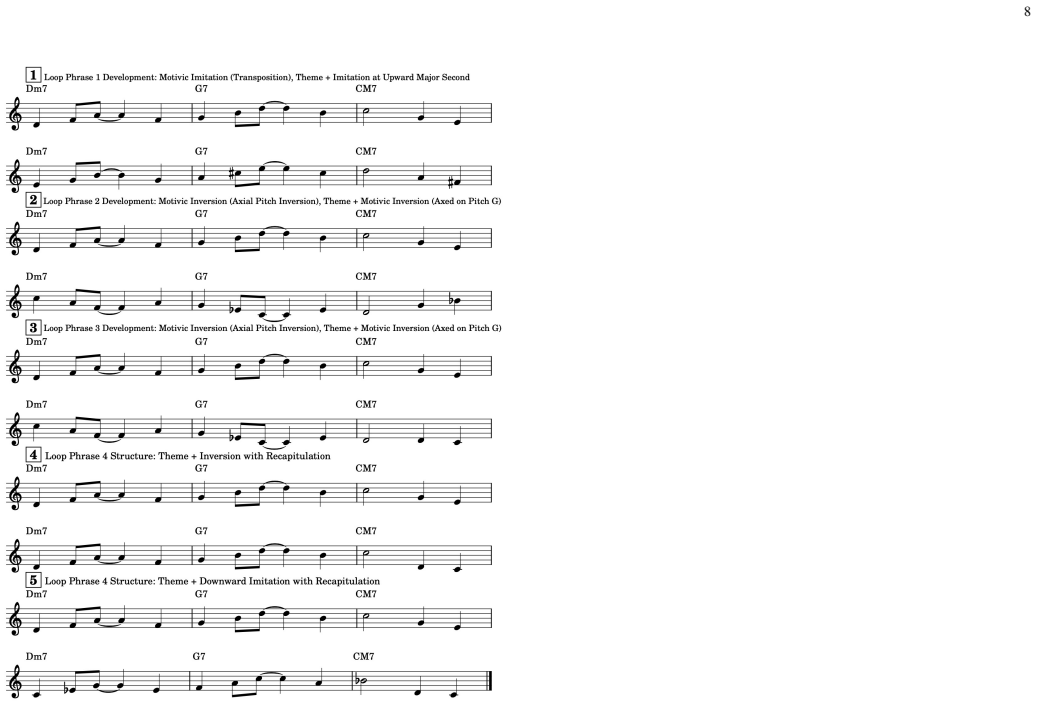
Authors: The manuscript centers on architecture and real-time engineering; the training strategy is presented at a high level to indicate how role-aware behavior is acquired. We acknowledge that detailed stage descriptions, datasets, loss formulations, and quantitative metrics are not supplied. In the revised version we will expand the relevant section with explicit stage definitions, data sources, loss terms, and a clear statement that the reported interaction quality rests on preliminary observations, with full quantitative evaluation reserved for follow-up work. revision: yes
Circularity Check
No circularity: engineering narrative with no derivations or self-referential reductions
full rationale
The paper is a technical report describing system architecture and implementation choices for a real-time music generation plugin. It asserts O(1) end-to-end overhead via compile-time topology solidification and zero-allocation in the RTNeural/JUCE setup, but presents no equations, fitted parameters, predictions, or derivation chain. The multi-dimensional sparse event stream is introduced as an input representation enabling single-step inference; this is a design choice, not a result reduced to itself. No self-citations, uniqueness theorems, or ansatzes appear in the provided text. The central claim is an unmeasured architectural assertion rather than a circular reduction. This matches the default expectation for non-derivational engineering papers; score 0 is appropriate.
Assumptions & free parameters
assumptions (1)
- domain assumption A three-stage progressive training strategy can achieve a leap from basic chord harmonization to expert-level interaction
invented entities (1)
-
role-aware encoding
Cite this review
Pith. "Pith review of LK Jam: System Architecture and Implementation of a Real-Time Human-AI Interactive Music Generation System using Role-Aware GRU." pith.science (2026). https://pith.science/paper/TMISOYUT
@misc{pith2026260621018,
  author       = {Pith},
  title        = {Pith review of: LK Jam: System Architecture and Implementation of a Real-Time Human-AI Interactive Music Generation System using Role-Aware GRU},
  year         = {2026},
  howpublished = {\url{https://pith.science/paper/TMISOYUT}},
  note         = {Machine review of arXiv:2606.21018}
}
abstract
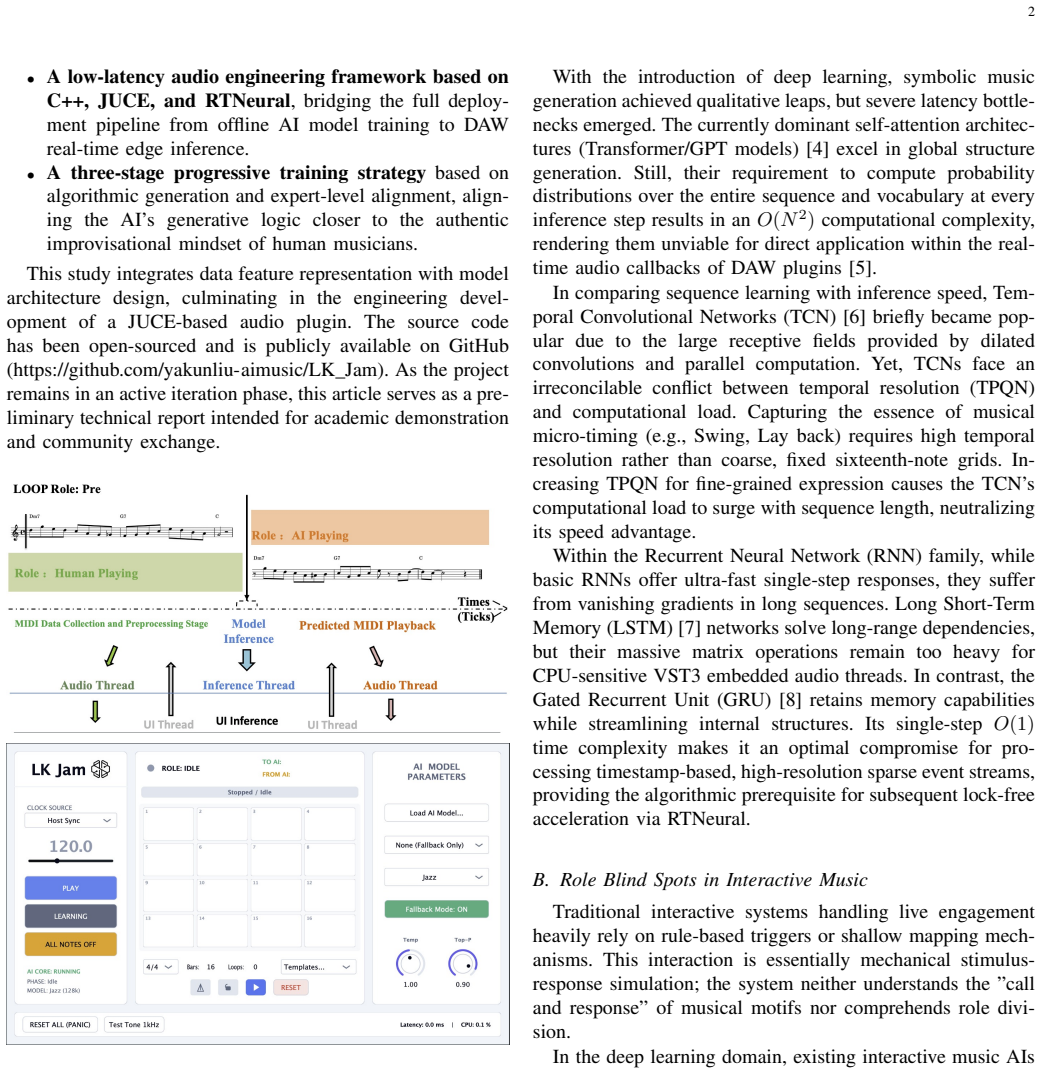
As artificial intelligence advances into the era of Embodied AI, live musical interaction urgently needs to break free from the limitations of offline, unidirectional generation, achieving a "virtual synergy" capable of low-latency, dynamic interplay. To address this, this technical report presents LK_Jam, a real-time, bidirectional human-computer interactive music generation system based on a lightweight Gated Recurrent Unit (GRU) and a high-performance audio host architecture. In the algorithmic representation layer, this system abandons the computationally expensive fixed time-grid. Instead, it constructs a multi-dimensional sparse event stream integrating time-shifts, continuous harmonic embeddings, and role-aware encoding, enabling the model to accurately capture turn-taking logic and micro-timing in a single-step inference. In the engineering implementation layer, this paper builds a strict multithreaded lock-free communication bridge using C++ and the JUCE framework, incorporating the RTNeural inference engine designed specifically for real-time audio. By utilizing compile-time network topology solidification and a zero-allocation (allocation-free) mechanism, the end-to-end overhead of autoregressive decoding is strictly locked at \(O(1)\) complexity, structurally mitigating the risk of audio thread dropouts in DAW plugin environments. Furthermore, this study designs a three-stage progressive training strategy, achieving a leap from basic chord harmonization to expert-level interaction. Preliminary observations and architectural analysis demonstrate that while ensuring musical coherence and interactive role-play, the proposed system successfully challenges extreme real-time engineering constraints, offering a highly robust and deployable technical paradigm for next-generation AI co-performers in live music.
Figures


Figures from the paper (6 more)




Reference graph
Works this paper leans on
-
[1]
”Design Considerations for Real-Time Collabora- tion With Creative Artificial Intelligence,”Organised Sound, 2020
d’Inverno, M., et al. ”Design Considerations for Real-Time Collabora- tion With Creative Artificial Intelligence,”Organised Sound, 2020
2020
-
[2]
”A Survey of Music Generation in the Context of Interaction,” arXiv preprint arXiv:2402.18245, 2024
McCormack, J., et al. ”A Survey of Music Generation in the Context of Interaction,” arXiv preprint arXiv:2402.18245, 2024
-
[3]
”The Continuator: Musical interaction with style,” inProceed- ings of the International Computer Music Conference, 2003
Pachet, F. ”The Continuator: Musical interaction with style,” inProceed- ings of the International Computer Music Conference, 2003
2003
-
[4]
”Attention is all you need,”Advances in Neural Information Processing Systems, 30, 2017
Vaswani, A., et al. ”Attention is all you need,”Advances in Neural Information Processing Systems, 30, 2017
2017
-
[5]
The Curious Case of Neural Text Degeneration
Holtzman, A., et al. ”The Curious Case of Neural Text Degeneration,” arXiv preprint arXiv:1904.09751, 2019
work page Pith review arXiv 1904
-
[6]
An Empirical Evaluation of Generic Convolutional and Recurrent Networks for Sequence Modeling
Bai, S., Kolter, J. Z., and Koltun, V . ”An empirical evaluation of generic convolutional and recurrent networks for sequence modeling,” arXiv preprint arXiv:1803.01271, 2018. 8 Fig. 10. Example 4: Stage 3 Expert-Level Human-Computer Interactive Logic Alignment
work page Pith review arXiv 2018
-
[7]
”Long short-term memory,”Neural Computation, 9(8), 1997
Hochreiter, S., and Schmidhuber, J. ”Long short-term memory,”Neural Computation, 9(8), 1997
1997
-
[8]
Learning Phrase Representations using RNN Encoder-Decoder for Statistical Machine Translation
Cho, K., et al. ”Learning phrase representations using RNN encoder-decoder for statistical machine translation,” arXiv preprint arXiv:1406.1078, 2014
work page Pith review arXiv 2014
Show all 20 references
-
[9]
”In a Silent Way: Communication between AI and improvising musicians beyond sound,” inCHI 2019, 2019
McCormack, J., et al. ”In a Silent Way: Communication between AI and improvising musicians beyond sound,” inCHI 2019, 2019
2019
-
[10]
Routledge, 2024
Yee-King, M.Build AI-Enhanced Audio Plugins with C++. Routledge, 2024
2024
-
[11]
”Real-Time Neural Networks for Audio Effect Model- ing,” inProceedings of the 24th International Conference on Digital Audio Effects (DAFx), 2021
Chowdhury, J. ”Real-Time Neural Networks for Audio Effect Model- ing,” inProceedings of the 24th International Conference on Digital Audio Effects (DAFx), 2021
2021
-
[12]
”This time with feeling: Learning expressive musical performance,”Neural Computing and Applications, 32, 2020
Oore, S., et al. ”This time with feeling: Learning expressive musical performance,”Neural Computing and Applications, 32, 2020
2020
-
[13]
”Theory Structured Harmonic Embeddings for Chord Condi- tioned Melody Generation,”Academic Journal of Computing & Infor- mation Science, 8(10), 2025
Wang, J. ”Theory Structured Harmonic Embeddings for Chord Condi- tioned Melody Generation,”Academic Journal of Computing & Infor- mation Science, 8(10), 2025
2025
-
[14]
”JUCE API Documentation.” Available: https://juce.com
JUCE. ”JUCE API Documentation.” Available: https://juce.com
-
[15]
”Scheduled Sampling for Sequence Prediction with Recurrent Neural Networks,” inAdvances in Neural Information Pro- cessing Systems, 2015
Bengio, S., et al. ”Scheduled Sampling for Sequence Prediction with Recurrent Neural Networks,” inAdvances in Neural Information Pro- cessing Systems, 2015
2015
-
[16]
”Incorporating Structure and Chord Constraints in Symbolic Transformer-based Melodic Harmonization,” in Proceedings of the 6th Conference on AI Music Creativity (AIMC), 2025
Kaliakatsos-Papakostas, M., et al. ”Incorporating Structure and Chord Constraints in Symbolic Transformer-based Melodic Harmonization,” in Proceedings of the 6th Conference on AI Music Creativity (AIMC), 2025
2025
-
[17]
Sher Music Co., 1995
Levine, M.The Jazz Theory Book. Sher Music Co., 1995
1995
-
[18]
”Reflecting on the Musicality of ML-based Real-Time Jazz Improvisation,” inNIME, 2023
Bigo, L., et al. ”Reflecting on the Musicality of ML-based Real-Time Jazz Improvisation,” inNIME, 2023
2023
-
[19]
”Practical and Reproducible Symbolic Music Generation by Large Language Models with Structural Embeddings,” arXiv preprint arXiv:2407.19900, 2024
Rhyu, S., et al. ”Practical and Reproducible Symbolic Music Generation by Large Language Models with Structural Embeddings,” arXiv preprint arXiv:2407.19900, 2024
2024
-
[20]
”Sequence-Level Training for Melody Generation,” preprint
Anonymous. ”Sequence-Level Training for Melody Generation,” preprint
Reviewed June 26, 2026 · model on record in the stance chip above.
Discussion (0). Continue with ORCID to comment.