REVIEW 3 major objections 2 minor
TRIG factorizes multi-camera poses into ego-trajectory and static rig so metric geometry learning can exploit vehicle rigidity.
Reviewed by Pith at T0; open to challenge. T0 means a machine referee read the full paper against a public rubric. the ladder, T0–T4 →
T0 review · grok-4.5
2026-07-15 10:00 UTC pith:TMPJLIEF
load-bearing objection Abstract-only: clean trajectory–rig factorization for multi-cam AD geometry; SOTA claims uncheckable until full text. the 3 major comments →
TRIG: Trajectory-Rig Decoupled Metric Geometry Learning
The pith
A machine-rendered reading of the paper's core claim, the machinery that carries it, and where it could break.
Core claim
Camera poses in rigid multi-camera driving systems can be cleanly factorized into a time-varying ego-trajectory and a static camera-rig geometry; once those two factors are encoded and supervised separately, metric-consistent geometry learning improves over models that keep them entangled.
What carries the argument
Trajectory-rig factorization with decoupled pose encoding/supervision, plus sparse Temporal–Spatial attention that separates cross-camera interaction from temporal aggregation.
Load-bearing premise
Multi-camera vehicle systems can be treated as a perfectly static rigid rig whose topology cleanly separates from ego-motion, even under real calibration noise and synchronization error.
What would settle it
On a multi-camera driving sequence whose extrinsic calibration is known to vary (temperature, vibration, or deliberate detuning), measure whether TRIG’s metric depth and pose errors rise faster than those of an entangled baseline that does not assume a fixed rig.
Editorial analysis
A structured set of objections, weighed in public.
Referee Report
Summary. The manuscript proposes TRIG (Trajectory-Rig Decoupled Metric Geometry Learning), a geometry perception framework for vision-centric autonomous driving. It factorizes multi-camera poses into a time-varying ego-trajectory and a static camera-rig topology, applies decoupled pose encoding and supervision to constrain each factor separately for metric-consistent learning, and uses sparse Temporal–Spatial attention to separate cross-camera interaction from temporal aggregation. The abstract claims state-of-the-art results on five autonomous driving benchmarks for pose estimation, metric depth prediction, and 3D reconstruction by better exploiting rigid multi-camera geometric priors than entangled visual geometry models.
Significance. If the factorization, decoupled supervision, and sparse attention design are sound and the SOTA claims hold under fair comparison, the work would be a useful contribution to multi-camera metric geometry for autonomous driving: it would show that explicitly separating static rig geometry from ego-motion improves metric consistency and efficiency relative to entangled pose representations. The emphasis on vehicle-side rigid priors and reduced global attention cost is practically relevant. Significance cannot be confirmed from the abstract alone, because no quantitative results, ablations, or technical formulations are provided.
major comments (3)
- Only the abstract is available for review. The central SOTA claim on five benchmarks (pose estimation, metric depth, 3D reconstruction) is stated without numbers, baselines, error bars, ablations, or failure cases. Without tables, experimental protocol, or comparisons, the empirical claim cannot be load-bearing-tested and is not yet assessable for a serious journal.
- Abstract: the trajectory–rig factorization and “decoupled pose encoding and supervision” are asserted to yield metric-consistent learning, but no equations, loss definitions, or encoding details are given. It is therefore impossible to verify whether separate constraints on trajectory evolution and rig geometry actually enforce metric consistency rather than merely fitting parameters, or how calibration noise and synchronization are handled under the static-rigid-rig premise.
- Abstract: sparse Temporal–Spatial attention is claimed to separate cross-camera interaction from temporal aggregation while preserving geometric reasoning and reducing cost. No architecture diagram, attention formulation, complexity analysis, or ablation isolating this module is available, so the design’s necessity and contribution to the reported gains cannot be evaluated.
minor comments (2)
- Abstract: “five autonomous driving benchmarks” are named only by count; listing the datasets (and which metrics per task) would make the scope of the claim clearer even at abstract length.
- Abstract: “metric-consistent learning” is used as a key selling point but is not defined operationally (e.g., scale recovery, cross-camera consistency residual). A one-phrase operational definition would help readers.
Circularity Check
Abstract-only review: no equations, fits, or self-citation chains available to exhibit circular reduction; honest non-finding of circularity.
full rationale
Only the abstract is available. It describes an architectural factorization (trajectory vs. static camera-rig), decoupled pose encoding/supervision, and sparse Temporal–Spatial attention, then claims SOTA on five AD benchmarks for pose, metric depth, and 3D reconstruction. No equations, loss definitions, fitted parameters, uniqueness theorems, or load-bearing citations appear in the provided text. Without those, no step can be shown to reduce by construction to its inputs (self-definitional, fitted-input-as-prediction, or self-citation load-bearing). The abstract’s claims are ordinary method-plus-results statements; they are not tautological rewrites of disclosed fits. Per the hard rules, absence of inspectable derivation material yields score 0 and empty steps rather than manufactured circularity. Residual risks (undisclosed scale-fixing supervision, calibration priors, or whether the rigid-rig premise holds under real noise) are correctness/evidence-gap concerns, not demonstrated circularity.
Axiom & Free-Parameter Ledger
free parameters (1)
- Unspecified network and loss hyperparameters
axioms (3)
- domain assumption Vehicle multi-camera systems are rigid: camera-to-camera geometry is static over time while only ego-trajectory varies.
- ad hoc to paper Separately supervising ego-trajectory evolution and rig geometry yields metric-consistent multi-view learning.
- ad hoc to paper Sparse Temporal–Spatial attention can separate cross-camera interaction from temporal aggregation without losing geometric reasoning.
invented entities (1)
-
Trajectory-rig decoupled pose representation (TRIG factorization)
no independent evidence
read the original abstract
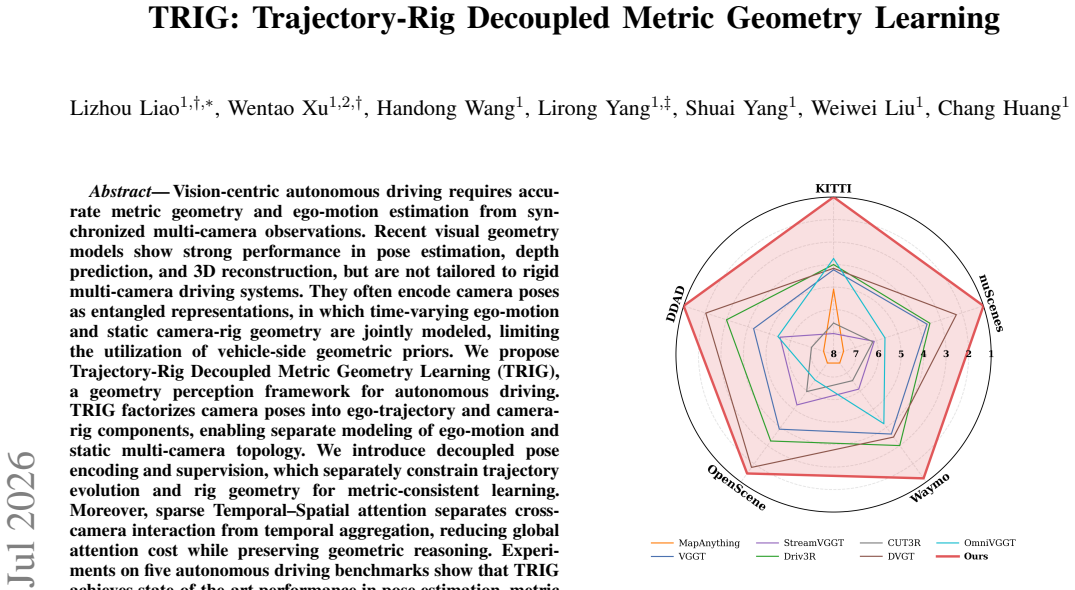
Vision-centric autonomous driving requires accurate metric geometry and ego-motion estimation from synchronized multi-camera observations. Recent visual geometry models show strong performance in pose estimation, depth prediction, and 3D reconstruction, but are not tailored to rigid multi-camera driving systems. They often encode camera poses as entangled representations, in which time-varying ego-motion and static camera-rig geometry are jointly modeled, limiting the utilization of vehicle-side geometric priors. We propose Trajectory-Rig Decoupled Metric Geometry Learning (TRIG), a geometry perception framework for autonomous driving. TRIG factorizes camera poses into ego-trajectory and camera-rig components, enabling separate modeling of ego-motion and static multi-camera topology. We introduce decoupled pose encoding and supervision, which separately constrain trajectory evolution and rig geometry for metric-consistent learning. Moreover, sparse Temporal--Spatial attention separates cross-camera interaction from temporal aggregation, reducing global attention cost while preserving geometric reasoning. Experiments on five autonomous driving benchmarks show that TRIG achieves state-of-the-art performance in pose estimation, metric depth prediction, and 3D reconstruction.
Figures


discussion (0)
Sign in with ORCID, Apple, or X to comment. Anyone can read and Pith papers without signing in.