REVIEW 1 major objections 2 minor 2 cited by
Unbiased extremal rank-one measurements generate up to the maximum possible quantum randomness in dimensions with SICs.
Reviewed by Pith at T0; open to challenge. T0 means a machine referee read the full paper against a public rubric. the ladder, T0–T4 →
T0 review · grok-4.3
2026-05-20 10:08 UTC pith:TN2CVVNF
load-bearing objection This paper gives an explicit characterization of randomness from unbiased extremal rank-one measurements in dimension two and shows SICs reach the maximum 2 log d bits where they exist. the 1 major comments →
Quantum randomness beyond projective measurements
The pith
A machine-rendered reading of the paper's core claim, the machinery that carries it, and where it could break.
Core claim
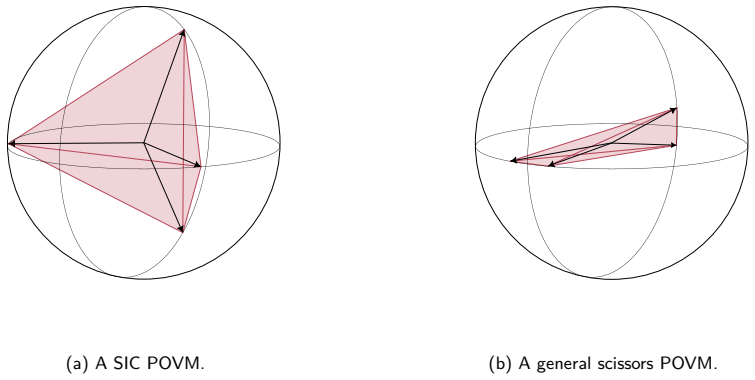
We characterise the randomness generated by any unbiased extremal rank-one measurement acting on any state, solving the problem explicitly in dimension two. Four-outcome qubit measurements of this type are tomographic, so these results hold for fully source-device-dependent randomness too. The tetrahedral symmetric informationally complete (SIC) measurement has the least intrinsic randomness within this class. We also present the skewed SIC family of measurements, and use them to partially solve an open problem: we prove that 2 log d bits of randomness, the maximal amount, can be generated device-dependently (or source-device-independently) in any dimension in which there exists a SIC.
What carries the argument
Guessing probability optimization for unbiased extremal rank-one POVMs, which bounds an eavesdropper's best guess of the outcomes.
Load-bearing premise
Extremal measurements do not allow information to leak to an eavesdropper in the adversarial scenario.
What would settle it
An explicit calculation or experiment that finds a higher optimal guessing probability for any unbiased extremal rank-one POVM on a qubit than the value derived in the characterization.
If this is right
- Four-outcome unbiased extremal rank-one measurements on qubits are tomographic and therefore certify randomness even in fully source-device-dependent scenarios.
- The tetrahedral SIC achieves the minimum randomness among all such four-outcome qubit measurements.
- The skewed SIC family enables construction of protocols that reach the absolute maximum of 2 log d bits whenever a SIC exists.
- Maximal randomness extraction holds in both device-dependent and source-device-independent settings for these measurements.
Where Pith is reading between the lines
- The explicit qubit formulas could be used to select measurements that maximize certified randomness output in practical random number generators.
- Analogous characterizations for biased or non-rank-one POVMs would extend the current bounds to a wider class of measurements.
- If SICs exist in every dimension, the result would imply that maximal randomness is always attainable with this type of measurement.
Editorial analysis
A structured set of objections, weighed in public.
Referee Report
Summary. The manuscript characterizes the intrinsic randomness (via guessing probability in an adversarial setting) generated by unbiased extremal rank-one POVMs acting on arbitrary states. It provides an explicit solution to this problem in dimension two. It introduces the skewed SIC family of measurements and proves that SIC measurements achieve the maximal 2 log d bits of randomness (device-dependently or source-device-independently) in any dimension admitting a SIC.
Significance. If the central derivations hold, the work constitutes a concrete step toward quantifying randomness from non-projective extremal measurements. The d=2 solution and the SIC-based construction for maximal randomness supply explicit, usable results for randomness extraction protocols in quantum information. The approach relies on standard quantum information tools (guessing-probability optimization over extremal POVMs) with no free parameters or invented entities.
major comments (1)
- [d=2 characterization section] The explicit solution for d=2 (stated in the abstract and presumably derived in the main text) is load-bearing for the claim that four-outcome qubit measurements are tomographic; the derivation should explicitly verify that the unbiased rank-one extremal condition suffices to close the optimization without additional assumptions on the state.
minor comments (2)
- [Introduction] The abstract and introduction would benefit from a brief statement of the open problem being partially solved, with a forward reference to the relevant theorem or proposition.
- [Skewed SIC section] Notation for the skewed SIC family should be introduced with a clear definition (e.g., via a parameter or equation) before its use in the maximal-randomness construction.
Simulated Author's Rebuttal
We thank the referee for their careful reading of the manuscript, positive evaluation of its significance, and recommendation for minor revision. We address the single major comment below.
read point-by-point responses
-
Referee: [d=2 characterization section] The explicit solution for d=2 (stated in the abstract and presumably derived in the main text) is load-bearing for the claim that four-outcome qubit measurements are tomographic; the derivation should explicitly verify that the unbiased rank-one extremal condition suffices to close the optimization without additional assumptions on the state.
Authors: We appreciate the referee highlighting the need for explicit verification here. In the d=2 section, the guessing probability is optimized by parameterizing all unbiased extremal rank-one POVMs (which in dimension 2 are necessarily four-outcome) and then minimizing the maximum eigenvalue of the associated operator over all input states. The unbiasedness condition fixes the trace of each element to 1/4, while extremality and rank-one together constrain the possible directions such that the convex optimization over states closes without requiring any further restrictions (e.g., no purity or eigenstate assumptions). In the revised manuscript we have inserted a short clarifying paragraph immediately after the main derivation that makes this closure explicit, thereby confirming that the tomographic property holds for arbitrary states and that the randomness quantification is fully source-device-dependent. revision: yes
Circularity Check
No significant circularity detected
full rationale
The paper's central results follow from an explicit analytic characterization of the guessing probability for unbiased extremal rank-one POVMs (solved in d=2) together with a direct construction showing that SIC measurements saturate the 2 log d bound in dimensions where they exist. These steps rest on the standard SDP formulation of the adversarial guessing probability, the stated premises of unbiasedness and rank-one extremality, and known properties of SIC POVMs; none of the load-bearing claims reduce by construction to fitted parameters, self-definitions, or unverified self-citations. The derivation is therefore self-contained against external quantum-information benchmarks.
Axiom & Free-Parameter Ledger
axioms (1)
- domain assumption Quantum mechanics framework for states, POVMs, and adversarial randomness quantification via guessing probability
Cite this review
Pith. "Pith review of Quantum randomness beyond projective measurements." pith.science (2026). https://pith.science/paper/TN2CVVNF
@misc{pith2026260518291,
  author       = {Pith},
  title        = {Pith review of: Quantum randomness beyond projective measurements},
  year         = {2026},
  howpublished = {\url{https://pith.science/paper/TN2CVVNF}},
  note         = {Machine review of arXiv:2605.18291}
}
read the original abstract
The unpredictability of quantum physics gives rise to intrinsic randomness. In an adversarial scenario, any additional degrees of freedom must be attributed to an eavesdropper with correlations to the measurement set-up. The true randomness is then quantified by the probability that she correctly guesses the measurement outcomes, optimised over all possible strategies. Extremal measurements are appealing here, since they do not allow information to leak to such an eavesdropper. Beyond projective measurements, however, a simple question remains open: how much intrinsic randomness can be generated by a given extremal measurement? In a step towards solving it, we characterise the randomness generated by any unbiased extremal rank-one measurement acting on any state, solving the problem explicitly in dimension two. Four-outcome qubit measurements of this type are tomographic, so these results hold for fully source-device-dependent randomness too. The tetrahedral symmetric informationally complete (SIC) measurement, we find, has the least intrinsic randomness within this class. We also present the skewed SIC family of measurements, and use them to partially solve an open problem: we prove that $2 \log d$ bits of randomness, the maximal amount, can be generated device-dependently (or source-device-independently) in any dimension in which there exists a SIC measurement.
Figures



Lean theorems connected to this paper
-
IndisputableMonolith/Cost/FunctionalEquation.leanwashburn_uniqueness_aczel unclear?
unclearRelation between the paper passage and the cited Recognition theorem.
Pguess(ρ,M) = d/n max_σ∈P F(ρ,σ) ... unbiased extremal rank-one POVM
-
IndisputableMonolith/Foundation/RealityFromDistinction.leanreality_from_one_distinction unclear?
unclearRelation between the paper passage and the cited Recognition theorem.
skewed SIC family ... 2 log d bits ... SIC measurement
What do these tags mean?
- matches
- The paper's claim is directly supported by a theorem in the formal canon.
- supports
- The theorem supports part of the paper's argument, but the paper may add assumptions or extra steps.
- extends
- The paper goes beyond the formal theorem; the theorem is a base layer rather than the whole result.
- uses
- The paper appears to rely on the theorem as machinery.
- contradicts
- The paper's claim conflicts with a theorem or certificate in the canon.
- unclear
- Pith found a possible connection, but the passage is too broad, indirect, or ambiguous to say the theorem truly supports the claim.
Forward citations
Cited by 2 Pith papers
-
From minimal informationally complete measurements to orthocentric simplices and back again
A minimal informationally complete measurement is s-tight if and only if its suitably rescaled vectors form an acute orthocentric simplex centered at the origin, equivalent to homothetic self-duality.
-
Neural Network Learning of One-Bit Protocols for Qubit Measurement Simulation
One classical bit exactly simulates the continuous isotropic qubit POVM and highly accurately approximates finite symmetric equal-weight informationally complete POVMs via an analytical protocol distilled from neural ...
Reference graph
Works this paper leans on
-
[1]
Quantum random number generation
Xiongfeng Ma, Xiao Yuan, Zhu Cao, Bing Qi, and Zhen Zhang. “Quantum random number generation”. npj Quantum Information2(2016). arXiv:1510.08957
work page internal anchor Pith review Pith/arXiv arXiv 2016
-
[2]
Quantum Random Number Generators
Miguel Herrero-Collantes and Juan Carlos Garcia-Escartin. “Quantum random num- ber generators”. Reviews of Modern Physics89(2017). arXiv:1604.03304
work page internal anchor Pith review Pith/arXiv arXiv 2017
-
[3]
Vaisakh Mannalatha, Sandeep Mishra, and Anirban Pathak. “A comprehensive review of quantum random number generators: concepts, classification and the origin of randomness”. Quantum Information Processing22(2023). arXiv:2203.00261
-
[4]
Classical randomness in quantum measurements
Giacomo Mauro D’Ariano, Paoloplacido Lo Presti, and Paolo Perinotti. “Classical randomness in quantum measurements”. Journal of Physics A: Mathematical and General38, 5979–5991 (2005). arXiv:quant-ph/0408115
work page internal anchor Pith review Pith/arXiv arXiv 2005
-
[5]
Intrinsic random- ness under general quantum measurements
Hao Dai, Boyang Chen, Xingjian Zhang, and Xiongfeng Ma. “Intrinsic random- ness under general quantum measurements”. Phys. Rev. Res.5, 033081 (2023). arXiv:2203.08624
-
[6]
Quantifying the intrin- sic randomness of quantum measurements
Gabriel Senno, Thomas Strohm, and Antonio Acín. “Quantifying the intrin- sic randomness of quantum measurements”. Physical Review Letters131(2023). arXiv:2211.03581
-
[7]
Quantum randomness extraction for various levels of characterization of the devices
Yun Zhi Law, Le Phuc Thinh, Jean-Daniel Bancal, and Valerio Scarani. “Quantum randomness extraction for various levels of characterization of the devices”. Journal of Physics A: Mathematical and Theoretical47, 424028 (2014). arXiv:1401.4243
work page internal anchor Pith review Pith/arXiv arXiv 2014
-
[8]
The operational meaning of min- and max-entropy
Robert Konig, Renato Renner, and Christian Schaffner. “The operational mean- ing of min- and max-entropy”. IEEE Transactions on Information Theory55, 4337–4347 (2009). arXiv:0807.1338v2
work page internal anchor Pith review Pith/arXiv arXiv 2009
-
[9]
Security of quantum key distribution
Renato Renner. “Security of quantum key distribution” (2006). arXiv:quant- ph/0512258
-
[10]
Sampling of min-entropy relative to quantum knowledge
Robert Konig and Renato Renner. “Sampling of min-entropy relative to quan- tum knowledge”. IEEE Transactions on Information Theory57, 4760–4787 (2011). arXiv:0712.4291. 13
work page internal anchor Pith review Pith/arXiv arXiv 2011
-
[11]
Maximal intrinsic randomness of a quantum state
Shuyang Meng, Fionnuala Curran, Gabriel Senno, Victoria J. Wright, Máté Farkas, Valerio Scarani, and Antonio Acín. “Maximal intrinsic randomness of a quantum state”. Phys. Rev. A110, L010403 (2024). arXiv:2307.15708
-
[12]
How much secure random- ness is in a quantum state?
Kriss Gutierrez Anco, Tristan Nemoz, and Peter Brown. “How much secure random- ness is in a quantum state?” (2024). arXiv:2410.16447
- [13]
-
[14]
Maximal randomness from par- tially entangled states
Erik Woodhead, Jędrzej Kaniewski, Boris Bourdoncle, Alexia Salavrakos, Joseph Bowles, Antonio Acín, and Remigiusz Augusiak. “Maximal randomness from par- tially entangled states”. Physical Review Research2(2020). arXiv:1901.06912
-
[15]
Unbounded randomness from uncharacterized sources
Marco Avesani, Hamid Tebyanian, Paolo Villoresi, and Giuseppe Vallone. “Unbounded randomness from uncharacterized sources”. Communications Physics5(2022). arXiv:2010.05798
-
[16]
Tight informationally complete quantum measurements
A. J. Scott. “Tight informationally complete quantum measurements”. Journal of Physics A: Mathematical and General39, 13507–13530 (2006). arXiv:quant- ph/0604049v6
-
[17]
Neumark’s theorem and quantum inseparability
Asher Peres. “Neumark’s theorem and quantum inseparability”. Foundations of Physics20, 1441–1453 (1990)
work page 1990
-
[18]
Information-theoretical aspects of quantum measurement
E. Prugovečki. “Information-theoretical aspects of quantum measurement”. Int J Theor Phys16, 321–331 (1977)
work page 1977
-
[19]
Informationally complete sets of physical quantities
P. Busch. “Informationally complete sets of physical quantities”. Int J Theor Phys30, 1217–1227 (1991)
work page 1991
-
[20]
Unknown Quantum States: The Quantum de Finetti Representation
Carlton M. Caves, Christopher A. Fuchs, and Rüdiger Schack. “Unknown quantum states: The quantum de Finetti representation”. Journal of Mathematical Physics43, 4537–4559 (2002). arXiv:quant-ph/0104088v1
work page internal anchor Pith review Pith/arXiv arXiv 2002
-
[21]
Maximal device-independent randomness in every dimension
Máté Farkas, Jurij Volčič, Sigurd A. L. Storgaard, Ranyiliu Chen, and Laura Mančin- ska. “Maximal device-independent randomness in every dimension”. Nature Physics 22, 319–324 (2026). arXiv:2409.18916
-
[22]
The varieties of min- imal tomographically complete measurements
John B. DeBrota, Christopher A. Fuchs, and Blake C. Stacey. “The varieties of min- imal tomographically complete measurements”. International Journal of Quantum Information19, 2040005 (2021). arXiv:1812.08762
-
[23]
Grundzüge einer nichtkommutativen Designtheorie
Gerhard Zauner. “Grundzüge einer nichtkommutativen Designtheorie” (1999). PhD thesis, University of Vienna. English translation available, “Quantum designs: Foun- dations of a noncommutative design theory” (2011)
work page 1999
-
[24]
Symmetric Informationally Complete Quantum Measurements
Joseph M. Renes, Robin Blume-Kohout, A. J. Scott, and Carlton M. Caves. “Sym- metric informationally complete quantum measurements”. Journal of Mathematical Physics45, 2171–2180 (2004). arXiv:quant-ph/0310075
work page internal anchor Pith review Pith/arXiv arXiv 2004
-
[25]
The SIC Question: History and State of Play
Christopher Fuchs, Michael Hoang, and Blake Stacey. “The SIC question: History and state of play”. Axioms6, 21 (2017). arXiv:1703.07901
work page internal anchor Pith review Pith/arXiv arXiv 2017
-
[26]
Quantum-Bayesian Coherence: The No-Nonsense Version
Christopher A. Fuchs and Rüdiger Schack. “Quantum-Bayesian coherence”. Reviews of Modern Physics85, 1693–1715 (2013). arXiv:1301.3274
work page internal anchor Pith review Pith/arXiv arXiv 2013
-
[27]
Equiangular spherical codes in quantum cryptography
J. M. Renes. “Equiangular spherical codes in quantum cryptography”. Quantum Information and Computation5, 80–91 (2005). arXiv:quant-ph/0409043
-
[28]
Efficient and Robust Quantum Key Distribution With Minimal State Tomography
Berthold-Georg Englert, Dagomir Kaszlikowski, Hui Khoon Ng, Wee Kang Chua, Jaroslav Řeháček, and Janet Anders. “Efficient and robust quantum key distribution with minimal state tomography” (2008). arXiv:quant-ph/0412075
work page internal anchor Pith review Pith/arXiv arXiv 2008
-
[29]
Frédéric Bouchard, Khabat Heshami, Duncan England, Robert Fickler, Robert W. Boyd, Berthold-Georg Englert, Luis L. Sánchez-Soto, and Ebrahim Karimi. “Exper- 14 imental investigation of high-dimensional quantum key distribution protocols with twisted photons”. Quantum2, 111 (2018). arXiv:1802.05773
work page internal anchor Pith review Pith/arXiv arXiv 2018
-
[30]
Optimal randomness certification from one entangled bit
Antonio Acín, Stefano Pironio, Tamás Vértesi, and Peter Wittek. “Optimal ran- domness certification from one entangled bit”. Physical Review A93(2016). arXiv:1505.03837
work page internal anchor Pith review Pith/arXiv arXiv 2016
-
[31]
Mutually unbiased bases and symmetric informationally complete mea- surements in Bell experiments
Armin Tavakoli, Máté Farkas, Denis Rosset, Jean-Daniel Bancal, and Jedrzej Kaniewski. “Mutually unbiased bases and symmetric informationally complete mea- surements in Bell experiments”. Science Advances7(2021). arXiv:1912.03225
-
[32]
Quantum And Relativistic Protocols For Secure Multi-Party Computation
Roger Colbeck. “Quantum and relativistic protocols for secure multi-party computa- tion” (2011). arXiv:0911.3814
work page internal anchor Pith review Pith/arXiv arXiv 2011
-
[33]
Random Numbers Certified by Bell's Theorem
S. Pironio, A. Acín, S. Massar, A. Boyer de la Giroday, D. N. Matsukevich, P. Maunz, S. Olmschenk, D. Hayes, L. Luo, T. A. Manning, and C. Monroe. “Random numbers certified by Bell’s theorem”. Nature464, 1021–1024 (2010). arXiv:0911.3427
work page internal anchor Pith review Pith/arXiv arXiv 2010
-
[34]
Source-independent quantum random number generation
Zhu Cao, Hongyi Zhou, Xiao Yuan, and Xiongfeng Ma. “Source-independent quantum random number generation”. Physical Review X6(2016). arXiv:1508.04880v2
work page internal anchor Pith review Pith/arXiv arXiv 2016
-
[35]
Source-device-independent Ultra-fast Quantum Random Number Generation
Davide G. Marangon, Giuseppe Vallone, and Paolo Villoresi. “Source-device- independent ultrafast quantum random number generation”. Physical Review Letters 118(2017). arXiv:1509.07390
work page internal anchor Pith review Pith/arXiv arXiv 2017
-
[36]
Secure heterodyne-based quantum random number generator at 17 Gbps
Marco Avesani, Davide G. Marangon, Giuseppe Vallone, and Paolo Villoresi. “Source- device-independent heterodyne-based quantum random number generator at 17 gbps”. Nature Communications9(2018). arXiv:1801.04139
work page internal anchor Pith review Pith/arXiv arXiv 2018
-
[37]
Unification of different views of decoherence and discord
Patrick J. Coles. “Unification of different views of decoherence and discord”. Physical Review A85(2012). arXiv:1110.1664
work page internal anchor Pith review Pith/arXiv arXiv 2012
-
[38]
Secure self-calibrating quantum random bit generator
M. Fiorentino, C. Santori, S. M. Spillane, R. G. Beausoleil, and W. J. Munro. “Se- cure self-calibrating quantum random-bit generator”. Physical Review A75(2007). arXiv:quant-ph/0612112
work page internal anchor Pith review Pith/arXiv arXiv 2007
-
[39]
Informationally complete measurements and groups representation
G. M. D’Ariano, P. Perinotti, and M. F. Sacchi. “Informationally complete measure- ments and group representation”. Journal of Optics B: Quantum and Semiclassical Optics6(2004). arXiv:quant-ph/0310013
work page internal anchor Pith review Pith/arXiv arXiv 2004
-
[40]
Welch bounds and quantum state tomography
Aleksandrs Belovs. “Welch bounds and quantum state tomography” (2008). Master’s thesis, University of Waterloo
work page 2008
-
[41]
The monomial representations of the Clifford group
D. Markus Appleby, Ingemar Bengtsson, Stephen Brierley, Markus Grassl, David Gross, and Jan-Åke Larsson. “The monomial representations of the Clifford group”. Quantum Information and Computation12, 404–431 (2012). arXiv:1102.1268v2
-
[42]
Stephen Boyd and Lieven Vandenberghe. “Convex optimization”. Cambridge Univer- sity Press. (2004)
work page 2004
-
[43]
Semidefinite programming in quantum in- formation science
Paul Skrzypczyk and Daniel Cavalcanti. “Semidefinite programming in quantum in- formation science”. 2053-2563. IOP Publishing. (2023)
work page 2053
-
[44]
The theory of quantum information
John Watrous. “The theory of quantum information”. Cambridge University Press. Cambridge (2018)
work page 2018
-
[45]
Interior-point polynomial algorithms in convex programming
Yurii Nesterov and Arkadii Nemirovskii. “Interior-point polynomial algorithms in convex programming”. Society for Industrial and Applied Mathematics. (1994)
work page 1994
-
[46]
Maximum Confidence Quantum Measurements
SarahCroke, ErikaAndersson, StephenM.Barnett, ClaireR.Gilson, andJohnJeffers. “Maximum confidence quantum measurements”. Physical Review Letters96(2006). arXiv:quant-ph/0604026v1
work page internal anchor Pith review Pith/arXiv arXiv 2006
-
[47]
Geometry of quantum states: An intro- duction to quantum entanglement
Ingemar Bengtsson and Karol Życzkowski. “Geometry of quantum states: An intro- duction to quantum entanglement”. Cambridge University Press. Cambridge (2017). 2nd edition. 15
work page 2017
-
[48]
Properties of QBist State Spaces
D. M. Appleby, Åsa Ericsson, and Christopher A. Fuchs. “Properties of Qbist state spaces”. Foundations of Physics41, 564–579 (2011). arXiv:0910.2750. A Optimisation problems A.1 Vector optimisation Following [42], we can write an optimisation problem in standard form as minimizex f0(x) subject tog i(x) = 0for alli, hj(x)≤0for allj, (50) where the function...
work page internal anchor Pith review Pith/arXiv arXiv 2011
-
[49]
By(139), the remaining vectors must have the form ⃗ r3 = (x3, y3, z3) ⃗ r4 = (2 cosδ−x3,−y3,−z3). (143) 27 Applying |⃗ r3|2 =|⃗ r4|2 = 1,(144) we find x3 = cosδ, y 2 3 +z 2 3 = sin2δ.(145) Without loss of generality, we can then write y3 =−sinδsinα, z3 =±sinδcosα(146) for some angle−π 2 <α< π
-
[50]
The final vectors are then ⃗ r3 = (cosδ,−sinδsinα,sinδcosα) ⃗ r4 = (cosδ,sinδsinα,−sinδcosα)
We take the liberty of choosing the positive sign forz3 such that⃗ r3 lives in the upper hemisphere of the Bloch sphere. The final vectors are then ⃗ r3 = (cosδ,−sinδsinα,sinδcosα) ⃗ r4 = (cosδ,sinδsinα,−sinδcosα). (147) From(138), the volume of the polytope is Vol(P) = 4 3 sin2δcosδcosα,(148) which is nonzero in the range0< δ <π 2 and−π 2 < α <π 2, so al...
discussion (0)
Sign in with ORCID, Apple, or X to comment. Anyone can read and Pith papers without signing in.