Probing inflationary particle production with the CMB power spectrum
Pith reviewed 2026-06-26 04:18 UTC · model grok-4.3
The pith
A burst of particle production during inflation imprints features in the CMB power spectrum that joint Planck and ACT data mildly prefer at 2 sigma.
A machine-rendered reading of the paper's core claim, the machinery that carries it, and where it could break.
Core claim
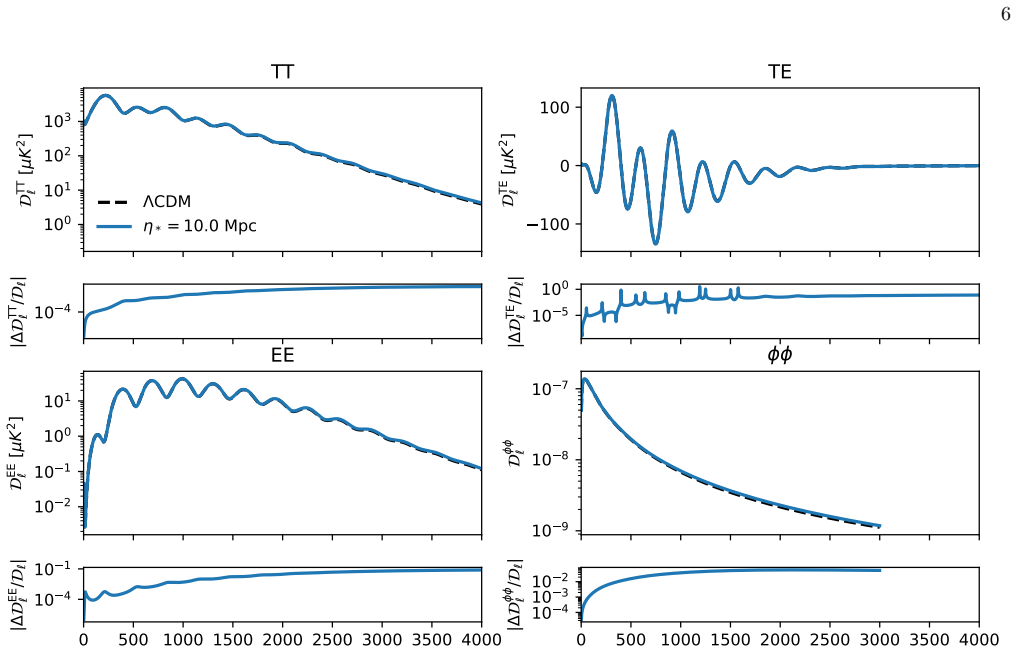
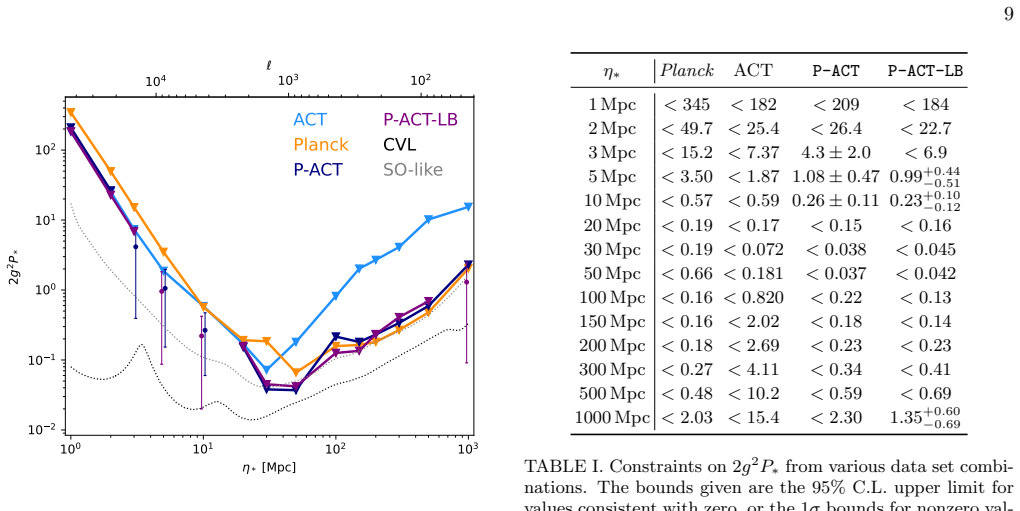
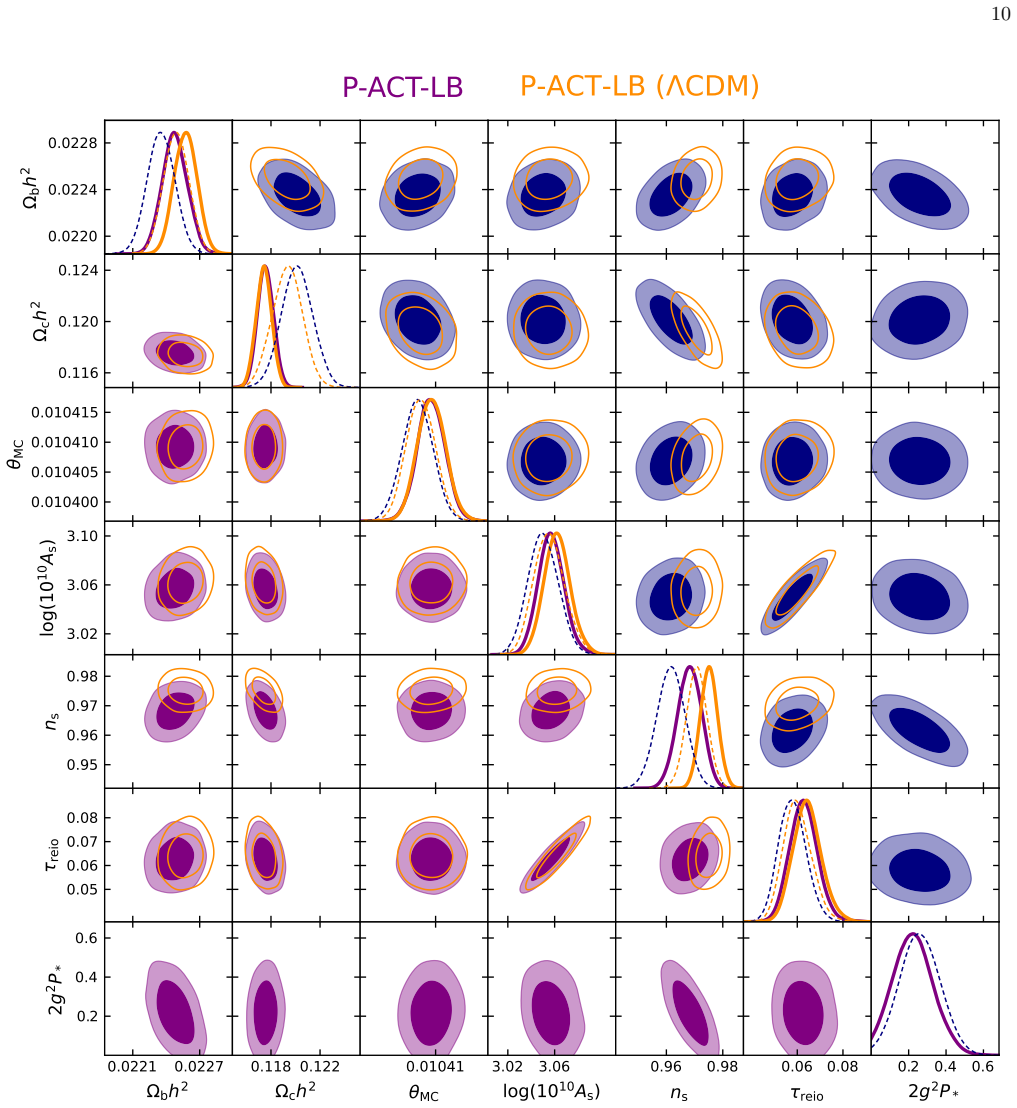
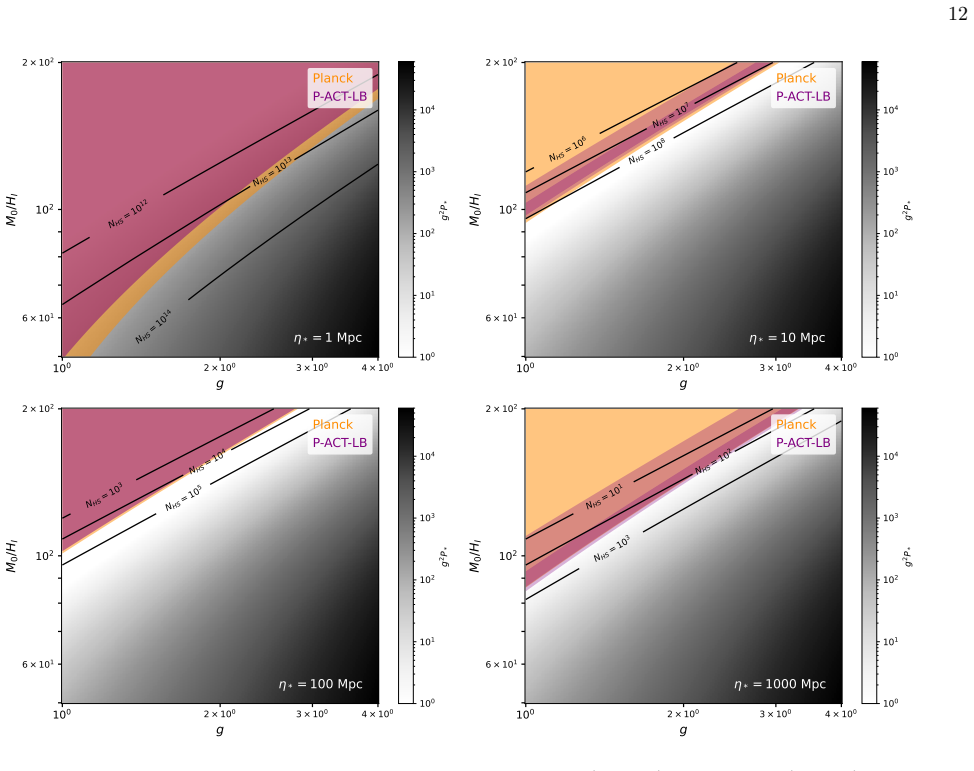
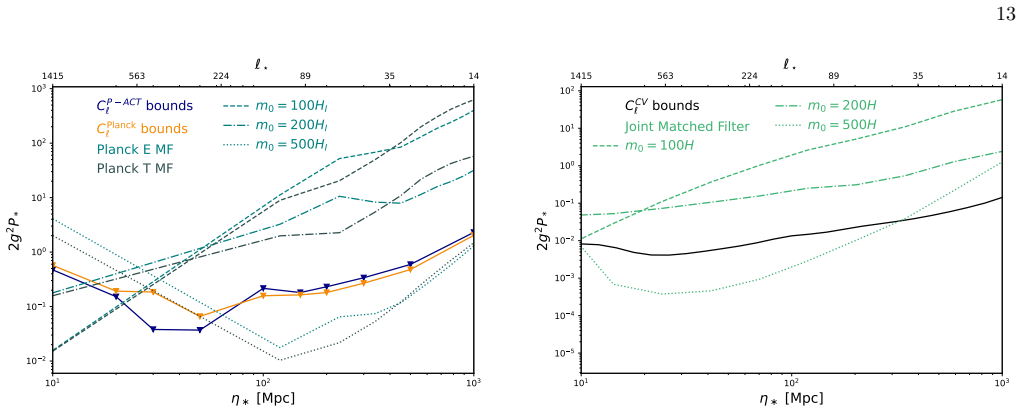
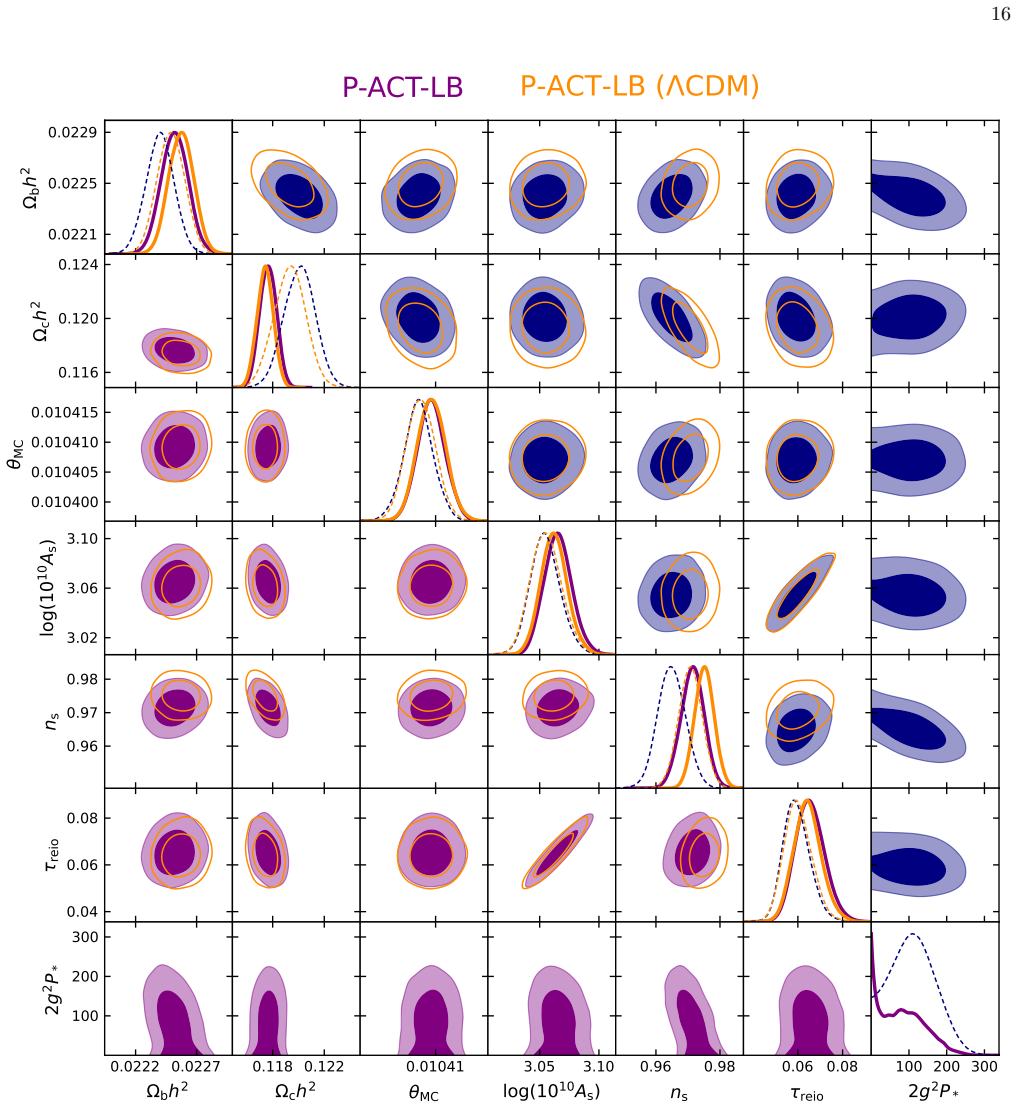
In this model the inflaton couples to a field with mass much larger than the inflationary Hubble scale, producing particles in a single burst at conformal time η*. The resulting temperature and polarization two-point functions are computed exactly and compared directly to Planck and ACT power-spectrum measurements. The joint analysis yields a mild ~2σ hint for the model when 3 Mpc ≤ η* ≤ 10 Mpc, with no comparable preference in either dataset taken separately. The power-spectrum constraints are more than an order of magnitude tighter than matched-filter bounds for particle masses below roughly 200 H_I, while a Fisher forecast shows that a Simons Observatory-like experiment would reach 3-5σ s
What carries the argument
The burst particle-production event at a single conformal time η*, which sources localized features in the CMB temperature and polarization power spectra.
If this is right
- Joint analysis of Planck and ACT data is required to see the 2σ hint; neither dataset alone shows it.
- The power-spectrum approach yields constraints more than ten times stronger than matched filters when the particle mass is below 200 H_I.
- A Simons Observatory-like experiment is forecast to detect the features at 3-5σ if they are real.
- In the high-mass regime where particle production is rare, matched-filter methods remain stronger than the power-spectrum search.
- The model can be tested on smaller angular scales using ACT data in addition to Planck.
Where Pith is reading between the lines
- Adding polarization-only or cross-spectrum analyses could help separate the signal from possible foreground mimics.
- The hinted scale range 3-10 Mpc may map onto specific predictions from concrete microphysical inflation models that could be checked independently.
- If the signal is confirmed, it would directly constrain the existence and coupling of heavy fields during inflation.
- Extending the search to higher-resolution data or combining with non-Gaussianity measurements could test whether the feature is unique to this mechanism.
Load-bearing premise
Any feature detected in the power spectrum must be produced exclusively by this particle-production burst and cannot be mimicked by foregrounds, systematics, or other inflationary dynamics.
What would settle it
A Simons Observatory-like survey that measures the CMB power spectrum to the forecasted precision and finds no evidence for the predicted features at 3-5 sigma would rule out the signal at the level of the current mild hint.
Figures
read the original abstract
Particle production is common to many microphysical models of inflation and can imprint observable features in the cosmic microwave background (CMB) anisotropies. We consider a scenario in which the inflaton couples to an extremely massive field ($m_\chi \gtrsim \mathcal{O}(100 H_I)$, where $H_I$ is the inflationary Hubble scale). In this model, particle production happens in a burst at a characteristic conformal time, $\eta_*$, which sources localized features in the CMB. In this paper, we compute the full temperature and polarization two-point functions for this model. We then search for these features in CMB power spectrum data from Planck and the Atacama Cosmology Telescope (ACT), with the latter allowing access to features on smaller angular scales. In the joint analysis of Planck and ACT data, we find a mild $\sim 2 \sigma$ hint for a signal induced by this inflationary model on scales $3 \,\, \text{Mpc}\leq\eta_*\leq 10 \,\, \text{Mpc}$, though this hint is not present at a statistically significant level in either dataset when analyzed individually. Using a Fisher forecast, we find that these features should be observable at the $3-5\sigma$ level for a Simons Observatory-like experiment, if they are indeed real. We also compare our power-spectrum-based constraints to previous matched-filter-based bounds on this model. For sufficiently light particles ($m_\chi \lesssim 200 H_I$), the power spectrum yields tighter constraints by more than an order of magnitude, but in the higher-mass regime where particle production is rare, the matched-filter approach provides stronger bounds.
Editorial analysis
A structured set of objections, weighed in public.
Referee Report
Summary. The paper computes the full temperature and polarization CMB power spectra induced by a burst of particle production from a massive field (mχ ≳ 100 HI) during inflation at a characteristic conformal time η∗. It fits this model to Planck and ACT data, reporting a mild ∼2σ preference for η∗ in 3–10 Mpc only in the joint analysis (absent individually), provides a Fisher forecast showing 3–5σ detectability with a Simons Observatory-like experiment, and compares power-spectrum constraints to prior matched-filter bounds, finding the former tighter for mχ ≲ 200 HI.
Significance. If the joint hint proves robust to systematics and alternative templates, the work would be significant for constraining microphysical inflationary models via localized CMB features. The computation of the full TT/EE spectra and the regime-dependent comparison to matched-filter methods are strengths; the Fisher forecast is standard but useful for planning.
major comments (2)
- [Abstract / joint analysis] Abstract and joint-analysis results: the ∼2σ hint for the specific burst-production model is reported only in the combined Planck+ACT fit and disappears when datasets are analyzed separately. This is load-bearing for interpreting the result as even a mild hint, because the model power spectrum is compared directly to the data without additional marginalization over dataset-specific systematics, calibration differences, or alternative localized-feature templates.
- [Methods / data analysis] Analysis description: no nuisance parameters are introduced to account for possible foreground leakage, beam/calibration residuals in ACT, or Planck foreground modeling differences when fitting the particle-production template. This assumption that any detected feature arises solely from the burst mechanism is central to the claim and requires explicit checks or marginalization.
minor comments (2)
- [Abstract] The abstract states the hint is 'not present at a statistically significant level' individually but does not quote the individual posterior significances or Δχ² values; adding these numbers would improve clarity.
- [Introduction] Notation for the mass ratio mχ/HI and the scale η∗ should be defined at first use in the main text with explicit units.
Simulated Author's Rebuttal
We thank the referee for the detailed and constructive report. We address each major comment below and will revise the manuscript accordingly to improve clarity on the joint-analysis interpretation and the treatment of systematics.
read point-by-point responses
-
Referee: [Abstract / joint analysis] Abstract and joint-analysis results: the ∼2σ hint for the specific burst-production model is reported only in the combined Planck+ACT fit and disappears when datasets are analyzed separately. This is load-bearing for interpreting the result as even a mild hint, because the model power spectrum is compared directly to the data without additional marginalization over dataset-specific systematics, calibration differences, or alternative localized-feature templates.
Authors: We agree that the mild ~2σ preference is reported only in the joint fit and is absent individually; this is already stated explicitly in the abstract and Section 4. To address the concern, we will expand the discussion in the results section to include a quantitative assessment of dataset tension (e.g., via posterior predictive checks) and add a new subsection testing robustness against alternative localized-feature templates. We will also emphasize that the result remains a mild hint requiring confirmation with future data. These additions will be made without altering the reported significance. revision: partial
-
Referee: [Methods / data analysis] Analysis description: no nuisance parameters are introduced to account for possible foreground leakage, beam/calibration residuals in ACT, or Planck foreground modeling differences when fitting the particle-production template. This assumption that any detected feature arises solely from the burst mechanism is central to the claim and requires explicit checks or marginalization.
Authors: The public Planck and ACT likelihoods already marginalize over their standard nuisance parameters for foregrounds, beams, and calibration. However, we did not introduce additional parameters to capture possible residuals specific to the burst template. We will revise the methods section to explicitly state this and add robustness tests: (i) repeating the fit with varied ACT calibration priors and (ii) including a simple extra nuisance term for a possible additive feature-like residual. These checks will be presented in a new appendix. revision: yes
Circularity Check
No circularity: model spectra derived from first principles then fitted to external data
full rationale
The paper derives the temperature and polarization power spectra directly from the burst particle-production Lagrangian and inflaton coupling, then performs a standard likelihood fit of the single parameter η* to Planck and ACT spectra. The reported ~2σ joint hint is the output of that external-data fit, not a quantity that reduces to the input equations by construction. No self-citation is invoked to justify a uniqueness theorem, ansatz, or load-bearing premise, and the comparison to prior matched-filter bounds is presented only as a consistency check rather than as the foundation of the result. The derivation chain is therefore self-contained against external benchmarks.
Axiom & Free-Parameter Ledger
free parameters (2)
- η∗
- mχ / HI
Reference graph
Works this paper leans on
-
[1]
in-in” formalism, as described in Appendix A. Our formalism bears sim- ilarity to the astrophysical “halo model
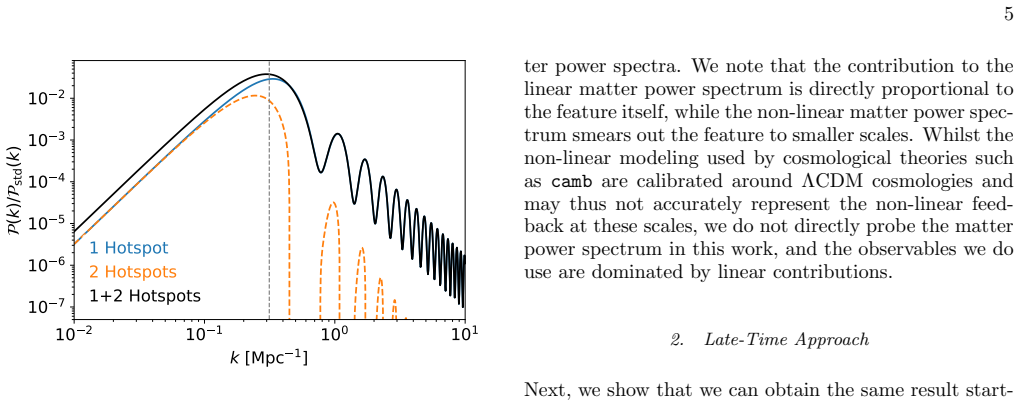
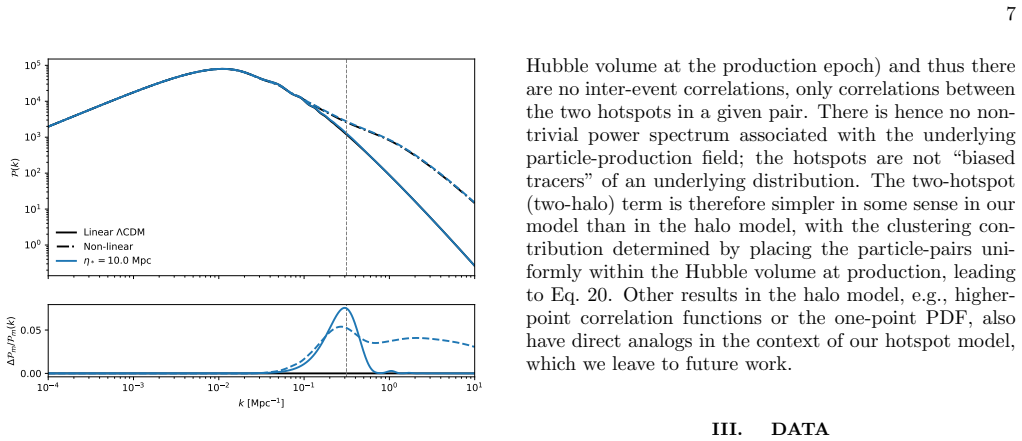
Primordial Approach We start by deriving the contribution of massive par- ticles to the primordial power spectrum. The produc- tion of particles is treated as Poissonian and is, at least to leading order, uncorrelated with inflaton fluctuations. As noted above, conservation of momentum implies that each production event creates two massive particles; thus...
-
[2]
late time
Late-Time Approach Next, we show that we can obtain the same result start- ing from the late-time temperature field and adding spa- tially local (pairwise) hotspots. This approach connects cleanly to the position-space searches considered in pre- vious works [e.g., 1, 15]. From Sec. VIII of [1], the contribution of a single hotspot at positionx HS to the ...
2000
-
[3]
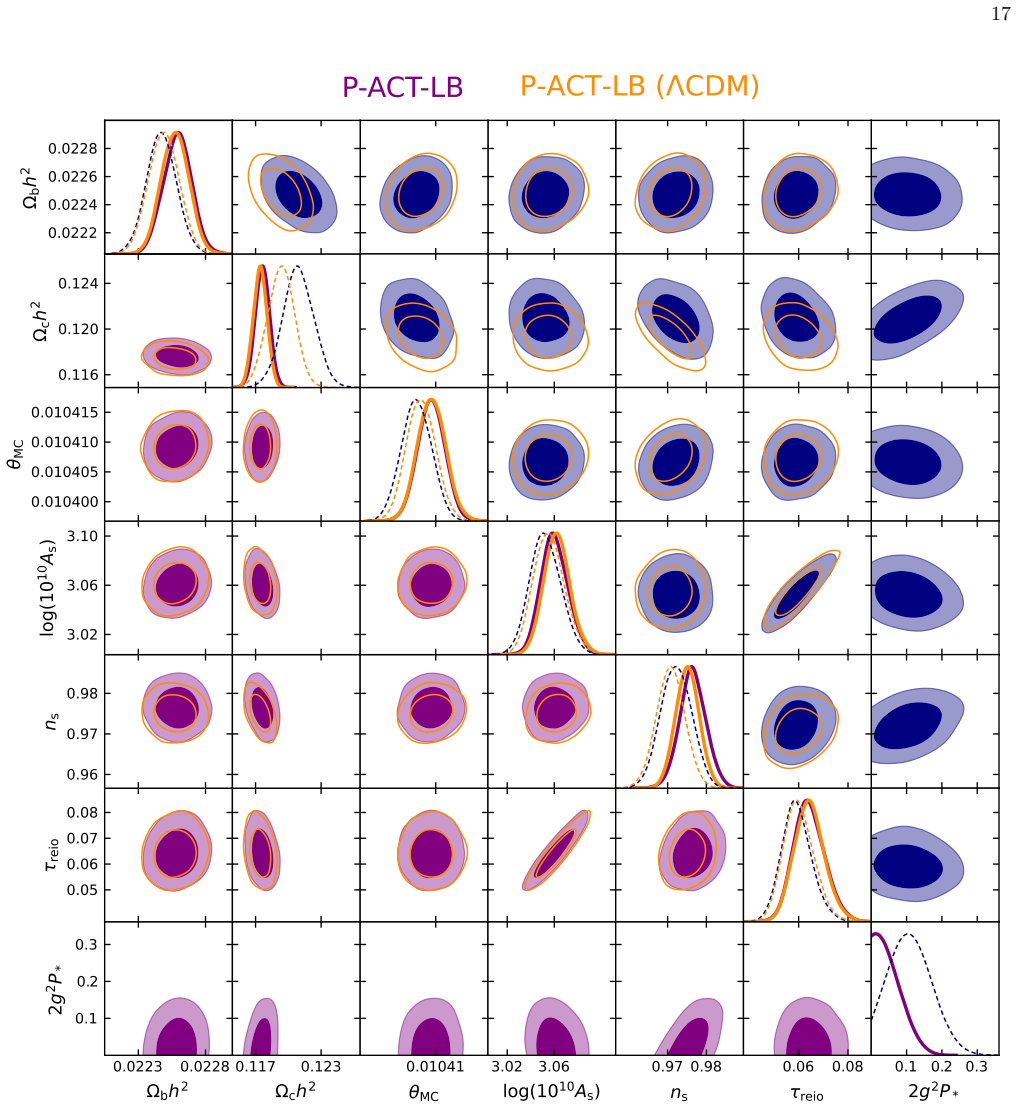
L. H. A. El-Haj, O. H. E. Philcox, and J. C. Hill, Constraining inflationary particle production with CMB polarization, Phys. Rev. D113, 103518 (2026), 16 0.0222 0.0227 bh2 100 200 300 2g2P* 0.04 0.06 0.08 reio 0.96 0.97 0.98 ns 3.02 3.06 3.10 log(1010As) 0.010400 0.010405 0.010410 0.010415 MC 0.116 0.120 0.124 ch2 0.118 0.122 ch2 0.01041 MC 3.05 3.10 log...
Pith/arXiv arXiv 2026
-
[4]
N. Arkani-Hamed and J. Maldacena, Cosmological col- lider physics (2015), arXiv:1503.08043 [hep-th]
Pith/arXiv arXiv 2015
-
[5]
O. H. E. Philcox, Searching for inflationary physics with the cmb trispectrum: 1. primordial theory & optimal es- timators (2025), arXiv:2502.04434 [astro-ph.CO]
arXiv 2025
-
[6]
Sohn, D.-G
W. Sohn, D.-G. Wang, J. R. Fergusson, and E. Shellard, Searching for cosmological collider in the planck cmb data, Journal of Cosmology and Astroparticle Physics 2024(09), 016
2024
-
[7]
Chen and Y
X. Chen and Y. Wang, Quasi-single field inflation and non-gaussianities, Journal of Cosmology and Astroparti- cle Physics2010(04), 027–027
-
[8]
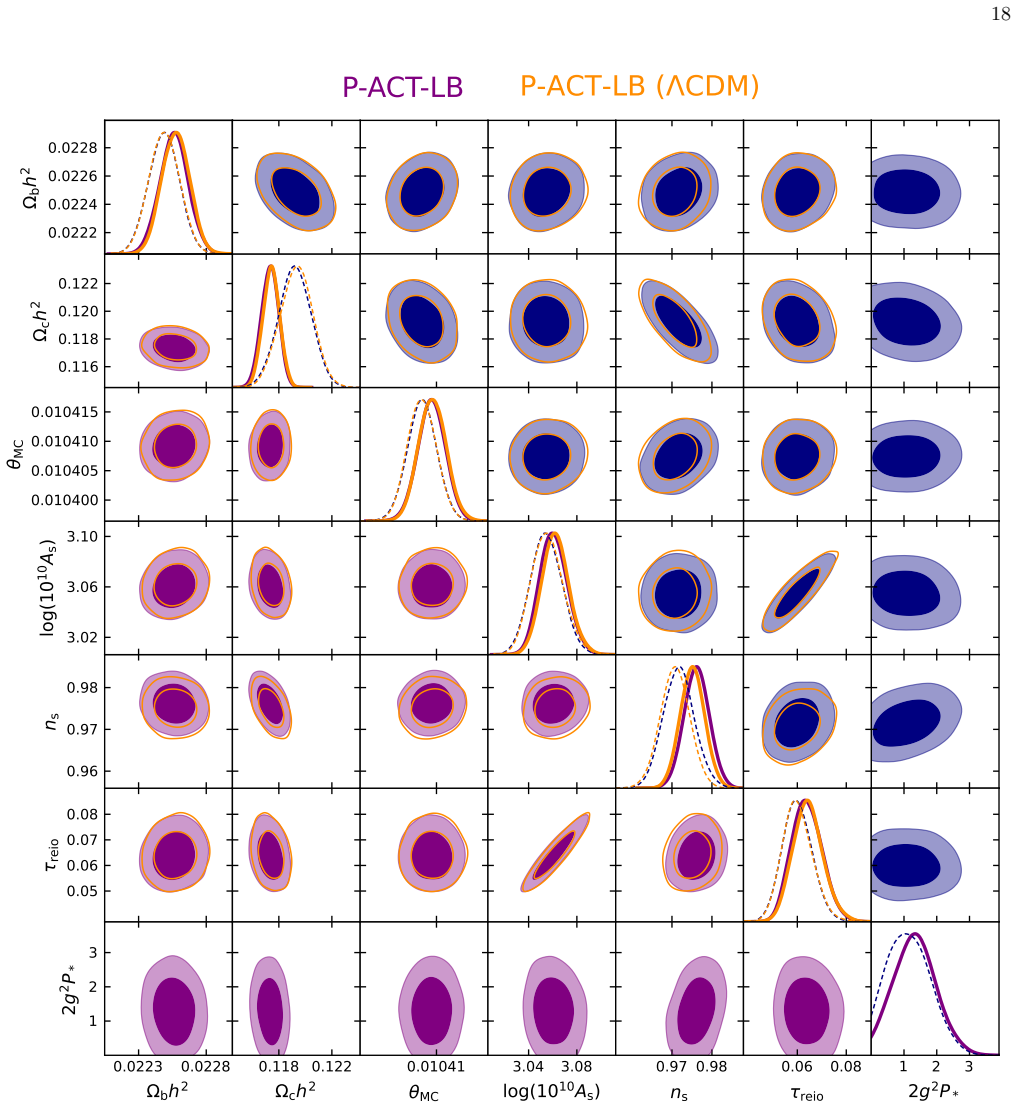
H. Lee, D. Baumann, and G. L. Pimentel, Non- 17 0.0223 0.0228 bh2 0.1 0.2 0.3 2g2P* 0.05 0.06 0.07 0.08 reio 0.96 0.97 0.98 ns 3.02 3.06 3.10 log(1010As) 0.010400 0.010405 0.010410 0.010415 MC 0.116 0.120 0.124 ch2 0.117 0.123 ch2 0.01041 MC 3.02 3.06 log(1010As) 0.97 0.98 ns 0.06 0.08 reio 0.1 0.2 0.3 2g2P* 0.0222 0.0224 0.0226 0.0228 bh2 P-ACT-LB P-ACT-...
-
[9]
P. Suman, D.-G. Wang, W. Sohn, J. R. Fergusson, and E. P. S. Shellard, Searching for Cosmological Col- lider in the Planck CMB Data II: collider templates and Modal analysis, arXiv preprint arXiv:2512.22085 (2025), arXiv:2512.22085 [astro-ph.CO]
arXiv 2025
-
[10]
O. H. E. Philcox, What Shape is the Inflationary Bispectrum?, arXiv preprint arXiv:2603.17004 (2026), arXiv:2603.17004 [astro-ph.CO]
arXiv 2026
-
[11]
S. Kumar, Q. Lu, Z.-Z. Xianyu, and Y. Zhang, Scalars at the Cosmological Collider: Full Shapes of Tree Diagrams and Bispectrum Searches using Planck Data, arXiv preprint arXiv:2604.07434 (2026), arXiv:2604.07434 [hep-ph]
Pith/arXiv arXiv 2026
-
[12]
S. Kumar and N. Weiner, Early galaxies from rare 18 0.0223 0.0228 bh2 1 2 3 2g2P* 0.05 0.06 0.07 0.08 reio 0.96 0.97 0.98 ns 3.02 3.06 3.10 log(1010As) 0.010400 0.010405 0.010410 0.010415 MC 0.116 0.118 0.120 0.122 ch2 0.118 0.122 ch2 0.01041 MC 3.04 3.08 log(1010As) 0.97 0.98 ns 0.06 0.08 reio 1 2 3 2g2P* 0.0222 0.0224 0.0226 0.0228 bh2 P-ACT-LB P-ACT-LB...
arXiv 2025
-
[13]
T. Kim, J. H. Kim, S. Kumar, A. Martin, M. M¨ unchmeyer, and Y. Tsai, Probing cosmological particle production and pairwise hotspots with deep neural networks, Phys. Rev. D108, 043525 (2023), arXiv:2303.08869 [hep-ph]
arXiv 2023
-
[14]
J. H. Kim, S. Kumar, A. Martin, and Y. Tsai, Cosmo- logical particle production and pairwise hotspots on the CMB, JHEP11, 158, arXiv:2107.09061 [hep-ph]
-
[15]
Flauger, M
R. Flauger, M. Mirbabayi, L. Senatore, and E. Sil- verstein, Productive interactions: heavy particles and non-gaussianity, Journal of Cosmology and Astroparti- cle Physics2017(10), 058–058
-
[16]
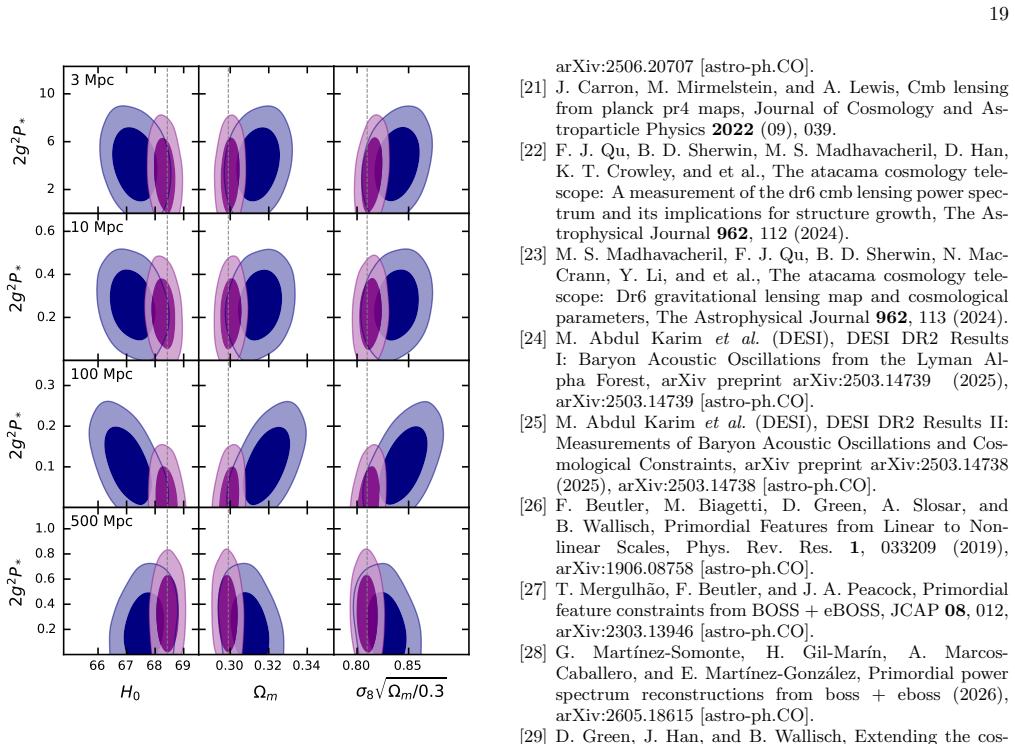
M. M¨ unchmeyer and K. M. Smith, Higher N-point func- tion data analysis techniques for heavy particle produc- 19 2 6 10 2g2P* 3 Mpc 0.2 0.4 0.6 2g2P* 10 Mpc 0.1 0.2 0.3 2g2P* 100 Mpc 66 67 68 69 H0 0.2 0.4 0.6 0.8 1.0 2g2P* 500 Mpc 0.30 0.32 0.34 m 0.80 0.85 8 m/0.3 FIG. 11. The effects of our primordial hotspot feature on H0, Ω m, andS 8. The scales cho...
arXiv 2019
-
[17]
O. H. E. Philcox, S. Kumar, and J. C. Hill, Searching for inflationary particle production in Planck data, Phys. Rev. D111, 103523 (2025), arXiv:2405.03738 [astro- ph.CO]
arXiv 2025
-
[18]
H. V. Peiriset al.(WMAP), First year Wilkinson Mi- crowave Anisotropy Probe (WMAP) observations: Im- plications for inflation, Astrophys. J. Suppl.148, 213 (2003), arXiv:astro-ph/0302225
Pith/arXiv arXiv 2003
-
[19]
cosmolog- ical parameters, A&A641, A6 (2020)
Planck Collaboration, Planck 2018 results - vi. cosmolog- ical parameters, A&A641, A6 (2020)
2018
-
[20]
constraints on inflation, A&A641, A10 (2020)
Planck Collaboration, Planck 2018 results - x. constraints on inflation, A&A641, A10 (2020)
2018
-
[21]
T. Louiset al.(ACT), The Atacama Cosmology Tele- scope: DR6 Power Spectra, Likelihoods and ΛCDM Parameters, arXiv preprint arXiv:2503.14452 (2025), arXiv:2503.14452 [astro-ph.CO]
Pith/arXiv arXiv 2025
-
[22]
E. Camphuiset al.(SPT-3G), SPT-3G D1: CMB tem- perature and polarization power spectra and cosmol- ogy from 2019 and 2020 observations of the SPT-3G Main field, arXiv preprint arXiv:2506.20707 (2025), arXiv:2506.20707 [astro-ph.CO]
Pith/arXiv arXiv 2019
-
[23]
Carron, M
J. Carron, M. Mirmelstein, and A. Lewis, Cmb lensing from planck pr4 maps, Journal of Cosmology and As- troparticle Physics2022(09), 039
-
[24]
F. J. Qu, B. D. Sherwin, M. S. Madhavacheril, D. Han, K. T. Crowley, and et al., The atacama cosmology tele- scope: A measurement of the dr6 cmb lensing power spec- trum and its implications for structure growth, The As- trophysical Journal962, 112 (2024)
2024
-
[25]
M. S. Madhavacheril, F. J. Qu, B. D. Sherwin, N. Mac- Crann, Y. Li, and et al., The atacama cosmology tele- scope: Dr6 gravitational lensing map and cosmological parameters, The Astrophysical Journal962, 113 (2024)
2024
-
[26]
M. Abdul Karimet al.(DESI), DESI DR2 Results I: Baryon Acoustic Oscillations from the Lyman Al- pha Forest, arXiv preprint arXiv:2503.14739 (2025), arXiv:2503.14739 [astro-ph.CO]
Pith/arXiv arXiv 2025
-
[27]
M. Abdul Karimet al.(DESI), DESI DR2 Results II: Measurements of Baryon Acoustic Oscillations and Cos- mological Constraints, arXiv preprint arXiv:2503.14738 (2025), arXiv:2503.14738 [astro-ph.CO]
Pith/arXiv arXiv 2025
-
[28]
F. Beutler, M. Biagetti, D. Green, A. Slosar, and B. Wallisch, Primordial Features from Linear to Non- linear Scales, Phys. Rev. Res.1, 033209 (2019), arXiv:1906.08758 [astro-ph.CO]
arXiv 2019
-
[29]
T. Mergulh˜ ao, F. Beutler, and J. A. Peacock, Primordial feature constraints from BOSS + eBOSS, JCAP08, 012, arXiv:2303.13946 [astro-ph.CO]
-
[30]
G. Mart´ ınez-Somonte, H. Gil-Mar´ ın, A. Marcos- Caballero, and E. Mart´ ınez-Gonz´ alez, Primordial power spectrum reconstructions from boss + eboss (2026), arXiv:2605.18615 [astro-ph.CO]
Pith/arXiv arXiv 2026
- [31]
-
[32]
E. Calabreseet al.(ACT), The Atacama Cosmology Telescope: DR6 Constraints on Extended Cosmologi- cal Models, arXiv preprint arXiv:2503.14454 (2025), arXiv:2503.14454 [astro-ph.CO]
Pith/arXiv arXiv 2025
-
[33]
Nerval and R
S. Nerval and R. Hloˇ zek, (in prep.)
-
[34]
A. Cooray and R. K. Sheth, Halo Models of Large Scale Structure, Phys. Rept.372, 1 (2002), arXiv:astro- ph/0206508
arXiv 2002
-
[35]
J. C. Hill and E. Pajer, Cosmology from the ther- mal sunyaev-zel’dovich power spectrum: Primordial non- gaussianity and massive neutrinos, Physical Review D 88, 10.1103/physrevd.88.063526 (2013)
-
[36]
Seljak, Analytic model for galaxy and dark matter clustering, Mon
U. Seljak, Analytic model for galaxy and dark matter clustering, Mon. Not. Roy. Astron. Soc.318, 203 (2000), arXiv:astro-ph/0001493
Pith/arXiv arXiv 2000
-
[37]
cmb power spectra and likelihoods, A&A641, A5 (2020)
Planck Collaboration, Planck 2018 results - v. cmb power spectra and likelihoods, A&A641, A5 (2020)
2018
-
[38]
Pagano, L., Delouis, J.-M., Mottet, S., Puget, J.-L., and Vibert, L., Reionization optical depth determination from planck hfi data with ten percent accuracy, A&A 635, A99 (2020)
2020
-
[39]
A. Lewis, A. Challinor, and A. Lasenby, Efficient com- putation of CMB anisotropies in closed FRW models, Astrophys. J.538, 473 (2000), arXiv:astro-ph/9911177
Pith/arXiv arXiv 2000
-
[40]
S. Choudhury, S. K. Singh, and S. K. Sahoo, Quintessen- tial inflation in light of act dr6 (2025), arXiv:2511.19898 [gr-qc]
arXiv 2025
-
[41]
E. McDonough and E. G. M. Ferreira, The spectrum ofn s constraints from desi and cmb data (2026), 20 arXiv:2512.05108 [astro-ph.CO]
arXiv 2026
-
[42]
J. Bezerra-Sobrinho and L. G. Medeiros, Starobinsky in- flation and the latest cmb data: A subtle tension? (2025), arXiv:2511.06640 [astro-ph.CO]
arXiv 2025
-
[43]
S. Maity, Act-ing on inflation: Implications of non bunch- davies initial condition and reheating on single-field slow roll models (2026), arXiv:2505.10534 [astro-ph.CO]
Pith/arXiv arXiv 2026
-
[44]
M. R. Haque and D. maity, Minimal plateau inflation in light of act dr6 observations (2025), arXiv:2505.18267 [astro-ph.CO]
arXiv 2025
-
[45]
N. Okada and O. Seto, Smooth hybrid inflation in light of act dr6 data, Physical Review D112, 10.1103/y9s8-7b5b (2025)
-
[46]
M. Lynker and R. Schimmrigk, Act implications for hill- top inflation (2025), arXiv:2507.15076 [astro-ph.CO]
arXiv 2025
-
[47]
D. Zharov, O. Sobol, and S. Vilchinskii, Act observations, reheating, and starobinsky and higgs inflation, Physical Review D112, 10.1103/km3q-rm34 (2025)
- [48]
-
[49]
M. M¨ unchmeyer and K. M. Smith, Fast Wiener fil- tering of CMB maps with Neural Networks, arXiv preprint arXiv:1905.05846 (2019), arXiv:1905.05846 [astro-ph.CO]
Pith/arXiv arXiv 1905
-
[50]
Maldacena, Non-gaussian features of primordial fluctu- ations in single field inflationary models, Journal of High Energy Physics2003, 013–013 (2003)
J. Maldacena, Non-gaussian features of primordial fluctu- ations in single field inflationary models, Journal of High Energy Physics2003, 013–013 (2003)
2003
discussion (0)
Sign in with ORCID, Apple, or X to comment. Anyone can read and Pith papers without signing in.