Constraining Inflationary Particle Production with CMB Polarization
Pith reviewed 2026-05-18 13:00 UTC · model grok-4.3
The pith
Planck polarization maps set new upper limits on how the inflaton couples to massive scalars produced during inflation.
A machine-rendered reading of the paper's core claim, the machinery that carries it, and where it could break.
Core claim
Using an adapted thermal Sunyaev-Zel'dovich cluster-finding pipeline and a full Poissonian likelihood on hotspot counts in Planck PR4 E-mode maps, the authors report no strong evidence for primordial hotspots and thereby obtain novel upper bounds on the couplings between the inflaton and massive scalars, improving previous limits by more than an order of magnitude for particles with M0 ≲ 100 HI.
What carries the argument
Adapted thermal Sunyaev-Zel'dovich cluster-finding pipeline combined with a new Poissonian likelihood for the number of localized hotspots.
Load-bearing premise
Any massive scalars produced during inflation create localized hot or cold spots whose statistical properties are accurately captured by the adapted cluster-finding pipeline and Poissonian likelihood without significant contamination or mismatch in the Planck PR4 E-mode maps.
What would settle it
A statistically significant excess of hotspots above the Poisson background expectation in the E-mode maps, or a mismatch between the observed size-brightness distribution of any candidate spots and the distribution predicted by the particle-production model.
Figures


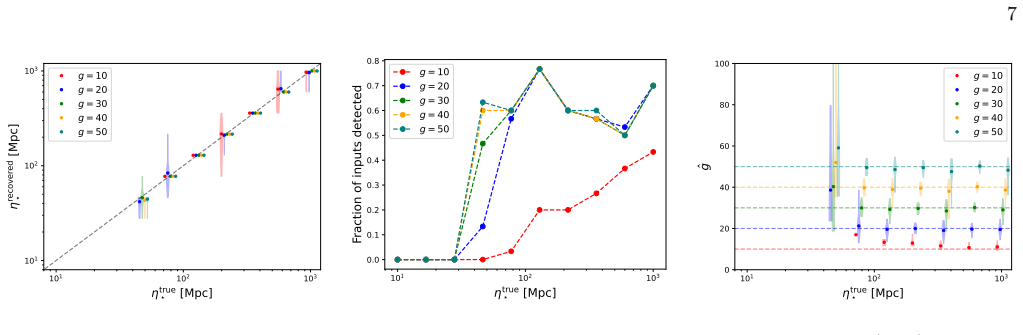


read the original abstract
Following Philcox et al. (2025), we investigate a scenario with a massive partner to the inflaton ($O(100)$ times the inflationary Hubble scale), in which particles are produced during a narrow time period, leaving characteristic hot- or cold-spots in the cosmic microwave background (CMB). Using tools developed for thermal Sunyaev-Zel'dovich cluster-finding, we search component-separated Planck PR4 $E$-mode maps for these hotspots, and compare to analogous results in $T$. Our analysis pipeline is validated on simulated observations and gives unbiased constraints for sufficiently large and bright hotspots. At Planck sensitivities, the temperature data are more sensitive to small hotspots, but for sufficiently large hotspots the polarization data are more sensitive. We improve upon earlier work by building a full Poissonian likelihood for the hotspot abundance. We find no strong evidence for primordial hotspots and thereby place novel bounds on the couplings between the inflaton and massive scalars during inflation, probing physics at energies many orders of magnitude above any feasible terrestrial collider. The bounds derived from our new likelihood improve upon those of Philcox et al. (2025) by more than an order of magnitude for sufficiently light particles ($M_0\lesssim100H_I$). We also forecast the inferred bounds on inflationary physics for a search using Atacama Cosmology Telescope (ACT) data, and from an optimistic cosmic-variance-limited experiment (CV), for which $E$-mode data provide stronger constraints than $T$ on nearly all scales. ACT should improve on the Planck constraints by $\gtrsim10\%$, nearing the CV limit allowed by its sky coverage. Finally, we compare the constraining power of localized searches to that of a power spectrum analysis, and demonstrate that for sufficiently few produced particles the localized search performed herein is dominant.
Editorial analysis
A structured set of objections, weighed in public.
Referee Report
Summary. The paper extends Philcox et al. (2025) by searching for primordial hot- or cold-spots produced by a massive scalar partner to the inflaton in component-separated Planck PR4 E-mode maps. It adapts thermal Sunyaev-Zel'dovich cluster-finding tools, validates the pipeline on simulations (unbiased recovery for large and bright hotspots), constructs a full Poissonian likelihood for hotspot abundance, reports no strong evidence for such spots, and derives improved upper bounds on the inflaton-scalar coupling for M0 ≲ 100 H_I. Forecasts are provided for ACT and cosmic-variance-limited experiments, and the localized search is compared to a power-spectrum analysis, showing dominance for low particle numbers.
Significance. If the adapted pipeline and Poissonian likelihood correctly recover hotspot counts without significant efficiency bias or unmodeled contamination for light particles, the work would deliver novel, order-of-magnitude tighter constraints on inflationary particle production at energies far above collider reach. Strengths include the explicit validation on simulations, the new likelihood construction, polarization-specific sensitivity comparisons, and the direct comparison to power-spectrum constraints. The result is internally consistent with the stated assumptions but hinges on the extrapolation of the validation regime.
major comments (2)
- Abstract and validation section: The pipeline yields unbiased constraints only for 'sufficiently large and bright' hotspots, yet the headline order-of-magnitude improvement over Philcox et al. (2025) is claimed specifically for M0 ≲ 100 H_I. In this light-particle regime the angular size or contrast may lie outside the validated range, raising the possibility of efficiency bias, E/B leakage, or foreground residuals that would directly affect the reported upper limits on the coupling.
- Likelihood and results sections: The Poissonian likelihood is presented as the key advance, but the manuscript does not quantify how detection efficiency or false-positive rate is modeled as a function of M0; without this, it is unclear whether the improved bounds for light particles are robust or an artifact of the assumed model.
minor comments (2)
- The abstract states that temperature data are more sensitive to small hotspots while polarization is more sensitive to large ones; a quantitative figure or table showing the crossover scale as a function of M0 would clarify this claim.
- Forecasts for ACT and CV experiments are useful but would benefit from explicit tabulation of the assumed sky coverage, noise levels, and beam parameters used in the projections.
Simulated Author's Rebuttal
We thank the referee for their careful and constructive review of our manuscript. The comments highlight important aspects of the validation and likelihood construction that we have addressed by expanding the relevant sections with additional details and explicit quantifications. Our point-by-point responses follow.
read point-by-point responses
-
Referee: Abstract and validation section: The pipeline yields unbiased constraints only for 'sufficiently large and bright' hotspots, yet the headline order-of-magnitude improvement over Philcox et al. (2025) is claimed specifically for M0 ≲ 100 H_I. In this light-particle regime the angular size or contrast may lie outside the validated range, raising the possibility of efficiency bias, E/B leakage, or foreground residuals that would directly affect the reported upper limits on the coupling.
Authors: We thank the referee for this observation. The validation simulations demonstrate unbiased recovery for hotspots with angular scales ≳ 5–10 arcmin and contrasts ≳ few μK, which encompasses the expected properties in the M0 ≲ 100 H_I regime. Lighter particles correspond to earlier production epochs, yielding larger angular sizes due to subsequent expansion, placing them firmly inside the validated range. To address the concern directly, we have revised the validation section to include an explicit mapping of M0 to expected angular size and contrast, along with additional simulation tests confirming negligible E/B leakage and foreground residuals in the component-separated PR4 E-mode maps for this parameter range. The headline improvement is therefore restricted to the validated regime, as now stated more clearly in the abstract and results. revision: yes
-
Referee: Likelihood and results sections: The Poissonian likelihood is presented as the key advance, but the manuscript does not quantify how detection efficiency or false-positive rate is modeled as a function of M0; without this, it is unclear whether the improved bounds for light particles are robust or an artifact of the assumed model.
Authors: The Poissonian likelihood incorporates the expected hotspot abundance, where the theoretical production rate is multiplied by a detection efficiency factor obtained from the same simulation suite used for validation. This efficiency is high and stable for the relevant M0 values, but we agree that an explicit functional dependence was not shown. We have added a new figure and accompanying text in the revised likelihood section that plots the recovered efficiency and false-positive rate versus M0, derived from injecting simulated hotspots across the mass range into the Planck-like maps and measuring the recovery fraction. These results confirm that efficiency remains ≳ 80% with low contamination for M0 ≲ 100 H_I, supporting the robustness of the reported bounds rather than indicating an artifact. revision: yes
Circularity Check
Minor self-citation to overlapping-author prior work for scenario setup; central bounds are independent data-driven constraints from Planck PR4 maps and new likelihood
full rationale
The paper follows Philcox et al. (2025) to set up the massive scalar production scenario during inflation and adopts tools from tSZ cluster finding, but the central result—no strong evidence for hotspots and improved bounds on inflaton-scalar couplings—is obtained by applying a newly constructed Poissonian likelihood to counts extracted from external Planck PR4 E-mode maps, with validation on simulations showing unbiased recovery for sufficiently large/bright hotspots. This chain is externally falsifiable against the observed maps and does not reduce any prediction or bound to a fit of the same data used to define the model, nor to a load-bearing self-citation chain whose content is unverified. The order-of-magnitude improvement for M0 ≲ 100 H_I arises from the new polarization channel and likelihood rather than by construction from prior inputs.
Axiom & Free-Parameter Ledger
free parameters (2)
- M0
- coupling strength
axioms (2)
- domain assumption Standard single-field slow-roll inflation background with a massive scalar partner produced non-perturbatively in a narrow time window.
- domain assumption Linear perturbation theory and standard recombination physics map the produced particles to observable temperature and E-mode polarization spots.
invented entities (1)
-
Massive scalar partner to the inflaton
no independent evidence
Forward citations
Cited by 1 Pith paper
-
Strongly Coupled Sectors in Inflation: Gapped Theories of Unparticles
Compactified 5D unparticle theories generate gapped excitations whose exchange in inflationary correlators yields oscillations modulated by anomalous dimensions and possible interference patterns under brane-localized...
Reference graph
Works this paper leans on
- [1]
-
[2]
D. Baumann, Tasi lectures on inflation (2012), arXiv:0907.5424 [hep-th]. 15 SNR (151 , 78 ) (73 , 72 ) (124 , 72 ) (215 , 65 ) (265 , 71 ) (78 , 62 ) (225 , 43 ) SEVEM 9e+01 9e+01 7e+01 1e+02 8e+01 7e+01 9e+01 SNR (339 , 49 ) (299 , 39 ) (34 , 41 ) (83 , 30 ) (210 , 27 ) (37 , 24 ) (275 , 24 ) SEVEM 1e+02 1e+02 1e+02 8e+01 9e+01 9e+01 6e+01 SNR (242 , 29 ...
work page internal anchor Pith review Pith/arXiv arXiv 2012
-
[3]
Multi-Field Inflation from String Theory
P. Berglund and G. Ren, Multi-field inflation from string theory (2009), arXiv:0912.1397 [hep-th]
work page internal anchor Pith review Pith/arXiv arXiv 2009
- [4]
-
[5]
R. Flauger, M. Mirbabayi, L. Senatore, and E. Sil- verstein, Productive interactions: heavy particles and non-gaussianity, Journal of Cosmology and Astroparti- cle Physics2017(10), 058–058
-
[6]
M. Mirbabayi, L. Senatore, E. Silverstein, and M. Zal- darriaga, Gravitational waves and the scale of infla- tion, Physical Review D91, 10.1103/physrevd.91.063518 (2015)
- [7]
-
[8]
Maldacena, A model with cosmological bell inequali- ties, Fortschritte der Physik64, 10–23 (2015)
J. Maldacena, A model with cosmological bell inequali- ties, Fortschritte der Physik64, 10–23 (2015)
work page 2015
-
[9]
M. M¨ unchmeyer and K. M. Smith, Higher N-point func- tion data analysis techniques for heavy particle produc- tion and WMAP results, Phys. Rev. D100, 123511 16 SNR Longitude [ ◦] Latitude [ ◦] ˆg η ∗ [Mpc]η HS [Mpc] 5.2 144.4 81.8 29 46.4 242.4 5.0 114.8 81.5 13 215.4 221.7 5.2 214.6 64.6 28 46.4 259.3 5.0 230.9 63.6 10 599.5 240.0 5.1 265.5 71.2 12 129....
- [10]
-
[11]
Akramiet al.(Planck),P lanckintermediate results
Y. Akramiet al.(Planck),P lanckintermediate results. LVII. Joint Planck LFI and HFI data processing, Astron. Astrophys.643, A42 (2020), arXiv:2007.04997 [astro- ph.CO]
- [12]
- [13]
-
[14]
Y. B. Zeldovich and R. A. Sunyaev, The Interaction of Matter and Radiation in a Hot-Model Universe, Astro- physics & Space Science4, 301 (1969)
work page 1969
-
[16]
S. Naesset al.(ACT), The Atacama Cosmology Tele- scope: DR6 Maps, arXiv preprint arXiv:2503.14451 (2025), arXiv:2503.14451 [astro-ph.CO]
-
[17]
The Atacama Cosmology Telescope: DR6 Constraints on Extended Cosmological Models
E. Calabreseet al.(ACT), The Atacama Cosmology Telescope: DR6 Constraints on Extended Cosmologi- cal Models, arXiv preprint arXiv:2503.14454 (2025), arXiv:2503.14454 [astro-ph.CO]
work page internal anchor Pith review Pith/arXiv arXiv 2025
-
[18]
E. Camphuiset al.(SPT-3G), SPT-3G D1: CMB tem- perature and polarization power spectra and cosmol- ogy from 2019 and 2020 observations of the SPT-3G Main field, arXiv preprint arXiv:2506.20707 (2025), arXiv:2506.20707 [astro-ph.CO]
work page internal anchor Pith review Pith/arXiv arXiv 2019
-
[19]
The Simons Observatory: Science goals and forecasts
P. Adeet al.(Simons Observatory), The Simons Ob- servatory: Science goals and forecasts, JCAP02, 056, arXiv:1808.07445 [astro-ph.CO]
work page internal anchor Pith review Pith/arXiv arXiv
-
[20]
M. Abitbolet al.(Simons Observatory), The Simons Observatory: science goals and forecasts for the en- hanced Large Aperture Telescope, JCAP08, 034, arXiv:2503.00636 [astro-ph.IM]
-
[21]
Tristramet al., Cosmological parameters derived from the final Planck data release (PR4), Astron
M. Tristramet al., Cosmological parameters derived from the final Planck data release (PR4), Astron. Astrophys. 682, A37 (2024), arXiv:2309.10034 [astro-ph.CO]
- [22]
- [23]
-
[24]
Planck 2015 results. XXII. A map of the thermal Sunyaev-Zeldovich effect
N. Aghanimet al.(Planck), Planck 2015 results. XXII. A map of the thermal Sunyaev-Zeldovich effect, Astron. Astrophys.594, A22 (2016), arXiv:1502.01596 [astro- ph.CO]
work page internal anchor Pith review Pith/arXiv arXiv 2015
-
[25]
´I. Zubeldia, J. Chluba, and R. Battye, Mitigating the impact of the CIB on galaxy cluster SZ detection with spectrally constrained matched filters, Mon. Not. Roy. Astron. Soc.522, 5123 (2023), arXiv:2212.07410 [astro- ph.CO]
-
[26]
´I. Zubeldia, A. Rotti, J. Chluba, and R. Battye, Galaxy cluster sz detection with unbiased noise estimation: an iterative approach, Monthly Notices of the Royal Astro- nomical Society522, 4766–4780 (2023)
work page 2023
-
[27]
K. M. Gorski, E. Hivon, A. J. Banday, B. D. Wandelt, F. K. Hansen, M. Reinecke, and M. Bartelmann, Healpix: A framework for high-resolution discretization and fast analysis of data distributed on the sphere, The Astro- physical Journal622, 759–771 (2005)
work page 2005
-
[28]
F. McCarthy and J. C. Hill, Component-separated, CIB- cleaned thermal Sunyaev-Zel’dovich maps from Planck PR4 data with a flexible public needlet ILC pipeline, Phys. Rev. D109, 023528 (2024), arXiv:2307.01043 [astro-ph.CO]
-
[29]
A. Lewis and A. Challinor, CAMB: Code for Anisotropies in the Microwave Background, Astrophysics Source Code Library, record ascl:1102.026 (2011)
work page 2011
- [30]
-
[31]
Shakya, The tachyonic higgs and the inflationary uni- verse (2023), arXiv:2301.08754 [hep-ph]
B. Shakya, The tachyonic higgs and the inflationary uni- verse (2023), arXiv:2301.08754 [hep-ph]
-
[32]
S. Kumar and N. Weiner, Early galaxies from rare inflationary processes and jwst observations (2025), arXiv:2502.08701 [astro-ph.CO]
-
[33]
M. G. Haehnelt and M. Tegmark, Using the kinematic Sunyaev-Zeldovich effect to determine the peculiar ve- locities of clusters of galaxies, Mon. Not. Roy. Astron. Soc.279, 545 (1996), arXiv:astro-ph/9507077
work page internal anchor Pith review Pith/arXiv arXiv 1996
- [34]
-
[35]
Z. Atkinset al., The Atacama Cosmology Telescope: semi-analytic covariance matrices for the DR6 CMB power spectra, JCAP05, 015, arXiv:2412.07068 [astro- 17 ph.CO]
-
[36]
The Atacama Cosmology Telescope: DR6 Power Spectra, Likelihoods and $\Lambda$CDM Parameters
T. Louiset al.(ACT), The Atacama Cosmology Tele- scope: DR6 Power Spectra, Likelihoods and ΛCDM Parameters, arXiv preprint arXiv:2503.14452 (2025), arXiv:2503.14452 [astro-ph.CO]
work page internal anchor Pith review Pith/arXiv arXiv 2025
-
[37]
L. E. Bleem, T. M. Crawford, B. Ansarinejad, B. A. Ben- son, S. Bocquet, J. E. Carlstrom, C. L. Chang, R. Chown, A. T. Crites, T. d. Haan, M. A. Dobbs, W. B. Everett, E. M. George, R. Gualtieri, N. W. Halverson, G. P. Holder, W. L. Holzapfel, J. D. Hrubes, L. Knox, A. T. Lee, D. Luong-Van, D. P. Marrone, J. J. McMahon, S. S. Meyer, M. Millea, L. M. Mocanu...
work page 2022
-
[38]
CMB-S4 Science Case, Reference Design, and Project Plan
K. Abazajianet al., CMB-S4 Science Case, Reference De- sign, and Project Plan, arXiv preprint arXiv:1907.04473 (2019), arXiv:1907.04473 [astro-ph.IM]
work page internal anchor Pith review Pith/arXiv arXiv 1907
-
[39]
B. Beringueet al., The Atacama Cosmology Tele- scope: DR6 Power Spectrum Foreground Model and Validation, arXiv preprint arXiv:2506.06274 (2025), arXiv:2506.06274 [astro-ph.CO]
- [40]
-
[41]
Planck Collaboration and Y. e. Akrami, Planck 2018 results. IX. Constraints on primordial non-Gaussianity, Astron. Astrophys.641, A9 (2020), arXiv:1905.05697 [astro-ph.CO]
work page internal anchor Pith review Pith/arXiv arXiv 2018
-
[43]
C. Mondino, D. Pˆ ırvu, J. Huang, and M. C. Johnson, Axion-induced patchy screening of the Cosmic Microwave Background, JCAP10, 107, arXiv:2405.08059 [hep-ph]
-
[44]
S. Goldstein, F. McCarthy, C. Mondino, J. C. Hill, J. Huang, and M. C. Johnson, Constraints on Ax- ions from Patchy Screening of the Cosmic Microwave Background, Phys. Rev. Lett.134, 081001 (2025), arXiv:2409.10514 [astro-ph.CO]
- [45]
-
[46]
F. McCarthy, D. Pirvu, J. C. Hill, J. Huang, M. C. John- son, and K. K. Rogers, Dark Photon Limits from Patchy Dark Screening of the Cosmic Microwave Background, Phys. Rev. Lett.133, 141003 (2024), arXiv:2406.02546 [hep-ph]
- [47]
-
[48]
J. D. Hunter, Matplotlib: A 2d graphics environment, Computing in Science & Engineering9, 90 (2007)
work page 2007
- [49]
-
[50]
K. M. G´ orski, E. Hivon, A. J. Banday, B. D. Wan- delt, F. K. Hansen, M. Reinecke, and M. Bartelmann, HEALPix: A Framework for High-Resolution Discretiza- tion and Fast Analysis of Data Distributed on the Sphere, Astrophys. J.622, 759 (2005), arXiv:astro-ph/0409513
work page internal anchor Pith review Pith/arXiv arXiv 2005
-
[51]
R. Arnowitt, S. Deser, and C. W. Misner, Republication of: The dynamics of general relativity, General Relativity and Gravitation40, 1997–2027 (2008)
work page 1997
-
[52]
J. Maldacena, Non-gaussian features of primordial fluctu- ations in single field inflationary models, Journal of High Energy Physics2003, 013–013 (2003)
work page 2003
-
[53]
Steering-induced phase transition in measurement-only quantum cir- cuits,
S. Weinberg, Quantum contributions to cosmologi- cal correlations, Physical Review D72, 10.1103/phys- revd.72.043514 (2005)
- [54]
discussion (0)
Sign in with ORCID, Apple, or X to comment. Anyone can read and Pith papers without signing in.