REVIEW 3 major objections 5 minor 52 references
Quantum thermalization in a dimerized J1-J2 model
T0 review · 3 major / 5 minor · reviewed 2026-08-06 · deepseek-v4-flash
Pith's one-line read In the dimerized J1–J2 spin-1/2 chain, eigenstate thermalization is strongest at intermediate dimerization δ ≈ 0.5 with next-nearest-neighbor coupling J2 between about 0.5 and 1, a window that lies in the spiral ground-state phase, and…
desk verdict Useful numerical map of thermalization in the dimerized J1-J2 chain, but the headline ETH-phase link rests on a sector-mixed fluctuation measure and needs a sector-resolved recomputation. read the letter →
The pith
A machine-rendered reading of the paper's core claim, the machinery that carries it, and where it could break.
The reading
What carries the argument
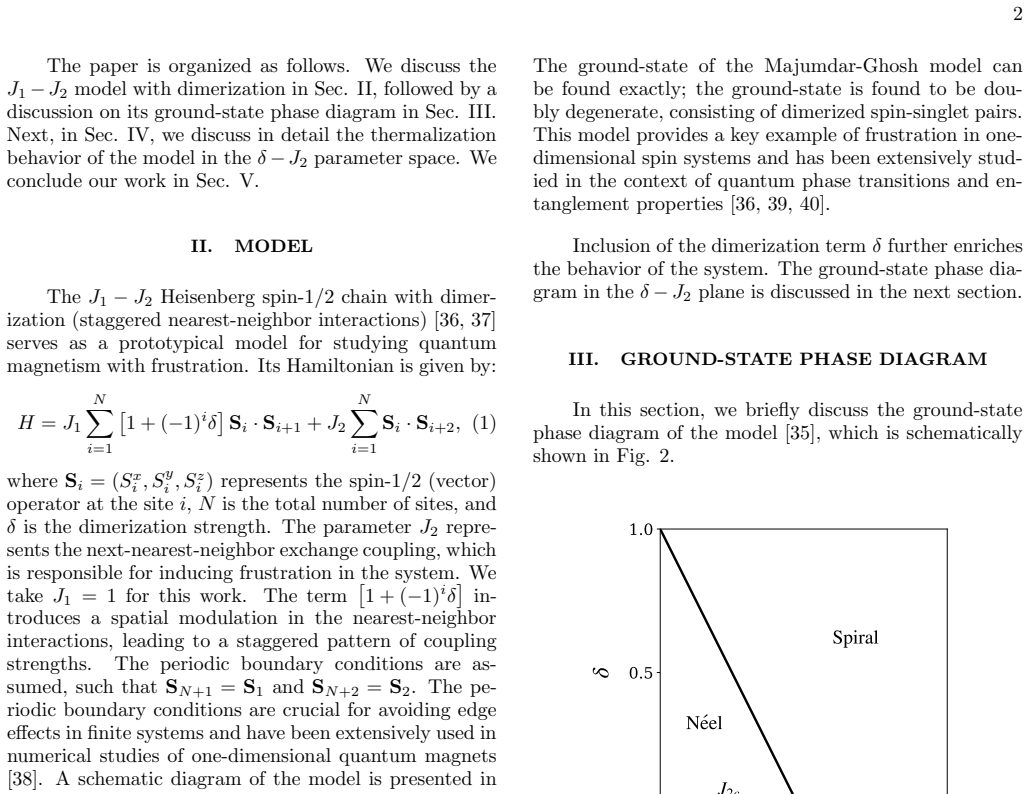
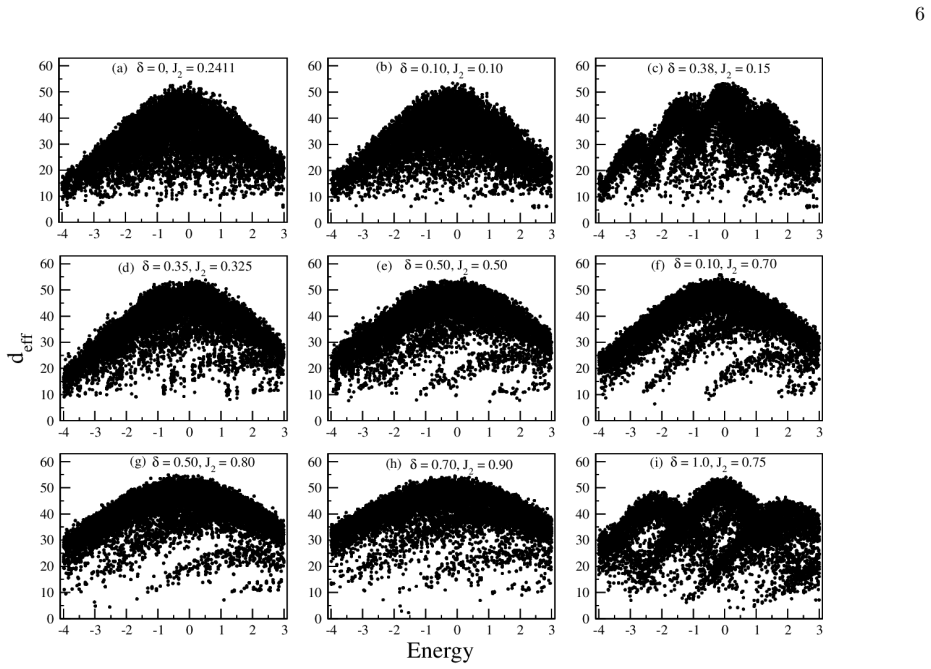
The load-bearing quantity is the mid-spectrum fluctuation $\sigma_{sc} = \sqrt{\overline{O^2} - \overline{O}^{\,2}}$ of the local operator $O=S^z_1 S^z_2$, computed over eigenstates in a narrow middle-of-spectrum energy window of the full $S^z=0$ sector; small $\sigma_{sc}$ is the paper's signature of strong ETH compliance. Two supporting diagnostics carry the interpretation: the subsystem effective dimension $d_{\rm eff} = 1/{\rm Tr}(\rho^2)$ (related to Rényi-2 entropy) and the average von Neumann entropy $S_{vn}$ of a subsystem, whose volume-law coefficient should approach $\ln 2$ in a chaotic nonintegrable system. The argument maps these quantities onto the known ground-state phase diagram, using the Néel/spiral disorder line $2J_2 + \delta = 1$ and the gapless segment $\delta=0$, $J_2 \le J_{2c} \approx 0.241$ as the reference structure against which thermalization strength is read.
What would settle it
Resolve the exact-diagonalization data by total spin $S$ and recompute $\sigma_{sc}$ inside each sector for the labeled parameter points (a)–(i); if the intermediate-$\delta$, intermediate-$J_2$ spiral points no longer show the smallest per-sector fluctuations, the claimed link between ground-state phase and ETH compliance is an artifact of sector mixing.
Extended reading notes
Core claim
The paper's central claim is that the dimerized J1–J2 chain realizes sharply different eigenstate thermalization regimes across the δ–J2 plane, and that the boundaries of these regimes line up with the ground-state phase diagram. The smallest mid-spectrum fluctuations of the local operator $O = S^z_1 S^z_2$ occur for δ around 0.5 and J2 from about 0.5 to 1, inside the gapped spiral phase; the largest fluctuations, i.e., the weakest ETH compliance, occur on the Néel side and most clearly in the gapless segment δ=0, 0 ≤ J2 ≤ J2c ≈ 0.241, where finite-size scaling of the entanglement ratio $S_{vn}/N_s$ also fails to approach the chaotic value $\ln 2$. In the corner of large δ and small J2, the spectrum acquires a banded structure with gaps, which the paper interprets as a localized phase of weakly coupled rungs where ETH compliance is not a meaningful diagnostic. The paper further shows that unresolved total-spin sectors produce multi-branched entanglement profiles, and that explicit breaking of SU(2) symmetry removes the branches, so the reported mid-spectrum quantities are sector-mixed measures.
Load-bearing premise
The thermal phase diagram is built from fluctuations computed in the full $S^z=0$ sector without separating total-spin sectors, so if different spin sectors have different mean values of the measured correlation, the comparisons can be distorted even when every sector individually thermalizes.
Editorial extensions
If this is right
- The gapless uniform-chain window $J_2 \le J_{2c}$ emerges as the parameter region where ETH violation is most likely, so quench experiments there should show slow or incomplete relaxation despite the system being nonintegrable.
- At $\delta \approx 0.5$ and $J_2 \in [0.5,1]$ the model predicts near-maximal subsystem entanglement and small eigenstate-to-eigenstate fluctuations, meaning a quantum simulator should relax to the microcanonical ensemble quickly.
- The large-$\delta$, small-$J_2$ corner is a disorder-free localized regime characterized by a banded spectrum; as a practical consequence, bond-alternation strength can switch a clean chain between thermalizing and localized behavior without any disorder.
- Because the strongest-ETH window lies inside the spiral phase, ground-state phase structure becomes a predictor of mid-spectrum thermalization in this family of chains, not merely a low-energy curiosity.
- Bond alternation is therefore a control parameter: at fixed $J_2$ around 0.5–0.8, tuning $\delta$ from 0 upward moves the system from ETH-fragile, through strongly thermal, into a localized dimer regime.
Reading between the lines
- A sector-resolved reanalysis (fixing total spin $S$ within $S^z=0$) would determine whether the spiral-region advantage survives; the paper's own branching plots suggest each spin sector may thermalize separately, so the unsplit $\sigma_{sc}$ could be dominated by inter-sector offsets.
- Reading the DOS banding as localization is the paper's interpretation; a level-statistics test (for example the adjacent-gap ratio) in the large-$\delta$, small-$J_2$ corner would tell whether this is true many-body localization, an integrable dimer limit, or a prethermal regime.
- An obvious experimental extension is to probe the same map with a different local observable, such as a dimer or chirality correlator; if the low-fluctuation region moves, the phase-diagram link is observable-dependent rather than universal.
- A testable consequence the paper does not pursue is that the slow-thermalization gapless window should leave a signature in operator spreading or the spectral form factor: the spiral region should show fast decay, the Néel region slow oscillations.
Editorial analysis
A structured set of objections, weighed in public.
Referee Report
Summary. The manuscript studies the dimerized J1-J2 spin-1/2 chain in Eq. (1) by exact diagonalization in the Sz=0 sector for N=16, computing the mid-spectrum fluctuation sigma_sc of the local observable O=S_1^z S_2^z in Eq. (3), the effective subsystem dimension d_eff in Eq. (4), and the average von Neumann entropy S_vn in Eq. (6). The authors report that sigma_sc is smallest for intermediate dimerization delta around 0.5 and J2 roughly between 0.5 and 1.0, a regime inside the spiral ground-state phase, and that the gapless line delta=0 with J2 below J2c is more prone to ETH violation. They also identify a large-delta, small-J2 region with a banded density of states and label it a localized phase, excluding it from the ETH analysis. The paper concludes that bond alternation can be used to engineer thermalization in quantum simulators.
Significance. If established, the claimed connection between ground-state phase structure and mid-spectrum ETH compliance in a clean frustrated spin chain would be of genuine interest to the quantum thermalization and quantum simulator communities. The parameter scan is systematic, and no quantities are fitted to the target conclusion, which is a strength. The authors are also transparent about the SU(2) sector issue and about the exclusions in the white region. Nevertheless, the central quantitative measure is computed without resolving total-spin sectors, so the phase diagram currently conflates sector-dependent mean values with eigenstate-to-eigenstate fluctuations. The quantitative claims also lack error estimates and finite-size analysis for sigma_sc itself. The paper is promising but not yet conclusive.
major comments (3)
- [Sec. IV A, Eq. (3), Fig. 4] The central measure sigma_sc is computed in the full Sz=0 sector without resolving total-spin sectors, even though the Hamiltonian in Eq. (1) is SU(2) symmetric. Since the observable O=S_1^z S_2^z takes different thermal expectation values in different total-spin sectors, the variance in Eq. (3) contains a between-sector contribution that does not vanish with system size. The authors explicitly attribute the branch structure in d_eff to SU(2) in Sec. IV B, but they do not apply the same reasoning to sigma_sc. Consequently, the map in Fig. 4 and the ordering in Table I measure a mixture of sector structure and true ETH fluctuations; the claim that ETH is strongest near delta=0.5 and J2=0.5-1 is not established until sigma_sc is recomputed with total spin S resolved or the between-sector contribution is shown to be negligible.
- [Table I and Sec. IV D, Fig. 10] The paper reports no error bars or energy-window sensitivity for sigma_sc and provides no finite-size scaling of sigma_sc itself. The values in Table I range only from about 0.011 to 0.021, yet the qualitative distinction between the gapless point a (0.01698) and gapped points such as b (0.01794) or f (0.01600) is not statistically supported. Fig. 10 scales S_vn/N_s, not sigma_sc, and at N=16 the ratios are still far below ln(2) for all points. The authors should report the dependence of sigma_sc on the window width and on N for N=8 to 16, with bootstrap or jackknife uncertainties, before drawing the phase diagram.
- [Sec. IV B, Fig. 7] The statement that 'ETH appears to be satisfied within each branch associated with a fixed total spin sector' is not quantified. The d_eff profiles are qualitative, and no within-branch variance of any observable is computed. Since the quantitative phase diagram depends on sigma_sc, this qualitative statement cannot substitute for a sector-resolved sigma_sc. Please provide a quantitative within-branch diagnostic or limit the conclusions to the qualitative level that the current data support.
minor comments (5)
- [Sec. III] The uniform spin-1/2 Heisenberg chain at delta=0, J2=0 is called 'the Haldane spin-1/2 chain'; the Haldane phase is normally associated with integer-spin chains, so please correct the terminology.
- [Abstract and Sec. IV A] The phrase 'a parameter regime falls within the spiral ground-state phase' is grammatically incomplete; it should read 'which falls' or 'a regime that falls'.
- [Sec. IV A] The statement that the large-delta, small-J2 regime is 'evidently in a localized phase' is stronger than the evidence shown; the banded DOS demonstrates spectral gaps, not many-body localization. Please soften the claim or add level-statistics and dynamical diagnostics.
- [Sec. IV B] The sentence 'when rho is a pure state, d_eff = 1' is imprecise for a reduced density matrix; a subsystem's rho is pure only when the global eigenstate is unentangled across that bipartition.
- [Fig. 4] The color scale is very narrow (0.010 to 0.024) and the white-region boundary is not clearly marked; consider adding contour labels and a legend entry for the excluded region.
Circularity Check
No significant circularity: the thermalization claim is a direct numerical scan over physical parameters, with no fitted quantity renamed as a prediction.
full rationale
The paper's central claim (ETH strongest for intermediate delta ~ 0.5 and J2 ~ 0.5-1, and more prone to violation in the gapless phase) is obtained by exact diagonalization of the Hamiltonian in Eq. (1), computing the mid-spectrum fluctuation sigma_sc via Eq. (3) over a grid of physical parameters delta and J2. No parameter is fitted to the target conclusion, and the quantities reported (sigma_sc, deff, Svn) are numerical diagnostics, not fits. The ground-state phase diagram is adopted from the independent reference [35], and the disorder line 2J2 + delta = 1 is an external result, not derived from the present thermalization data. The only self-citation, [44] (Mishra and Sahoo), is used to justify the statement that ETH-satisfying systems maximize average subsystem entropy; this is an interpretive diagnostic and is not load-bearing for the main sigma_sc-based phase map, which is computed directly. The authors' acknowledged choice to work in the full Sz = 0 sector without resolving total-spin sectors (Sec. IV A) is a possible source of systematic error in comparing sigma_sc values, but that is a technical validity concern, not a circularity: the observable and fluctuation measure are not defined in terms of the conclusion, nor is any result forced by an equation. Hence the derivation chain is self-contained and no step reduces to its own input.
Assumptions & free parameters
assumptions (5)
- domain assumption ETH compliance can be assessed using the full Sz = 0 sector without resolving total-spin S sectors; branch structure is attributed to SU(2) but the main sigma_sc measure pools all sectors.
- domain assumption N = 16 exact diagonalization is representative enough to infer thermalization trends in the thermodynamic limit.
- domain assumption The ground-state phase diagram of Chitra et al. (1995) applies to the finite-size mid-spectrum properties.
- standard math The volume-law coefficient for a nonintegrable system in the Sz = 0 sector is alpha_V = ln(2).
- ad hoc to paper The white region of large delta and small J2 is a localized phase where ETH diagnostics are less meaningful.
Cite this review
Pith. "Pith review of Quantum thermalization in a dimerized J1-J2 model." pith.science (2026). https://pith.science/paper/TNTQHNRT
@misc{pith2026250802398,
  author       = {Pith},
  title        = {Pith review of: Quantum thermalization in a dimerized J1-J2 model},
  year         = {2026},
  howpublished = {\url{https://pith.science/paper/TNTQHNRT}},
  note         = {Machine review of arXiv:2508.02398}
}
read the original abstract
We revisit the J1-J2 frustrated Heisenberg spin-1/2 chain with dimerization ({\delta}) or modulation in the nearest-neighbor couplings to investigate its thermalization behavior. While the dimerization tends to induce localization, the next-nearest-neighbor interaction J2 generally favors thermalization, making the assessment of the model's compliance with the Eigenstate Thermalization Hypothesis (ETH) particularly subtle. The challenge is further compounded by the model's SU(2) symmetry; the study of ETH compliance is necessarily done for each symmetry sector but separating different sectors of this symmetry is known to be a computationally demanding task. The current study is driven by two main motivations: first, to explore whether the well-known ground-state phases of the model have any bearing on its thermalization properties; and second, to understand how the interplay between two competing factors, namely, the non-uniformity (via {\delta}) and the beyond-nearest-neighbor interactions (via J2) governs the system's approach to thermal equilibrium. A systematic analysis shows that the ETH is most strongly satisfied for intermediate values of {\delta} (~ 0.5) with J2 ranging from intermediate (~ 0.5) to large (~ 1)- a parameter regime falls within the spiral ground-state phase. It is also found that when the system is in the gapless ground-state phase (which falls within the N'eel phase), the ETH is more prone to violation. In the regime of large {\delta} and small J2, the system is seen to enter a localized phase (characterized here by modulation in density-of-states; assessing ETH compliance is less meaningful for this phase.
Figures


Figures from the paper (5 more)



Reference graph
Works this paper leans on
-
[35]
J. T. Schneider, J. Despres, S. J. Thomson, L. Tagli- acozzo, and L. Sanchez-Palencia, Spreading of correla- tions and entanglement in the long-range transverse ising chain, Phys. Rev. Res. 3, L012022 (2021)
work page 2021
-
[46]
S. Sahoo and S. Ramasesha, Full spin and spatial symme- try adapted technique for correlated electronic hamiltoni- ans: Application to an icosahedral cluster, International Journal of Quantum Chemistry 112, 1041 (2012)
work page 2012
-
[1]
A profile with high fluctuations in the values of deff without a clear branch structure, as seen for (δ = 0, J2 = 0) in Fig. 6
-
[2]
A multi-branched profile where distinct, narrow peaks appear at different energies with comparable prominence, as for ( δ = 0 .5, J2 = 0) in the same figure
-
[3]
A profile with broader, unequal branches, where a weaker structure appears beneath a more dominant one — exemplified by the profile for ( δ = 0 , J2 = 0.8) in Fig. 7. 6 FIG. 9: Effective dimension deff of the subsystem for the individual eigenstates across the energy spectrum is shown for the nine selected points, ( a) - ( i), from Fig. 4. The first type ...
-
[4]
J. M. Deutsch, Quantum statistical mechanics in a closed system, Phys. Rev. A 43, 2046 (1991)
1991
-
[5]
Srednicki, Chaos and quantum thermalization, Phys
M. Srednicki, Chaos and quantum thermalization, Phys. Rev. E 50, 888 (1994)
1994
-
[6]
Gogolin and J
C. Gogolin and J. Eisert, Equilibration, thermalisation, and the emergence of statistical mechanics in closed quantum systems, Reports on Progress in Physics 79, 056001 (2016)
2016
Show all 52 references
-
[7]
D’Alessio, Y
L. D’Alessio, Y. Kafri, A. Polkovnikov, and M. Rigol, From quantum chaos and eigenstate thermalization to statistical mechanics and thermodynamics, Advances in Physics 65, 239 (2016)
2016
-
[8]
T. Mori, T. N. Ikeda, E. Kaminishi, and M. Ueda, Thermalization and prethermalization in isolated quan- tum systems: a theoretical overview, Journal of Physics B: Atomic, Molecular and Optical Physics 51, 112001 (2018)
2018
-
[9]
Alba, Eigenstate thermalization hypothesis and in- tegrability in quantum spin chains, Phys
V. Alba, Eigenstate thermalization hypothesis and in- tegrability in quantum spin chains, Phys. Rev. B 91, 155123 (2015)
2015
-
[10]
Steinigeweg, J
R. Steinigeweg, J. Herbrych, and P. Prelovˇ sek, Eigenstate thermalization within isolated spin-chain systems, Phys. Rev. E 87, 012118 (2013)
2013
-
[11]
J. M. Deutsch, Eigenstate thermalization hypothesis, Re- ports on Progress in Physics 81, 082001 (2018)
2018
-
[12]
Dymarsky, N
A. Dymarsky, N. Lashkari, and H. Liu, Subsystem eigen- state thermalization hypothesis, Phys. Rev. E 97, 012140 (2018)
2018
-
[13]
ˇSuntajs, J
J. ˇSuntajs, J. Bonˇ ca, T. Prosen, and L. Vidmar, Ergod- icity breaking transition in finite disordered spin chains, Phys. Rev. B 102, 064207 (2020)
2020
-
[14]
Sugimoto, R
S. Sugimoto, R. Hamazaki, and M. Ueda, Eigenstate thermalization in long-range interacting systems, Phys. Rev. Lett. 129, 030602 (2022)
2022
-
[15]
H. Li, J. Wang, X.-J. Liu, and H. Hu, Many-body local- ization in ising models with random long-range interac- tions, Phys. Rev. A 94, 063625 (2016)
2016
-
[16]
Rigol, V
M. Rigol, V. Dunjko, V. Yurovsky, and M. Olshanii, Re- laxation in a completely integrable many-body quantum system: An ab initio study of the dynamics of the highly excited states of 1d lattice hard-core bosons, Phys. Rev. Lett. 98, 050405 (2007)
2007
-
[17]
A. C. Cassidy, C. W. Clark, and M. Rigol, Generalized thermalization in an integrable lattice system, Phys. Rev. Lett. 106, 140405 (2011)
2011
-
[18]
D.-Z. Wang, H. Zhu, J. Cui, J. Arg¨ uello-Luengo, M. Lewenstein, G.-F. Zhang, P. Sierant, and S.-J. Ran, Eigenstate thermalization and its breakdown in quantum spin chains with inhomogeneous interactions, Phys. Rev. B 109, 045139 (2024)
2024
-
[19]
Sels and A
D. Sels and A. Polkovnikov, Dynamical obstruction to localization in a disordered spin chain, Phys. Rev. E 104, 9 054105 (2021)
2021
-
[20]
Pal and D
A. Pal and D. A. Huse, Many-body localization phase transition, Phys. Rev. B 82, 174411 (2010)
2010
-
[21]
Nandkishore and D
R. Nandkishore and D. A. Huse, Many-body localization and thermalization in quantum statistical mechanics, An- nual Review of Condensed Matter Physics 6, 15 (2015)
2015
-
[22]
Serbyn, Z
M. Serbyn, Z. Papi´ c, and D. A. Abanin, Quantum quenches in the many-body localized phase, Phys. Rev. B 90, 174302 (2014)
2014
-
[23]
Chandran, A
A. Chandran, A. Pal, C. R. Laumann, and A. Scardic- chio, Many-body localization beyond eigenstates in all dimensions, Phys. Rev. B 94, 144203 (2016)
2016
-
[24]
Mondaini and M
R. Mondaini and M. Rigol, Many-body localization and thermalization in disordered hubbard chains, Phys. Rev. A 92, 041601 (2015)
2015
-
[25]
Lian, Quantum breakdown model: From many-body localization to chaos with scars, Phys
B. Lian, Quantum breakdown model: From many-body localization to chaos with scars, Phys. Rev. B 107, 115171 (2023)
2023
-
[26]
Smith, A
J. Smith, A. Lee, P. Richerme, B. Neyenhuis, P. W. Hess, P. Hauke, M. Heyl, D. A. Huse, and C. Mon- roe, Many-body localization in a quantum simulator with programmable random disorder, Nature Physics 12, 907 (2016)
2016
-
[27]
A. M. Kaufman, M. E. Tai, A. Lukin, M. Rispoli, R. Schittko, P. M. Preiss, and M. Greiner, Quantum ther- malization through entanglement in an isolated many- body system, Science 353, 794 (2016)
2016
-
[28]
Roushan, C
P. Roushan, C. Neill, J. Tangpanitanon, V. M. Bastidas, A. Megrant, R. Barends, Y. Chen, Z. Chen, B. Chiaro, A. Dunsworth, A. Fowler, B. Foxen, M. Giustina, E. Jef- frey, J. Kelly, E. Lucero, J. Mutus, M. Neeley, C. Quin- tana, D. Sank, A. Vainsencher, J. Wenner, T. White, H. ...
2017
-
[29]
Beugeling, R
W. Beugeling, R. Moessner, and M. Haque, Finite-size scaling of eigenstate thermalization, Phys. Rev. E 89, 042112 (2014)
2014
-
[30]
J. D. Noh, Eigenstate thermalization hypothesis and eigenstate-to-eigenstate fluctuations, Phys. Rev. E 103, 012129 (2021)
2021
-
[31]
Laflorencie, Quantum entanglement in condensed matter systems, Physics Reports 646, 1 (2016)
N. Laflorencie, Quantum entanglement in condensed matter systems, Physics Reports 646, 1 (2016)
2016
-
[32]
Foss-Feig, P
M. Foss-Feig, P. Niroula, J. T. Young, M. Hafezi, A. V. Gorshkov, R. M. Wilson, and M. F. Maghrebi, Emergent equilibrium in many-body optical bistability, Phys. Rev. A 95, 043826 (2017)
2017
-
[33]
Pino, Entanglement growth in many-body localized systems with long-range interactions, Phys
M. Pino, Entanglement growth in many-body localized systems with long-range interactions, Phys. Rev. B 90, 174204 (2014)
2014
-
[34]
Neyenhuis, J
B. Neyenhuis, J. Zhang, P. W. Hess, J. Smith, A. C. Lee, P. Richerme, Z.-X. Gong, A. V. Gorshkov, and C. Mon- roe, Observation of prethermalization in long-range inter- acting spin chains, Science Advances 3, e1700672 (2017)
2017
-
[36]
Ranabhat and M
N. Ranabhat and M. Collura, Thermalization of long range ising model in different dynamical regimes: A full counting statistics approach, SciPost Phys. Core 7, 017 (2024)
2024
-
[37]
J. A. Kj¨ all, J. H. Bardarson, and F. Pollmann, Many- body localization in a disordered quantum ising chain, Phys. Rev. Lett. 113, 107204 (2014)
2014
-
[38]
Chitra, S
R. Chitra, S. Pati, H. R. Krishnamurthy, D. Sen, and S. Ramasesha, Density-matrix renormalization-group studies of the spin-1/2 heisenberg system with dimer- ization and frustration, Phys. Rev. B 52, 6581 (1995)
1995
-
[39]
C. K. Majumdar and D. K. Ghosh, On next-nearest- neighbor interaction in linear chain. i, Journal of Mathe- matical Physics 10, 1388 (1969)
1969
-
[40]
Okamoto and K
K. Okamoto and K. Nomura, Fluid-dimer critical point in s = 1/2 antiferromagnetic heisenberg chain with next nearest neighbor interactions, Physics Letters A169, 433 (1992)
1992
-
[41]
Schollw¨ ock, The density-matrix renormalization group in the age of matrix product states, Annals of Physics 326, 96 (2011)
U. Schollw¨ ock, The density-matrix renormalization group in the age of matrix product states, Annals of Physics 326, 96 (2011)
2011
-
[42]
B. S. Shastry, Exact solution of an s=1/2 heisenberg anti- ferromagnetic chain with long-ranged interactions, Phys. Rev. Lett. 60, 639 (1988)
1988
-
[43]
D. P. Goli, S. Sahoo, S. Ramasesha, and D. Sen, Quan- tum phases of dimerized and frustrated heisenberg spin chains with s = 1/2, 1 and 3/2: an entanglement entropy and fidelity study, Journal of Physics: Condensed Matter 25, 125603 (2013)
2013
-
[44]
F. D. M. Haldane, Nonlinear field theory of large-spin heisenberg antiferromagnets: Semiclassically quantized solitons of the one-dimensional easy-axis n´ eel state, Phys. Rev. Lett. 50, 1153 (1983)
1983
-
[45]
Sahoo, R
S. Sahoo, R. Rajamani, S. Ramasesha, and D. Sen, Fully symmetrized valence-bond based technique for solving exchange hamiltonians of molecular magnets, Phys. Rev. B 78, 054408 (2008)
2008
-
[47]
Mishra and S
S. Mishra and S. Sahoo, Quantum thermaliza- tion and average entropy of a subsystem, arXiv 10.48550/arXiv.2506.19896 (2025)
2025 doi
-
[48]
N. P. Konstantinidis, Thermalization away from inte- grability and the role of operator off-diagonal elements, Phys. Rev. E 91, 052111 (2015)
2015
-
[49]
N. P. Konstantinidis, Thermalization of a dimerized an- tiferromagnetic spin chain, J. of Phys.: Condens. Matter 28, 026001 (2015)
2015
-
[50]
LeBlond, K
T. LeBlond, K. Mallayya, L. Vidmar, and M. Rigol, En- tanglement and matrix elements of observables in in- teracting integrable systems, Phys. Rev. E 100, 062134 (2019)
2019
-
[51]
Bianchi, L
E. Bianchi, L. Hackl, M. Kieburg, M. Rigol, and L. Vid- mar, Volume-law entanglement entropy of typical pure quantum states, PRX Quantum 3, 030201 (2022)
2022
-
[52]
Vidmar, L
L. Vidmar, L. Hackl, E. Bianchi, and M. Rigol, Entangle- ment entropy of eigenstates of quadratic fermionic hamil- tonians, Phys. Rev. Lett. 119, 020601 (2017)
2017
Reviewed August 6, 2026 · model on record in the stance chip above.
Discussion (0). Continue with ORCID to comment.