REVIEW 3 major objections 5 minor 58 references
Spin-selective Aharonov-Casher caging in a topological quantum network
T0 review · 3 major / 5 minor · reviewed 2026-08-14 · deepseek-v4-flash
Pith's one-line read A rhombic quantum network with an out-of-plane electric field completely cages half-odd-integer spins at a single spin-orbit coupling strength, collapsing the spectrum to five localized states while leaving integer spins extended.
desk verdict Clean spin-selective caging result with a fixable formula typo and a proof gap that is actually one line. read the letter →
The pith
A machine-rendered reading of the paper's core claim, the machinery that carries it, and where it could break.
The reading
What carries the argument
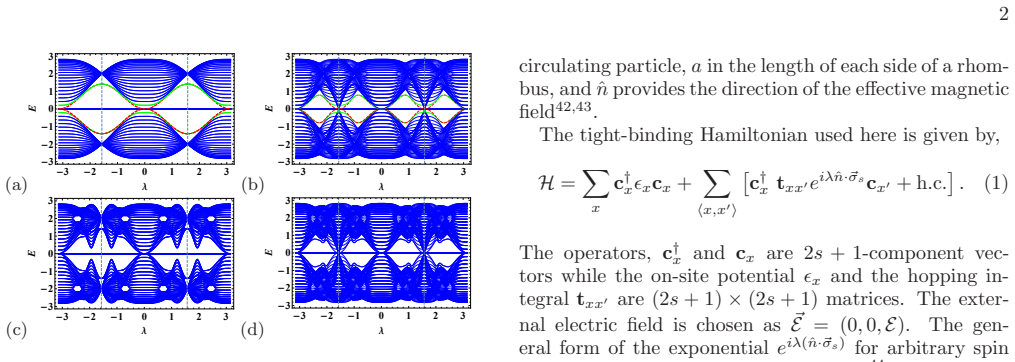
The carrying mechanism is the non-Abelian Aharonov-Casher phase factor $\exp[i\lambda(\hat{n}\cdot\sigma_s)]$ multiplying each nearest-neighbour hopping amplitude, where $\sigma_s$ is the $(2s+1)$-dimensional spin matrix for spin $s$ and the spin matrices are scaled so that $S = (\hbar/2)\sigma_s$. Two calculations work together: a trace identity that fixes the round-trip Aharonov-Casher phase $\Lambda_{\mathrm{AC}}$ from the product of four hopping phases, giving $\Lambda_{\mathrm{AC}} = \pi$ at $\lambda = \pi/2$, and a real-space renormalization-group decimation of the $A$ vertices that reduces the network to an effective chain with renormalized hopping $\tilde{t}_{BB}$ between $B$ sites. For $s=1/2$ at $\lambda=\pi/2$, $\tilde{t}_{BB}$ is exactly the zero matrix; the vanishing of this hopping is what cages the wave functions.
What would settle it
Compute the renormalized hopping matrix of Eq. (6) explicitly for $s=3/2$ or $s=5/2$ at $\lambda = \pi/2$: if any entry is nonzero, the effective chain does not decouple and the spectrum cannot collapse to five states. Equivalently, measure transmission through a spin-$3/2$ or spin-$5/2$ rhombic array at this coupling; any nonzero transmission would rule out complete caging.
Extended reading notes
Core claim
For a particle of half-odd-integer spin $s$ in a periodic rhombic array with an out-of-plane electric field, the Aharonov-Casher phase accumulated around one rhombus at spin-orbit coupling $\lambda = \pi/2$ amounts to an effective rotation by $2\pi$. Such a rotation flips a half-integer spinor, so the wave function interferes destructively at the junction between neighbouring rhombi; equivalently, the renormalized hopping between consecutive $B$ sites vanishes. The spectrum therefore consists only of five localized levels, $E = 0, \pm 2, \pm\sqrt{2}$, with the $E=0$ level being a $\lambda$-independent flat band present for every spin and the $\pm\sqrt{2}$ levels being topological edge states that disappear under periodic boundary conditions. For integer spins the same $2\pi$ rotation acts as the identity, interference is constructive, and the spectrum keeps extended bands, so no extreme localization occurs.
Load-bearing premise
The load-bearing premise is that the renormalized hopping between neighbouring $B$ sites vanishes at $\lambda = \pi/2$ for every half-odd-integer spin, but the paper shows this null matrix explicitly only for $s=1/2$; for $s=3/2$ and $5/2$ it relies on trace formulas, numerical spectra, and the stated belief that the result holds in general.
Editorial extensions
If this is right
- At $\lambda = \pi/2$, a rhombic array carrying half-odd-integer spins becomes completely opaque: the transmission coefficient is zero at all energies, so the structure acts as a perfect spin-selective block.
- For integer spins at $\lambda = \pi/2$, the network decouples into $2s+1$ independent spin-projected rhombic arrays, and transmission becomes unattenuated and identical across spin projections — the opposite of the half-integer case.
- The half-odd-integer spectrum at $\lambda = \pi/2$ consists of exactly five states, $E = 0, \pm 2, \pm\sqrt{2}$; the $\pm\sqrt{2}$ states are topological edge states that vanish under periodic boundary conditions.
- Because these five energies coincide with those measured in photonic Aharonov-Bohm cages, the same sharp five-line spectrum should be observable in photonic or ultracold-atom lattices with half-integer spin degrees of freedom.
- Integer-spin spectra retain continuous bands around the localized levels even at the special coupling, so the complete collapse and its accompanying zero transmission are unique to half-odd-integer spins.
Reading between the lines
- This suggests a spin-statistics filter: at $\lambda = \pi/2$, the same device blocks every half-odd-integer (fermionic) spin channel while remaining open to integer (bosonic) spin channels, so the network could separate particles by spin statistics, not just by spin projection.
- The paper demonstrates the null hopping explicitly for $s=1/2$ and checks $s=3/2, 5/2$ numerically; proving $\tilde{t}_{BB}=0$ for general half-odd-integer $s$ would turn the extrapolated claim into a general theorem.
- Because the caging mechanism is an effective $2\pi$ spinor rotation around one loop, other planar lattices whose unit cells generate the same non-Abelian phase should show the same half-integer-versus-integer localization dichotomy; the rhombic chain is one concrete member of that family.
Signed reviews
Editorial analysis
A structured set of objections, weighed in public.
Referee Report
Summary. The manuscript studies a one-dimensional chain of rhombi described by a tight-binding Hamiltonian whose hopping amplitudes carry a non-Abelian Aharonov-Casher phase controlled by the spin-orbit coupling strength λ. Exact diagonalization is reported for spins s = 1/2, 1, 3/2, and 2, together with density-of-states and transmission calculations for s = 1/2 and s = 1. The central claim is that for all half-odd-integer spins, at the special coupling λ = π/2, the spectrum collapses to five sharp localized states at E = 0, ±2, and ±√2, corresponding to complete Aharonov-Casher caging, while integer spins never exhibit such a complete collapse. The analytical support is based on trace formulas for the loop rotation angle Λ_AC (Eqs. 4 and 5) and on a real-space renormalization-group decimation that supposedly produces a null effective hopping between neighboring B sites (Eqs. 6 and 7).
Significance. If established, the predicted spin-selective Aharonov-Casher caging is an appealing spin analog of the well-known Aharonov-Bohm caging in photonic and superconducting networks, and it could be relevant for spin-filtering devices and ultracold-atom experiments. The numerical evidence for s = 1/2 and s = 3/2 is convincing in the sense that the spectral collapse at λ = π/2 is directly visible and the s = 1/2 transmission vanishes. No data are fitted: λ = π/2 is derived from the trace equations, and the energy values are outputs of the Hamiltonian; the comparison to the photonic AB-cage eigenvalues is a parallel rather than a fit. The main weakness is that the analytic argument for the universal claim is incomplete and contains an inconsistency in the trace formula, so the word 'exact' in the abstract is not yet supported.
major comments (3)
- [Analyzing the observations, Eq. (4a)] The stated trace relation is off by a factor of two. For s = 1/2, the loop product U = e^{-iλσ_x} e^{-iλσ_y} e^{iλσ_x} e^{iλσ_y} has trace 2 − 4 sin^4 λ. Equation (4a) instead sets 2 cos Λ_AC = F_{1/2}(λ) = 1 − 2 sin^4 λ, which at λ = π/2 gives cos Λ_AC = −1/2, i.e. Λ_AC = 2π/3, not Λ_AC = π as claimed in the following paragraph. Since the caging mechanism relies on the condition Λ_AC = π corresponding to a 2π rotation, Eq. (4a) must be corrected, and the analogous trace formulas (4b), (4c), (5a), and (5b) must be re-examined for the same factor.
- [Analyzing the observations, Eq. (6)] The claim immediately after Eq. (7) that the renormalized hopping t_tilde_BB vanishes 'for all the half odd integer spins' is not demonstrated anywhere in the manuscript. The explicit nulling is shown only for s = 1/2 in Eq. (7). For s = 3/2 and higher, t_tilde_BB is a (2s+1) × (2s+1) matrix, and the loop-trace condition Λ_AC = π does not by itself imply that the sum of the two path matrices t e^{iλσ_x}(E−ε)^{-1} t e^{iλσ_y} and its partner is zero. The complete spectral collapse for arbitrary half-odd-integer s requires this matrix nulling; please provide a general proof or, failing that, explicit numerical evaluation for s = 3/2 and s = 5/2.
- [Abstract and 'The theory and the results'] The statement 'Our results are exact' and the universal formulation 'for any half-odd integer spin' exceed the evidence presented in the manuscript. Exact diagonalization is shown for s = 1/2, 1, 3/2, and 2; s = 5/2 is mentioned but no spectrum or transport data are shown. The RG nulling is verified only for s = 1/2. To support the headline claim, the authors need either to supply the missing general derivation or to explicitly restrict the exact-caging claim to the spins for which the calculation is presented.
minor comments (5)
- [Title] The title contains a typo: 'qu antum' should be 'quantum'.
- [Abstract] The phrase 's ≥ nℏ/2, with n odd' is confusing; since n is restricted to odd integers, the inequality should presumably be an equality, i.e. s = nℏ/2 with n odd. Please rephrase.
- [Throughout] The symbol σ is used both for Pauli matrices and for general (2s+1)-dimensional spin matrices; the notation should be defined explicitly, e.g. σ_s, to avoid confusion when s > 1/2.
- [Transmission coefficient and its spin selectivity] The text says the total collapse at λ = π/2 'has been checked to be also true for the half odd integer spins 3/2 and 5/2', but no corresponding figure or calculation is included; please provide the data or qualify the statement.
- [References] Reference 43 lists the year as 1985, but the volume number Phys. Rev. B 95, 085411 corresponds to 2017; please verify the citation.
Circularity Check
No circularity: the caging condition and the collapsed energies are derived from the spin-rotation trace identities and exact diagonalization, with no fitted parameters and no load-bearing self-citation.
full rationale
The derivation chain is self-contained. The special spin-orbit coupling lambda = pi/2 is identified analytically from the trace identities in Eqs. (4) and (5), where it corresponds to an accumulated Aharonov-Casher phase Lambda_AC = pi; it is not extracted by fitting to the spectrum. The renormalized hopping in Eq. (6) is obtained by decimating the A sites from the Schroedinger equation, and for s = 1/2 the null matrix result at lambda = pi/2 is shown explicitly in Eq. (7). The reported caged energies E = 0, +/-2, +/-sqrt(2) are eigenvalues of the finite Hamiltonian from exact diagonalization, not re-labeled inputs. The photonic AB-cage experiments are invoked as an experimental parallel and motivation, not as a premise from which the result is deduced, and no uniqueness theorem or ansatz is imported from prior work by these authors. The paper's weak point is that the nulling of Eq. (6) for every half-odd-integer spin is asserted rather than proven for general s, but that is an unsupported generalization and a proof gap, not a circular reduction: accepting it would make the conclusion stronger, whereas circularity would make it true by construction. Accordingly, no step qualifies as self-definitional, fitted-input-called-prediction, self-citation load-bearing, or renaming of a known result.
Assumptions & free parameters
assumptions (4)
- domain assumption e^{iλ σ·n} with σ the spin-s Pauli-type matrices describes the Aharonov-Casher phase of a hop; the product of four such factors around a rhombus is a rotation matrix in the SU(2) representation of spin s.
- domain assumption The accumulated loop phase can be characterized by a single angle Λ_AC obtained by equating traces of the product to a rotation matrix (Eq. 3), and the sign of the spinor under the corresponding 2π rotation determines destructive or constructive interference.
- standard math A 2π rotation of a half-integer spin state multiplies the wavefunction by -1, while for integer spin it is +1.
- domain assumption The tight-binding model with hard-wall boundary conditions and leads with t_lead = t_lead-system = 1.5 is an adequate representation of the transport setup.
Cite this review
Pith. "Pith review of Spin-selective Aharonov-Casher caging in a topological quantum network." pith.science (2026). https://pith.science/paper/TOSFRCNM
@misc{pith2026190807175,
  author       = {Pith},
  title        = {Pith review of: Spin-selective Aharonov-Casher caging in a topological quantum network},
  year         = {2026},
  howpublished = {\url{https://pith.science/paper/TOSFRCNM}},
  note         = {Machine review of arXiv:1908.07175}
}
read the original abstract
A periodic network of connected rhombii, mimicking a spintronic device, is shown to exhibit an intriguing spin selective extreme localization, when submerged in a uniform out of plane electric field. The topological Aharonov Casher phase acquired by a travelling spin is seen to induce a complete caging, triggered at a special strength of the spin orbit coupling, for half odd integer spins s \ge n\hbar/2, with n odd, sparing the integer spins. The observation finds exciting experimental parallels in recent literature on caged, extreme localized modes in analogous photonic lattices. Our results are exact.
Figures


Figures from the paper (2 more)


Reference graph
Works this paper leans on
-
[1]
note We shall drop the correct but cumbersome ^ (s) notation in the following and let s be implied by the context of the discussion. Stop
-
[2]
Non-zero amplitude in this case would be pinned at the B-vertices
note If we released a spin-half particle at one of the A sites, then on a full rotation the destructive interference would occur at A-vertices. Non-zero amplitude in this case would be pinned at the B-vertices. Stop
- [3]
- [4]
-
[5]
B. Deissler, M. Zaccanti, G. Roati, C. D'Errico, M. Fattori, M. Modugno, G. Modugno, and M. Inguscio, Nat. Phys. 6, 354 (2010)
work page 2010
-
[6]
E. Lucioni, B. Deissler, L. Tanzi, G. Roati, M. Zaccanti, M. Modugno, M. Larcher, F. Dalfovo, M. Inguscio, and G. Modugno, Phys. Rev. Lett. 106, 230403 (2011)
work page 2011
-
[7]
P. W. Anderson, Phys. Rev. 109, 1492 (1958)
1958
-
[8]
D. J. Thouless, Phys. Rep. 13, 43 (1974)
work page 1974
Show all 58 references
-
[9]
Abrahams, P
E. Abrahams, P. W. Anderson, D. C. Liciardello, and T. V. Ramakrishnan, Phys. Rev. Lett. 42, 673 (1979)
1979
-
[10]
R. E. Borland, Proc. R. Soc. London Ser. A 274, 529 (1963)
1963
-
[11]
John, Phys
S. John, Phys. Rev. Lett. 58, 2486 (1987)
1987
-
[12]
Yablonovitch, Physics Today 44, 32 (1991)
E. Yablonovitch, Physics Today 44, 32 (1991)
1991
-
[13]
A. Celi, P. Massignan, J. Ruseckas, N. Goldman, I. B. Spielman, G. Juzeliūnas, and M. Lewenstein, Phys. Rev. Lett. 112, 043001 (2014)
2014
-
[14]
H. M. Price, T. Ozawa, and N. Goldman, Phys. Rev. A 95, 023607 (2017)
2017
-
[15]
Greiner, O
M. Greiner, O. Mandel, T. Esslinger, T. W. H\" a nsch and I. Bloch, Nature 415, 39 (2002)
2002
-
[16]
Jordens, N
R. Jordens, N. Strohmaier, K. G\" u nter, H. Moritz, and T. Esslinger, Nature 455, 204 (2008)
2008
-
[17]
F\" o lling, F
S. F\" o lling, F. Gerbier, A. Widera, O. Mandel, T. Gericke, and I. Bloch, Nature 434, 481 (2005)
2005
-
[18]
T. Rom, Th. Best, D. v. Oosten, U. Schneider, S. F\" o lling, B. Paredes, and I. Bloch, Nature 444, 733 (2006)
2006
-
[19]
Simon, W
J. Simon, W. S. Bakr, R. Ma, M. E. Tai, P. M. Preiss, and M. Greiner, Nature 472, 307 (2011)
2011
-
[20]
D. L. Campbell, G. Juzeli\" u nas, and I. B. Spielman, Phys. Rev. A 84, 025602 (2011)
2011
-
[21]
J. H. Pixley, S. S. Natu, I. B. Spielman, and S. Das Sarma, Phys. Rev. B 93, 081101 (R) (2016)
2016
-
[22]
D. L. Campbell, R. M. Price, A. Putra, A. Vald\' e s-Curiel, D. Trypogeorgos, I. B. Spielman, arXiv:1501.05984
-
[23]
o fer, D. R. Fernandes, I. Bloch, and S. F\
L. Riegger, N. D. Oppong, M. H\" o fer, D. R. Fernandes, I. Bloch, and S. F\" o lling, Phys. Rev. Lett. 120, 143601 (2018)
2018
-
[24]
Y.-J. Lin, K. Jim\' e nez-Garc\' i a, and I. B. Spielman, Nature (London) 471, 83 (2011)
2011
-
[25]
Dalibard, F
J. Dalibard, F. Gerbier, G. Juzeli\= u nas, and P. \" O hberg, Rev. Mod. Phys. 83, 1523 (2011)
2011
-
[26]
Wang, Z.-Q
P. Wang, Z.-Q. Yu, Z. Fu, J. Miao, L. Huang, S. Chai, H. Zhai, and J. Zhang, Phys. Rev. Lett. 109, 095301 (2012)
2012
-
[27]
L. W. Cheuk, A. T. Sommer, Z. Hadzibabic, T. Yefsah, W. S. Bakr, and M. W. Zwierlein, Phys. Rev. Lett. 109, 095302 (2012)
2012
-
[28]
Zhu, D.-W
S.-L. Zhu, D.-W. Zhang, and Z. D. Wang, Phys. Rev. Lett. 102, 210403 (2009)
2009
-
[29]
M. J. Edmonds, J. Otterbatch, R. G. Unanyan, M. Fleischhauer, M. Titov, and P. \" O hberg, New. J. Phys. 14, 073056 (2012)
2012
-
[30]
L. Zhou, H. Pu, and W. Zhang, Phys. Rev. A 023625 (2013)
2013
-
[31]
Aharony, O
A. Aharony, O. Entin-Wohlman, Y. Tokura, and S. Katsumoto, Phys. Rev. B 78, 125328 (2008)
2008
-
[32]
Billy et al, Nature 453, 891 (2008)
J. Billy et al, Nature 453, 891 (2008)
2008
-
[33]
Chabe et al, Phys
J. Chabe et al, Phys. Rev. Lett. 101, 255702 (2008)
2008
-
[34]
Vidal, R
J. Vidal, R. Mosseri, and B. Dou c ot, Phys. Rev. Lett. 81, 5888 (1998)
1998
-
[35]
Vidal, P
J. Vidal, P. Butaud, B. Dou c out, and R. Mosseri, Phys. Rev. B 64, 155306 (2001)
2001
-
[36]
Aharonov and D
Y. Aharonov and D. Bohm, Phys. Rev. 115, 485 (1959)
1959
-
[37]
D. R. Hofstadter, Phys. Rev.B 14, 2239 (1976)
1976
-
[38]
C. C. Abilio, P. Butaud, Th. Fournier, B. Pannetier, J. Vidal, S. Tedesco, and B. Dalzotto, Phys. Rev. Lett. 83, 5102 (1999)
1999
-
[39]
C. Naud, G. Faini, and D. Mally, Phys. Rev. Lett. 86, 5104 (2001)
2001
-
[40]
Mukherjee and R
S. Mukherjee and R. R. Thomson, Opt. Lett. 40, 5443 (2015)
2015
-
[41]
Mukherjee, M
S. Mukherjee, M. D. Liberto, P. \" O hberg, R. R. Thomson, and N. Goldman, Phys. Rev. Lett. 121, 075502 (2018)
2018
-
[42]
Kremer, I
M. Kremer, I. Petrides, E. Meyer, M. Heinrich, O. Zilberberg, and A. Szameit, arXiv:1805.05209v1
-
[43]
Maimaiti, A
W. Maimaiti, A. Andreanov, H. C. Park, O. Gendelman, and S. Flach, Phys. Rev. B 95, 115135 (2017)
2017
-
[44]
Ramachandran, A
A. Ramachandran, A. Andreanov, and S. Flach, Phys. Rev. B 96. 161104 (2017)
2017
-
[45]
Leykam, A
D. Leykam, A. Andreanov, and S. Flach, Adv. Phys. X 3, 1473052 (2018)
2018
-
[46]
Pal and A
B. Pal and A. Chakrabarti, Phys. Rev. B 85, 214203 (2012)
2012
-
[47]
Aharonov and A
Y. Aharonov and A. Casher, Phys. Rev. Lett. 53, 319 (1984)
1984
-
[48]
Oreg and O
Y. Oreg and O. Entin-Wohlman, Phys. Rev. B 46, 2393 (1992)
1992
-
[49]
Avishai and Y
Y. Avishai and Y. B. Band, Phys. Rev. B 95, 104429 (2017)
2017
-
[50]
Matityahu, A
S. Matityahu, A. Aharony, O. Entin-Wohlman, and C. A. Balseiro, Phys. Rev. B 95, 085411 (1985)
1985
-
[51]
T. L. Curtright, D. B. Fairlie, and C. K. Zachos, Symmetry, Integrability and Geometry: Methods and Applications 10, 084 (2014)
2014
-
[52]
L\" o wdin, J
P.-O. L\" o wdin, J. Math. Phys. 3, 969 (1962)
1962
-
[53]
Datta and B
S. Datta and B. Das, Applied Physics Letters 56, 82, 1990
1990
-
[54]
Datta, Electronic Transport in Mesoscopic Systems (Cambridge, UK, 1995)
S. Datta, Electronic Transport in Mesoscopic Systems (Cambridge, UK, 1995)
1995
-
[55]
P. A. Lee and D. S. Fisher, Phys. Rev. Lett. 47, 882 (1981)
1981
-
[56]
D. K. Ferry and S. M. Goodnick, Transport in Nanostructures (Cambridge, UK, 1997)
1997
-
[57]
Cresti, G
A. Cresti, G. Grosso, and G. Pastori Parravicini, Eur. Phys. J. B 53, 537 (2005)
2005
-
[58]
M. P. Lopez Sancho, J. M. Lopez Sancho, and J. Rubio, J. Phys. F 15, 851 (1985)
1985
Reviewed August 14, 2026 · model on record in the stance chip above.
Discussion (0). Continue with ORCID to comment.