Distributionally Robust Complex Chance-Constrained Optimization
Pith reviewed 2026-05-25 04:05 UTC · model grok-4.3
The pith
Complex chance constraints reduce to convex second-order cone programs under elliptical symmetry.
A machine-rendered reading of the paper's core claim, the machinery that carries it, and where it could break.
Core claim
The central claim is that complex chance-constrained linear programs, including their distributionally robust variants, admit convex reformulations: individual probabilistic constraints become second-order cone constraints under the complex elliptically symmetric assumption, while joint constraints are bounded via copula approximations, with the resulting models solved on the minimum-variance distortionless-response beamforming problem and shown to deliver empirical performance consistent with the prescribed chance levels.
What carries the argument
The density-based reformulation of the 3CP model that converts each individual complex chance constraint into a deterministic second-order cone constraint.
If this is right
- The individual-constraint problems become polynomial-time solvable with standard convex solvers.
- Upper and lower bounds on joint chance constraints are obtained directly from copula representations.
- Moment-based, support-based, and data-driven ambiguity sets each yield tractable robust counterparts.
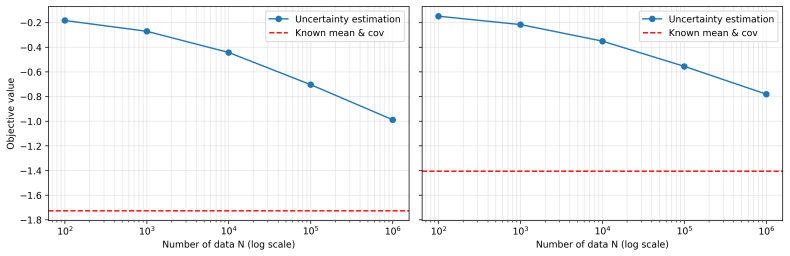
- The beamforming application produces feasible solutions whose empirical violation rates match the design probability.
Where Pith is reading between the lines
- The same reformulation steps could be tested on other complex-valued applications such as array signal processing with phase constraints.
- The data-driven ambiguity set may require larger sample sizes when the dimension of the complex parameter vector grows.
- Copula bounds could be tightened by incorporating known dependence structures typical of wireless channels.
Load-bearing premise
The random parameters follow a complex elliptically symmetric distribution.
What would settle it
A set of samples drawn from a complex elliptically symmetric distribution for which the optimal solution of the second-order cone program violates the original chance constraint at a rate exceeding the allowed probability.
Figures


read the original abstract
This paper introduces a framework for Chance-Constrained Optimization with Complex Variables, addressing complex linear programming for both individual and joint probabilistic constraints in the complex domain. We first analyze the 3CP model in the density-based setting under the assumption that the random parameters follow a Complex Elliptically Symmetric distribution. The framework is then extended to distributionally robust settings, which include a moment-based model where the moments are known or bounded; a support-based model, where the ambiguity set contains distributions supported on norm-bounded uncertainty sets; and a data-driven model where moments are estimated empirically. The individual constraints are transformed into a convex deterministic second-order cone problem. We employ copula theory to the joint probability constraints and derive both upper and lower approximations. Finally, we demonstrate the proposed framework on the minimum variance distortionless response beamforming problem in signal processing. We further evaluate empirical out-of-sample rates and show that the observed behavior closely matches the prescribed probabilistic guarantees.
Editorial analysis
A structured set of objections, weighed in public.
Referee Report
Summary. The manuscript presents a framework for chance-constrained optimization with complex variables. It analyzes the 3CP model under the assumption that random parameters follow a Complex Elliptically Symmetric distribution, transforming individual constraints into convex deterministic second-order cone programs. The framework is extended to distributionally robust settings via moment-based, support-based, and data-driven ambiguity sets. Copula theory is used to derive upper and lower approximations for joint chance constraints. The approach is demonstrated on the minimum variance distortionless response beamforming problem, with empirical evaluation showing out-of-sample rates close to the prescribed probabilistic guarantees.
Significance. If the transformations and approximations are valid, the work extends chance-constrained optimization to the complex domain and adds distributional robustness, which is relevant for signal processing applications. The explicit use of the CES assumption for the SOCP reformulation, the copula-based handling of joint constraints, and the empirical out-of-sample validation are strengths that support practical applicability.
major comments (2)
- [3CP model analysis (density-based setting)] The central claim that individual constraints transform into a convex deterministic second-order cone problem (stated in the abstract and developed in the 3CP density-based analysis) holds specifically under the Complex Elliptically Symmetric distribution assumption. The manuscript should include or clearly reference the full derivation steps for this equivalence, as this assumption is load-bearing for the deterministic convex reformulation.
- [Joint probability constraints section] For the joint chance constraints, the copula-based upper and lower approximations need explicit bounds on approximation error or tightness analysis; without this, the practical conservatism of the resulting optimization problem in the beamforming example cannot be fully assessed.
minor comments (2)
- Notation for complex elliptical symmetry and related parameters could be introduced with a brief reminder or reference in the main text for accessibility.
- [Numerical experiments / beamforming application] In the beamforming numerical results, additional details on the specific values of the uncertainty bounds or sample sizes used in the data-driven model would improve reproducibility.
Simulated Author's Rebuttal
We thank the referee for the positive evaluation and recommendation of minor revision. The comments are constructive and we address each point below, indicating the revisions we will make.
read point-by-point responses
-
Referee: [3CP model analysis (density-based setting)] The central claim that individual constraints transform into a convex deterministic second-order cone problem (stated in the abstract and developed in the 3CP density-based analysis) holds specifically under the Complex Elliptically Symmetric distribution assumption. The manuscript should include or clearly reference the full derivation steps for this equivalence, as this assumption is load-bearing for the deterministic convex reformulation.
Authors: We agree that the CES distribution assumption is essential for the SOCP equivalence. The manuscript already states this assumption in the 3CP analysis section, but we will strengthen the presentation by including the full derivation steps (currently sketched) as a dedicated appendix subsection with explicit references back to the main text and abstract. This addresses the load-bearing nature of the assumption without altering any claims. revision: yes
-
Referee: [Joint probability constraints section] For the joint chance constraints, the copula-based upper and lower approximations need explicit bounds on approximation error or tightness analysis; without this, the practical conservatism of the resulting optimization problem in the beamforming example cannot be fully assessed.
Authors: We acknowledge that analytical error bounds on the copula approximations would allow a more complete assessment of conservatism. Deriving general closed-form bounds is challenging without further restrictions on the copula family or dependence. In the revision we will add a new subsection in the joint constraints section providing a numerical tightness analysis using the beamforming example: this will compare the upper/lower bounds against Monte Carlo estimates of the true joint probability and quantify the resulting conservatism in the optimized objective, building directly on the existing out-of-sample validation. revision: partial
Circularity Check
No significant circularity; derivations follow from stated distributional assumptions
full rationale
The paper states its core reformulation of individual chance constraints to SOCP explicitly under the Complex Elliptically Symmetric distribution assumption for the 3CP model, then extends to distributionally robust variants and applies copula approximations for joint constraints. No self-definitional loops, fitted parameters renamed as predictions, or load-bearing self-citations appear in the provided abstract or description. The derivation chain is conditional on external assumptions and standard techniques (copulas, moment bounds), remaining self-contained without reducing results to inputs by construction.
Axiom & Free-Parameter Ledger
axioms (1)
- domain assumption Random parameters follow a Complex Elliptically Symmetric distribution
Reference graph
Works this paper leans on
-
[1]
Nonlinear programming in complex space: Sufficient conditions and duality
Robert A Abrams. Nonlinear programming in complex space: Sufficient conditions and duality. Journal of Mathematical Analysis and Applications, 38(3):619–632, 1972. ISSN 0022-247X. doi:https://doi.org/10.1016/0022- 247X(72)90073-X
-
[2]
A variable neighborhood search algorithm for massive mimo resource allocation
Pablo Adasme and Abdel Lisser. A variable neighborhood search algorithm for massive mimo resource allocation. InMobile Web and Intelligent Information Systems, pages 3–15, Cham, 2019. Springer International Publishing. ISBN 978-3-030-27192-3
work page 2019
-
[3]
Lars Valerian Ahlfors and Lars V Ahlfors.Complex analysis. McGraw-Hill New York, 1979
work page 1979
-
[4]
Giuseppe Carlo Calafiore and L El Ghaoui. On distributionally robust chance- constrained linear programs.Journal of Optimization Theory and Applications, 130(1):1–22, 2006. doi:https://doi.org/10.1007/s10957-006-9084-x
-
[5]
Chance-constrained programming
Abraham Charnes and William W Cooper. Chance-constrained programming. Management science, 1959. doi:https://doi.org/10.1287/mnsc.6.1.73
-
[6]
A second-order cone program- ming approach for linear programs with joint probabilistic constraints
Jianqiang Cheng and Abdel Lisser. A second-order cone program- ming approach for linear programs with joint probabilistic constraints. Operations Research Letters , 40(5):325–328, 2012. ISSN 0167-6377. doi:https://doi.org/10.1016/j.orl.2012.06.008
-
[7]
Distributionally robust stochastic knapsack problem.SIAM Journal on Optimization, 24(3):1485–1506,
Jianqiang Cheng, Erick Delage, and Abdel Lisser. Distributionally robust stochastic knapsack problem.SIAM Journal on Optimization, 24(3):1485–1506,
-
[8]
doi:10.1137/130915315
-
[9]
Chance constrained 0–1 quadratic programs using copulas
Jianqiang Cheng, Michal Houda, and Abdel Lisser. Chance constrained 0–1 quadratic programs using copulas. Optimization Letters , 2015. doi:https://doi.org/10.1007/s11590-015-0854-y
-
[10]
H. Cox, R. Zeskind, and M. Owen. Robust adaptive beamforming. IEEE 23 Transactions on Acoustics, Speech, and Signal Processing, 35(10):1365–1376,
-
[11]
doi:10.1109/TASSP.1987.1165054
-
[12]
Oscar Ferrero. On nonlinear programming in complex spaces.Journal of Math- ematical Analysis and Applications, 164(2):399–416, 1992. ISSN 0022-247X. doi:https://doi.org/10.1016/0022-247X(92)90123-U
-
[13]
Probability inequalities for sums of bounded random vari- ables
Wassily Hoeffding. Probability inequalities for sums of bounded random vari- ables. Journal of the American Statistical Association, 58(301):13–30, 1963. ISSN 01621459, 1537274X
work page 1963
-
[14]
Roxana A Ion, Chris AJ Klaassen, and Edwin R van den Heuvel. Sharp inequalities of bienaymé–chebyshev and gauß type for possibly asymmetric intervals around the mean. Test, 32(2):566–601, 2023. doi:https://doi.org/10.1007/s11749-022-00844-9
-
[15]
The Complex Gradient Operator and the CR-Calculus
Ken Kreutz-Delgado. The complex gradient operator and the cr-calculus.arXiv preprint arXiv:0906.4835, 2009
work page internal anchor Pith review Pith/arXiv arXiv 2009
-
[16]
Luigi Di Lauro, Stefania Sciara, Bennet Fischer, Junliang Dong, Imtiaz Alam- gir, Benjamin Wetzel, Goëry Genty, Mitchell Nichols, Armaghan Eshaghi, David J. Moss, and Roberto Morandotti. Optimization methods for integrated and programmable photonics in next-generation classical and quantum smart communication and signal processing systems.Adv. Opt. Photon...
-
[17]
Linear programming in complex space
Norman Levinson. Linear programming in complex space. Journal of Math- ematical Analysis and Applications, 14(1):44–62, 1966. ISSN 0022-247X. doi:https://doi.org/10.1016/0022-247X(66)90061-8
-
[18]
Stochastic geometric optimization with joint probabilistic constraints
Jia Liu, Abdel Lisser, and Zhiping Chen. Stochastic geometric optimization with joint probabilistic constraints. Operations Research Letters, 44(5):687– 691, 2016. ISSN 0167-6377. doi:https://doi.org/10.1016/j.orl.2016.08.002
-
[19]
Distributionally robust chance con- strained geometric optimization
Jia Liu, Abdel Lisser, and Zhiping Chen. Distributionally robust chance con- strained geometric optimization. Mathematics of Operations Research, 47(4): 2950–2988, 2022. doi:10.1287/moor.2021.1233
-
[20]
Raneem Madani and Abdel Lisser. Chance constrained optimization with com- plex variables. InOptimization and Learning, pages 279–290. Springer Nature Switzerland, 2026. ISBN 978-3-032-13589-6. doi:https://doi.org/10.1007/978- 3-032-13589-6_21
-
[21]
Data-driven joint complex- valued chance-constrained programs under wasserstein ambiguity set
Raneem Madani, Abdel Lisser, and Zeno Toffano. Data-driven joint complex- valued chance-constrained programs under wasserstein ambiguity set. HAL preprint, hal-05536419, 2026
work page 2026
-
[22]
Albert W. Marshall and Ingram Olkin. Multivariate Chebyshev Inequal- ities. The Annals of Mathematical Statistics , 31(4):1001 – 1014, 1960. doi:10.1214/aoms/1177705673
-
[23]
D. Middleton. Man-made noise in urban environments and transportation sys- 24 tems: Models and measurements.IEEE Transactions on Communications, 21 (11):1232–1241, 1973. doi:10.1109/TCOM.1973.1091566
-
[24]
Roger B Nelsen. An introduction to copulas . Springer, 2006. doi:https://doi.org/10.1007/0-387-28678-0
-
[25]
Hoang Nam Nguyen, Abdel Lisser, and Jia Liu. Convexity of linear joint chance constrained optimization with elliptically distributed dependent rows. Results in Control and Optimization , 12:100285, 2023. ISSN 2666-7207. doi:https://doi.org/10.1016/j.rico.2023.100285
-
[26]
Mike Novey, Tülay Adali, and Anindya Roy. A complex generalized gaussian distribution— characterization, generation, and estimation.IEEE Transactions on Signal Processing, 58(3):1427–1433, 2010. doi:10.1109/TSP.2009.2036049
-
[27]
E. Ollila and V. Koivunen. Generalized complex elliptical distributions. In Processing Workshop Proceedings, 2004 Sensor Array and Multichannel Signal, pages 460–464, 2004. doi:10.1109/SAM.2004.1502990
-
[28]
Esa Ollila, David E. Tyler, Visa Koivunen, and H. Vincent Poor. Com- plex elliptically symmetric distributions: Survey, new results and applica- tions. IEEE Transactions on Signal Processing, 60(11):5597–5625, 2012. doi:10.1109/TSP.2012.2212433
-
[29]
Zhangjie Peng, Zhibo Zhang, Cunhua Pan, Marco Di Renzo, Octavia A. Dobre, and Jiangzhou Wang. Beamforming optimization for active ris-aided multiuser communications with hardware impairments.IEEE Transactions on Wireless Communications, 23(8):9884–9898, 2024. doi:10.1109/TWC.2024.3367131
-
[30]
Hamed Rahimian and Sanjay Mehrotra. Frameworks and Results in Distribu- tionally Robust Optimization.Open Journal of Mathematical Optimization, 3: 4, 2022. doi:10.5802/ojmo.15
-
[31]
P.J. Schreier and L.L. Scharf. Second-order analysis of improper complex ran- dom vectors and processes. IEEE Transactions on Signal Processing, 51(3): 714–725, 2003. doi:10.1109/TSP.2002.808085
-
[32]
Laurent Sorber, Marc Van Barel, and Lieven De Lathauwer. Unconstrained optimization of real functions in complex variables.SIAM Journal on Opti- mization, 22(3):879–898, 2012. doi:10.1137/110832124
-
[33]
Maximizing signal to interference noise ratio for massive mimo: A stochastic neurodynamic approach
Siham Tassouli and Abdel Lisser. Maximizing signal to interference noise ratio for massive mimo: A stochastic neurodynamic approach. InMobile Web and Intelligent Information Systems, pages 221–234, Cham, 2023. Springer Nature Switzerland. ISBN 978-3-031-39764-6
work page 2023
-
[34]
V Varagapriya, Vikas Vikram Singh, and Abdel Lisser. Convex approximations of random constrained markov decision processes.SIAM Journal on Optimiza- tion, 35(3):1703–1730, 2025. doi:10.1137/24M1660711
-
[35]
Complex quadratic optimization and semidefinite programming
Shuzhong Zhang and Yongwei Huang. Complex quadratic optimization and semidefinite programming. SIAM Journal on Optimization, 16(3):871–890,
-
[36]
doi:10.1137/04061341X. 25
discussion (0)
Sign in with ORCID, Apple, or X to comment. Anyone can read and Pith papers without signing in.