REVIEW 3 major objections 4 minor 7 references
Physics-Assisted and Topology-Informed Deep Learning for Weather Prediction
T0 review · 3 major / 4 minor · reviewed 2026-08-15 · deepseek-v4-flash
Pith's one-line read Spherical physics-AI weather model beats operational IFS T42
desk verdict PASSAT is a genuinely new hybrid architecture with honest, extensive experiments, but the paper's headline claim of outperforming all deep learning baselines is contradicted by its own tables. read the letter →
The pith
A machine-rendered reading of the paper's core claim, the machinery that carries it, and where it could break.
The reading
What carries the argument
The central machinery is the coupling of a spherical advection-Navier-Stokes solver with a two-branch spherical graph neural network. For each weather variable $u$, the advection equation gives the advective tendency $- (v_\theta \partial u/\partial\theta + \frac{v_\varphi}{\cos\theta}\partial u/\partial\varphi)$, and the spherical Navier-Stokes equations (7)-(8) update the velocity components $v_\theta$ and $v_\varphi$ under advection, curvature, Coriolis, pressure-gradient (replaced by the z500 geopotential gradient) and viscous terms. The spherical graph neural network supplies the initial velocity fields and the hourly interaction tendency. Solving on the sphere rather than the planar latitude-longitude grid eliminates the $\sec\theta$ amplification that distorts velocities near the poles, and the 0.2-hour Euler time stepping with an hourly-constant interaction term keeps the autoregressive rollout stable without backpropagating through every sub-step.
What would settle it
Ablate the Navier-Stokes velocity update by replacing it with a neural-network velocity updater of matched capacity, or simple persistence of velocities, while keeping the advection solver and spherical graph fixed; if RMSE does not degrade, the Navier-Stokes equations are not load-bearing. A second check would correlate PASSAT's learned initial velocity fields for t2m and z500 with ERA5 wind components; near-zero correlation would indicate the physics is a learned latent, not atmospheric advection.
Extended reading notes
Core claim
PASSAT decomposes the total tendency of any weather variable into an advective part and an interaction part. The advective part is computed by solving the advection equation on the unit sphere, with future velocity fields obtained from the Navier-Stokes equations on the sphere, closed by replacing the pressure-gradient force with the gradient of the 500 hPa geopotential. The interaction part, radiation, clouds, and subgrid turbulence, is estimated by a spherical graph neural network whose interaction branch runs once per hour, while its velocity branch generates the initial velocity fields. All equations are integrated with a 0.2-hour Euler step, and the graph is built with nodes at the grid points on the sphere using a Haversine/Gaussian kernel. The paper's central discovery is that this physics-assisted, topology-informed architecture achieves the lowest root-mean-square error and highest anomaly correlation among the five compared deep learning models (GraphCast, ClimODE, Pangu, FourCastNet, SFNO) for all five variables, at all lead times up to 144 hours, and also beats IFS T42 at the two reported NWP lead times of 72 and 120 hours. Ablation studies show that removing either the physics equations or the spherical topology degrades accuracy, with most variables benefiting more from the topology correction.
Load-bearing premise
The learned velocity fields that drive advection behave enough like real atmospheric winds that the Navier-Stokes equations genuinely govern their evolution, rather than the equations merely acting as a smoothness regularizer on learned latent quantities.
Editorial extensions
If this is right
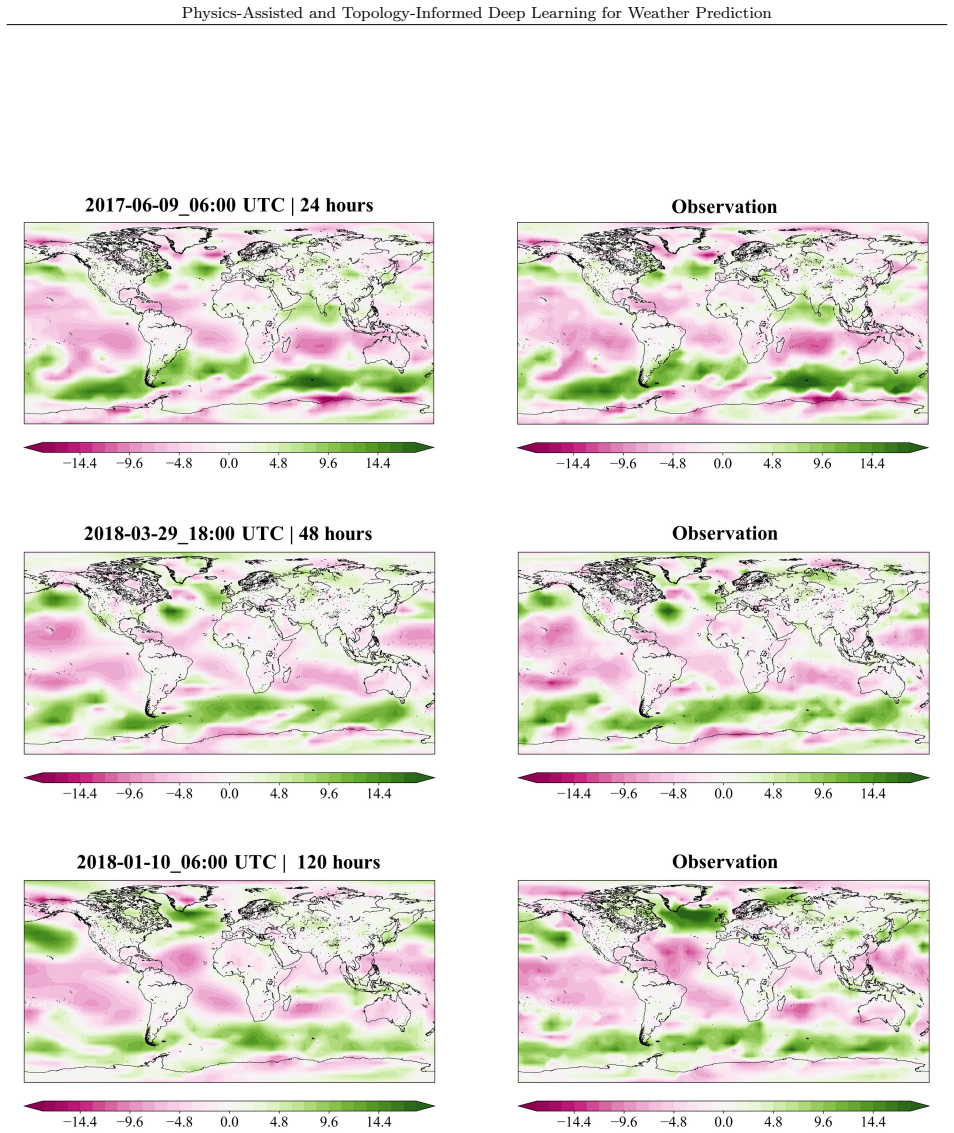
- PASSAT achieves the best RMSE and ACC among the five parameter-matched deep learning baselines for all five variables (t2m, t850, z500, u10, v10) at every lead time from 6 to 144 hours.
- It outperforms the operational IFS T42 model at the two reported lead times (72 and 120 hours) for t2m, t850, and z500, despite IFS T42 running at a finer 2.8-degree resolution.
- Ablation results show that both the physics equations and the spherical topology contribute to the gain; for t2m the two contributions are roughly equal, while for t850, z500, u10, and v10 the topology information is the larger contributor.
- The 0.2-hour integration step with hourly interaction updates is sufficient for stable 144-hour forecasts, suggesting the Euler scheme is not a practical bottleneck at this resolution.
Reading between the lines
- Inference: the learned velocity fields for scalar variables such as t2m and z500 are probably not physical winds; if the observed wind fields were used inside the advection equation instead, the results would reveal whether the Navier-Stokes update is genuinely physical or merely a structured smoothing prior.
- Inference: the topology benefit likely comes mostly from the $1/\cos\theta$ metric factor in the spherical advective derivative, which prevents the polar amplification of planar velocities; this could be tested by keeping the spherical graph but switching the advection derivative back to the planar form.
- Inference: because the machinery is variable-agnostic, the same architecture could be applied to other advection-dominated spherical fields, such as ocean surface tracers or atmospheric chemical concentrations, provided interaction terms can be learned.
- Inference: the comparison with IFS T42 is limited to two lead times and one coarse resolution; a natural extension would test PASSAT at higher input resolution and against IFS T63-equivalent skill, where the paper reports the gap closes.
Signed reviews
Editorial analysis
A structured set of objections, weighed in public.
Referee Report
Summary. The paper proposes PASSAT, a deep learning weather-prediction model that combines a spherical graph neural network with numerical solves of the advection equation and the Navier-Stokes equations on the sphere. The GNN estimates the Earth-atmosphere interaction tendency and the initial velocity fields, while the PDE solver advances the variables and their velocities in time. Experiments are conducted on the 5.625-degree ERA5 dataset for t2m, t850, z500, u10, and v10, with lead times up to 144 hours. The paper claims that PASSAT outperforms both state-of-the-art deep learning weather models and the operational IFS T42 model, and ablation studies are used to argue that both physics and topology information contribute to the gains. The appendices provide architecture details, training procedures, modifications of the baseline models, and full comparison tables.
Significance. If the central claims were fully supported, the paper would be a useful contribution to physics-assisted, topology-aware data-driven weather forecasting. The most valuable parts are the spherical treatment of the advection equation, the attempt to couple learned interaction terms with PDE-based advection, and the availability of code and checkpoints. The ablation results are internally consistent and show clear gains over the authors' own variants. However, the headline claim of outperforming state-of-the-art deep learning models is not supported as written, because the baseline models were downscaled to roughly 1.15 million parameters before comparison, and because the paper's own tables contain counterexamples to the strict-dominance statement. The comparison with IFS T42 is also limited to three variables and two lead times. With recalibrated claims and additional validation of the learned velocity fields, the core idea remains worth publishing.
major comments (3)
- [Section 4 and Appendix F, Tables 8-9] The statement in Section 4 that 'PASSAT outperforms the other deep learning models in all weather variables across different lead times' is directly contradicted by the paper's own results in Tables 8 and 9. For t2m, GraphCast has lower RMSE than PASSAT at 24 h (1.21 vs 1.25), 48 h (1.52 vs 1.54), and 72 h (1.84 vs 1.85), while FourCastNet has lower RMSE at 144 h (2.68 vs 2.69) and ties at 96 h and 120 h. On ACC, GraphCast leads t2m at 24 h (0.972 vs 0.970), 48 h (0.956 vs 0.955), and 72 h (0.937 vs 0.935), and FourCastNet leads at 120 h (0.888 vs 0.886) and 144 h (0.865 vs 0.862). The t850 result at 24 h is tied on both RMSE and ACC. The abstract and the conclusion should be revised to state that PASSAT improves on most variables and lead times, especially z500, u10, v10, and longer leads, rather than claiming superiority in every cell.
- [Section 4, 'Baseline deep learning models'; Appendix E, Tables 3-7] The comparison with 'state-of-the-art' deep learning models is not a comparison with the published models themselves. GraphCast, Pangu, FourCastNet, and SFNO were reduced from 36.7M, 64M, 59.1M, and 107M parameters, respectively, to about 1.15M parameters and retrained from scratch at 5.625 degrees. A 1.15M-parameter GraphCast is not the GraphCast from the Science paper, and the same holds for the other baselines. This makes the controlled comparison legitimate but does not support the abstract's claim that PASSAT 'outperforms the state-of-the-art deep learning-based weather prediction models.' The claim should be explicitly limited to parameter-matched reimplementations trained on this dataset, or the authors should add comparisons with the original pretrained models at their native parameter counts.
- [Section 3.5, Section 3.7, and Algorithm 1] The paper does not provide evidence that the learned per-weather-variable velocity fields v(t,s) correspond to physical atmospheric winds. Each variable t2m, t850, z500, u10, and v10 is assigned its own velocity field, and the Navier-Stokes equations (7)-(8) are then solved for these fields. For variables such as t2m and z500, there is no separately measured physical velocity in the dataset, so these fields are learned latents whose physical interpretation is unclear. If the learned velocities do not resemble real winds, then equations (7)-(8) act as a learned regularizer rather than as a physical law, and the claim that PASSAT 'seamlessly integrates the physics of weather evolution' is overstated. A concrete test would be to compare the velocity-branch output for u10 and v10 against ERA5 wind fields, or to couple all advected variables to a single shared wind field. The authors should either add such validation or substantially soften the physics-language claims.
minor comments (4)
- [Section 3.5] The viscosity coefficient mu appears in equations (7) and (8) and in Algorithm 1 but its value is never reported in the paper. Since this coefficient controls the strength of the friction term, the authors should state its value and, ideally, report sensitivity to it.
- [Appendix D.2] There is a typo in 'GeForece RTX 2080'; it should read 'GeForce RTX 2080.' Additional typos include 'Naiver-Stokes' in Section 5 and 'planner' in Figure 2's caption, and 'Pacth Size' in Table 4.
- [Tables 8 and 9] The ClimODE rows show ACC values that collapse to 0.510 at 72 h and 0.020 at 96 h before becoming NAN at 120 h and 144 h. If this reflects numerical instability or a training failure, it should be stated explicitly so that readers do not interpret the missing entries as an unqualified failure of the baseline.
- [Section 4, comparison with IFS T42] The comparison with IFS T42 is limited to t2m, t850, and z500 at 72 h and 120 h, as the paper notes. The abstract's claim that PASSAT outperforms the operational NWP model IFS T42 should be qualified accordingly, since no claim is made for u10, v10, or other lead times.
Circularity Check
No significant circularity; the physics-assisted solver is a coupled PDE system with learned source and velocity terms, not a derivation from its own outputs.
full rationale
The paper's derivation chain is self-contained. The advection equation (Eq. 4) and the Navier-Stokes equations (Eqs. 7-8) are standard external PDEs, cited to [Cha22] and [LTW92]; no fitted parameter is renamed as a prediction. The velocity fields are produced by the same spherical GNN that estimates the Earth-atmosphere interaction, and the pressure-gradient term in Section 3.7 is replaced by the gradient of the model's own predicted z500, but this is a closed dynamical coupling rather than a definitional equivalence: u and v co-evolve through the numerical solver, and the predicted weather is not the fitted quantity itself. The reference list contains no self-citations by the present authors, so there is no load-bearing self-citation chain and no imported uniqueness theorem. The learned per-variable velocities for scalars such as t2m and z500 are not validated against observed winds (Section 3.5 and Algorithm 1), which weakens the physical-interpretation claim, and the Section 4 statement that PASSAT outperforms all deep learning models in all variables is contradicted by the paper's own Tables 8 and 9 (e.g., GraphCast has lower t2m RMSE at 24 h and 48 h). Both are correctness/consistency concerns rather than circularity. The ablation section also declines to isolate the individual effects of the advection and Navier-Stokes equations (Section 5), but that is an acknowledged experimental limitation, not a circular argument. No circular step can be exhibited, so the score is 0.
Assumptions & free parameters
free parameters (3)
- mu (viscous friction coefficient) =
not reported
- lambda1, lambda2, lambda3 (loss penalty weights) =
10, 1, 1
- Velocity clamp bound =
0.005 (in units of 6731 km/hour)
assumptions (6)
- domain assumption Earth's surface is modeled as an ideal unit sphere
- domain assumption Vertical actions are neglected
- domain assumption Tendency decomposes into advection plus Earth-atmosphere interaction
- standard math The advection and Navier-Stokes equations on the sphere from [LTW92] are the governing equations
- ad hoc to paper The interaction tendency h is constant within each one-hour interval
- ad hoc to paper Pressure gradient force is replaced by z500 geopotential gradients
invented entities (1)
-
Per-weather-variable velocity fields v(t,s)
Cite this review
Pith. "Pith review of Physics-Assisted and Topology-Informed Deep Learning for Weather Prediction." pith.science (2026). https://pith.science/paper/TQGXN5OO
@misc{pith2026250504918,
  author       = {Pith},
  title        = {Pith review of: Physics-Assisted and Topology-Informed Deep Learning for Weather Prediction},
  year         = {2026},
  howpublished = {\url{https://pith.science/paper/TQGXN5OO}},
  note         = {Machine review of arXiv:2505.04918}
}
abstract
Although deep learning models have demonstrated remarkable potential in weather prediction, most of them overlook either the \textbf{physics} of the underlying weather evolution or the \textbf{topology} of the Earth's surface. In light of these disadvantages, we develop PASSAT, a novel Physics-ASSisted And Topology-informed deep learning model for weather prediction. PASSAT attributes the weather evolution to two key factors: (i) the advection process that can be characterized by the advection equation and the Navier-Stokes equation; (ii) the Earth-atmosphere interaction that is difficult to both model and calculate. PASSAT also takes the topology of the Earth's surface into consideration, other than simply treating it as a plane. With these considerations, PASSAT numerically solves the advection equation and the Navier-Stokes equation on the spherical manifold, utilizes a spherical graph neural network to capture the Earth-atmosphere interaction, and generates the initial velocity fields that are critical to solving the advection equation from the same spherical graph neural network. In the $5.625^\circ$-resolution ERA5 data set, PASSAT outperforms both the state-of-the-art deep learning-based weather prediction models and the operational numerical weather prediction model IFS T42. Code and checkpoint are available at https://github.com/Yumenomae/PASSAT_5p625.
Figures


Figures from the paper (8 more)



Reference graph
Works this paper leans on
-
[1]
Accurate medium-range global weather forecasting with 3D neural networks
[Bi+23] Kaifeng Bi, Lingxi Xie, Hengheng Zhang, Xin Chen, Xiaotao Gu, and Qi Tian. “Accurate medium-range global weather forecasting with 3D neural networks.” In:Nature 619.7970 (2023), pp. 533–538. [Bon+23] Boris Bonev, Thorsten Kurth, Christian Hundt, Jaideep Pathak, Maximilian Baust, Karthik Kashinath, and Anima Anandkumar. “Spherical Fourier Neural Op...
arXiv 2023
-
[190]
[Coh+18] Taco S. Cohen, Mario Geiger, Jonas Köhler, and Max Welling. “Spherical CNNs.” In:International Conference on Learning Representations(2018). [Daw+21] Arka Daw, Anuj Karpatne, William Watkins, Jordan Read, and Vipin Kumar. “Physics-guided Neural Networks (PGNN): An Application in Lake Temperature Modeling.” In:arXiv preprint arXiv:1710.11431 (2021...
arXiv 2018
-
[237]
[Mai+23] Gengchen Mai, Yao Xuan, Wenyun Zuo, Yutong He, Jiaming Song, Stefano Ermon, Krzysztof Janowicz, and Ni Lao. “Sphere2Vec: A general-purpose location representation learning over a spherical surface for large-scale geospatial predictions.” In:ISPRS Journal of Photogrammetry and Remote Sensing202 (2023), pp. 439–462. [Ngu+24] Tung Nguyen, Rohan Shah...
arXiv 2023
-
[1984]
ClimODE: Climate and Weather Forecasting with Physics-informed Neural ODEs
[VHG24] Yogesh Verma, Markus Heinonen, and Vikas Garg. “ClimODE: Climate and Weather Forecasting with Physics-informed Neural ODEs.” In:International Conference on Learning Representations (2024). [Wu+21] Zonghan Wu, Shirui Pan, Fengwen Chen, Guodong Long, Chengqi Zhang, and Philip S. Yu. “A Comprehensive Survey on Graph Neural Networks.” In:IEEE Transact...
arXiv 2024
-
[2007]
WeatherBench: a benchmark data set for data-driven weather forecasting
[Ras+20] Stephan Rasp, Peter D Dueben, Sebastian Scher, Jonathan A Weyn, Soukayna Mouatadid, and Nils Thuerey. “WeatherBench: a benchmark data set for data-driven weather forecasting.” In: Journal of Advances in Modeling Earth Systems12.11 (2020). 13 Physics-Assisted and Topology-Informed Deep Learning for Weather Prediction [Roo87] Richard B Rood. “Numer...
work page 2020
-
[2022]
Neural ordinary differential equations
[Che+18] Ricky TQ Chen, Yulia Rubanova, Jesse Bettencourt, and David K Duvenaud. “Neural ordinary differential equations.” In:Advances in Neural Information Processing Systems(2018). [Che+23a] Kang Chen, Tao Han, Junchao Gong, Lei Bai, Fenghua Ling, Jing-Jia Luo, Xi Chen, Leiming Ma, Tianning Zhang, Rui Su, et al. “Fengwu: Pushing the skillful global medi...
arXiv 2018
-
[2049]
The Art and Science of Climate Model Tuning
[Hou+17] Frédéric Hourdin, Thorsten Mauritsen, Andrew Gettelman, Jean-Christophe Golaz, Venkatramani Balaji, Qingyun Duan, Doris Folini, Duoying Ji, Daniel Klocke, Yun Qian, Florian Rauser, Catherine Rio, Lorenzo Tomassini, Masahiro Watanabe, and Daniel Williamson. “The Art and Science of Climate Model Tuning.” In:Bulletin of the American Meteorological S...
arXiv 2017
Reviewed August 15, 2026 · model on record in the stance chip above.
Discussion (0). Continue with ORCID to comment.