REVIEW 4 major objections 5 minor 23 references
Statistical stability of random potentials to thermal and quantum activation
T0 review · 4 major / 5 minor · reviewed 2026-08-10 · deepseek-v4-flash
Pith's one-line read For a particle in a random Gaussian potential, realization-averaged thermal and quantum escape rates obey universal power laws whose crossover scales are fixed solely by the potential's two-point correlator, giving an inverse route to…
desk verdict A clean derivation of averaged escape rates in Gaussian random potentials, spoiled slightly by presenting high-T and small-mass scaling laws without the caveat, admitted only in Appendix B, that the cubic truncation fails there. read the letter →
The pith
A machine-rendered reading of the paper's core claim, the machinery that carries it, and where it could break.
The reading
What carries the argument
The load-bearing object is the probability density for the Taylor coefficients $u_n=U^{(n)}(0)$ of the potential at a point. For a Gaussian random potential the authors show $p(u) = (2\pi)^{-N/2}[\det(\mathcal{G})]^{-1/2}\exp(-\tfrac12 u \mathcal{G}^{-1} u)$ with $\mathcal{G}_{m\ell}=(-1)^\ell G^{(m+\ell)}(0)$, a purely algebraic object built from derivatives of the two-point correlator. This turns the functional average $\langle f\rangle = \int \mathcal{D}[U]P[U] f$ into the ordinary integral $\int du\, p(u) f(u)$ over only the derivatives that $f$ depends on. The escape observables then use the cubic-truncation barrier $U_b = 2u_2^3/(3u_3^2)$ and the WKB action $\Lambda_b = \sqrt{2(2m/\hbar^2)}(6u_2^{5/2}/5u_3^2)$, whose averages over $p(u_1=0,u_2,u_3)$ produce the hypergeometric functions and the asymptotic scalings.
What would settle it
Simulate particles in a Gaussian random potential with known $G(x-y)$ (for instance, many realizations of a sum of Lorentzian wells), compute the exact thermal escape rate by Langevin dynamics and the exact quantum tunneling probability by the full WKB action, and compare with Eqs. (26) and (29)-(30). If, for temperatures $k_B T/E_T$ of order one or masses below the truncation threshold, the measured $\langle\Omega\rangle$ exceeds the reported upper bound or departs from the predicted $1-\text{const}\cdot T^{-1/2}$ and $1-\text{const}\cdot m^{1/4}$ branches, the cubic-truncation assumption is falsified and the claimed spectroscopic link is broken.
Extended reading notes
Core claim
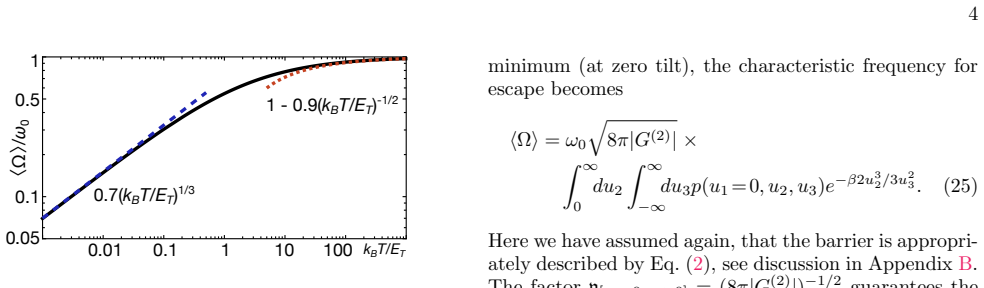
The paper's central claim is that for a Gaussian random potential with two-point correlator $G(x-y)$, the realization-averaged escape of a particle from a zero-tilt local minimum follows determinate, correlator-dependent scaling laws in temperature and mass. Specifically, $\langle\Omega\rangle/\omega_0 \sim (k_B T/E_T)^{1/3}$ for $k_B T \ll E_T$ and $\langle\Omega\rangle/\omega_0 \sim 1 - C (E_T/k_B T)^{1/2}$ for $k_B T \gg E_T$, with $E_T$ built from $G^{(2)}(0)$, $G^{(4)}(0)$, and $G^{(6)}(0)$. In parallel, the WKB tunneling probability obeys $\langle|T|^2\rangle \sim (\mu/\mu_Q)^{-1/5}$ for $\mu \gg \mu_Q$ and $\langle|T|^2\rangle \sim 1 - \nu (\mu/\mu_Q)^{1/4}$ for $\mu \ll \mu_Q$. The authors further claim that this provides an inverse route: by measuring the temperature slope of the escape rate (and repeating at nonzero tilt), one can extract the principal characteristics of the Green's function of the random potential.
Load-bearing premise
The argument assumes the potential around each minimum is accurately captured by keeping only the quadratic and cubic Taylor terms when computing the barrier height and tunneling action; when this cubic truncation fails, the reported rates are only upper bounds and the extraction of the correlator from scaling slopes is no longer guaranteed.
Editorial extensions
If this is right
- The low-temperature slope of $\langle\Omega\rangle$ directly measures the characteristic thermal energy $E_T$, and combining that with stable-area-fraction measurements yields the variance of the pinning force in a vortex landscape.
- Repeating the thermal-activation measurement at different tilts $u_1$ allows one to extract $G^{(2)}(0)$, $G^{(4)}(0)$, and $G^{(6)}(0)$ independently, in principle.
- The predicted $T^{1/3}$ and $T^{-1/2}$ scaling laws are testable in single-vortex scanning probe experiments, where the attempt frequency is set by the depinning resonance.
- The algebraic reduction applies to any observable that depends on finitely many derivatives of a Gaussian random potential, so the same machinery covers area fractions, stability thresholds, and higher-order correlations.
Reading between the lines
- Because the exponents $1/3$, $-1/2$, $-1/5$, and $1/4$ follow from the cubic barrier form rather than the Gaussian weight, the same exponents should appear for any short-range-correlated disorder that retains a cubic-dominated barrier; only the crossover scales would vary. This is an extension the paper does not state.
- The inverse extraction of $G$ from escape data is most reliable in the low-temperature and large-mass regimes, since Appendix B shows the high-temperature and small-mass asymptotics are only upper bounds; an experiment that sees apparent breakdown of the $T^{-1/2}$ or $m^{1/4}$ branch could be testing the truncation rather than the Gaussian statistics.
- The area-fraction result that negative potentials tend to have convex curvature suggests a generic bias in random Ginzburg-Landau theories toward needing sixth-order stabilizing terms; this could be probed in cold-atom speckle potentials, where the correlator is controlled externally.
Editorial analysis
A structured set of objections, weighed in public.
Referee Report
Summary. The paper studies the statistical properties of minima of Gaussian random potentials in one dimension. Its main technical result is a closed-form probability density (Eq. (15)) for the Taylor coefficients of the potential at a point, obtained by Gaussian functional integration. The authors then use this density to compute the realization-averaged thermal activation rate (Eq. (25)) and quantum tunneling probability (Eq. (28)) from a zero-tilt minimum, assuming that the potential barrier is described by a cubic truncation of the local expansion (Eq. (2)). The resulting asymptotic predictions are: the thermal rate grows as T^(1/3) at low temperature and approaches the attempt frequency as 1 - const*T^(-1/2) at high temperature (Eq. (26)); the tunneling probability decays as m^(-1/5) for large mass and approaches 1 - const*m^(1/4) for small mass (Eqs. (29) and (30)). The paper further claims that these activation laws provide a spectroscopic route to infer the two-point correlator of the random potential. A numerical section demonstrates convergence of finite-density Lorentzian defect potentials to the Gaussian limit.
Significance. If the low-temperature and large-mass branches are valid, the paper offers a genuinely useful and elegant tool: the reduction of a functional average to a finite-dimensional algebraic integral (Eq. (15)) is clean, and the numerical verification of convergence to the Gaussian limit is a valuable check. The predicted T^(1/3) low-temperature scaling is a falsifiable signature that could, in principle, be tested in single-vortex creep experiments. However, the paper's central claim is broader than what the derivation supports. The high-temperature and small-mass scaling laws are obtained from a cubic-truncated barrier that the authors themselves state is invalid in those regimes (Appendix B), so the uncritical presentation of all four scaling branches and the inversion protocol built on them overreaches. The low-T and large-mass branches, together with the algebraic probability framework, are the defensible core.
major comments (4)
- [Sec. III.B, Eq. (26), Fig. 1] The high-temperature asymptotic branch (βE_T << 1, i.e., ⟨Ω⟩/ω_0 → 1 - const·(βE_T)^(1/2)) is derived entirely from the cubic-truncated barrier of Eq. (2). Appendix B explicitly states that for k_B T > U_{b,4} the calculated rate is only an upper limit. Since the condition βE_T << 1 necessarily probes temperatures at which k_B T exceeds the quartic barrier scale (unless the correlator parameters are fine-tuned so that E_T << U_{b,4}, which is not shown), the second line of Eq. (26) and the corresponding high-temperature part of Fig. 1 are not predictions of the model. The paper should either restrict the central claims to the low-temperature branch or provide a controlled treatment of the high-temperature regime.
- [Sec. III.C, Eq. (30), Fig. 2] The small-mass branch ⟨|T|^2⟩ → 1 - ν_< (μ/μ_Q)^(1/4) in Eq. (30) is computed from the same cubic truncation of the tunneling action (Λ_b given after Eq. (27)). Appendix B states that for masses below the quartic-barrier criterion the tunneling rate is an upper boundary, so the limit μ << μ_Q lies in the uncontrolled regime. Presenting this branch in Fig. 2 and in the abstract as a predicted saturation law is therefore misleading. The large-mass branch (29) may be defensible, but the small-mass asymptotics require either a higher-order calculation or an explicit statement, in the abstract and main text, that it is an upper-bound estimate rather than the actual rate.
- [Appendix B, Eq. (B2)] The justification of the cubic truncation is not quantitative. The sentence 'Despite the absence of a parametric difference, this trend justifies the truncation' does not constitute an error estimate, and the claim that 'mostly small barriers contribute to the escape rates' is not demonstrated. Since the barrier height (2) and the tunneling action are the load-bearing steps for all subsequent scaling laws, the paper needs either a bound on the error introduced by neglecting u_4, u_5, ..., or an explicit limit (e.g., small E or large mass) in which the cubic term is proven to dominate.
- [Abstract and Sec. III.B] The claimed route to infer the Green's function from activation measurements relies on measuring the scaling slopes of the four asymptotic branches. Because the high-temperature slope is uncontrolled by the present derivation, the inversion protocol is not supported for that branch. The paper should make clear, at the point of the claim, that only the low-temperature thermal slope and the large-mass tunneling slope provide reliable spectroscopic information within the current approximation.
minor comments (5)
- [Eq. (14) and Eq. (15)] The definition of the matrix G_{mℓ} = (-1)^ℓ G^{(m+ℓ)} appears after Eq. (14) with the sign factor (-1)^ℓ on only one index, while the exponent in Eq. (14) has the same factor; it would be helpful to spell out explicitly that the quadratic form is symmetric under m ↔ ℓ because G^{(m+ℓ)} is even and the sign factor is symmetric only after using the parity of the derivatives.
- [Fig. 1 and Fig. 2] The asymptotic branch 1 - const·T^(-1/2) (and similarly 1 - const·m^(1/4)) is not a pure power law, so plotting it on a doubly logarithmic axis as a straight line is geometrically inaccurate; a linear or semi-log inset would be more informative for these saturation branches.
- [Table I caption and Eq. (31)] The caption uses 'npω' and 'ω' as the length scale, while the text uses ξ for the Lorentzian width; the notation should be unified to avoid confusion.
- [Appendix A, Eq. (A6)] The generalized hypergeometric representation of ⟨|T|^2⟩ contains parameters such as 2/8 and 4/8 that are presumably meant as 1/4 and 1/2; this simplification should be made for readability, and the hypergeometric parameters should be checked for consistency with the prefactors.
- [Ref. [24]] The supplementary material is described as 'provided upon reasonable request' rather than being archived; for the numerical data and animations to be reproducible, they should be made available through a permanent repository or as journal supplementary material.
Circularity Check
No significant circularity: forward calculation takes G as input and derives rates; no fitted-input-as-prediction or self-definitional reduction.
full rationale
The derivation chain is self-contained. The probability density p(u) in Eq. (15) is obtained by Gaussian functional integration over the two-point correlator G, not by imposing the escape rates. The thermal activation formula, Eq. (25), is an explicit integral over p(u2,u3) times the Arrhenius weight e^{-β 2u3^2/(3u2^3)}; the asymptotic forms in Eq. (26) follow from expanding that integral, with the crossover scale ET defined by G derivatives. Similarly, the quantum tunneling expression, Eq. (28), directly averages the WKB tunneling factor over the same Gaussian distribution and yields the mass scaling in Eqs. (29)-(30); the exponents are not fitted but emerge from the integration. Reference [19] (same author) is cited for two supporting facts: ensemble-versus-position average equivalence and the central-limit realization of Gaussian disorder from random wells. These are standard, independently checkable statements, and the paper further verifies the Gaussian limit numerically in Fig. 3, so the citations are not load-bearing. Appendix B explicitly concedes that at high temperature or small mass the cubic truncation fails and the computed rates are upper bounds; this is an acknowledged approximation limitation, not a circular reduction. The proposed inversion from measured rates to G values is a suggested application and is not used as an input to any derivation. No parameter is fitted to the predicted observables, and no result reduces by construction to its own input.
Assumptions & free parameters
assumptions (6)
- domain assumption Gaussian functional measure with zero mean and two-point correlation G(x-y)
- domain assumption Stationarity and evenness of G, so odd derivatives G^(2l+1)(0) vanish
- domain assumption Spatial average over x0 is equivalent to statistical average over potential realizations
- ad hoc to paper Taylor expansion of U around a minimum can be truncated after the cubic term in the barrier and tunneling action
- domain assumption WKB approximation for quantum tunneling probability
- domain assumption Central-limit behavior of a dense set of independent Lorentzian wells reproduces Gaussian statistics
Cite this review
Pith. "Pith review of Statistical stability of random potentials to thermal and quantum activation." pith.science (2026). https://pith.science/paper/TQM7TNHH
@misc{pith2026260807194,
  author       = {Pith},
  title        = {Pith review of: Statistical stability of random potentials to thermal and quantum activation},
  year         = {2026},
  howpublished = {\url{https://pith.science/paper/TQM7TNHH}},
  note         = {Machine review of arXiv:2608.07194}
}
read the original abstract
In numerous physical, chemical, and biological systems the dynamics can be reduced to the motion of state variables in a complex potential landscape. In case the manifold is known, the motion and response of the embedded object can be described deterministically up to stochastic effects usually associated with a noise. In contrast, if the manifold is unknown, the static and dynamic response of the state variable may be used as a spectroscopic tool to characterize the potential landscape. Inspired by a seminal work of L.\ Embon and co-workers, [Sci.\ Rep.\ \textbf{5}, 7598 (2015)] we investigate the statistical properties of potential minima, in particular, their stability to thermal and quantum activation. For Gaussian random manifolds, we derive an algebraic expression to evaluate the statistical probability of the potential character (value, slope, curvature, ...). With this tool, we compute the expectation value for the rate of thermal and quantum activation and link these findings to the principal characteristics of the Gaussian potential, i.e., its Green's function. This link provides the opportunity to access information on the potential's Green's function by studying the activation behavior of an object in this manifold.
Figures

Reference graph
Works this paper leans on
-
[1]
T. Nattermann, Y. Shapir, and I. Vilfan,Interface pin- ning and dynamics in random systems, Physical Review B42, 8577 (1990)
work page 1990
-
[2]
A. Guinier,X-ray Diffraction in Crystals, Imperfect Crystals, and Amorphous Bodies, Dover Books on Physics Series (Dover Publications, 1994)
work page 1994
- [3]
-
[4]
D. M. Ragan,Structural Geology: An Introduction to Geometrical Techniques(Cambridge University Press, 2009)
work page 2009
-
[5]
D. L. Stern,The genetic causes of convergent evolution, Nature Reviews Genetics14(2013), 10.1038/nrg3483
-
[6]
X. Gu, G. Li, H. Pang, S. Wang, B. Ni, F. Luo, R. Peng, and L. Chen,Statistical Analysis of Very Low Frequency Atmospheric Noise Caused by the Global Lightning Using Ground-Based Observations in China, Journal of Geo- physical Research: Space Physics126, e2020JA029101 (2021)
work page 2021
-
[7]
M. Kac,On the average number of real roots of a random algebraic equation, Bulletin of the American Mathemat- ical Society49, 314 (1943)
work page 1943
-
[8]
S. O. Rice,Mathematical Analysis of Random Noise, Bell System Technical Journal24, 46 (1945)
work page 1945
Show all 23 references
-
[9]
Kac,On the average number of real roots of a ran- dom algebraic equation (II), Proceedings of the London Mathematical Society49, 314 (1943)
M. Kac,On the average number of real roots of a ran- dom algebraic equation (II), Proceedings of the London Mathematical Society49, 314 (1943)
1943
-
[10]
M. S. Longuet-Higgins and G. E. R. Deacon,The statis- tical analysis of a random, moving surface, Philosophical Transactions of the Royal Society of London. Series A, Mathematical and Physical Sciences249, 321 (1957)
1957
-
[11]
M. S. Longuet-Higgins,Reflection and Refraction at a Random Moving Surface. II. Number of Specular Points in a Gaussian Surface, Journal of the Optical Society of America50, 845 (1960)
1960
-
[12]
Y. V. Fyodorov,High-Dimensional Random Fields and Random Matrix Theory, Markov Processes And Related Fields21, 483 (2015)
2015
-
[13]
Guillam´ on, H
I. Guillam´ on, H. Suderow, S. Vieira, J. Ses´ e, R. C´ ordoba, J. M. De Teresa, and M. R. Ibarra,Direct Observation of Stress Accumulation and Relaxation in Small Bundles of Superconducting Vortices in Tungsten Thin Films, Phys- ical Review Letters106, 077001 (2011)
2011
-
[14]
Embon, Y
L. Embon, Y. Anahory, A. Suhov, D. Halbertal, J. Cup- pens, A. Yakovenko, A. Uri, Y. Myasoedov, M. L. Rap- paport, M. E. Huber, A. Gurevich, and E. Zeldov,Prob- ing dynamics and pinning of single vortices in supercon- ductors at nanometer scales, Scientific Reports5, 7598 (2015)
2015
-
[15]
Kremen, S
A. Kremen, S. Wissberg, N. Haham, E. Persky, Y. Frenkel, and B. Kalisky,Mechanical Control of Indi- vidual Superconducting Vortices, Nano Letters16, 1626 (2016)
2016
-
[16]
Herrera, J
E. Herrera, J. Benito-Llorens, U. S. Kaluarachchi, S. L. Bud’ko, P. C. Canfield, I. Guillam´ on, and H. Suderow, Vortex creep at very low temperatures in single crystals of the extreme type-II superconductorRh 9In4S4, Physical Review B95, 134505 (2017)
2017
-
[17]
Embon, Y
L. Embon, Y. Anahory, ˇZ. L. Jeli´ c, E. O. Lachman, Y. Myasoedov, M. E. Huber, G. P. Mikitik, A. V. Sil- hanek, M. V. Miloˇ sevi´ c, A. Gurevich, and E. Zeldov, Imaging of super-fast dynamics and flow instabilities of superconducting vortices, Nature Communications8, 85 (2017)
2017
-
[18]
Willa, J
R. Willa, J. A. Galvis, J. Benito-Llorens, E. Herrera, I. Guillamon, and H. Suderow,Thermal creep induced by cooling a superconducting vortex lattice, Physical Review Research2, 013125 (2020)
2020
-
[19]
Willa, V
R. Willa, V. B. Geshkenbein, and G. Blatter,Hes- sian characterization of the pinning landscape in a type-II superconductor, Physical Review B105(2022), 10.1103/PhysRevB.105.144504
2022 doi
-
[20]
Sa-yakanit,Electron density of states in a Gaussian random potential: Path-integral approach, Physical Re- view B19, 2266 (1979)
V. Sa-yakanit,Electron density of states in a Gaussian random potential: Path-integral approach, Physical Re- view B19, 2266 (1979)
1979
-
[21]
Peacock,Cosmological Physics, Cambridge Astro- physics (Cambridge University Press, 1999)
J. Peacock,Cosmological Physics, Cambridge Astro- physics (Cambridge University Press, 1999)
1999
-
[22]
Hanson, A
D. Hanson, A. Challinor, and A. Lewis,Weak lensing of the CMB, General Relativity and Gravitation42, 2197 (2010)
2010
-
[23]
Dobramysl, M
U. Dobramysl, M. Pleimling, and U. C. T¨ auber,Pin- ning time statistics for vortex lines in disordered envi- ronments, Physical Review E90, 062108 (2014). [24]Animated visuals ofp(u 0, u2),p(u 1, u3), orp(u 2, u3)as a function of the defect densityn p are provided upon rea- s...
2014
Reviewed August 10, 2026 · model on record in the stance chip above.
Discussion (0). Continue with ORCID to comment.