REVIEW 3 major objections 4 minor 2 cited by
Spin polarization for massive fermion in a shear flow: complete results at $O(\partial)$
T0 review · 3 major / 4 minor · reviewed 2026-08-12 · deepseek-v4-flash
Pith's one-line read This paper claims that collisional and dynamical effects raise shear-induced spin polarization of a massive fermion by 50 percent, with the total coefficient approaching $3/2$ at high momentum.
desk verdict The 3/2 asymptotic enhancement is likely right, but the claimed subleading solution and the numerical curves built on it do not satisfy the paper's own ODE; the boundary condition needs correction. read the letter →
The pith
A machine-rendered reading of the paper's core claim, the machinery that carries it, and where it could break.
The reading
What carries the argument
The central object is the axial-vector component of the Wigner function, $A^\mu = 2\pi\delta(P^2-m^2)(a^\mu f_A + S^{\mu\nu}_{u,m}D_\nu f)$, whose shear-flow part is parametrized by a single scalar coefficient $N_P$. The split into dynamical ($N_a$), kinematic magnetization-current ($N_\partial$), and collisional displacement-current ($N_\Sigma$) contributions is fixed by the decomposition in Eqs. (5)-(9). Frame independence of $A^\mu$, inherited from the side-jump structure of relativistic kinetic theory, fixes the dynamical piece in the massless and small-mass limits. For arbitrary mass, the detailed-balance condition — that the axial collision term $C_A^\mu$ vanishes at $O(\partial)$ in steady state — turns the spin kinetic equation into a second-order differential equation for $N_P$; its asymptotic solutions provide boundary conditions for the numerical solution plotted across momenta and masses.
What would settle it
Solve the axial kinetic equation (50) with the homogeneous term retained and a specified initial spin polarization, and evolve the probe to late time: if the asymptotic $N_P$ at $p\gg m,T$ is not $3/2$, or if a full leading-log simulation of massive fermions in a sheared QED plasma initialized unpolarized relaxes to $N_P=1$, the detailed-balance boundary condition is falsified.
Extended reading notes
Core claim
For a massive probe fermion in a steady shear flow, the complete first-order spin polarization is not the free-theory value $N_P=1$: once both the probe and the medium fermions reach steady state, the collisional displacement-current contribution and the dynamical spin-evolution contribution combine with the kinematic term. In the phenomenologically relevant limit $p\gg m$ and $p\gg T$, the paper derives $N_P = 3/2 + 21T/(2p)$, so collisions and spin dynamics together enhance the spin-shear coupling by 50 percent relative to the collisionless result. Although the individual contributions depend on the collision rate, the coupling constant drops out of the final coefficient at leading logarithmic order. In the massless limit the dynamical part vanishes and $N_P = 1 - 2T_3^{\mathrm{prob}}/p$, while in the non-relativistic limit $m\gg p$ the coefficient develops a $1/p^2$ enhancement traced to the probe's shear-induced redistribution.
Load-bearing premise
The whole calculation hinges on the assumption that in a steady shear flow the spin-dependent collision term must vanish at first order and that, with no shear, spin polarization would decay to zero; a different boundary condition would change the $3/2$ result.
Editorial extensions
If this is right
- In the limit $p\gg m$ and $p\gg T$, the complete coefficient $N_P = 3/2 + 21T/(2p)$ means the collisional plus dynamical contributions enhance the spin-shear coupling by 50 percent over the collisionless value.
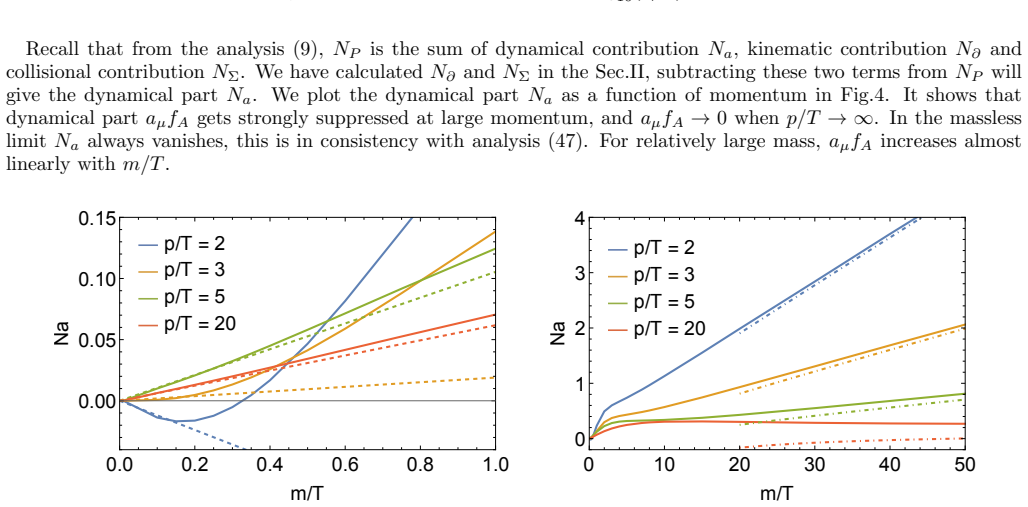
- The dynamical part $a^\mu f_A$ vanishes for massless fermions, is strongly suppressed at large momentum, and grows roughly linearly with $m/T$ for larger masses.
- The coupling constant $e$ cancels out of the final $N_P$ at leading logarithmic order even though the collision terms individually depend on it.
- In the non-relativistic limit $m\gg p$, $N_P$ acquires a $1/p^2$ enhancement from the redistribution of the probe fermion, the same mechanism seen in the massless counterpart.
- If the result carries over to QCD, existing phenomenological studies that use the collisionless spin-shear coupling may underestimate the shear contribution to local $\Lambda$ polarization.
Reading between the lines
- If the same 50 percent enhancement holds in QCD, hydrodynamics codes that currently use $N_P=1$ for strange quarks would need a momentum-dependent $N_P$ rising toward $3/2$, which would strengthen the shear contribution to local $\Lambda$ polarization.
- The discarded homogeneous solution could instead be selected by the initial spin state of the probe; a test is to prepare the plasma with a known nonzero polarization and check whether the late-time coefficient still approaches $3/2$.
- Because $N_P\to 3/2$ is derived at leading logarithmic order with a heavy probe ($m\gg eT$), the prediction is specific to weak coupling; at stronger coupling, Compton and pair-annihilation channels could add contributions outside the present QED setup.
- The massless result $N_P=1-2T_3^{\mathrm{prob}}/p$ shows that even without a dynamical part, steady-state collisions shift the chiral-fermion coefficient away from the collisionless value 1, so $N_P=1$ is not the steady-state fixed point.
Editorial analysis
A structured set of objections, weighed in public.
Referee Report
Summary. The paper analyzes the spin polarization of a massive probe fermion in a massless QED plasma with a steady shear flow, aiming at the shear-induced polarization of strange quarks in heavy-ion collisions. The total spin-polarization coefficient N_P is decomposed into a kinematic part, a non-dynamical collisional part from self-energy corrections, and a dynamical part from the axial kinetic equation. The non-dynamical part is computed from the self-energy using the known steady-state redistribution of medium fermions and a newly computed redistribution of the massive probe. The dynamical part is fixed by imposing a detailed-balance condition, i.e., the vanishing of the axial collision term at O(delta). This leads to a second-order ordinary differential equation for N_P, which is solved analytically in the p >> m and p << m limits and numerically in between. The central claim is that in the phenomenologically interesting ultrarelativistic limit the total coefficient approaches N_P -> 3/2, a 50% enhancement over the collisionless value N_P = 1, with a subleading correction N_P = 3/2 + 21T/(2p).
Significance. If correct, the result would be directly relevant to the local spin polarization puzzle for Lambda hyperons, because it shows that collisional and dynamical contributions, not just the free-theory spin-shear coupling, set the O(delta) polarization of a massive strange-like quark. The paper contains substantial technical work: explicit two-loop self-energy integrals, analytic expressions for the redistribution coefficients T_2 and T_3, reduction of the multi-loop collision term to a one-dimensional ODE, and a non-trivial observation that the coupling constant cancels in the final coefficient at leading logarithmic order. The leading asymptotic coefficient 3/2 is an exact particular solution of the printed large-momentum ODE and is not invalidated by the subleading inconsistency discussed below. These strengths make the paper potentially important, but the reported complete finite-momentum results are undermined by an inconsistency between the claimed asymptotic solution and the published ODE coefficients.
major comments (3)
- [Sec. IV.B and Appendix A, Eq. (A20)] Equation (53) does not solve the large-momentum ODE (50) with the coefficients printed in Eq. (A20). Direct substitution of N_P = 3/2 + 21T/(2p) gives a left-hand side of -63 c_A T/p (or -21 c_A/p for T = 1), not zero. The constant 3/2 is an exact particular solution, but the 21T/(2p) term is not a homogeneous solution at the stated order, because the printed ODE contains no 1/p source. Since the numerical shooting in Figs. 3–5 uses Eq. (53) as the large-p boundary condition, the finite-p curves and the extracted dynamical part N_a(p) are not determined self-consistently. The authors must correct either Eq. (53), Eq. (A20), or the numerical boundary-condition procedure.
- [Sec. IV.B, boundary condition] The selection of the large-p solution rests on the assertion that the homogeneous solution is discarded because without shear the axial Wigner function would vanish. This is an assumption, not a derivation. Equation (50) is a second-order ODE for the steady-state coefficient N_P, and simply dropping the homogeneous solution imposes the boundary condition by fiat. The authors should show that the discarded homogeneous modes are irregular at p -> infinity, violate the physical limit N_P -> 0 as the shear source is removed, or are excluded by the time-dependent axial kinetic equation. This point is load-bearing because the leading value 3/2 and the entire extracted N_a(p) depend on this choice.
- [Sec. II, Eq. (16) and Figs. 3–5] The probe redistribution chi^prob_p in Eq. (16) is derived by keeping only the leading powers of p and is therefore valid only for p >> T. The text and the Fig. 3 caption acknowledge that the results for p less than or similar to T are unreliable. Nevertheless, Figs. 3–5 present numerical solutions over the full momentum range, and Fig. 5 extracts N_a at p/T = 2, 3, 5, and 20, some of which are outside the strict validity domain of Eq. (16). This does not invalidate the p >> T asymptotic statement, but it does undercut the title's claim of complete results at O(delta) for finite momentum; the paper should either extend the redistribution calculation beyond the leading-p approximation or clearly restrict all finite-p claims.
minor comments (4)
- [Sec. V, conclusion] The sentence 'The enhancement seems to be phenomenologically favored...' is duplicated verbatim and should be removed.
- [Sec. II, Fig. 2] The caption of Fig. 2 states that the ratio for p less than or similar to T is unreliable, but the figure itself still plots that region; shading or a cutoff marker for the unreliable region would improve clarity.
- [Appendix A, Eq. (A20)] The units and the temperature dependence in Eq. (A20) should be stated explicitly; as printed, the reader cannot tell whether the constants +4 and +6 are in units of T or are genuinely p-independent terms.
- [Reference [37]] Reference [37] appears to be a footnote rather than a citation to a published work; this should be formatted consistently with the journal's reference style.
Circularity Check
No circular reduction found: NP is solved from the axial detailed-balance ODE with independently computed coefficients, and the self-citations supply standard transport inputs rather than the target result.
full rationale
The central coefficient NP is not an input: it is defined by the decomposition (4)/(9) and then determined by the detailed-balance condition CA=0, which is converted into the differential equation (50) with coefficients c_diff and cpol printed in (A11)-(A20). These coefficients are computed from the self-energy and redistribution expressions (10)-(22), with no target value of NP inserted; the massless limit (47) and the large-momentum limit (51) are consequences of those coefficients. The frame-independence result (40) for the O(m) dynamical part is explicitly presented as an ansatz ("we choose the corresponding N^mu..."), and it is cross-checked, not assumed, against the numerical solution of (50); thus it is not a circular prediction. The paper does use the authors' earlier results [24,25] for the medium-fermion redistribution and the massless displacement current, but these are analytic expressions with stated derivations and are externally checkable, so they are independent support rather than load-bearing self-citation. One non-circular defect should be flagged: substituting the printed asymptotic solution (53), NP=3/2+21T/(2p), into (50) with the printed large-p coefficients (A20) leaves a nonzero remainder -63 cA T/p, so (53) is not actually a solution of the printed ODE at subleading order. This is a correctness/self-consistency problem in the boundary condition used for the numerical integration, not an equivalence-by-construction; the leading value 3/2 is independently fixed by the coefficient ratio in (51).
Assumptions & free parameters
assumptions (8)
- domain assumption Collisional QKT with Wigner-function decomposition (Eqs. 1 and 42) correctly describes massive fermion spin transport in a plasma.
- domain assumption Both probe and medium fermions are in steady state in the shear flow, with deviations delta f = fp(1-fp) I_p_ij sigma_ij chi_p; chi_prob is approximated by the p >> T solution (16).
- domain assumption For m >> eT, only Coulomb scattering of the probe with medium fermions contributes at leading-log order; Compton scattering and pair annihilation are suppressed.
- domain assumption Leading-logarithmic soft-momentum approximation: hard fermions with p,k ~ T, soft momentum transfer eT << q << T, and the q integral gives ln(1/e).
- domain assumption Detailed balance: for a steady shear flow and f_A ~ O(delta), P*dot*delta A_mu is O(delta^2), so the axial collision term C_A must vanish at O(delta).
- ad hoc to paper The homogeneous solution of the detailed-balance ODE (50) is discarded; without the shear source the axial Wigner function should vanish.
- domain assumption Frame-independence ansatz N_mu (36) determines the leading mass correction to the dynamical term, with O(m^2) corrections neglected.
- domain assumption The QED result is used as a proxy for QCD strange-quark polarization in heavy-ion collisions.
Cite this review
Pith. "Pith review of Spin polarization for massive fermion in a shear flow: complete results at $O(\partial)$." pith.science (2026). https://pith.science/paper/TRFUPEZK
@misc{pith2026241119550,
  author       = {Pith},
  title        = {Pith review of: Spin polarization for massive fermion in a shear flow: complete results at $O(\partial)$},
  year         = {2026},
  howpublished = {\url{https://pith.science/paper/TRFUPEZK}},
  note         = {Machine review of arXiv:2411.19550}
}
abstract
Motivated by the key role of shear induced polarization in understanding the local spin polarization puzzle of $\Lambda$ hyperons in heavy ion collisions, we perform a complete analysis of spin polarization of massive fermion in a quantum electrodynamic plasma with shear flow. Apart from the well-known spin-shear coupling in free theory, we include two more collision dependent contributions: one is a non-dynamical contribution fixed by shifted spin-averaged distribution in steady state; the other is a dynamical contribution following from spin evolution. Despite of the dependencies on collision, we find the dependencies on coupling drop out in the final results. These contributions can lead to significant enhancement of the spin-shear coupling in phenomenologically interesting regime.
Figures


Figures from the paper (2 more)

Forward citations
Cited by 2 Pith papers
-
Is the shear induced spin polarization non-dissipative?
Shear-induced spin polarization leaves the momentum-integrated entropy production rate unchanged in chiral kinetic theory, but Zubarev's linear response suggests a dissipative origin.
-
Spin polarization of an expanding and rotating system
Derives closed equations for spin moments and a first-order longitudinal polarization formula for a boost-invariant, rotating relativistic fluid, connecting free streaming to hydrodynamics.
Reference graph
Works this paper leans on
-
[1]
Adamczyk et al
L. Adamczyk et al. Global Λ hyperon polarization in nuclear collisions: evidence for the most vortical fluid. Nature, 548:62–65, 2017
2017
-
[2]
Globally polarized quark-gluon plasma in non-central A+A collisions
Zuo-Tang Liang and Xin-Nian Wang. Globally polarized quark-gluon plasma in non-central A+A collisions. Phys. Rev. Lett., 94:102301, 2005. [Erratum: Phys.Rev.Lett. 96, 039901 (2006)]
2006
-
[3]
Spin alignment of vector mesons in non-central A+A collisions
Zuo-Tang Liang and Xin-Nian Wang. Spin alignment of vector mesons in non-central A+A collisions. Phys. Lett. B, 629:20–26, 2005
2005
-
[4]
Global quark polar- ization in non-central A+A collisions
Jian-Hua Gao, Shou-Wan Chen, Wei-tian Deng, Zuo-Tang Liang, Qun Wang, and Xin-Nian Wang. Global quark polar- ization in non-central A+A collisions. Phys. Rev. C, 77:044902, 2008
work page 2008
-
[5]
Quark Polarization in a Viscous Quark-Gluon Plasma
Xu-Guang Huang, Pasi Huovinen, and Xin-Nian Wang. Quark Polarization in a Viscous Quark-Gluon Plasma. Phys. Rev. C, 84:054910, 2011
work page 2011
-
[6]
Rotating quark-gluon plasma in relativistic heavy ion collisions
Yin Jiang, Zi-Wei Lin, and Jinfeng Liao. Rotating quark-gluon plasma in relativistic heavy ion collisions. Phys. Rev. C, 94(4):044910, 2016. [Erratum: Phys.Rev.C 95, 049904 (2017)]
2017
-
[7]
Event-by-event generation of electromagnetic fields in heavy-ion collisions
Wei-Tian Deng and Xu-Guang Huang. Event-by-event generation of electromagnetic fields in heavy-ion collisions. Phys. Rev. C, 85:044907, 2012
work page 2012
-
[8]
Vortical Fluid and Λ Spin Correlations in High- Energy Heavy-Ion Collisions
Long-Gang Pang, Hannah Petersen, Qun Wang, and Xin-Nian Wang. Vortical Fluid and Λ Spin Correlations in High- Energy Heavy-Ion Collisions. Phys. Rev. Lett., 117(19):192301, 2016. 18
work page 2016
Show all 42 references
-
[9]
Probing vorticity structure in heavy-ion collisions by local Λ polarization
Xiao-Liang Xia, Hui Li, Ze-Bo Tang, and Qun Wang. Probing vorticity structure in heavy-ion collisions by local Λ polarization. Phys. Rev. C, 98:024905, 2018
2018
-
[10]
Polarization of Λ ( ¯Λ) hyperons along the beam direction in Au+Au collisions at √sN N= 200 GeV
Jaroslav Adam et al. Polarization of Λ ( ¯Λ) hyperons along the beam direction in Au+Au collisions at √sN N= 200 GeV. Phys. Rev. Lett., 123(13):132301, 2019
2019
-
[11]
Becattini and Iu
F. Becattini and Iu. Karpenko. Collective Longitudinal Polarization in Relativistic Heavy-Ion Collisions at Very High Energy. Phys. Rev. Lett., 120(1):012302, 2018
2018
-
[12]
Thermal vorticity and spin polarization in heavy-ion collisions
De-Xian Wei, Wei-Tian Deng, and Xu-Guang Huang. Thermal vorticity and spin polarization in heavy-ion collisions. Phys. Rev. C, 99(1):014905, 2019
2019
-
[13]
Hydrodynamic study of hyperon spin polarization in relativistic heavy ion collisions
Baochi Fu, Kai Xu, Xu-Guang Huang, and Huichao Song. Hydrodynamic study of hyperon spin polarization in relativistic heavy ion collisions. Phys. Rev. C, 103(2):024903, 2021
2021
-
[14]
Shuai Y. F. Liu and Yi Yin. Spin polarization induced by the hydrodynamic gradients. JHEP, 07:188, 2021
2021
-
[15]
Becattini, M
F. Becattini, M. Buzzegoli, and A. Palermo. Spin-thermal shear coupling in a relativistic fluid. Phys. Lett. B, 820:136519, 2021
2021
-
[16]
Nonlinear Responses of Chiral Fluids from Kinetic Theory
Yoshimasa Hidaka, Shi Pu, and Di-Lun Yang. Nonlinear Responses of Chiral Fluids from Kinetic Theory. Phys. Rev. D, 97(1):016004, 2018
2018
-
[17]
Baochi Fu, Shuai Y. F. Liu, Longgang Pang, Huichao Song, and Yi Yin. Shear-Induced Spin Polarization in Heavy-Ion Collisions. Phys. Rev. Lett., 127(14):142301, 2021
2021
-
[18]
Becattini, M
F. Becattini, M. Buzzegoli, G. Inghirami, I. Karpenko, and A. Palermo. Local Polarization and Isothermal Local Equilib- rium in Relativistic Heavy Ion Collisions. Phys. Rev. Lett., 127(27):272302, 2021
2021
-
[19]
Reexamination of local spin polarization beyond global equilibrium in relativistic heavy ion collisions
Cong Yi, Shi Pu, and Di-Lun Yang. Reexamination of local spin polarization beyond global equilibrium in relativistic heavy ion collisions. Phys. Rev. C, 104(6):064901, 2021
2021
-
[20]
Signatures of the spin Hall effect in hot and dense QCD matter
Baochi Fu, Longgang Pang, Huichao Song, and Yi Yin. Signatures of the spin Hall effect in hot and dense QCD matter. 1 2022
2022
-
[21]
Local and global polarization of Λ hyperons across RHIC-BES energies: The roles of spin hall effect, initial condition, and baryon diffusion
Xiang-Yu Wu, Cong Yi, Guang-You Qin, and Shi Pu. Local and global polarization of Λ hyperons across RHIC-BES energies: The roles of spin hall effect, initial condition, and baryon diffusion. Phys. Rev. C, 105(6):064909, 2022
2022
-
[22]
Moore, and Laurence G
Peter Brockway Arnold, Guy D. Moore, and Laurence G. Yaffe. Transport coefficients in high temperature gauge theories
-
[23]
JHEP, 11:001, 2000
Leading log results. JHEP, 11:001, 2000
2000
-
[24]
Peter Brockway Arnold, Guy D Moore, and Laurence G. Yaffe. Transport coefficients in high temperature gauge theories
-
[25]
JHEP, 05:051, 2003
Beyond leading log. JHEP, 05:051, 2003
2003
-
[26]
Shear induced polarization: Collisional contributions
Shu Lin and Ziyue Wang. Shear induced polarization: Collisional contributions. 6 2022
2022
-
[27]
Steady state, displacement current and spin polarization for massless fermion in a shear flow
Shu Lin and Ziyue Wang. Steady state, displacement current and spin polarization for massless fermion in a shear flow. 6 2024
2024
-
[28]
Collisional corrections to spin polarization from quantum kinetic theory using Chapman-Enskog expansion
Shuo Fang and Shi Pu. Collisional corrections to spin polarization from quantum kinetic theory using Chapman-Enskog expansion. 8 2024
2024
-
[29]
Effective quantum kinetic theory for spin transport of fermions with collsional effects
Di-Lun Yang, Koichi Hattori, and Yoshimasa Hidaka. Effective quantum kinetic theory for spin transport of fermions with collsional effects. JHEP, 07:070, 2020
2020
-
[30]
Quantum kinetic theory for quantum electrodynamics
Shu Lin. Quantum kinetic theory for quantum electrodynamics. Phys. Rev. D, 105(7):076017, 2022
2022
-
[31]
Axial Kinetic Theory and Spin Transport for Fermions with Arbitrary Mass
Koichi Hattori, Yoshimasa Hidaka, and Di-Lun Yang. Axial Kinetic Theory and Spin Transport for Fermions with Arbitrary Mass. Phys. Rev. D, 100(9):096011, 2019
2019
-
[32]
Nora Weickgenannt, Xin-Li Sheng, Enrico Speranza, Qun Wang, and Dirk H. Rischke. Kinetic theory for massive spin-1/2 particles from the Wigner-function formalism. Phys. Rev. D, 100(5):056018, 2019
2019
-
[33]
Relativistic Quantum Kinetic Theory for Massive Fermions and Spin Effects
Jian-Hua Gao and Zuo-Tang Liang. Relativistic Quantum Kinetic Theory for Massive Fermions and Spin Effects. Phys. Rev. D, 100(5):056021, 2019
2019
-
[34]
Covariant Spin Kinetic Theory I: Collisionless Limit
Yu-Chen Liu, Kazuya Mameda, and Xu-Guang Huang. Covariant Spin Kinetic Theory I: Collisionless Limit. Chin. Phys. C, 44(9):094101, 2020. [Erratum: Chin.Phys.C 45, 089001 (2021)]
2021
-
[35]
Moore, and Laurence G
Peter Brockway Arnold, Guy D. Moore, and Laurence G. Yaffe. Effective kinetic theory for high temperature gauge theories. JHEP, 01:030, 2003
2003
-
[36]
Spin evolution of massive fermion in QED plasma
Ziyue Wang. Spin evolution of massive fermion in QED plasma. Phys. Rev. D, 106(7):076011, 2022
2022
-
[37]
Son, and Mikhail A
Jing-Yuan Chen, Dam T. Son, and Mikhail A. Stephanov. Collisions in Chiral Kinetic Theory. Phys. Rev. Lett., 115(2):021601, 2015
2015
-
[38]
Xin-Li Sheng, Qun Wang, and Dirk H. Rischke. Lorentz-covariant kinetic theory for massive spin-1/2 particles. Phys. Rev. D, 106(11):L111901, 2022
2022
-
[39]
We have dropped the symmetry factor 1 2! irrelevant for our case with probe fermion
-
[40]
Relativistic Chiral Kinetic Theory from Quantum Field Theories
Yoshimasa Hidaka, Shi Pu, and Di-Lun Yang. Relativistic Chiral Kinetic Theory from Quantum Field Theories. Phys. Rev. D, 95(9):091901, 2017
2017
-
[41]
The condition of steady shear can be relaxed to a slow-varying shear, which does not affect our discussions
-
[42]
Quantum kinetic theory for dynamical spin polarization from QED-type interaction
Shuo Fang, Shi Pu, and Di-Lun Yang. Quantum kinetic theory for dynamical spin polarization from QED-type interaction. Phys. Rev. D, 106(1):016002, 2022
2022
Reviewed August 12, 2026 · model on record in the stance chip above.
Discussion (0). Continue with ORCID to comment.