REVIEW 3 major objections 4 minor 3 references
A new pharmacological preconditioning-based target: from drosophila to kidney transplantation
T0 review · 3 major / 4 minor · reviewed 2026-08-14 · deepseek-v4-flash
Pith's one-line read This review argues that GC7, a drug that blocks eIF5A activation, can precondition kidneys against ischemia-reperfusion injury and improve transplant outcomes.
desk verdict A clear narrative review that usefully assembles the eIF5A hypusination preconditioning story, but its 'appears clearly' conclusion about pig kidney transplantation outruns the evidence in the single pig study it cites. read the letter →
The pith
A machine-rendered reading of the paper's core claim, the machinery that carries it, and where it could break.
The reading
What carries the argument
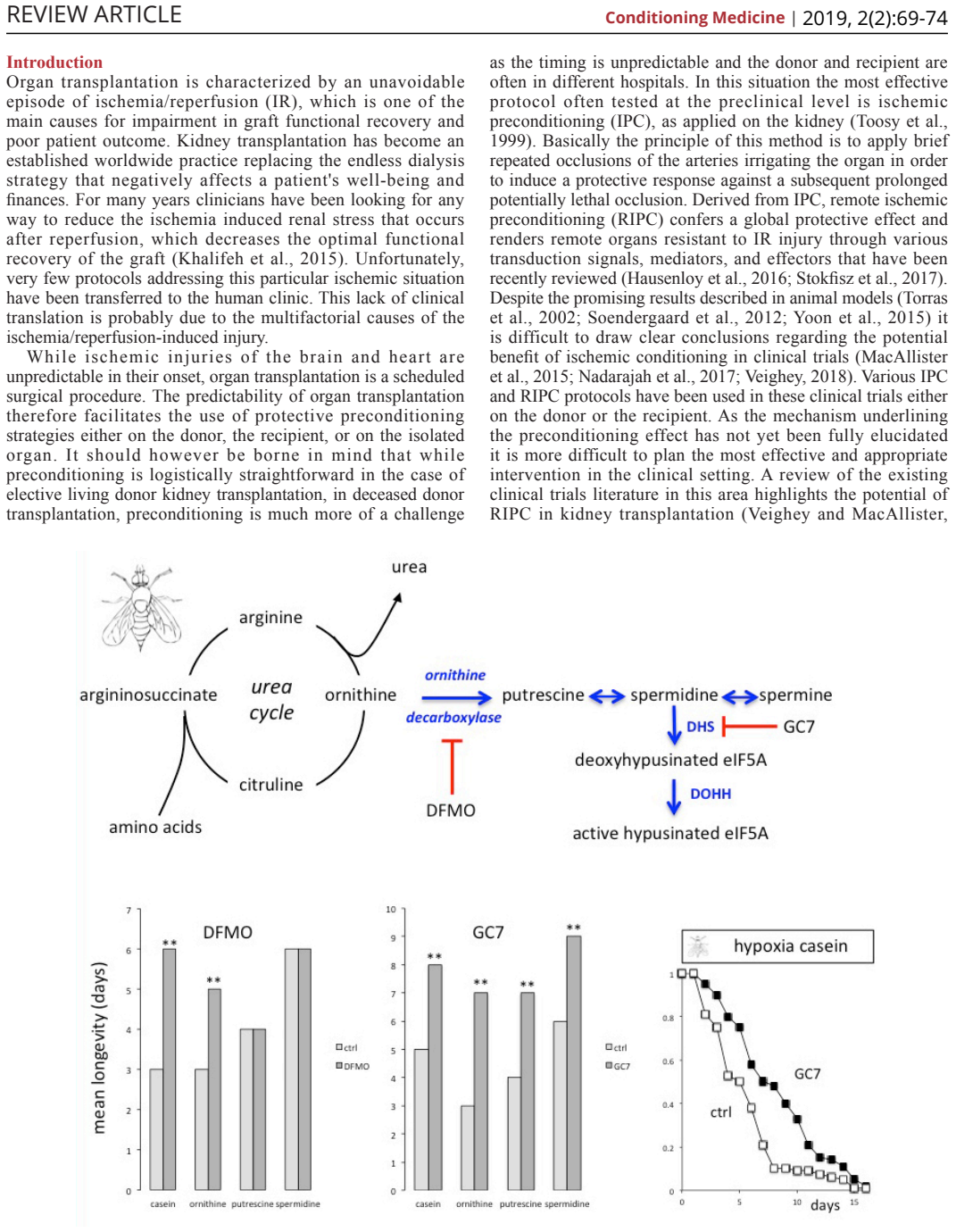
The load-bearing object is eIF5A and its unique post-translational activation by hypusination, the addition of a polyamine-derived hypusine residue to a specific lysine. GC7 (N1-guanyl-1,7-diaminoheptane) is a competitive inhibitor of deoxyhypusine synthase, the enzyme that catalyzes the first step of the modification; in this review it functions as the pharmacological test of whether blocking eIF5A activation is sufficient to create ischemic tolerance. The proposed downstream mechanism is mitochondrial silencing: a reversible fall in oxidative phosphorylation and oxygen consumption, reduced reactive oxygen species generation, and a compensatory shift to anaerobic glycolysis.
What would settle it
Give GC7 to an animal or cell line whose eIF5A has been mutated at the hypusine-acceptor lysine so the modification cannot occur; if the drug still protects against ischemia, its effect is not via hypusination, and the review's central claim fails. Conversely, if protection disappears in the mutant but remains in wild-type controls, the proposed mechanism is supported.
Extended reading notes
Core claim
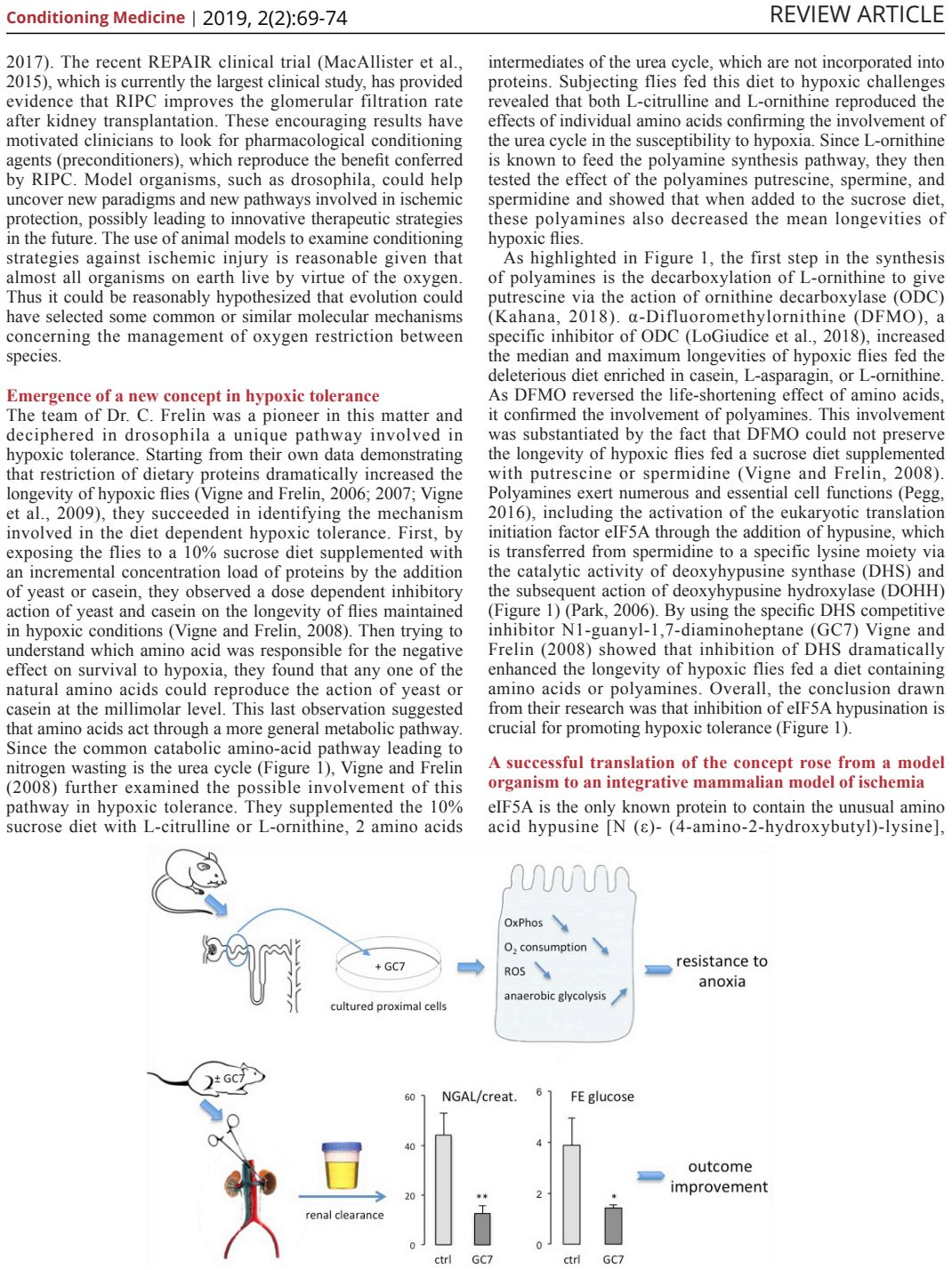
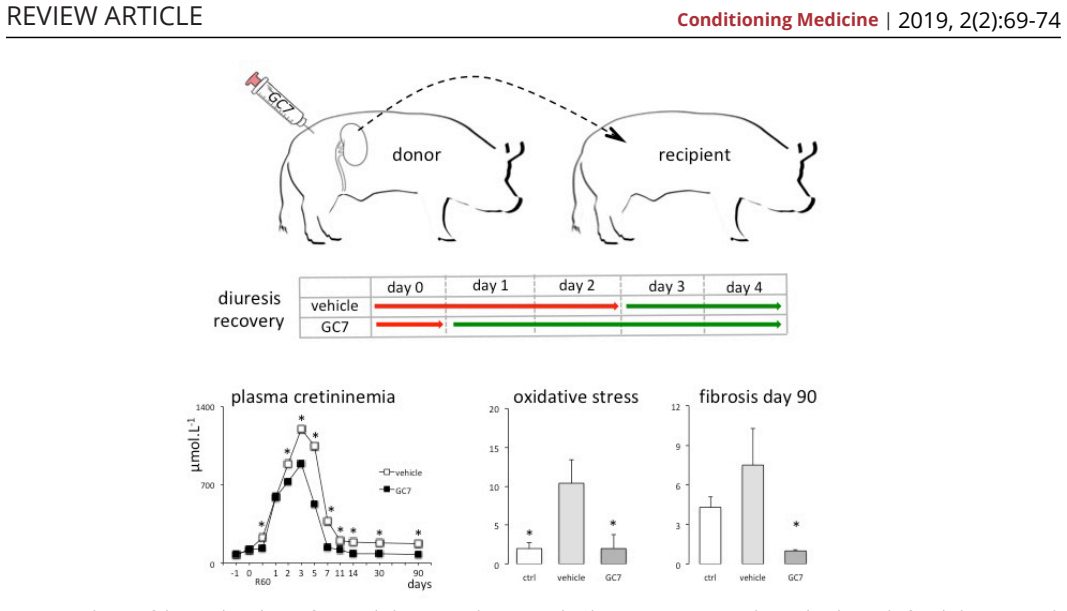
The central discovery, on the paper's own terms, is that the conserved pathway of eIF5A hypusination is a pharmacologically addressable switch for ischemic tolerance. GC7 inhibits deoxyhypusine synthase, the enzyme that initiates the transfer of spermidine-derived hypusine onto eIF5A; this block appears to put mitochondria into a reversible low-consumption state, cutting oxygen use and reactive oxygen species while glycolysis preserves cell energetics. The review assembles the evidence that this mechanism, first found in Drosophila feeding experiments, transfers to a mammalian kidney ischemia model and then to a large-animal transplant model, where GC7-preconditioned grafts recover diuresis earlier, show less oxidative stress, and develop less interstitial fibrosis by three months.
Load-bearing premise
The load-bearing assumption is that GC7's protection in the fly and in mammalian models comes specifically from inhibiting eIF5A hypusination, rather than from an off-target effect of the drug, and that this target behaves the same way in human kidney transplantation.
Editorial extensions
If this is right
- Donor preconditioning with GC7 could become a scheduled, drug-based alternative to ischemic preconditioning in kidney transplantation.
- If the protective effect holds in humans, marginal donor kidneys that are now often declined because of ischemia sensitivity might be used more often.
- Because eIF5A and its hypusination enzymes are conserved across eukaryotes, the same target could be tested in other predictable ischemia-reperfusion settings, such as liver or heart transplantation.
- The reported reduction in interstitial fibrosis at three months suggests that GC7 preconditioning may improve long-term graft survival, not only early function.
- Combining GC7 with other preconditioning strategies that act through different pathways could yield additive or synergistic protection.
Reading between the lines
- The review leaves implicit that GC7 could be tested directly in organ preservation solutions or machine perfusion, rather than only as donor preconditioning, since its proposed mechanism is metabolic rather than transcriptional.
- If the mitochondrial-silencing mechanism is right, the same drug might protect against ischemia-reperfusion injury in organs with high oxygen demand, including brain and heart; the review stops short of making that claim.
- A decisive control experiment would be to see whether GC7 still protects when eIF5A cannot be hypusinated, using a mutant in which the target lysine is replaced; the review does not report such a control, but its whole argument rests on that specificity.
Signed reviews
Editorial analysis
A structured set of objections, weighed in public.
Referee Report
Summary. This review article proposes that pharmacological preconditioning targeting eIF5A hypusination, via the DHS inhibitor GC7, can protect organs against ischemia-reperfusion injury, with kidney transplantation as the principal clinical target. The authors trace the pathway from Drosophila studies showing that dietary amino acids and polyamines reduce hypoxic survival, through identification of the urea cycle and polyamine synthesis as key mediators, to the demonstration that GC7 inhibits deoxyhypusine synthase and improves hypoxic tolerance. They then summarize their own work in mouse proximal tubule cells and a rat kidney ischemia model, where GC7 and siRNA against DHS/DOHH reduce anoxic cell death and preserve renal function. Finally, they describe a porcine kidney transplantation study in which donor preconditioning with GC7 improved early graft function, diuresis, oxidative stress markers, and long-term fibrosis, leading to the conclusion that 'GC7 preconditioning improves graft function outcome in kidney transplantation.'
Significance. If the reported findings are correct, this review identifies a plausible and evolutionarily conserved pharmacological target for preconditioning in organ transplantation, with a mechanistic chain extending from Drosophila to a large-animal preclinical model. The review's strengths are that it is grounded in independent primary studies, that the central cell and rat experiments include siRNA and western-blot confirmation of eIF5A hypusination inhibition, and that it explicitly connects a molecular pathway to a clinically scheduled ischemic event. The significance is moderated, however, by the narrow translational evidence base: the key claim for kidney transplantation rests on a single porcine study, and the review does not critically assess that study's limitations or the degree to which off-target effects of GC7 might explain the observed outcomes.
major comments (3)
- [The perspective of a clinical translation in kidney transplantation] The central translational claim rests on the porcine kidney transplantation study (Melis et al., 2017), but the text reports no direct evidence of target engagement in pigs: no quantification of hypusinated eIF5A, no measurement of DHS activity, and no correlation between any biochemical marker of hypusination inhibition and the functional endpoints. As written, the conclusion that "GC7 preconditioning improves graft function outcome in kidney transplantation" is stronger than what the reported pig data demonstrate, since the outcomes could in principle reflect off-target effects of GC7. Please either add the missing target-engagement data from the original study or explicitly qualify the claim as consistent with, but not directly demonstrating, on-target eIF5A hypusination inhibition in the transplant model.
- [The perspective of a clinical translation in kidney transplantation] The description of the porcine study omits essential experimental details: number of animals per group, randomization, blinding, and the statistical tests used for each endpoint (creatininemia, sodium FE, diuresis, fibrosis). Since the review makes a strong efficacy claim, these details are needed for the reader to judge the strength of the evidence. Please provide them or state explicitly that they are not reported in the primary source.
- [Conclusion] The sentence "The data reported in the literature shows that GC7 is an efficient cell and organ preconditioner against ischemia" conflates evidence of different quality. The cell and rat experiments include siRNA and western-blot confirmation of hypusination inhibition, whereas the pig experiment, as described, does not. The conclusion should differentiate the strength of the mechanistic evidence in cells and rats from the evidence for transplant outcome, which comes from a single preclinical model without direct mechanistic confirmation in that model.
minor comments (4)
- [Figure 1 legend] In the legend, DOHH is defined as "deoxyhypusine synthase" twice; it should be defined as "deoxyhypusine hydroxylase."
- [Emergence of a new concept in hypoxic tolerance] The text refers to "L-asparagin," which should be "L-asparagine."
- [The perspective of a clinical translation in kidney transplantation] The term "creatininemia" is nonstandard; "plasma creatinine" or "serum creatinine" would be clearer.
- [Introduction] The statement "No drug/target pair has been envisioned and validated in the clinic" is too absolute, since the review itself discusses the REPAIR trial of RIPC; this sentence should be qualified to say that no pharmacological preconditioning drug/target pair has been clinically validated.
Circularity Check
No circularity: the review summarizes independent experimental studies; no prediction reduces to its inputs.
full rationale
This is a narrative review without equations, fitted parameters, or new data. Its central claim—that GC7 preconditioning improves graft outcome via eIF5A hypusination inhibition—rests on cited primary experiments: Vigne and Frelin (2008) in Drosophila, and Melis et al. (2017) in mouse proximal tubule cells, rat ischemia-reperfusion, and pig kidney transplantation. These are separate experimental works, not derivations from the review itself. The conclusion 'It appears clearly that GC7 preconditioning improves graft function outcome in kidney transplantation' is a summary of the porcine transplant findings reproduced from Melis et al. (2017); it is a report of prior data, not a prediction obtained from a fit. Some authors of this review are also authors of the cited studies, but the cited studies contain independent experimental evidence (e.g., western blot demonstrating reduced hypusinated eIF5A in rat kidney, siRNA against DHS/DOHH in cell culture), so the self-citations are not load-bearing in a circular sense. The skeptic's concern—that the pig study does not directly demonstrate on-target hypusination inhibition in the graft—is a legitimate gap in evidence or mechanistic extrapolation, but it is not a circularity: no quantity is defined in terms of the claim it is supposed to support. Therefore score 0.
Assumptions & free parameters
assumptions (3)
- domain assumption Hypoxia management pathways are functionally conserved between Drosophila and mammals.
- domain assumption GC7 acts specifically as a DHS inhibitor in intact organisms.
- domain assumption eIF5A hypusination is the mediator of the preconditioning effect.
Cite this review
Pith. "Pith review of A new pharmacological preconditioning-based target: from drosophila to kidney transplantation." pith.science (2026). https://pith.science/paper/TROLU3GI
@misc{pith2026190803336,
  author       = {Pith},
  title        = {Pith review of: A new pharmacological preconditioning-based target: from drosophila to kidney transplantation},
  year         = {2026},
  howpublished = {\url{https://pith.science/paper/TROLU3GI}},
  note         = {Machine review of arXiv:1908.03336}
}
read the original abstract
One of the biggest challenges in medicine is to dampen the pathophysiological stress induced by an episode of ischemia. Such stress, due to various pathological or clinical situations, follows a restriction in blood and oxygen supply to tissue, causing a shortage of oxygen and nutrients that are required for cellular metabolism. Ischemia can cause irreversible damage to target tissue leading to a poor physiological recovery outcome for the patient. Contrariwise, preconditioning by brief periods of ischemia has been shown in multiple organs to confer tolerance against subsequent normally lethal ischemia. By definition, preconditioning of organs must be applied preemptively. This limits the applicability of preconditioning in clinical situations, which arise unpredictably, such as myocardial infarction and stroke. There are, however, clinical situations that arise as a result of ischemia-reperfusion injury, which can be anticipated, and are therefore adequate candidates for preconditioning. Organ and more particularly kidney transplantation, the optimal treatment for suitable patients with end stage renal disease (ESRD), is a predictable surgery that permits the use of preconditioning protocols to prepare the organ for subsequent ischemic/reperfusion stress. It therefore seems crucial to develop appropriate preconditioning protocols against ischemia that will occur under transplantation conditions, which up to now mainly referred to mechanical ischemic preconditioning that triggers innate responses. It is not known if preconditioning has to be applied to the donor, the recipient, or both. No drug/target pair has been envisioned and validated in the clinic. Options for identifying new target/drug pairs involve the use of model animals, such as drosophila, in which some physiological pathways, such as the management of oxygen, are highly conserved across evolution. Oxygen is the universal element of life existence on earth. In this review we focus on a very specific pathway of pharmacological preconditioning identified in drosophila that was successfully transferred to mammalian models that has potential application in human health. Very few mechanisms identified in these model animals have been translated to an upper evolutionary level. This review highlights the commonality between oxygen regulation between diverse animals.
Figures
Reference graph
Works this paper leans on
-
[1]
Brigstock DR (2010) Connective tissue growth factor (CCN2, CTGF) and organ fibrosis: lessons from transgenic animals. J Cell Commun Signal 4:1–4. Duranton C, Rubera I, Cougnon M, Melis N, Chargui A, Mograbi B, Tauc M (2012) CFTR is involved in the fine tuning of intracellular redox status: physiological implications in cystic fibrosis. Am J Pathol 181:1367–
work page 2010
-
[822]
Nadarajah L, Yaqoob MM, McCafferty K (2017) Ischemic conditioning in solid organ transplantation: is it worth giving your right arm for? Curr Opin Nephrol Hypertens 26:467–476. Park MH (2006) The post-translational synthesis of a polyamine-derived amino acid, hypusine, in the eukaryotic translation initiation factor 5A (eIF5A). J Biochem 139:161–169. Pegg...
work page 2017
-
[1377]
J Biomed Biotechnol 2011:532127
Giraud S, Favreau F, Chatauret N, Thuillier R, Maiga S, Hauet T (2011) Contribution of large pig for renal ischemia- reperfusion and transplantation studies: the preclinical model. J Biomed Biotechnol 2011:532127. Hansell P, Welch WJ, Blantz RC, Palm F (2013) Determinants of kidney oxygen consumption and their relationship to tissue oxygen tension in diab...
work page 2011
Reviewed August 14, 2026 · model on record in the stance chip above.
Discussion (0). Continue with ORCID to comment.