REVIEW 3 major objections 4 minor 1 cited by
On a 546-site camera-trap benchmark, naively fine-tuning a foundation model on everything seen so far frequently degrades accuracy below the zero-shot baseline, and the paper isolates why and how to avoid it.
Reviewed by Pith at T0; open to challenge. T0 means a machine referee read the full paper against a public rubric. the ladder, T0–T4 →
T0 review · deepseek-v4-flash
2026-08-02 17:46 UTC pith:TROQO4RG
load-bearing objection A genuinely useful benchmark and a stark finding—naive accumulated fine-tuning can fall below zero-shot—but the 'consistently outperforms' recipe claim and the closed-set evaluation design need careful handling in revision. the 3 major comments →
Lessons and Open Questions from a Unified Study of Camera-Trap Species Recognition Over Time
The pith
A machine-rendered reading of the paper's core claim, the machinery that carries it, and where it could break.
Core claim
Under a streaming evaluation that fine-tunes on cumulative data up to interval j and tests on interval j+1, naive adaptation is counterproductive: on 20 representative sites it underperforms the zero-shot BioCLIP 2 baseline by up to 30+ points. Even an oracle trained on all intervals jointly loses to zero-shot on 214 of 546 sites, so the difficulty is not only temporal shift but intrinsic low-shot, imbalanced data. The paper identifies two drivers—extreme class imbalance (~71% majority share) and a Temporal Class Distribution Shift (TCDS) metric—and shows that Balanced Softmax loss plus LoRA lifts the oracle above zero-shot on 474 sites, while logit calibration, weight interpolation, and int
What carries the argument
The load-bearing element is the streaming evaluation protocol: each camera trap is split into chronological ~30-day intervals, and at interval j the model is updated on all past labeled data and evaluated on the next interval's class-balanced test split. Two instruments carry the diagnosis: the TCDS metric, which averages per-class frequency differences between consecutive intervals to quantify temporal distribution shift, and an imbalance analysis showing the two most frequent classes average ~71% of images. The proposed recipe is Balanced Softmax (BSM)—a loss that reweights logits by class counts—combined with Low-Rank Adaptation (LoRA), a parameter-efficient fine-tuning that updates only
Load-bearing premise
Evaluation assumes the species list at each site is known in advance, excludes species with fewer than 10 samples per interval from the main metric, and uses class-balanced test splits; conclusions may not transfer to open-set or rare-species-focused deployments.
What would settle it
Run the streaming protocol on a hold-out set where rare species (fewer than 10 samples per interval) are included in the test set and the vocabulary is open; if the accumulated-model recipe no longer beats zero-shot, the paper's core comparison is an artifact of the curated evaluation. Alternatively, check whether TCDS predicts per-site degradation: sites with low TCDS should show little benefit from the recipe if temporal shift is the primary driver.
If this is right
- At sites where a foundation model already exceeds ~90% zero-shot accuracy (161 of 546 sites), deploying without adaptation is likely the best option; naive fine-tuning can erase that advantage.
- When updates are needed, the BSM+LoRA recipe is a strong first choice: it beat zero-shot on 474 of 546 sites in the oracle setting and consistently beat zero-shot in the streaming protocol.
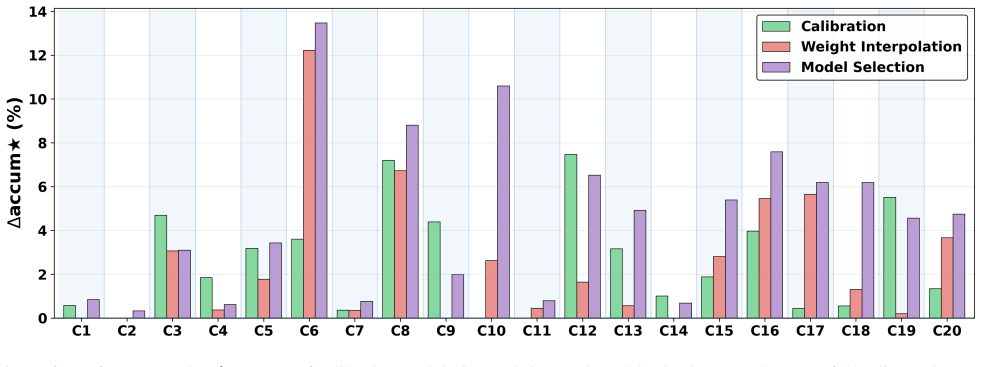
- Post-hoc logit calibration, weight interpolation, and interval model selection each recover part of the performance drop, and picking the best per site nearly closes the gap to the oracle upper bound.
- Simple confidence or feature-distance signals (MSP, CLIP features) do not reliably decide Adapt-or-Skip, so determining when to update remains an open problem.
- Under open vocabularies the zero-shot baseline collapses (82.5 to 37.8 in the paper's relaxation), and including rare species makes the oracle recipe fall below zero-shot—so deployment in the open world needs new methods.
Where Pith is reading between the lines
- The relaxed-evaluation results imply the paper's conclusions are conditional on a curated, closed-set, rare-species-excluded design; real deployments that care about rare or novel species may need to revisit the evaluation, not just the recipe.
- Because the oracle recipe over-adapts to common classes and erodes rare-species recognition, combining the recipe with open-set or anomaly detection could be a testable extension worth trying.
- Since unlabeled confidence statistics fail at Adapt-or-Skip, a small labeled probe set from the current interval (active learning) might predict adaptation value better than MSP or feature distances.
- The optimistic post-processing results used future data for hyperparameter selection; a practical future-blind selector remains necessary before the gains can be realized in field deployments.
Editorial analysis
A structured set of objections, weighed in public.
Referee Report
Summary. This paper introduces STREAMTRAP, a camera-trap benchmark built from 546 traps in the LILA BC repository, with a streaming evaluation protocol that trains on accumulated labeled data up to interval j and tests on interval j+1. Using BioCLIP 2 as the base model, the study reports four findings: zero-shot accuracy varies widely across sites; naive accumulated fine-tuning often falls below zero-shot accuracy; class imbalance and temporal class-distribution shift are the main drivers; and a recipe combining Balanced Softmax with LoRA, augmented by post-hoc calibration, weight interpolation, or model selection, substantially improves accuracy. The paper also presents preliminary analyses of predicting zero-shot sufficiency and deciding when to adapt.
Significance. If the claims are properly scoped, the benchmark and pipeline are a valuable community resource: the 546-trap streaming benchmark, the FAIR preprocessing pipeline, and the oracle control in Sec. 4.3 are well-designed contributions. The observation that naive fine-tuning can degrade below zero-shot under a realistic temporal protocol is important and non-obvious. However, several headline claims are stronger than the evidence. The paper's own complete results table contradicts the claim that the proposed recipe consistently outperforms zero-shot, and the main post-processing gains rely on access to future test labels. These issues are load-bearing for the paper's central conclusions and require revision.
major comments (3)
- [Sec. 4.4, Fig. 6, Table A5] Interval model selection is defined as selecting the checkpoint that attains the highest accuracy on the test split of interval j+1, and Table A5's 'Best Post-Processing' row selects the best-performing post-processing method per camera trap using future test labels. These are oracle upper bounds, not deployable recipes. The text discloses this for hyperparameter selection in Sec. 4.4, but the abstract's claim 4 and Fig. 6 present the post-processing gains as part of an actionable recipe. The closing of the gap from 8.8 to 1.4 in Table A5 is unattainable without access to future labels and should be labeled as an upper-bound analysis, not a component of the recommended deployment guidelines.
- [Sec. 4.4 vs. Table A8] The statement that the accumulated⋆ model 'consistently outperforms the zero-shot baseline' is contradicted by the paper's own complete results. Table A8 contains many camera traps with negative Accum* minus ZS deltas, e.g., C43 (ZS 86.1 vs. Accum* 79.4) and C81 (ZS 63.6 vs. Accum* 33.4). Table 1 supports the claim only because it is restricted to 20 selected traps. This is load-bearing for the paper's fourth finding; the claim should be replaced by a success-rate analysis over the full set, with the failure cases characterized.
- [Sec. 3.1, Sec. 4, Table A4] The main evaluation assumes a closed species vocabulary, excludes species with fewer than 10 samples per interval, and builds class-balanced test splits. The paper's own relaxed-evaluation table shows how much these choices carry: opening the vocabulary drops zero-shot from 82.5 to 37.8, and adding rare species drops the oracle⋆ recipe below the zero-shot baseline. Table A4 does not report the naive Accum model under either relaxed setting, so the central 'naive adaptation degrades below zero-shot' claim of Sec. 4.2 is never tested where the design assumptions are lifted. The claims should be re-scoped to the curated protocol, and the missing Accum numbers under relaxed settings should be reported.
minor comments (4)
- [References] References [5] and [6] are duplicates of the same ECCV 2018 paper; this is likely a citation-numbering error and should be fixed.
- [Table A8 / Table 1] The sign convention for deltas is inconsistent across tables: Table 1 reports signed differences while Table A8 appears to use absolute values with color coding, and some entries differ for the same camera trap (e.g., C10). Please unify the convention and make the sign explicit in the table text.
- [Sec. 4.4] The phrase 'compact inter-interval distribution shift' should likely read 'combat' or 'counteract'.
- [Sec. 5.0.2 / Table 2] Table 2 is based on only 8 camera traps; the main text should explicitly state this small sample size when drawing the conclusion that continual adaptation yields compounding benefits.
Circularity Check
Core comparisons are empirical and non-circular; the post-processing 'model selection' gain is an oracle fitted to the test split, and the paper's own relaxed-evaluation table shows the headline conclusions are design-conditional.
specific steps
-
fitted input called prediction
[Sec. 4.4 (Interval model selection; also Fig. 6 and 'Recommended Adaptation Recipes')]
"To investigate the feasibility of exploiting this phenomenon, we conduct a preliminary study in which we explicitly select the historical and current model that attains the highest accuracy on the test split of interval j+1."
The selection criterion is exactly the evaluation metric on the future interval's test split. The reported gain of 'interval model selection' over Accum* is therefore max_k Acc(model_k, test_{j+1}) - Acc(Accum*, test_{j+1}) by construction, i.e., an upper bound, not a deployable predictive method. The paper later concedes 'we evaluate these approaches in an optimistic, upper-bound setting: selecting the performance-maximizing hyperparameters,' yet interval model selection is still listed among the post-processing techniques supporting the finding that 'effective integration of model-update and post-processing techniques can largely improve accuracy' and is repeated in the recommended recipes. A portion of that finding is thus a fit to the evaluation target, not an independent empirical res
full rationale
The central empirical comparisons (naive accumulated fine-tuning falling below zero-shot; BSM+LoRA consistently beating zero-shot) are computed by training on past intervals and evaluating on held-out future intervals, with no parameter fitted to the target and then renamed as a prediction; these findings are not derivationally circular. The genuine circular element is the post-processing evaluation: 'interval model selection' (Sec. 4.4) is defined as choosing the model with the highest accuracy on the test split of the upcoming interval, so its gain is an oracle bound by definition. The paper is transparent that all post-processing results use 'an optimistic, upper-bound setting: selecting the performance-maximizing hyperparameters,' but it still promotes interval model selection as part of the recommended recipe and uses the post-processing gains to support abstract finding 4, so the by-construction nature affects a headline claim. The self-citations (BioCLIP 2 [19], logit calibration [30]) are to published models/methods; the zero-shot and adaptation accuracies are newly computed here, so these are not load-bearing self-citation chains. An additional, non-circularity limitation is the paper's own Table A4: under an open vocabulary zero-shot drops from 82.5 to 37.8 and adding rare species makes Oracle* fall below the zero-shot baseline, while the headline Accum-vs-ZS comparison is never rerun in those relaxed settings. That makes the actionable conclusions conditional on the closed-set, rare-species-excluded design, but it is an external-validity caveat rather than a derivation-to-input reduction. The Adapt-or-Skip oracle upper bound (Sec. 5.0.3 / C.4) is likewise defined by the target test data, but it is explicitly offered as a reference upper bound, so it does not add a second independent circularity count. Overall: partial circularity localized to the post-processing/model-selection claims, with the main comparative results independent, giving a score of 6.
Axiom & Free-Parameter Ledger
free parameters (5)
- Post-hoc calibration factor gamma =
per-site, tuned on future test data (value not reported)
- WiSE-FT interpolation ratio alpha =
per-site, tuned on future test data (value not reported)
- Interval model selection rule =
oracle: checkpoint with highest accuracy on test split of interval j+1
- Rare-species cutoff =
10 samples per interval
- Interval window and merge threshold =
30-day windows; merged when <200 images
axioms (5)
- domain assumption LILA BC metadata (species labels, datetimes, sequence IDs) are correct, and MegaDetector v5a boxes at confidence >0.8 correctly localize animals so image-level labels transfer to the cropped patches.
- domain assumption The candidate species set at each camera trap is known a priori (closed-set), and species with fewer than 10 samples per interval are excluded from the main metric.
- domain assumption BioCLIP 2's zero-shot predictions over common-name prompts are a clean baseline, with no training-data overlap with the STREAMTRAP evaluation sites.
- ad hoc to paper 30-day intervals (merged when <200 images) capture the deployment timescale that matters.
- domain assumption Treating each frame of a multi-frame burst as an independent sample is valid evaluation, given sequence-level splitting prevents train/test leakage.
Cite this review
Pith. "Pith review of Lessons and Open Questions from a Unified Study of Camera-Trap Species Recognition Over Time." pith.science (2026). https://pith.science/paper/TROQO4RG
@misc{pith2026260320509,
  author       = {Pith},
  title        = {Pith review of: Lessons and Open Questions from a Unified Study of Camera-Trap Species Recognition Over Time},
  year         = {2026},
  howpublished = {\url{https://pith.science/paper/TROQO4RG}},
  note         = {Machine review of arXiv:2603.20509}
}
read the original abstract
Camera traps are vital for large-scale biodiversity monitoring, yet accurate automated analysis remains challenging due to diverse deployment environments. While the computer vision community has mostly framed this challenge as cross-domain generalization, this perspective overlooks a primary challenge faced by ecological practitioners: maintaining reliable recognition at the fixed site over time, where the dynamic nature of ecosystems introduces profound temporal shifts in both background and animal distributions. To bridge this gap, we present the first unified study of camera-trap species recognition over time. We introduce a realistic benchmark comprising 546 camera traps with a streaming protocol that evaluates models over chronologically ordered intervals. Our end-user-centric study yields four key findings. (1) Biological foundation models (e.g., BioCLIP 2) underperform at numerous sites even in initial intervals, underscoring the necessity of site-specific adaptation. (2) Adaptation is challenging under realistic evaluation: when models are updated using past data and evaluated on future intervals (mirrors real deployment lifecycles), naive adaptation can even degrade below zero-shot performance. (3) We identify two drivers of this difficulty: severe class imbalance and pronounced temporal shift in both species distribution and backgrounds between consecutive intervals. (4) We find that effective integration of model-update and post-processing techniques can largely improve accuracy, though a gap from the upper bounds remains. Finally, we highlight critical open questions, such as predicting when zero-shot models will succeed at a new site and determining whether/when model updates are necessary. Our benchmark and analysis provide actionable deployment guidelines for ecological practitioners while establishing new directions for future research in vision and machine learning.
Figures



Forward citations
Cited by 1 Pith paper
-
Democratising Camera Trap AI: An Open-Source Model for Detecting UK Mammals
A YOLO26x object detector for 31 UK camera trap classes reports mAP 0.984 at IoU 0.5 on held-out data from the same sites as training.
Reference graph
Works this paper leans on
-
[1]
Lila bc: Labeled information library of alexandria: Biology and conservation.https://lila.science/. 2, 4
-
[2]
Gradient based sample selection for online continual learning.Advances in neural information processing sys- tems, 32, 2019
Rahaf Aljundi, Min Lin, Baptiste Goujaud, and Yoshua Ben- gio. Gradient based sample selection for online continual learning.Advances in neural information processing sys- tems, 32, 2019. 1
2019
-
[3]
Monitoring the mammalian fauna of ur- ban areas using remote cameras and citizen science.Journal of Urban Ecology, 4(1):juy002, 2018
Victor Anton, Stephen Hartley, Andre Geldenhuis, and Heiko U Wittmer. Monitoring the mammalian fauna of ur- ban areas using remote cameras and citizen science.Journal of Urban Ecology, 4(1):juy002, 2018. 8
2018
-
[4]
The MegaDetector: Large-scale deployment of computer vision for conservation and biodiversity monitor- ing
Sara Beery. The MegaDetector: Large-scale deployment of computer vision for conservation and biodiversity monitor- ing. InAI for Social Impact. Cambridge University Press,
-
[5]
Recognition in terra incognita
Sara Beery, Grant Van Horn, and Pietro Perona. Recognition in terra incognita. InProceedings of the European confer- ence on computer vision (ECCV), pages 456–473, 2018. 6, 8
2018
-
[6]
Recognition in terra incognita
Sara Beery, Grant Van Horn, and Pietro Perona. Recognition in terra incognita. InProceedings of the European confer- ence on computer vision (ECCV), pages 456–473, 2018. 1
2018
-
[7]
The iwildcam 2018 challenge dataset.arXiv preprint arXiv:1904.05986, 2019
Sara Beery, Grant Van Horn, Oisin Mac Aodha, and Pietro Perona. The iwildcam 2018 challenge dataset.arXiv preprint arXiv:1904.05986, 2019. 3, 1
Pith/arXiv arXiv 2018
-
[8]
The iwildcam 2021 competition dataset.arXiv preprint arXiv:2105.03494, 2021
Sara Beery, Arushi Agarwal, Elijah Cole, and Vighnesh Birodkar. The iwildcam 2021 competition dataset.arXiv preprint arXiv:2105.03494, 2021. 2, 3, 1
Pith/arXiv arXiv 2021
-
[9]
Peggy A Bevan, Omiros Pantazis, Holly Pringle, Guil- herme Braga Ferreira, Daniel J Ingram, Emily Madsen, Liam Thomas, Dol Raj Thanet, Thakur Silwal, Santosh Rayama- jhi, et al. Deep learning-based ecological analysis of camera trap images is impacted by training data quality and quantity. arXiv preprint arXiv:2408.14348, 2024. 3, 2
arXiv 2024
-
[10]
Pelagic Publishing Ltd, 2016
Luigi Boitani.Camera trapping for wildlife research. Pelagic Publishing Ltd, 2016. 3, 1
2016
-
[11]
Automated wildlife image classification: An active learning tool for ecological applica- tions.Ecological Informatics, 77:102231, 2023
Ludwig Bothmann, Lisa Wimmer, Omid Charrakh, Tobias Weber, Hendrik Edelhoff, Wibke Peters, Hien Nguyen, Caryl Benjamin, and Annette Menzel. Automated wildlife image classification: An active learning tool for ecological applica- tions.Ecological Informatics, 77:102231, 2023. 1
2023
-
[12]
Class-balanced loss based on effective number of samples, 2019
Yin Cui, Menglin Jia, Tsung-Yi Lin, Yang Song, and Serge Belongie. Class-balanced loss based on effective number of samples, 2019. 7, 2
2019
-
[13]
Class-balanced loss based on effective number of samples
Yin Cui, Menglin Jia, Tsung-Yi Lin, Yang Song, and Serge Belongie. Class-balanced loss based on effective number of samples. InProceedings of the IEEE/CVF conference on computer vision and pattern recognition, pages 9268–9277,
-
[14]
A continual learning survey: Defying for- getting in classification tasks.IEEE transactions on pattern analysis and machine intelligence, 44(7):3366–3385, 2021
Matthias De Lange, Rahaf Aljundi, Marc Masana, Sarah Parisot, Xu Jia, Ale ˇs Leonardis, Gregory Slabaugh, and Tinne Tuytelaars. A continual learning survey: Defying for- getting in classification tasks.IEEE transactions on pattern analysis and machine intelligence, 44(7):3366–3385, 2021. 1
2021
-
[15]
Zalan Fabian, Zhongqi Miao, Chunyuan Li, Yuanhan Zhang, Ziwei Liu, Andr´es Hern´andez, Andr´es Montes-Rojas, Rafael Escucha, Laura Siabatto, Andr ´es Link, et al. Multimodal foundation models for zero-shot animal species recognition in camera trap images.arXiv preprint arXiv:2311.01064,
-
[16]
A brief review of domain adaptation
Abolfazl Farahani, Sahar V oghoei, Khaled Rasheed, and Hamid R Arabnia. A brief review of domain adaptation. Advances in data science and information engineering: pro- ceedings from ICDATA 2020 and IKE 2020, pages 877–894,
2020
-
[17]
Wildclip: Scene and animal attribute retrieval from camera trap data with domain-adapted vision-language models.International Journal of Computer Vision, 132(9): 3770–3786, 2024
Valentin Gabeff, Marc Rußwurm, Devis Tuia, and Alexan- der Mathis. Wildclip: Scene and animal attribute retrieval from camera trap data with domain-adapted vision-language models.International Journal of Computer Vision, 132(9): 3770–3786, 2024. 3, 1
2024
-
[18]
Geodesic flow kernel for unsupervised domain adaptation
Boqing Gong, Yuan Shi, Fei Sha, and Kristen Grauman. Geodesic flow kernel for unsupervised domain adaptation. In2012 IEEE conference on computer vision and pattern recognition, pages 2066–2073. IEEE, 2012. 4
2066
-
[19]
Jianyang Gu, Samuel Stevens, Elizabeth G Campolongo, Matthew J Thompson, Net Zhang, Jiaman Wu, Andrei Kopanev, Zheda Mai, Alexander E White, James Balhoff, et al. Bioclip 2: Emergent properties from scaling hierarchi- cal contrastive learning.arXiv preprint arXiv:2505.23883,
-
[20]
Dan Hendrycks and Kevin Gimpel. A baseline for detect- ing misclassified and out-of-distribution examples in neural networks.arXiv preprint arXiv:1610.02136, 2016. 9
Pith/arXiv arXiv 2016
-
[21]
Parameter-efficient transfer learning for nlp, 2019
Neil Houlsby, Andrei Giurgiu, Stanislaw Jastrzebski, Bruna Morrone, Quentin de Laroussilhe, Andrea Gesmundo, Mona Attariyan, and Sylvain Gelly. Parameter-efficient transfer learning for nlp, 2019. 7, 2
2019
-
[22]
Lora: Low-rank adaptation of large language models.ICLR, 1(2):3, 2022
Edward J Hu, Yelong Shen, Phillip Wallis, Zeyuan Allen- Zhu, Yuanzhi Li, Shean Wang, Lu Wang, Weizhu Chen, et al. Lora: Low-rank adaptation of large language models.ICLR, 1(2):3, 2022. 7, 2
2022
-
[23]
Idaho camera traps.https://lila.science/datasets/idaho- camera-traps/
Idaho Department of Fish and Game. Idaho camera traps.https://lila.science/datasets/idaho- camera-traps/. 8
-
[24]
Northern and central annamites camera traps 2.0
IUCN SSC Asian Wild Cattle Specialist Group’s Saola Working Group. Northern and central annamites camera traps 2.0. Dataset, 2021. SWG (2021). 6
2021
-
[25]
Vi- sual prompt tuning, 2022
Menglin Jia, Luming Tang, Bor-Chun Chen, Claire Cardie, Serge Belongie, Bharath Hariharan, and Ser-Nam Lim. Vi- sual prompt tuning, 2022. 7, 2
2022
-
[26]
Wilds: A benchmark of in-the- wild distribution shifts
Pang Wei Koh, Shiori Sagawa, Henrik Marklund, Sang Michael Xie, Marvin Zhang, Akshay Balsubra- mani, Weihua Hu, Michihiro Yasunaga, Richard Lanas Phillips, Irena Gao, et al. Wilds: A benchmark of in-the- wild distribution shifts. InInternational conference on machine learning, pages 5637–5664. PMLR, 2021. 2, 3, 1 10
2021
-
[27]
Microsoft coco: Common objects in context
Tsung-Yi Lin, Michael Maire, Serge Belongie, James Hays, Pietro Perona, Deva Ramanan, Piotr Doll´ar, and C Lawrence Zitnick. Microsoft coco: Common objects in context. In European conference on computer vision, pages 740–755. Springer, 2014. 6
2014
-
[28]
Supervised contrastive replay: Revisiting the nearest class mean classifier in online class-incremental continual learning
Zheda Mai, Ruiwen Li, Hyunwoo Kim, and Scott San- ner. Supervised contrastive replay: Revisiting the nearest class mean classifier in online class-incremental continual learning. InProceedings of the IEEE/CVF conference on computer vision and pattern recognition, pages 3589–3599,
-
[29]
Online continual learning in image classification: An empirical survey.Neurocomputing, 469:28–51, 2022
Zheda Mai, Ruiwen Li, Jihwan Jeong, David Quispe, Hyun- woo Kim, and Scott Sanner. Online continual learning in image classification: An empirical survey.Neurocomputing, 469:28–51, 2022. 3, 4, 1
2022
-
[30]
Fine-tuning is fine, if cali- brated.Advances in Neural Information Processing Systems, 37:136084–136119, 2024
Zheda Mai, Arpita Chowdhury, Ping Zhang, Cheng-Hao Tu, Hong-You Chen, Vardaan Pahuja, Tanya Berger-Wolf, Song Gao, Charles Stewart, Yu Su, et al. Fine-tuning is fine, if cali- brated.Advances in Neural Information Processing Systems, 37:136084–136119, 2024. 2, 3, 7, 1
2024
-
[31]
Lessons and insights from a unifying study of parameter-efficient fine-tuning (peft) in visual recognition
Zheda Mai, Ping Zhang, Cheng-Hao Tu, Hong-You Chen, Quang-Huy Nguyen, Li Zhang, and Wei-Lun Chao. Lessons and insights from a unifying study of parameter-efficient fine-tuning (peft) in visual recognition. InProceedings of the Computer Vision and Pattern Recognition Conference, pages 14845–14857, 2025. 2, 7
2025
-
[32]
Farjad Malik, Simon Wouters, Ruben Cartuyvels, Erfan Ghadery, and Marie-Francine Moens. Two-phase training mitigates class imbalance for camera trap image classifica- tion with cnns.arXiv preprint arXiv:2112.14491, 2021. 3, 2
Pith/arXiv arXiv 2021
-
[33]
Trail camera images of new zealand animals.https://lila.science/datasets/nz- trailcams
New Zealand Trailcams. Trail camera images of new zealand animals.https://lila.science/datasets/nz- trailcams. 8
-
[34]
Mohammad Sadegh Norouzzadeh, Anh Nguyen, Margaret Kosmala, Alexandra Swanson, Meredith S Palmer, Craig Packer, and Jeff Clune. Automatically identifying, count- ing, and describing wild animals in camera-trap images with deep learning.Proceedings of the National Academy of Sci- ences, 115(25):E5716–E5725, 2018. 3, 1
2018
-
[35]
Snap- shot safari: A large-scale collaborative to monitor africa’s remarkable biodiversity.South African Journal of Science, 117(1-2):1–4, 2021
Lain E Pardo, Sara Bombaci, Sarah E Huebner, Michael J Somers, Herve Fritz, Colleen Downs, Abby Guthmann, Robyn S Hetem, Mark Keith, Aliza le Roux, et al. Snap- shot safari: A large-scale collaborative to monitor africa’s remarkable biodiversity.South African Journal of Science, 117(1-2):1–4, 2021. 8
2021
-
[36]
Har- nessing artificial intelligence to fill global shortfalls in biodi- versity knowledge.Nature Reviews Biodiversity, pages 1–17,
Laura J Pollock, Justin Kitzes, Sara Beery, Kaitlyn M Gaynor, Marta A Jarzyna, Oisin Mac Aodha, Bernd Meyer, David Rolnick, Graham W Taylor, Devis Tuia, et al. Har- nessing artificial intelligence to fill global shortfalls in biodi- versity knowledge.Nature Reviews Biodiversity, pages 1–17,
-
[37]
Learning transferable visual models from natural language supervision, 2021
Alec Radford, Jong Wook Kim, Chris Hallacy, Aditya Ramesh, Gabriel Goh, Sandhini Agarwal, Girish Sastry, Amanda Askell, Pamela Mishkin, Jack Clark, Gretchen Krueger, and Ilya Sutskever. Learning transferable visual models from natural language supervision, 2021. 2
2021
-
[38]
Balanced meta-softmax for long-tailed visual recog- nition.Advances in neural information processing systems, 33:4175–4186, 2020
Jiawei Ren, Cunjun Yu, Xiao Ma, Haiyu Zhao, Shuai Yi, et al. Balanced meta-softmax for long-tailed visual recog- nition.Advances in neural information processing systems, 33:4175–4186, 2020. 2, 3
2020
-
[39]
Balanced meta-softmax for long-tailed visual recognition, 2020
Jiawei Ren, Cunjun Yu, Shunan Sheng, Xiao Ma, Haiyu Zhao, Shuai Yi, and Hongsheng Li. Balanced meta-softmax for long-tailed visual recognition, 2020. 7, 2
2020
-
[40]
A broad review on class imbalance learning techniques.Applied Soft Computing, 143:110415, 2023
Salim Rezvani and Xizhao Wang. A broad review on class imbalance learning techniques.Applied Soft Computing, 143:110415, 2023. 3, 2
2023
-
[41]
Extend- ing the wilds benchmark for unsupervised adaptation.arXiv preprint arXiv:2112.05090, 2021
Shiori Sagawa, Pang Wei Koh, Tony Lee, Irena Gao, Sang Michael Xie, Kendrick Shen, Ananya Kumar, Weihua Hu, Michihiro Yasunaga, Henrik Marklund, et al. Extend- ing the wilds benchmark for unsupervised adaptation.arXiv preprint arXiv:2112.05090, 2021. 2, 3
Pith/arXiv arXiv 2021
-
[42]
Catalog: A camera trap language-guided contrastive learning model
Julian D Santamaria, Claudia Isaza, and Jhony H Giraldo. Catalog: A camera trap language-guided contrastive learning model. In2025 IEEE/CVF Winter Conference on Applica- tions of Computer Vision (WACV), pages 1197–1206. IEEE,
-
[43]
Online class- incremental continual learning with adversarial shapley value
Dongsub Shim, Zheda Mai, Jihwan Jeong, Scott San- ner, Hyunwoo Kim, and Jongseong Jang. Online class- incremental continual learning with adversarial shapley value. InProceedings of the AAAI Conference on Artificial Intelligence, pages 9630–9638, 2021. 1
2021
-
[44]
Domain adaptation: challenges, methods, datasets, and applications.IEEE access, 11:6973–7020,
Peeyush Singhal, Rahee Walambe, Sheela Ramanna, and Ketan Kotecha. Domain adaptation: challenges, methods, datasets, and applications.IEEE access, 11:6973–7020,
-
[45]
Bioclip: A vision foundation model for the tree of life
Samuel Stevens, Jiaman Wu, Matthew J Thompson, Eliza- beth G Campolongo, Chan Hee Song, David Edward Carlyn, Li Dong, Wasila M Dahdul, Charles Stewart, Tanya Berger- Wolf, et al. Bioclip: A vision foundation model for the tree of life. InProceedings of the IEEE/CVF conference on com- puter vision and pattern recognition, pages 19412–19424,
-
[46]
Snapshot serengeti, high-frequency annotated camera trap images of 40 mammalian species in an african savanna.Scientific data, 2(1):1–14, 2015
Alexandra Swanson, Margaret Kosmala, Chris Lintott, Robert Simpson, Arfon Smith, and Craig Packer. Snapshot serengeti, high-frequency annotated camera trap images of 40 mammalian species in an african savanna.Scientific data, 2(1):1–14, 2015. 1, 6, 8
2015
-
[47]
Machine learning to classify ani- mal species in camera trap images: Applications in ecology
Michael A Tabak, Mohammad S Norouzzadeh, David W Wolfson, Steven J Sweeney, Kurt C VerCauteren, Nathan P Snow, Joseph M Halseth, Paul A Di Salvo, Jesse S Lewis, Michael D White, et al. Machine learning to classify ani- mal species in camera trap images: Applications in ecology. Methods in Ecology and Evolution, 10(4):585–590, 2019. 6, 8
2019
-
[48]
Use of camera traps for wildlife studies: a review.Biotechnologie, Agronomie, Soci ´et´e et En- vironnement, 18(3), 2014
Franck Trolliet, C ´edric Vermeulen, Marie-Claude Huynen, and Alain Hambuckers. Use of camera traps for wildlife studies: a review.Biotechnologie, Agronomie, Soci ´et´e et En- vironnement, 18(3), 2014. 3, 1
2014
-
[49]
Holistic trans- fer: towards non-disruptive fine-tuning with partial target data.Advances in Neural Information Processing Systems, 36:29149–29173, 2023
Cheng-Hao Tu, Hong-You Chen, Zheda Mai, Jike Zhong, Vardaan Pahuja, Tanya Berger-Wolf, Song Gao, Charles Stewart, Yu Su, and Wei-Lun Harry Chao. Holistic trans- fer: towards non-disruptive fine-tuning with partial target data.Advances in Neural Information Processing Systems, 36:29149–29173, 2023. 2, 3, 7 11
2023
-
[50]
Perspectives in machine learning for wildlife conservation.Nature communications, 13(1):792,
Devis Tuia, Benjamin Kellenberger, Sara Beery, Blair R Costelloe, Silvia Zuffi, Benjamin Risse, Alexander Mathis, Mackenzie W Mathis, Frank Van Langevelde, Tilo Burghardt, et al. Perspectives in machine learning for wildlife conservation.Nature communications, 13(1):792,
-
[51]
The inaturalist species classification and de- tection dataset
Grant Van Horn, Oisin Mac Aodha, Yang Song, Yin Cui, Chen Sun, Alex Shepard, Hartwig Adam, Pietro Perona, and Serge Belongie. The inaturalist species classification and de- tection dataset. InProceedings of the IEEE conference on computer vision and pattern recognition, pages 8769–8778,
-
[52]
Reliable and efficient integration of ai into camera traps for smart wildlife monitoring based on continual learning.Eco- logical Informatics, 83:102815, 2024
Delia Velasco-Montero, Jorge Fern ´andez-Berni, Ricardo Carmona-Gal´an, Ariadna Sanglas, and Francisco Palomares. Reliable and efficient integration of ai into camera traps for smart wildlife monitoring based on continual learning.Eco- logical Informatics, 83:102815, 2024. 1
2024
-
[53]
An evaluation of platforms for processing camera-trap data using artificial intelligence
Juliana V ´elez, William McShea, Hila Shamon, Paula J Castiblanco-Camacho, Michael A Tabak, Carl Chalmers, Paul Fergus, and John Fieberg. An evaluation of platforms for processing camera-trap data using artificial intelligence. Methods in Ecology and Evolution, 14(2):459–477, 2023. 8
2023
-
[54]
Robust fine-tuning of zero-shot models
Mitchell Wortsman, Gabriel Ilharco, Jong Wook Kim, Mike Li, Simon Kornblith, Rebecca Roelofs, Raphael Gon- tijo Lopes, Hannaneh Hajishirzi, Ali Farhadi, Hongseok Namkoong, et al. Robust fine-tuning of zero-shot models. InProceedings of the IEEE/CVF conference on computer vi- sion and pattern recognition, pages 7959–7971, 2022. 2, 8
2022
-
[55]
Generalized out-of-distribution detection: A survey.Inter- national Journal of Computer Vision, 132(12):5635–5662,
Jingkang Yang, Kaiyang Zhou, Yixuan Li, and Ziwei Liu. Generalized out-of-distribution detection: A survey.Inter- national Journal of Computer Vision, 132(12):5635–5662,
-
[56]
Han-Jia Ye, Hong-You Chen, De-Chuan Zhan, and Wei-Lun Chao. Identifying and compensating for feature deviation in imbalanced deep learning.arXiv preprint arXiv:2001.01385,
Pith/arXiv arXiv 2001
-
[57]
Pro- crustean training for imbalanced deep learning
Han-Jia Ye, De-Chuan Zhan, and Wei-Lun Chao. Pro- crustean training for imbalanced deep learning. InProceed- ings of the IEEE/CVF international conference on computer vision, pages 92–102, 2021. 7
2021
-
[58]
Identifying and compensating for feature deviation in imbalanced deep learning, 2022
Han-Jia Ye, Hong-You Chen, De-Chuan Zhan, and Wei-Lun Chao. Identifying and compensating for feature deviation in imbalanced deep learning, 2022. 7, 2
2022
-
[59]
Automated identification of animal species in camera trap images
Xiaoyuan Yu, Jiangping Wang, Roland Kays, Patrick A Jansen, Tianjiang Wang, and Thomas Huang. Automated identification of animal species in camera trap images. EURASIP Journal on Image and Video Processing, 2013(1): 52, 2013. 3, 1
2013
-
[60]
Deep long-tailed learning: A survey.IEEE transactions on pattern analysis and machine intelligence, 45(9):10795–10816, 2023
Yifan Zhang, Bingyi Kang, Bryan Hooi, Shuicheng Yan, and Jiashi Feng. Deep long-tailed learning: A survey.IEEE transactions on pattern analysis and machine intelligence, 45(9):10795–10816, 2023. 3, 7, 2
2023
-
[61]
Domain generalization: A survey.IEEE transactions on pattern analysis and machine intelligence, 45(4):4396–4415, 2022
Kaiyang Zhou, Ziwei Liu, Yu Qiao, Tao Xiang, and Chen Change Loy. Domain generalization: A survey.IEEE transactions on pattern analysis and machine intelligence, 45(4):4396–4415, 2022. 2, 3
2022
-
[62]
Class incremental learning for wildlife biodiversity monitoring in camera trap images.Ecological Informatics, 71:101760, 2022
Haowei Zhu, Ye Tian, and Junguo Zhang. Class incremental learning for wildlife biodiversity monitoring in camera trap images.Ecological Informatics, 71:101760, 2022. 1 12 Lessons and Open Questions from a Unified Study of Camera-Trap Species Recognition Over Time Supplementary Material In this supplementary material, we provide more details and experiment...
2022
discussion (0)
Sign in with ORCID, Apple, or X to comment. Anyone can read and Pith papers without signing in.