REVIEW 4 major objections 5 minor 17 references
Towards Counterfactual and Contrastive Explainability and Transparency of DCNN Image Classifiers
T0 review · 4 major / 5 minor · reviewed 2026-08-10 · deepseek-v4-flash
Pith's one-line read The paper argues that a CNN image classifier's decision can be explained by two sparse sets of top-layer filters: one that alone preserves the predicted class, and one whose boosted activations switch the prediction to a chosen…
desk verdict A genuinely novel filter-mask counterfactual explainer for DCNNs, but the 'minimum' claim is uncertified, the evaluation is thin, and the method still deserves a serious referee. read the letter →
The pith
A machine-rendered reading of the paper's core claim, the machinery that carries it, and where it could break.
The reading
What carries the argument
The machinery is a counterfactual explanation (CFE) model attached to a pre-trained DCNN at the global average pooling layer. The convolutional feature extractor is frozen and shared; a single dense layer predicts a filter mask. For MC filters the mask is binarized through sigmoid and thresholded ReLU and multiplied onto the pooled activations, $F_{MC} \circ g$, so only the selected filters contribute to the classifier head $h$. For MI filters the mask is a nonnegative additive vector produced by ReLU and added to the pooled activations, $g + F_{MI}$. The MC mask is trained with cross-entropy, an $\ell^1$ sparsity penalty, and a negative-logits term that favors filters with high weight toward the inferred class; the MI mask is trained with cross-entropy and an $\ell^1$ penalty on the additive values. The selected filters are then visualized by their receptive fields to show which visual features separate the inferred class from the alter class.
What would settle it
Take a set of test images for a class, introduce into each image the exact features that the MI filters highlight (such as the red eye or bluish wing tinge), and count how often the model's decision flips to the alter class; if flips occur no more often than for equally many randomly chosen feature edits, the MI filters are not the minimal cause of the decision change the paper claims.
Extended reading notes
Core claim
The central discovery is that a DCNN's decision on an image can be accounted for by a small, learnable set of filters in its top convolutional layer: those that are sufficient to reproduce the decision and those whose augmented activations are sufficient to overturn it. The paper calls the first set minimum correct (MC) and the second minimum incorrect (MI). It claims that these sets are sparse, that the filters are visually interpretable as high-level concepts, and that the contrast between them provides both contrastive ("why this class and not that one") and counterfactual ("what would have to be different") explanations that make the model transparent. It further claims that the same machinery exposes faulty reasoning in misclassifications, and reports that disabling the globally important MC filters for a class collapses class recall while leaving overall accuracy nearly unchanged.
Load-bearing premise
The load-bearing premise is that modifying a filter's post-pooling activation acts as a faithful intervention on the visual feature that filter detects, so the sparse masks reveal the concepts the model actually uses.
Editorial extensions
If this is right
- If a small MC mask suffices to reproduce the original prediction, the remaining top-layer filters are not doing load-bearing work for that image, so explanations can identify where the model's decision actually lives.
- The MI mask gives an actionable counterfactual: boosting the pooled activations of a handful of filters flips the decision to the alter class, meaning those filters encode features that separate the two classes.
- Misclassification analysis becomes possible by contrasting MC filters for the wrong class with MI filters for the true class; in the paper's example, a background-branch filter drives a wrong prediction and a missing red wing spot explains why the true class was not chosen.
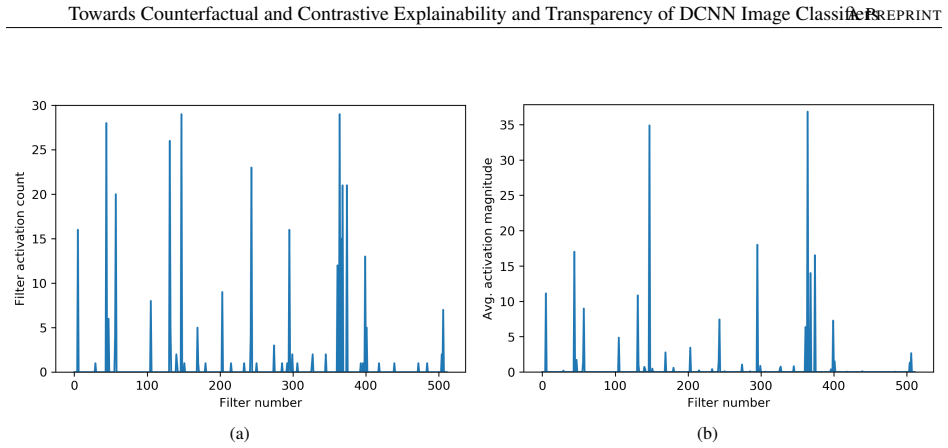
- Disabling the globally important MC filters for a class drops class recall sharply (e.g., 93.3% to 30% for Red-winged blackbird) while overall accuracy falls by only about 2%, indicating these filters encode class-exclusive concepts.
- User evaluations with Explanation Satisfaction scores suggest that both expert and non-expert users find the filter-based explanations understandable and useful compared with heatmap and attribute-based baselines.
Reading between the lines
- The paper's "minimum" is a claim about what L1-regularized training returns, not a certificate of true minimality; a stronger test would compare the MC mask against exhaustive or random subsets of the same size.
- The causal reading is strongest when the features highlighted by MI filters are introduced into real images; the paper demonstrates this on hand-edited examples, and a systematic study across many images and classes would show whether the identified filters are genuinely sufficient to flip decisions.
- Because the method operates on post-pooling activations, its transparency likely degrades for lower layers, where filters are less semantic; the same architecture could be tested there to map the limits of concept-level explanations.
- The MI filters point to features whose presence pushes the model across a decision boundary, which suggests a natural connection to adversarial perturbations: features that flip decisions could be checked for overlap with adversarial patterns.
Editorial analysis
A structured set of objections, weighed in public.
Referee Report
Summary. The paper proposes a post-hoc explainability method for DCNN image classifiers, applied to VGG-16 on CUB-2011. Given an input image, a per-class 'counterfactual explanation' (CFE) network predicts two sets of masks over the top convolutional layer's post-GAP filter activations: a binary 'minimum correct' (MC) mask that, when multiplied with the activations, is claimed to be the minimum set of filters sufficient to preserve the model's original decision, and a nonnegative 'minimum incorrect' (MI) additive perturbation that, when added to the activations, is claimed to flip the decision to a specified alter class. The masks are trained by minimizing cross-entropy, an L1 sparsity penalty, and (for MC) a negative logits loss. The paper evaluates the masks through qualitative visualizations, a misclassification case study, a user study, a class-recall ablation, and a comparison with GradCAM and SCOUT.
Significance. If the claims were fully established, the method would be a useful addition to the explainability toolbox: it is model-intrusive, produces compact filter-level explanations, and the misclassification analysis in Section 4.2.2 is a compelling demonstration that filter-level reasoning can diagnose an erroneous decision. The paper also ships a user study and an attempt at quantitative comparison, which is more than many XAI papers provide. However, the central 'minimum set' claim is currently a fitted property of a learned surrogate, not a verified property of the explained model, and the quantitative comparison is underspecified. The significance of the contribution is therefore conditional on reframing and additional validation.
major comments (4)
- [Section 1 and Section 3.1-3.2, Eqs. (3) and (9)] The central claim that the method identifies the 'minimum set' of filters is not established. The masks are outputs of a per-class dense network trained on the class-averaged loss, not solutions of the per-image optimization written in Eqs. (3) and (9). L1 regularization selects one sparse solution and provides no certificate that no smaller or alternative mask exists. Table 3 itself shows that at the reported lambda=2 the testing accuracy is 99.1%, meaning that for about 1% of test images the predicted MC mask does not even preserve the decision, which contradicts the 'necessary' interpretation. Please either reframe the claims as 'sparse sufficient masks' or provide per-image minimality evidence, for example by comparing predicted masks against greedy or exhaustive search on a sample of images, reporting the distribution of mask sizes, and testing whether removing any individual predicted filter breaks the prediction.
- [Section 4.5, Table 5] The quantitative comparison with GradCAM and SCOUT is under-specified for the proposed filter-based method. The recall and precision metrics are defined over an 'explanation region', but the paper never states how a binary MC filter mask or an MI perturbation is converted into a spatial explanation region on the input image. Without this mapping, the numbers in Table 5 are not reproducible and the comparison is not meaningful. Please specify the spatial aggregation rule, describe how part annotations are matched to the region, and ideally release code for the evaluation.
- [Section 3.1, Eq. (2), and Section 3.2, Eq. (8)] The paper treats scalar modification of post-GAP filter activations as equivalent to enabling or disabling visual concepts in the input. This assumption is not validated: a GAP value is an average over spatial locations, and zeroing or adding to that scalar does not remove or insert the corresponding visual feature in the image or in the feature maps. The manual image edits in Section 4.2.1 (Fig. 4) and Section 4.2.2 (Fig. 7) are a different intervention and do not test the scalar-level operation. As a result, the claims that the masks correspond to 'features and concepts' and that the model is made 'transparent' rest on an unverified causal linkage. Please add experiments that compare scalar-level interventions with spatial feature-map interventions or input-level perturbations on the same images.
- [Section 4.4.2, Table 3] The sparsity-loss analysis does not support the 'minimum' conclusion. The table reports average filter counts and accuracy values as a function of lambda, but it never checks whether a strictly smaller subset of the predicted filters would still suffice for a given image, nor whether a different sparse subset would be equally effective. Thus the trade-off shown in Table 3 is between the surrogate's training objective and its output size, not a demonstration that the CFE model finds the minimal sufficient set. Please include a minimality check or weaken the conclusion accordingly.
minor comments (5)
- [Section 3.1, Eq. (4)] The cross-entropy loss is written as if ci were a probability vector, but ci is defined earlier as a class index. Please use one-hot notation or a sparse softmax cross-entropy formulation to avoid ambiguity.
- [Table 2] The 'Rand. disabled' column appears to report a single random draw of filters; please state how many random subsets were used and report the variance, since the conclusion that random disabling has little effect depends on that.
- [Section 4.4.2, Tables 3 and 4] The 'Filters' columns report averages without standard deviations or percentiles; given that the masks vary per image, a distribution would be more informative than a point average.
- [Section 4.1] The reported VGG-16 test accuracy of 69.5% on CUB-2011 is not contextualized against standard baselines; adding a reference to prior reported accuracies on this benchmark would help the reader judge the explained model.
- [Section 4.5] The paper claims 'consistently better' recall/precision than SCOUT, but Table 5 reports only a few classes and no significance testing; please state how many images and class pairs were used and whether the differences are statistically reliable.
Circularity Check
No significant circularity; the paper's mask predictors are trained and evaluated out-of-sample, and the 'minimum' overclaim is an evidence gap rather than a circular reduction.
full rationale
The paper's derivation chain is not circular in the sense required by the review criteria. The MC and MI filter masks are outputs of a learned single-layer network trained with cross-entropy, L1 sparsity, and (for MC) logits losses (Eqs. 3 and 9); the later demonstrations that the masks preserve or flip the classifier's decision are out-of-sample evaluations of that trained predictor (e.g., Table 3), which is standard supervised learning rather than a construction that forces the reported behavior. The 'minimum' wording is an overclaim, because L1 regularization selects a sparse solution and does not certify global minimality, and the average mask size varies with the chosen sparsity weight λ in Table 3; however, that is an evidentiary or correctness gap, not a circular reduction: the paper does not define minimality as the trained output and then use that same definition as proof. There are no load-bearing self-citations, no imported uniqueness theorems, and no known result merely renamed. Therefore no specific circular step can be exhibited, and the appropriate score is 0.
Assumptions & free parameters
free parameters (4)
- lambda_MC =
2
- lambda_MI =
1
- binarization_threshold_t =
0.5
- CFE dense layer weights =
learned on CUB-200-2011 training split
assumptions (4)
- domain assumption Top convolutional layer filters encode high-level, semantically meaningful concepts.
- ad hoc to paper Multiplying or adding scalar values to post-GAP filter activations is a faithful causal intervention on the model's visual decision process.
- domain assumption The class weights W_{k,c} in the negative logits loss correctly rank how much each filter contributes to class c.
- ad hoc to paper L1-regularized minimization finds the true minimum sufficient filter masks.
invented entities (2)
-
MC filter mask FM_C
-
MI filter perturbation FM_I
Cite this review
Pith. "Pith review of Towards Counterfactual and Contrastive Explainability and Transparency of DCNN Image Classifiers." pith.science (2026). https://pith.science/paper/TTB7KVAO
@misc{pith2026250106831,
  author       = {Pith},
  title        = {Pith review of: Towards Counterfactual and Contrastive Explainability and Transparency of DCNN Image Classifiers},
  year         = {2026},
  howpublished = {\url{https://pith.science/paper/TTB7KVAO}},
  note         = {Machine review of arXiv:2501.06831}
}
read the original abstract
Explainability of deep convolutional neural networks (DCNNs) is an important research topic that tries to uncover the reasons behind a DCNN model's decisions and improve their understanding and reliability in high-risk environments. In this regard, we propose a novel method for generating interpretable counterfactual and contrastive explanations for DCNN models. The proposed method is model intrusive that probes the internal workings of a DCNN instead of altering the input image to generate explanations. Given an input image, we provide contrastive explanations by identifying the most important filters in the DCNN representing features and concepts that separate the model's decision between classifying the image to the original inferred class or some other specified alter class. On the other hand, we provide counterfactual explanations by specifying the minimal changes necessary in such filters so that a contrastive output is obtained. Using these identified filters and concepts, our method can provide contrastive and counterfactual reasons behind a model's decisions and makes the model more transparent. One of the interesting applications of this method is misclassification analysis, where we compare the identified concepts from a particular input image and compare them with class-specific concepts to establish the validity of the model's decisions. The proposed method is compared with state-of-the-art and evaluated on the Caltech-UCSD Birds (CUB) 2011 dataset to show the usefulness of the explanations provided.
Figures


Figures from the paper (7 more)


Reference graph
Works this paper leans on
-
[3]
Andreas Holzinger, Chris Biemann, Constantinos S Pattichis, and Douglas B Kell. What do we need to build explainable ai systems for the medical domain? arXiv preprint arXiv:1712.09923,
-
[5]
Interpretable Neural Network Decoupling
PMLR. Yuchao Li, Rongrong Ji, Shaohui Lin, Baochang Zhang, Chenqian Yan, Yongjian Wu, Feiyue Huang, and Ling Shao. Dynamic neural network decoupling. arXiv preprint arXiv:1906.01166,
work page Pith review arXiv 1906
-
[6]
Training Interpretable Convolutional Neural Networks by Differentiating Class-specific Filters
Haoyu Liang, Zhihao Ouyang, Yuyuan Zeng, Hang Su, Zihao He, Shu-Tao Xia, Jun Zhu, and Bo Zhang. Training interpretable convolutional neural networks by differentiating class-specific filters. arXiv preprint arXiv:2007.08194,
work page Pith review arXiv 2007
-
[8]
Efficientps: Efficient panoptic segmentation
Rohit Mohan and Abhinav Valada. Efficientps: Efficient panoptic segmentation. arXiv preprint arXiv:2004.02307,
arXiv 2004
-
[9]
Rise: Randomized input sampling for explanation of black-box models
Vitali Petsiuk, Abir Das, and Kate Saenko. Rise: Randomized input sampling for explanation of black-box models. arXiv preprint arXiv:1806.07421,
-
[11]
Very deep convolutional networks for large-scale image recognition
Karen Simonyan and Andrew Zisserman. Very deep convolutional networks for large-scale image recognition. arXiv preprint arXiv:1409.1556,
-
[13]
Mingxing Tan and Quoc V Le. Efficientnet: Rethinking model scaling for convolutional neural networks.arXiv preprint arXiv:1905.11946,
arXiv 1905
-
[14]
C. Wah, S. Branson, P. Welinder, P. Perona, and S. Belongie. The Caltech-UCSD Birds-200-2011 Dataset. Technical Report CNS-TR-2011-001, California Institute of Technology,
work page 2011
Show all 17 references
-
[15]
Explainability of vision-based autonomous driving systems: Review and challenges
Éloi Zablocki, Hédi Ben-Younes, Patrick Pérez, and Matthieu Cord. Explainability of vision-based autonomous driving systems: Review and challenges. arXiv preprint arXiv:2101.05307,
-
[17]
Object detectors emerge in deep scene cnns
Bolei Zhou, Aditya Khosla, Agata Lapedriza, Aude Oliva, and Antonio Torralba. Object detectors emerge in deep scene cnns. arXiv preprint arXiv:1412.6856,
-
[2014]
Deep inside convolutional networks: Visualising image classification models and saliency maps
Karen Simonyan, Andrea Vedaldi, and Andrew Zisserman. Deep inside convolutional networks: Visualising image classification models and saliency maps. arXiv preprint arXiv:1312.6034,
-
[2015]
Wojciech Samek, Thomas Wiegand, and Klaus-Robert Müller
doi:10.1007/s11263-015-0816- y. Wojciech Samek, Thomas Wiegand, and Klaus-Robert Müller. Explainable artificial intelligence: Understanding, visualizing and interpreting deep learning models. arXiv preprint arXiv:1708.08296,
-
[2017]
Architecture disentanglement for deep neural networks
Jie Hu, Rongrong Ji, Qixiang Ye, Tong Tong, ShengChuan Zhang, Ke Li, Feiyue Huang, and Ling Shao. Architecture disentanglement for deep neural networks. arXiv preprint arXiv:2003.13268,
2003 arXiv
-
[2018]
Metrics for explainable ai: Challenges and prospects
Robert R Hoffman, Shane T Mueller, Gary Klein, and Jordan Litman. Metrics for explainable ai: Challenges and prospects. arXiv preprint arXiv:1812.04608,
-
[2019]
Neuron shapley: Discovering the responsible neurons
Amirata Ghorbani and James Zou. Neuron shapley: Discovering the responsible neurons. arXiv preprint arXiv:2002.09815,
2002 arXiv
-
[2020]
Adaptiveface: Adaptive margin and sampling for face recognition
Hao Liu, Xiangyu Zhu, Zhen Lei, and Stan Z Li. Adaptiveface: Adaptive margin and sampling for face recognition. In Proceedings of the IEEE Conference on Computer Vision and Pattern Recognition, pages 11947–11956, 2019a. Haomiao Liu, Ruiping Wang, Shiguang Shan, and Xilin Chen....
1907 arXiv
-
[2021]
Resnest: Split-attention networks
Hang Zhang, Chongruo Wu, Zhongyue Zhang, Yi Zhu, Zhi Zhang, Haibin Lin, Yue Sun, Tong He, Jonas Mueller, R Manmatha, et al. Resnest: Split-attention networks. arXiv preprint arXiv:2004.08955,
2004 arXiv
Reviewed August 10, 2026 · model on record in the stance chip above.
Discussion (0). Continue with ORCID to comment.