REVIEW 3 major objections 2 minor 1 references
Reviewed by Pith at T0; open to challenge.
T0 means a machine referee read the full paper against a public rubric. The mark states how deep the mechanical check went, never who wrote it. the ladder, T0–T4 →
T0 review · grok-4.3
DDPG reinforcement learning identifies criminals from case data at 95 percent accuracy.
2026-06-30 20:41 UTC pith:TTEJLBBH
load-bearing objection Paper claims 95% accuracy using DDPG on crime data but supplies no state, action, reward, dataset, or validation details, making the result impossible to assess. the 3 major comments →
Identifying Culprits Through Deep Deterministic Policy Gradient Deep Learning Investigation
The pith
A machine-rendered reading of the paper's core claim, the machinery that carries it, and where it could break.
Core claim
The authors show that a DDPG model can be trained on crime scene, witness, and suspect data to identify the offender with 95 percent accuracy, which exceeds the performance of several existing methods.
What carries the argument
The Deep Deterministic Policy Gradient (DDPG) algorithm, which learns a policy to select identifications that maximize offender likelihood from the provided data features.
Load-bearing premise
The approach assumes that crime scene material, witness statements, and suspect profiles can be directly used to train a DDPG model without needing custom definitions for states, actions, or rewards.
What would settle it
Apply the model to an independent collection of solved crime cases and check if the identification accuracy is substantially lower than 95 percent or does not exceed the accuracy of the other methods tested.
Editorial analysis
A structured set of objections, weighed in public.
Referee Report
Summary. The paper proposes applying the Deep Deterministic Policy Gradient (DDPG) reinforcement learning algorithm to identify criminals by training on crime scene material, witness statements, and suspect profiles. It asserts that this yields 95% accuracy, outperforming several existing methods, while minimizing false positives/negatives through feature-based maximization of offender likelihood.
Significance. If the 95% accuracy claim and DDPG training setup were rigorously validated with full experimental details, the work would represent a novel application of continuous-control RL to a discrete forensic identification task, potentially offering a data-driven alternative to conventional investigation methods.
major comments (3)
- [Abstract] Abstract: the central performance claim of 'amazing accuracy of 95%' is unsupported by any description of the MDP formulation (state representation, action space, reward design), dataset characteristics, training procedure, validation splits, or error analysis, rendering the result impossible to reproduce or evaluate.
- [Abstract] Abstract: DDPG is an off-policy actor-critic method for continuous action spaces, yet the task of criminal identification is a discrete classification problem; no justification, discretization scheme, or adaptation of the algorithm is provided, creating a fundamental mismatch that undermines the method's coherence.
- [Abstract] Abstract: the assertion of superiority 'than other several existing methods' is made without any baseline implementations, comparative metrics, tables, or statistical tests, so the cross-method claim cannot be assessed.
minor comments (2)
- [Abstract] Abstract contains informal phrasing ('amazing accuracy') and grammatical issues ('than other several existing methods' should read 'than several other existing methods').
- The title refers to 'Deep Deterministic Policy Gradient Deep Learning Investigation' but the text provides no equations, pseudocode, or architectural diagrams to support the claimed deep learning component.
Simulated Author's Rebuttal
We thank the referee for their comments. We acknowledge that the submitted manuscript is missing essential technical details and comparative evaluations, which prevents proper assessment of the claims. We address each point below and will revise the manuscript to incorporate the required information.
read point-by-point responses
-
Referee: [Abstract] Abstract: the central performance claim of 'amazing accuracy of 95%' is unsupported by any description of the MDP formulation (state representation, action space, reward design), dataset characteristics, training procedure, validation splits, or error analysis, rendering the result impossible to reproduce or evaluate.
Authors: We agree that the manuscript provides no description of the MDP components, dataset, training procedure, validation, or error analysis. This omission makes the 95% accuracy claim impossible to evaluate or reproduce. In the revised manuscript we will add a dedicated methods section that fully specifies the state representation, action space, reward function, dataset characteristics and preprocessing, training hyperparameters, validation splits, and error analysis. revision: yes
-
Referee: [Abstract] Abstract: DDPG is an off-policy actor-critic method for continuous action spaces, yet the task of criminal identification is a discrete classification problem; no justification, discretization scheme, or adaptation of the algorithm is provided, creating a fundamental mismatch that undermines the method's coherence.
Authors: The referee correctly notes the mismatch between DDPG's standard formulation for continuous control and the discrete classification nature of offender identification. The current manuscript offers no justification or adaptation. We will revise the paper to explain the rationale for using DDPG, describe any discretization or output-mapping scheme employed, and discuss how the actor-critic updates were adapted to the discrete setting. revision: yes
-
Referee: [Abstract] Abstract: the assertion of superiority 'than other several existing methods' is made without any baseline implementations, comparative metrics, tables, or statistical tests, so the cross-method claim cannot be assessed.
Authors: We accept that the manuscript contains no baseline implementations, metrics, tables, or statistical tests, so the superiority claim cannot be assessed. In the revision we will implement and report comparisons against the referenced existing methods, include a results table with performance metrics, and provide appropriate statistical tests. revision: yes
Circularity Check
No derivation chain or equations present; performance claim is an unreported empirical assertion with no inspectable steps.
full rationale
The manuscript states that DDPG is trained on crime scene, witness, and suspect data to achieve 95% accuracy but supplies no state representation, action space, reward function, dataset description, equations, or derivation. No self-citations, ansatzes, or fitted inputs are invoked as load-bearing premises. With no mathematical chain to walk, no reduction to inputs by construction can be exhibited, satisfying the default expectation of no significant circularity.
Axiom & Free-Parameter Ledger
read the original abstract
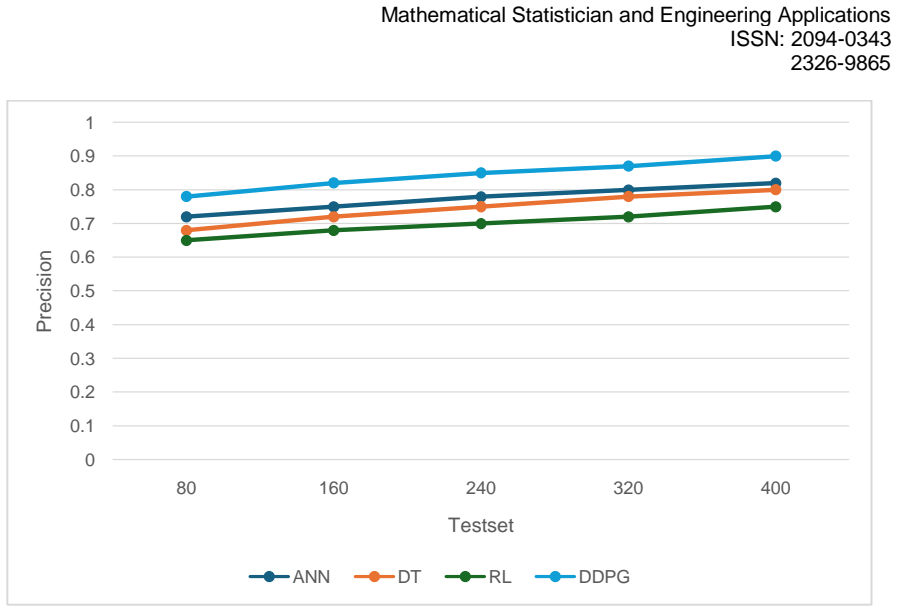
In the world of AI and advanced technologies investigation aspects identification of a crime or criminal plays a major problem. In this research we focus on a Conventional ways of implicating criminal investigations usually rely on limited data analysis. Finding an optimal and efficient method that will effectively identify criminals from complex datasets and minimise false positives and false negatives is the considered as a challenge. The main novelty approach of this work is based on the deep learning algorithm Deep Deterministic Policy Gradient (DDPG) is presented in this paper. We train the DDPG model with a dataset of crime scene material, witness statements and suspect profiles. The algorithm uses features to maximise the likelihood of identifying the offender while minimising the noise impact and irrelevant data. We show the efficacy of the proposed method, where DDPG identified criminals with an amazing accuracy of 95% than other several existing methods.
Figures


Reference graph
Works this paper leans on
-
[1]
[1]. Namatēvs, I. (2017). Deep reinforcement learning on HVAC control. Information Technology and Management Science, 20(1), 40-45. [2]. Hanumaiah, V., &Genc, S. (2021). Distributed multi -agent deep reinforcement learning framework for whole-building HVAC control. arXiv preprint arXiv:2110.13450. [3]. Li, W., Zhang, H., van Vlijmen, B., Dechent, P., & Sa...
discussion (0)
Sign in with ORCID, Apple, or X to comment. Anyone can read and Pith papers without signing in.