REVIEW 4 major objections 5 minor 9 cited by
EnerVerse-AC: Envisioning Embodied Environments with Action Condition
T0 review · 4 major / 5 minor · reviewed 2026-08-15 · deepseek-v4-flash
Pith's one-line read An action-conditional video world model can stand in for real-robot testing, ranking policies by generated rollouts.
desk verdict EVAC is a plausible engineering extension of EnerVerse with an under-supported evaluator claim; it deserves serious refereeing but not acceptance at current evidence. read the letter →
The pith
A machine-rendered reading of the paper's core claim, the machinery that carries it, and where it could break.
The reading
What carries the argument
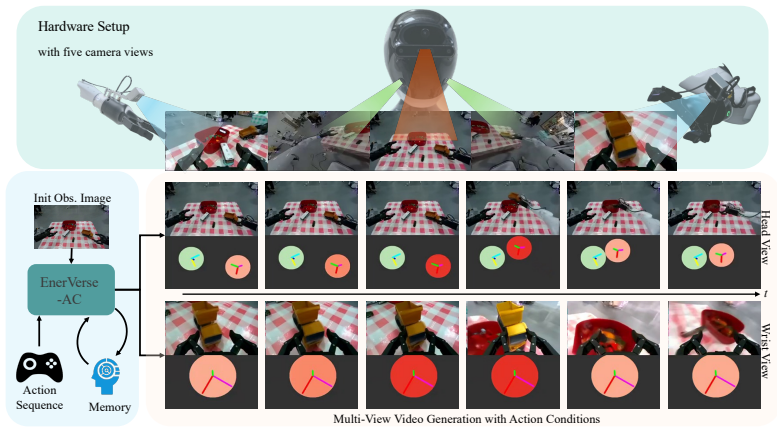
The load-bearing mechanism is the multi-level action-conditioning stream. At each timestep, the end-effector pose and gripper openness are rendered into an action map, with pixel coordinates from calibrated cameras, orientation unit vectors, and a shaded circle encoding grip state; a frozen vision encoder turns this map into features concatenated with the image latents. A separate delta action attention module computes differences between consecutive actions and injects those motion cues through cross-attention, giving the model access to speed and acceleration. For moving wrist cameras, ray maps defined by camera origins and directions are concatenated into the input features so the model knows where each view is looking at each instant. The generation itself is chunk-wise autoregressive diffusion with a sparse memory of four history frames, which keeps the video visually consistent over multiple 16-frame chunks. The training mix also includes failure trajectories, and the paper shows this is what prevents the model from fabricating a grasp when the gripper never contacts the object.
What would settle it
Run a policy on a task that shifts its action distribution, for example by adding increasing position or velocity offsets to its action outputs, and compare EVAC's success-rate rankings against real-robot rollouts from the same initial frames. If the rankings diverge as the offset grows, or if EVAC shows successful grasps in videos where the generated gripper never closes, the evaluator claim is falsified for out-of-distribution actions.
Extended reading notes
Core claim
On its own terms, the paper establishes that an embodied world model can be made action-controllable and can double as a low-cost evaluator. EVAC builds on a diffusion-based video generator and injects the robot's action at two levels: spatial-aware pose maps that draw the end-effector's position, orientation, and gripper state into image space, and a delta action attention module that encodes velocities and accelerations between consecutive actions. Multi-view consistency, including dynamic wrist cameras, is handled by ray map encoding of camera origins and directions. Trained on a large-scale manipulation dataset supplemented with deliberately collected failure trajectories, EVAC generates video that human raters score consistently with real rollouts: reported success rates for four tasks and three training checkpoints follow the same trends (for example, bottle retrieval 28% real versus 25% EVAC; training checkpoints 40/40, 61/63, 79/76 real versus EVAC). The same generator, run in reverse, synthesizes augmented training trajectories that improved policy success from 0.28 to 0.36 on a bottle-extraction task.
Load-bearing premise
The evaluator's usefulness rests on the assumption that the policy being tested produces actions similar to those EVAC saw during training; the paper does not measure how far a policy can deviate before the generated video becomes plausible-looking but physically wrong.
Editorial extensions
If this is right
- Policies can be ranked and compared during development by generating rollouts rather than deploying on robots, cutting hardware and setup costs.
- Human evaluators or video-language models can score generated rollouts; EVAC's results show it picks out the same performance trends as real tests, including progress across training steps.
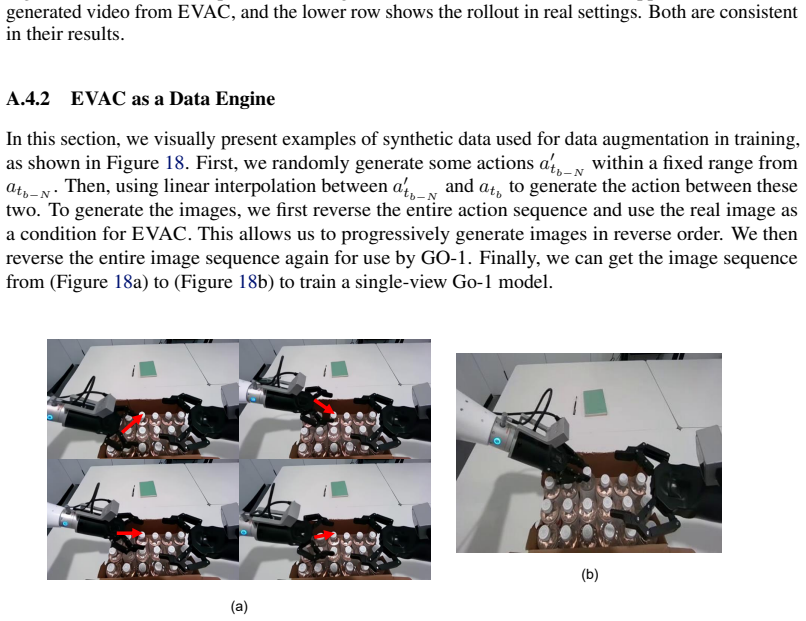
- Small expert datasets can be expanded: augmenting 20 demonstrations with 30 percent EVAC-generated trajectories raised a bottle-extraction policy's success rate from 0.28 to 0.36.
- Including failure data in world-model training suppresses hallucinations, so generated video can be trusted to show failed grasps instead of inventing successes.
- Multi-view generation with ray maps supports dynamic wrist-camera observations, which are important for dexterous manipulation policies.
Reading between the lines
- If the correlation generalizes, the bottleneck in robot manipulation shifts from physical testing to world-model fidelity and video review, making large-scale policy search and training-time evaluation far cheaper.
- The same action-conditioned mechanism could be used for test-time planning, not just evaluation: select action sequences by generating and scoring their outcomes before execution.
- The delta action attention finding suggests that explicit conditioning on velocity and acceleration is a broadly useful recipe for physically plausible video generation, with applications outside robotics.
- A prudent extension would measure how close a queried policy's actions are to EVAC's training distribution and use that distance as a confidence bound on evaluator results.
Signed reviews
Editorial analysis
A structured set of objections, weighed in public.
Referee Report
Summary. The paper introduces EVAC (EnerVerse-AC), an action-conditional video-diffusion world model for robot manipulation built on the EnerVerse architecture. The method injects robotic actions through spatial action maps and a delta-action attention module, extends generation to multiple camera views with ray map encodings, and trains on both successful and failure trajectories. EVAC is proposed for two applications: as a data engine that augments small human-collected demonstration sets with generated trajectories, and as a policy evaluator that scores policies from generated video instead of physical robot rollouts. The experiments include qualitative generation results, four task-level comparisons between EVAC-based and real-robot evaluation, an ablation of failure data, and a data-augmentation experiment reporting an increase in success rate from 0.28 to 0.36.
Significance. If the evaluator claim were quantitatively established, EVAC would be a practically valuable tool for reducing hardware costs in robot policy development. The paper has notable strengths: the authors promise code, checkpoints, and datasets; the qualitative figures show genuinely action-controllable and multi-view consistent generation; and the failure-data ablation in Section 4.5 is a concrete, honest demonstration of a known failure mode. However, the central quantitative claims are not backed by sufficient statistical evidence: there are no error bars or seed counts for the data-engine result, no objective video-quality metrics, no inter-rater agreement for the evaluator study, and no quantitative comparison against the EnerVerse baseline on which the method builds. The contribution is therefore plausible but not yet established at the standard claimed in the abstract.
major comments (4)
- [§4.3, Figure 7] The headline claim of a high correlation between EVAC-based evaluation and real-robot evaluation is not statistically supported. Figure 7 shows success rates for only four tasks and three training-step points, with no error bars, no confidence intervals, no correlation coefficient, and no inter-rater agreement metric even though the text states that three evaluators were used. Since each task was evaluated 40 times according to Appendix A.4.1, the authors should report bootstrap confidence intervals, a rank correlation across the task-level points, and an agreement statistic such as Cohen's kappa; without these, the claim is indistinguishable from chance agreement over four points.
- [§4.3, §4.5, Appendix A.4.1] Evaluator validity is established only for the GO-1 policy on four tasks that are close to the AgiBot-World training distribution, and robustness to out-of-distribution action sequences is never measured. The evaluator feeds action chunks sampled from the policy under test into EVAC, but the paper does not quantify how far those actions are from EVAC's training action distribution. Section 4.5 demonstrates the concrete failure mode: when failure trajectories are absent, EVAC hallucinates a successful grasp even though no contact occurred. This is precisely the regime in which a hardware-free evaluator is most needed, such as for partially trained or noisy policies. An experiment that injects action noise or tests policies at varied training stages with reported action-distance diagnostics is necessary to support the generalization claim.
- [§4.4, Table 1] The data-engine result rests on a single pair of success rates (0.28 baseline versus 0.36 augmented) with no number of seeds, no standard deviation, no per-condition episode counts, and no significance test. With a difference of 0.08, random seed variation in policy training could easily explain the observed gap. The experiment should be repeated over multiple seeds with mean and variance reported, and the meaning of '30% additional trajectories' should be made precise, including the absolute number of generated trajectories used.
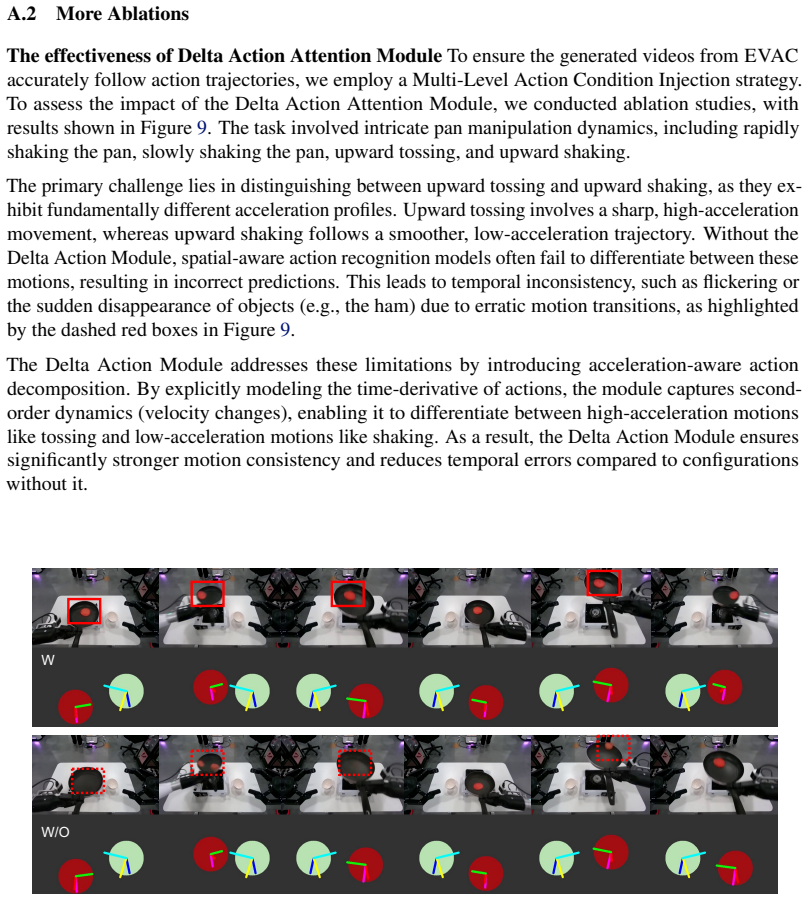
- [§4.2, Appendix A.2] No objective video-quality metrics (such as FVD, LPIPS, action-follow error, or cross-view consistency) are reported for the generation claims; statements that videos remain sharp and reliable for up to 30 chunks are supported only by qualitative stills. The delta-action ablation in Figure 9 is also qualitative. Because the paper positions EVAC as a world simulator, quantitative fidelity metrics and a direct comparison against the EnerVerse baseline are needed to establish that the proposed architecture, rather than the curated training data, improves over the prior system.
minor comments (5)
- [§3.1] The heading 'Mutli-Level Action Condition Injection' contains a typo and should read 'Multi-Level Action Condition Injection'.
- [§3, first equation] The notation 'O∈R V×(H+K)×3×h×w' appears to be missing a multiplication sign between V and (H+K); it should be 'R^{V × (H+K) × 3 × h × w}'.
- [§4.3, Figure 7] The left panel reports success rates as 28%, 100%, 85%, 55%, 25%, 90%, 88%, and 50% without an explicit legend mapping each bar to the four tasks and two evaluation modes; adding direct labels above each bar would greatly improve readability.
- [References] Several references are incomplete or informal, including [20] (missing title and venue details) and [21] (a blog post with no author or title); these should be completed or reformatted.
- [§6] The limitations section does not mention the distribution-shift limitation of the evaluator application, which is the most serious limitation from the paper's own Section 4.5; a sentence acknowledging this would make the stated limitations more consistent with the experimental evidence.
Circularity Check
No significant circularity: the central evaluator claim is benchmarked against real-robot ground truth, and no load-bearing step reduces to its inputs.
full rationale
The paper's central claim is empirical, not derived: EVAC-generated videos serve as a policy evaluator whose results correlate with real-world outcomes. Section 4.3 anchors this claim to external ground truth: 'real-world evaluations were conducted first, and the initial frame recordings from these tests were used as the image condition for EVAC evaluations. Success or failure was determined by three independent evaluators who observed either real-world executions or EVAC-generated sequences.' This is an external benchmark, not a tautology, so the evaluator claim is independently testable. The architecture builds on prior work from overlapping authors ('Built upon prior embodied world model architectures like EnerVerse [1]'), but the cited works provide a baseline architecture and training data, not the specific claimed result of evaluator correlation; citing a baseline is not circular. The data-engine experiment (Section 4.4) compares a policy trained on 20 expert episodes against the same episodes augmented with EVAC-generated trajectories, with success rate improving from 0.28 to 0.36. Table 1 does not explicitly state whether these success rates were measured on a real robot or through EVAC itself; if they were EVAC-measured, that could be partially circular, but the text provides no explicit statement to that effect, so flagging it would be speculation. The failure-data analysis (Section 4.5) and delta-action ablation (Appendix A.2) are empirical ablations against visual artifacts and hallucination, not definitional reductions. The limitations section openly admits hallucination without failure data and reduced multi-view chunk length, which are robustness/scope concerns rather than circularity. No fitted parameter is renamed as a prediction, no uniqueness theorem is imported from the authors' prior work, and no equation is equivalent to its input by construction. The paper is self-contained as an empirical system paper, so the appropriate finding is no significant circularity.
Assumptions & free parameters
free parameters (3)
- memory size =
4
- chunk size =
16
- synthetic augmentation ratio =
30%
assumptions (3)
- domain assumption Generated video frames are a valid proxy for real physical interaction for policy evaluation.
- domain assumption Ray maps computed from camera poses encode wrist-camera motion sufficiently to condition generation.
- domain assumption AgiBot-World and the mined failure trajectories cover the distribution of policies and actions to be evaluated.
Cite this review
Pith. "Pith review of EnerVerse-AC: Envisioning Embodied Environments with Action Condition." pith.science (2026). https://pith.science/paper/TTQOX6XM
@misc{pith2026250509723,
  author       = {Pith},
  title        = {Pith review of: EnerVerse-AC: Envisioning Embodied Environments with Action Condition},
  year         = {2026},
  howpublished = {\url{https://pith.science/paper/TTQOX6XM}},
  note         = {Machine review of arXiv:2505.09723}
}
read the original abstract
Robotic imitation learning has advanced from solving static tasks to addressing dynamic interaction scenarios, but testing and evaluation remain costly and challenging due to the need for real-time interaction with dynamic environments. We propose EnerVerse-AC (EVAC), an action-conditional world model that generates future visual observations based on an agent's predicted actions, enabling realistic and controllable robotic inference. Building on prior architectures, EVAC introduces a multi-level action-conditioning mechanism and ray map encoding for dynamic multi-view image generation while expanding training data with diverse failure trajectories to improve generalization. As both a data engine and evaluator, EVAC augments human-collected trajectories into diverse datasets and generates realistic, action-conditioned video observations for policy testing, eliminating the need for physical robots or complex simulations. This approach significantly reduces costs while maintaining high fidelity in robotic manipulation evaluation. Extensive experiments validate the effectiveness of our method. Code, checkpoints, and datasets can be found at <https://annaj2178.github.io/EnerverseAC.github.io>.
Figures


Figures from the paper (14 more)




Forward citations
Cited by 9 Pith papers
-
XEWorld: Can Action-Conditioned World Models Generalize to Unseen Robot Embodiments?
Current action-conditioned world models generalize to unseen robots based on visual similarity, not physical kinematics, and need pixel-space actions and time-aligned appearance cues to work at all.
-
RoboWorld: Fast and Reliable Neural Simulators for Generalist Robot Policy Evaluation
Step Forcing trains a few-step autoregressive video world model so RoboWorld closed-loop rollouts plus a task-progress VLM judge recover real-world policy rankings at r=0.989 and ρ=0.970.
-
GeniWorld: A Generalizable Interactive World Model for Robotic Manipulation via Visual Actions
An autoregressive video world model conditioned on URDF-rendered visual actions generalizes to unseen scenes and can evaluate policies and synthesize training data.
-
GigaWorld-1: A Roadmap to Build World Models for Robot Policy Evaluation
Long-horizon action-faithful consistency, not short-term visual realism, dominates world-model reliability for robot policy evaluation; GigaWorld-1 implements that roadmap and gains 14.9% on evaluator-alignment metrics.
-
WoVR: World Models as Reliable Simulators for Post-Training VLA Policies with RL
WoVR shows that reinforcement learning can improve VLA robot policies through imagined rollouts in a video world model, reporting +29.3 points on LIBERO and +30.0 points on real Franka tasks.
-
WorldEval: World Model as Real-World Robot Policies Evaluator
WorldEval conditions a video generation model on a policy's internal action embeddings (Policy2Vec) and shows generated-video success rates correlate with real-world robot success rates.
-
A Definition and Roadmap for World Models
A perspective article defining world models as finite-resource compression of physical state transitions and outlining a roadmap toward physical AGI via unified representations and interactive simulators.
-
ERMV: Editing 4D Robotic Multi-view images to enhance embodied agents
ERMV edits 4D multi-view robot videos from one edited frame plus robot states, and VLA policies trained on the edited data show higher success rates in simulation and real robot tests.
-
FaceAnonyMixer: Cancelable Faces via Identity Consistent Latent Space Mixing
FaceAnonyMixer claims a cancelable face generation method that irreversibly mixes real latent codes with key-derived synthetic codes for privacy-preserving face recognition.
Reference graph
Works this paper leans on
- [1]
-
[2]
Q. Bu, J. Cai, L. Chen, X. Cui, Y . Ding, S. Feng, S. Gao, X. He, X. Huang, S. Jiang, et al. Agibot world colosseo: A large-scale manipulation platform for scalable and intelligent embodied systems.arXiv preprint arXiv:2503.06669, 2025
arXiv 2025
-
[3]
Brooks, B
T. Brooks, B. Peebles, C. Holmes, W. DePue, Y . Guo, L. Jing, D. Schnurr, J. Tay- lor, T. Luhman, E. Luhman, C. Ng, R. Wang, and A. Ramesh. Video genera- tion models as world simulators. 2024. URL https://openai.com/research/ video-generation-models-as-world-simulators
2024
-
[4]
Bruce, M
J. Bruce, M. D. Dennis, A. Edwards, J. Parker-Holder, Y . Shi, E. Hughes, M. Lai, A. Mavalankar, R. Steigerwald, C. Apps, et al. Genie: Generative interactive environments. InForty-first International Conference on Machine Learning, 2024
2024
-
[5]
S. Yang, Y . Du, K. Ghasemipour, J. Tompson, L. Kaelbling, D. Schuurmans, and P. Abbeel. Learning interactive real-world simulators, 2024. URL https://arxiv.org/abs/2310. 06114
work page 2024
-
[7]
R. Rombach, A. Blattmann, D. Lorenz, P. Esser, and B. Ommer. High-resolution image synthesis with latent diffusion models.CoRR, abs/2112.10752, 2021. URL https://arxiv.org/abs/ 2112.10752
arXiv 2021
-
[8]
Y . Ma, Y . He, X. Cun, X. Wang, S. Chen, Y . Shan, X. Li, and Q. Chen. Follow your pose: Pose-guided text-to-video generation using pose-free videos, 2024. URL https://arxiv. org/abs/2304.01186
arXiv 2024
-
[9]
L. Hu, X. Gao, P. Zhang, K. Sun, B. Zhang, and L. Bo. Animate anyone: Consistent and controllable image-to-video synthesis for character animation, 2024. URL https://arxiv. org/abs/2311.17117. 9
arXiv 2024
Show all 38 references
-
[10]
S. Zhou, Y . Du, J. Chen, Y . Li, D.-Y . Yeung, and C. Gan. Robodreamer: Learning compositional world models for robot imagination, 2024. URLhttps://arxiv.org/abs/2404.12377
2024 arXiv
-
[11]
B. Wang, N. Sridhar, C. Feng, M. V . der Merwe, A. Fishman, N. Fazeli, and J. J. Park. This&that: Language-gesture controlled video generation for robot planning, 2024. URL https://arxiv.org/abs/2407.05530
2024 arXiv
-
[12]
Todorov, T
E. Todorov, T. Erez, and Y . Tassa. Mujoco: A physics engine for model-based control. In2012 IEEE/RSJ International Conference on Intelligent Robots and Systems, pages 5026–5033. IEEE,
-
[13]
Coumans and Y
E. Coumans and Y . Bai. Pybullet, a python module for physics simulation for games, robotics and machine learning.http://pybullet.org, 2016–2021
2016
-
[14]
Makoviychuk, L
V . Makoviychuk, L. Wawrzyniak, Y . Guo, M. Lu, K. Storey, M. Macklin, D. Hoeller, N. Rudin, A. Allshire, A. Handa, and G. State. Isaac gym: High performance gpu-based physics simulation for robot learning, 2021. URLhttps://arxiv.org/abs/2108.10470
2021 arXiv
-
[15]
Akkaya, M
OpenAI, I. Akkaya, M. Andrychowicz, M. Chociej, M. Litwin, B. McGrew, A. Petron, A. Paino, M. Plappert, G. Powell, R. Ribas, J. Schneider, N. Tezak, J. Tworek, P. Welinder, L. Weng, Q. Yuan, W. Zaremba, and L. Zhang. Solving rubik’s cube with a robot hand.CoRR, abs/1910.07113,...
1910 arXiv
-
[16]
Brohan, N
A. Brohan, N. Brown, J. Carbajal, Y . Chebotar, J. Dabis, C. Finn, K. Gopalakrishnan, K. Haus- man, A. Herzog, J. Hsu, J. Ibarz, B. Ichter, A. Irpan, T. Jackson, S. Jesmonth, N. J. Joshi, R. Julian, D. Kalashnikov, Y . Kuang, I. Leal, K.-H. Lee, S. Levine, Y . Lu, U. Malla, D....
2023 arXiv
-
[17]
O’Neill, A
A. O’Neill, A. Rehman, A. Maddukuri, A. Gupta, A. Padalkar, A. Lee, A. Pooley, A. Gupta, A. Mandlekar, A. Jain, et al. Open x-embodiment: Robotic learning datasets and rt-x models: Open x-embodiment collaboration 0. In2024 IEEE International Conference on Robotics and Automati...
2024
-
[18]
O. M. Team, D. Ghosh, H. Walke, K. Pertsch, K. Black, O. Mees, S. Dasari, J. Hejna, T. Kreiman, C. Xu, et al. Octo: An open-source generalist robot policy.arXiv preprint arXiv:2405.12213, 2024
2024 arXiv
-
[19]
M. J. Kim, K. Pertsch, S. Karamcheti, T. Xiao, A. Balakrishna, S. Nair, R. Rafailov, E. Foster, G. Lam, P. Sanketi, et al. Openvla: An open-source vision-language-action model.arXiv preprint arXiv:2406.09246, 2024
2024 arXiv
-
[20]
Q. Bu, H. Li, L. Chen, J. Cai, J. Zeng, H. Cui, M. Yao, and Y . Qiao. Towards synergistic, generalized, and efficient dual-system for robotic manipulation, 2025. URL https://arxiv. org/abs/2410.08001
2025 arXiv
-
[21]
Pi0: [title of the blog post]
Physical Intelligence. Pi0: [title of the blog post]. https://www.physicalintelligence. company/blog/pi0, 2025. Accessed: 2025-04-23
2025
-
[22]
Huang, Y
S. Huang, Y . Liao, S. Feng, S. Jiang, S. Liu, H. Li, M. Yao, and G. Ren. Adversarial data collection: Human-collaborative perturbations for efficient and robust robotic imitation learning. arXiv preprint arXiv:2503.11646, 2025
2025 arXiv
-
[23]
J. Xing, M. Xia, Y . Zhang, H. Chen, W. Yu, H. Liu, X. Wang, T.-T. Wong, and Y . Shan. Dynamicrafter: Animating open-domain images with video diffusion priors.arXiv preprint arXiv:2310.12190, 2023. 10
2023 arXiv
-
[24]
Z. Wang, Z. Yuan, X. Wang, Y . Li, T. Chen, M. Xia, P. Luo, and Y . Shan. Motionctrl: A unified and flexible motion controller for video generation. InACM SIGGRAPH 2024 Conference Papers, pages 1–11, 2024
2024
-
[25]
X. Wang, H. Yuan, S. Zhang, D. Chen, J. Wang, Y . Zhang, Y . Shen, D. Zhao, and J. Zhou. Videocomposer: Compositional video synthesis with motion controllability.Advances in Neural Information Processing Systems, 36:7594–7611, 2023
2023
-
[26]
T. Wang, L. Li, K. Lin, Y . Zhai, C.-C. Lin, Z. Yang, H. Zhang, Z. Liu, and L. Wang. Disco: Disentangled control for realistic human dance generation. InProceedings of the IEEE/CVF Conference on Computer Vision and Pattern Recognition, pages 9326–9336, 2024
2024
-
[27]
X. Li, L. Xu, J. Liu, M. Zhang, J. Xu, S. Huang, I. Ponomarenko, Y . Shen, S. Zhang, and H. Dong. Crayonrobo: Toward generic robot manipulation via crayon visual prompting.arXiv preprint arXiv:2505.02166, 2025
2025 arXiv
-
[28]
W. Lin, X. Wei, R. An, P. Gao, B. Zou, Y . Luo, S. Huang, S. Zhang, and H. Li. Draw-and- understand: Leveraging visual prompts to enable mllms to comprehend what you want.arXiv preprint arXiv:2403.20271, 2024
2024 arXiv
-
[29]
Radford, J
A. Radford, J. W. Kim, C. Hallacy, A. Ramesh, G. Goh, S. Agarwal, G. Sastry, A. Askell, P. Mishkin, J. Clark, G. Krueger, and I. Sutskever. Learning transferable visual models from natural language supervision.CoRR, abs/2103.00020, 2021
2021 arXiv
-
[30]
Alayrac, J
J.-B. Alayrac, J. Donahue, P. Luc, A. Miech, I. Barr, Y . Hasson, K. Lenc, A. Mensch, K. Millican, M. Reynolds, et al. Flamingo: a visual language model for few-shot learning.Advances in neural information processing systems, 35:23716–23736, 2022
2022
-
[31]
Jaegle, F
A. Jaegle, F. Gimeno, A. Brock, O. Vinyals, A. Zisserman, and J. Carreira. Perceiver: General perception with iterative attention. InInternational conference on machine learning, pages 4651–4664. PMLR, 2021
2021
-
[32]
R. Gao, A. Hoł y ´nski, P. Henzler, A. Brussee, R. Martin-Brualla, P. Srinivasan, J. T. Barron, and B. Poole. Cat3d: Create anything in 3d with multi-view diffusion models. InAdvances in Neural Information Processing Systems, volume 37, pages 75468–75494, 2024
2024
-
[33]
B. Liu, Y . Zhu, C. Gao, Y . Feng, Q. Liu, Y . Zhu, and P. Stone. Libero: Benchmarking knowledge transfer for lifelong robot learning.Advances in Neural Information Processing Systems, 36: 44776–44791, 2023
2023
-
[34]
Ha and J
D. Ha and J. Schmidhuber. Recurrent world models facilitate policy evolu- tion. InAdvances in Neural Information Processing Systems 31, pages 2451–
-
[35]
Hafner, T
D. Hafner, T. Lillicrap, M. Norouzi, and J. Ba. Mastering atari with discrete world models, 2022
2022
-
[36]
Hafner, J
D. Hafner, J. Pasukonis, J. Ba, and T. Lillicrap. Mastering diverse domains through world models, 2023. 11 A Appendix In this appendix, we first provide additional training details and model parameters in Section A.1. Next, we present an ablation study to evaluate the effectiv...
2023
-
[2012]
doi:10.1109/IROS.2012.6386109
2012
-
[2020]
URLhttps://arxiv.org/abs/2006.11239
2006 arXiv
-
[2463]
URL https://papers.nips.cc/paper/ 7512-recurrent-world-models-facilitate-policy-evolution
Curran Associates, Inc., 2018. URL https://papers.nips.cc/paper/ 7512-recurrent-world-models-facilitate-policy-evolution . https: //worldmodels.github.io
2018
Reviewed August 15, 2026 · model on record in the stance chip above.
Discussion (0). Continue with ORCID to comment.