In-plane vector-field imaging of propagating surface phonon polaritons
Pith reviewed 2026-06-26 02:32 UTC · model grok-4.3
The pith
A far-field nonlinear microscopy technique directly images the in-plane vector components of surface phonon polaritons.
A machine-rendered reading of the paper's core claim, the machinery that carries it, and where it could break.
Core claim
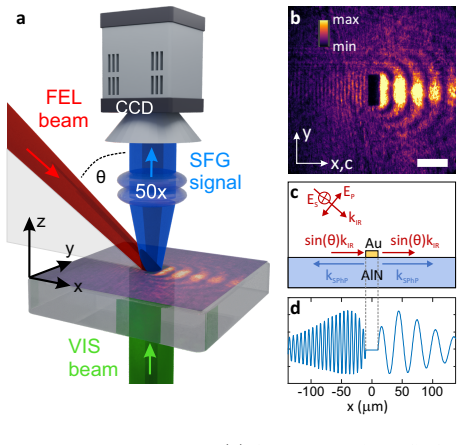
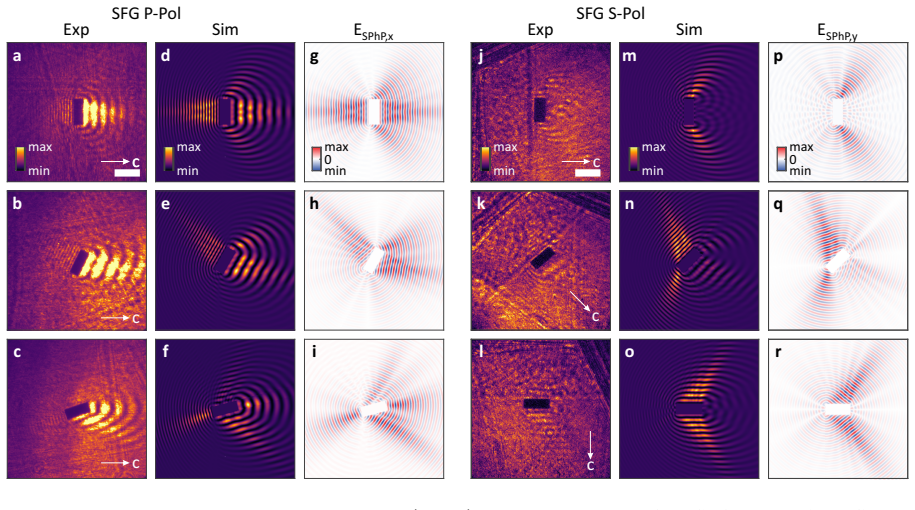
Wide-field infrared-visible sum-frequency generation microscopy, combined with polarization control and spatial interferometry, selectively images both in-plane components of surface phonon polariton fields at the AlN-air interface, supplying a far-field complement to tip-based near-field microscopy that has been limited to out-of-plane components.
What carries the argument
Nonlinear sum-frequency generation in wide-field geometry whose symmetry selection rules enable polarization-selective spatial interferometry of in-plane polariton fields.
If this is right
- Direct measurement of in-plane components becomes possible for hyperbolic polaritons and skyrmion-like modes instead of inference from out-of-plane data alone.
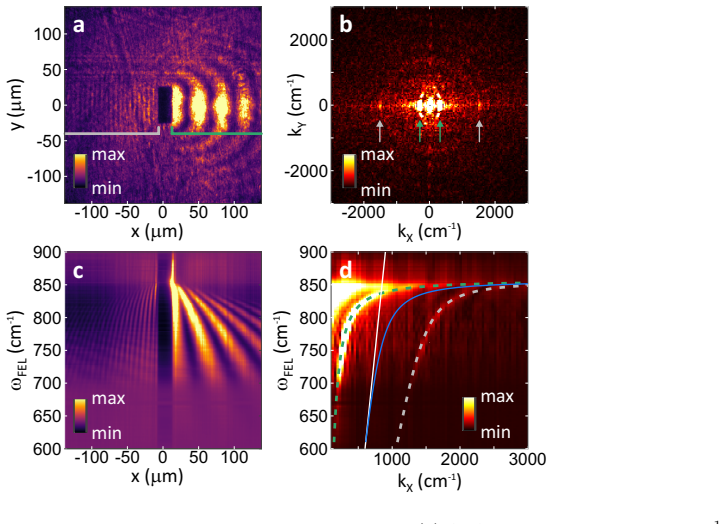
- Hyperspectral scans with a tunable laser yield the polariton dispersion relation across a range of frequencies.
- The wide-field format supports high-throughput mapping of many nanophotonic structures in a single acquisition.
- A simple semi-analytical model already reproduces the observed propagation patterns, indicating the imaging faithfully captures the vector field evolution.
Where Pith is reading between the lines
- The same nonlinear selection rules could be applied to other infrared surface modes or 2D-material polaritons to reveal propagation features hidden from out-of-plane probes.
- Extending the method to multiple nonlinear processes might allow full three-component vector tomography of evanescent fields.
- Because the technique is far-field and wide-field, it could be combined with pump-probe schemes to track time-resolved in-plane dynamics in complex mode patterns.
Load-bearing premise
The sum-frequency signal arises only from the in-plane polariton fields at the interface and follows the expected symmetry rules without significant mixing from other field components or the excitation beam.
What would settle it
If the recorded spatial interference fringes in the visible sum-frequency images fail to match the in-plane field distributions predicted by electromagnetic simulations of the antenna-launched polaritons, the claim of selective in-plane probing would not hold.
Figures
read the original abstract
Polariton interferometry through optical near-field microscopy has become a powerful tool in nanophotonics, enabling direct spatial access to the propagation characteristics of strongly confined, evanescent polariton modes. Scattering-type near-field optical microscopy has matured as the prime tool for such studies, yet mostly the out-of-plane components of the optical near fields are probed, owing to the elongated geometry of the nanotip. Here, we demonstrate a complementary far-field nonlinear microscopy approach which allows to selectively probe in-plane polariton field components. Accessing the full vector field is interesting when studying complex mode patterns such as hyperbolic polaritons or skyrmions, where the in-plane field components are typically only inferred from the out-of-plane component but not measured directly. To this end, we use nonlinear infrared-visible wide-field sum-frequency generation microscopy, where the short visible wavelength of the nonlinear signal provides the high spatial resolution to access evanescent modes in the infrared. The symmetry selection rules of the nonlinear process further enable polarization-selective imaging of both in-plane polariton field components through spatial interferometry. The concept is demonstrated experimentally using surface phonon polaritons at the AlN-air interface launched by a gold antenna. A simple, semi-analytical model reproduces the peculiar propagation patterns. Hyperspectral imaging with a tunable narrowband laser further gives access to the polariton dispersion. The wide-field methodology holds high promise for in-depth and high-throughput studies of infrared nanophotonic structures.
Editorial analysis
A structured set of objections, weighed in public.
Referee Report
Summary. The manuscript claims to introduce a far-field nonlinear microscopy method using infrared-visible sum-frequency generation (SFG) wide-field imaging to selectively probe the in-plane vector components of propagating surface phonon polaritons at the AlN-air interface. It asserts that nonlinear symmetry selection rules enable polarization-selective spatial interferometry of both Ex and Ey components, demonstrated via a gold antenna launcher, reproduced by a semi-analytical model, and extended to hyperspectral dispersion mapping.
Significance. If the central claims hold, the work provides a useful far-field complement to scattering-type near-field microscopy for direct access to in-plane polariton fields in complex modes (e.g., hyperbolic polaritons), where such components are typically only inferred. The semi-analytical model and hyperspectral capability are noted strengths for reproducibility and dispersion access.
major comments (1)
- [Abstract] Abstract (and implied Methods/Results sections): The central claim that symmetry selection rules enable polarization-selective imaging of both in-plane components (Ex, Ey) without Ez contamination or cross-talk lacks any explicit derivation, table, or citation of the relevant χ(2) tensor elements for the wurtzite AlN-air interface under the chosen visible/IR polarizations; this analysis is load-bearing for the selectivity assertion and is not provided.
Simulated Author's Rebuttal
We thank the referee for their careful review and constructive comment. We agree that an explicit derivation of the nonlinear selection rules is important to support the central claim and will incorporate this in the revised manuscript.
read point-by-point responses
-
Referee: [Abstract] Abstract (and implied Methods/Results sections): The central claim that symmetry selection rules enable polarization-selective imaging of both in-plane components (Ex, Ey) without Ez contamination or cross-talk lacks any explicit derivation, table, or citation of the relevant χ(2) tensor elements for the wurtzite AlN-air interface under the chosen visible/IR polarizations; this analysis is load-bearing for the selectivity assertion and is not provided.
Authors: We acknowledge that the manuscript does not contain an explicit derivation or table of the χ(2) tensor elements. In the revised version we will add a concise section (or supplementary note) that (i) states the non-zero elements of the χ(2) tensor for wurtzite AlN (6mm symmetry), (ii) shows the relevant tensor contractions for the chosen IR and visible polarization combinations, and (iii) demonstrates that the SFG process couples only to the in-plane components Ex and Ey with no Ez contribution or cross-talk under the experimental geometry. Appropriate references on nonlinear optics of wurtzite crystals will be included. revision: yes
Circularity Check
No significant circularity; experimental demonstration relies on established nonlinear optics
full rationale
The paper demonstrates a far-field SFG microscopy technique for in-plane polariton imaging, invoking standard symmetry selection rules of the nonlinear process without deriving them from the target result. No equations reduce a claimed prediction to a fitted input by construction, no load-bearing self-citation chain justifies the central premise, and the semi-analytical model is presented as reproducing observed patterns rather than being tautological. The approach applies known concepts to a new geometry and is self-contained against external benchmarks in nonlinear optics.
Axiom & Free-Parameter Ledger
axioms (1)
- domain assumption Symmetry selection rules of the nonlinear sum-frequency generation process enable polarization-selective imaging of in-plane components.
Reference graph
Works this paper leans on
-
[1]
2A. S. Barker,Phys. Rev. Lett.1972,28892. 3N. Marschall, B. Fischer,Phys. Rev. Lett.1972, 28811. 4H. J. Falge, A. Otto,Phys. Status Solidi B1973, 56, 2
1972
-
[2]
6J. D. Caldwell, A. V. Kretinin, Y. Chen, V. Gi- annini, M. M. Fogler, Y. Francescato, C. T. Ellis, J. G. Tischler, C. R. Woods, A. J. Giles, et al., Nat. Commun.2014,5, 1
2014
-
[3]
Galiffi, G
7E. Galiffi, G. Carini, X. Ni, G. Álvarez Pérez, S. Yves, E. M. Renzi, R. Nolen, S. Wasserroth, M. Wolf, P. Alonso-Gonzalez, et al.,Nat. Rev. Mater.2024,9, 1
2024
-
[4]
8Y. Zhou, Z. Guo, A. Tarazaga Martín-Luengo, C.Lanza, G.ÁlvarezPérez, C.Yu, C.Li, W.Xia, J. Álvarez Cuervo, X. Duan, et al.,Nat. Nan- otechnol.2025, 1–16. 9M. He, L. Lindsay, T. E. Beechem, T. Folland, J. Matson, K. Watanabe, A. Zavalin, A. Ueda, W. E. Collins, T. Taniguchi, et al.,J. Mater. Res.2021,364394. 10W. Ma, P. Alonso-GonzÁlez, S. Li, A. Y. Nikit...
2025
-
[5]
13X. Ni, G. Carini, W. Ma, E. M. Renzi, E. Galiffi, S. Wasserroth, M. Wolf, P. Li, A. Paarmann, A. Alù,Nat. Commun.2023,14, 1
2023
-
[6]
Díaz-Núñez, C
14P. Díaz-Núñez, C. Lanza, Z. Wang, V. G. Kravets, J. Duan, J. Álvarez Cuervo, A. T. Martín-Luengo, A. N. Grigorenko, Q. Yang, A. Paarmann, et al.,Sci. Adv.2025,11, 29 eadw3452. 15J. D. Caldwell, O. J. Glembocki, Y. Francescato, N. Sharac, V. Giannini, F. J. Bezares, J. P. Long, J. C. Owrutsky, I. Vurgaftman, J. G. Tischler, V. D. Wheeler, N. D. Bassim, L...
2025
-
[7]
Barnett, D
16J. Barnett, D. Wendland, M. Lewin, K. Wirth, A. Heßler, T. Taubner,Appl. Phys. Lett.2022, 120,
2022
-
[8]
19G. Lu, C. R. Gubbin, J. R. Nolen, T. Folland, M. J. Tadjer, S. De Liberato, J. D. Caldwell, Nano Lett.2021,21, 4
2021
-
[9]
24J. Duan, N. Capote-Robayna, J. Taboada- Gutiérrez, G. Álvarez Pérez, I. Prieto, J. Martín- SÁnchez, A. Y. Nikitin, P. Alonso-GonzÁlez, Nano Lett.2020,20, 7
2020
-
[10]
Álvarez Cuervo, M
25J. Álvarez Cuervo, M. Obst, S. Dixit, A. F. Tresguerres-Mata, C. Lanza, E. TerÁn- García, L. Álvarez Tomillo, K. Diaz-Granados, et al.,Nat. Commun.2024,15, 1
2024
-
[11]
26J.Taboada-Gutiérrez, G.ÁlvarezPérez, J.Duan, W. Ma, K. Crowley, I. Prieto, A. Bylinkin, M. Autore, H. Volkova, K. Kimura, et al.,Nat. Mater.2020,19, 9
2020
-
[12]
27A. J. Giles, S. Dai, I. Vurgaftman, T. Hoff- man, S. Liu, L. Lindsay, C. T. Ellis, N. Assefa, I. Chatzakis, T. L. Reinecke, et al.,Nat. Mater. 2018,17, 2
2018
-
[13]
28M. Chen, Y. Zhong, E. Harris, J. Li, Z. Zheng, H. Chen, J.-S. Wu, P. Jarillo-Herrero, Q. Ma, J. Edgar, et al.,Nat. Commun.2023,14, 1
2023
-
[14]
Carini, M
9 29G. Carini, M. Pradhan, E. Gelžinyt˙ e, A. Ar- denghi, S. Dixit, M. Obst, A. S. Senarath, N. S. Mueller, G. Álvarez Pérez, K. Diaz-Granados, et al.,Adv. Mater.2026,38, 11 e14561. 30C. Hu, T. Sun, Y. Zeng, W. Ma, Z. Dai, X. Yang, X. Zhang, P. Li,Elight2023,3, 1
2026
-
[15]
Matson, S
31J. Matson, S. Wasserroth, X. Ni, M. Obst, K. Diaz-Granados, G. Carini, E. M. Renzi, E. Galiffi, T. G. Folland, L. M. Eng, et al.,Nat. Commun.2023,14, 1
2023
-
[16]
Hillenbrand, Y
32R. Hillenbrand, Y. Abate, M. Liu, X. Chen, D. Basov,Nat. Rev. Mater.2025, 1–26. 33Z. Yao, X. Chen, L. Wehmeier, S. Xu, Y. Shao, Z. Zeng, F. Liu, A. S. Mcleod, S. N. Gilbert Corder, M. Tsuneto, et al.,Nat. Com- mun.2021,12, 1
2025
-
[17]
Neuman, P
34T. Neuman, P. Alonso-González, A. Garcia- Etxarri, M. Schnell, R. Hillenbrand, J. Aizpurua, Laser Photonics Rev.2015,9, 6
2015
-
[18]
35T. J. Davis, D. Janoschka, P. Dreher, B. Frank, F.-J. Meyer zu Heringdorf, H. Giessen,Science 2020,368, 6489 eaba6415. 36K. Frischwasser, K. Cohen, J. Kher-Alden, S. Dolev, S. Tsesses, G. Bartal,Nat. Photonics 2021,15, 6
2020
-
[19]
Niemann, S
37R. Niemann, S. Wasserroth, G. Lu, S. Gewin- ner, M. De Pas, W. Schöllkopf, J. D. Caldwell, M. Wolf, A. Paarmann,Appl. Phys. Lett.2022, 120,
2022
-
[20]
38R.Niemann, N.S.Mueller, S.Wasserroth, G.Lu, M. Wolf, J. D. Caldwell, A. Paarmann,Adv. Mater.2024,36, 33 2312507. 39D. S. Mader, R. Niemann, M. Wolf, S. F. Maehrlein, A. Paarmann,J. Chem. Phys.2024, 161,
2024
-
[21]
40N. S. Mueller, A. P. Fellows, B. John, A. E. Na- clerio, C. Carbogno, K. Gharagozloo-Hubmann, D. BalÁž, R. A. Kowalski, H. H. Heenen, C. Scheurer, et al.,Adv. Mater.2026,38, 7 e10124. 41T. Khan, B. John, R. Niemann, A. Paarmann, M. Wolf, M. Thämer,Opt. Express2023,31, 18 28792. 42W. Schöllkopf, S. Gewinner, H. Junkes, A. Paar- mann, G. von Helden, H. P....
2026
-
[22]
SPIE,2015 238–250. 43W. Schöllkopf, S. Gewinner, M. D. Pas, H. Junkes, S. Kray, W. Kirstaedter, W. B. Colson, D. H. Dowell, S. C. Gottschalk, J. W. Rathke, T. J. Schultheiss, A. M. M. Todd, L. M. Young, A. C. Behera, A. Y. Torres-Boy, M. Wolf, A. Paarmann, G. von Helden, G. Meijer, A two-color dual-oscillator infrared free-electron laser,2026, URL https:/...
Pith/arXiv arXiv 2015
-
[23]
45N. C. Passler, A. Paarmann,J. Opt. Soc. Am. B 2017,34, 10
2017
-
[24]
46K. V. Voronin, G. Álvarez Pérez, A. Tarazaga Martín-Luengo, P. Alonso-González, A. Y. Nikitin,Nano Lett.2025,25, 37 13811. 47K. V. Voronin, G. Álvarez Pérez, C. Lanza, P. Alonso-González, A. Y. Nikitin,ACS Pho- tonics2024,11, 2
2025
-
[25]
Dreher, A
48P. Dreher, A. Neuhaus, D. Janoschka, A. Rödl, T. C. Meiler, B. Frank, T. J. Davis, H. Giessen, F. M. zu Heringdorf,Adv. Photonics2024,6, 6 066007. 49F. Mangold, E. Baù, L. Nan, J. Schwab, T. Gölz, A. Mancini, B. Frank, A. Tittl, H. Giessen,Light Sci. Appl.2026,15, 1
2026
-
[26]
51O. Hellman, L. Kronik,arXiv preprint arXiv:2505.039152025. 52W.-T. Liu, Y. Shen,Phys. Rev. B2008,78, 2 024302. 53G. Knippels, M. Van de Pol, H. Pellemans, P. Planken, A. Van der Meer,Opt. Lett.1998, 23, 22
arXiv 1998
-
[27]
Niemann, et al.,in preparation2026
55R. Niemann, et al.,in preparation2026. 56A. P. Fellows, B. John, M. Wolf, M. Thämer, Nat. Commun.2024,15, 1
2024
discussion (0)
Sign in with ORCID, Apple, or X to comment. Anyone can read and Pith papers without signing in.