REVIEW 3 major objections 3 minor 66 references
Gauge-invariant electromagnetic responses in superconductors
T0 review · 3 major / 3 minor · reviewed 2026-08-10 · deepseek-v4-flash
Pith's one-line read A Ward-identity-based construction makes electromagnetic responses of superconductors gauge invariant at every order in the external field.
desk verdict Generalized CFOP is a real contribution; the Ward-identity proof for the mean-field self-energy has a repairable gap. read the letter →
The pith
A machine-rendered reading of the paper's core claim, the machinery that carries it, and where it could break.
The reading
What carries the argument
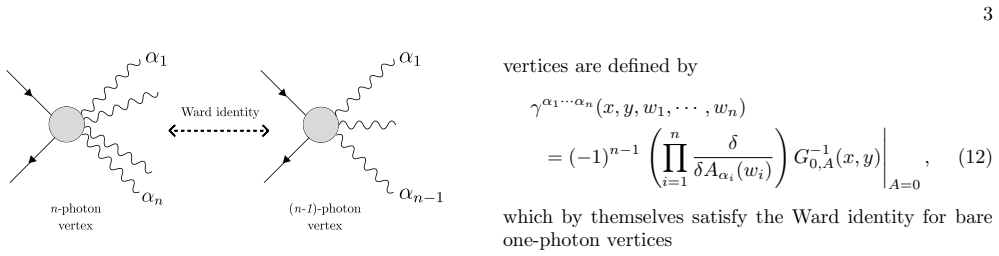
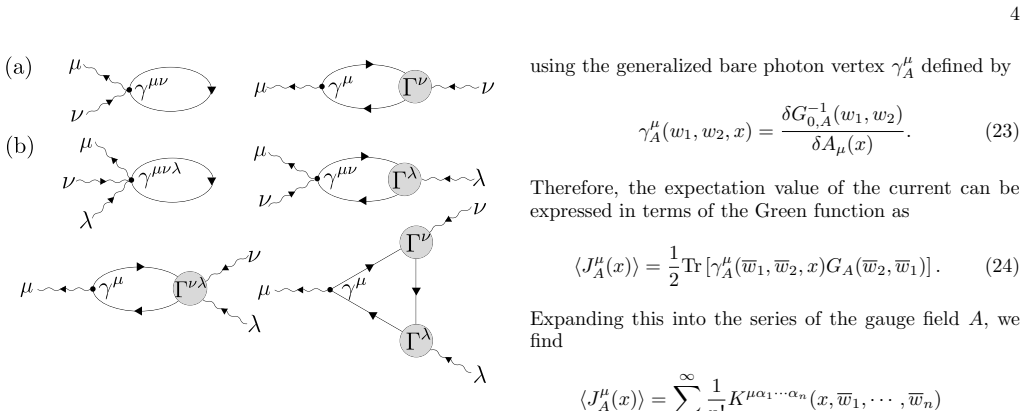
The central object is the full $n$-photon vertex $\Gamma^{\alpha_1\cdots\alpha_n}$, defined as the $(n-1)$-th functional derivative of the inverse Green function with respect to the gauge field. The Ward identity relates the divergence of the $n$-photon vertex to a commutator of $\tau_3$ with the $(n-1)$-photon vertex; when the response kernel is built from these full vertices, this identity forces every contraction $K^{\mu\alpha_1\cdots\alpha_n}(q_1,\ldots,q_n)(q_n)_{\alpha_n}$ to vanish. The generalized CFOP construction supplies the correction parts of the full vertices by differentiating the gap equation, so that gauge-field-induced gap fluctuations are included self-consistently. The Feynman rules enumerate all diagrams built from bare vertices, full vertices, and Green functions, giving a systematic recipe for arbitrary order.
What would settle it
Compute the contraction $K^{\mu\alpha_1\cdots\alpha_n}(q_1,\ldots,q_n)(q_n)_{\alpha_n}$ for a third-order kernel built from the generalized CFOP vertices in a tight-binding superconductor; any nonzero result falsifies the construction. Experimentally, in a two-band superconductor the framework predicts a collective-mode peak in the second-harmonic conductivity near the phase-difference mode frequency, so a frequency-resolved measurement of $\sigma_{xxx}(\omega,\omega)$ that resolves this peak would test it directly.
Extended reading notes
Core claim
The paper's central claim is that electromagnetic responses of superconductors can be computed gauge invariantly to all orders if one uses full photon vertices — functional derivatives of the inverse Green function with respect to the gauge field — rather than bare vertices, and if those full vertices are constructed so that the Ward identities hold order by order. For a mean-field superconductor whose pairing comes from a gauge-independent density-density interaction, the gap function's response to the gauge field (the fluctuation of the order parameter) is shown to satisfy the same Ward identity as the self-energy. This yields closed integral equations for the vertex corrections, and the resulting response kernel satisfies $K^{\mu\alpha_1\cdots\alpha_n}(q_1,\ldots,q_n)(q_n)_{\alpha_n}=0$. The framework reduces to the standard linear-response methods for conventional superconductors, reproduces the random-phase-approximation effective interaction at linear order in multiband models, and gives new results for nonlinear responses and for finite-momentum d-wave pairing, where the full vertices are not locked to the d-wave form factor.
Load-bearing premise
The load-bearing premise is that the electron-electron interaction in the microscopic Hamiltonian is completely independent of the gauge field; if interactions such as pair hopping couple directly to the vector potential, the Ward identity for the self-energy no longer holds and the construction does not guarantee gauge invariance.
Editorial extensions
If this is right
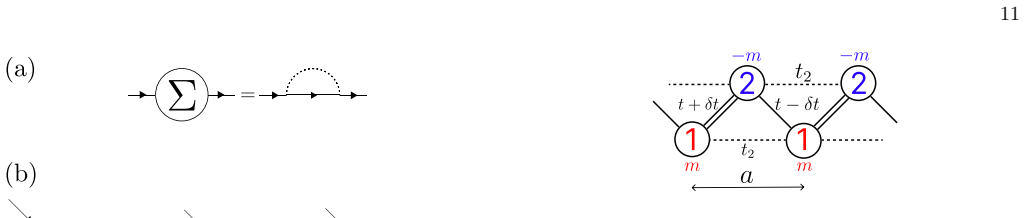
- Linear optical conductivity of multiband superconductors acquires a collective-mode peak at the phase-difference mode frequency only when the gauge-invariant vertex corrections are included.
- In a two-band model with broken inversion symmetry, vertex corrections strongly suppress the low-energy linear and second-order optical conductivities, and can change the sign of second-harmonic and photocurrent responses.
- For a d-wave superconductor carrying a supercurrent, the full photon vertices are not constrained to the d-wave form factor; at larger center-of-mass momentum this produces an additional optical resonance that the earlier ladder-vertex treatment misses.
- The same framework applies to spin-triplet and finite-momentum Cooper pairing, so nonlinear shift-current and photocurrent responses in unconventional superconductors can be computed gauge invariantly.
- At linear order the generalized CFOP equations reduce to the random-phase-approximation effective interaction, recovering previous linear-response results as a special case.
Reading between the lines
- A natural stress test is to compute third- or fourth-order kernels in a lattice model and verify the contraction identity numerically to machine precision; the paper's proof is algebraic, so a numerical check would confirm that no subtlety was missed in solving the integral equations.
- Because the framework is built entirely from Ward identities, it should automatically enforce nonlinear conductivity sum rules across different orders; deriving those sum rules explicitly could give experimental signatures simpler to measure than full frequency-resolved spectra.
- Materials with interactions that couple directly to the gauge field, such as pair-hopping or current-current interactions, lie outside this construction; a parallel formulation would need a generalized Ward identity that includes the interaction's gauge dependence.
- The d-wave finite-momentum example suggests that supercurrent flow can mix pairing symmetries and thereby activate collective-mode resonances at unexpected frequencies; ultrafast terahertz experiments on biased superconducting wires could look for such peaks.
Editorial analysis
A structured set of objections, weighed in public.
Referee Report
Summary. This paper develops a theoretical framework for computing gauge-invariant electromagnetic response kernels in superconductors at arbitrary orders in an external field. The authors derive Ward identities for n-photon vertices, define linear and nonlinear response kernels from bare and full photon vertices, and show that the transversality condition K^{mu alpha_1...alpha_n}(q_1,...,q_n)(q_n)_{alpha_n}=0 follows when the vertices satisfy the Ward identity. The main new contribution is a 'generalized CFOP' method that constructs full photon vertices from functional derivatives of the mean-field self-energy determined by the gap equation. The method is applied to a multiband Rice-Mele model and a finite-momentum d-wave model, with numerical results for linear and second-order optical responses including vertex corrections.
Significance. If the central claims are established, this framework would be a substantial advance: it extends the linear-response CFOP formalism to arbitrary order and to unconventional and finite-momentum superconductors, and it provides explicit Feynman rules for constructing gauge-invariant response kernels. The paper includes a careful derivation of the Ward identities in Appendix A, an explicit lattice Ward identity check in Sec. IV.B.1, and extensive numerical comparisons with previous approaches. However, the central claim rests on the self-energy Ward identity in Sec. III.B, whose proof is circular as detailed in the major comments; the optical calculations at q=0 do not provide independent evidence for the transversality condition. The overall approach is plausible and likely repairable, but the current manuscript does not yet fully establish its main theorem.
major comments (3)
- [Sec. III.B, Eq. (62)] The proof of the self-energy Ward identity (60) is circular. In the displayed derivation, the second equality substitutes the exact Ward identity (7) for delta G_A^{-1}/delta A_mu, but Eq. (7) was derived in Appendix A for the exact Green function of the locally U(1)-invariant microscopic action. The mean-field Green function G_A is defined by the Dyson equation with the self-energy (58), so the Ward identity for this approximate G_A is precisely the property that needs to be proven. Using (7) as an input therefore assumes the conclusion. The claim in Sec. IV.B.1 that the lattice version of Eq. (62) proves the lattice Ward identities inherits the same problem. A non-circular proof should derive Eq. (60) from the CFOP vertex equation (113) together with the bare Ward identity (13), or invoke Phi-derivability in the sense of Baym-Kadanoff; neither appears in the paper.
- [Sec. II.C / Sec. IV] The numerical optical-response calculations do not test the central transversality condition (39). In Eq. (46), the optical conductivity is defined with all photon momenta set to zero, q_i=0, for which the contraction K^{...}(q_1,...,q_n)(q_n)_{alpha_n}=0 reduces to 0=0. Therefore Figs. 6-10 cannot be cited as evidence that the constructed full photon vertices satisfy the Ward identity or that the response kernels are gauge invariant. Finite-momentum checks, even at small nonzero q, would be needed to validate Eq. (39) numerically.
- [Appendix B, Eq. (B2)] The proof that the Fock approximation is compatible with the Ward identities is subject to the same circularity as Eq. (62). The substitution of delta G_A^{-1}/delta A by the exact Ward identity (7) in the second line of Eq. (B2) assumes the approximate G_A satisfies the identity that is being established. Consequently, the statement in Sec. IV.A that the Bethe-Salpeter construction yields gauge-invariant responses is not proven by the argument given.
minor comments (3)
- [Sec. IV.B.3] The text refers to results in 'Fig. 6(d) and Fig. 6(e)', but Fig. 6 contains only panels (a)-(d); the missing panel should be added or the text corrected.
- [Eq. (64)] The notation gamma^{alpha_1...alpha_n}(k) for the bare vertices leaves the photon momenta q_1,...,q_n implicit; specifying them explicitly would avoid ambiguity when comparing with Eq. (36) and the Feynman rules in Table I.
- [Sec. II.B, Eq. (34)] The Fourier convention for the delta function delta(q - sum_i q_i) is not stated; a brief comment on the (2pi)^4 factors used in the momentum-space integrals would improve reproducibility.
Circularity Check
Mean-field Ward-identity proof is circular: Eq. (62) assumes the exact Ward identity (7) for the approximate BdG Green function, which is the statement to be proven.
-
self definitional
[Sec. III.B, Eq. (62)]
"We can prove that this relation is compatible with the adopted approximations as follows, using the definition of the gap function in Eq. (59): [Eq. (62)] ∂zμ δ[ΔA(x,y)]αβ / δAμ(z) = ... Tr[Pγδ GA(x,x') δG^{-1}_A(x',y')/δAμ(z) GA(y',y)] = ... Tr[Pγδ GA(x,x'){iδ(x'−z)τ3G^{-1}_A(x',y') − iG^{-1}_A(x',y')τ3δ(y'−z)}GA(y',y)] = i[ΔA(x,y)]αβδ(y−z)+i[ΔA(x,y)]αβδ(x−z)."
The displayed proof of the self-energy Ward identity (60) differentiates the mean-field gap equation and then replaces ∂z δG_A^{-1}/δA with the exact Ward identity expression iδτ3G_A^{-1} − iG_A^{-1}τ3δ, which is Eq. (7). But Eq. (7) was derived in Appendix A for the exact Green function G_A of the locally U(1)-invariant microscopic action. In the mean-field approximation, G_A is the BdG propagator (Eq. 63), not the exact propagator; for this approximate G_A, Eq. (7) is not an established identity. Indeed, via the Dyson equation (15) and the bare Ward identity, Eq. (7) for G_A is algebraically equivalent to the very self-energy Ward identity (60) the section claims to verify. Thus Eq. (62) inserts the desired conclusion as an assumption. If instead G_A in Eq.
full rationale
The general gauge-invariance framework in Sec. II is non-circular: the response kernel is constructed from functional derivatives of G_A^{-1}, the Ward identities (13), (14), and (42) hold by construction for bare and full vertices defined from the exact Green function, and the transversality condition (39) is proved by direct contraction in Eqs. (40) and (43). No parameter is fitted to the predicted responses; numerical parameters are chosen to reproduce the external benchmarks [53] and [47]. No load-bearing self-citation was found: the reference to the authors' prior work [48] merely provides context, and the equivalence to RPA is explicitly acknowledged. The central circularity is confined to Sec. III.B: the paper's only verification that the mean-field self-energy satisfies the required Ward identity is Eq. (62), which substitutes the exact Ward identity (7) for the approximate BdG Green function. Since (7) for that approximate G_A is equivalent to the target identity (60) under Dyson's equation, the proof assumes what it needs to show. This step is load-bearing because the gauge invariance of all subsequent generalized-CFOP response kernels, including the numerical examples, rests on condition (60). The q→0 optical conductivity calculations do not provide a nontrivial test of Eq. (39), because the contraction with q_n vanishes trivially in that limit, but that is a limitation rather than an independent circularity. Overall, the paper contains substantial independent diagrammatic and numerical content, but one key consistency proof reduces to its own input, giving partial circularity.
Assumptions & free parameters
free parameters (3)
- Coupling constants g1, g2 in two-band model (Sec. IV B) =
g1 = g2 ≈ 0.990
- Coupling constant g in d-wave model (Sec. IV C) =
g ≈ 1.8 × 10^2
- Model parameters (t, μ, δt, m, t2, Δ1, Δ2, η, a, Qx, θ) =
varies by figure
assumptions (5)
- domain assumption The microscopic action is invariant under local U(1) gauge transformations (Eq. 4).
- domain assumption The interaction term in the action does not depend on the gauge field (Eq. 18).
- domain assumption The electron-electron interaction has the form of Eq. (47) with the antisymmetry V^{βαδγ}(y-x)=V^{αβγδ}(x-y).
- domain assumption The mean-field approximation in the Cooper channel is valid; the self-energy is off-diagonal in Nambu space and given by the gap function (Eqs. 58, 59).
- domain assumption For lattice models, the Ward identity remains valid with spatial derivatives replaced by lattice difference operators (Sec. IV B).
Cite this review
Pith. "Pith review of Gauge-invariant electromagnetic responses in superconductors." pith.science (2026). https://pith.science/paper/TULB3DGC
@misc{pith2026250113722,
  author       = {Pith},
  title        = {Pith review of: Gauge-invariant electromagnetic responses in superconductors},
  year         = {2026},
  howpublished = {\url{https://pith.science/paper/TULB3DGC}},
  note         = {Machine review of arXiv:2501.13722}
}
abstract
Gauge invariance is essential for making physically meaningful predictions. In superconductors, mean-field Hamiltonians that explicitly break $U(1)$ symmetry often yield gauge-dependent results. While this issue has been resolved for linear responses in conventional superconductors, a unified framework that also covers unconventional superconductors and nonlinear responses has yet to be established. In this study, we present a comprehensive theoretical framework that enables gauge-invariant calculations of electromagnetic responses at arbitrary orders in external fields, applicable to both conventional and unconventional superconductors. Our construction generalizes the consistent-fluctuation-of-the-order-parameter (CFOP) approach to full photon vertices and admits a diagrammatic representation of the response kernel in terms of Feynman diagrams.
Figures
Figures from the paper (8 more)


Reference graph
Works this paper leans on
-
[1]
Model Let us consider a chain with the sublattice degrees of freedom l = 1 , 2 as well as the spin degrees of freedom s = ↑, ↓. We use the Rice-Mele model [56] with the next- nearest-neighbor hopping t2 as the Hamiltonian in nor- mal state [Fig.4]: ˆHN = X x,s 1 2 (t + δt)ˆc† x,1sˆcx,2s + 1 2 (t − δt)ˆc† x,2sˆcx+1,1s + t2 2 ˆc† x,1sˆcx+1,1s + t2 2 ˆc† x,2...
-
[2]
Calculations of the full photon vertices based on the CFOP method Let us introduce the gauge field and consider the electromagnetic responses. Substituting Eq. (99) into Eq. (90), the gap function is given by [∆A(x, y)]ll′ = δll′∆l,A(x, y), (108) ∆l,A(x, y) = −Vl(x − y)Tr PllGA(x, y) , (109) where Vl(x − y) = glδ(x − y)δ(x0 − y0 − 0−). Let us sepa- rate t...
-
[3]
Collective mode excitations First, let us see responses of collective mode. In multi- band superconductors, there can occur a collective exci- tation known as the Leggett mode, corresponding to the fluctuations of the phase difference between the two or- der parameters [57]. Here, we calculate the linear and second-order optical responses based on the gen...
-
[4]
The suppression of the nonlinear optical conductivity Next, we consider the situation discussed in Ref. [7], which analyzed systems with spatial inversion symmetry in the normal conducting phase, where this symmetry is broken by the superconducting gap, leading to finite lin- ear and second-order optical responses. However, their analysis neglected many-b...
-
[5]
As an example, let us consider spin-singlet d-wave superconductors on a square lattice
Model Our formulation can be applied to the anisotropic pair- ing. As an example, let us consider spin-singlet d-wave superconductors on a square lattice. The normal-state Hamiltonian is defined by ˆHN = X ks ˆc† ksϵ(k)ˆcks (124) where ϵ(k) = t(2 − cos kx − cos ky) − µ. The microscopic interaction in real space is given by V s1s2s3s4 (x − y) = 1 2 V (x − ...
-
[6]
The microscopic interaction in Eq
The full photon vertices Now, let us calculate the full vertices based on the gen- eralized CFOP method. The microscopic interaction in Eq. (125) leads to the the self-energy of superconduc- tors [Eqs. (89) and (90)]: ΣA(x, y) = ∆A(x, y) ∆† A(x, y) ! , (132) ∆A(x, y) = −V (x − y)Tr P GA(x, y) , (133) where V (x−y) = V (x−y)δ(x0 −y0 −0−). If we separate th...
-
[7]
Numerical calculations We perform numerical calculations to investigate how the results obtained using the generalized CFOP method differ from those of a previous study [47]. To this end, we introduce a finite center-of-mass momentum of Cooper pairs along the x-direction, Q = Qxex, and set the pa- rameters as t = 1.0 × 10², µ = 9.0 × 101, ∆d = 2.3 × 101, ...
-
[8]
J. R. J. R. Schrieffer, Theory of superconductivity, rev. printing ed., Advanced book classics (Perseus Books, 1999)
work page 1999
Show all 66 references
-
[9]
Bardeen, L
J. Bardeen, L. N. Cooper, and J. R. Schrieffer, Theory of superconductivity, Phys. Rev. 108, 1175 (1957)
1957
-
[10]
J. E. Sipe and A. I. Shkrebtii, Second-order optical re- sponse in semiconductors, Phys. Rev. B 61, 5337 (2000)
2000
-
[11]
Morimoto and N
T. Morimoto and N. Nagaosa, Topological nature of nonlinear optical effects in solids, Science Advances 2, e1501524 (2016)
2016
-
[12]
Orenstein, J
J. Orenstein, J. Moore, T. Morimoto, D. Torchinsky, J. Harter, and D. Hsieh, Topology and symmetry of quan- tum materials via nonlinear optical responses, Annual Review of Condensed Matter Physics 12, 247 (2021)
2021
-
[13]
Wakatsuki and N
R. Wakatsuki and N. Nagaosa, Nonreciprocal current in noncentrosymmetric rashba superconductors, Phys. Rev. Lett. 121, 026601 (2018)
2018
-
[14]
T. Xu, T. Morimoto, and J. E. Moore, Nonlinear optical effects in inversion-symmetry-breaking superconductors, Phys. Rev. B 100, 220501 (2019)
2019
-
[15]
Daido, Y
A. Daido, Y. Ikeda, and Y. Yanase, Intrinsic supercon- ducting diode effect, Phys. Rev. Lett.128, 037001 (2022)
2022
-
[16]
N. F. Q. Yuan and L. Fu, Supercurrent diode effect and finite-momentum superconductors, Proceedings of the National Academy of Sciences 119, e2119548119 (2022)
2022
-
[17]
Watanabe, A
H. Watanabe, A. Daido, and Y. Yanase, Nonrecipro- cal optical response in parity-breaking superconductors, Phys. Rev. B 105, 024308 (2022)
2022
-
[18]
Tanaka, H
H. Tanaka, H. Watanabe, and Y. Yanase, Nonlinear op- tical responses in noncentrosymmetric superconductors, Phys. Rev. B 107, 024513 (2023)
2023
-
[19]
Tanaka, H
H. Tanaka, H. Watanabe, and Y. Yanase, Nonlinear opti- cal response in superconductors in magnetic field: Quan- tum geometry and topological superconductivity, Phys. Rev. B 110, 014520 (2024)
2024
-
[20]
M. J. Buckingham, A note on the energy gap model of superconductivity, Il Nuovo Cimento (1955-1965)5, 1763 (1957)
1957
-
[21]
M. R. Schafroth, Remarks on the meissner effect, Phys. Rev. 111, 72 (1958)
1958
-
[22]
Rickayzen, Meissner effect and gauge invariance, Phys
G. Rickayzen, Meissner effect and gauge invariance, Phys. Rev. 111, 817 (1958)
1958
-
[23]
Wentzel, Meissner effect, Phys
G. Wentzel, Meissner effect, Phys. Rev.111, 1488 (1958)
1958
-
[24]
Pines and J
D. Pines and J. R. Schrieffer, Gauge invariance in the the- ory of superconductivity, Il Nuovo Cimento (1955-1965) 10, 496 (1958)
1958
-
[25]
P. W. Anderson, Random-phase approximation in the theory of superconductivity, Phys. Rev.112, 1900 (1958)
1958
-
[26]
N. N. Bogoliubov, V. V. Tolmachev, and D. V. Shirkov,A new method in the theory of superconductivity(Academy of Sciences of USSR Press, Moskow, 1958)
1958
-
[27]
Yosida, Collective excitations in superconductors, Progress of Theoretical Physics 21, 731 (1959)
K. Yosida, Collective excitations in superconductors, Progress of Theoretical Physics 21, 731 (1959)
1959
-
[28]
Rickayzen, Collective excitations and the meissner ef- fect, Phys
G. Rickayzen, Collective excitations and the meissner ef- fect, Phys. Rev. Lett. 2, 90 (1959)
1959
-
[29]
Rickayzen, Collective excitations in the theory of su- perconductivity, Phys
G. Rickayzen, Collective excitations in the theory of su- perconductivity, Phys. Rev. 115, 795 (1959)
1959
-
[30]
Nambu, Quasi-particles and gauge invariance in the theory of superconductivity, Phys
Y. Nambu, Quasi-particles and gauge invariance in the theory of superconductivity, Phys. Rev. 117, 648 (1960)
1960
-
[31]
P. C. Martin and J. Schwinger, Theory of many-particle systems. i, Phys. Rev. 115, 1342 (1959)
1959
-
[32]
L. P. Kadanoff and P. C. Martin, Theory of many- particle systems. ii. superconductivity, Phys. Rev. 124, 670 (1961)
1961
-
[33]
Baym and L
G. Baym and L. P. Kadanoff, Conservation laws and cor- relation functions, Phys. Rev. 124, 287 (1961)
1961
-
[34]
Baym, Self-consistent approximations in many-body systems, Phys
G. Baym, Self-consistent approximations in many-body systems, Phys. Rev. 127, 1391 (1962)
1962
-
[35]
Ambegaokar and L
V. Ambegaokar and L. P. Kadanoff, Electromagnetic properties of superconductors, Il Nuovo Cimento (1955-
1955
-
[36]
I. O. Kulik, O. Entin-Wohlman, and R. Orbach, Pair susceptibility and mode propagation in superconductors: A microscopic approach, Journal of Low Temperature Physics 43, 591 (1981)
1981
-
[37]
Y. Zha, K. Levin, and D. Z. Liu, Collective modes and implications for c-axis optical experiments in layered cuprates, Phys. Rev. B 51, 6602 (1995)
1995
-
[38]
Guo, C.-C
H. Guo, C.-C. Chien, and Y. He, Theories of linear re- sponse in bcs superfluids and how they meet fundamental constraints, Journal of Low Temperature Physics 172, 5 (2013)
2013
-
[39]
R. M. Lutchyn, P. Nagornykh, and V. M. Yakovenko, Gauge-invariant electromagnetic response of a chiralpx + ipy superconductor, Phys. Rev. B 77, 144516 (2008)
2008
-
[40]
B. M. Anderson, R. Boyack, C.-T. Wu, and K. Levin, Go- ing beyond the bcs level in the superfluid path integral: A consistent treatment of electrodynamics and thermo- dynamics, Phys. Rev. B 93, 180504 (2016)
2016
-
[41]
Boyack, B
R. Boyack, B. M. Anderson, C.-T. Wu, and K. Levin, Gauge-invariant theories of linear response for strongly correlated superconductors, Phys. Rev. B 94, 094508 (2016)
2016
-
[42]
Dai and P
Z. Dai and P. A. Lee, Optical conductivity from pair density waves, Phys. Rev. B 95, 014506 (2017)
2017
-
[43]
Boyack, Restoring gauge invariance in conventional fluctuation corrections to a superconductor, Phys
R. Boyack, Restoring gauge invariance in conventional fluctuation corrections to a superconductor, Phys. Rev. B 98, 184504 (2018)
2018
-
[44]
Papaj and J
M. Papaj and J. E. Moore, Current-enabled optical con- ductivity of superconductors, Phys. Rev. B 106, L220504 (2022)
2022
-
[45]
Oh and H
C.-g. Oh and H. Watanabe, Revisiting electromagnetic response of superconductors in mean-field approxima- tion, Phys. Rev. Res. 6, 013058 (2024)
2024
-
[46]
K. Wang, R. Boyack, and K. Levin, Higgs amplitude mode in optical conductivity in the presence of a su- percurrent: Gauge-invariant formulation with disorder, Physical Review B 111, 10.1103/physrevb.111.144512 (2025)
2025 doi
-
[47]
Yu and M
T. Yu and M. W. Wu, Gauge-invariant theory of quasi- particle and condensate dynamics in response to tera- hertz optical pulses in superconducting semiconductor quantum wells. i. s-wave superconductivity in the weak spin-orbit coupling limit, Phys. Rev. B96, 155311 (2017)
2017
-
[48]
Yu and M
T. Yu and M. W. Wu, Gauge-invariant theory of quasi- particle and condensate dynamics in response to tera- hertz optical pulses in superconducting semiconductor quantum wells. ii. ( s + p)-wave superconductivity in the strong spin-orbit coupling limit, Phys. Rev. B 96, 155312 (2017)
2017
-
[49]
Yang and M
F. Yang and M. W. Wu, Gauge-invariant microscopic ki- netic theory of superconductivity in response to electro- 19 magnetic fields, Phys. Rev. B 98, 094507 (2018)
2018
-
[50]
Yang and M
F. Yang and M. W. Wu, Gauge-invariant microscopic kinetic theory of superconductivity: Application to the optical response of nambu-goldstone and higgs modes, Phys. Rev. B 100, 104513 (2019)
2019
-
[51]
Yang and M
F. Yang and M. W. Wu, Theory of higgs modes in d-wave superconductors, Phys. Rev. B 102, 014511 (2020)
2020
-
[52]
Yang and M
F. Yang and M. W. Wu, Influence of scattering on the optical response of superconductors, Phys. Rev. B 102, 144508 (2020)
2020
-
[53]
Tanaka and Y
H. Tanaka and Y. Yanase, Vertex correction for the linear and nonlinear optical responses in superconduc- tors: multiband effect and topological superconductivity (2025), arXiv:2502.15373 [cond-mat.supr-con]
2025
-
[54]
Huang and J
L. Huang and J. Wang, Second-order optical response of superconductors induced by supercurrent injection, Phys. Rev. B 108, 224516 (2023)
2023
-
[55]
Watanabe and H
S. Watanabe and H. Watanabe, A gauge-invariant for- mulation of optical responses in superconductors (2024), arXiv:2410.18679 [cond-mat.supr-con]
2024 arXiv
-
[56]
J. C. Ward, An identity in quantum electrodynamics, Phys. Rev. 78, 182 (1950)
1950
-
[57]
Takahashi, On the generalized ward identity, Il Nuovo Cimento (1955-1965) 6, 371 (1957)
Y. Takahashi, On the generalized ward identity, Il Nuovo Cimento (1955-1965) 6, 371 (1957)
1957
-
[58]
Rostami, M
H. Rostami, M. I. Katsnelson, G. Vignale, and M. Polini, Gauge invariance and ward identities in nonlinear re- sponse theory, Annals of Physics 431, 168523 (2021)
2021
-
[59]
D. E. Parker, T. Morimoto, J. Orenstein, and J. E. Moore, Diagrammatic approach to nonlinear optical re- sponse with application to weyl semimetals, Phys. Rev. B 99, 045121 (2019)
2019
-
[60]
Kamatani, S
T. Kamatani, S. Kitamura, N. Tsuji, R. Shimano, and T. Morimoto, Optical response of the leggett mode in multiband superconductors in the linear response regime, Phys. Rev. B 105, 094520 (2022)
2022
-
[61]
Nagashima, S
R. Nagashima, S. Tian, R. Haenel, N. Tsuji, and D. Manske, Classification of lifshitz invariant in multi- band superconductors: An application to leggett modes in the linear response regime in kagome lattice models, Phys. Rev. Res. 6, 013120 (2024)
2024
-
[62]
Nagashima, T
R. Nagashima, T. Mouilleron, and N. Tsuji, Optically ac- tive higgs and leggett modes in multiband pair-density- wave superconductors with lifshitz invariant (2024), arXiv:2410.18438 [cond-mat.supr-con]
2024 arXiv
-
[63]
M. J. Rice and E. J. Mele, Elementary excitations of a linearly conjugated diatomic polymer, Phys. Rev. Lett. 49, 1455 (1982)
1982
-
[64]
A. J. Leggett, Number-Phase Fluctuations in Two-Band Superconductors, Progress of Theoretical Physics 36, 901 (1966)
1966
-
[65]
Paramekanti, M
A. Paramekanti, M. Randeria, T. V. Ramakrishnan, and S. S. Mandal, Effective actions and phase fluctuations in d-wave superconductors, Phys. Rev. B 62, 6786 (2000)
2000
-
[66]
Ahn and N
J. Ahn and N. Nagaosa, Theory of optical responses in clean multi-band superconductors, Nature Communica- tions 12, 1617 (2021). 20 Appendix A: The detailed derivation of the W ard identities In this appendix, we present the detailed derivation of the Ward identities. Given a ...
2021
Reviewed August 10, 2026 · model on record in the stance chip above.
Discussion (0). Continue with ORCID to comment.