REVIEW 3 major objections 5 minor 34 references
UniTraffic-Agent: Unified Traffic Video Reasoning for AI City Challenge 2026 Track 3 with Two Out-of-Domain Evaluations
T0 review · 3 major / 5 minor · reviewed 2026-08-15 · deepseek-v4-flash
Pith's one-line read A single multimodal agent, combining timestamped frame sampling with clip-level joint reasoning, ranks near the top on two traffic-video benchmarks it was not fine-tuned for (FETV 2nd, PSI-VQA 4th) and 16th on the main anomaly-reasoning…
desk verdict A clean, well-documented challenge system with competitive leaderboard results, but the out-of-domain generalization claim is unsupported because the closed API model may have memorized the public test sets. read the letter →
The pith
A machine-rendered reading of the paper's core claim, the machinery that carries it, and where it could break.
The reading
What carries the argument
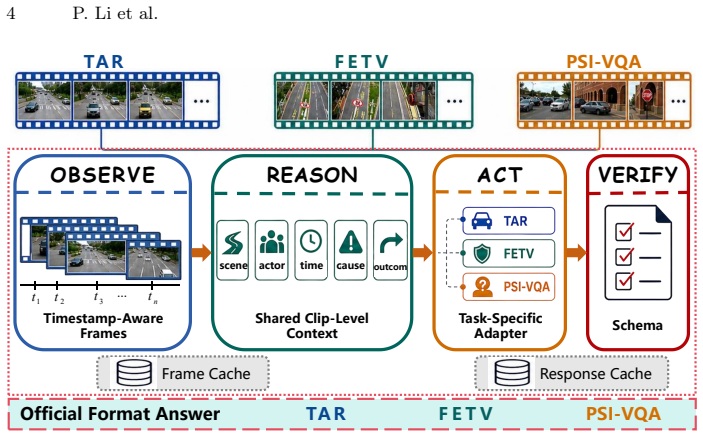
The central mechanism is the observe-reason-act-verify loop, and its load-bearing piece is timestamp-aware observation. The sampler keeps endpoints, a duration-adaptive grid, and a +/-1 second neighborhood around any question-provided timestamp, pairing every frame with its time so the model can relate visual evidence to temporal intervals. Clip-level joint reasoning then grounds all outputs in one event context, reducing contradictions in actor identity and causal explanation. The task-specific adapters (TAR answer formatting, FETV 13-field violation record, PSI-VQA cue/intent/temporal outputs) and validation step close the loop by making raw model output conform to benchmark schemas.
What would settle it
Rerun the identical pipeline with an open-weights multimodal model on the same FETV and PSI-VQA inputs, using the same prompts, frame sets, and adapters; if its scores fall near chance while gpt-5.5 stays near its leaderboard values, the claimed transfer is largely base-model exposure rather than the timestamp-aware agent architecture.
Extended reading notes
Core claim
On its own terms, the paper's central claim is that an observe-reason-act-verify workflow built on a hosted multimodal LLM transfers across CCTV, fisheye, and dashcam traffic video without task-specific model training. During observation, the agent composes a compact timestamped frame set from global coverage and local windows around question anchors; during reasoning, it answers all questions for a clip jointly to build one consistent event interpretation; during action and verification, task-specific adapters and a validator turn that interpretation into official submissions. The evidence is the official public leaderboard: 2nd on FETV with 0.4884, 4th on PSI-VQA with 64.4161, and 16th on TAR with 0.5780. The paper interprets these ranks as showing effective out-of-domain transfer.
Load-bearing premise
The entire out-of-domain story depends on FETV and PSI-VQA clips not having been meaningfully present in gpt-5.5's pretraining, which the paper cannot check because the model is closed.
Editorial extensions
If this is right
- A single MLLM agent can cover heterogeneous traffic video domains (CCTV, fisheye, dashcam) with no per-task fine-tuning, so deployment reduces to prompt/adapter engineering and frame selection.
- Sparse-event understanding improves when frames near question-specified timestamps are included explicitly, since critical evidence may occupy only a few seconds.
- Answering all questions for a clip in one request enforces consistency across outputs that describe the same event, reducing contradictory actor or cause statements.
- Where this agent falls short, namely reference-aligned long-form descriptions, fisheye intersection geometry, pedestrian intent, and temporal boundaries, marks the next targets for traffic-video reasoning.
Reading between the lines
- The one-request-per-clip design is a general recipe for multi-question video benchmarks beyond traffic; testing it on other sparse-event QA sets would show whether joint reasoning is the active ingredient.
- Removing the local +/-1-second windows around question timestamps would isolate how much of the FETV and PSI-VQA scores comes from temporal anchoring versus global frame coverage.
- The shared-event-context idea could extend to structured output tasks outside video, such as industrial or medical inspection clips, where multiple questions target a single scene.
Signed reviews
Editorial analysis
A structured set of objections, weighed in public.
Referee Report
Summary. The paper describes UniTraffic-Agent, a gpt-5.5-based agent for Track 3 of the 10th AI City Challenge. The system follows an observe–reason–act–verify workflow: it samples timestamp-aware frames per clip, performs joint clip-level reasoning over all questions, maps the shared interpretation through task-specific adapters for TAR, FETV, and PSI-VQA, and verifies identifiers and formats before submission. On the official Public leaderboards, MR-CAS ranks 16th on TAR (0.5780), 2nd on FETV (0.4884), and 4th on PSI-VQA (64.4161). The authors interpret the FETV and PSI-VQA results as evidence of strong out-of-domain generalization, since the system is used without task-specific fine-tuning.
Significance. If the headline claim is accepted, the paper demonstrates that a single closed-source MLLM agent with modest engineering can reach near-top scores on three heterogeneous traffic-video benchmarks, including a 0.0007 gap to first place on FETV and a top-5 rank on PSI-VQA. The paper has several strengths: the system description is unusually detailed, the task-specific adapters are specified concretely, the evaluation uses official leaderboard metrics and formulas, and the inference procedure is deterministic (temperature 0 with caching and retries) with a public code link. The main significance hinges on the 'out-of-domain' interpretation, however, and that interpretation is undermined by the absence of any contamination check for the closed gpt-5.5 backbone.
major comments (3)
- [§4.4 'Cross-Domain Analysis' and §4.3 Implementation Details] The central claim that FETV and PSI-VQA demonstrate 'strong out-of-domain generalization' is not supported as stated. FETV [1] and PSI-VQA [15] are public datasets, and gpt-5.5 is a closed model with an undisclosed pretraining corpus; the paper provides no contamination check (e.g., frame-level deduplication against pretraining data, canary probes, or evaluation on a private held-out subset). Section 4.3's compliance statement addresses test-set annotation but does not address pretraining overlap. Please either supply such an analysis or rephrase the claim to 'competitive performance on two additional Track 3 tasks' rather than 'out-of-domain generalization.'
- [§3 and Tables 1–4] The component-level contributions—timestamp-aware observation, clip-level joint reasoning, task-specific adapters, and verification—are described but never ablated. With no variant comparisons (e.g., global-only frames, per-question inference, no verifier, or a non-agent baseline), the leaderboard results cannot be attributed to the proposed workflow. Since the paper's framing presents these components as contributions, add at least a small ablation on the official validation/test splits, or explicitly restrict the paper's scope to a system description without component-level claims.
- [§4.2 and Tables 1–4] All results are single official Public submissions with no repeated-run statistics. Comparisons near the top, especially the FETV gap of 0.0007 and small component differences in Tables 3 and 4, are reported without any measure of variance. Temperature 0 reduces but does not eliminate nondeterminism in a hosted API, and the official leaderboard may report only one submission. Please report variance across repeated runs if available, or state clearly that the scores are single submissions with no error bars.
minor comments (5)
- [Abstract and §5] The abstract promises code at a GitHub URL, but the full text does not repeat the URL or provide a versioned release, commit hash, or access date; add this information for reproducibility.
- [§4.3] The sentence 'Public training annotations are used only to construct answer-format examples' is ambiguous about whether this includes the FETV and PSI-VQA training splits in addition to TAR's auxiliary training data; please clarify.
- [§3.1] The frame-selection priority rule is described verbally; a short algorithm block or pseudo-code would make the sampling strategy fully reproducible.
- [Table 2] The rows 'BCQ-OE' and 'MCQ-OE' are not defined in §4.2; please define these open-ended variants explicitly.
- [Throughout] There are minor LaTeX artifacts (e.g., 'T able' before Section 4.2) and the text is tightly compressed; a light copyedit would improve readability.
Circularity Check
No circularity: the paper's claims are external leaderboard results, not derived from fitted parameters or self-justified by construction.
full rationale
UniTraffic-Agent is an empirical challenge report: its central evidence is the official Public leaderboard ranks for TAR, FETV, and PSI-VQA, which are generated by an external evaluation system and are not computed from any quantity the paper fits. The only task-specific components are the action adapters, which map model output into the benchmark submission schemas; the paper explicitly states public training annotations are used only to construct answer-format examples, not to fit test predictions. The frame-sampling strategy, prompt, and GPT-5.5 API calls are described procedurally, and no equation in the paper equals its own output by construction. The evaluation formulas (Eqs. 1-3) are metric definitions from the challenge protocol and are not used to derive a prediction from an input. The self-citations in the related-work section are background references and are not load-bearing for any derivation. The 'out-of-domain' framing of FETV and PSI-VQA is a data-domain assumption that is asserted rather than validated by a distribution-shift measurement, but that is a correctness/evidence concern about possible pretraining contamination, not a circularity: the paper does not define transfer in terms of its own outputs or reduce a prediction to an input. Accordingly, no circular step can be quoted and exhibited, and the honest finding is no significant circularity.
Assumptions & free parameters
free parameters (5)
- Frame budget M =
32
- Global frame count G =
16
- Timestamp neighborhood =
±1 second
- Image encoding settings =
JPEG quality 100, max side 768 px
- Inference temperature =
0
assumptions (4)
- domain assumption gpt-5.5 provides sufficient multimodal reasoning for traffic video understanding.
- domain assumption The official leaderboard evaluation is an accurate measure of system capability.
- domain assumption FETV and PSI-VQA are genuinely out-of-domain for the system.
- domain assumption The system complied with challenge rules (no test-set annotations, no private data).
Cite this review
Pith. "Pith review of UniTraffic-Agent: Unified Traffic Video Reasoning for AI City Challenge 2026 Track 3 with Two Out-of-Domain Evaluations." pith.science (2026). https://pith.science/paper/TWWANWJB
@misc{pith2026260813031,
  author       = {Pith},
  title        = {Pith review of: UniTraffic-Agent: Unified Traffic Video Reasoning for AI City Challenge 2026 Track 3 with Two Out-of-Domain Evaluations},
  year         = {2026},
  howpublished = {\url{https://pith.science/paper/TWWANWJB}},
  note         = {Machine review of arXiv:2608.13031}
}
read the original abstract
Traffic video understanding has become an important problem in intelligent transportation, as road videos provide direct evidence for accidents, violations, and interactions between vehicles and vulnerable road users. A useful system should explain how a traffic event develops, why it happens, and when the relevant interaction occurs, yet this remains difficult for multimodal large language models (MLLMs) because traffic videos contain sparse events and varied viewpoints. We introduce UniTraffic-Agent, the MR-CAS solution for Track~3 of the 10th AI City Challenge, which includes Traffic Anomaly Reasoning (TAR) and two out-of-domain evaluations: FETV for fisheye traffic events and PSI-VQA for pedestrian intention reasoning. UniTraffic-Agent follows an observe--reason--act--verify workflow that samples timestamped visual evidence, reasons over all questions from the same clip in one request, and converts responses through task-specific action adapters. On the official Public leaderboards, MR-CAS ranks 16th on TAR with a score of 0.5780, 2nd on FETV with 0.4884, and 4th on PSI-VQA with 64.4161. The code is available at https://github.com/Roclp/UniTraffic-Agent.
Figures
Reference graph
Works this paper leans on
-
[1]
Abduljawad, A., Shaik, N.S., S S, M., Chang, M.C., Hsieh, J.W., Gochoo, M.: FETV: Fisheye traffic event and violation dataset.https://github.com/MoyoG/ FETV(2026) 2, 3, 5, 6
work page 2026
-
[15]
ISE-ICE Lab: PSI-VQA: AI City Challenge 2026 Track 3 out-of-domain pedestrian intent vqa dataset.https://huggingface.co/datasets/ise-ice-lab/PSI_VQA (2026) 2, 3, 5, 6
work page 2026
-
[2]
IEEE Transactions on Pattern Analysis and Machine Intelligence (2025) 2
Bao, S., Xu, Q., Li, F., Han, B., Yang, Z., Cao, X., Huang, Q.: Towards size- invariant salient object detection: A generic evaluation and optimization approach. IEEE Transactions on Pattern Analysis and Machine Intelligence (2025) 2
work page 2025
-
[3]
IEEE Trans- actions on Pattern Analysis and Machine Intelligence45(1), 1017–1035 (2022) 3
Bao, S., Xu, Q., Yang, Z., Cao, X., Huang, Q.: Rethinking collaborative metric learning: Toward an efficient alternative without negative sampling. IEEE Trans- actions on Pattern Analysis and Machine Intelligence45(1), 1017–1035 (2022) 3
work page 2022
-
[4]
IEEE Transactions on Pattern Analysis and Machine Intelligence46(12), 9004–9022 (2024) 2
Bao, S., Xu, Q., Yang, Z., He, Y., Cao, X., Huang, Q.: Improved diversity- promoting collaborative metric learning for recommendation. IEEE Transactions on Pattern Analysis and Machine Intelligence46(12), 9004–9022 (2024) 2
work page 2024
-
[5]
IEEE Transactions on Pattern Analysis and Machine Intelligence47(6), 4579–4596 (2025) 3
Bao, S., Xu, Q., Yang, Z., He, Y., Cao, X., Huang, Q.: Aucpro: Auc-oriented provable robustness learning. IEEE Transactions on Pattern Analysis and Machine Intelligence47(6), 4579–4596 (2025) 3
work page 2025
-
[6]
Neurocomputing 618, 129061 (2025).https://doi.org/10.1016/j.neucom.2024.1290613, 5
Chen, X., Xu, H., Ruan, M., Bian, M., Chen, Q., Huang, Y.: SO-TAD: A surveillance-oriented benchmark for traffic accident detection. Neurocomputing 618, 129061 (2025).https://doi.org/10.1016/j.neucom.2024.1290613, 5
-
[7]
In: Proceedings of the IEEE/CVF Conference on Computer Vision and Pattern Recognition Workshops
Dinh, Q.M., Ho, M.K., Dang, A.Q., Tran, H.P.: TrafficVLM: A controllable visual language model for traffic video captioning. In: Proceedings of the IEEE/CVF Conference on Computer Vision and Pattern Recognition Workshops. pp. 7134– 7143 (2024) 1, 3
work page 2024
Show all 34 references
-
[8]
In: Proceedings of the IEEE/CVF Conference on Computer Vision and Pattern Recognition Workshops
Gochoo, M., Otgonbold, M.E., Ganbold, E., Hsieh, J.W., Chang, M.C., Chen, P.Y., Dorj, B., Al Jassmi, H., Batnasan, G., Alnajjar, F., Abduljabbar, M., Lin, F.P.: FishEye8K: A benchmark and dataset for fisheye camera object detection. In: Proceedings of the IEEE/CVF Conference o...
2023
-
[9]
arXiv preprint arXiv:2509.26636 (2025) 3, 5
Gu, S., Wang, X., Ying, D., Zhao, H., Yang, R., Jin, M., Li, B., Pavone, M., Yeung- Levy, S., Wang, J., et al.: Accidentbench: Benchmarking multimodalunderstanding and reasoning in vehicle accidents and beyond. arXiv preprint arXiv:2509.26636 (2025) 3, 5
2025
-
[10]
In: 2025 IEEE/CVF International Conference on Computer Vision Work- shops (ICCVW)
Ha, V.T.D., Tran, T.H., Dong, G.T., Chu, N.C., Vu, H., Nguyen, T.C.: Domain- aware enhancements to vision-language models for urban traffic safety question an- swering. In: 2025 IEEE/CVF International Conference on Computer Vision Work- shops (ICCVW). pp. 5425–5433. IEEE (2025) 2, 3
2025
-
[11]
arXiv preprint arXiv:2405.09321 (2024) 3
Hua, C., Xu, Q., Bao, S., Yang, Z., Huang, Q.: Reconboost: Boosting can achieve modality reconcilement. arXiv preprint arXiv:2405.09321 (2024) 3
2024 arXiv
-
[12]
arXiv preprint arXiv:2505.05180 (2025) 3
Hua, C., Xu, Q., Yang, Z., Wang, Z., Bao, S., Huang, Q.: Openworldauc: Towards unified evaluation and optimization for open-world prompt tuning. arXiv preprint arXiv:2505.05180 (2025) 3
2025 arXiv
-
[13]
Ad- vances in neural information processing systems38, 118486–118518 (2026) 2, 3, 5 10 P
Huang, C., Wang, B., Wang, W., Wen, J., Liu, C., Shen, L., Cao, X.: Vad-r1: To- wards video anomaly reasoning via perception-to-cognition chain-of-thought. Ad- vances in neural information processing systems38, 118486–118518 (2026) 2, 3, 5 10 P. Li et al
2026
-
[14]
arXiv preprint arXiv:2507.10778 (2025) 3
Huang, H.W., Cheng, J.H., Chen, K.M., Yang, C.Y., Alattar, B., Lin, Y.R., Kim, P., Kim, S., Kim, K., Huang, C.I., Hwang, J.N.: Warehouse spatial question an- swering with LLM agent. arXiv preprint arXiv:2507.10778 (2025) 3
2025 arXiv
-
[16]
In: Proceedings of the IEEE/CVF International Conference on Computer Vision Workshops
Kachhadiya, R., Patil, D., Anastasiu, D.C.: Multi-agent cooperation for traffic safety description and analysis. In: Proceedings of the IEEE/CVF International Conference on Computer Vision Workshops. pp. 5486–5494 (2025) 3
2025
-
[17]
Advances in Neural Information Processing Systems34, 11846–11858 (2021) 2, 3
Lei, J., Berg, T.L., Bansal, M.: Detecting moments and highlights in videos via natural language queries. Advances in Neural Information Processing Systems34, 11846–11858 (2021) 2, 3
2021
-
[18]
In: Advances in Neural Information Processing Systems (2023) 2
Liu, H., Li, C., Wu, Q., Lee, Y.J.: Visual instruction tuning. In: Advances in Neural Information Processing Systems (2023) 2
2023
-
[19]
IEEE Transactions on Image Processing30, 4505–4515 (2021).https://doi.org/10.1109/TIP.2021.30728633, 5
Lv, H., Zhou, C., Cui, Z., Xu, C., Li, Y., Yang, J.: Localizing anomalies from weakly-labeled videos. IEEE Transactions on Image Processing30, 4505–4515 (2021).https://doi.org/10.1109/TIP.2021.30728633, 5
2021
-
[20]
In: Proceedings of the 62nd Annual Meeting of the Association for Computational Linguistics (Volume 1: Long Papers)
Maaz, M., Rasheed, H., Khan, S., Khan, F.S.: Video-ChatGPT: Towards detailed video understanding via large vision and language models. In: Proceedings of the 62nd Annual Meeting of the Association for Computational Linguistics (Volume 1: Long Papers). pp. 12585–12602 (2024) 2
2024
-
[21]
In: 2025 IEEE/CVF International Conference on Computer Vision Workshops (IC- CVW)
Nguyen-Nhu, T.A., Minh, T.D.H., To-Thanh, D., Le-Gia, P., Vo-Lan, T., Nguyen, T.H.: Ster-vlm: Spatio-temporal with enhanced reference vision-language models. In: 2025 IEEE/CVF International Conference on Computer Vision Workshops (IC- CVW). pp. 5516–5525. IEEE (2025) 1, 3
2025
-
[22]
OpenAI: GPT-4V(ision) System Card.https://openai.com/index/gpt- 4v- system-card/(2023) 2
2023
-
[23]
In: Proceedings of the IEEE/CVF International Conference on Computer Vision Workshops
Park, B., Yang, W., Yuan, S., Anwar, S.M., Marsic, I.: TrafficVILA: A multi- modal framework for traffic safety description and analysis. In: Proceedings of the IEEE/CVF International Conference on Computer Vision Workshops. pp. 5460– 5468 (2025) 1, 3
2025
-
[24]
In: Proceed- ings of the IEEE/CVF International Conference on Computer Vision
Rasouli, A., Kotseruba, I., Kunic, T., Tsotsos, J.K.: PIE: A large-scale dataset and models for pedestrian intention estimation and trajectory prediction. In: Proceed- ings of the IEEE/CVF International Conference on Computer Vision. pp. 6261– 6270 (2019) 2, 3
2019
-
[25]
Rasouli, A., Kotseruba, I., Tsotsos, J.K.: Are they going to cross? a benchmark datasetandbaselineforpedestriancrosswalkbehavior.In:2017IEEEInternational Conference on Computer Vision Workshops (ICCVW). pp. 206–213. IEEE (2017) 2, 3
2017
-
[26]
Ren, S., Yao, L., Li, S., Sun, X., Hou, L.: Timechat: A time-sensitive multimodal largelanguagemodelforlongvideounderstanding.In:2024IEEE/CVFConference on Computer Vision and Pattern Recognition (CVPR). pp. 14313–14323. IEEE (2024) 2, 3
2024
-
[27]
In: Proceedings of the IEEE Conference on Computer Vision and Pattern Recognition (2018) 3, 5
Sultani, W., Chen, C., Shah, M.: Real-world anomaly detection in surveillance videos. In: Proceedings of the IEEE Conference on Computer Vision and Pattern Recognition (2018) 3, 5
2018
-
[28]
In: ECCV Workshops
Tang, Z., Wang, S., Anastasiu, D.C., Chang, M.C., et al.: The 10th AI City Chal- lenge. In: ECCV Workshops. Malm"o, Sweden (2026) 2, 5
2026
-
[29]
arXiv preprint arXiv:2312.11805 (2023) 2 UniTraffic-Agent 11
Team, G., Anil, R., Borgeaud, S., Alayrac, J.B., Yu, J., Soricut, R., Schalkwyk, J., Dai, A.M., Hauth, A., Millican, K., et al.: Gemini: a family of highly capable multimodal models. arXiv preprint arXiv:2312.11805 (2023) 2 UniTraffic-Agent 11
2023 arXiv
-
[30]
In: Proceedings of the Conference on Empirical Meth- ods in Natural Language Processing
Xu, H., Ghosh, G., Huang, P.Y., Okhonko, D., Aghajanyan, A., Metze, F., Zettle- moyer, L., Feichtenhofer, C.: VideoCLIP: Contrastive pre-training for zero-shot video-text understanding. In: Proceedings of the Conference on Empirical Meth- ods in Natural Language Processing. pp...
2021
-
[31]
IEEE Access13, 2018–2033 (2024) 3, 5
Xu, Y., Hu, H., Huang, C., Nan, Y., Liu, Y., Wang, K., Liu, Z., Lian, S.: Tad: A large-scale benchmark for traffic accidents detection from video surveillance. IEEE Access13, 2018–2033 (2024) 3, 5
2024
-
[32]
arXiv preprint arXiv:2212.04979 (2022) 2
Yan, S., Zhu, T., Wang, Z., Cao, Y., Zhang, M., Ghosh, S., Wu, Y., Yu, J.: Video- CoCa: Video-text modeling with zero-shot transfer from contrastive captioners. arXiv preprint arXiv:2212.04979 (2022) 2
2022 arXiv
-
[33]
IEEE Transactions on Pattern Analysis and Machine Intelligence45(12), 15494–15511 (2023) 2
Yang, Z., Xu, Q., Hou, W., Bao, S., He, Y., Cao, X., Huang, Q.: Revisiting auc- oriented adversarial training with loss-agnostic perturbations. IEEE Transactions on Pattern Analysis and Machine Intelligence45(12), 15494–15511 (2023) 2
2023
-
[34]
arXiv preprint arXiv:1904.09675 (2019) 6
Zhang, T., Kishore, V., Wu, F., Weinberger, K.Q., Artzi, Y.: Bertscore: Evaluating text generation with bert. arXiv preprint arXiv:1904.09675 (2019) 6
2019 arXiv
Reviewed August 15, 2026 · model on record in the stance chip above.
Discussion (0). Continue with ORCID to comment.