REVIEW 4 major objections 7 minor 279 references
Optimal temperature–pressure recipes raise metastable surface-polymorph yield from 73% to 97% in the same time.
Reviewed by Pith at T0; open to challenge. T0 means a machine referee read the full paper against a public rubric. the ladder, T0–T4 →
T0 review · grok-4.5
2026-07-12 02:57 UTC pith:TXDTM2H4
load-bearing objection Solid methods paper: OCT on a kMC-fitted nucleation–growth model beats a clear three-step baseline for metastable SBW yield; the 97% is model-internal and the late-stage kMC mismatch is real but already disclosed. the 4 major comments →
Computational Determination of Optimal Growth Protocols for Metastable Polymorphs
The pith
A machine-rendered reading of the paper's core claim, the machinery that carries it, and where it could break.
Core claim
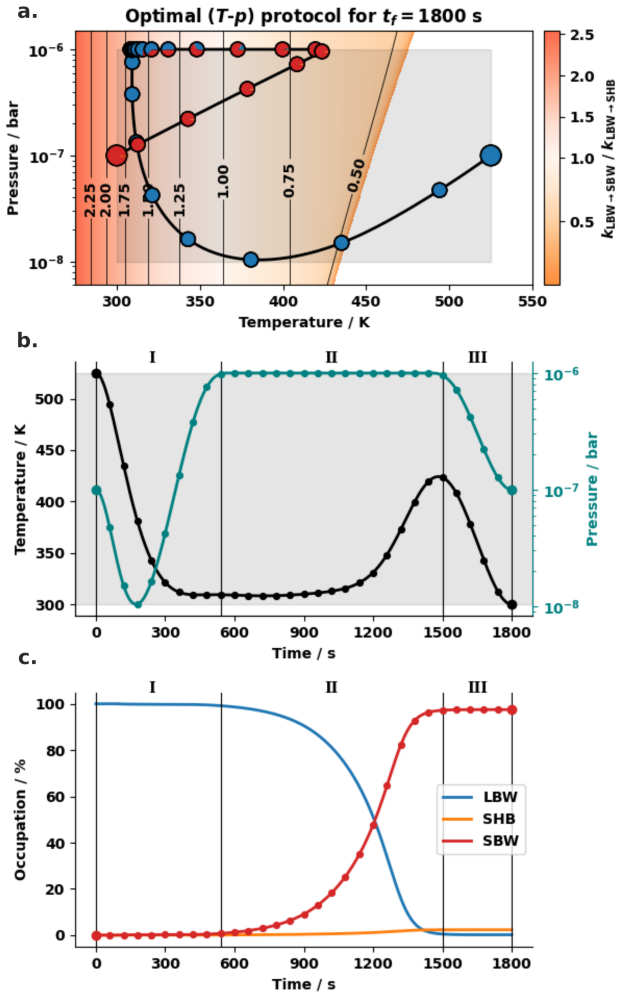
For a fixed protocol duration of 1800 s and the same experimental bounds on heating, cooling and pressure change, an optimal-control temperature–pressure trajectory raises the yield of the metastable SBW surface polymorph from 73% (best manually optimized three-step protocol) to about 97% in the effective model by guiding the system through kinetic regimes that favor the target while suppressing nucleation and growth of the stable SHB competitor.
What carries the argument
A three-state nucleation-and-growth ODE whose rates are Arrhenius functions of T and p and whose interfacial lengths are approximated by powers of the surface fractions; the ODE is least-squares fitted to kMC trajectories and then treated as the dynamical constraint of a direct pseudospectral optimal-control problem that maximizes final SBW occupation subject to rate and smoothness bounds.
Load-bearing premise
The fitted nucleation-and-growth equations remain accurate enough under the optimized time-varying path, including in high-coverage, high-temperature regimes that lie outside the original fitting data and where the paper’s own kMC check already shows extra unwanted phase.
What would settle it
Run the exact optimized T–p trajectory in independent kinetic Monte Carlo simulations (or in a real organic-monolayer experiment under the stated pressure and temperature limits) and measure whether final SBW coverage still reaches ~97% or falls significantly because of excess SHB nucleation not captured by the effective model.
Editorial analysis
A structured set of objections, weighed in public.
Referee Report
Summary. The manuscript formulates selective growth of a metastable organic monolayer polymorph (SBW) as an optimal-control problem in temperature and partial pressure. Elementary rates from a prior kMC model are used to generate (T,p)-grid trajectories that are least-squares fitted to a three-state nucleation-and-growth ODE (Eq. 1 / S1) with phenomenological interfacial lengths l_ij ∝ c_i^{α_i} c_j^{α_j} and Arrhenius-like rates. Under fixed bounds on T, p and their rates of change and a fixed protocol duration t_f = 1800 s, a manually optimized three-stage protocol yields 73% SBW in the effective model, while a pseudospectral optimal-control trajectory raises that model yield to ~97% by steering around kinetic regimes that favor the thermodynamically stable SHB phase. The optimized open-loop T(t), p(t) is then re-executed in kMC (Fig. 4, 20 runs), with good agreement until a late-stage regime where the model underestimates SHB.
Significance. If the reported gain survives consistent scoring in the underlying stochastic dynamics, the work would provide a concrete, experimentally constrained route from kMC-parameterized kinetics to open-loop growth recipes for metastable interface polymorphs—an important and under-served problem in organic electronics and surface science. Strengths include physically grounded control bounds, an explicit manual baseline under identical constraints, transparent acknowledgment of the late-stage model–kMC discrepancy, and a reproducible OCT pipeline (yapss/Ipopt, stated regularization and bounds). The contribution is methodological rather than a new materials prediction; its value hinges on whether the optimized protocol still outperforms the manual baseline when both are evaluated in kMC, not only inside the fitted ODE.
major comments (4)
- [Abstract; Results (Fig. 3–4); Conclusion] The abstract and main quantitative claim state that the optimized protocol raises the SBW yield from 73% to 97% for t_f = 1800 s. That 97% figure is obtained only inside the fitted effective model (Results; Fig. 3c). The kMC validation (Fig. 4 and surrounding text) shows a clear late-stage excess of SHB relative to the model, which the authors attribute to an extrapolative high-SBW, T > 400 K regime absent from the fitting data. The manuscript never reports the final kMC SBW occupation (mean ± std over the 20 runs). Because the optimizer is free to exploit precisely the under-penalized region of the surrogate, the headline 97% is an upper bound that is not demonstrated for the physical dynamics the paper claims to address. Please report the kMC final yield for the optimized trajectory and revise the abstract/conclusion claims to match what is actually validated.
- [Results (Fig. 2 vs Fig. 4); Abstract] The 73% manual baseline is likewise obtained by grid search over (T_growth, p_growth) inside the same effective model (Fig. 2b), not in kMC. A fair assessment of the OCT gain therefore requires scoring both the best three-stage protocol and the OCT trajectory under identical kMC conditions (same initial LBW coverage, same bounds, same t_f, same number of independent runs). Without that comparison, it is unknown whether the relative improvement shrinks, vanishes, or remains large once both protocols are evaluated in the underlying stochastic model. This is load-bearing for the central claim that OCT ‘increases the yield … from 73% to 97%’.
- [Results (paragraph on Fig. 4); SI §S3] The fitting grid and initial condition (pure LBW on a regular (T,p) mesh; SI §S3, Figs. 7–10) do not cover configurations with near-complete SBW coverage at T ≳ 400 K—the regime the optimized protocol enters in its final stage. The paper correctly flags this as extrapolative, but then still presents the model-internal 97% as the primary result. Either (i) enlarge the kMC training set to include high-SBW / elevated-T trajectories and re-fit before re-optimizing, or (ii) constrain the OCT problem (or post-filter candidate trajectories) so that the open-loop protocol remains inside the validated (T,p,c) envelope. Leaving the optimizer free to exploit an untrained corner of the surrogate undermines confidence in the reported optimum.
- [SI §S1–S4; Eq. (S3)–(S5)] SI §S4 imposes an irreversible, skew-symmetric growth matrix and an acyclicity penalty so that reverse growth channels are not co-fitted. That choice is numerically convenient but means detailed balance is not satisfied channel-wise, and the fitted rates are not guaranteed to remain consistent under long, time-varying protocols that reverse direction in (T,p). The manuscript should either (a) quantify how much the fit degrades if reverse growth terms are restored, or (b) demonstrate that under the optimized trajectory the neglected reverse fluxes remain negligible relative to the retained ones. As written, the ODE is an effective one-way surrogate whose domain of validity is not fully characterized.
minor comments (7)
- [Figure 3a caption] Figure 3a caption states ‘protocol duration of t_f = 1200 s’, while the main text, Fig. 3c, and the rest of the paper use t_f = 1800 s. Correct the caption.
- [Abstract; Conclusion] Abstract and Fig. 2 report 73% for the manual protocol; the Conclusion states 72%. Harmonize the number.
- [Abstract] Abstract: ‘a prototypical model of an organic molecules adsorbed’ → grammar (‘organic molecule’ or ‘organic molecules’).
- [Results (manual protocol paragraph)] Main text: ‘na ¨ ıve approach’ appears with a broken diaeresis; replace with ‘naive’ or ‘naïve’.
- [§5.1 Computational Methods] Eq. (4) writes ‘k_tot(t) si the time-dependent’ (typo for ‘is’). Also the integral limits use Δt' inconsistently with the left-hand side.
- [SI §S3; Results] The omission of LHB is justified by ‘no significant yield’ from pure-LBW kMC (SI), but a short statement of the (T,p) window where LHB would become competitive would help readers judge transferability.
- [SI §S6; Eq. (10)] Regularization weights α_T = 0.25 and α_q = 2500 are stated in SI without a sensitivity check. A brief note that the qualitative path (low-p entry, high-p growth plateau) is robust to order-of-magnitude changes in α would strengthen the OCT section.
Circularity Check
97% yield (and 73%→97% gain) is an OCT result on a least-squares surrogate ODE fitted to the same kMC system; late-stage extrapolation that the optimizer exploits already underestimates SHB vs kMC validation.
specific steps
-
fitted input called prediction
[Abstract; Results §3 (Fig. 2b, Fig. 3, text after Fig. 3); SI §S3 least-squares parametrization]
"Compared to a manually optimized three-step protocol, the optimized control trajectory increases the yield of the desired metastable phase from 73 % to 97 % for the same total protocol duration. ... All the parameters appearing in Equations 1–3 were then obtained using a least-squares fitting procedure. ... Toward the final stage, however, a noticeable deviation emerges ... the final part of the optimized protocol therefore lies in an extrapolative regime of the growth model. In this regime the parametrized model appears to underestimate the formation of SHB nuclei, which leads to a reduced yi"
Both the manual 73% baseline and the OCT 97% are obtained by integrating the identical least-squares-fitted nucleation-growth ODE (Eq. 1/S1 with Arrhenius rates and l_ij = c_i^{α_i} c_j^{α_j}) whose parameters were extracted from a pure-LBW kMC grid of the same three-phase system. Maximizing final c_SBW on that surrogate therefore produces a yield improvement that is forced by construction inside the fit; the paper's own kMC re-simulation of the open-loop protocol already shows excess SHB (lower SBW yield) exactly in the high-coverage, T>400 K region the optimizer exploits and that was absent from the training data. The absolute 97% figure is consequently an optimistic model-internal number, not an independent prediction of the underlying stochastic dynamics.
full rationale
The paper's central quantitative claim is a genuine optimization result (OCT trajectory vs. a constrained three-step manual baseline) performed on one and the same effective nucleation-and-growth ODE. That ODE's rates and interfacial exponents are least-squares fitted to a (T,p) grid of pure-LBW kMC trajectories of the identical three-phase model; both the 73% and 97% numbers are therefore evaluations of the fitted surrogate, not independent external predictions. The paper itself documents that the optimized open-loop protocol enters a high-SBW, T>400 K regime absent from the training data, where the surrogate underestimates SHB nucleation relative to kMC (Fig. 4). This is classic fitted-input-called-prediction circularity of moderate severity: the relative improvement is real inside the model and the method is transparent, yet the headline absolute yields and the claimed experimental relevance rest on a surrogate that the authors' own validation already shows is optimistic precisely where the optimizer spends time. Self-citation of the authors' prior kMC rates and connector-phase idea (Ref. 21) supplies the elementary kinetics but is not load-bearing for a uniqueness claim; the OCT objective and path constraints are independent of that citation. No self-definitional loop, uniqueness import, or renamed empirical law is present. Score 4 reflects partial circularity confined to the yield numbers while the control-theoretic contribution remains non-tautological.
Axiom & Free-Parameter Ledger
free parameters (9)
- Nucleation prefactors f_nucl_ij (3×3 matrix, off-diagonal)
- Nucleation barriers ΔE_nucl_ij
- Growth prefactors f_grow_ij
- Growth barriers ΔE_grow_ij
- Interfacial exponents α_LBW, α_SBW, α_SHB
- Δθ_ij stoichiometric coefficients (restricted to {-1,0,1})
- OCT regularization weights α_T=0.25, α_q=2500
- Protocol bounds (T 300–525 K, p 1e-8–1e-6 bar, |dT/dt|≤1 K/s, |dq/dt|≤0.01 log10(bar)/s, second-derivative caps)
- Interface-length regularization ε
axioms (6)
- ad hoc to paper Surface evolution is well described by a three-state nucleation-plus-growth ODE with conserved total coverage (LHB omitted).
- ad hoc to paper Exposed interfacial length scales as l_ij ∝ c_i^{α_i} c_j^{α_j}.
- ad hoc to paper Growth-rate matrix is skew-symmetric (irreversible preferred direction per channel); reverse growth not co-fitted.
- domain assumption Effective rates follow Arrhenius form with ideal-gas chemical potential μ_gas (translational+rotational only) and ΔG = ΔE − μ Δθ.
- domain assumption kMC elementary rates (diffusion, reorientation, ads/des) from the prior model system and temporal acceleration preserve growth-relevant statistics.
- domain assumption Optimal control with curvature penalty and vanishing endpoint derivatives yields experimentally relevant smooth protocols.
invented entities (1)
-
Three-state effective nucleation-and-growth model for LBW/SBW/SHB with fitted Arrhenius channels
no independent evidence
read the original abstract
The reliable growth of a desired target structure remains a central challenge for organic-inorganic interfaces. Specific interface structures can exhibit properties that are superior compared to those of other possible interface structures, but identifying growth conditions that selectively produce a given surface structure is difficult, particularly when the target structure is thermodynamically metastable. Here, we demonstrate how time-dependent temperature and pressure protocols can be optimized to promote the high-yield formation of a metastable surface polymorph. To this end, we combine kinetic Monte Carlo simulations with a parameterized nucleation-and-growth model and apply optimal control theory to predict growth recipes that maximize the yield of the desired target structure. Applying this approach to a prototypical model of an organic molecules adsorbed on a metal surface, we identify experimentally plausible protocols that guide the system through phase space while avoiding kinetic growth regimes in which formation of the thermodynamically stable structure is favored. Compared to a manually optimized three-step protocol, the optimized control trajectory increases the yield of the desired metastable phase from 73 % to 97 % for the same total protocol duration.
Figures




Reference graph
Works this paper leans on
-
[1]
doi:10.1039/B9NR00386J , url =
Lateral Engineering of Surface States – towards Surface-State Nanoelectronics , author =. doi:10.1039/B9NR00386J , url =
-
[2]
Abu Bakar, Mohd R. and Nagy, Zoltan K. and Saleemi, Ali N. and Rielly, Chris D. , date =. The. doi:10.1021/cg800595v , url =
-
[3]
Agam, Oded and Schiller, Avraham , date =. Projecting the. doi:10.1103/PhysRevLett.86.484 , url =
-
[4]
doi:10.1088/0953-8984/17/13/005 , url =
Mirages and Many-Body Effects in Quantum Corrals , author =. doi:10.1088/0953-8984/17/13/005 , url =
-
[5]
Piecewise Polynomial Monotonic Interpolation of
Allemand-Giorgis, Léo and Bonneau, Georges-Pierre and Hahmann, Stefanie and Vivodtzev, Fabien , date =. Piecewise Polynomial Monotonic Interpolation of. doi:10.1007/978-3-662-44900-4_5 , url =
-
[6]
Maintaining Discrete Probability Distributions in Practice
Allendorf, Daniel , date =. Maintaining. doi:10.48550/arXiv.2302.05682 , url =. 2302.05682 , eprinttype =
work page internal anchor Pith review Pith/arXiv arXiv doi:10.48550/arxiv.2302.05682
-
[7]
Ambrosch-Draxl, Claudia and Nabok, Dmitrii and Puschnig, Peter and Meisenbichler, Christian , date =. The Role of Polymorphism in Organic Thin Films: Oligoacenes Investigated from First Principles , shorttitle =. doi:10.1088/1367-2630/11/12/125010 , url =
-
[8]
Andersen, Mie and Plaisance, Craig P. and Reuter, Karsten , date =. Assessment of Mean-Field Microkinetic Models for. doi:10.1063/1.4989511 , url =
-
[9]
Andersen, Mie and Panosetti, Chiara and Reuter, Karsten , date =. A
-
[10]
Anderson, William J. , editor =. Continuous-. doi:10.1007/978-1-4612-3038-0 , url =
- [11]
-
[12]
doi:10.1103/PhysRevMaterials.7.025602 , url =
Temperature-Induced Transformation between Layered Herringbone Polymorphs in Molecular Bilayer Organic Semiconductors , author =. doi:10.1103/PhysRevMaterials.7.025602 , url =
-
[13]
Arulkumaran, Kai and Deisenroth, Marc Peter and Brundage, Miles and Bharath, Anil Anthony , date =. Deep. doi:10.1109/MSP.2017.2743240 , url =
- [14]
-
[15]
Quantum Objects on Show , author =. doi:10.1038/462416a , url =
-
[16]
doi:10.1038/s41598-021-91068-8 , url =
Accelerated Mapping of Electronic Density of States Patterns of Metallic Nanoparticles via Machine-Learning , author =. doi:10.1038/s41598-021-91068-8 , url =
-
[17]
Bartels, L. and Meyer, G. and Rieder, K.-H. , date =. Basic. doi:10.1103/PhysRevLett.79.697 , url =
-
[18]
doi:10.1103/PhysRevB.87.184115 , url =
On Representing Chemical Environments , author =. doi:10.1103/PhysRevB.87.184115 , url =
-
[19]
Recent Advances in Efficient Emissive Materials-Based
Bauri, Jayanta and Choudhary, Ram Bilash and Mandal, Gobind , date =. Recent Advances in Efficient Emissive Materials-Based. doi:10.1007/s10853-021-06503-y , url =
-
[20]
Bell, Ronald P. , date =. The. doi:10.1098/rspa.1936.0060 , url =
-
[21]
and Yadavalli, Sai Sharath and Stamatakis, Michail , date =
Benson, Raz L. and Yadavalli, Sai Sharath and Stamatakis, Michail , date =. Speeding up the. doi:10.1021/acs.jpca.3c05581 , url =
-
[22]
and Jeindl, Andreas and Hörmann, Lukas and Hofmann, Oliver T
Berger, Richard K. and Jeindl, Andreas and Hörmann, Lukas and Hofmann, Oliver T. , date =. Role of. doi:10.1021/acs.jpcc.2c00994 , url =
-
[23]
Berland, Kristian and Einstein, Ted and Hyldgaard, Per , date =. Response of the. doi:10.1103/PhysRevB.85.035427 , abstract =
-
[24]
doi:10.1016/0020-0190(77)90017-5 , url =
Two Dimensional Pattern Matching , author =. doi:10.1016/0020-0190(77)90017-5 , url =
-
[25]
Blowey, P. J. and Rochford, L. A. and Duncan, D. A. and Warr, D. A. and Lee, T.-L. and Woodruff, D. P. and Costantini, G. , date =. Probing the Interplay between Geometric and Electronic Structure in a Two-Dimensional. doi:10.1039/C7FD00093F , url =
-
[26]
doi:10.1039/C8NR02237B , url =
Re-Evaluating How Charge Transfer Modifies the Conformation of Adsorbed Molecules , author =. doi:10.1039/C8NR02237B , url =
-
[27]
doi:10.1007/BF01397477 , url =
Zur Quantenmechanik der Stoßvorgänge , author =. doi:10.1007/BF01397477 , url =
-
[28]
Bortz, A. B. and Kalos, M. H. and Lebowitz, J. L. , date =. A New Algorithm for. doi:10.1016/0021-9991(75)90060-1 , url =
-
[29]
What Does 'harder than Diamond' Mean? , author =. doi:10.1038/nmat1196 , url =
-
[30]
Brédas, J. L. and Calbert, J. P. and family=Silva Filho, given=D. A., prefix=da, useprefix=true and Cornil, J. , date =. Organic Semiconductors:. doi:10.1073/pnas.092143399 , url =
-
[31]
doi:10.1515/zpch-1924-10814 , url =
Die katalytische Zersetzung des Nitramids und ihre physikalisch-chemische Bedeutung , author =. doi:10.1515/zpch-1924-10814 , url =
-
[32]
Bröker, B. and Hofmann, O. T. and Rangger, G. M. and Frank, P. and Blum, R.-P. and Rieger, R. and Venema, L. and Vollmer, A. and Müllen, K. and Rabe, J. P. and Winkler, A. and Rudolf, P. and Zojer, E. and Koch, N. , date =. Density-. doi:10.1103/PhysRevLett.104.246805 , url =
-
[33]
Bronsted, J. N. , date =. Acid and. doi:10.1021/cr60019a001 , url =
-
[34]
doi:10.1073/pnas.2119315119 , url =
Temperature Protocols to Guide Selective Self-Assembly of Competing Structures , author =. doi:10.1073/pnas.2119315119 , url =
-
[35]
Calcinelli, Fabio and Jeindl, Andreas and Hörmann, Lukas and Ghan, Simiam and Oberhofer, Harald and Hofmann, Oliver T. , date =. Interfacial. doi:10.1021/acs.jpcc.1c09986 , url =
-
[36]
Cao, Bing and Adutwum, Lawrence A. and Oliynyk, Anton O. and Luber, Erik J. and Olsen, Brian C. and Mar, Arthur and Buriak, Jillian M. , date =. How. doi:10.1021/acsnano.8b04726 , url =
-
[37]
and Gulans, Andris and Hofmann, Oliver T
Carbogno, Christian and Thygesen, Kristian Sommer and Bieniek, Björn and Draxl, Claudia and Ghiringhelli, Luca M. and Gulans, Andris and Hofmann, Oliver T. and Jacobsen, Karsten W. and Lubeck, Sven and Mortensen, Jens Jørgen and Strange, Mikkel and Wruss, Elisabeth and Scheffler, Matthias , date =. Numerical Quality Control for. doi:10.1038/s41524-022-007...
-
[38]
Carlson, R. E. and Fritsch, F. N. , date =. Monotone. 2157021 , eprinttype =
-
[39]
Polymorphism Mediated by Electric Fields:
Cartus, Johannes and Jeindl, Andreas and Werkovits, Anna and Hörmann, Lukas and Hofmann, Oliver , date =. Polymorphism Mediated by Electric Fields:. doi:10.1039/D2NA00851C , abstract =
-
[40]
Cheimarios, Nikolaos and To, Deifilia and Kokkoris, George and Memos, George and Boudouvis, Andreas G. , date =. Monte. doi:10.3389/fphy.2021.631918 , url =
-
[41]
Chen, Wen-Kai and Liu, Shu-Hong and Cao, Mei-Juan and Lu, Chun-Hai and Xu, Ying and Li, Jun-Qian , date =. Adsorption of. doi:10.1002/cjoc.200690166 , url =
-
[42]
Choi, Joonmyung , date =. A. doi:10.1007/s42493-024-00105-x , url =
-
[43]
doi:10.1039/C5TC04390E , url =
Polymorphism as an Emerging Design Strategy for High Performance Organic Electronics , author =. doi:10.1039/C5TC04390E , url =
-
[44]
Coropceanu, Veaceslav and Cornil, Jérôme and family=Silva Filho, given=Demetrio A., prefix=da, useprefix=true and Olivier, Yoann and Silbey, Robert and Brédas, Jean-Luc , date =. Charge. doi:10.1021/cr050140x , url =
-
[45]
doi:10.1103/PhysRevB.71.035418 , url =
Quantum Corral Wave-Function Engineering , author =. doi:10.1103/PhysRevB.71.035418 , url =
-
[46]
, date =
Cramer, Christopher J. , date =. Essentials of. k4R6cf7I7q0C , eprinttype =
-
[47]
Cranston, Rosemary R. and Lessard, Benoît H. , date =. Metal Phthalocyanines: Thin-Film Formation, Microstructure, and Physical Properties , shorttitle =. doi:10.1039/D1RA03853B , url =
-
[48]
Crommie, M. F. and Lutz, C. P. and Eigler, D. M. , date =. Confinement of. doi:10.1126/science.262.5131.218 , url =
-
[49]
On the Calculation of Reaction Rate Constants in the Transition Path Ensemble , author =. doi:10.1063/1.478569 , url =
-
[50]
doi:10.1016/j.matdes.2022.110815 , url =
Learning Time-Dependent Deposition Protocols to Design Thin Films via Genetic Algorithms , author =. doi:10.1016/j.matdes.2022.110815 , url =
-
[51]
doi:10.1126/science.aaa6760 , url =
Crystallization by Particle Attachment in Synthetic, Biogenic, and Geologic Environments , author =. doi:10.1126/science.aaa6760 , url =
-
[52]
Díaz-Tendero, Sergio and Olsson, Fredrik E. and Borisov, Andrey G. and Gauyacq, Jean-Pierre , date =. Theoretical Study of Electron Confinement in. doi:10.1103/PhysRevB.77.205403 , url =
-
[53]
and Facchetti, Antonio and Ratner, Mark A
DiBenedetto, Sara A. and Facchetti, Antonio and Ratner, Mark A. and Marks, Tobin J. , date =. Molecular. doi:10.1002/adma.200803267 , url =
-
[54]
Efficient Global Sensitivity Analysis of Kinetic
Dortaj, Sina and Matera, Sebastian , date =. Efficient Global Sensitivity Analysis of Kinetic. doi:10.1063/5.0160873 , url =
-
[55]
Dou, Rui-Fen and Ma, Xu-Cun and Xi, Luan and Yip, Hin Lap and Wong, King Young and Lau, Woon Ming and Jia, Jin-Feng and Xue, Qi-Kun and Yang, Wei-Sheng and Ma, Hong and Jen, Alex K-Y. , date =. Self-. doi:10.1021/la052987u , url =
-
[56]
Orientation-Dependent Ionization Energies and Interface Dipoles in Ordered Molecular Assemblies , author =. doi:10.1038/nmat2119 , url =
-
[57]
Duhm, S. and Gerlach, A. and Salzmann, I. and Bröker, B. and Johnson, R. L. and Schreiber, F. and Koch, N. , date =. doi:10.1016/j.orgel.2007.10.004 , url =
-
[58]
Dybeck, Eric C. and Plaisance, Craig P. and Neurock, Matthew , date =. Generalized. doi:10.1021/acs.jctc.6b00859 , url =
-
[59]
Egger, Alexander and Hörmann, Lukas and Jeindl, Andreas and Scherbela, Michael and Obersteiner, Veronika and Todorović, Milica and Rinke, Patrick and Hofmann, Oliver , date =. Charge. doi:10.1002/advs.202000992 , abstract =
-
[60]
doi:10.1098/rsta.2004.1367 , abstract =
Information Transport and Computation in Nanometre-Scale Structures , author =. doi:10.1098/rsta.2004.1367 , abstract =
-
[61]
Ellis, J. A. and Fiedler, L. and Popoola, G. A. and Modine, N. A. and Stephens, J. A. and Thompson, A. P. and Cangi, A. and Rajamanickam, S. , date =. Accelerating Finite-Temperature. doi:10.1103/PhysRevB.104.035120 , url =
-
[62]
Erley, W. , date =. Reflection-Absorption Infrared Spectroscopy of Adsorbates on a. doi:10.1016/0368-2048(87)87008-1 , url =
-
[63]
Erley, W. and Ibach, H. , date =. Spectroscopic Evidence for Surface Anion Radical Formation of Tetracyanoethylene Adsorbed on Copper(111) at 100. doi:10.1021/j100295a059 , url =
-
[64]
doi:10.1039/TF9353100875 , url =
Some Applications of the Transition State Method to the Calculation of Reaction Velocities, Especially in Solution , author =. doi:10.1039/TF9353100875 , url =
-
[65]
doi:10.1039/TF9363201333 , url =
Further Considerations on the Thermodynamics of Chemical Equilibria and Reaction Rates , author =. doi:10.1039/TF9363201333 , url =
-
[66]
doi:10.1039/TF9383400011 , url =
Inertia and Driving Force of Chemical Reactions , author =. doi:10.1039/TF9383400011 , url =
-
[67]
Eyring, Henry , date =. The. doi:10.1063/1.1749604 , url =
-
[68]
Eyring, H , langid =
-
[69]
doi:10.1038/s41578-019-0127-y , url =
Interfaces in Organic Electronics , author =. doi:10.1038/s41578-019-0127-y , url =
-
[70]
Faraggi, Marisa N. and Jiang, Nan and Gonzalez-Lakunza, Nora and Langner, Alexander and Stepanow, Sebastian and Kern, Klaus and Arnau, Andres , date =. Bonding and. doi:10.1021/jp306780n , url =
-
[71]
Fiete, Gregory A. and Heller, Eric J. , date =. Colloquium:. doi:10.1103/RevModPhys.75.933 , url =
-
[72]
Freitas, Luis Paulo and Schleder, Gabriel R
Focassio, Bruno and M. Freitas, Luis Paulo and Schleder, Gabriel R. , date =. Performance. doi:10.1021/acsami.4c03815 , url =
-
[73]
Optical Absorption Spectra of Ultrathin
Forker, Roman and Golnik, Christian and Pizzi, Giovanni and Dienel, Thomas and Fritz, Torsten , date =. Optical Absorption Spectra of Ultrathin. doi:10.1016/j.orgel.2009.08.005 , url =
-
[74]
Franch, Jaume and Agrawal, Sunil K. , date =. Optimal. doi:10.2514/2.4817 , url =
-
[75]
doi:10.21468/SciPostPhys.9.6.085 , url =
Coupling Quantum Corrals to Form Artificial Molecules , author =. doi:10.21468/SciPostPhys.9.6.085 , url =
-
[76]
Understanding
Frenkel, Daan and Smit, Berend , date =. Understanding. 5qTzldS9ROIC , eprinttype =
-
[77]
Fritsch, F. N. and Butland, J. , date =. A. doi:10.1137/0905021 , url =
-
[78]
Fritsch, F. N. and Carlson, R. E. , date =. Monotone. doi:10.1137/0717021 , url =
-
[79]
and Zhao, Yuzhou and Hamers, Robert J
Fu, Yongping and Wu, Tao and Wang, Jue and Zhai, Jianyuan and Shearer, Melinda J. and Zhao, Yuzhou and Hamers, Robert J. and Kan, Erjun and Deng, Kaiming and Zhu, X.-Y. and Jin, Song , date =. Stabilization of the. doi:10.1021/acs.nanolett.7b01500 , url =
-
[80]
Efficient Parametrization of Complex Molecule–Surface Force Fields , author =. doi:10.1002/jcc.23904 , url =
discussion (0)
Sign in with ORCID, Apple, or X to comment. Anyone can read and Pith papers without signing in.