REVIEW 5 major objections 5 minor 25 references
MeVe: A Modular System for Memory Verification and Effective Context Control in Language Models
T0 review · 5 major / 5 minor · reviewed 2026-08-05 · deepseek-v4-flash
Pith's one-line read This paper claims a five-phase pipeline can shrink RAG context tokens by 57–75% while adding only about 0.1–0.2 seconds of retrieval time.
desk verdict Real token reductions and a clean modular design, but the evaluation doesn't support the claim that MeVe improves grounding or factual support; worth a look as an engineering sketch, not as evidence. read the letter →
The pith
A machine-rendered reading of the paper's core claim, the machinery that carries it, and where it could break.
The reading
What carries the argument
The load-bearing object is the five-phase MeVe pipeline: (1) initial kNN retrieval, (2) cross-encoder relevance verification with threshold τ, (3) keyword fallback when verified candidates fall below Nmin, (4) prioritization by relevance score plus redundancy filtering by embedding cosine similarity, and (5) greedy token-budget packing to a Tmax limit. The design's purpose is to make the composition of context an explicit, tunable, auditable sequence rather than a monolithic top-k append; each phase is independently replaceable, and the efficiency gain is carried by Phase 2, which typically discards most initial candidates, with Phase 3 ensuring the pipeline does not hand the LLM an empty co
What would settle it
Take a set of questions with known answers, run MeVe and standard RAG on identical retrieval indexes, and ask a real LLM to answer from only the final context. If MeVe's shorter contexts yield the same or better factual accuracy, the efficiency claim is genuine; if accuracy drops and the discarded documents (below τ=0.5) contain the true answers, the reduction is mostly deletion of useful evidence.
Extended reading notes
Core claim
The central claim is that context efficiency in retrieval-augmented generation can be improved substantially by making verification a first-class stage rather than an implicit part of retrieval. MeVe operationalizes this as a five-phase serial pipeline leading from a query q to a final context C_final: k-nearest-neighbour retrieval over dense embeddings; a cross-encoder relevance score for each candidate, with candidates below a threshold τ=0.5 discarded; a keyword fallback triggered when fewer than Nmin=3 verified documents remain; reordering by relevance and removal of near-duplicate chunks by embedding similarity; and greedy packing under a token budget Tmax=512. In the reported proof-of-
Load-bearing premise
The load-bearing assumption is that a cross-encoder score above 0.5 separates useful context from noise; if the threshold discards answer-bearing documents, the savings are partly information loss, a possibility the paper itself acknowledges as over-filtering.
Editorial extensions
If this is right
- If the reported numbers hold, MeVe demonstrates that most retrieved tokens in standard RAG are not needed for context composition: final contexts shrink from 188.8 to 79.8 tokens on Wikipedia, and from 308.6 to 78.5 on HotpotQA.
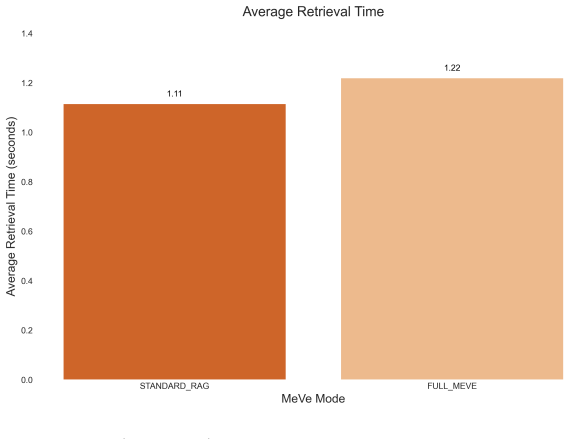
- Retrieval time overhead stays small (1.22s vs 1.12s on Wikipedia; 1.98s vs 1.80s on HotpotQA), so the modular verification stages do not obviously price the system out of latency-sensitive use.
- The modular decomposition makes failures attributable: if answers are poor, one can inspect whether relevance verification, fallback retrieval, or token budgeting is the bottleneck.
- Disabling verification (No Verification mode) essentially reverts context size to standard RAG levels, confirming that Phase 2, not the later phases, is what drives the measured compression.
- MeVe does not by itself solve factual grounding: a large fraction of generated answers is labeled 'Derived from Context (Often Irrelevant)' in every retrieval-augmented mode, so efficiency and control come before accuracy in this proof-of-concept.
Reading between the lines
- If the verification threshold were calibrated per corpus rather than fixed at 0.5, the token reductions would probably change: an easy corpus with direct answers would retain more tokens, while a noisy corpus would discard even more; that makes the 57–75% figure a property of the threshold and corpus as much as of the architecture.
- The paper's simulation answers by keyword overlap cannot distinguish 'useful context' from 'lexically related context'; a natural next test is to run MeVe against standard RAG on a factual QA benchmark with real LLM generation and graded answers, measuring whether the shorter contexts preserve accuracy.
- Because full MeVe often produced zero verified documents on general-knowledge queries, the aggressive filtering effectively converts the system from a semantic retriever into a keyword fallback retriever for those queries; the 57–75% savings may partly reflect a shift in retrieval strategy, not just noise removal.
Editorial analysis
A structured set of objections, weighed in public.
Referee Report
Summary. The paper introduces MeVe, a five-phase modular pipeline for retrieval-augmented generation: initial kNN retrieval, cross-encoder relevance verification, BM25 fallback, context prioritization with redundancy filtering, and token-budget packing. The authors report that on a 100-article Wikipedia subset and a subset of HotpotQA, MeVe reduces the average final context size by 57.7% and 75% respectively compared to a Standard RAG baseline that retrieves 20 dense chunks without verification, while adding only modest retrieval-time overhead (1.22s vs 1.12s on Wikipedia; 1.98s vs 1.80s on HotpotQA). They also report an ablation study and a heuristic 'Context Grounding Proxy' that simulates LLM answers by selecting the context sentence with maximum keyword overlap. The paper releases a reference implementation and candidly discusses limitations, including over-filtering and the poor semantic relevance of fallback content.
Significance. If the central claim were fully supported, the paper would provide a useful, auditable decomposition of the RAG pipeline: separating retrieval, verification, fallback, prioritization, and budgeting is a sensible design pattern, and the token reductions are real, deterministic consequences of the filtering stages. The availability of a reference implementation is a concrete strength. However, the evaluation never uses an actual LLM, and the only answer-quality signal is a keyword-overlap simulation that cannot measure factual correctness. The paper's own results show that a large share of answers are 'Derived from Context (Often Irrelevant)' in all retrieval-augmented modes, and §5.2 concedes that fallback content is frequently unrelated. Consequently, the evidence supports only the narrow claim that MeVe shrinks context, not the broader claims about better grounding, more accurate factual support, or improved LLM performance. The significance is therefore conditional on substantial additional evaluation.
major comments (5)
- [§5.1/Table 1, §5.4, and §A.5] The central claim that MeVe 'improves context efficiency' and 'offers a path toward better grounding and more accurate factual support' is not supported by the experiments because no real LLM is used. The simulated 'answer' in §A.5 is only the context sentence with maximal keyword overlap; it cannot assess factual correctness. Figure 5 reports a large proportion of 'Derived from Context (Often Irrelevant)' for Full MeVe, and §5.2 concedes fallback content was 'sometimes only tangentially relevant or entirely unrelated.' Thus the 57–75% token reductions are equally compatible with removing useful evidence as with removing noise. The authors should either reframe the central claim to 'token-count reduction' or, preferably, evaluate with real LLMs and answer-accuracy metrics.
- [§4 and §5.2] The comparison is asymmetric in a way that makes the headline reduction partly by construction. Standard RAG returns all 20 dense chunks without verification, while MeVe applies a cross-encoder threshold τ=0.5, a redundancy threshold, and a fallback trigger. The paper itself states in §5.2 that Phase 2 'typically produced zero verified documents for general knowledge questions' and in §6 that τ=0.5 'can result in over-filtering.' Therefore the efficiency gain is not evidence of improved context quality unless the authors measure whether the retained context preserves answer-relevant information. A matched-quality comparison, e.g., with equal token budgets or with answer recall of the context, is needed.
- [§4, §5.1, §5.4, Tables 1] No error bars, confidence intervals, or query counts are reported. Tables and figures report only means, and the HotpotQA 'subset' is not specified (number of questions, sampling procedure, difficulty mix). Without this information, the claimed 57.7% and 75% reductions and the latency comparisons cannot be assessed for statistical reliability. The authors should report the number of queries, standard deviations/standard errors, and significance tests, and describe the HotpotQA subset precisely.
- [§5.3/Figure 5] The ablation's own grounding proxy shows no material shift toward 'Potentially Relevant' answers for Full MeVe relative to Standard RAG; the figure shows a dominant share of 'Derived from Context (Often Irrelevant)' across all retrieval modes. The text interprets this as a 'broader, inherent challenge,' but this interpretation undercuts the paper's claim that MeVe 'mitigates context pollution' or improves grounding. The authors need to report exact counts/proportions and analyze why the verification and prioritization phases do not improve the proxy, or the framing of the contribution must be limited to token efficiency.
- [§3.7] The computational-complexity discussion contains unsupported and imprecise statements, e.g., that ANN search is 'often closer to O(log N)' and that MeVe's modularity 'maintains efficiency while significantly enhancing quality.' The quality claim is not established by the empirical section, and the complexity bounds are not tied to the measured latencies. Please either remove the quality assertion or support it with data.
minor comments (5)
- [§A.3 and References [21][22]] The corpus is described as the Hugging Face 'wikipedia' dataset with config '20220301.en', but reference [21] is a Wikidata subsetting paper and reference [22] is a Figshare quality-assessment dataset. The reference for the corpus used appears to be missing or mis-cited.
- [§A.5] The 'No RAG' mode uses hardcoded placeholder answers. This is not a meaningful baseline for LLM behavior; please clarify explicitly that this mode is not a simulation of an LLM and should not be compared numerically to the other modes.
- [§5.2] The anecdotal Eiffel Tower example would be more useful with the exact query and retrieved snippets, so readers can see why the retrieved information was irrelevant and how Phase 2/4 handled it.
- [Throughout] There are typographical artifacts such as 'T able 1', 'V erification', 'F allback', 'MeV e', and inconsistent rounding (57% in the abstract vs 57.7% in §5.1). A careful proofread is needed.
- [§5.3/Figure 5] The figure caption says 'correctness proxy simulated' but the legend and text use different category names ('Derived from Context (Often Irrelevant)' vs 'Potentially Relevant'). Please standardize the terminology and describe how the categories are computed in §A.5.
Circularity Check
No circular derivation: the 57%/75% token reductions and latency figures are measured outputs of a specified pipeline/baseline comparison, not predictions fitted from the target values; the paper's own limitation statements concern external validity, not circular reasoning.
full rationale
MeVe's central quantitative claims are empirical measurements (Tables 1, Figs. 2,3,6,7), not results derived from equations that assume the same values. The pipeline definition Cver = {ci in Cinit | V(q,ci) >= tau} and the greedy token budget determine how the final context is constructed, but no parameter (tau, Nmin, Tmax) is fitted to hit the reported 57%/75% reductions; the magnitudes are data-dependent and reported as observations. The fact that a verification/filtering system produces shorter contexts than an unfiltered top-20 baseline is directionally expected, but that is a design property of the comparison, not a circular step: the paper does not rename a fitted parameter as a prediction, does not define 'context efficiency' as the output of its own filter in a way that makes the result tautologically true beyond the measured token counts, and does not rely on a self-citation chain. The paper even concedes the limits of its interpretation: phase-2 filtering is so aggressive that fallback often supplies the final context (§5.2), fallback content can be 'only tangentially relevant or entirely unrelated' (§5.2), the threshold 'can result in over-filtering' (§6), and the grounding proxy is 'not a definite metric for factual correctness' (§A.5). These are genuine threats to the substantive claim that shorter context means better grounding, and they would matter for experimental validity, but they are not circularity. The ablation result that disabling verification increases token count follows immediately from the definition of verification; the paper's assertion that this 'validates' the module is an interpretive overreach, not a circular derivation. No uniqueness theorems or ansatz-carrying self-citations are used. Hence no circular step meets the evidence bar.
Assumptions & free parameters
free parameters (5)
- Initial retrieval count k =
20
- Relevance threshold tau =
0.5
- Minimum verified documents Nmin =
3
- Redundancy threshold theta_redundancy =
0.85
- Token budget Tmax =
512
assumptions (5)
- domain assumption Dense embedding cosine similarity captures semantic relevance between query and document.
- ad hoc to paper Cross-encoder relevance scores, after sigmoid, are calibrated enough that a fixed threshold of 0.5 separates relevant from irrelevant documents.
- ad hoc to paper Keyword overlap between question and a context sentence is a valid proxy for whether a simulated LLM answer is derived from the context.
- domain assumption GPT-2 tokenizer counts are a valid approximation of the target LLM's tokenization for budgeting.
- domain assumption Sentence-level chunking of the corpus preserves enough context for questions to be answerable from the retrieved chunks.
invented entities (1)
-
Context Grounding Proxy
Cite this review
Pith. "Pith review of MeVe: A Modular System for Memory Verification and Effective Context Control in Language Models." pith.science (2026). https://pith.science/paper/TY3EFVDF
@misc{pith2026250901514,
  author       = {Pith},
  title        = {Pith review of: MeVe: A Modular System for Memory Verification and Effective Context Control in Language Models},
  year         = {2026},
  howpublished = {\url{https://pith.science/paper/TY3EFVDF}},
  note         = {Machine review of arXiv:2509.01514}
}
read the original abstract
Retrieval-Augmented Generation (RAG) systems typically face constraints because of their inherent mechanism: a simple top-k semantic search [1]. The approach often leads to the incorporation of irrelevant or redundant information in the context, degrading performance and efficiency [10][11]. This paper presents MeVe, a novel modular architecture intended for Memory Verification and smart context composition. MeVe rethinks the RAG paradigm by proposing a five-phase modular design that distinctly breaks down the retrieval and context composition process into distinct, auditable, and independently tunable phases: initial retrieval, relevance verification, fallback retrieval, context prioritization, and token budgeting. This architecture enables fine-grained control of what knowledge is made available to an LLM, enabling task-dependent filtering and adaptation. We release a reference implementation of MeVe as a proof of concept and evaluate its performance on knowledge-heavy QA tasks over a subset of English Wikipedia [22]. Our results demonstrate that by actively verifying information before composition, MeVe significantly improves context efficiency, achieving a 57% reduction on the Wikipedia dataset and a 75% reduction on the more complex HotpotQA dataset compared to standard RAG implementations [25]. This work provides a framework for more scalable and reliable LLM applications. By refining and distilling contextual information, MeVe offers a path toward better grounding and more accurate factual support [16].
Figures


Figures from the paper (4 more)


Reference graph
Works this paper leans on
-
[1]
T., Rockt¨ aschel, T., Riedel, S., & Kiela, D
Lewis, P., Perez, E., Piktus, A., Petroni, F., Karpukhin, V., Goyal, N., K¨ uttler, H., Lewis, M., Yih, W. T., Rockt¨ aschel, T., Riedel, S., & Kiela, D. (2020). Retrieval-augmented generation for knowledge- intensive NLP tasks. Advances in Neural Information Processing Systems, 33, 9459–9474
work page 2020
-
[2]
Gao, Y., Xiong, Y., Gao, X., Jia, K., Pan, J., Bi, Y., Dai, Y., Sun, J., & Wang, H. (2023). Retrieval- augmented generation for large language models: A survey. arXiv preprint arXiv:2312.10997
arXiv 2023
-
[3]
Mallen, A., Asai, A., Zhong, V., Das, R., Khashabi, D., & Hajishirzi, H. (2022). When not to trust lan- guage models: Investigating effectiveness of parametric and non-parametric memories. arXiv preprint arXiv:2212.10511
arXiv 2022
-
[4]
Chen, H., Wang, Z., & Li, Y. (2023). Modular retrieval for generalization and interpretation. arXiv preprint arXiv:2303.17612
work page Pith review arXiv 2023
-
[5]
Packer, C., Wooders, S., Lin, K., Fang, V., Patil, S. G., Stoica, I., & Gonzalez, J. E. (2023). MemGPT: Towards LLMs as operating systems. arXiv preprint arXiv:2310.08560
arXiv 2023
-
[6]
W., Narang, S., Yogatama, D., Vaswani, A., & Metzler, D
Tay, Y., Dehghani, M., Rao, J., Fedus, W., Abnar, S., Chung, H. W., Narang, S., Yogatama, D., Vaswani, A., & Metzler, D. (2024). Beyond the limits: A survey of techniques to extend the context length in large language models. arXiv preprint arXiv:2402.02244
arXiv 2024
-
[7]
Liu, H., Zaharia, M., & Abbeel, P. (2023). Ring attention with blockwise transformers for near-infinite context. arXiv preprint arXiv:2310.01889
arXiv 2023
-
[8]
Weaviate. (2025, June 18). Keyword search (BM25). Retrieved from https://weaviate.io/ developers/weaviate/concepts/search/keyword-search
work page 2025
Show all 25 references
-
[9]
Singh, S. P. (2024). Cross-Encoder models for enhanced search relevance: A multi-domain analysis of performance and applications. International Journal of Research in Computer Applications and Information Technology, 7(2), 2673–2685
2024
-
[10]
Filice, S., et al. (2025). The distracting effect: Understanding irrelevant passages in RAG. arXiv preprint arXiv:2505.06914
2025
-
[11]
(2025, June 18)
CEUR Workshop Proceedings. (2025, June 18). How noise and distractors impact retrieval-augmented generation. CEUR Workshop Proceedings, Vol-3802
2025
-
[12]
Levy, S., Mazor, N., Shalmon, L., Hassid, M., & Stanovsky, G. (2025). More documents, same length: Isolating the challenge of multiple documents in RAG. arXiv preprint arXiv:2503.04388
2025
-
[13]
Cuconasu, F., Trappolini, G., Siciliano, F., Filice, S., Campagnano, C., Maarek, Y., Tonellotto, N., & Silvestri, F. (2024). The power of noise: Redefining retrieval for RAG systems. In Proceedings of the 47th International ACM SIGIR Conference on Research and Development in I...
2024
-
[14]
T., & Fischer, K
Rose, L. T., & Fischer, K. W. (2011). Garbage In, Garbage Out: Having Useful Data Is Everything. Measurement: Interdisciplinary Research and Perspectives, 9(4), 222–226
2011
-
[15]
Shyani, M., & Naamad, Y. (2025). Filtered semantic search via vector arithmetic. Submitted
2025
-
[16]
Tonmoy, S. M. T. I., Zaman, S. M. M., Jain, V., Rani, A., Rawte, V., Chadha, A., & Das, A. (2024). A comprehensive survey of hallucination mitigation techniques in large language models. arXiv preprint arXiv:2401.01313
2024 arXiv
-
[17]
Han, T., Wang, Z., Fang, C., Zhao, S., Ma, S., & Chen, Z. (2025). Token-budget-aware LLM reasoning. arXiv preprint arXiv:2412.18547
2025 arXiv
-
[18]
Wang, Y. (2023). Review on greedy algorithm. Theoretical and Natural Science, 14(1), 233–239. https: //doi.org/10.54254/2753-8818/14/20241041
2023 doi
-
[19]
C., Rege Cambrin, D., & Garza, P
Tcaciuc, C. C., Rege Cambrin, D., & Garza, P. (2025). Multi Stage Retrieval for Web Search During Crisis. Future Internet, 17(6), Article 239
2025
-
[20]
AIModels.fyi. (2024). multi-qa-mpnet-base-dot-v1 model card. Retrieved from https://www.aimodels. fyi/models/huggingFace/multi-qa-mpnet-base-dot-v1-sentence-transformers
2024
-
[21]
A., Razniewski, S., Vougiouklis, P., Beghaeiraveri, S
Kaffee, L. A., Razniewski, S., Vougiouklis, P., Beghaeiraveri, S. A. H., Gayo, J. E. L., Waagmeester, A., & Gray, A. J. (2024). Wikidata subsetting: Approaches, tools, and evaluation. Semantic Web, 15(2), 231–265
2024
-
[22]
(2023, June 18)
Figshare. (2023, June 18). English Wikipedia quality assessment dataset. Retrieved from https:// figshare.com/articles/dataset/English_Wikipedia_Quality_Asssessment_Dataset/1375406
2023
-
[23]
Eppalapally, S., et al. (2024). KaPQA: Knowledge-augmented product question-answering. arXiv preprint arXiv:2407.16073
2024 arXiv
-
[24]
Hugging Face. (2025). Cross-Encoder/ms-marco-MiniLM-L6-v2 model card. Retrieved from https: //huggingface.co/cross-encoder/ms-marco-MiniLM-L6-v2
2025
-
[25]
W., Salakhutdinov, R., Manning, C
Yang, Z., Qi, P., Zhang, S., Bengio, Y., Cohen, W. W., Salakhutdinov, R., Manning, C. D. (2018). HotpotQA: A dataset for diverse, explainable multi-hop question answering. arXiv preprint arXiv:1809.09600. Authors A. Ottem studied Media and Communication in high school and has ...
2018 arXiv
Reviewed August 5, 2026 · model on record in the stance chip above.
Discussion (0). Sign in to comment.