REVIEW 4 major objections 5 minor 1 cited by
Respond Beyond Language: A Benchmark for Video Generation in Response to Realistic User Intents
T0 review · 4 major / 5 minor · reviewed 2026-08-07 · deepseek-v4-flash
Pith's one-line read This paper's benchmark of 4,500 real queries shows that even the best text-to-video model scores only 0.29 on reference-based answer quality.
desk verdict A genuinely new benchmark for T2V-as-answerer, but the unvalidated LLM judge makes the central 'struggle' claim provisional. read the letter →
The pith
A machine-rendered reading of the paper's core claim, the machinery that carries it, and where it could break.
The reading
What carries the argument
The engine of the argument is RealVideoQuest, a benchmark built in three stages. Real queries with video intent are sifted from chatbot logs by a GPT-3.5-Turbo classifier called the video intent recognizer, then grouped into skill demonstration, knowledge explanation, art creation, and human-machine interaction. For each query, a YouTube video is retrieved, split into scene clips with PySceneDetect, merged by ImageBind similarity, captioned by Qwen2VL-7B, and ranked against the query with BGE embeddings; GPT-4o then rewrites the query to match the chosen clip. The evaluation machine is an LLM-as-a-Judge protocol in which GPT-4o-mini scores each generated video from 0 to 3 on relevance, correctness, coherence, and completeness, either with or without the golden clip in context, alongside VBench and VideoScore for visual quality. The completeness metric does the diagnostic work: generated videos are a few seconds long and omit stages of the requested process.
What would settle it
Have human annotators rate a random subset of the same generated videos with the paper's four-point rubric and compare their scores to the LLM judge's. If human median scores for the best model sit well above 0.29, the central claim would not survive; if humans land near the LLM, the claim is supported.
Extended reading notes
Core claim
On its own terms, the paper's claim is that answering a user's query with a generated video is a distinct capability from generating a pretty video, and current models do not have it. The evidence is a head-to-head comparison on 998 held-out query-video pairs: the strongest system, Wan2.1, averages 0.2885 on the four reference-based QA metrics, and every model's weakest dimension is completeness, with Wan2.1 at 0.2134. On the same outputs, conventional quality suites give high marks for motion smoothness, subject consistency, and visual quality. The paper interprets this split as showing that models lack structured world knowledge and the ability to produce long, coherent demonstrations, rather than basic rendering skill.
Load-bearing premise
The results assume the automated judge, GPT-4o-mini, scores videos the way a human would; the paper reports no human check of these ratings, so the uniformly low scores could in principle be an artifact of the judge.
Editorial extensions
If this is right
- If current T2V models really answer real queries this poorly, visual-quality leaderboards are not sufficient evidence that generation models are useful, and QA-oriented metrics must be reported alongside them.
- If completeness is the binding constraint, simply increasing generated video length without adding structured knowledge will not fix the failure, since models will still omit or invent steps.
- The benchmark's 998 test queries provide a fixed, reusable set for measuring future improvements in query-to-video answering.
- The reference-based evaluation protocol, golden video clips plus judge rubrics, can be reused to evaluate other video-answering systems without new manual annotation.
Reading between the lines
- An extension the paper does not pursue: the same judge-rubric protocol could be adapted to image- or audio-answering tasks, provided human validation of the judge is added.
- Because queries were rewritten after seeing the golden clip, a model only receives the refined prompt during generation; scores therefore measure how well models follow the rewritten prompt, not necessarily the original user intent.
- A per-category breakdown of the QA scores would likely show that skill demonstration and human-machine interaction suffer most, since they require multi-step, temporally extended content; the paper leaves this analysis for future work.
Editorial analysis
A structured set of objections, weighed in public.
Referee Report
Summary. The paper introduces RealVideoQuest, a benchmark for text-to-video (T2V) generation in response to real user queries. The authors curate 7.5K video-intent queries from LMSYS-Chat-1M and Chatbot-Arena, retrieve and clip YouTube videos as reference answers, rewrite queries to align with video content, and assemble 4.6K query-video pairs. They propose four QA-quality metrics (relevance, correctness, coherence, completeness) evaluated by GPT-4o-mini in both non-reference and reference-based modes, together with VBench and VideoScore. Experiments on five T2V models (T2V-Turbo, CogVideoX, Hunyuan, SkyReels, Wan2.1) show low QA-quality scores, leading to the conclusion that current T2V models struggle to answer realistic user queries.
Significance. If the benchmark and evaluation are valid, this is a useful contribution: it moves T2V evaluation from caption-video alignment to query answering with real user intents, and the release of queries with YouTube segment URLs is a practical resource. The paper also ships a multi-angle evaluation framework and a clear set of metrics. However, the central claim depends on the validity of an unvalidated LLM judge and on a video-intent filter with low precision, so the current evidence is suggestive rather than conclusive.
major comments (4)
- [Section 3, Figure 3, Table 9] The paper reports no human validation of the GPT-4o-mini judge used for all QA-quality scores. The central claim that T2V models 'struggle' is based on the absolute values in Table 1 (e.g., Wan2.1 at 0.29 reference-based average); if the judge is systematically harsh or fails to follow the rubric, the low scores could be an artifact. I recommend the authors collect human ratings on a sample (e.g., 150-200 query-video pairs), report correlation or agreement (e.g., Spearman, quadratic-weighted kappa), and calibrate the LLM judge before drawing conclusions.
- [Section 4.2, Table 4] The video intent recognizer has precision of 0.2778 at recall 1.0, meaning that a large majority of queries flagged as video-intent may be false positives. The paper asserts that downstream retrieval filters unsuitable queries, but Section 2.3 does not describe any explicit filtering step that removes non-video-intent queries; it only picks the highest-similarity segment. As a result, the final test set may contain many queries that do not genuinely require video answers, which would weaken the benchmark's construct validity. The authors should report human verification of video intent on the final test set, or at least the precision of the overall pipeline.
- [Section 2.3 and Limitation] The 'golden' video answers are the top-1 YouTube retrieval, with no human verification that the retrieved segment actually answers the query. The Limitation paragraph acknowledges this risk, but reference-based scores in Table 1 depend on these references. If a retrieved segment is off-topic or ambiguous, all models could be scored unfairly low on correctness/completeness in the reference-based branch. The authors should provide a human-verified subset of references, or show that the conclusions are unchanged when only verified references are used.
- [Section 4.1] Only one generated video is produced per query for each model. Since T2V generation is stochastic, the reported low average could be affected by sampling luck. The paper acknowledges this as a limitation but does not quantify the variance. Running multiple seeds on a subset of queries (e.g., 100) and reporting mean and variance would strengthen the claim that models uniformly struggle.
minor comments (5)
- [Table 3 title] The title contains a typo: 'statisitc' should be 'statistics'.
- [Table 5] In the definition of Human-machine interaction, 'interacte' should be 'interact'.
- [Appendix C] The word 'specious' is ambiguous in context; consider 'superficially plausible' or 'visually appealing' to describe the generated video.
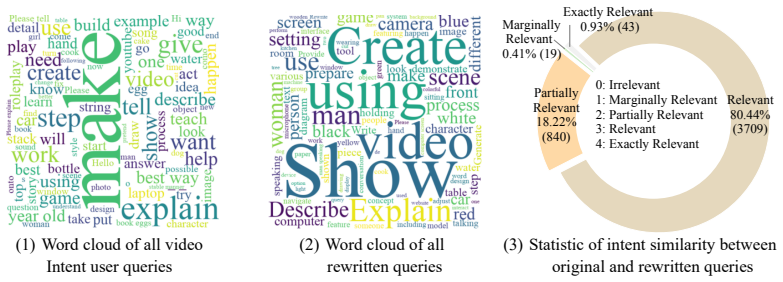
- [Figure 1] The caption says 'Figures 1' but refers to a single figure; also, labeling the three panels (a), (b), (c) would make the reference to panel (3) easier to follow.
- [General] The paper says code and data will be published upon acceptance; consider including a data card and a more detailed description of the annotation interfaces for the human studies in the final version.
Circularity Check
No significant circularity: the benchmark measures external T2V models with a constructed dataset and an LLM judge, with no fitted parameter or self-citation chain forcing the conclusion.
full rationale
The paper's central claim is that current text-to-video models struggle to answer real user queries, supported by empirical scores from Table 1. The generation chain is external: real user queries come from ChatbotArena, video answers are retrieved from YouTube, and T2V models produce the evaluated videos. The GPT-4o-mini judge applies the separately defined rubrics in Table 9, and no parameter is fitted to the benchmark's own outcomes. The only potentially self-referential step is that rewritten queries are conditioned on the retrieved golden videos (Section 2.3), but this is a data-construction choice rather than a reduction of the experimental result; the judge prompt explicitly instructs that the ground-truth video is a non-unique reference and that world knowledge should be used. Self-citations appear only as incidental context (e.g., Wang et al. 2025c on diverse query presentations) and are not load-bearing. The absence of human validation of the LLM judge is a legitimate external-validity concern, and the Limitation section acknowledges reference quality and single-sample evaluation, but these are validity risks, not circularity. The derivation is therefore self-contained and the score is 0.
Assumptions & free parameters
free parameters (2)
- adjacent clip merge similarity threshold =
0.3
- top-1 YouTube retrieval =
1
assumptions (4)
- domain assumption GPT-3.5-Turbo can reliably classify video intents in user queries.
- domain assumption GPT-4o-mini provides valid multi-dimensional scores for video QA quality.
- domain assumption Retrieved YouTube clips are correct ground-truth answers to the queries.
- domain assumption ImageBind and BGE embeddings capture query-video semantic relevance.
Cite this review
Pith. "Pith review of Respond Beyond Language: A Benchmark for Video Generation in Response to Realistic User Intents." pith.science (2026). https://pith.science/paper/TYCFIVET
@misc{pith2026250601689,
  author       = {Pith},
  title        = {Pith review of: Respond Beyond Language: A Benchmark for Video Generation in Response to Realistic User Intents},
  year         = {2026},
  howpublished = {\url{https://pith.science/paper/TYCFIVET}},
  note         = {Machine review of arXiv:2506.01689}
}
read the original abstract
Querying generative AI models, e.g., large language models (LLMs), has become a prevalent method for information acquisition. However, existing query-answer datasets primarily focus on textual responses, making it challenging to address complex user queries that require visual demonstrations or explanations for better understanding. To bridge this gap, we construct a benchmark, RealVideoQuest, designed to evaluate the abilities of text-to-video (T2V) models in answering real-world, visually grounded queries. It identifies 7.5K real user queries with video response intents from Chatbot-Arena and builds 4.5K high-quality query-video pairs through a multistage video retrieval and refinement process. We further develop a multi-angle evaluation system to assess the quality of generated video answers. Experiments indicate that current T2V models struggle with effectively addressing real user queries, pointing to key challenges and future research opportunities in multimodal AI.
Figures


Forward citations
Cited by 1 Pith paper
-
T2VWorldBench: A Benchmark for Evaluating World Knowledge in Text-to-Video Generation
A 1,200-prompt benchmark across six world-knowledge domains reports that ten state-of-the-art text-to-video models average below 0.70 on a 0 to 1 scale for producing videos consistent with real-world knowledge.
Reference graph
Works this paper leans on
-
[1]
If the query requires visual demonstrations, dynamic processes, or relies on visual or auditory context, it should be answered via video
-
[2]
# Instructions Return 1 if the query would be better answered via a video
If the query can be fully and clearly answered using concise text, numbers, or static information, it should not be answered via video. # Instructions Return 1 if the query would be better answered via a video. Return 0 otherwise. Your response should only be a number 0 or 1. Video Intent Recognition (third-round filtering) # Task Description You will be ...
-
[3]
Knowledge explanation Example: "how sun makes energy?", "hello, give me a short visual description of The Fool tarot card"
-
[4]
Pretend you are Spiderman and wish me for my birthday
Human-machine interaction and role play Example: "Pretend you are Spiderman and wish me for my birthday" ## Output format Return only a number from 0 to 4, where 1-4 correspond to the given categories, and 0 means the query does not fit into any category. Do not return anything other than a number. Query: ${query} Return only a number from 0 to 4. 10 Tabl...
-
[5]
generate a unique design of LED light for house
Art creation and designing Example: "generate a unique design of LED light for house"
-
[6]
How do i clean my water bottle if i can’t reach down into it
Skill demonstration Example: "How do i clean my water bottle if i can’t reach down into it", "How to bake a cake?"
-
[9]
It represents your rating result for the relevance of the re- sponse video. CorrectnessCorrectness: This metric measures the correctness of the response video, which is decided by assessing whether the response video correctly contains the key information for answering the query. It is a four-scale rating with the definition as below: - 0 means the contai...
-
[10]
It represents your rating result for the correctness of the response video. Coherence This metric measures whether the development process or steps of the response video content are logical and consistent and whether the consistency is reasonable. It is a four-scale rating: - 0 means the content of the response video is totally non-coherent and illogical....
Show all 12 references
-
[11]
It represents your rating result for the correctness of the response video. CompletenessCompleteness: It evaluates the completeness of the response video and is a four-scale rating: - 0 means the response video contains no useful information for answering the query. - 1 means ...
-
[12]
12 The prompt template for our LLM-as-a-Judge evaluation
It represents your rating result for the completeness of the response video. 12 The prompt template for our LLM-as-a-Judge evaluation. ## Task definition You are an expert query-video answer evaluator, and Your task is to evaluate whether the generated response questions can w...
-
[2022]
In NeurIPS
Training language models to follow instruc- tions with human feedback. In NeurIPS. SkyReels-AI. 2025. Skyreels v1: Human-centric video foundation model. https://github.com/ SkyworkAI/SkyReels-V1. Ang Wang, Baole Ai, Bin Wen, Chaojie Mao, Chen-Wei Xie, Di Chen, Feiwu Yu, Haimin...
2025 arXiv
-
[2024]
Explain how to tie a knot
Cogvideox: Text-to-video diffusion mod- els with an expert transformer. arXiv preprint arXiv:2408.06072. A Detailed Descriptions of Query Types and Examples In this section, we further provide the detailed de- scriptions of our self-devised query types and the corresponding qu...
Reviewed August 7, 2026 · model on record in the stance chip above.
Discussion (0). Sign in to comment.