REVIEW 4 major objections 6 minor 42 references
Bespoke multiresolution analysis of graph signals
T0 review · 4 major / 6 minor · reviewed 2026-08-15 · deepseek-v4-flash
Pith's one-line read The paper transplants the Euclidean samplet transform to graphs by embedding each patch in Euclidean space, and proves that locally polynomial graph signals compress far more sparsely than with Haar wavelets.
desk verdict A genuinely new construction of graph samplets with a clean idea, but the main decay bound is currently too weak to support the compression claims, and the experiments run on a pipeline the theory does not cover. read the letter →
The pith
A machine-rendered reading of the paper's core claim, the machinery that carries it, and where it could break.
The reading
What carries the argument
The load-bearing object is the samplet, a localized orthogonal discrete signed measure that annihilates all polynomials up to a fixed degree. The construction proceeds patch by patch: after embedding a patch into $\mathbb{R}^q$, the algorithm builds a cluster tree by recursively splitting bounding boxes, forms the moment matrix $M^\tau_j=[\phi(v_i)^\alpha]_{\alpha,i}$, and QR-factorizes its transpose. The first $m_s=\binom{s+q}{q}$ columns become scaling distributions and the remaining columns become samplets with $s+1$ vanishing moments. Pulling the basis back through the chart $\phi^{-1}$ and assembling all patches block-diagonally yields an orthogonal transform that, for balanced trees, costs $O(N)$ and turns local polynomial smoothness into rapid coefficient decay.
What would settle it
On a 'Y'-shaped graph patch where three branches meet, construct samplets with the paper's pipeline and check whether a smooth signal's coefficients decay according to Proposition 4.1; if they do not, or if the representation is no sparser than Haar wavelets, the single-chart manifold premise has been violated.
Extended reading notes
Core claim
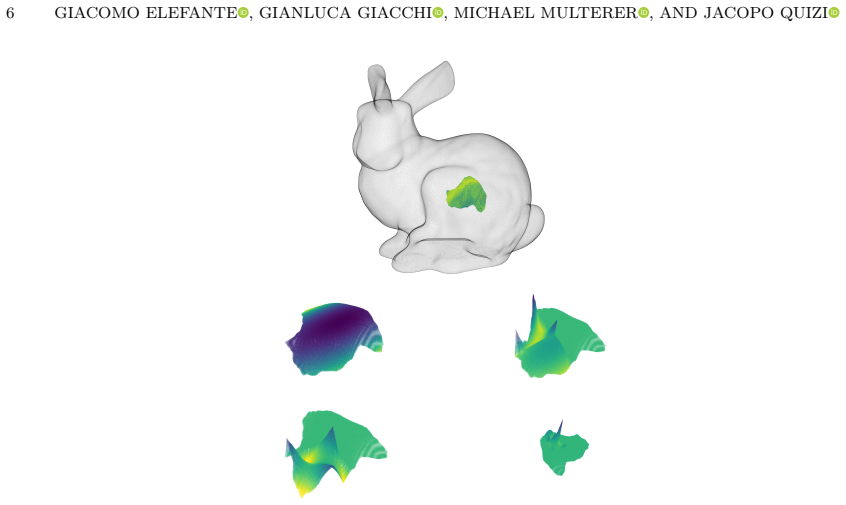
The central claim is that a patchwise samplet basis on a graph can annihilate pulled-back polynomials up to any chosen degree $s$, and that this vanishing-moment property is exactly what makes smooth graph signals compressible. For a signal $f$ in the graph microlocal class $C^\gamma_G(C,v_0)$, Proposition 4.1 bounds any samplet coefficient at a cluster $\tau$ containing $v_0$ by $C\max_{v_j\in U} d(v_j,v_0)^\gamma\sqrt{|\tau|}$. Since the cluster size shrinks geometrically, coefficients decay quickly away from any singular point. The numerical experiments on an embedded unit square, a Swiss roll, and the Stanford bunny show that reconstructing such signals with $1\%$ relative error needs orders of magnitude fewer nonzero coefficients than the Haar-wavelet baseline.
Load-bearing premise
The construction assumes every graph patch is a faithful discretization of one smooth manifold patch with a single coordinate chart, and that the embedding recovers those coordinates closely enough that the pulled-back polynomial space retains its vanishing-moment meaning; if either fails, the decay estimate and the compression gains collapse.
Editorial extensions
If this is right
- Signals in the graph microlocal classes $C^\gamma_G(C,v_0)$ have provably sparse samplet expansions with controlled error in the Euclidean norm.
- Graph data sampled from a low-dimensional manifold can be compressed without suffering the curse of ambient dimensionality, because the polynomial spaces live in the intrinsic coordinate dimension $q$.
- Both adaptive tree coarsening and best-$k$ thresholding on samplet coefficients yield reconstructions with a guaranteed relative error $\varepsilon$ using far fewer coefficients than Haar wavelets.
- The construction opens the way for graph versions of other samplet applications, such as compressed sensing and kernel learning, by providing a sparsifying basis for graph-structured signals.
Reading between the lines
- An implicit extension is that the patch chart need not come from Isomap: any embedding that approximately preserves local geometry could feed the same construction, and the decay estimate then becomes a measurable test of embedding quality.
- Because the error analysis covers exact Isomap while the experiments use landmark Isomap, a natural testable extension is to compare empirical coefficient decay with the proposition's bound on patches where exact and landmark embeddings diverge.
- On graphs that violate the single-chart manifold assumption, such as branched or self-intersecting patches, the samplet basis loses exact polynomial vanishing moments; whether useful compression survives is a question the paper leaves open.
Signed reviews
Editorial analysis
A structured set of objections, weighed in public.
Referee Report
Summary. The paper proposes a multiresolution analysis framework for graph signals. The graph is partitioned into patches, each patch is embedded into a Euclidean space via Isomap or landmark Isomap, samplets are constructed in the coordinate domains using a moment-matrix QR construction, and the resulting bases are pulled back to the graph. The central theoretical claim is Proposition 4.1, which asserts that signals in a microlocal class C^gamma_G have samplet coefficients decaying with the cluster size, so that truncation of the expansion yields sparse approximations. The authors also present adaptive-tree and best-k-term compression strategies and report numerical experiments on a million-point embedded unit square, a Swiss roll, and the Stanford bunny, where they observe large compression gains over Haar wavelets.
Significance. If the theoretical decay estimate were rigorously connected to the implemented pipeline, this would be a valuable contribution: the construction of orthogonal, localized, higher-order vanishing-moment bases on graphs with an underlying manifold structure is clean, the assumptions are stated explicitly, and the numerical experiments are large-scale and consistent with the intended effect. The paper gives a self-contained derivation of vanishing moments from the moment-matrix QR step, and the comparison with Haar wavelets is clearly reported. However, there is a substantial gap between the theory, which works with exact chart coordinates, and the numerics, which use landmark Isomap, and Proposition 4.1 as stated is too weak to support the claimed rapid decay. These issues affect the central claim and need to be addressed before the paper can be recommended for publication.
major comments (4)
- [Section 4.1, Eq. (4)] The bound uses max_{v_j in U} d(v_j,v0)^gamma over the whole patch U rather than over the cluster tau that supports the samplet. As written, the factor max_U^gamma is independent of the level j, so the bound decays only as sqrt(|tau|) and does not establish the gamma-dependent rapid decay claimed in the abstract and in Section 7. Please correct the statement to use a maximum over tau, or introduce a localized version of Definition 2.1 that yields a scale-dependent error.
- [Sections 3 and 5.3] Proposition 4.1 assumes that samplets annihilate the true coordinate monomials X^alpha = x^alpha o phi_r. In the implemented pipeline the moment matrix (3) is built from Isomap or landmark Isomap coordinates, and Proposition 5.2 only bounds the difference between the true and estimated moment matrices. A bound on moment matrices does not by itself control the inner products <psi_{j,k}, X^alpha> because the samplet filters are obtained through a QR factorization, and no perturbation or stability theorem for the samplet coefficients is provided. The paper should supply a perturbation estimate for the samplet filters, or the decay theorem cannot be applied to the algorithm whose results are reported in Section 6.
- [Remark 5.3 and Section 6] All numerical experiments use landmark Isomap, while Propositions 5.1 and 5.2 concern exact Isomap; this is an explicit gap. The authors should either extend the consistency analysis to landmark Isomap, provide a controlled comparison with exact Isomap, or state clearly that the numerical results are not covered by the theorem. The high lost-energy values in Table 3 (e.g., 0.36 at p=50, q=2) indicate substantial embedding distortion, so this is not a purely formal concern.
- [Section 5.2, Proposition 5.1] The minimization in Proposition 5.1 is over O(d), but the embedded points y_i and the exact coordinates z_i lie in R^q; the orthogonal group should be O(q). Please also verify that the exponent 1/q is the one supplied by the cited Corollary 4 of [2], since the dimensions of the domain and codomain affect the rate.
minor comments (6)
- [Section 4.1] The name "Cauchy-Schwartz" should be "Cauchy-Schwarz".
- [Definition 2.1] The condition sum_{|beta|=floor(gamma)}|c_beta| != 0 is not used in Proposition 4.1 and is confusing when gamma < 1; please clarify its role or remove it.
- [Section 3] The sentence explaining the QR step, "Since R^T is a lower triangular matrix...", is ambiguous about the dimensions of Q_Phi, Q_Psi, and R; a short description of the block structure would help the reader verify the vanishing-moments claim.
- [Table 4] For p=100, q=3, the reported lost energy is 6.78e-1, which is an order of magnitude larger than the neighboring entries and contradicts the text's statement that lost energy decreases from p=50 to p=100; please check this entry.
- [Section 6] The lost-energy metric is defined via the trace of the Gram matrix of landmark points, but the relation of this quantity to the embedding error in Proposition 5.1 is not explained; please state why this is a meaningful proxy for coordinate accuracy.
- [Proposition 4.1] The notation f o phi^{-1} is used although f is defined on vertices; consider writing the inner product directly as <psi_{j,k}, f> or clarifying the pullback notation.
Circularity Check
No significant circularity: the decay estimate is derived from the stated local-polynomial regularity and a self-contained vanishing-moment construction.
full rationale
The paper's central derivation chain is self-contained. Definition 2.1 introduces the graph microlocal class C^gamma_G(C,v0) via local approximation by polynomials in the chart coordinates phi_r(v). Section 3 constructs samplets whose vanishing moments hold for those same monomials by QR factorization of the moment matrix, and Proposition 4.1 then proves coefficient decay directly from the defining inequality (2) together with the vanishing-moment property; the proof is written out in full and uses no fitted constants. The numerical compression tables are experiments reported after constructing the basis, not predictions forced by the theory, so there is no fitted-input-called-prediction step. The only self-referential feature is that both the signal class and the samplet filters are expressed in terms of the same coordinate map phi_r; this is a deliberate design choice (the basis is tailored to the coordinates), not a logical circularity, because the class is defined by signal regularity relative to those coordinates and the decay consequence is proved rather than assumed. Citations to prior samplet work, including [22] and [3], supply the Euclidean construction and motivation, but the graph version's proof does not rest on those citations. The gap between the L-Isomap numerics and the exact-Isomap error bounds in Propositions 5.1 and 5.2, acknowledged in Remark 5.3, is a correctness or validation gap, not a circular reduction, and therefore does not raise the circularity score.
Assumptions & free parameters
free parameters (6)
- embedding dimension q =
2, 3, 4 (scanned)
- patch count p =
1, 50, 100, 150, 200 (scanned)
- vanishing moments s+1 =
1 to 5 (scanned)
- landmarks per patch =
100
- graph connectivity radius epsilon =
4e-3, 5e-3, 6e-3
- compression threshold epsilon =
1e-2
assumptions (5)
- domain assumption Each graph patch G_r is a discretization of a Riemannian manifold U_r of dimension q with a unique chart phi_r (Section 2.1).
- domain assumption Graph distances approximate geodesic distances on the manifold (Section 2.1 and Section 5.2, via [7]).
- domain assumption The Isomap perturbation bound [2, Corollary 4] holds for the sampled patches, including the reach and quasi-uniformity conditions (Proposition 5.1).
- domain assumption Landmark Isomap behaves like exact Isomap for the used landmark counts (Remark 5.3).
- standard math Standard tools: QR decomposition, Cauchy-Schwarz, and the Binev-DeVore adaptive tree approximation [9].
Cite this review
Pith. "Pith review of Bespoke multiresolution analysis of graph signals." pith.science (2026). https://pith.science/paper/TYRGELSF
@misc{pith2026250719181,
  author       = {Pith},
  title        = {Pith review of: Bespoke multiresolution analysis of graph signals},
  year         = {2026},
  howpublished = {\url{https://pith.science/paper/TYRGELSF}},
  note         = {Machine review of arXiv:2507.19181}
}
read the original abstract
We present a novel framework for discrete multiresolution analysis of graph signals. The main analytical tool is the samplet transform, originally defined in the Euclidean framework as a discrete wavelet-like construction, tailored to the analysis of scattered data. The first contribution of this work is defining samplets on graphs. To this end, we subdivide the graph into a fixed number of patches, embed each patch into a Euclidean space, where we construct samplets, and eventually pull the construction back to the graph. This ensures orthogonality, locality, and the vanishing moments property with respect to properly defined polynomial spaces on graphs. Compared to classical Haar wavelets, this framework broadens the class of graph signals that can efficiently be compressed and analyzed. Along this line, we provide a definition of a class of signals that can be compressed using our construction. We support our findings with different examples of signals defined on graphs whose vertices lie on smooth manifolds. For efficient numerical implementation, we combine heavy edge clustering, to partition the graph into meaningful patches, with landmark \texttt{Isomap}, which provides low-dimensional embeddings for each patch. Our results demonstrate the method's robustness, scalability, and ability to yield sparse representations with controllable approximation error, significantly outperforming traditional Haar wavelet approaches in terms of compression efficiency and multiresolution fidelity.
Figures


Figures from the paper (2 more)


Reference graph
Works this paper leans on
-
[2]
E. Arias-Castro, A. Javanmard, and B. Pelletier. Perturbation bounds for procrustes, classical scaling, and trilateration, with applications to manifold learning.J. Mach. Learn. Res., 21:Paper No. 15, 37, 2020
work page 2020
-
[1]
R. Archibald and B. Whitney. Haar-like wavelets on hierarchical trees.J. Sci. Comput., 99(1):Paper No. 3, 34, 2024
work page 2024
-
[3]
Multiresolution local smoothness detection in non-uniformly sampled multivariate signals
S. Avesani, G. Giacchi, and M. Multerer. Multiresolution local smoothness detection in non-uniformly sampled multivariate signals.arXiv:2507.13480, 2025. BESPOKE MULTIRESOLUTION ANALYSIS OF GRAPH SIGNALS 15 Table 4. Stanford bunny performances for embedding dimension 3. lost energy s + 1 nnz (AT) nnz (NT) p = 50 1.63· 10−1 1 579753 128082 1.63· 10−1 2 123...
work page Pith review arXiv 2025
-
[4]
S. Avesani, R. Kempf, M. Multerer, and H. Wendland. Multiscale scattered data analysis in samplet coordinates. arXiv preprint arXiv:2409.14791, 2024
arXiv 2024
-
[5]
M. Balasubramanian and E. L. Schwartz. The isomap algorithm and topological stability. Science, 295(5552):7–7, 2002
work page 2002
- [6]
-
[7]
M. Bernstein, V. De Silva, J. C. Langford, and J. B. Tenenbaum. Graph approximations to geodesics on embedded manifolds. Technical report, Department of Psychology, Stanford University, 2000
work page 2000
- [8]
Show all 42 references
-
[9]
Binev and R
P. Binev and R. A. DeVore. Fast computation in adaptive tree approximation.Numer. Math., 97:193–217, 2004
2004
-
[10]
Borg and P
I. Borg and P. J. F. Groenen.Modern Multidimensional Scaling. Springer Series in Statistics. Springer, New York, second edition, 2005
2005
-
[11]
I. M. Bulai and S. Saliani. Spectral graph wavelet packets frames.Appl. Comput. Harmon. Anal., 66:18–45, 2023. 16 GIACOMO ELEF ANTE , GIANLUCA GIACCHI , MICHAEL MULTERER , AND JACOPO QUIZI Table 5. Stanford bunny performances for embedding dimension 4. lost energy s + 1 nnz (A...
2023
-
[12]
Chen and M
G. Chen and M. Maggioni. Multiscale geometric wavelets for the analysis of point clouds. In2010 44th Annual Conference on Information Sciences and Systems (CISS), pages 1–6, 2010
2010
-
[13]
R. R. Coifman and M. Maggioni. Diffusion wavelets.Appl. Comput. Harmon. Anal., 21(1):53–94, 2006
2006
-
[14]
S. Dam, P. Maurel, and J. Coloigner. Graph wavelet packets for the classification of brain data in anxiety and depression. In2024 32nd European Signal Processing Conference (EUSIPCO), pages 1436–1440, 2024
2024
-
[15]
De Silva and J
V. De Silva and J. B. Tenenbaum. Global versus local methods in nonlinear dimensionality reduction. In Proceedings of the 16th International Conference on Neural Information Processing Systems, NIPS’02, page 721–728, Cambridge, MA, USA, 2002. MIT Press
2002
-
[16]
De Silva and J
V. De Silva and J. B. Tenenbaum. Sparse multidimensional scaling using landmark points. Technical report, Stanford University, 2004
2004
-
[17]
D. L. Donoho. CART and best-ortho-basis: a connection.Ann. Statist., 25(5):1870–1911, 1997
1911
-
[18]
W. Erb. Graph wedgelets: adaptive data compression on graphs based on binary wedge partitioning trees and geometric wavelets.IEEE Trans. Signal Inform. Process. Netw., 9:24–34, 2023
2023
-
[19]
Gavish, B
M. Gavish, B. Nadler, and R. R. Coifman. Multiscale wavelets on trees, graphs and high dimensional data: theory and applications to semi supervised learning. InProceedings of the 27th International Conference on International Conference on Machine Learning, ICML’10, page 367–3...
2010
-
[20]
Goerttler, M
S. Goerttler, M. Wu, and F. He. The effect of graph frequencies on dynamic structures in graph signal processing. In 2022 IEEE Signal Processing in Medicine and Biology Symposium (SPMB), pages 1–6, 2022
2022
-
[21]
D. K. Hammond, P. Vandergheynst, and R. Gribonval. Wavelets on graphs via spectral graph theory. Appl. Comput. Harmon. Anal., 30(2):129–150, 2011
2011
-
[22]
Harbrecht and M
H. Harbrecht and M. Multerer. Samplets: Construction and scattered data compression.J. Comput. Phys., 471:111616, 2022
2022
-
[23]
Harbrecht, M
H. Harbrecht, M. Multerer, O. Schenk, and C. Schwab. Multiresolution kernel matrix algebra.Numer. Math., 156(3):1085–1114, 2024
2024
-
[24]
Huang, M
W. Huang, M. Valsecchi, and M. Multerer. Anisotropic multiresolution analyses for deep fake detection. Pattern Recognit., 164:111551, 2025
2025
-
[25]
In2021 43rd Annual International Conference of the IEEE Engineering in Medicine & Biology Society (EMBC), pages 657–660, 2021
P.Humbert, L.Oudre, andC.Dubost.Learningspatialfiltersfromeegsignalswithgraphsignalprocessing methods. In2021 43rd Annual International Conference of the IEEE Engineering in Medicine & Biology Society (EMBC), pages 657–660, 2021
2021
-
[26]
InICASSP 2019 - 2019 IEEE International Conference on Acoustics, Speech and Signal Processing (ICASSP), pages 8157–8161, 2019
V.N.Ioannidis, A.G.Marques, andG.B.Giannakis.Arecurrentgraphneuralnetworkformulti-relational data. InICASSP 2019 - 2019 IEEE International Conference on Acoustics, Speech and Signal Processing (ICASSP), pages 8157–8161, 2019
2019
-
[27]
S. Jaffard. Pointwise smoothness, two-microlocalization and wavelet coefficients.Publ. Mat., 35(1):155– 168, 1991
1991
-
[28]
Karypis and V
G. Karypis and V. Kumar. Metis—a software package for partitioning unstructured graphs, partitioning meshes and computing fill-reducing ordering of sparse matrices.University of Minnesota, Department of Computer Science, 1997
1997
-
[29]
Karypis and V
G. Karypis and V. Kumar. Multilevel k-way partitioning scheme for irregular graphs.J. Parallel Distrib. Comput., 48(1):96–129, 1998
1998
-
[30]
A. B. Lee, B. Nadler, and L. Wasserman. Treelets—an adaptive multi-scale basis for sparse unordered data. Ann. Appl. Stat., 2(2):435–471, 2008
2008
-
[31]
G. Li, J. Yang, and S. Liang. Ergnn: Spectral graph neural network with explicitly-optimized rational graph filters. In ICASSP 2025 - 2025 IEEE International Conference on Acoustics, Speech and Signal Processing (ICASSP), pages 1–5, 2025
2025
-
[32]
S. G. Mallat. A theory for multiresolution signal decomposition: the wavelet representation.IEEE Trans- actions on Pattern Analysis and Machine Intelligence, 11(7):674–693, 1989
1989
-
[33]
D. M. Mohan, M. T. Asif, N. Mitrovic, J. Dauwels, and P. Jaillet. Wavelets on graphs with application to transportation networks. In17th International IEEE Conference on Intelligent Transportation Systems (ITSC), pages 1707–1712, 2014
2014
-
[34]
F. Murtagh. The Haar wavelet transform of a dendrogram.J. Classification, 24(1):3–32, 2007
2007
-
[35]
Nishi, K
T. Nishi, K. Otaki, K. Hayakawa, and T. Yoshimura. Traffic signal control based on reinforcement learning with graph convolutional neural nets. In2018 21st International Conference on Intelligent Transportation Systems (ITSC), pages 877–883, 2018
2018
-
[36]
I. Ram, M. Elad, and I. Cohen. Generalized tree-based wavelet transform.IEEE Trans. Signal Process., 59(9):4199–4209, 2011
2011
-
[37]
D. I. Shuman, S. K. Narang, P. Frossard, A. Ortega, and P. Vandergheynst. The emerging field of signal processing on graphs: Extending high-dimensional data analysis to networks and other irregular domains. IEEE Signal Process. Mag., 30(3):83–98, 2013
2013
-
[38]
J. B. Tenenbaum, V. De Silva, and J. C. Langford. A Global Geometric Framework for Nonlinear Dimen- sionality Reduction.Science, 290(5500):2319–2323, 2000
2000
-
[39]
W. S. Torgerson. Multidimensional scaling. I. Theory and method.Psychometrika, 17:401–419, 1952
1952
-
[40]
Von Luxburg
U. Von Luxburg. A tutorial on spectral clustering.Statist. Comput., 17(4):395–416, 2007
2007
-
[41]
H. Wei, N. Xu, H. Zhang, G. Zheng, X. Zang, C. Chen, W. Zhang, Y. Zhu, K. Xu, and Z. Li. Colight: Learning network-level cooperation for traffic signal control. InProceedings of the 28th ACM International Conference on Information and Knowledge Management, CIKM ’19, page 1913–...
1913
-
[42]
Z. Xu. Data reconstruction of wireless sensor network based on graph signal.Transactions on Engineering and Technology Research, 1:129–136, Dec. 2023. 18 GIACOMO ELEF ANTE , GIANLUCA GIACCHI , MICHAEL MULTERER , AND JACOPO QUIZI IDSIA USI-SUPSI, Università della Svizzera itali...
2023
Reviewed August 15, 2026 · model on record in the stance chip above.
Discussion (0). Continue with ORCID to comment.