GQL-Based Physical-Constraint-Preserving High-Order Finite Difference Schemes for Special Relativistic Hydrodynamics in Arbitrary Dimensions
Pith reviewed 2026-07-01 03:34 UTC · model grok-4.3
The pith
Geometric quasilinearization turns nonlinear relativistic constraints into linear inequalities solvable by small eigenvalue problems for high-order PCP schemes.
A machine-rendered reading of the paper's core claim, the machinery that carries it, and where it could break.
Core claim
By expressing the physical constraints of special relativistic hydrodynamics through geometric quasilinearization and solving the resulting limiter parameters via rational stereographic parameterization and small symmetric eigenvalue problems, high-order WENO finite-difference schemes can be made physical-constraint-preserving in arbitrary dimensions without iteration.
What carries the argument
Geometric quasilinearization (GQL) representation that converts nonlinear RHD constraints into linear inequalities, combined with rational stereographic parameterization of the GQL normal vector that reduces worst-case minimization to a generalized Rayleigh-quotient eigenvalue problem.
If this is right
- The same GQL-based limiter can be inserted into any high-order finite-difference or finite-volume scheme for RHD without changing the underlying reconstruction or flux.
- Design-order accuracy is retained for smooth solutions while discontinuities remain sharply captured and admissible.
- The method extends directly from one to three spatial dimensions with only a modest increase in the size of the eigenvalue problems.
- Relaxed variants lower computational cost in multidimensions while still guaranteeing physical states.
Where Pith is reading between the lines
- The approach may generalize to other hyperbolic systems whose admissibility sets admit a similar quasilinear inequality description.
- Because the eigenvalue solves are small and independent per cell, the limiter is a natural candidate for GPU or distributed-memory parallelization.
- If the GQL normal vector can be computed analytically from the equation of state, the entire limiter step becomes fully explicit.
Load-bearing premise
The geometric quasilinearization representation must exactly convert the nonlinear physical constraints into an equivalent family of linear inequalities.
What would settle it
A single run of the scheme on an ultra-relativistic Riemann problem in which the limiter is disabled and a cell is observed to reach negative density or superluminal velocity.
Figures
read the original abstract
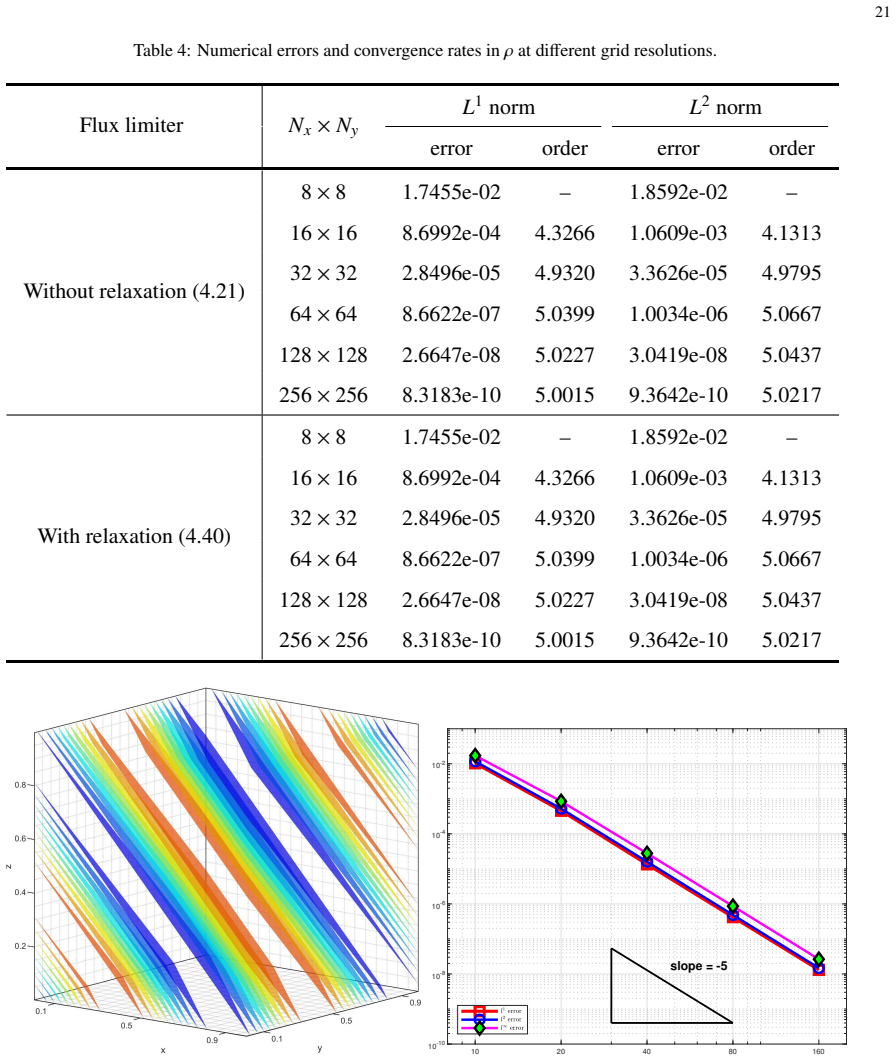
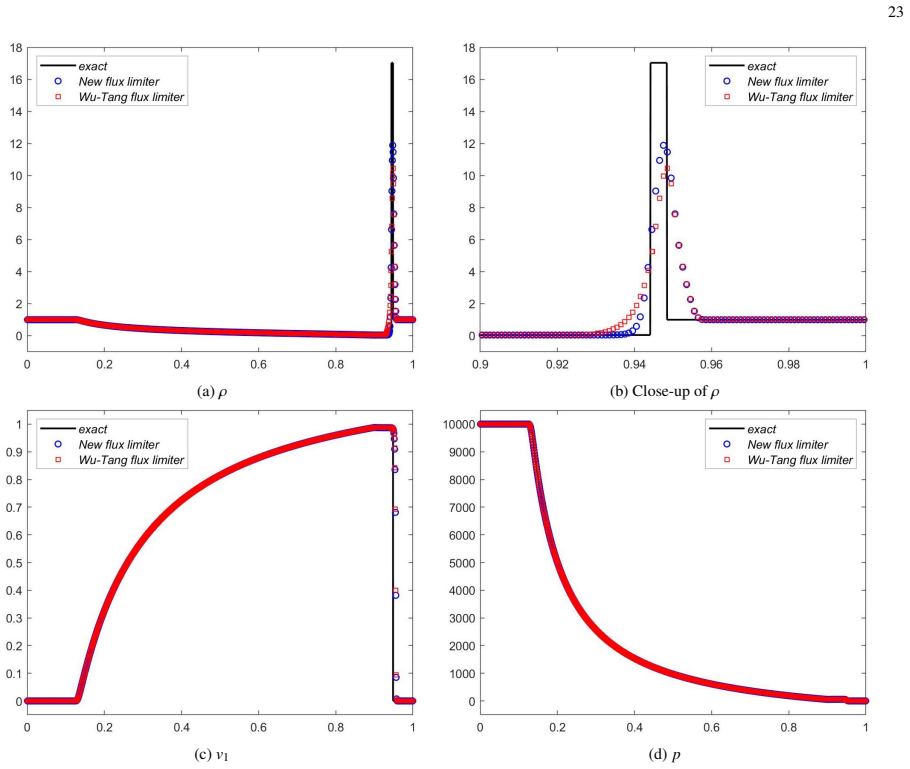
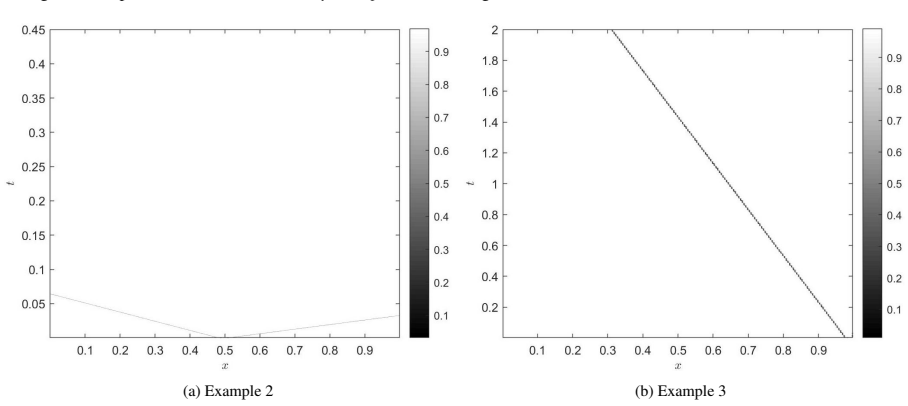
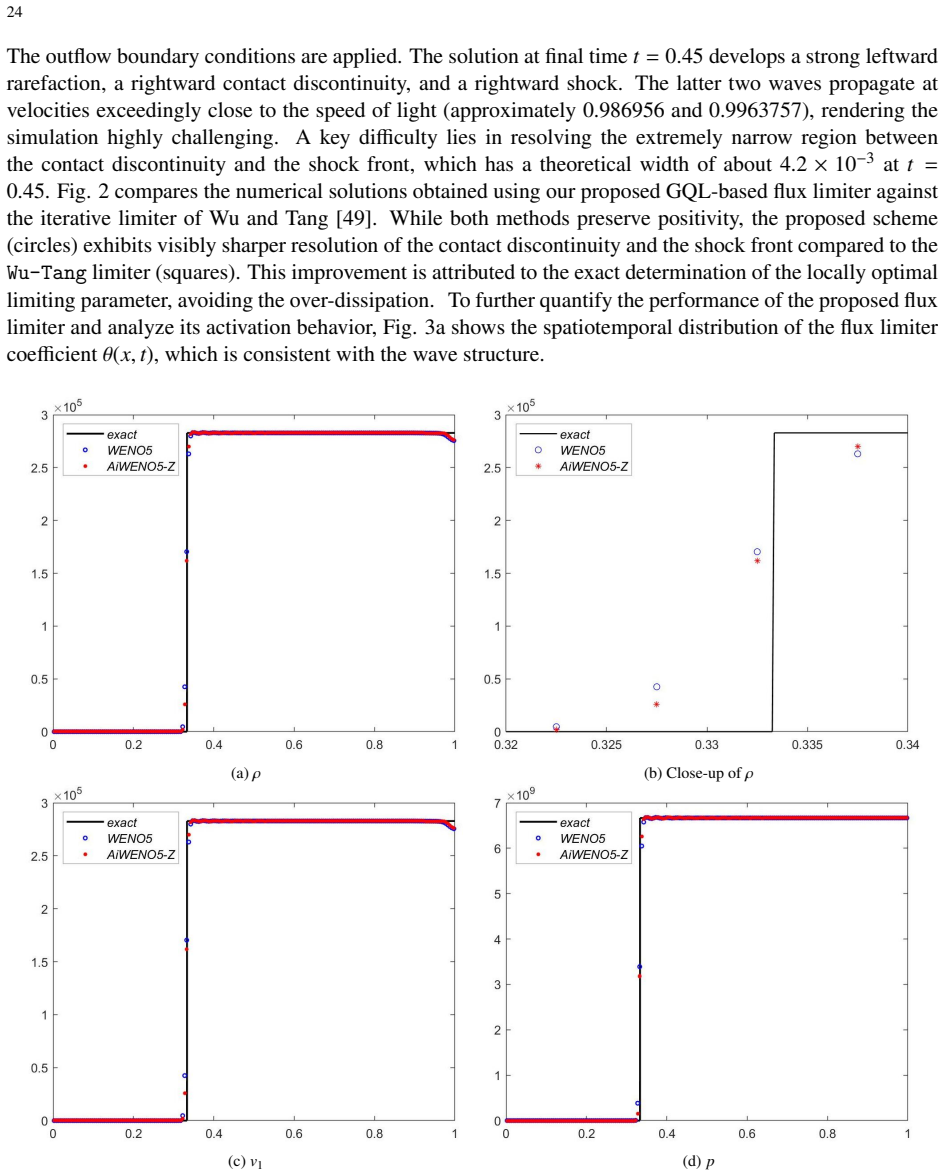
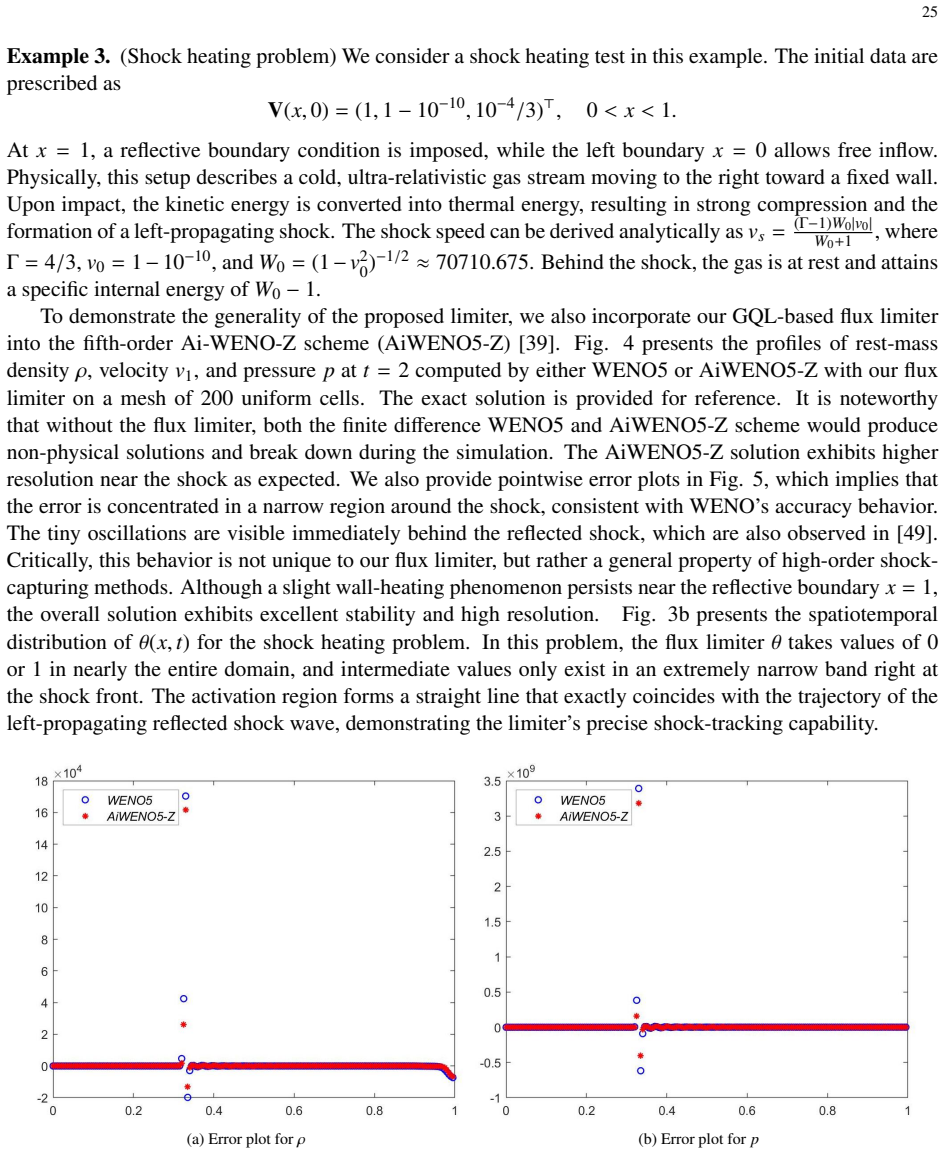
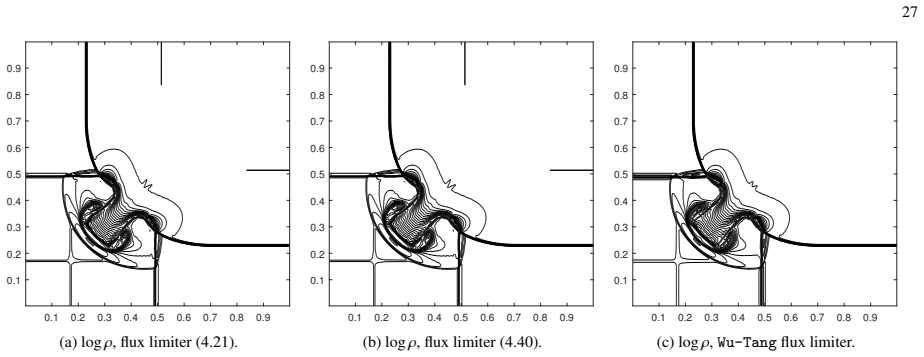
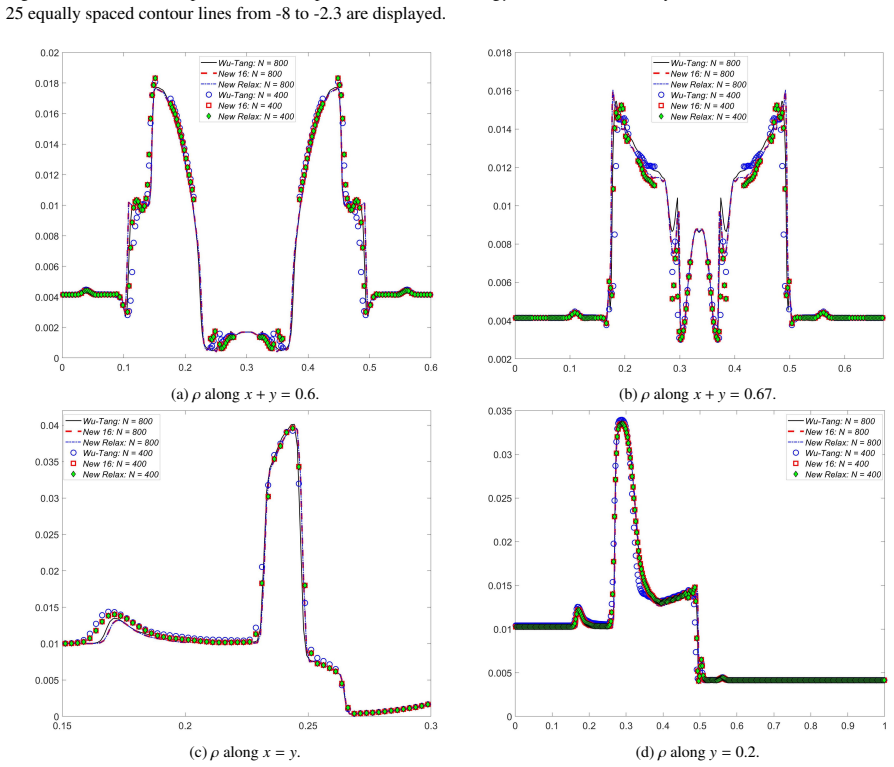
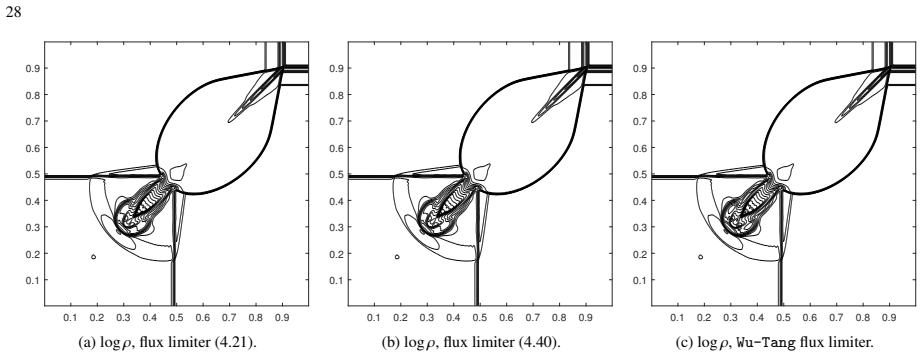
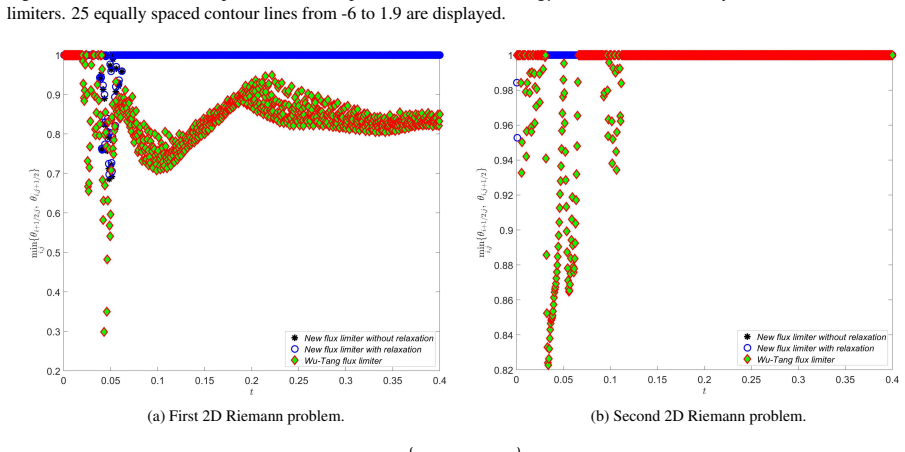
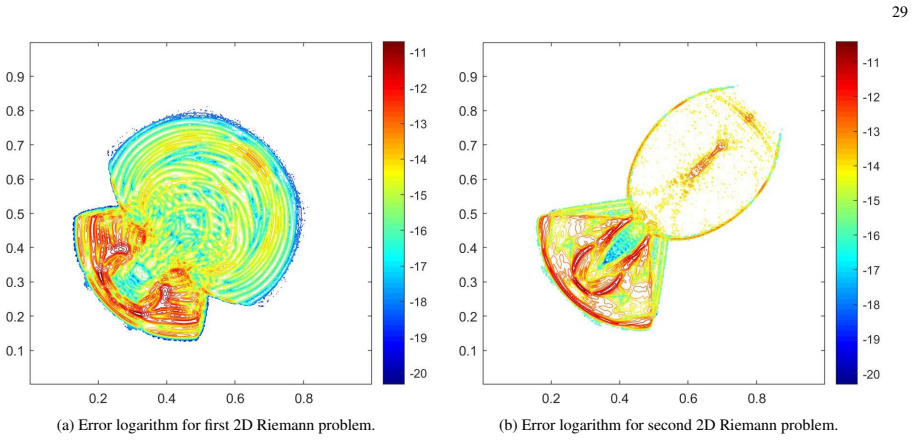
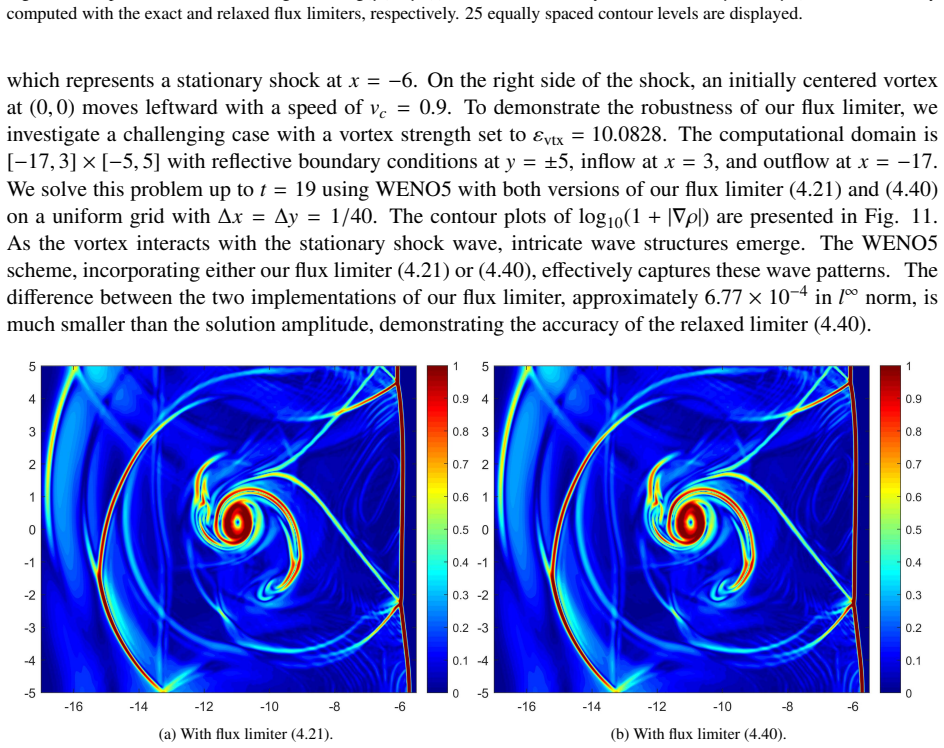
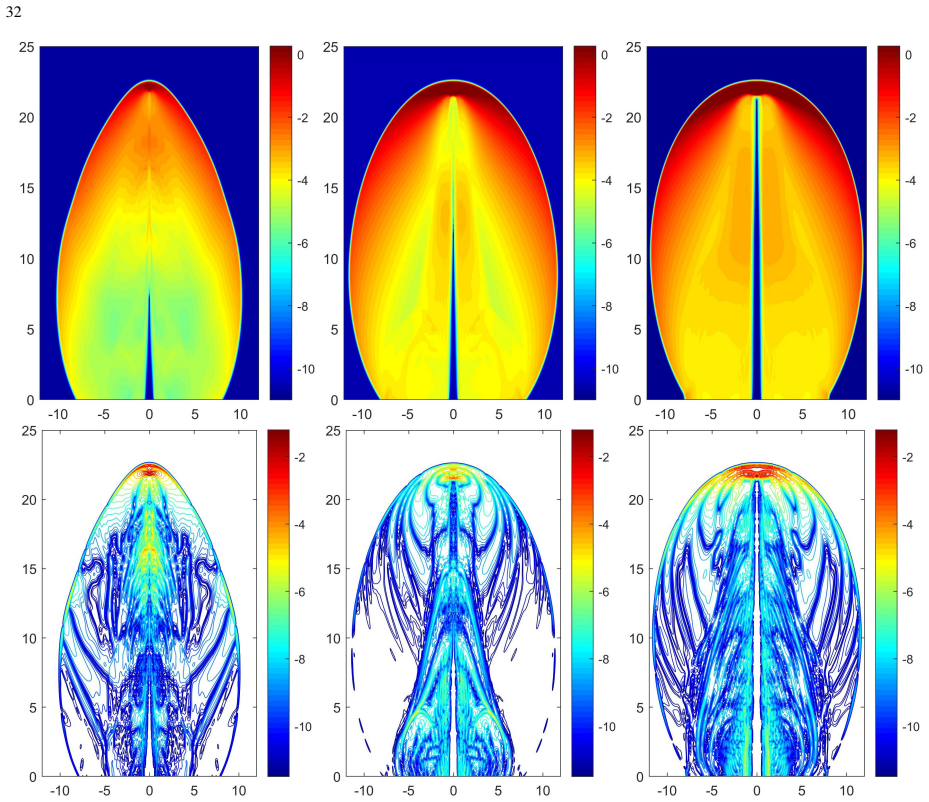
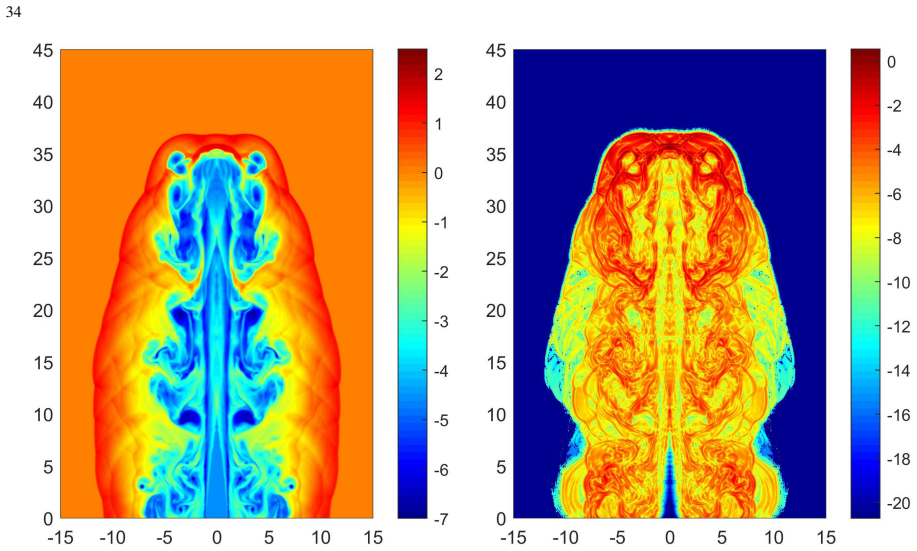
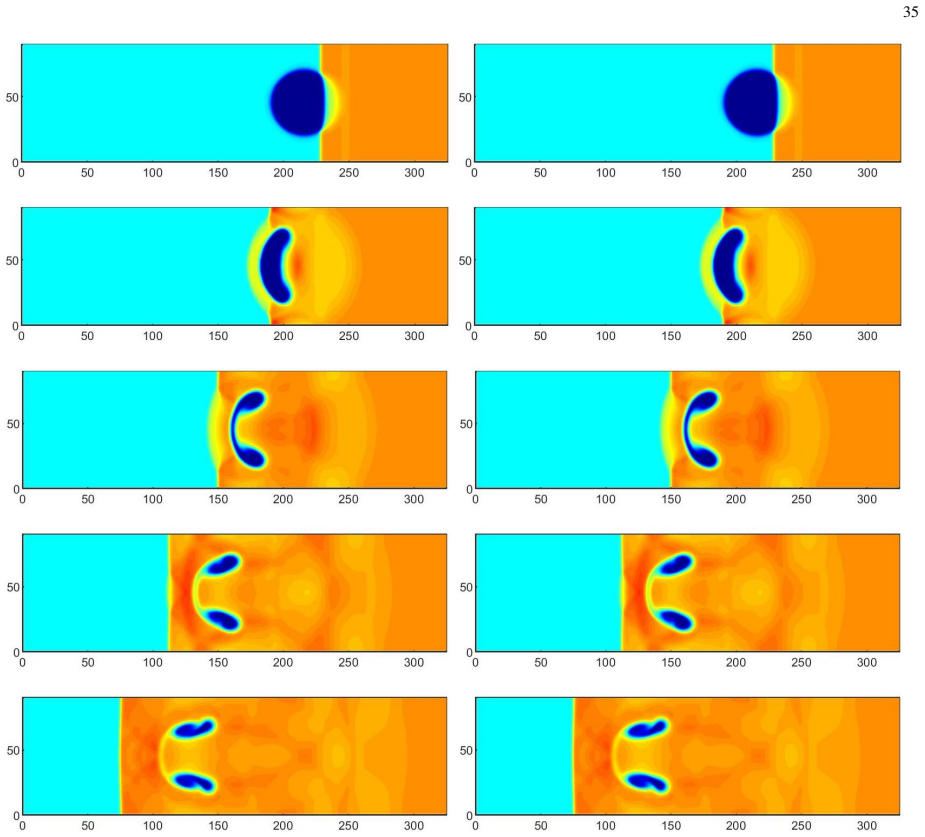
High-order accurate simulations of special relativistic hydrodynamics (RHD) are prone to numerical breakdown if intrinsic physical constraints (positive rest-mass density/pressure and subluminal velocity) are violated near strong discontinuities. In this work, we develop a robust and efficient physical-constraint-preserving (PCP) flux-limiting framework for high-order schemes, using finite-difference WENO as a representative example. By leveraging the geometric quasilinearization (GQL) representation, which equivalently reformulates the nonlinear RHD constraints into a family of linear inequalities, we integrate a Zalesak-type Flux-Corrected Transport (FCT) update into a scalar-style limiter that acts directly on conservative variables. A critical innovation is the explicit, non-iterative determination of limiting parameters via a rational stereographic parameterization of the GQL normal vector. This technique transforms the required worst-case minimization over auxiliary variables into a generalized Rayleigh-quotient formulation, allowing the optimal parameters to be obtained by solving small symmetric eigenvalue problems ($2\times2$ in 1D; $(d+1)\times(d+1)$ in $d$ dimensions). Relaxed variants are further introduced to reduce computational costs in multidimensions while retaining the PCP guarantee. Extensive numerical benchmarks ranging from 1D to 3D, including ultra-relativistic Riemann problems and astrophysical jets, demonstrate that the proposed method robustly enforces physical admissibility, sharply resolves discontinuities, and maintains design-order accuracy for smooth solutions.
Editorial analysis
A structured set of objections, weighed in public.
Referee Report
Summary. The manuscript develops a physical-constraint-preserving (PCP) flux-limiting framework for high-order finite-difference WENO schemes for special relativistic hydrodynamics (RHD) in arbitrary dimensions. It employs geometric quasilinearization (GQL) to reformulate the nonlinear RHD admissibility constraints (positive density/pressure, subluminal velocity) as linear inequalities, integrates a Zalesak-type FCT update, and uses a rational stereographic parameterization of the GQL normal vector to convert the worst-case minimization into a generalized Rayleigh-quotient problem solved via small symmetric eigenvalue problems (2×2 in 1D; (d+1)×(d+1) in d dimensions). Relaxed variants reduce cost while retaining the PCP property. Extensive 1D–3D benchmarks, including ultra-relativistic Riemann problems and astrophysical jets, are presented to demonstrate enforcement of physical admissibility, sharp discontinuity capture, and retention of design-order accuracy on smooth solutions.
Significance. If the claimed exact algebraic equivalences in the GQL reformulation and stereographic parameterization hold without approximation, the work provides a non-iterative, dimension-independent PCP limiter that preserves high-order accuracy while guaranteeing admissibility. This is a meaningful advance for robust high-order RHD simulations in astrophysics, where standard methods frequently fail near strong shocks. The explicit reduction to small eigenproblems and the supporting numerical evidence constitute clear strengths.
minor comments (3)
- The description of the relaxed variants in multidimensions would benefit from an explicit statement of the trade-off between computational cost and the size of the admissible set (e.g., a short paragraph comparing flop counts or iteration counts for the full versus relaxed eigenproblems).
- Notation for the GQL normal vector and the auxiliary variables should be made uniform between the derivation of the linear inequalities and the subsequent Rayleigh-quotient formulation to improve readability.
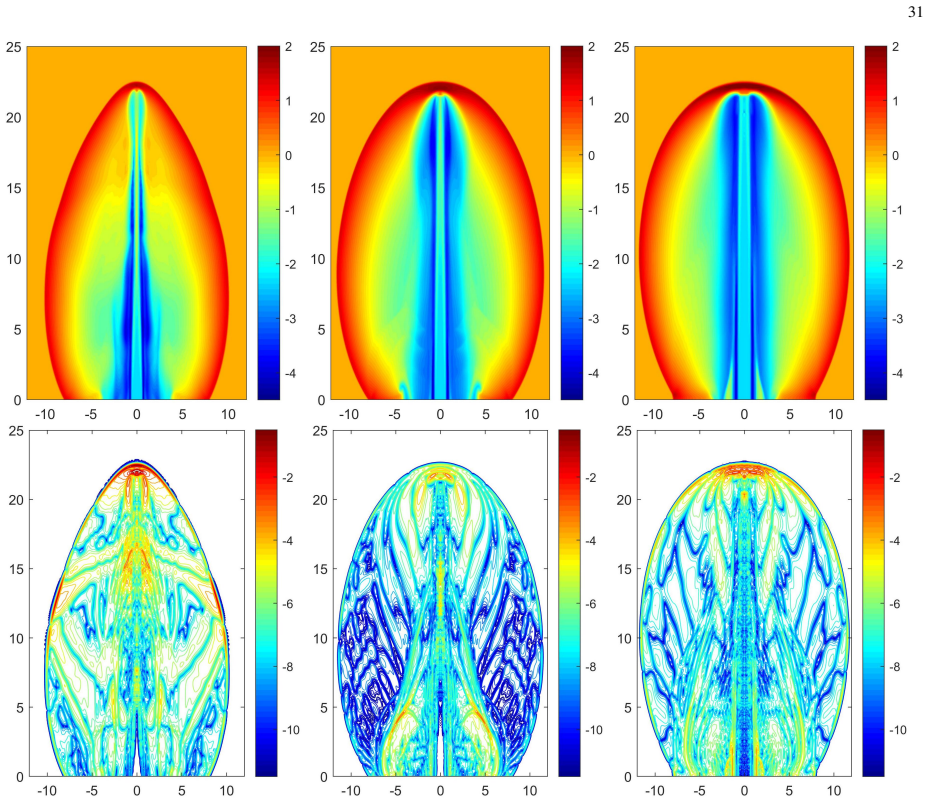
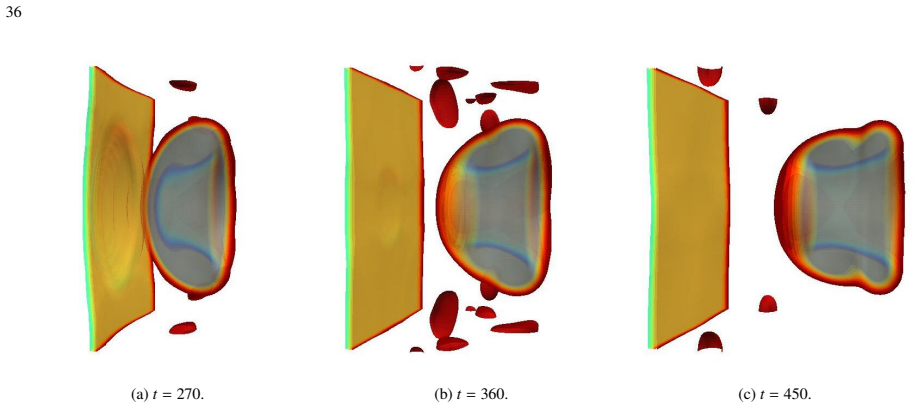
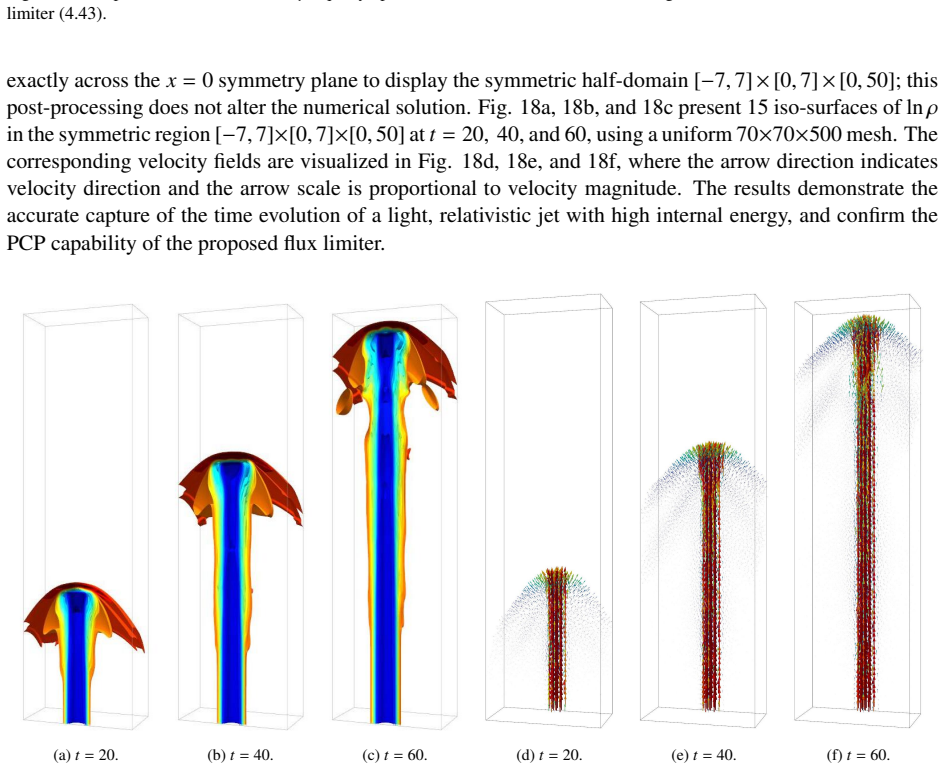
- Figure captions for the 3D jet benchmarks should include a brief note on the grid resolution and the observed order of accuracy at the final time to allow direct comparison with the 1D/2D convergence tables.
Simulated Author's Rebuttal
We thank the referee for the positive assessment of our work, the clear summary of its contributions, and the recommendation for minor revision. No specific major comments were listed in the report.
Circularity Check
No significant circularity
full rationale
The derivation chain begins from the stated GQL reformulation of nonlinear RHD constraints into linear inequalities, followed by an explicit rational stereographic parameterization that algebraically converts the min-max problem into a generalized Rayleigh quotient solved by small symmetric eigenproblems. These steps are presented as direct equivalences without any fitted parameter being relabeled as a prediction, without self-definitional loops, and without load-bearing uniqueness imported via self-citation. The numerical benchmarks function only as post-derivation validation. No enumerated circular pattern is exhibited by the quoted construction.
Axiom & Free-Parameter Ledger
Reference graph
Works this paper leans on
-
[1]
Abgrall, M
R. Abgrall, M. Jiao, Y . Liu, and K. Wu. A novel and simple invariant-domain-preserving framework for PAMPA scheme: 1D case. SIAM J. Sci. Comput., 47(6):A3536–A3565, 2025
2025
-
[2]
Abgrall, M
R. Abgrall, M. Jiao, Y . Liu, and K. Wu. Bound preserving Point-Average-Moment PolynomiAl-interpreted (PAMPA) scheme: one-dimensional case. Commun. Comput. Phys., 39(5):29–58, 2026
2026
-
[3]
R. Abgrall, Y . Liu, and W. Boscheri. Bound preserving Point-Average-Moment PolynomiAl-interpreted (PAMPA) on polyg- onal meshes. 2025. https: //arxiv.org/abs/2502.10069
-
[4]
D. L. Book, J. P. Boris, and K. Hain. Flux-corrected transport II: Generalizations of the method.J. Comput. Phys., 18(3):248– 283, 1975
1975
-
[5]
Borges, M
R. Borges, M. Carmona, B. Costa, and W. S. Don. An improved weighted essentially non-oscillatory scheme for hyperbolic conservation laws. Journal of computational physics, 227(6):3191–3211, 2008
2008
-
[6]
J. P. Boris and D. L. Book. Flux-corrected transport. I. SHASTA, a fluid transport algorithm that works. J. Comput. Phys., 11(1):38–69, 1973
1973
-
[7]
J. P. Boris and D. L. Book. Flux-corrected transport. III. Minimal-error FCT algorithms. J. Comput. Phys., 20(4):397–431, 1976
1976
-
[8]
C. Cai, J. Qiu, and K. Wu. Provably convergent newton–raphson methods for recovering primitive variables with applications to physical-constraint-preserving hermite weno schemes for relativistic hydrodynamics.J. Comput. Phys., 498:112669, 2024
2024
-
[9]
H. Cao, M. Peng, and K. Wu. Robust discontinuous Galerkin methods maintaining physical constraints for general relativistic hydrodynamics. J. Comput. Phys., 526:113770, 2025
2025
-
[10]
Y . Chen, Y . Kuang, and H. Tang. Second-order accurate BGK schemes for the special relativistic hydrodynamics with the Synge equation of state. J. Comput. Phys., 442:110438, 2021
2021
-
[11]
Chen and K
Y . Chen and K. Wu. A physical-constraint-preserving finite volume WENO method for special relativistic hydrodynamics on unstructured meshes. J. Comput. Phys., 466:111398, 2022
2022
-
[12]
S. Cui, K. Wu, and L. Xu. On local minimum entropy principle of high-order schemes for relativistic Euler equations. Math. Comp., in press, 2025. https://doi.org/10.1090/mcom/4139
-
[13]
Duan and H
J. Duan and H. Tang. High-order accurate entropy stable finite di fference schemes for one-and two-dimensional special relativistic hydrodynamics. Adv. Appl. Math. Mech., 12(1):1–29, 2020
2020
-
[14]
Duan and H
J. Duan and H. Tang. Entropy stable adaptive moving mesh schemes for 2D and 3D special relativistic hydrodynamics. J. Comput. Phys., 426:109949, 2021
2021
-
[15]
Guermond, M
J.-L. Guermond, M. Nazarov, B. Popov, and I. Tomas. Second-order invariant domain preserving approximation of the Euler equations using convex limiting. SIAM J. Sci. Comput., 40(5):A3211–A3239, 2018
2018
-
[16]
Guermond and B
J.-L. Guermond and B. Popov. Invariant domains and second-order continuous finite element approximation for scalar conservation equations. SIAM J. Numer. Anal., 55(6):3120–3146, 2017
2017
-
[17]
Guermond, B
J.-L. Guermond, B. Popov, and I. Tomas. Invariant domain preserving discretization-independent schemes and convex limiting for hyperbolic systems. Comput. Methods Appl. Mech. Eng., 347:143–175, 2019
2019
-
[18]
He and H
P. He and H. Tang. An adaptive moving mesh method for two-dimensional relativistic hydrodynamics. Commun. Comput. Phys., 11(1):114–146, 2012
2012
-
[19]
X. Y . Hu, N. A. Adams, and C.-W. Shu. Positivity-preserving method for high-order conservative schemes solving com- pressible Euler equations. J. Comput. Phys., 242:169–180, 2013
2013
-
[20]
P. A. Hughes, M. A. Miller, and G. C. Duncan. Three-dimensional hydrodynamic simulations of relativistic extragalactic jets. Astrophys. J., 572(2):713, 2002
2002
-
[21]
Jiang and C.-W
G.-S. Jiang and C.-W. Shu. E fficient implementation of weighted ENO schemes. J. Comput. Phys., 126(1):202–228, 1996. 42
1996
-
[22]
Jiang and Z
Y . Jiang and Z. Xu. Parametrized maximum principle preserving limiter for finite di fference WENO schemes solving convection-dominated diffusion equations. SIAM J. Sci. Comput., 35(6):A2524–A2553, 2013
2013
-
[23]
D. Kuzmin. Positive finite element schemes based on the flux-corrected transport procedure. Computational Fluid and Solid Mechanics, Elsevier, pages 887–888, 2001
2001
-
[24]
D. Kuzmin. Monolithic convex limiting for continuous finite element discretizations of hyperbolic conservation laws. Com- put. Methods Appl. Mech. Engrg., 361:112804, 2020
2020
-
[25]
Kuzmin, R
D. Kuzmin, R. L ¨ohner, and S. Turek. Flux-corrected transport: principles, algorithms, and applications . Springer Science & Business Media, 2012
2012
-
[26]
Kuzmin, M
D. Kuzmin, M. M ¨oller, and S. Turek. High-resolution FEM–FCT schemes for multidimensional conservation laws. Comput. Methods Appl. Mech. Engrg., 193(45-47):4915–4946, 2004
2004
-
[27]
Liang and Z
C. Liang and Z. Xu. Parametrized maximum principle preserving flux limiters for high order schemes solving multi- dimensional scalar hyperbolic conservation laws. J. Sci. Comput., 58(1):41–60, 2014
2014
-
[28]
X.-D. Liu, S. Osher, and T. Chan. Weighted essentially non-oscillatory schemes. J. Comput. Phys., 115(1):200–212, 1994
1994
-
[29]
Marquina, S
A. Marquina, S. Serna, and J. M. Ib ´a˜nez. Capturing composite waves in non-convex special relativistic hydrodynamics. J. Sci. Comput., 81(3):2132–2161, 2019
2019
-
[30]
J. M. Mart ´ı and E. M¨uller. Numerical hydrodynamics in special relativity. Living Rev. Relativ., 6(1):7, 2003
2003
-
[31]
J. M. Mart ´ı and E. M ¨uller. Grid-based methods in relativistic hydrodynamics and magnetohydrodynamics. Living Rev. Comput. Astrophys., 1(1):3, 2015
2015
-
[32]
M. M. May and R. H. White. Hydrodynamic calculations of general-relativistic collapse. Phys. Rev., 141(4):1232, 1966
1966
-
[33]
M. Peng, Z. Sun, and K. Wu. OEDG: Oscillation-eliminating discontinuous Galerkin method for hyperbolic conservation laws. Mathematics of Computation, 94(353):1147–1198, 2025
2025
-
[34]
Qin, C.-W
T. Qin, C.-W. Shu, and Y . Yang. Bound-preserving discontinuous Galerkin methods for relativistic hydrodynamics. J. Comput. Phys., 315:323–347, 2016
2016
-
[35]
Radice and L
D. Radice and L. Rezzolla. Discontinuous Galerkin methods for general-relativistic hydrodynamics: formulation and appli- cation to spherically symmetric spacetimes. Phys. Rev. D, 84(2):024010, 2011
2011
-
[36]
Radice and L
D. Radice and L. Rezzolla. THC: a new high-order finite-di fference high-resolution shock-capturing code for special- relativistic hydrodynamics. Astron. Astrophys., 547:A26, 2012
2012
-
[37]
Rezzolla and O
L. Rezzolla and O. Zanotti. Relativistic Hydrodynamics. Oxford University Press, 2013
2013
-
[38]
Suresh and H
A. Suresh and H. T. Huynh. Accurate monotonicity-preserving schemes with Runge–Kutta time stepping. J. Comput. Phys., 136(1):83–99, 1997
1997
-
[39]
Wang and W
B.-S. Wang and W. S. Don. A ffine-invariant WENO weights and operator. Applied Numerical Mathematics, 181:630–646, 2022
2022
-
[40]
J. R. Wilson. Numerical study of fluid flow in a Kerr space. Astrophys. J., 173:431, 1972
1972
-
[41]
K. Wu. Design of provably physical-constraint-preserving methods for general relativistic hydrodynamics. Phys. Rev. D, 95(10):103001, 2017
2017
-
[42]
K. Wu. Positivity-preserving analysis of numerical schemes for ideal magnetohydrodynamics. SIAM J. Numer. Anal. , 56(4):2124–2147, 2018
2018
-
[43]
K. Wu. Minimum principle on specific entropy and high-order accurate invariant region preserving numerical methods for relativistic hydrodynamics. SIAM J. Sci. Comput., 43(6):B1164–B1197, 2021
2021
-
[44]
Wu and C.-W
K. Wu and C.-W. Shu. A provably positive discontinuous Galerkin method for multidimensional ideal magnetohydrodynam- ics. SIAM J. Sci. Comput., 40(5):B1302–B1329, 2018
2018
-
[45]
Wu and C.-W
K. Wu and C.-W. Shu. Provably positive high-order schemes for ideal magnetohydrodynamics: analysis on general meshes. Numer. Math., 142(4):995–1047, Aug 2019
2019
-
[46]
Wu and C.-W
K. Wu and C.-W. Shu. Entropy symmetrization and high-order accurate entropy stable numerical schemes for relativistic MHD equations. SIAM J. Sci. Comput., 42(4):A2230–A2261, 2020
2020
-
[47]
Wu and C.-W
K. Wu and C.-W. Shu. Provably physical-constraint-preserving discontinuous Galerkin methods for multidimensional rela- tivistic MHD equations. Numer. Math., 2021
2021
-
[48]
Wu and C.-W
K. Wu and C.-W. Shu. Geometric quasilinearization framework for analysis and design of bound-preserving schemes. SIAM Rev., 65(4):1031–1073, 2023
2023
-
[49]
Wu and H
K. Wu and H. Tang. High-order accurate physical-constraints-preserving finite di fference WENO schemes for special rela- tivistic hydrodynamics. J. Comput. Phys., 298:539–564, 2015
2015
-
[50]
Wu and H
K. Wu and H. Tang. Admissible states and physical-constraints-preserving schemes for relativistic magnetohydrodynamic equations. Math. Models Methods Appl. Sci., 27(10):1871–1928, 2017
1928
-
[51]
Wu and H
K. Wu and H. Tang. Physical-constraint-preserving central discontinuous Galerkin methods for special relativistic hydrody- namics with a general equation of state. Astrophys. J. Suppl. Ser., 228(1), 2017
2017
-
[52]
K. Wu, X. Zhang, and C.-W. Shu. High order numerical methods preserving invariant domain for hyperbolic and related systems. SIAM Rev., in press, 2025. https://doi.org/10.48550/arXiv.2512.09116
-
[53]
Xiong, J.-M
T. Xiong, J.-M. Qiu, and Z. Xu. Parametrized positivity preserving flux limiters for the high order finite di fference WENO 43 scheme solving compressible Euler equations. J. Sci. Comput., 67(3):1066–1088, 2016
2016
-
[54]
L. Xu, S. Ding, and K. Wu. High-order accurate entropy stable schemes for relativistic hydrodynamics with general synge- type equation of state. J. Sci. Comput., 98(2):43, 2024
2024
-
[55]
Z. Xu. Parametrized maximum principle preserving flux limiters for high order schemes solving hyperbolic conservation laws: one-dimensional scalar problem. Math. Comp., 83(289):2213–2238, 2014
2014
-
[56]
S. T. Zalesak. Fully multidimensional flux-corrected transport algorithms for fluids. J. Comput. Phys., 31(3):335–362, 1979
1979
-
[57]
S. T. Zalesak. The design of Flux-Corrected Transport (FCT) algorithms for structured grids. Springer, 2012
2012
-
[58]
Zhang and A
W. Zhang and A. I. MacFadyen. RAM: A relativistic adaptive mesh refinement hydrodynamics code. Astrophys. J. Suppl. S., 164(1):255, 2006
2006
-
[59]
X. Zhang. On positivity-preserving high order discontinuous Galerkin schemes for compressible Navier-Stokes equations. J. Comput. Phys., 328:301–343, 2017
2017
-
[60]
Zhang and C.-W
X. Zhang and C.-W. Shu. On maximum-principle-satisfying high order schemes for scalar conservation laws. J. Comput. Phys., 229(9):3091–3120, 2010
2010
-
[61]
Zhang and C.-W
X. Zhang and C.-W. Shu. On positivity-preserving high order discontinuous Galerkin schemes for compressible Euler equations on rectangular meshes. J. Comput. Phys., 229(23):8918–8934, 2010
2010
-
[62]
Zhang and C.-W
X. Zhang and C.-W. Shu. Positivity-preserving high order finite difference WENO schemes for compressible Euler equations. J. Comput. Phys., 231(5):2245–2258, 2012
2012
-
[63]
Zhao and H
J. Zhao and H. Tang. Runge–Kutta discontinuous Galerkin methods with WENO limiter for the special relativistic hydrody- namics. J. Comput. Phys., 242:138–168, 2013
2013
discussion (0)
Sign in with ORCID, Apple, or X to comment. Anyone can read and Pith papers without signing in.