REVIEW 1 major objections 2 minor 38 references
A lightweight routing adapter lets wireless foundation models handle multiple tasks by mixing hidden states from different transformer layers without changing the pretrained backbone.
Reviewed by Pith at T0; open to challenge. T0 means a machine referee read the full paper against a public rubric. the ladder, T0–T4 →
T0 review · grok-4.3
2026-06-27 13:54 UTC pith:TZXZ5B4B
load-bearing objection RAFC is an incremental layer-wise router for adapting wireless foundation models that claims solid empirical gains with low overhead, but the abstract leaves the experimental controls unclear. the 1 major comments →
A Unified Adaptive Feature Composition Framework for Multi-Task Generalization in Wireless Foundation Models
The pith
A machine-rendered reading of the paper's core claim, the machinery that carries it, and where it could break.
Core claim
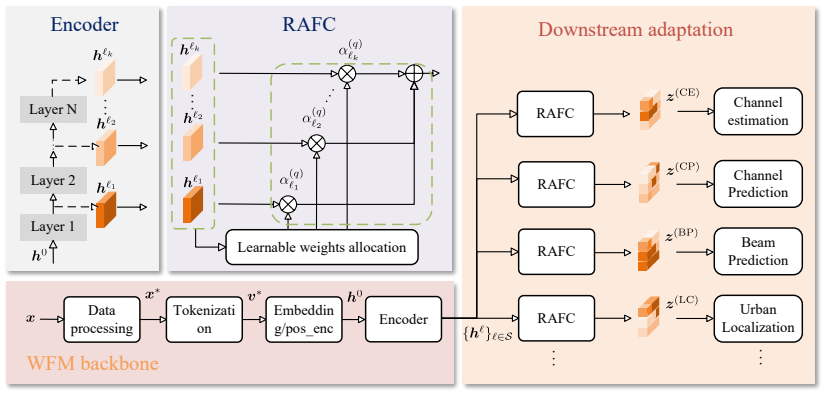
The Routing Adapter for Feature Composition (RAFC) treats hidden states from different Transformer depths as a reusable pool of multi-level features. A lightweight task-driven network produces layer-wise aggregation weights that combine the representations through weighted summation. Each downstream task thereby receives a tailored mixture of low-, mid-, and high-level wireless features without any modification to the pretrained backbone, yielding better performance than conventional adaptation methods while adding fewer than 50K parameters and exposing interpretable layer preferences.
What carries the argument
The Routing Adapter for Feature Composition (RAFC), a lightweight network that learns task-specific weights to aggregate hidden states from multiple transformer layers into a single adapted representation.
Load-bearing premise
Hidden states from different transformer depths contain complementary information whose best combination for any task can be discovered by a small network trained only on the downstream data.
What would settle it
An experiment on a new wireless task in which RAFC performance falls below both a frozen last-layer extractor and a fully fine-tuned model while staying within its stated parameter budget.
If this is right
- Each task receives a suitable mixture of features from multiple depths without altering the backbone.
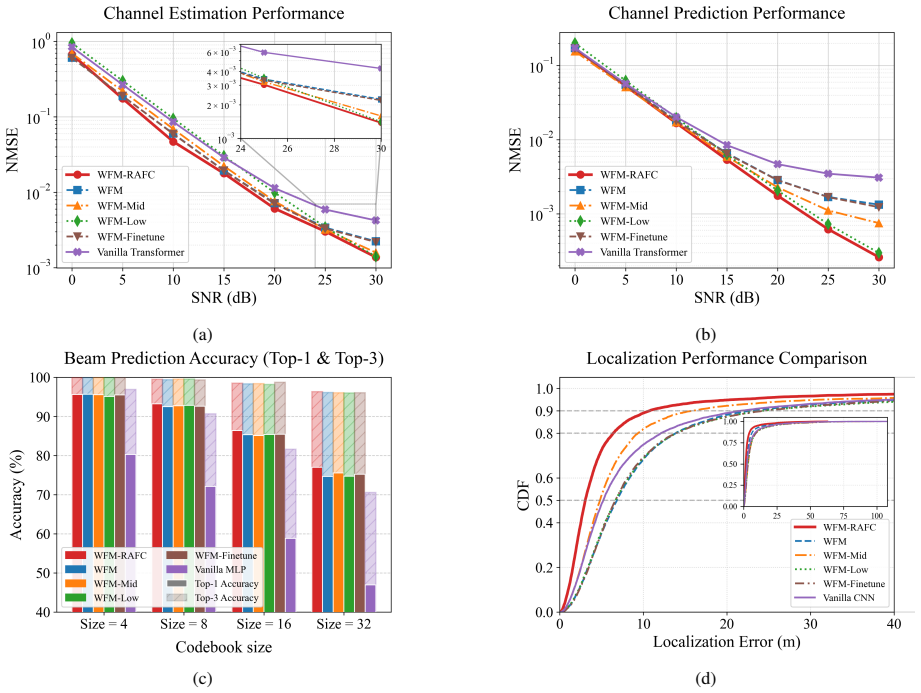
- Performance exceeds that of conventional adaptation baselines across representative wireless tasks.
- The added parameter count remains under 50,000 for all tested tasks.
- Routing weights supply direct evidence of task-specific preferences among transformer layers.
- The design forms a low-complexity and scalable interface for adapting the same model to new scenarios.
Where Pith is reading between the lines
- The same layer-mixing idea could reduce the need for separate pretraining runs when new wireless tasks appear.
- Interpretability of the routing weights might guide improvements to the original pretraining objective.
- The approach suggests that hierarchical representations learned on wireless data remain reusable across quite different downstream objectives.
Editorial analysis
A structured set of objections, weighed in public.
Referee Report
Summary. The manuscript proposes the Routing Adapter for Feature Composition (RAFC) as a unified framework for adapting wireless foundation models (WFMs) to multiple downstream tasks. RAFC treats hidden states from different Transformer depths as a reusable pool of multi-level features and uses a lightweight task-driven router to learn layer-wise aggregation weights, combining them via weighted summation without modifying the pretrained backbone. The central empirical claim is that RAFC outperforms conventional adaptation baselines on four representative wireless tasks while adding fewer than 50K parameters and yields interpretable task-specific routing weights.
Significance. If the reported gains hold after controlling for experimental variables, the work supplies a parameter-efficient and explainable adaptation interface for WFMs that avoids the overhead of full fine-tuning and the sub-optimality of frozen extraction. The low additional parameter count and multi-level feature reuse could facilitate scalable multi-task deployment in wireless communications, with the routing weights offering a secondary benefit of task-specific interpretability.
major comments (1)
- The central claim of consistent outperformance rests entirely on external comparisons to baselines; the manuscript should report variance across random seeds, statistical significance tests, and details of hyperparameter search ranges in the experimental section to confirm the gains are not attributable to tuning differences.
minor comments (2)
- Abstract: the four wireless tasks are not named; listing them would improve reader context without lengthening the paragraph.
- Notation: ensure the router network architecture (input dimension, hidden layers, output activation) is defined with explicit equations or a diagram in the methods section.
Simulated Author's Rebuttal
We thank the referee for the constructive feedback. We address the concern by committing to strengthen the experimental reporting in the revised manuscript.
read point-by-point responses
-
Referee: The central claim of consistent outperformance rests entirely on external comparisons to baselines; the manuscript should report variance across random seeds, statistical significance tests, and details of hyperparameter search ranges in the experimental section to confirm the gains are not attributable to tuning differences.
Authors: We agree that additional statistical rigor is needed to support the claims. In the revised manuscript, we will expand the experimental section to report mean performance and standard deviations across at least five random seeds, include statistical significance tests (such as paired t-tests) against baselines, and document the hyperparameter search ranges and selection procedure. These changes will demonstrate that the observed gains are robust. revision: yes
Circularity Check
No significant circularity
full rationale
The paper introduces RAFC as a lightweight router that aggregates hidden states from multiple transformer layers via learned task-specific weights. Its central claim is an empirical performance gain on four wireless tasks with <50K added parameters, presented as the outcome of external experiments rather than any internal derivation. No equations, self-citations, or fitted quantities are shown to reduce the reported results to quantities defined by the same inputs; the design is a standard hierarchical adapter pattern whose validity rests on comparative evaluation outside the method itself.
Axiom & Free-Parameter Ledger
free parameters (1)
- router network weights
axioms (1)
- domain assumption Hidden states at different transformer depths encode complementary multi-level wireless features.
invented entities (1)
-
Routing Adapter for Feature Composition (RAFC)
no independent evidence
read the original abstract
Though wireless foundation models (WFMs) have shown strong potential in learning universal channel representations, their adaptation to various downstream tasks remains constrained by existing paradigms. Fine-tuning strategies introduces substantial computational and storage overhead, while frozen feature extraction leads to sub-optimal performance across diverse downstream tasks. To address this issue, we propose a unified adaptive feature composition framework for multitask generalization in WFMs, where the key component is the Routing Adapter for Feature Composition (RAFC). Instead of extracting only the final-layer output, this router treats the hidden states from different Transformer depths as a reusable pool of multi-level hidden features, and employs a lightweight task-driven feature composition network to generate layer-wise aggregation weights, then adaptively combine hierarchical representations through weighted summation. This design enables each downstream task to access suitable mixture of low-, mid-, and high-level wireless features without modifying the pretrained backbone. Extensive experiments on four representative wireless tasks demonstrate that RAFC consistently outperforms conventional adaptation baselines while introducing fewer than 50K additional parameters. Moreover, the learned routing weights provide interpretable evidence of task-specific layer preferences, making the proposed framework a low-complexity, scalable, and explainable interface for adapting WFMs to diverse downstream scenarios.
Figures





Reference graph
Works this paper leans on
-
[1]
MIMO channel estimation using score-based generative models,
M. Arvinte and J. I. Tamir, “MIMO channel estimation using score-based generative models,”IEEE Trans. Wireless Commun., vol. 22, no. 6, pp. 3698–3713, Jun. 2023
2023
-
[2]
Channelformer: Attention based neural solution for wireless channel estimation and effective online training,
D. Luan and J. Thompson, “Channelformer: Attention based neural solution for wireless channel estimation and effective online training,” IEEE Trans. Wireless Commun., vol. 22, no. 10, pp. 6562–6577, Oct. 2023
2023
-
[3]
PARAMOUNT: Toward generalizable deep learning for mmwave beam selection using sub-6 GHz channel measurements,
K. Vuckovic, M. B. Mashhadi, F. Hejazi, N. Rahnavard, and A. Alkha- teeb, “PARAMOUNT: Toward generalizable deep learning for mmwave beam selection using sub-6 GHz channel measurements,”IEEE Trans. Wireless Commun., vol. 23, no. 5, pp. 5187–5202, May 2024
2024
-
[4]
Model- driven deep learning-based MIMO-OFDM detector: Design, simulation, and experimental results,
X. Zhou, J. Zhang, C.-W. Syu, C.-K. Wen, J. Zhang, and S. Jin, “Model- driven deep learning-based MIMO-OFDM detector: Design, simulation, and experimental results,”IEEE Trans. Commun., vol. 70, no. 8, pp. 5193–5207, Aug. 2022
2022
-
[5]
Deep learning-based low complexity MIMO detection via partial MAP,
L. Bai, Q. Zeng, R. Han, J. Choi, and W. Zhang, “Deep learning-based low complexity MIMO detection via partial MAP,”IEEE Trans. Wireless Commun., vol. 24, no. 3, pp. 2126–2139, Mar. 2025
2025
-
[6]
Large language models empowered autonomous edge AI for connected intelligence,
Y . Shen, J. Shao, X. Zhang, Z. Lin, H. Pan, D. Li, J. Zhang, and K. B. Letaief, “Large language models empowered autonomous edge AI for connected intelligence,”IEEE Commun. Mag., vol. 62, no. 10, pp. 140– 146, Oct. 2024
2024
-
[7]
Large language models for wireless communications: From adaptation to autonomy,
L. Liang, H. Ye, Y . Sheng, O. Wang, J. Wang, S. Jin, and G. Y . Li, “Large language models for wireless communications: From adaptation to autonomy,”IEEE Commun. Mag., 2026, early Access
2026
-
[8]
Big AI models for 6G wireless networks: Opportunities, challenges, and research directions,
Z. Chen, Z. Zhang, and Z. Yang, “Big AI models for 6G wireless networks: Opportunities, challenges, and research directions,”IEEE Wireless Commun., vol. 31, no. 5, pp. 164–172, Oct. 2024
2024
-
[9]
ChannelGPT: A large model toward real-world channel foundation model for 6G environment intelligence communication,
L. Yu, L. Shi, J. Zhang, Z. Zhang, Y . Zhang, and G. Liu, “ChannelGPT: A large model toward real-world channel foundation model for 6G environment intelligence communication,”IEEE Commun. Mag., vol. 63, no. 10, pp. 68–74, Oct. 2025
2025
-
[10]
LLM4CP: Adapting large language models for channel prediction,
B. Liu, X. Liu, S. Gao, X. Cheng, and L. Yang, “LLM4CP: Adapting large language models for channel prediction,”J. Commun. Inf. Netw., vol. 9, no. 2, pp. 113–125, Jun. 2024
2024
-
[11]
Foundation model empowered synesthesia of machines (SoM): AI-native intelligent multi- modal sensing-communication integration,
X. Cheng, B. Liu, X. Liu, E. Liu, and Z. Huang, “Foundation model empowered synesthesia of machines (SoM): AI-native intelligent multi- modal sensing-communication integration,”IEEE Trans. Netw. Sci. Eng., 2025, early Access
2025
-
[12]
LLM4WM: Adapting LLM for wireless multi-tasking,
X. Liu, S. Gao, B. Liu, X. Cheng, and L. Yang, “LLM4WM: Adapting LLM for wireless multi-tasking,”IEEE Trans. Mach. Learn. Commun. Netw., vol. 3, pp. 835–847, 2025
2025
-
[13]
Large multimodal model-based environment-aware beam management,
S. Kim, S. Saha, S. Jeong, B. Shim, and M. Z. Win, “Large multimodal model-based environment-aware beam management,”IEEE J. Sel. Areas Commun., vol. 44, pp. 991–1007, 2026
2026
-
[14]
WirelessGPT: A generative pre-trained multi-task learning framework for wireless communication,
T. Yang, P. Zhang, M. Zheng, Y . Shi, L. Jing, J. Huang, and N. Li, “WirelessGPT: A generative pre-trained multi-task learning framework for wireless communication,”IEEE Netw., vol. 39, no. 5, pp. 58–65, Sep. 2025
2025
-
[15]
LWM: A pre-trained wireless foundation model for universal feature extraction,
S. Alikhani, G. Charan, and A. Alkhateeb, “LWM: A pre-trained wireless foundation model for universal feature extraction,” inProc. IEEE Int. Conf. Mach. Learn. Commun. Netw. (ICMLCN), Barcelona, Spain, May 2025
2025
-
[16]
WiFo: Wireless foundation model for channel prediction,
B. Liu, S. Gao, X. Liu, X. Cheng, and L. Yang, “WiFo: Wireless foundation model for channel prediction,”Sci. China Inf. Sci., vol. 68, no. 6, p. 162302, Jun. 2025
2025
-
[17]
WiFo-2: a generalist foundation model unifies heterogeneous wireless system design
B. Liu, X. Liu, S. Gao, X. Cheng, and L. Yang, “Foundation model for intelligent wireless communications,”arXiv:2511.22222, Nov. 2025
work page internal anchor Pith review Pith/arXiv arXiv 2025
-
[18]
A wireless foundation model for multi-task prediction,
Y . Sheng, J. Wang, X. Zhou, L. Liang, H. Ye, S. Jin, and G. Y . Li, “A wireless foundation model for multi-task prediction,”arXiv:2507.05938, Jul. 2025
-
[19]
A multi-task foundation model for wireless channel representation using contrastive and masked autoencoder learning,
B. Guler, G. Geraci, and H. Jafarkhani, “A multi-task foundation model for wireless channel representation using contrastive and masked autoencoder learning,”IEEE J. Sel. Areas Commun., vol. 44, pp. 4489– 4504, 2026
2026
-
[20]
X. Liu, S. Gao, B. Liu, X. Cheng, and L. Yang, “WiFo-MiSAC: A wireless foundation model for multimodal sensing and communication integration via synesthesia of machines (SoM),”arXiv:2604.18255, Apr. 2026
work page internal anchor Pith review Pith/arXiv arXiv 2026
-
[21]
Parameter-efficient transfer learning for nlp,
N. Houlsby, A. Giurgiu, S. Jastrzebski, B. Morrone, Q. de Laroussilhe, A. Gesmundo, M. Attariyan, and S. Gelly, “Parameter-efficient transfer learning for nlp,” inProc. 36th Int. Conf. Mach. Learn. (ICML), Long Beach, CA, USA, Jun. 9–15, 2019, 2019, pp. 2790–2799
2019
-
[22]
LoRA: Low-rank adaptation of large language models,
E. J. Hu, Y . Shen, P. Wallis, Z. Allen-Zhu, Y . Li, S. Wang, L. Wang, and W. Chen, “LoRA: Low-rank adaptation of large language models,” inProc. 10th Int. Conf. Learn. Represent. (ICLR), Virtual Event, Apr. 25–29, 2022, 2022
2022
-
[23]
Mitigating over- smoothing in transformers via regularized nonlocal functionals,
T. Nguyen, T. M. Nguyen, and R. G. Baraniuk, “Mitigating over- smoothing in transformers via regularized nonlocal functionals,” inProc. Adv. Neural Inf. Process. Syst. (NeurIPS), vol. 36, New Orleans, LA, USA, Dec. 2023, pp. 80 233–80 256
2023
-
[24]
Anti-oversmoothing in deep vision transformers via the Fourier domain analysis: From theory to practice,
P. Wang, W. Zheng, T. Chen, and Z. Wang, “Anti-oversmoothing in deep vision transformers via the Fourier domain analysis: From theory to practice,” inProc. Int. Conf. Learn. Represent. (ICLR), Virtual Event, Apr. 2022
2022
-
[25]
What does BERT learn about the structure of language?
G. Jawahar, B. Sagot, and D. Seddah, “What does BERT learn about the structure of language?” inProc. 57th Annu. Meeting Assoc. Comput. Linguistics (ACL), Florence, Italy, Jul. 2019, pp. 3651–3657
2019
-
[26]
A primer in BERTology: What we know about how BERT works,
A. Rogers, O. Kovaleva, and A. Rumshisky, “A primer in BERTology: What we know about how BERT works,”Trans. Assoc. Comput. Lin- guistics, vol. 8, pp. 842–866, Dec. 2020
2020
-
[27]
BERT rediscovers the classical NLP pipeline,
I. Tenney, D. Das, and E. Pavlick, “BERT rediscovers the classical NLP pipeline,” inProc. 57th Annu. Meeting Assoc. Comput. Linguistics (ACL), Florence, Italy, Jul. 2019, pp. 4593–4601
2019
-
[28]
Deep contextualized word representations,
M. E. Peters, M. Neumann, M. Iyyer, M. Gardner, C. Clark, K. Lee, and L. Zettlemoyer, “Deep contextualized word representations,” inProc. Conf. North Amer. Chapter Assoc. Comput. Linguistics: Human Lang. Technol. (NAACL-HLT), New Orleans, LA, USA, Jun. 2018, pp. 2227– 2237
2018
-
[29]
Exploiting deep representations for neural machine translation,
Z.-Y . Dou, Z. Tu, X. Wang, S. Shi, and T. Zhang, “Exploiting deep representations for neural machine translation,” inProc. Conf. Empirical Methods Natural Lang. Process. (EMNLP), Brussels, Belgium, Oct./Nov. 2018, pp. 4253–4262
2018
-
[30]
Understanding and improving encoder layer fusion in sequence-to- sequence learning,
X. Liu, L. Wang, D. F. Wong, L. Ding, L. S. Chao, and Z. Tu, “Understanding and improving encoder layer fusion in sequence-to- sequence learning,” inProc. Int. Conf. Learn. Represent. (ICLR), Virtual Event, May 2021
2021
-
[31]
Vision transformer adapter for dense predictions,
Z. Chen, Y . Duan, W. Wang, J. He, T. Lu, J. Dai, and Y . Qiao, “Vision transformer adapter for dense predictions,” inProc. Int. Conf. Learn. Represent. (ICLR), Kigali, Rwanda, May 2023
2023
-
[32]
ViT-CoMer: Vision transformer with convolutional multi-scale feature interaction for dense predictions,
C. Xia, X. Wang, F. Lv, X. Hao, and Y . Shi, “ViT-CoMer: Vision transformer with convolutional multi-scale feature interaction for dense predictions,” inProc. IEEE/CVF Conf. Comput. Vis. Pattern Recognit. (CVPR), Seattle, W A, USA, Jun. 2024, pp. 5493–5502
2024
-
[33]
Depth-wise attention (DW Att): A layer fusion method for data-efficient classification,
M. N. ElNokrashy, B. AlKhamissi, and M. Diab, “Depth-wise attention (DW Att): A layer fusion method for data-efficient classification,” in Proc. Joint Int. Conf. Comput. Linguistics, Lang. Resour. Eval. (LREC- COLING), Turin, Italy, May 2024, pp. 4665–4674
2024
-
[34]
AdapterFu- sion: Non-destructive task composition for transfer learning,
J. Pfeiffer, A. Kamath, A. R ¨uckl´e, K. Cho, and I. Gurevych, “AdapterFu- sion: Non-destructive task composition for transfer learning,” inProc. Conf. Eur. Chapter Assoc. Comput. Linguistics (EACL), Online, Apr. 2021, pp. 487–503
2021
-
[35]
Task-customized mixture of adapters for general image fusion,
P. Zhu, Y . Sun, B. Cao, and Q. Hu, “Task-customized mixture of adapters for general image fusion,” inProc. IEEE/CVF Conf. Comput. Vis. Pattern Recognit. (CVPR), Seattle, W A, USA, Jun. 2024, pp. 10 628–10 638
2024
-
[36]
DeepMIMO: A Generic Deep Learning Dataset for Millimeter Wave and Massive MIMO Applications
A. Alkhateeb, “DeepMIMO: A generic deep learning dataset for mil- limeter wave and massive MIMO applications,”arXiv.1902.06435, Feb. 2019
work page internal anchor Pith review Pith/arXiv arXiv 1902
-
[37]
Study on Artificial Intelligence (AI)/Machine Learning (ML) for NR Air Interface,
3GPP, “Study on Artificial Intelligence (AI)/Machine Learning (ML) for NR Air Interface,” 3rd Generation Partnership Project (3GPP), Technical Report TR 38.843, 2024, Release 18, Version 18.0.0
2024
-
[38]
AI/ML for NR Air Interface,
J. Montojo, “AI/ML for NR Air Interface,” 3GPP Technology Article, 2023, 3GPP, last updated Jan. 25, 2023
2023
discussion (0)
Sign in with ORCID, Apple, or X to comment. Anyone can read and Pith papers without signing in.