REVIEW 3 major objections 4 minor 39 references
Correlation-Aware and Gaussianity-Preserving Robust Latent Angular Watermarking for Diffusion Models
T0 review · 3 major / 4 minor · reviewed 2026-08-01 · deepseek-v4-flash
Pith's one-line read A watermark can be hidden in the angles of the diffusion latent while keeping every coordinate Gaussian.
desk verdict The paper's central claim of Gaussianity preservation is refuted by its own construction: paired encoding/reference vectors are exactly orthogonal, so a dot-product test detects LAW latents perfectly; the paper has useful analytic bits but needs major rework. read the letter →
The pith
A machine-rendered reading of the paper's core claim, the machinery that carries it, and where it could break.
The reading
What carries the argument
The central object is the angular (phase) relation between two latent pairs: the encoding pair x_i and a reference pair r_i. The embedding rotates x_i so its phase is ϕ_{r,i} ± π/2, exploiting the rotation invariance of the isotropic Gaussian prior to preserve Gaussianity. The decoding rule is simply a phase comparison (Eq. 6). Two analytical results carry the argument: the closed-form autocorrelation block structure R = [[I_{2L}, A],[A^T, I_{2L}],[0,0,I]] with A_i = (1-2m_i)[[0, -π/4],[π/4, 0]] (Property 2), which characterizes the induced i.i.d. degradation; and var(Δφ) ≈ σ²/ρ² (Property 3), which justifies the magnitude-driven LAW-M variant that sorts pairs by norm.
What would settle it
Run LAW with all-zero message bits on a set of prompts, generate images with no attacks, invert them back to the latent, and measure the angular differences φ_x - φ_r across all bits. If a nontrivial fraction of bits falls within, say, 30° of the decision boundary at φ_x = φ_r (or if the empirical variance of Δφ exceeds the predicted σ²/ρ² by a large margin), the core decoding assumption fails. A complementary check: compare the inversion ℓ1 error for LAW-correlated latents against i.i.d. Gaussian latents; if the error gap is large enough to cross the ±π/2 decision margin, the robustness claim
Extended reading notes
Core claim
LAW embeds watermark bits as rotations in the latent prior: each bit is stored as the angle between an encoding pair and a reference pair, set to ±π/2 relative to the reference angle. Because an isotropic Gaussian is rotation-invariant, the marginal distribution of every coordinate remains standard normal. The paper derives the full autocorrelation matrix of the watermarked latent and proves it equals a block identity matrix plus sparse off-diagonal blocks of value ±π/4 coupling each encoding pair to its reference pair — a closed-form characterization of how much the i.i.d. condition is violated. It also proves that under isotropic Gaussian perturbation the angular error at decoding has vari
Load-bearing premise
The entire extraction pipeline assumes that inverting the diffusion process on the watermarked image recovers the latent pairs' phase difference closely enough to preserve the ±π/2 separation; the paper's own appendix shows inversion error grows when latent coordinates are correlated, and LAW is precisely what introduces such correlations.
Editorial extensions
If this is right
- LAW provides a training-free, keyless (base variant) watermark that does not change the marginal Gaussianity of the latent prior, so model behaviour is minimally altered.
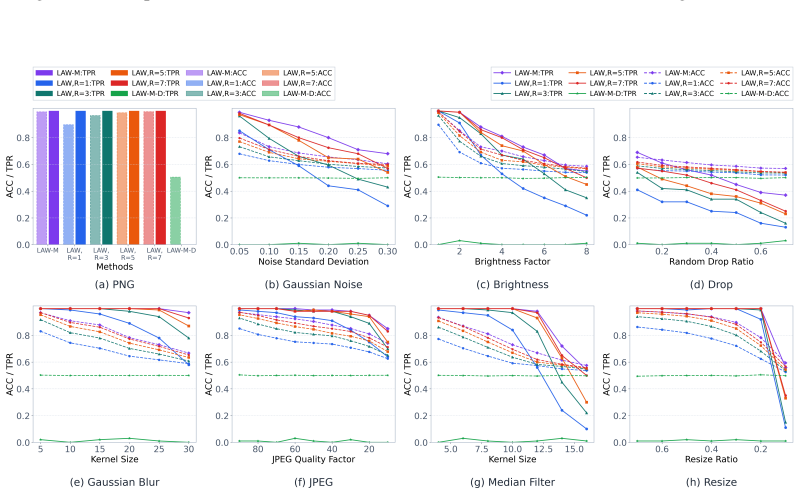
- Because watermarked latents remain statistically indistinguishable from clean noise, classifiers trained to detect watermarks at image or latent level fail (accuracy stays near chance), blocking the usual first step of removal attacks.
- The closed-form autocorrelation matrix lets a deployer predict and cap the i.i.d. violation introduced by watermarking, using watermark length L and message bits m rather than relying only on image-level FID.
- LAW-M's magnitude anchoring gives a provable robustness advantage: choosing high-norm pairs lowers decoding angular-error variance ∝1/ρ², though it requires storing a per-image private key.
- Capacity scales with the number of latent pairs: 512 bits in the experiments for LAW and 4096 for LAW-M without repeated embedding, avoiding the diversity loss of majority-vote schemes.
Reading between the lines
- The angular-pair construction is not specific to diffusion latent priors; any generative model whose initial noise is isotropic Gaussian could in principle carry the same watermark, making the approach a general template for distribution-preserving latent watermarking.
- The correlation analysis stops at second-order statistics; an editorial extension is to test whether the sparse ±π/4 cross-correlations create detectable higher-order dependencies after several denoising steps, which would tighten or weaken the indistinguishability claim.
- Since bits are decoded from phase differences, combining angular encoding with error-correcting codes over the phase domain could push capacity beyond 4096 bits while retaining the Gaussianity guarantee.
- The paper's own limitation (weakness against random drop) suggests a concrete testable fix: interleave or replicate encoding/reference pair assignments and re-derive the autocorrelation blocks to see whether the structured-correlation bound still holds.
Editorial analysis
A structured set of objections, weighed in public.
Referee Report
Summary. The paper proposes Latent Angular Watermarking (LAW) and a magnitude-driven variant LAW-M for diffusion models. Watermark bits are embedded by rotating disjoint latent pairs to ±π/2 relative to fixed reference pairs, with decoding via phase comparison after DDIM inversion. The authors claim the method preserves Gaussianity, induces only sparse, structured correlations (Property 2), gives angular-error variance inversely proportional to pair magnitude (Property 3), and achieves state-of-the-art robustness and fidelity. The paper includes closed-form derivations of the covariance structure and extensive experiments against post-processing and regeneration attacks.
Significance. If the Gaussianity-preservation and indistinguishability claims were correct, the method would be a notable advance: keyless, high-capacity, robust latent-domain watermarking with a rigorous correlation analysis. The covariance characterization in Property 2 is a useful analytic contribution, and the experimental comparison is reasonably thorough. However, the central claim is contradicted by the paper's own embedding equation: each encoding/reference pair is exactly orthogonal, giving a simple deterministic detector that separates watermarked from pristine latents. This invalidates the claimed Gaussianity preservation and computational indistinguishability, and therefore the significance of the method as presented is not established.
major comments (3)
- [§3.2.1, Eq. (14)] Eq. (14) implies x'_i · r_i = 0 identically for every encoding/reference pair. Substituting x'_i = [-(1-2m_i)ρ_x sin φ_r, (1-2m_i)ρ_x cos φ_r] and r_i = [ρ_r cos φ_r, ρ_r sin φ_r] gives cancellation. In a pristine i.i.d. Gaussian latent, the dot product of two independent pairs is a continuous random variable with variance 2, so it is exactly zero with probability 0. A detector that computes the dot product over the public partition and thresholds near zero will therefore separate LAW-watermarked latents from pristine ones with near-100% TPR at 0% FPR in the latent domain. This is a direct contradiction of the Gaussianity-preserving and computational-indistinguishability claims in the abstract, §1, and §4.2. Property 1 only proves zero mean and unit variance of the marginals, not joint Gaussianity; the watermarked distribution is supported on a submanifold of codimension L. The latent-le
- [Appendix F] The paper's own controlled experiment shows that introducing correlations into the initial latent increases the DDIM inversion ℓ1 error from 0.3304 to 0.9274. LAW's construction introduces both the covariance structure of Property 2 and the stronger exact-orthogonality constraint, yet no inversion-error or phase-preservation analysis is provided for LAW's own watermarked latents. Since decoding (Eq. 6) operates on phase differences between encoding and reference pairs estimated via DDIM inversion, the robustness results in Table 2 lack support for the no-attack and post-attack regimes until this inversion error is characterized.
- [Property 1 / Abstract] The terminology 'Gaussianity preservation' is overloaded. Property 1 (Appendix A.2) establishes only E[v'_j]=0 and Var(v'_j)=1 for each marginal; it does not establish that the vector v' is jointly Gaussian, and the appendix's own covariance computation plus the exact orthogonality constraint show it is not. The abstract and introduction nevertheless claim that the method 'preserving the Gaussianity' and that the latent remains 'statistically undetectable'. This is an overclaim that goes beyond the proven statement and is contradicted by the construction.
minor comments (4)
- [§2.2] Typo: 'watermark removal network is is trained' should be 'is trained'.
- [§3.2.1] Capitalization inconsistency: 'Law also requires' should be 'LAW also requires'.
- [Appendix A] Property numbering is inconsistent with the main text: Appendix A numbers Properties 1-6 differently from Properties 1-3 in §3.4. Please align numbering.
- [§4.2 / Figure 3] The description says classification is evaluated at both image and latent levels, but the figure appears to show only one panel; clarify which panel corresponds to which level and add the dot-product baseline discussed above.
Circularity Check
No significant circularity: LAW's theoretical claims are direct consequences of its explicitly defined embedding rule, not fitted or self-citation-dependent.
full rationale
The paper's central derivation chain is self-contained. The embedding rule in Eq. (2) and its equivalent form in Eq. (14) define each watermarked encoding pair x'_i as a deterministic rotation of the original pair to ±π/2 relative to its reference pair r_i. Property 2's autocorrelation structure (Eqs. 9-10) is obtained by direct moment computation from this rule, using independence of the original Gaussian pairs; it is an analytic consequence of the construction rather than a prediction fitted to data. Property 3's angular-error variance (Eq. 11) is the standard small-angle approximation for isotropic perturbations and involves no fitted parameters. The paper does not fit a parameter to a subset and then predict a closely related quantity, nor does it define any central quantity in terms of its conclusion. The only author-overlapping citations ([3,4]) are used to motivate the existence of removal attacks and do not support any theorem or uniqueness claim; no load-bearing result is imported from prior self-citation. The possible concern that the exact orthogonality of the watermark is detectable is a correctness/security critique, not a circularity of the derivation. Accordingly, no circular step can be exhibited with the required specificity, and the circularity score is 0.
Assumptions & free parameters
assumptions (4)
- domain assumption DDIM inversion with an empty prompt recovers the watermarked latent with sufficient accuracy for angular decoding
- domain assumption Latent perturbations during extraction are isotropic Gaussian noise with small σ relative to pair magnitude
- ad hoc to paper Rotating (or re-angling) a pair of latent elements preserves the full joint Gaussianity of the latent vector
- ad hoc to paper The fixed public partition into encoding/reference/non-encoding regions is secure against a keyless adversary
Cite this review
Pith. "Pith review of Correlation-Aware and Gaussianity-Preserving Robust Latent Angular Watermarking for Diffusion Models." pith.science (2026). https://pith.science/paper/U2DSIH2D
@misc{pith2026260722386,
  author       = {Pith},
  title        = {Pith review of: Correlation-Aware and Gaussianity-Preserving Robust Latent Angular Watermarking for Diffusion Models},
  year         = {2026},
  howpublished = {\url{https://pith.science/paper/U2DSIH2D}},
  note         = {Machine review of arXiv:2607.22386}
}
abstract
Latent domain watermarking for diffusion models embeds watermarks directly into the latent prior, enjoying non-intrusiveness to model parameters and seamless integration with the generation process. However, due to the violation of latent Gaussianity or sensitivity to normal and malicious perturbations during latent inversion, existing methods are prone to watermark detection or removal attacks. A further overlooked problem is the violation of the i.i.d. latent condition after watermarking, which leads to latent correlation degradation and generation fidelity loss. Although this has been externally measured by FID, the internal correlation structure has yet to be rigorously characterized. To address the above issues, and motivated by the rotation-invariant property of isotropic Gaussian, we propose \textit{Latent Angular Watermarking (LAW)}, which encodes watermark bits as antipodal angles ($\pm\pi/2$ relative to a reference pair) between disjoint pairs of latent elements while preserving the Gaussianity. The antipodal ($\pi$-separation) encoding maximizes geometric separation between bit values, and we prove that the decoding angular-error variance is proportional to the norm of the latent pair, i.e., $\operatorname{var}(\Delta\phi) \propto 1/\rho^2$. We further propose a magnitude-driven variant, LAW-M, which anchors watermark bits in the most geometrically stable latent dimensions, yielding additional robustness gains. Theoretically, we provide a rigorous characterization of the induced correlation degradation, deriving in closed form the autocorrelation structure of the watermarked latent and proving that correlations are confined to a sparse, structured set of off-diagonal elements with fixed $\pm\pi/4$ values.
Figures


Figures from the paper (6 more)


Reference graph
Works this paper leans on
-
[1]
M, Archana Tampy.S, and Sasikumar M
Navas K Aa, Ajay Mathews Cheriyan, Lekshmi. M, Archana Tampy.S, and Sasikumar M. Dwt-dct-svd based watermarking. IEEE, 6 2008. doi: 10.1109/COMSW A.2008.4554423
arXiv 2008
-
[2]
Combined dwt-dct digital image watermarking.Journal of Computer Science, 3(9): 740–746, 2007
Ali Al-Haj. Combined dwt-dct digital image watermarking.Journal of Computer Science, 3(9): 740–746, 2007
2007
-
[3]
Removing box-free watermarks for image-to-image models via query- based reverse engineering
Haonan An, Guang Hua, Hangcheng Cao, Zhengru Fang, Guowen Xu, Susanto Rahardja, and Yuguang Fang. Removing box-free watermarks for image-to-image models via query- based reverse engineering. InProceedings of the AAAI Conference on Artificial Intelligence, volume 40, pages 19615–19622, 2026
2026
-
[4]
Box-free model watermarks are prone to black-box removal attacks.IEEE Transactions on Pattern Analysis and Machine Intelligence,
Haonan An, Guang Hua, Zhiping Lin, and Yuguang Fang. Box-free model watermarks are prone to black-box removal attacks.IEEE Transactions on Pattern Analysis and Machine Intelligence,
-
[5]
Varia- tional image compression with a scale hyperprior
Johannes Ballé, David Minnen, Saurabh Singh, Sung Jin Hwang, and Nick Johnston. Varia- tional image compression with a scale hyperprior. InInternational Conference on Learning Representations, 2018. URLhttps://openreview.net/forum?id=rkcQFMZRb
2018
-
[6]
G. E. P. Box and Mervin E. Muller. A Note on the Generation of Random Normal Deviates. The Annals of Mathematical Statistics, 29(2):610 – 611, 1958. doi: 10.1214/aoms/1177706645. URLhttps://doi.org/10.1214/aoms/1177706645
arXiv 1958
-
[7]
Trustmark: Robust watermarking and water- mark removal for arbitrary resolution images
Tu Bui, Shruti Agarwal, and John Collomosse. Trustmark: Robust watermarking and water- mark removal for arbitrary resolution images. InProceedings of the IEEE/CVF International Conference on Computer Vision (ICCV), pages 18629–18639, October 2025
2025
-
[8]
Huajie Chen, Tianqing Zhu, Chi Liu, Shui Yu, and Wanlei Zhou. High-frequency matters: Attack and defense for image-processing model watermarking.IEEE Transactions on Services Computing, 17(4):1565–1579, 2024. doi: 10.1109/TSC.2024.3349784
arXiv 2024
Show all 39 references
-
[9]
Learned image compression with discretized gaussian mixture likelihoods and attention modules
Zhengxue Cheng, Heming Sun, Masaru Takeuchi, and Jiro Katto. Learned image compression with discretized gaussian mixture likelihoods and attention modules. InProceedings of the IEEE/CVF Conference on Computer Vision and Pattern Recognition (CVPR), June 2020
2020
-
[10]
Ringid: Rethinking tree-ring watermarking for enhanced multi-key identification
Hai Ci, Pei Yang, Yiren Song, and Mike Zheng Shou. Ringid: Rethinking tree-ring watermarking for enhanced multi-key identification. In Aleš Leonardis, Elisa Ricci, Stefan Roth, Olga Russakovsky, Torsten Sattler, and Gül Varol, editors,Computer Vision – ECCV 2024, volume 15086 ...
2024
-
[11]
Aqualora: toward white-box protection for customized stable diffusion models via watermark lora
Weitao Feng, Wenbo Zhou, Jiyan He, Jie Zhang, Tianyi Wei, Guanlin Li, Tianwei Zhang, Weiming Zhang, and Nenghai Yu. Aqualora: toward white-box protection for customized stable diffusion models via watermark lora. InProceedings of the 41st International Conference on Machine Le...
2024
-
[12]
The sta- ble signature: Rooting watermarks in latent diffusion models
Pierre Fernandez, Guillaume Couairon, Hervé Jégou, Matthijs Douze, and Teddy Furon. The sta- ble signature: Rooting watermarks in latent diffusion models. InProceedings of the IEEE/CVF International Conference on Computer Vision (ICCV), pages 22466–22477, October 2023
2023
-
[13]
An undetectable watermark for generative image models
Sam Gunn, Xuandong Zhao, and Dawn Song. An undetectable watermark for generative image models. InProceedings of the International Conference on Learning Representations (ICLR), 2025
2025
-
[14]
Freqmark: Invisible image watermarking via frequency based optimization in latent space
Yiyang Guo, Ruizhe Li, Mude Hui, Hanzhong Guo, Chen Zhang, Chuangjian Cai, Le Wan, and Shangfei Wang. Freqmark: Invisible image watermarking via frequency based optimization in latent space. In A. Globerson, L. Mackey, D. Belgrave, A. Fan, U. Paquet, J. Tomczak, and C. Zhang, ...
2024 doi
-
[15]
Deep residual learning for im- age recognition
Kaiming He, Xiangyu Zhang, Shaoqing Ren, and Jian Sun. Deep residual learning for im- age recognition. InProceedings of the IEEE Conference on Computer Vision and Pattern Recognition (CVPR), June 2016
2016
-
[16]
Gans trained by a two time-scale update rule converge to a local nash equilibrium
Martin Heusel, Hubert Ramsauer, Thomas Unterthiner, Bernhard Nessler, and Sepp Hochreiter. Gans trained by a two time-scale update rule converge to a local nash equilibrium. InAdvances in Neural Information Processing Systems, volume 30, 2017
2017
-
[17]
Spherical watermark: Encryption-free, lossless watermarking for diffusion models
Xiaoxiao Hu, Jiaqi Jin, Sheng Li, Wanli Peng, Xinpeng Zhang, and Zhenxing Qian. Spherical watermark: Encryption-free, lossless watermarking for diffusion models. InThe Fourteenth International Conference on Learning Representations, 2026
2026
-
[18]
ROBIN: Robust and invisible watermarks for diffusion models with adversarial optimization
Huayang Huang, Yu Wu, and Qian Wang. ROBIN: Robust and invisible watermarks for diffusion models with adversarial optimization. InAdvances in Neural Information Processing Systems (NeurIPS), 2024
2024
-
[19]
Semantic watermarking reinvented: Enhancing robustness and generation quality with fourier integrity
Sung Ju Lee and Nam Ik Cho. Semantic watermarking reinvented: Enhancing robustness and generation quality with fourier integrity. InProceedings of the IEEE/CVF International Conference on Computer Vision (ICCV), pages 18759–18769, October 2025
2025
-
[20]
Gaussmarker: Robust dual-domain watermark for diffusion models
Kecen Li, Zhicong Huang, Xinwen Hou, and Cheng Hong. Gaussmarker: Robust dual-domain watermark for diffusion models. InProceedings of the 42nd International Conference on Machine Learning, 2025
2025
-
[21]
Lawrence Zitnick
Tsung-Yi Lin, Michael Maire, Serge Belongie, James Hays, Pietro Perona, Deva Ramanan, Piotr Dollár, and C. Lawrence Zitnick. Microsoft coco: Common objects in context. InEuropean Conference on Computer Vision (ECCV), pages 740–755. Springer, 2014
2014
-
[22]
Erase and repair: An efficient box-free removal attack on high-capacity deep hiding.IEEE Transactions on Information Forensics and Security, 18:5229–5242, 2023
Hangcheng Liu, Tao Xiang, Shangwei Guo, Han Li, Tianwei Zhang, and Xiaofeng Liao. Erase and repair: An efficient box-free removal attack on high-capacity deep hiding.IEEE Transactions on Information Forensics and Security, 18:5229–5242, 2023. doi: 10.1109/TIFS. 2023.3305839
2023
-
[23]
Dpm-solver++: Fast solver for guided sampling of diffusion probabilistic models.Machine Intelligence Re- search, 22:730–751, 2025
Cheng Lu, Yuhao Zhou, Fan Bao, Jianfei Chen, Chongxuan Li, and Jun Zhu. Dpm-solver++: Fast solver for guided sampling of diffusion probabilistic models.Machine Intelligence Re- search, 22:730–751, 2025
2025
-
[24]
A watermark-conditioned diffusion model for ip protection
Rui Min, Sen Li, Hongyang Chen, and Minhao Cheng. A watermark-conditioned diffusion model for ip protection. In Aleš Leonardis, Elisa Ricci, Stefan Roth, Olga Russakovsky, Torsten Sattler, and Gül Varol, editors,Computer Vision – ECCV 2024, pages 104–120, Cham, 2025. Springer ...
2024
-
[25]
Learning transferable visual models from natural language supervision
Alec Radford, Jong Wook Kim, Chris Hallacy, Aditya Ramesh, Gabriel Goh, Sandhini Agarwal, Girish Sastry, Amanda Askell, Pamela Mishkin, Jack Clark, et al. Learning transferable visual models from natural language supervision. InInternational Conference on Machine Learning (ICM...
2021
-
[26]
High- resolution image synthesis with latent diffusion models
Robin Rombach, Andreas Blattmann, Dominik Lorenz, Patrick Esser, and Björn Ommer. High- resolution image synthesis with latent diffusion models. InProceedings of the IEEE/CVF Conference on Computer Vision and Pattern Recognition (CVPR), pages 10684–10695, June 2022
2022
-
[27]
Rumelhart, Geoffrey E
David E. Rumelhart, Geoffrey E. Hinton, and Ronald J. Williams. Learning representations by back-propagating errors.Nature, 323(6088):533–536, 1986. doi: 10.1038/323533a0
1986 doi
-
[28]
Improved techniques for training gans
Tim Salimans, Ian Goodfellow, Wojciech Zaremba, Vicki Cheung, Alec Radford, and Xi Chen. Improved techniques for training gans. InAdvances in Neural Information Processing Systems, volume 29, 2016
2016
-
[29]
Denoising diffusion implicit models
Jiaming Song, Chenlin Meng, and Stefano Ermon. Denoising diffusion implicit models. In International Conference on Learning Representations (ICLR), 2021
2021
-
[30]
RAW: A robust and agile plug-and-play watermark framework for AI-generated images with provable guarantees
Ganghua Wang, Xun Xian, Xuan Bi, Jayanth Srinivasa, Ashish Kundu, Jie Ding, and Mingyi Hong. RAW: A robust and agile plug-and-play watermark framework for AI-generated images with provable guarantees. InAdvances in Neural Information Processing Systems (NeurIPS), 2024
2024
-
[31]
Tree-ring watermarks: Fingerprints for diffusion images that are invisible and robust
Yuxin Wen, John Kirchenbauer, Jonas Geiping, and Tom Goldstein. Tree-ring watermarks: Fingerprints for diffusion images that are invisible and robust. InAdvances in Neural Information Processing Systems (NeurIPS), 2023
2023
-
[32]
Gaussian shading: Provable performance-lossless image watermarking for diffusion models
Zijin Yang, Kai Zeng, Kejiang Chen, Han Fang, Weiming Zhang, and Nenghai Yu. Gaussian shading: Provable performance-lossless image watermarking for diffusion models. InProceed- ings of the IEEE/CVF Conference on Computer Vision and Pattern Recognition (CVPR), pages 12162–12171...
2024
-
[33]
Deep model intellectual property protection via deep watermarking.IEEE Transactions on Pattern Analysis and Machine Intelligence, 44(8):4005–4020, 2022
Jie Zhang, Dongdong Chen, Jing Liao, Weiming Zhang, Huamin Feng, Gang Hua, and Nenghai Yu. Deep model intellectual property protection via deep watermarking.IEEE Transactions on Pattern Analysis and Machine Intelligence, 44(8):4005–4020, 2022. doi: 10.1109/TPAMI.2021. 3064850
2022 doi
-
[34]
Robust model watermarking for image processing networks via structure consistency.IEEE Transactions on Pattern Analysis and Machine Intelligence, 46(10): 6985–6992, 2024
Jie Zhang, Dongdong Chen, Jing Liao, Zehua Ma, Han Fang, Weiming Zhang, Huamin Feng, Gang Hua, and Nenghai Yu. Robust model watermarking for image processing networks via structure consistency.IEEE Transactions on Pattern Analysis and Machine Intelligence, 46(10): 6985–6992, 2...
2024
-
[35]
Robust invisible video watermarking with attention.ArXiv, abs/1909.01285, 2019
Kevin Alex Zhang, Lei Xu, Alfredo Cuesta-Infante, and Kalyan Veeramachaneni. Robust invisible video watermarking with attention.ArXiv, abs/1909.01285, 2019. URL https: //api.semanticscholar.org/CorpusID:202540549
1909 arXiv
-
[36]
Suppressing high-frequency artifacts for generative model watermarking by anti-aliasing
Li Zhang, Yong Liu, Xinpeng Zhang, and Hanzhou Wu. Suppressing high-frequency artifacts for generative model watermarking by anti-aliasing. InProceedings of the ACM Workshop on Information Hiding and Multimedia Security, pages 223–234, 2024. doi: 10.1145/3658664. 3659634
2024 doi
-
[37]
Invisible image watermarks are prov- ably removable using generative AI
Xuandong Zhao, Kexun Zhang, Zihao Su, Saastha Vasan, Ilya Grishchenko, Christopher Kruegel, Giovanni Vigna, Yu-Xiang Wang, and Lei Li. Invisible image watermarks are prov- ably removable using generative AI. InAdvances in Neural Information Processing Systems (NeurIPS), 2024
2024
-
[38]
Hidden: Hiding data with deep networks
Jiren Zhu, Russell Kaplan, Justin Johnson, and Li Fei-Fei. Hidden: Hiding data with deep networks. InProceedings of the European Conference on Computer Vision (ECCV), September 2018. 12 A Gaussianity Analysis We analyze the statistical properties of the watermarked latent zm i...
2018
-
[2026]
doi: 10.1109/TPAMI.2026.3688047
2026
Reviewed August 1, 2026 · model on record in the stance chip above.
Discussion (0). Continue with ORCID to comment.