REVIEW 4 major objections 6 minor 44 references
Pruning Weights but Not Truth: Safeguarding Truthfulness While Pruning LLMs
T0 review · 4 major / 6 minor · reviewed 2026-08-15 · deepseek-v4-flash
Pith's one-line read Unstructured pruning at 50% sparsity can keep LLM lie detection near 88% accuracy.
desk verdict A genuinely new observation about pruning and lie detection, but the evaluation leaks test labels into the method and the main gain over OWL is within noise. read the letter →
The pith
A machine-rendered reading of the paper's core claim, the machinery that carries it, and where it could break.
The reading
What carries the argument
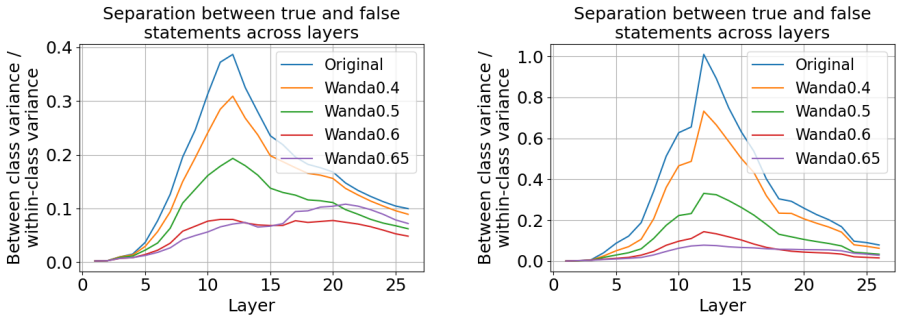
The load-bearing object is the Layer-wise Separability of True and False Distribution (LSD): for each layer, the ratio of between-class variance to within-class variance of the final-token residual-stream activations for true versus false statements. It identifies layer 12 in LLaMA3.1-8B-Instruct as the most discriminative layer and supplies the SWL sparsity prior; TPLO then blends that prior with OWL's layer-wise outlier ratios so that layers rich in both discriminative features and activation outliers are pruned least.
What would settle it
Recompute TPLO's layer-12 choice and layer-wise sparsity using only the training topics, then evaluate on the held-out topics; if the gap over uniform pruning disappears, the 88% figure is fitted to the test distribution rather than a general effect.
Extended reading notes
Core claim
The paper's central discovery is that lie-detection features in LLMs are not uniformly distributed across layers and that pruning destroys them at different rates in different layers. It defines a per-layer separability score (LSD) from the ratio of between-class to within-class variance of activations for true and false statements, shows that moderate pruning keeps it while heavy pruning degrades it, and then constructs TPLO by combining the separability-weighted sparsity assignment (SWL) with the outlier-ratio-weighted assignment (OWL). The result is a 50%-sparse LLaMA3.1-8B-Instruct whose probing classifiers still reach roughly 88% accuracy on twelve true/false datasets, close to the unpruned model and clearly above uniform Wanda pruning.
Load-bearing premise
The paper's sparsity plan is chosen using the separability of true and false statements measured on the original, unpruned model, and if pruning reorders which layers actually carry that information, the reported gains over uniform pruning would shrink or vanish.
Editorial extensions
If this is right
- A 50% unstructured-pruned LLaMA3.1-8B-Instruct can retain roughly 88% probing accuracy for true/false statements, close to the unpruned model's accuracy.
- Uniform pruning with Wanda degrades lie-detection features more than layer-wise allocation does; simply re-weighting by separability (SWL) is not enough and can hurt.
- TPLO preserves general zero-shot performance and perplexity on par with Wanda while improving truthfulness probing.
- Adding the enriched TruthfulQA calibration set (ETruthQA) moderately helps TruthfulQA multiple-choice and open-ended generation scores, and DoLa decoding can be combined with TPLO for further gains.
Reading between the lines
- Because TPLO's layer selection and sparsity allocation are computed from the same true/false statement distribution used for evaluation, its measured advantage over uniform pruning may shrink when applied to statement types whose discriminative layer is different; a held-out-topic test would clarify the size of the real gain.
- The same LSD-plus-outlier alignment idea could be transferred to other safety-relevant internal features, such as bias or refusal directions, where pruning currently risks silent degradation.
- TPLO's reliance on probing a single layer suggests that multi-layer or subspace-based probes might recover even more of the unpruned model's lie-detection accuracy at higher sparsities.
Signed reviews
Editorial analysis
A structured set of objections, weighed in public.
Referee Report
Summary. This paper studies how unstructured pruning at 50% sparsity affects the internal activation features used by probing classifiers to distinguish true from false statements in LLMs. The authors define a layer-wise separability (LSD) metric, observe that layer 12 of LLaMA3.1-8B-Instruct has the highest separability, and propose a baseline SWL that allocates sparsity inversely to separability, followed by TPLO that combines SWL's allocation with OWL's outlier-based layer-wise densities. They also introduce ETruthQA, a GPT-4o-enriched version of TruthfulQA, as calibration data. Experiments with LR, CCS, MM, and TTPD probes on true/false datasets and on TruthfulQA report that TPLO preserves lie-detection accuracy (about 88% at 50% sparsity) better than Wanda and OWL while keeping perplexity and general-task performance comparable.
Significance. If correct, this would be a useful finding: it would show that pruning damages internal truthfulness features in a layer-dependent way and that a simple layer-wise allocation can mitigate the damage. The paper includes several strengths: experiments on three model families, four probing techniques, integration with DoLa, and released code/data. However, the evaluation design contains a training/test leakage in the choice of probe layer and sparsity allocation, and the main comparison to OWL is within one standard deviation, so the central claim is not currently supported. The contribution is potentially interesting but needs a substantially cleaner evaluation before it can be assessed.
major comments (4)
- [Section 3.2, Section 4.1, Section 5.2] Test labels leak into the choice of probe layer and into the layer-wise sparsity allocation. LSD is computed in Figure 1 from activations of all true/false statements, and the same statements are later used in the leave-one-topic-out evaluation described in Section 5.2. Thus the held-out topic influences which layer is probed (layer 12 is selected by separability) and how TPLO/SWL distribute sparsity across layers (SWL is defined directly from the LSD values, and TPLO initializes from SWL). Please re-run the evaluation with layer selection and sparsity allocation derived only from the training topics, or from an independent truthfulness corpus, and report per-topic results.
- [Table 1] The claimed significant improvement over OWL is not supported by the reported numbers: TPLO-TTPD with C4 (0.8788) differs from OWL-TTPD with C4 (0.8776) by 0.0012, with overlapping standard deviations (0.0044 vs 0.0042); similar overlaps appear in several LR, CCS, and MM rows. No significance tests are provided anywhere in the table or the text. Please add paired significance tests across repeated runs, or clearly state which comparisons are statistically meaningful.
- [Section 4.2, Tables 6 and 7] The ETruthQA calibration data is generated by enriching TruthfulQA with GPT-4o, and TruthfulQA is also used as the evaluation benchmark in Tables 6 and 7. This creates a second leakage path for the TruthfulQA results, because the calibration data is derived from the same benchmark on which the pruned models are later tested. Please use a calibration source disjoint from the evaluation benchmark, or evaluate on a held-out split of TruthfulQA that is never used for enrichment.
- [Section 3.2, Section 4.1] Several free choices are made with access to the full true/false dataset: the lambda scaling factor for SWL, the number of early layers replaced by OWL values (10, 12, 12 for the three models), the outlier ratio threshold M=5, and the probe layer index. The manuscript provides no sensitivity analysis or validation-based selection for these hyperparameters, so it is unclear how much of TPLO's advantage comes from test-set fitting. Please report sensitivity to these choices and justify them from training data only.
minor comments (6)
- [Section 5.2] The text says the probe techniques were introduced in Subsection 4.2, but the probes are described in Section 5.2; please fix the cross-reference.
- [Appendix C] There is a typo in the open-ended generation section: 'we employ OpenAI's GPT-4o API to to assess' should read 'to assess'.
- [Table 5] The table header uses 'enrichedTruthQA' in the calibration-data column, while the rest of the paper uses 'ETruthQA'; please make the terminology consistent.
- [Table 1] The average column is described as the average over 12 true/false datasets, but the table only shows five dataset columns; please show all 12 datasets or explain why the others are omitted.
- [Section 4.1 footnote] The footnote says the number of early layers is chosen 'based on Figure 3, 10 and 11 respectively'; this should read 'based on Figures 3, 10, and 11' to avoid ambiguity.
- [Figure 2 caption] The caption says 'across several true false datasets'; add a slash or hyphen for readability ('true/false datasets').
Circularity Check
TPLO's layer-wise sparsity and probe layer are chosen from separability computed on all true/false datasets, including the topics later held out for testing; the headline 88% is therefore partly a fitted result rather than an independent prediction.
-
fitted input called prediction
[Sections 3.2, 4.1, 5.2 (LSD/SepPD layer-12 selection, SWL/TPLO sparsity construction, leave-one-topic-out evaluation)]
"we choose layer 12 (from 0) which exhibits the highest separability, to extract the activation vector ... Firstly, we calculate the Separability Probability Distribution (SepPD) as SepPD = [sep1,sep 2,...,sep L]/ PL l=1 sepl where sepl is separability of the l-th layer from Figure 1 ... we train the probing classifiers on an equal number of internal activations from all but one topic-specific dataset ..., holding out this excluded dataset for testing."
Figure 1's LSD is computed on true/false statement activations with no topic exclusion. SWL derives each layer's sparsity from SepPD over this LSD, and Section 4.1 states TPLO's density ratio is initialized 'as a copy of SWL's sparsity' (with OWL used for the first ten layers). Section 5.2 then evaluates by holding out one topic at a time from the same twelve true/false datasets. Hence the held-out topic's labels influence (i) which layer (layer 12) is used for probing and (ii) how much sparsity each layer receives. TPLO's advantage over Wanda/OWL in Table 1 is therefore partly an artifact of fitting the pruning allocation to the test distribution rather than a prediction from a general truth-preservation principle.
-
fitted input called prediction
[Section 4.2 (ETruthQA construction) and Section 5.3 / Tables 6-7 (TruthfulQA evaluation)]
"we utilize GPT-4o (Achiam et al., 2023) to enrich the TruthfulQA benchmark (Lin et al., 2021) to become the supplementary calibration data for pruning."
ETruthQA is generated by rewriting each statement in the TruthfulQA benchmark, and the same TruthfulQA benchmark is used for evaluation in Tables 6 and 7. Thus the calibration set shares test questions with the evaluation set. Any improvement attributed to incorporating ETruthQA as calibration on TruthfulQA can reflect exposure to the test benchmark rather than a general improvement in truthfulness preservation. The paper's own caveat that ETruthQA 'sometimes improves performance, but not consistently' limits the weight of this step, but for the TruthfulQA results it is a genuine test-set-contaminated input.
full rationale
The central derivation is not self-definitional: LSD is a real measured property, TPLO is a real pruning allocation, and the probing accuracies are genuine forward evaluations of the pruned models. However, the evaluation protocol lacks a nested holdout: the same twelve true/false datasets used to compute LSD (Figure 1) determine the probe layer (layer 12) and the SWL/TPLO per-layer sparsity, and then the same datasets are reused for leave-one-topic-out testing. Consequently the headline 88% accuracy and the Table 1 comparisons to Wanda and OWL are partially fitted to the test labels, so the 'prediction' is not statistically independent. This is the dominant circularity. A second, weaker leakage comes from ETruthQA, which is generated from TruthfulQA and then evaluated on TruthfulQA; the paper itself notes the gains are inconsistent. There is no load-bearing self-citation chain or imported uniqueness theorem in the circularity sense, and the issue is statistical rather than definitional. The absence of significance tests compounds the problem because TPLO-TTPD with C4 (0.8788) versus OWL-TTPD with C4 (0.8776) is within the reported standard deviations, but that is a correctness concern rather than an additional circular step.
Assumptions & free parameters
free parameters (5)
- lambda (SWL sparsity range) =
not specified
- number of early layers replaced by OWL =
10 for LLaMA3.1-8B, 12 for others
- probe layer index =
12 (8B), 14 (13B), 13 (Mistral)
- outlier ratio threshold M =
5
- number of ETruthQA samples in calibration =
64 of 128
assumptions (4)
- domain assumption Probing classifiers trained on internal activations provide a valid measure of whether an LLM is lying or hallucinating.
- ad hoc to paper The layer-wise separability of true and false statements in the original model remains a reliable indicator of which layers to protect after pruning.
- domain assumption The enriched TruthfulQA data generated by GPT-4o preserves the truth value and content of the original statements well enough to serve as calibration data.
- domain assumption Wanda and OWL pruning scores computed on a small calibration set transfer to the test data.
invented entities (1)
-
ETruthQA dataset
Cite this review
Pith. "Pith review of Pruning Weights but Not Truth: Safeguarding Truthfulness While Pruning LLMs." pith.science (2026). https://pith.science/paper/U2MNVBJ5
@misc{pith2026250900096,
  author       = {Pith},
  title        = {Pith review of: Pruning Weights but Not Truth: Safeguarding Truthfulness While Pruning LLMs},
  year         = {2026},
  howpublished = {\url{https://pith.science/paper/U2MNVBJ5}},
  note         = {Machine review of arXiv:2509.00096}
}
read the original abstract
Neural network pruning has emerged as a promising approach for deploying LLMs in low-resource scenarios while preserving downstream task performance. However, for the first time, we reveal that such pruning disrupts LLMs' internal activation features crucial for lie detection, where probing classifiers (typically small logistic regression models) trained on these features assess the truthfulness of LLM-generated statements. This discovery raises a crucial open question: how can we prune LLMs without sacrificing these critical lie detection capabilities? Our investigation further reveals that naively adjusting layer-wise pruning sparsity based on importance inadvertently removes crucial weights, failing to improve lie detection performance despite its reliance on the most crucial LLM layer. To address this issue, we propose Truthful Pruning aligned by Layer-wise Outliers (TPLO), which places greater emphasis on layers with more activation outliers and stronger discriminative features simultaneously. This preserves LLMs' original performance while retaining critical features of inner states needed for robust lie detection. Moreover, we introduce a prompting rule to enrich the TruthfulQA benchmark for better calibrating LLM pruning. Empirical results show that our approach improves the hallucination detection for pruned LLMs (achieving 88% accuracy at 50% sparsity) and enhances their performance on TruthfulQA.
Figures


Figures from the paper (5 more)



Reference graph
Works this paper leans on
-
[1]
Josh Achiam, Steven Adler, Sandhini Agarwal, Lama Ahmad, Ilge Akkaya, Florencia Leoni Aleman, Diogo Almeida, Janko Altenschmidt, Sam Altman, Shyamal Anadkat, et al. 2023. Gpt-4 technical report. arXiv preprint arXiv:2303.08774
arXiv 2023
-
[2]
Amos Azaria and Tom Mitchell. 2023. The internal state of an llm knows when it's lying. arXiv preprint arXiv:2304.13734
arXiv 2023
-
[3]
Guangji Bai, Yijiang Li, Chen Ling, Kibaek Kim, and Liang Zhao. 2024. Sparsellm: Towards global pruning of pre-trained language models. In The Thirty-eighth Annual Conference on Neural Information Processing Systems
work page 2024
-
[4]
Abhinav Bandari, Lu Yin, Cheng-Yu Hsieh, Ajay Kumar Jaiswal, Tianlong Chen, Li Shen, Ranjay Krishna, and Shiwei Liu. 2024. Is c4 dataset optimal for pruning? an investigation of calibration data for llm pruning. arXiv preprint arXiv:2410.07461
arXiv 2024
-
[5]
Farima Fatahi Bayat, Xin Liu, H Jagadish, and Lu Wang. 2024. Enhanced language model truthfulness with learnable intervention and uncertainty expression. In Findings of the Association for Computational Linguistics ACL 2024, pages 12388--12400
work page 2024
-
[6]
Lennart B \"u rger, Fred A Hamprecht, and Boaz Nadler. 2024. Truth is universal: Robust detection of lies in llms. arXiv preprint arXiv:2407.12831
arXiv 2024
-
[7]
Collin Burns, Haotian Ye, Dan Klein, and Jacob Steinhardt. 2022. Discovering latent knowledge in language models without supervision. arXiv preprint arXiv:2212.03827
arXiv 2022
-
[8]
Changyu Chen, Xiting Wang, Ting-En Lin, Ang Lv, Yuchuan Wu, Xin Gao, Ji-Rong Wen, Rui Yan, and Yongbin Li. 2024. Masked thought: Simply masking partial reasoning steps can improve mathematical reasoning learning of language models. arXiv preprint arXiv:2403.02178
arXiv 2024
Show all 44 references
-
[9]
Hongrong Cheng, Miao Zhang, and Javen Qinfeng Shi. 2024. A survey on deep neural network pruning: Taxonomy, comparison, analysis, and recommendations. IEEE Transactions on Pattern Analysis and Machine Intelligence
2024
-
[10]
Yung-Sung Chuang, Yujia Xie, Hongyin Luo, Yoon Kim, James Glass, and Pengcheng He. 2023. Dola: Decoding by contrasting layers improves factuality in large language models. arXiv preprint arXiv:2309.03883
2023 arXiv
-
[11]
Qingxiu Dong, Lei Li, Damai Dai, Ce Zheng, Jingyuan Ma, Rui Li, Heming Xia, Jingjing Xu, Zhiyong Wu, Tianyu Liu, et al. 2022. A survey on in-context learning. arXiv preprint arXiv:2301.00234
2022 arXiv
-
[12]
Abhimanyu Dubey, Abhinav Jauhri, Abhinav Pandey, Abhishek Kadian, Ahmad Al-Dahle, Aiesha Letman, Akhil Mathur, Alan Schelten, Amy Yang, Angela Fan, et al. 2024. The llama 3 herd of models. arXiv preprint arXiv:2407.21783
2024 arXiv
-
[13]
Gongfan Fang, Hongxu Yin, Saurav Muralidharan, Greg Heinrich, Jeff Pool, Jan Kautz, Pavlo Molchanov, and Xinchao Wang. 2024. Maskllm: Learnable semi-structured sparsity for large language models. arXiv preprint arXiv:2409.17481
2024 arXiv
-
[14]
Leo Gao, Jonathan Tow, Baber Abbasi, Stella Biderman, Sid Black, Anthony DiPofi, Charles Foster, Laurence Golding, Jeffrey Hsu, Alain Le Noac'h, Haonan Li, Kyle McDonell, Niklas Muennighoff, Chris Ociepa, Jason Phang, Laria Reynolds, Hailey Schoelkopf, Aviya Skowron, Lintang S...
2024 doi
-
[15]
Shangqian Gao, Chi-Heng Lin, Ting Hua, Tang Zheng, Yilin Shen, Hongxia Jin, and Yen-Chang Hsu. 2024 b . Disp-llm: Dimension-independent structural pruning for large language models. arXiv preprint arXiv:2410.11988
2024 arXiv
-
[16]
Haixia Han, Jiaqing Liang, Jie Shi, Qianyu He, and Yanghua Xiao. 2024. Small language model can self-correct. In Proceedings of the AAAI Conference on Artificial Intelligence, volume 38, pages 18162--18170
2024
-
[17]
Song Han, Jeff Pool, John Tran, and William Dally. 2015. Learning both weights and connections for efficient neural network. Advances in neural information processing systems, 28
2015
-
[18]
Junyuan Hong, Jinhao Duan, Chenhui Zhang, Zhangheng Li, Chulin Xie, Kelsey Lieberman, James Diffenderfer, Brian Bartoldson, Ajay Jaiswal, Kaidi Xu, et al. 2024. Decoding compressed trust: Scrutinizing the trustworthiness of efficient llms under compression. arXiv preprint arXi...
2024 arXiv
-
[19]
Yixin Ji, Yang Xiang, Juntao Li, Qingrong Xia, Ping Li, Xinyu Duan, Zhefeng Wang, and Min Zhang. 2024. Beware of calibration data for pruning large language models. arXiv preprint arXiv:2410.17711
2024 arXiv
-
[20]
Albert Q Jiang, Alexandre Sablayrolles, Arthur Mensch, Chris Bamford, Devendra Singh Chaplot, Diego de las Casas, Florian Bressand, Gianna Lengyel, Guillaume Lample, Lucile Saulnier, et al. 2023. Mistral 7b. arXiv preprint arXiv:2310.06825
2023 arXiv
-
[21]
Kenneth Li, Oam Patel, Fernanda Vi \'e gas, Hanspeter Pfister, and Martin Wattenberg. 2024. Inference-time intervention: Eliciting truthful answers from a language model. Advances in Neural Information Processing Systems, 36
2024
-
[22]
Stephanie Lin, Jacob Hilton, and Owain Evans. 2021. https://arxiv.org/abs/2109.07958 Truthfulqa: Measuring how models mimic human falsehoods . CoRR, abs/2109.07958
2021 arXiv
-
[23]
Gui Ling, Ziyang Wang, Yuliang Yan, and Qingwen Liu. 2024. Slimgpt: Layer-wise structured pruning for large language models. arXiv preprint arXiv:2412.18110
2024 arXiv
-
[24]
Samuel Marks and Max Tegmark. 2023. The geometry of truth: Emergent linear structure in large language model representations of true/false datasets. arXiv preprint arXiv:2310.06824
2023 arXiv
-
[25]
Lorenzo Pacchiardi, Alex J Chan, S \"o ren Mindermann, Ilan Moscovitz, Alexa Y Pan, Yarin Gal, Owain Evans, and Jan Brauner. 2023. How to catch an ai liar: Lie detection in black-box llms by asking unrelated questions. arXiv preprint arXiv:2309.15840
2023 arXiv
-
[26]
Jay M Patel and Jay M Patel. 2020. Introduction to common crawl datasets. Getting structured data from the internet: running web crawlers/scrapers on a big data production scale, pages 277--324
2020
-
[27]
Rajvardhan Patil and Venkat Gudivada. 2024. A review of current trends, techniques, and challenges in large language models (llms). Applied Sciences, 14(5):2074
2024
-
[28]
Jeff Pool, Abhishek Sawarkar, and Jay Rodge. 2021. Accelerating inference with sparsity using the nvidia ampere architecture and nvidia tensorrt. NVIDIA Developer Technical Blog, https://developer. nvidia. com/blog/accelerating-inference-with-sparsityusing-ampere-and-tensorrt
2021
-
[29]
Libo Qin, Qiguang Chen, Xiachong Feng, Yang Wu, Yongheng Zhang, Yinghui Li, Min Li, Wanxiang Che, and Philip S Yu. 2024. Large language models meet nlp: A survey. arXiv preprint arXiv:2405.12819
2024 arXiv
-
[30]
Mingjie Sun, Zhuang Liu, Anna Bair, and J Zico Kolter. 2023. A simple and effective pruning approach for large language models. arXiv preprint arXiv:2306.11695
2023 arXiv
-
[31]
Hugo Touvron, Louis Martin, Kevin Stone, Peter Albert, Amjad Almahairi, Yasmine Babaei, Nikolay Bashlykov, Soumya Batra, Prajjwal Bhargava, Shruti Bhosale, et al. 2023. Llama 2: Open foundation and fine-tuned chat models. arXiv preprint arXiv:2307.09288
2023 arXiv
-
[32]
Tianduo Wang, Shichen Li, and Wei Lu. 2024. Self-training with direct preference optimization improves chain-of-thought reasoning. arXiv preprint arXiv:2407.18248
2024 arXiv
-
[33]
Jason Wei, Xuezhi Wang, Dale Schuurmans, Maarten Bosma, Fei Xia, Ed Chi, Quoc V Le, Denny Zhou, et al. 2022. Chain-of-thought prompting elicits reasoning in large language models. Advances in neural information processing systems, 35:24824--24837
2022
-
[34]
Jiateng Wei, Quan Lu, Ning Jiang, Siqi Li, Jingyang Xiang, Jun Chen, and Yong Liu. 2024. Structured optimal brain pruning for large language models. In Proceedings of the 2024 Conference on Empirical Methods in Natural Language Processing, pages 13991--14007
2024
-
[35]
Miles Williams and Nikolaos Aletras. 2023. How does calibration data affect the post-training pruning and quantization of large language models? arXiv preprint arXiv:2311.09755
2023 arXiv
-
[36]
Zhichao Xu, Ashim Gupta, Tao Li, Oliver Bentham, and Vivek Srikumar. 2024. Beyond perplexity: Multi-dimensional safety evaluation of llm compression. arXiv preprint arXiv:2407.04965
2024 arXiv
-
[37]
Lu Yin, You Wu, Zhenyu Zhang, Cheng-Yu Hsieh, Yaqing Wang, Yiling Jia, Mykola Pechenizkiy, Yi Liang, Zhangyang Wang, and Shiwei Liu. 2023. Outlier weighed layerwise sparsity (owl): A missing secret sauce for pruning llms to high sparsity. arXiv preprint arXiv:2310.05175
2023 arXiv
-
[38]
Mingyang Zhang, Hao Chen, Chunhua Shen, Zhen Yang, Linlin Ou, Xinyi Yu, and Bohan Zhuang. 2023. Loraprune: Pruning meets low-rank parameter-efficient fine-tuning. arXiv preprint arXiv:2305.18403
2023 arXiv
-
[39]
Shaolei Zhang, Tian Yu, and Yang Feng. 2024 a . Truthx: Alleviating hallucinations by editing large language models in truthful space. arXiv preprint arXiv:2402.17811
2024 arXiv
-
[40]
Yunxiang Zhang, Muhammad Khalifa, Lajanugen Logeswaran, Jaekyeom Kim, Moontae Lee, Honglak Lee, and Lu Wang. 2024 b . Small language models need strong verifiers to self-correct reasoning. arXiv preprint arXiv:2404.17140
2024 arXiv
-
[41]
Wayne Xin Zhao, Kun Zhou, Junyi Li, Tianyi Tang, Xiaolei Wang, Yupeng Hou, Yingqian Min, Beichen Zhang, Junjie Zhang, Zican Dong, et al. 2023. A survey of large language models. arXiv preprint arXiv:2303.18223
2023 arXiv
-
[42]
Zixuan Zhou, Xuefei Ning, Ke Hong, Tianyu Fu, Jiaming Xu, Shiyao Li, Yuming Lou, Luning Wang, Zhihang Yuan, Xiuhong Li, et al. 2024. A survey on efficient inference for large language models. arXiv preprint arXiv:2404.14294
2024 arXiv
-
[43]
online" 'onlinestring :=
ENTRY address archivePrefix author booktitle chapter edition editor eid eprint eprinttype howpublished institution journal key month note number organization pages publisher school series title type volume year doi pubmed url lastchecked label extra.label sort.label short.list...
-
[44]
write newline
" write newline "" before.all 'output.state := FUNCTION n.dashify 't := "" t empty not t #1 #1 substring "-" = t #1 #2 substring "--" = not "--" * t #2 global.max substring 't := t #1 #1 substring "-" = "-" * t #2 global.max substring 't := while if t #1 #1 substring * t #2 gl...
Reviewed August 15, 2026 · model on record in the stance chip above.
Discussion (0). Continue with ORCID to comment.