REVIEW 4 major objections 5 minor 2 cited by
Quantum black holes split: one kills QPOs, one keeps them
Reviewed by Pith at T0; open to challenge. T0 means a machine referee read the full paper against a public rubric. the ladder, T0–T4 →
T0 review · deepseek-v4-flash
2026-08-04 20:15 UTC pith:U3JYOE6A
load-bearing objection A carefully done analytic and numerical study of QPOs in two quantum-corrected Schwarzschild-like metrics, but the observational claim is not established because the model is non-rotating while the comparison sources spin rapidly. the 4 major comments →
Analytic and Numerical Constraints on QPOs in EHT and XRB Sources Using Quantum-Corrected Black Holes
The pith
A machine-rendered reading of the paper's core claim, the machinery that carries it, and where it could break.
Core claim
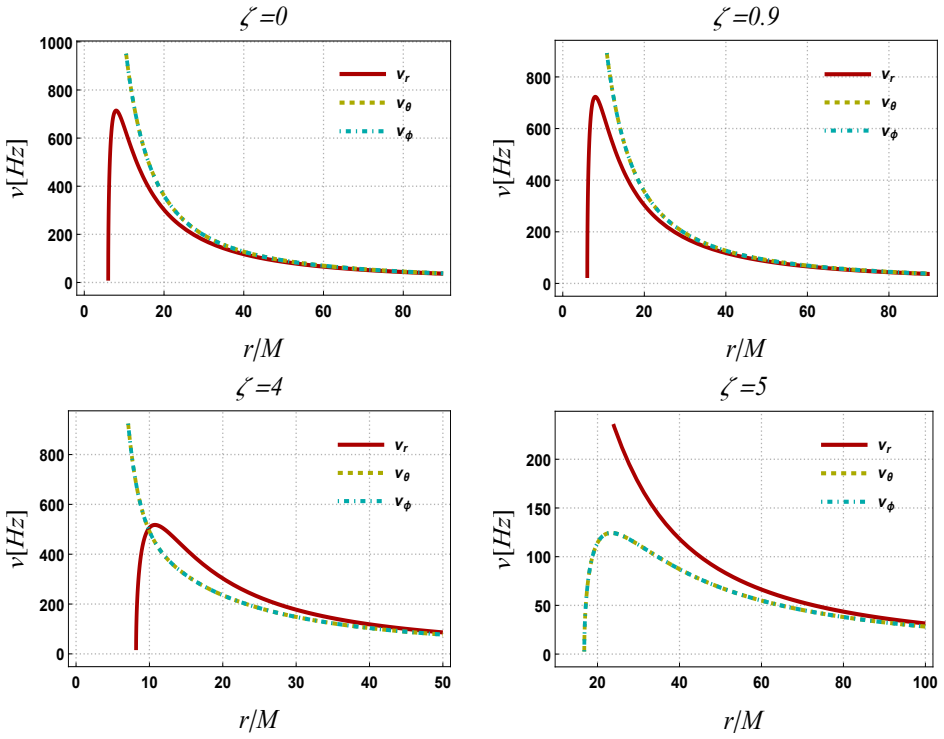
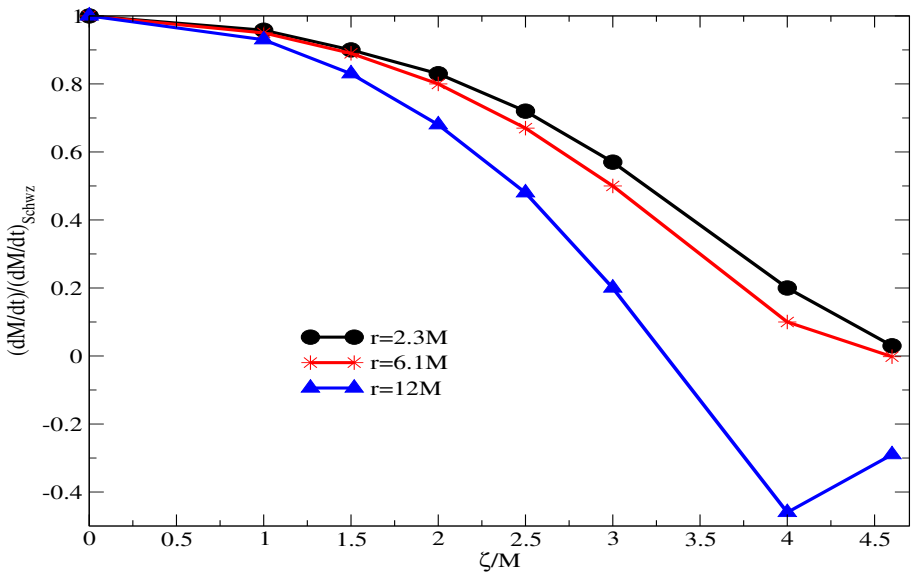
On its own terms, the paper's discovery is that the two quantum-corrected metrics are observationally distinguishable through QPO survival and frequency evolution. Model-I, with f(r) = g(r) = 1 − 2M/r + (ζ²/r²)(1 − 2M/r)², modifies both temporal and radial components; the paper derives r_ISCO = 6M + ζ⁴/(81M³) + O(ζ⁶) and shows numerically that the shock-cone stagnation point plunges from ~27M to ~5M as ζ grows, with mass accretion down by up to ~95% and QPOs absent for ζ ≥ 3M. Model-II, with f(r) Schwarzschild and only g(r) quantum-corrected, keeps νφ = νθ exactly Keplerian, factorizes the radial frequency as (2πν_r)² = M(r − 6M)(ζ²(r − 2M) + r³)/r⁷, and leaves the ISCO at exactly 6M; the st
What carries the argument
The stagnation point of the Bondi-Hoyle-Lyttleton shock cone: the radius inside the cone where the radial velocity changes sign, bounding the cavity that traps oscillatory modes. Its ζ-dependent position — migrating from 27M to 5M in Model-I, fixed near 26.8M in Model-II — determines whether QPO modes survive or are suppressed. The analytic support comes from epicyclic frequencies derived from the effective potential, with the zero of the radial frequency defining the ISCO: in Model-I that zero moves at order ζ⁴, while in Model-II it factorizes to remain at 6M for all ζ.
Load-bearing premise
The numerical results assume a non-spinning black hole, while the X-ray binaries used for comparison spin rapidly; if rotation changes the stagnation-point behavior or QPO suppression threshold, the ζ constraints could shift.
What would settle it
A long-term X-ray monitoring campaign on Sgr A* that finds no coherent ~78.6/115.9 µHz pair — the Model-I 3:2 doublet predicted at ζ ≈ 1M — would contradict the paper's mapping; likewise, observing a stable 3:2 HFQPO pair in a system whose inferred ζ exceeds ~3M would falsify Model-I's suppression threshold.
If this is right
- If Model-I is right, detections of high-frequency QPOs in stellar-mass black holes would push ζ below roughly 3M, while persistently non-variable accreting sources could be signatures of strong quantum corrections.
- If Model-II is right, QPO ratios alone cannot fix ζ because the Keplerian azimuthal frequency is unchanged; the model's observable handle is instead the slow enhancement of shock compression and infall speed with ζ.
- The predicted Sgr A* microhertz and M87* nanohertz doublets preserve the same 3:2 and 2:1 ratios, giving long-baseline X-ray monitoring campaigns a specific target to confirm or reject the quantum-correction mapping.
- The hydrodynamic ceiling ζ ≲ 4M agrees with EHT shadow bounds, meaning timing and imaging observations could jointly constrain the same quantum parameter rather than independent ones.
- The two models' differing QPO suppression thresholds offer a direct observational way to tell whether quantum corrections enter the time-time or only the space-space part of the metric.
Where Pith is reading between the lines
- The comparison sources rotate significantly while the simulated spacetimes are static and spherically symmetric; if rotation alters the stagnation-point trajectory or cavity stability, the claimed ζ bounds could shift. The paper leaves this as future work.
- The persistent 3:2, 2:1, and 5:3 ratios in both models may be generic features of any spherical metric with νθ = νφ degeneracy, so the ratios themselves may not uniquely identify these quantum-corrected spacetimes; the suppression threshold and stagnation migration are more distinctive.
- A testable extension is to run the same BHL plus power-spectral pipeline on rotating quantum-corrected metrics to see whether the ζ ≥ 3M QPO suppression survives; that would determine whether the stellar-mass constraints are robust.
- The agreement between the shadow-derived and accretion-derived ζ ceilings could partly reflect that both probes respond to near-horizon geometric focusing; combined shadow-plus-timing fits may overconstrain ζ if the two channels are not truly independent.
Editorial analysis
A structured set of objections, weighed in public.
Referee Report
Summary. The paper studies two spherically symmetric, quantum-corrected black-hole spacetimes (Model-I and Model-II) that reduce to Schwarzschild when ζ→0. For each model it derives epicyclic frequencies, the ISCO location, and periastron precession, and then presents Bondi-Hoyle-Lyttleton accretion simulations and PSD analyses, claiming that Model-I suppresses QPOs for ζ≳3M and that characteristic frequency ratios 3:2, 2:1, 5:3 match X-ray binaries such as GRS 1915+105, XTE J1550-564 and GX 339-4. The paper further states that hydrodynamically derived constraints ζ≲4M agree with EHT shadow constraints on M87* and Sgr A* from Ref. [23], and it rescales the QPO frequencies to predict microhertz and nanohertz variability for those two supermassive black holes.
Significance. If the central claims were established, the paper would provide an interesting two-model comparison for quantum-gravity phenomenology: a clean analytic separation between a model with an O(ζ^4) ISCO shift and a model with an exactly fixed ISCO, plus a numerical suggestion that the stagnation point in BHL accretion controls the QPO cavity. The analytic derivations of the epicyclic frequencies and the factorization in Model-II are transparent and, in the Schwarzschild limit, reduce correctly; the perturbative ISCO shift r_ISCO^(I) = 6M + ζ^4/(81M^3) is a concise and useful result. The manuscript also gives specific, falsifiable frequency ratios for future observations. However, the observational claims rest on a static, non-rotating model applied to rapidly spinning X-ray binaries and on PSD peak selection that is not statistically controlled; the numerical constraints are not reproducible from the information provided. These issues are central rather than cosmetic, so the current significance is conditional on the concerns below being resolved.
major comments (4)
- [Sec. 4.3, 5.2; Table 2; Sec. 6] The QPO comparison with X-ray binaries assumes spin independence without any supporting test. All simulations and PSD analyses use the static, spherically symmetric metrics (2)–(3), while the comparison sources GRS 1915+105, XTE J1550-564 and GX 339-4 are rapidly spinning (e.g., GRS 1915+105 with a≈0.98). In Kerr spacetime the ISCO, the epicyclic frequencies, and the frequency ratios change substantially with spin; the paper explicitly leaves rotating QCBHs for future work in Sec. 6. The claim that the computed non-rotating frequency ratios and the ζ≥3M suppression threshold are consistent with observations is therefore not established. A concrete test would be to repeat the epicyclic analysis for a rotating generalization of Model-I, or to show that spin does not affect the relevant ratios.
- [Sec. 4.3.1, 4.3.2; Figs. 16, 18, 19] The identification of 3:2, 2:1, and 5:3 frequency ratios appears post hoc. The PSDs contain many peaks (e.g., in Fig. 16 for ζ=1M the labeled peaks are 3.7, 10.2, 16.7, 27, 32.6, 38.1, 45.3, 48.1 Hz), and the authors select pairs such as 48.1:32.6 and 32.6:16.7 while other pairs are ignored. No statistical measure (e.g., false-alarm probability, peak significance, or a pre-specified selection criterion) is given, and the 0–7% error margin is stated only for the chosen pairs. With 5–8 peaks per PSD, near-commensurate ratios among random pairs are expected; the claimed agreement with GRS 1915+105, XTE J1550-564, and GX 339-4 is therefore not robust evidence for the models.
- [Sec. 4, 4.1, 4.3; Data Availability] The numerical constraints are not reproducible from the manuscript. Section 4 states that general-relativistic hydrodynamic equations are solved with HRSC and adaptive mesh refinement, but it does not specify the numerical scheme, the reconstruction method, the Riemann solver, the grid resolution, the computational domain, the boundary conditions, or the initial BHL parameters (density, velocity, sound speed, adiabatic index). The PSD analysis is also described only qualitatively. The Data Availability statement says the datasets are not publicly available. Given that the central quantitative claims—QPO suppression for ζ≥3M in Model-I, the stagnation-point curve in Fig. 13, and the constraint ζ≲4M—are derived from these simulations, the lack of reproducibility is a load-bearing deficiency. At minimum, a convergence study and a detailed numerical setup description are required.
- [Sec. 4.1.1, 4.2, 5.1] There is an internal contradiction about the photon sphere in Model-I. In Sec. 4.1.1 the paper states that the photon impact parameter b_ph shrinks with ζ while the photon sphere radius r_ph remains fixed at 3M; this is consistent with Eq. (2). However, Sec. 4.2 says 'in Model-I the photon sphere contracts slightly while the ISCO moves outward,' and Sec. 5.1 says that the decrease in b_ph indicates 'the photon sphere approaches the BH horizon.' The latter statements conflate the photon-sphere radius with the critical impact parameter and contradict the earlier exact statement. Since the agreement with EHT constraints in Sec. 5.1 is presented as a validation of the model, this inconsistency needs to be corrected and the distinction between r_ph and b_ph maintained throughout.
minor comments (5)
- [Abstract; Sec. 2] The abstract calls ζ a dimensionless parameter, but the metric functions in Eqs. (2)–(3) require ζ to have dimensions of length, and the tables/figures use ζ/M. Please make the dimensional status consistent.
- [Eqs. (25)–(26), Fig. 4] The text notes that νθ=νϕ in Model-I, but Fig. 4 plots νθ and νϕ as separate curves. Please clarify whether the two curves coincide exactly and consider a single label.
- [Sec. 4.3.1] The transition from QPOs at ζ<3M to 'strongly stable' behavior at ζ≥3M is stated without a quantitative criterion for what constitutes a QPO. Please specify how peaks are identified above the noise and how the suppression threshold is defined.
- [Sec. 5.1; Fig. 20] The phrase 'remarkable agreement' is overstated: the numerical constraint ζ≲4M from accretion suppression is a qualitative threshold, not a formal bound with uncertainty, and the EHT limits (ζ≤4.7M for M87* and ζ≤3.52M for Sgr A*) are themselves model-dependent. A more cautious wording would better match the actual evidence.
- [Throughout] There are frequent typographical artifacts such as 'efficient' and inconsistent hyphenation; a careful proofreading pass is needed.
Circularity Check
No significant circularity: analytic frequencies are derived from an externally sourced metric, numerical BHL simulations are independent, and EHT limits come from a separate paper.
full rationale
The derivation chain is self-contained. The metrics (Eqs. 2-3) are attributed to the independent paper [49]; the epicyclic frequencies and ISCO shifts (Eqs. 25-30) are obtained by direct algebra from those metrics, not from the QPO observations. The numerical BHL simulations use the same spacetime metric as an input but solve the relativistic hydrodynamic equations from scratch; the PSD peaks are outputs of the simulation, not inputs, and zeta is never fitted to any observed QPO frequency. Observational comparisons are qualitative: the paper lists discrete ratios (3:2, 2:1, 5:3) and reports 0-7% errors, but no parameter is adjusted to force agreement. The EHT-based constraints (zeta <= 4.7M for M87* and zeta <= 3.52M for Sgr A*) come from Chen & Yang 2025 [23], which has no author overlap with the present paper, so the agreement with the hydrodynamically inferred zeta ~ 4M is an independent cross-check. Self-citations ([67], [70]-[73]) concern numerical methods and the standard shock-cone QPO mechanism; they are not load-bearing because the QPO frequencies are computed from the present simulations and the analytic frequencies are derived here. The main limitation—the assumption of spherical symmetry while comparing to spinning XRBs, acknowledged in Sec. 6 ('Future investigations should focus on extending these results to rotating QCBHs')—is a scope/correctness risk about spin-independence, not a circularity.
Axiom & Free-Parameter Ledger
free parameters (2)
- zeta =
varied from 0 to 8M
- M =
10 M_sun
axioms (4)
- domain assumption Spacetime metric functions (Eq. 2 and 3) are valid quantum-corrected black hole solutions.
- standard math Linear epicyclic approximation is valid for QPOs in accretion disks.
- domain assumption BHL accretion flow around a non-rotating BH produces QPOs comparable to those from real XRBs.
- ad hoc to paper The stagnation point inside the shock cone determines the QPO cavity size.
Cite this review
Pith. "Pith review of Analytic and Numerical Constraints on QPOs in EHT and XRB Sources Using Quantum-Corrected Black Holes." pith.science (2026). https://pith.science/paper/U3JYOE6A
@misc{pith2026250908674,
  author       = {Pith},
  title        = {Pith review of: Analytic and Numerical Constraints on QPOs in EHT and XRB Sources Using Quantum-Corrected Black Holes},
  year         = {2026},
  howpublished = {\url{https://pith.science/paper/U3JYOE6A}},
  note         = {Machine review of arXiv:2509.08674}
}
read the original abstract
This investigation examines QPOs in two quantum-corrected BH spacetimes that preserve general covariance while incorporating quantum gravitational effects through a dimensionless parameter \zeta. We combine analytical derivations of epicyclic frequencies with comprehensive numerical simulations of BHL accretion to explore how quantum corrections manifest in observable astrophysical phenomena. Using a fiducial BH mass of M=10M_\odot representative of stellar-mass X-ray binaries, we demonstrate that the two models exhibit fundamentally different behaviors: Model-I modifies both temporal and radial metric components, leading to innermost stable circular orbit migration proportional to \zeta^4 and dramatic stagnation point evolution from 27M to 5M as quantum corrections strengthen. Model-II preserves the classical temporal component while altering only spatial geometry, maintaining constant stagnation points and stable cavity structures throughout the parameter range. Our numerical simulations reveal distinct QPO generation mechanisms, with Model-I showing systematic frequency evolution and cavity shrinkage that suppresses oscillations for \zeta \geq 3M, while Model-II maintains stable low-frequency modes up to \zeta \geq 5M. Power spectral density analyzes demonstrate characteristic frequency ratios (3:2, 2:1, 5:3) consistent with observations from X-ray binaries, providing specific targets for discriminating between quantum correction scenarios. The hydrodynamically derived constraints (\zeta \lesssim 4M) show remarkable agreement with independent EHT limits for M87* and Sgr A*, validating our theoretical framework through multiple observational channels. These results establish QPO frequency analysis as a probe for detecting quantum gravitational effects in astrophysical BHs and demonstrate the complementary nature of timing and imaging observations in constraining fundamental physics.
Figures






Forward citations
Cited by 2 Pith papers
-
Disformal Kerr Imprints on BHL Accretion: Shock Morphology, PSD Signatures, and Observational QPO Counterparts
Disformal Kerr black holes in BHL accretion produce modified shock structures and QPO frequencies at 43-68 Hz and lower that align with observations from GRS 1915+105, M82 X-1, and similar sources via inverse-mass scaling.
-
Disformal Kerr Imprints on BHL Accretion: Shock Morphology, PSD Signatures, and Observational QPO Counterparts
Numerical BHL accretion simulations in disformal Kerr spacetime produce QPO frequencies consistent with observations from GRS 1915+105, M82 X-1, NGC 5408 X-1, and RE J1034+396.
Reference graph
Works this paper leans on
-
[1]
van der Klis, ARAA 38, 717 (2000)
M. van der Klis, ARAA 38, 717 (2000)
2000
-
[2]
R. A. Remillard and J. E. McClintock, ARAA 44, 49 (2006)
2006
-
[3]
T. M. Belloni and S. E. Motta, Astrophysics and Space Science Library 440, 61 (2016) . 39
2016
-
[4]
Psaltis, Living Reviews in Relativity 11, 9 (2008)
D. Psaltis, Living Reviews in Relativity 11, 9 (2008)
2008
-
[5]
Stella and M
L. Stella and M. Vietri, APJ 492, L59 (1998)
1998
-
[6]
Bambi, Rev
C. Bambi, Rev. Mod. Phys. 89, 025001 (2017)
2017
-
[7]
Kato, PASJ 60, 889 (2008)
S. Kato, PASJ 60, 889 (2008)
2008
-
[8]
M. A. Abramowicz and W. Kluźniak, AAP 374, L19 (2001)
2001
-
[9]
Donmez and F
O. Donmez and F. Dogan, Physics of the Dark Universe 46, 101718 (2024)
2024
-
[10]
Dönmez, Journal of High Energy Astrophysics 45, 1 (2025)
O. Dönmez, Journal of High Energy Astrophysics 45, 1 (2025)
2025
-
[11]
I. D. Novikov and K. S. Thorne, Black Holes (Les Astres Occlus) , 343 (1973)
1973
-
[12]
J. M. Bardeen, W. H. Press, and S. A. Teukolsky, APJ 178, 347 (1972)
1972
-
[13]
T. E. Strohmayer, APJL 552, L49 (2001)
2001
-
[14]
J. E. McClintock and R. A. Remillard, Compact stellar X-ray sources , 157 (2006)
2006
-
[15]
Wang, Y.-C
D.-X. Wang, Y.-C. Ye, G.-Z. Yao, and R.-Y. Ma, MNRAS 359, 36 (2005)
2005
-
[16]
C. A. Perez, A. S. Silbergleit, R. V. Wagoner, and D. E. Lehr, APJ 476, 589 (1997)
1997
-
[17]
M. A. Abramowicz and W. Kluźniak, APSS 300, 127 (2005)
2005
-
[18]
Török, M
G. Török, M. A. Abramowicz, W. Kluźniak, and Z. Stuchlík, AAP 436, 1 (2005)
2005
-
[19]
Ingram and C
A. Ingram and C. Done, MNRAS 415, 2323 (2011)
2011
-
[20]
Event Horizon Telescope Collaboration, APJL 875, L1 (2019)
2019
-
[21]
Event Horizon Telescope Collaboration, APJL 930, L12 (2022)
2022
-
[22]
Johannsen and D
T. Johannsen and D. Psaltis, APJ 718, 446 (2010)
2010
-
[23]
Chen and J
J. Chen and J. Yang, European Physical Journal C 85, 512 (2025)
2025
-
[24]
B. P. Abbott et al. , PRL 116, 061102 (2016)
2016
-
[25]
Yunes and F
N. Yunes and F. Pretorius, PRD 80, 122003 (2009)
2009
-
[26]
Sucu and İ
E. Sucu and İ. Sakallı, Nucl. Phys. B 1018, 117081 (2025)
2025
-
[27]
E. Sucu, İ. Sakallı, Ö. Sert, and Y. Sucu, Phys. Dark Univ. 50, 102063 (2025)
2025
-
[28]
F. Ahmed, A. Al-Badawi, and İ. Sakallı, arXiv e-prints , arXiv:2508.03202 (2025)
Pith/arXiv arXiv 2025
-
[29]
Ahmed, A
F. Ahmed, A. Al-Badawi, and İ. Sakallı, Nucl. Phys. B 1017, 116951 (2025)
2025
-
[30]
Ahmed, A
F. Ahmed, A. Al-Badawi, and İ. Sakallı, Phys. Dark Univ. 48, 101925 (2025)
2025
-
[31]
Pourhassan, X
B. Pourhassan, X. Shi, S. S. Wani, S. Al-Kuwari, İ. Sakallı, N. A. Shah, M. Faizal, and A. Shabir, Annals Phys. 477, 169983 (2025) . 40
2025
-
[32]
Nicolini, A
P. Nicolini, A. Smailagic, and E. Spallucci, Physics Letters B 632, 547 (2006)
2006
-
[33]
Ashtekar and M
A. Ashtekar and M. Bojowald, Classical and Quantum Gravity 23, 391 (2006)
2006
-
[34]
Modesto, Classical and Quantum Gravity 25, 245018 (2008)
L. Modesto, Classical and Quantum Gravity 25, 245018 (2008)
2008
-
[35]
Bonanno and M
A. Bonanno and M. Reuter, PRD 62, 043008 (2000)
2000
-
[36]
Rovelli and F
C. Rovelli and F. Vidotto, International Journal of Modern Physics D 23, 1442026 (2014)
2014
-
[37]
Simpson and M
A. Simpson and M. Visser, JCAP 2019, 042 (2019)
2019
-
[38]
Toshmatov, Z
B. Toshmatov, Z. Stuchlík, and B. Ahmedov, PRD 95, 084037 (2017)
2017
-
[39]
Stuchlík and M
Z. Stuchlík and M. Kološ, European Physical Journal C 76, 32 (2016)
2016
-
[40]
Edgar, New Astronomy Reviews 48, 843 (2004)
R. Edgar, New Astronomy Reviews 48, 843 (2004)
2004
-
[41]
Foglizzo and M
T. Foglizzo and M. Ruffert, AAP 320, 342 (1997)
1997
-
[43]
Nozari and S
K. Nozari and S. H. Mehdipour, International Journal of Modern Physics , 4979 (2005)
2005
-
[44]
Du, H.-F
Y.-Z. Du, H.-F. Li, F. Liu, and L.-C. Zhang, Journal of High Energy Physics 2023, 137 (2023)
2023
-
[45]
Arzoumanian, K
Z. Arzoumanian, K. C. Gendreau, C. L. Baker, T. Cazeau, P. Hestnes, J. W. Kellogg, S. J. Kenyon, R. P. Kozon, K. C. Liu, S. S. Manthripragada, C. B. Markwardt, A. L. Mitchell, J. W. Mitchell, C. A. Monroe, T. Okajima, S. E. Pollard, D. F. Powers, B. J. Savadkin, L. B. Winternitz, P. T. Chen, M. R. Wright, R. Foster, G. Prigozhin, R. Remillard, and J. Doty...
2014
-
[46]
S.-N. Zhang and S. et. al., Space Telescopes and Instrumentation 2016: Ultraviolet to Gamma Ray , Society of Photo-Optical Instrumentation Engineers (SPIE) Conference Series 9905, 99051Q (2016) , arXiv:1607.08823 [astro-ph.IM]
arXiv 2016
-
[47]
Johannsen, PRD 87, 124017 (2013)
T. Johannsen, PRD 87, 124017 (2013)
2013
-
[48]
F. H. Vincent, T. Paumard, E. Gourgoulhon, and G. Perrin, Classical and Quantum Gravity 28, 225011 (2011)
2011
-
[49]
Zhang, J
C. Zhang, J. Lewandowski, Y. Ma, and J. Yang, Phys. Rev. D 111, L081504 (2025)
2025
-
[50]
Gambini and J
R. Gambini and J. Pullin, PRL 101, 161301 (2008)
2008
-
[51]
Hossenfelder and L
S. Hossenfelder and L. Smolin, PRD 81, 064009 (2010)
2010
-
[52]
Barcelo, S
C. Barcelo, S. Liberati, S. Sonego, and M. Visser, PRD 77, 044032 (2008)
2008
-
[53]
S. A. Hayward, PRL 96, 031103 (2006)
2006
-
[54]
Heidari, H
N. Heidari, H. Hassanabadi, and H. Chen, Physics Letters B 838, 137707 (2023)
2023
-
[55]
Ingram and S
A. Ingram and S. Motta, New Astronomy Reviews 85, 101524 (2019)
2019
-
[56]
G. C. Mancuso et al. , MNRAS 523, 2161 (2023) . 41
2023
-
[57]
Li, X.-M
Y.-Z. Li, X.-M. Kuang, and Y. Sang, European Physical Journal C 84, 529 (2024)
2024
-
[58]
Bambhaniya, M
P. Bambhaniya, M. J. Vyas, P. S. Joshi, and E. M. de Gouveia Dal Pino, Physics of the Dark Universe 48, 101949 (2025)
2025
-
[59]
A. El Byad et al. , Astrophysical Journal 989, 202 (2025) , arXiv:2410.14352 [astro-ph.HE]
arXiv 2025
-
[60]
A. Salganik, S. S. Tsygankov, S. V. Molkov, I. Y. Lapshov, A. A. Lutovinov, A. Y. Tkachenko, A. A. Mushtukov, and J. Poutanen, arXiv e-prints , arXiv:2506.19601 (2025) , arXiv:2506.19601 [astro-ph.HE]
arXiv 2025
-
[61]
W. Kluzniak and M. A. Abramowicz, arXiv e-prints , astro-ph/0105057 (2001)
Pith/arXiv arXiv 2001
-
[62]
Boutelier, P
M. Boutelier, P. Varniere, M. Tagger, and S. Ferrari, MNRAS 401, 1290 (2010)
2010
-
[63]
E. H. T. Collaboration, Astrophysical Journal Letters 930, L12 (2022)
2022
-
[64]
Akiyama et al
K. Akiyama et al. (Event Horizon Telescope), Astron. Astrophys. 693, A265 (2025)
2025
-
[65]
W. Liu, D. Wu, and J. Wang, Physics Letters B 858, 139052 (2024)
2024
-
[66]
R. A. Konoplya and O. S. Stashko, PRD 111, 104055 (2025)
2025
-
[67]
Dönmez, APSS 293, 323 (2004)
O. Dönmez, APSS 293, 323 (2004)
2004
-
[68]
Donmez, AM&C 181, 256 (2006)
O. Donmez, AM&C 181, 256 (2006)
2006
-
[69]
J. A. Font, Living Reviews in Relativity 3, 2 (2000)
2000
-
[70]
Dönmez, Journal of Cosmology and Astroparticle Physics 2024, 006 (2024)
O. Dönmez, Journal of Cosmology and Astroparticle Physics 2024, 006 (2024)
2024
-
[71]
Donmez and F
O. Donmez and F. Dogan, Universe 10, 152 (2024)
2024
-
[72]
Dönmez, O
O. Dönmez, O. Zanotti, and L. Rezzolla, MNRAS 412, 1659 (2011)
2011
-
[73]
Dönmez, MNRAS 426, 1533 (2012)
O. Dönmez, MNRAS 426, 1533 (2012)
2012
-
[74]
T. Foglizzo and M. Tagger, Astron. Astrophys. 363, 174 (2000), arXiv:astro-ph/0009193
Pith/arXiv arXiv 2000
-
[75]
Foglizzo, Astron
T. Foglizzo, Astron. Astrophys. 368, 311 (2001)
2001
-
[76]
Foglizzo, Astron
T. Foglizzo, Astron. Astrophys. 392, 353 (2002)
2002
-
[77]
Sreehari, A
H. Sreehari, A. Nandi, S. Das, V. K. Agrawal, S. Mandal, M. C. Ramadevi, and T. Katoch, MNRAS 499, 5891 (2020)
2020
-
[78]
H. Q. Gao, J. L. Qu, Z. Zhang, Z. B. Li, S. Zhang, L. Chen, M. Y. Ge, J. N. Zhou, L. M. Song, and J. M. Wang, MNRAS 438, 341 (2014)
2014
-
[79]
T. M. Belloni and D. Altamirano, MNRAS 432, 19 (2013)
2013
-
[80]
H. Liu, L. Ji, C. Bambi, P. Jain, R. Misra, D. Rawat, J. S. Yadav, and Y. Zhang, APJ 909, 63 (2021)
2021
-
[81]
Motta, J
S. Motta, J. Homan, T. Muñoz Darias, P. Casella, T. M. Belloni, B. Hiemstra, and M. Méndez, MNRAS 427, 595 (2012)
2012
discussion (0)
Sign in with ORCID, Apple, or X to comment. Anyone can read and Pith papers without signing in.