REVIEW 4 major objections 4 minor 2 cited by
The entanglement Hamiltonian of monitored free fermions undergoes an ergodic-to-localized spectral transition at the same critical measurement rate as the entanglement-entropy transition, and short-range spectral statistics detect it sharpl
Reviewed by Pith at T0; open to challenge. T0 means a machine referee read the full paper against a public rubric. the ladder, T0–T4 →
T0 review · deepseek-v4-flash
2026-08-04 20:24 UTC pith:U3PAMIAS
load-bearing objection The RMT entanglement-Hamiltonian diagnostic is a genuine step forward, but the 2D critical exponent ν≈0.86 is not yet established because the 2D scaling ansatz omits corrections that the paper's own 3D analysis requires. the 4 major comments →
Spectral Transitions of the Entanglement Hamiltonian in Monitored Free Fermions
The pith
A machine-rendered reading of the paper's core claim, the machinery that carries it, and where it could break.
Core claim
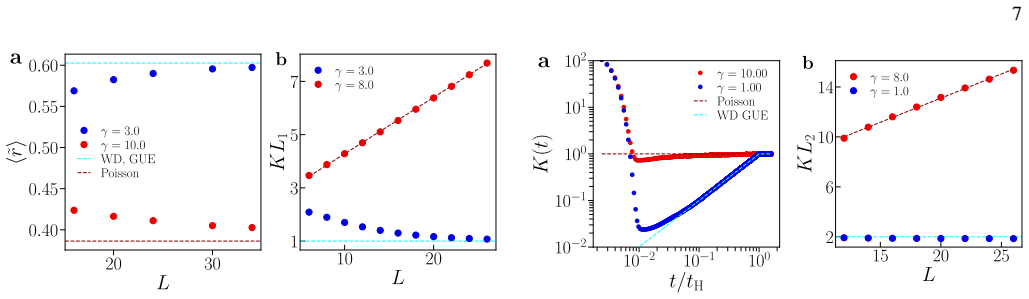
Defining the entanglement Hamiltonian H_A through ρ_A = Z_A^{-1} exp(−H_A), the paper analyzes the eigenvalue and eigenstate statistics of H_A for Gaussian monitored states on a checkerboard subsystem. Weak monitoring yields GUE level statistics and extended entanglement modes (⟨r̃⟩ ≈ 0.60, KL1 = O(1)); strong monitoring yields Poisson statistics and localized modes (⟨r̃⟩ ≈ 0.39, KL1 ∝ L). Both observables cross at γ_c ≈ 5.16 in D = 2, and a weighted one-parameter finite-size collapse gives γ_c = 5.16 ± 0.03 and ν = 0.86 ± 0.03. The spectral form factor and its Thouless time corroborate the transition, while the KL2 variant shows a crossing at an intermediate rate γ* < γ_c, which the authors
What carries the argument
The central object is the entanglement Hamiltonian H_A, defined by ρ_A = Z_A^{-1} exp(−H_A) for a subsystem A; because the monitored state remains Gaussian, H_A is a free-fermion Hamiltonian whose single-particle spectrum {ε_α} and eigenfunctions {ψ_α} can be computed from the subsystem correlation matrix. The paper treats H_A as a random matrix: the average adjacent gap ratio ⟨r̃⟩ and the Kullback–Leibler divergences KL1 and KL2 compare consecutive-level statistics and eigenfunction overlap, while the spectral form factor probes long-range correlations through the Thouless time. A checkerboard subsystem geometry samples all single-particle states evenly and suppresses boundary-dominated spe
Load-bearing premise
The 2D critical parameters rest on the assumption that the data collapse onto a single scaling function of (γ−γ_c)L^{1/ν} with no additional finite-size correction terms; the paper's own 3D analysis shows a conventional collapse fails there and needs an added correction A δγ, so if comparable corrections are present in 2D the extracted ν ≈ 0.86 could shift.
What would settle it
Repeat the 2D finite-size analysis at L = 64 and L = 80, fitting ⟨r̃⟩ and KL1 with the correction-augmented ansatz F(δγ L^{1/ν}(1 + A δγ)) used for 3D; if including A moves γ_c outside the quoted error bars or changes ν substantially from 0.86, the claimed sharp transition and percolation-like exponent are finite-size artifacts of the one-parameter collapse.
If this is right
- In D = 3 the same spectral toolkit locates the transition at γ_c ≈ 11.4, with KL1 giving ν ≈ 0.77, showing that the diagnostic transfers beyond two dimensions.
- In D = 1 there is no transition at finite measurement rate: the crossing point drifts toward γ = 0 as L grows, consistent with the nonlinear-sigma-model prediction that number-conserving monitored free fermions localize immediately in one dimension.
- The 2D exponent ν ≈ 0.86 is close to critical percolation in 3D and conflicts with earlier numerical and NLσM-based estimates ν > 1, so the transition's universality class is not captured by current field-theoretic approaches.
- KL2 shows a crossing at an intermediate rate γ* with γ_Fl < γ* < γ_c, suggesting a possible non-ergodic extended or multifractal regime that short-range probes would miss; the paper leaves this as an open question.
- Because the method only requires Gaussianity of the state, it extends directly to Z2-symmetric Majorana circuits and other monitored free-fermion settings.
Where Pith is reading between the lines
- Inference: If ν ≈ 0.86 holds at larger sizes, the 2D transition may belong to the same universality class as three-dimensional percolation; one test is measuring the fractal dimension of critical entanglement eigenstates and comparing it with the percolation value.
- Inference: The checkerboard-subsystem geometry that removes boundary-dominated spectral tails could be adopted in other entanglement-Hamiltonian studies, including disordered free-fermion systems, to sharpen level-statistics collapses.
- Inference: The Fermi-liquid fixed point's logarithmic growth with the same prefactor in space and time hints at an emergent Lorentz invariance at γ_Fl; unequal-time density correlations at this rate would test whether that is a true dynamical symmetry or an entanglement-only feature.
- Inference: The KL2 crossing below γ_c, if confirmed by larger systems, predicts an intermediate multifractal phase whose eigenstates occupy a vanishing fraction of the subsystem; a direct box-counting multifractal analysis of |ψ_α(i)|^2 at those rates would settle it.
Editorial analysis
A structured set of objections, weighed in public.
Referee Report
Summary. The paper studies monitored free fermions on hypercubic lattices in D=1,2,3, using the entanglement Hamiltonian of a subsystem as a diagnostic. The authors identify four fixed points from entanglement scaling: a Gaussian Page-law fixed point at γ→0+, a Fermi-liquid fixed point at moderate monitoring with logarithmic entanglement growth and emergent space-time invariance, a quantum Lifshitz fixed point at the measurement-induced transition, and a conventional area-law fixed point at strong monitoring. They then apply random-matrix-theory diagnostics—the adjacent gap ratio ⟨r̃⟩, Kullback-Leibler divergences KL1 and KL2, and the spectral form factor—to the entanglement spectrum. For D=2, they report a sharp ergodic-to-non-ergodic spectral transition at γc≈5.16 with correlation-length exponent ν≈0.86, close to 3D percolation, and corroborate this with long-range probes. They report an analogous transition in D=3, with less consistent exponents, and the absence of a transition in D=1. The paper also reports a possible non-ergodic extended regime at intermediate monitoring strengths, though it states the evidence is inconclusive.
Significance. If the central quantitative claim holds, the paper offers a useful new diagnostic for measurement-induced phase transitions in free-fermion systems, via the entanglement Hamiltonian's spectral statistics, and provides a concrete numerical connection to quantum Lifshitz and Fermi-liquid scaling that goes beyond current field-theoretic treatments. The strength of the paper is that several independent observables (⟨r̃⟩, KL1, SFF, and to some extent KL2) agree on the existence and approximate location of the spectral transition in D=2, and the null result in D=1 and extension to D=3 add internal consistency. The use of external RMT benchmarks (Wigner-Dyson, Poisson) anchors the interpretation in established physics rather than in a self-referential criterion. However, the paper's headline quantitative result—precise values of γc and ν supporting a percolation-type exponent—rests on a finite-size scaling analysis whose pure one-parameter ansatz is not tested against corrections to scaling, despite the paper's own D=3 analysis requiring such corrections. The statistical uncertainty estimates are also asserted rather than derived. These issues are fixable but currently leave the most load
major comments (4)
- [Section IV.A, Eq. (26)] The central D=2 claim—γc≈5.16 and ν≈0.86 close to 3D percolation—relies on the pure scaling ansatz F(γ,L)=F((γ−γc)L^{1/ν}) with no correction-to-scaling terms. However, Section IV.B and Eq. (27) show that the same observables in D=3 cannot be collapsed with the analogous A=0 ansatz and require the nonlinear correction (1+Aδγ). The paper does not test whether a similar correction is needed in D=2. If an analogous correction is present, the extracted ν is an effective exponent and the apparent agreement with ν≈0.87 may be a fitting artifact. This is load-bearing for the abstract's claim of 'precise estimates of the critical point and correlation length exponent' and for the percolation interpretation. The authors should either perform a corrected scaling collapse in D=2 (e.g., with an analogous A term) or demonstrate that such corrections do not affect ν within their error bars.
- [Section IV.A, cost-function analysis] The quoted error bars, e.g. γc=5.19±0.03 and ν=0.88±0.03, are estimated from contours at χ*+4 of a cost function F_cost, but the statistical interpretation of this contour as a confidence region is asserted, not derived. The data entering the collapse are correlated across γ and L (the same trajectories and spectra contribute to nearby points), so the residuals are not independent chi-squared variables. The paper should specify the exact definition of F_cost, how the spline and degrees of freedom are handled, and justify or replace the χ*+4 contour. Alternatively, the errors can be rephrased as sensitivity ranges of the collapse rather than confidence intervals.
- [Eq. (11) and fixed-point classification] The abstract and Section II.B state that the entanglement at the fixed points follows 'exact analytical scaling forms' and that the analytical dependence contains no free parameters at points (i), (ii), and (iv), while point (iii) involves a single fitting parameter. Equation (11), however, contains three parameters: the amplitude a, offset b, and λ, with values a≈−1, b≈0.3, and λ=1 reported numerically. It is unclear which of these are fitted, which are fixed, and how stable the identification of 'quantum Lifshitz scaling' is to variations in a and b. This should be clarified, and the claim of 'exact' scaling forms should be adjusted to state which parameters are free.
- [Section IV.B, Eq. (28)] In D=3, the correlation-length exponents extracted from ⟨r̃⟩ and KL1 differ drastically: ν=0.99±0.13 versus ν=0.77±0.02. The paper attributes this to finite-size effects in ⟨r̃⟩, noting its slow convergence to the Poisson limit. This is plausible, but it also means that the two observables do not independently confirm each other in D=3. The paper should provide additional evidence for this attribution (e.g., a larger-L study of ⟨r̃⟩, or an analysis of the collapse residual as a function of L) rather than relying on a post-hoc explanation, since the D=3 section is used to support the method's generality.
minor comments (4)
- [Section III.A / Fig. 2(d)] The caption of Fig. 2(d) says ratios are computed 'over the full ensemble of eigenvalues, i.e. bunched up across trajectories,' but Section III.C states that ⟨r̃⟩ is first averaged over levels of a single spectrum and then over trajectories. The text and figure caption should be reconciled.
- [Section IV.A, Fig. 6] The threshold ε=0.05 in the definition of the Thouless time is introduced without discussion of its dependence on system size or unfolding details. A sentence justifying the choice and its robustness would strengthen the SFF analysis.
- [Section II.B, Fig. 1] The text uses 'fixed points' in the RG sense, but Fig. 1 shows data at specific finite γ values. The distinction between fixed points and fixed-point scaling forms should be stated more carefully, especially since some readers may interpret the finite-size data as evidence of exact scale invariance rather than a scaling regime.
- [Appendix A, Fig. 10(a)] The extraction of c(γ) via a linear fit in 1/L is described briefly; reporting the fit range and residuals would help assess the claim that the crossing at γ_Fl is sharp.
Circularity Check
No circular derivation: central claims rest on independent numerical data and external RMT/scaling benchmarks; minor self-citations are not load-bearing, and one consistency check reuses fitted parameters without rising to definitional circularity.
full rationale
The paper's central chain is: (1) simulate monitored free fermions with exact Gaussian-state updates; (2) compute the entanglement entropy and the entanglement Hamiltonian spectrum directly from the correlation matrix; (3) compare spectral statistics to external, parameter-free benchmarks (GUE/Wigner-Dyson versus Poisson) and entanglement scaling to known analytical forms (Page law, Fermi-liquid log law, Lifshitz J(u)); (4) extract gamma_c and nu via an explicitly stated one-parameter scaling ansatz, F(gamma,L)=F((gamma-gamma_c)L^{1/nu}). No step defines a target quantity in terms of the quantity it is supposed to predict. The Lifshitz and Fermi-liquid fixed-point identifications are fits -- lambda, a, b, and s0 are fitted parameters, as the text acknowledges ('lambda a free parameter. Numerically we find lambda=1') -- but they are presented as matching forms, not as first-principles predictions of those parameters. The SFF/Thouless-time collapse in Sec. IV.A uses the short-range-fitted values gamma_c=5.16 and nu=0.86, making it a self-consistency check rather than an independent confirmation; this weakens the word 'corroborate' but does not make the central derivation circular. Self-citations (Refs. 45 and 46) are used for prior observations that are either independently reproduced here or belong to a different model, so no load-bearing uniqueness theorem or ansatz is imported solely through self-citation. The discrepancy with nu ~ 1.3 from other studies is explicitly acknowledged, further indicating that the result is not shielded by definition. Overall, the core claims are not circular; the score reflects only minor, non-load-bearing self-citations and an overclaimed consistency check.
Axiom & Free-Parameter Ledger
free parameters (13)
- gamma_Fl (Fermi-liquid fixed point rate) =
2.15
- gamma_c (2D critical rate) =
5.16 +/- 0.03 (combined)
- nu (2D correlation length exponent) =
0.86 +/- 0.03 (combined)
- lambda (Lifshitz scaling parameter) =
1
- a (Lifshitz amplitude) =
approx -1
- b (Lifshitz offset) =
approx 0.3
- s0 (Fermi-liquid offset) =
not reported
- gamma_c (3D critical rate) =
11.5 +/- 0.2
- nu (3D, from <r>) =
0.99 +/- 0.13
- nu (3D, from KL1) =
0.77 +/- 0.02
- A (3D scaling correction) =
+/- 0.02
- eta (SFF Gaussian filter width) =
0.5
- epsilon (Thouless-time threshold) =
0.05
axioms (6)
- standard math The reduced density matrix of a Gaussian state is Gaussian, so H_A is quadratic (Eq. 12, Sec. III.A).
- domain assumption The discrete-time update with Gaussian noise and QR normalization faithfully implements the continuous-measurement limit (Sec. II.A).
- domain assumption The checkerboard subsystem geometry is representative of the entanglement spectrum physics (Sec. III.B).
- ad hoc to paper The quantum Lifshitz scaling form (Eq. 11) describes the critical entropies of monitored free fermions.
- ad hoc to paper The 2D finite-size scaling ansatz F(gamma,L)=F((gamma-gamma_c)L^(1/nu)) is valid without correction terms (Sec. IV.A).
- domain assumption GUE/Poisson random matrix ensembles are the correct null models for the ergodic/localized entanglement spectrum (Sec. III.B/C).
invented entities (1)
-
Possible non-ergodic extended (multifractal) regime at intermediate coupling
no independent evidence
read the original abstract
We numerically investigate measurement-induced phase transitions in monitored free fermions through the spectral and eigenstate properties of the entanglement Hamiltonian. By analyzing entanglement scaling, we identify three non-trivial fixed points, for which the entanglement follows exact analytical scaling forms: chaotic unitary dynamics at infinitesimal monitoring, characterized by a Gaussian Page law; a Fermi-liquid fixed point at moderate monitoring, defining a metallic phase with logarithmic entanglement growth and emergent space-time invariance; and a quantum Lifshitz fixed point marking the measurement-induced phase transition into a localized area-law phase. Adopting a random-matrix perspective on the entanglement Hamiltonian, we show that short-range spectral correlations, such as the adjacent gap ratio $\langle \tilde r\rangle$ and the Kullback-Leibler divergence $KL_1$, sharply detect an ergodic to non-ergodic phase transition at the quantum Lifshitz fixed point, and yield precise estimates of the critical point and correlation length exponent. Long-range probes, including the spectral form factor and the associated Thouless time, corroborate this picture, while the variant $KL_2$ uncovers signatures of a possible non-ergodic extended (multifractal) regime at intermediate monitoring strengths. Together, these results establish the entanglement Hamiltonian as a powerful framework for diagnosing metallic, localized, and multifractal regimes in monitored quantum dynamics, and highlight unexpected scaling structures, Fermi-liquid and Lifshitz criticality, that lie beyond current field-theoretic approaches.
Figures




Forward citations
Cited by 2 Pith papers
-
Arrow of Time as an indicator of Measurement-Induced Phase Transitions
The arrow of time exhibits nonanalytic behavior at the critical point of measurement-induced phase transitions, with an identified critical exponent, in an exactly solved model of random quantum circuits with non-proj...
-
Absence of measurement- and unraveling-induced entanglement transitions in continuously monitored one-dimensional free fermions
Replica Keldysh analysis shows monitored 1D free fermions exhibit area-law entanglement beyond an exponentially large scale ln(l_φ,*) ~ J/[γ cos(φ)], with no genuine measurement- or unraveling-induced entanglement tra...
Reference graph
Works this paper leans on
-
[1]
author author B. Skinner , author J. Ruhman , \ and\ author A. Nahum ,\ 10.1103/PhysRevX.9.031009 journal journal Phys. Rev. X \ volume 9 ,\ pages 031009 ( year 2019 ) NoStop
-
[2]
author author Y. Li , author X. Chen , \ and\ author M. P. A. \ Fisher ,\ 10.1103/PhysRevB.98.205136 journal journal Phys. Rev. B \ volume 98 ,\ pages 205136 ( year 2018 ) NoStop
-
[3]
author author Y. Li , author X. Chen , \ and\ author M. P. A. \ Fisher ,\ 10.1103/PhysRevB.100.134306 journal journal Phys. Rev. B \ volume 100 ,\ pages 134306 ( year 2019 ) NoStop
-
[4]
author author M. J. \ Gullans \ and\ author D. A. \ Huse ,\ 10.1103/PhysRevX.10.041020 journal journal Phys. Rev. X \ volume 10 ,\ pages 041020 ( year 2020 ) NoStop
-
[5]
author author S. Choi , author Y. Bao , author X.-L. \ Qi , \ and\ author E. Altman ,\ 10.1103/PhysRevLett.125.030505 journal journal Phys. Rev. Lett. \ volume 125 ,\ pages 030505 ( year 2020 ) NoStop
-
[6]
author author C.-M. \ Jian , author Y.-Z. \ You , author R. Vasseur , \ and\ author A. W. W. \ Ludwig ,\ 10.1103/PhysRevB.101.104302 journal journal Phys. Rev. B \ volume 101 ,\ pages 104302 ( year 2020 ) NoStop
-
[7]
author author R. Fan , author S. Vijay , author A. Vishwanath , \ and\ author Y.-Z. \ You ,\ 10.1103/PhysRevB.103.174309 journal journal Phys. Rev. B \ volume 103 ,\ pages 174309 ( year 2021 ) NoStop
-
[8]
author author Y. Li \ and\ author M. P. A. \ Fisher ,\ 10.1103/PhysRevB.103.104306 journal journal Phys. Rev. B \ volume 103 ,\ pages 104306 ( year 2021 ) NoStop
-
[9]
author author A. Nahum , author S. Roy , author B. Skinner , \ and\ author J. Ruhman ,\ 10.1103/PRXQuantum.2.010352 journal journal PRX Quantum \ volume 2 ,\ pages 010352 ( year 2021 ) NoStop
-
[10]
author author S.-K. \ Jian , author C. Liu , author X. Chen , author B. Swingle , \ and\ author P. Zhang ,\ 10.1103/PhysRevLett.127.140601 journal journal Phys. Rev. Lett. \ volume 127 ,\ pages 140601 ( year 2021 ) NoStop
-
[11]
author author Y. Bao , author S. Choi , \ and\ author E. Altman ,\ https://doi.org/10.1016/j.aop.2021.168618 journal journal Annals of Physics \ ,\ pages 168618 ( year 2021 ) NoStop
arXiv 2021
-
[12]
author author X. Turkeshi , author A. Biella , author R. Fazio , author M. Dalmonte , \ and\ author M. Schir\'o ,\ 10.1103/PhysRevB.103.224210 journal journal Phys. Rev. B \ volume 103 ,\ pages 224210 ( year 2021 ) NoStop
-
[13]
author author D. A. \ Ivanov , author T. Y. \ Ivanova , author S. F. \ Caballero-Benitez , \ and\ author I. B. \ Mekhov ,\ 10.1103/PhysRevLett.124.010603 journal journal Phys. Rev. Lett. \ volume 124 ,\ pages 010603 ( year 2020 ) NoStop
-
[14]
author author G. Buonaiuto , author F. Carollo , author B. Olmos , \ and\ author I. Lesanovsky ,\ 10.1103/PhysRevLett.127.133601 journal journal Phys. Rev. Lett. \ volume 127 ,\ pages 133601 ( year 2021 ) NoStop
-
[15]
author author A. Zabalo , author M. J. \ Gullans , author J. H. \ Wilson , author S. Gopalakrishnan , author D. A. \ Huse , \ and\ author J. H. \ Pixley ,\ 10.1103/PhysRevB.101.060301 journal journal Phys. Rev. B \ volume 101 ,\ pages 060301 ( year 2020 ) NoStop
-
[16]
author author A. Zabalo , author M. J. \ Gullans , author J. H. \ Wilson , author R. Vasseur , author A. W. W. \ Ludwig , author S. Gopalakrishnan , author D. A. \ Huse , \ and\ author J. H. \ Pixley ,\ 10.1103/PhysRevLett.128.050602 journal journal Phys. Rev. Lett. \ volume 128 ,\ pages 050602 ( year 2022 ) NoStop
-
[17]
author author M. Ippoliti , author T. Rakovszky , \ and\ author V. Khemani ,\ 10.1103/PhysRevX.12.011045 journal journal Phys. Rev. X \ volume 12 ,\ pages 011045 ( year 2022 ) NoStop
-
[18]
author author M. P. \ Fisher , author V. Khemani , author A. Nahum , \ and\ author S. Vijay ,\ 10.1146/annurev-conmatphys-031720-030658 journal journal Annual Review of Condensed Matter Physics \ volume 14 ,\ pages 335 ( year 2023 ) ,\ http://arxiv.org/abs/https://doi.org/10.1146/annurev-conmatphys-031720-030658 https://doi.org/10.1146/annurev-conmatphys-...
-
[19]
author author M. Szyniszewski , author A. Romito , \ and\ author H. Schomerus ,\ 10.1103/PhysRevLett.125.210602 journal journal Phys. Rev. Lett. \ volume 125 ,\ pages 210602 ( year 2020 ) NoStop
-
[20]
author author M. Szyniszewski , author A. Romito , \ and\ author H. Schomerus ,\ 10.1103/PhysRevB.100.064204 journal journal Phys. Rev. B \ volume 100 ,\ pages 064204 ( year 2019 ) NoStop
-
[21]
author author T. Iadecola , author S. Ganeshan , author J. H. \ Pixley , \ and\ author J. H. \ Wilson ,\ 10.1103/PhysRevLett.131.060403 journal journal Phys. Rev. Lett. \ volume 131 ,\ pages 060403 ( year 2023 ) NoStop
-
[22]
author author T. Iadecola , author J. H. \ Wilson , \ and\ author J. Pixley ,\ 10.1103/PRXQuantum.6.010351 journal journal PRX Quantum \ volume 6 ,\ pages 010351 ( year 2025 ) NoStop
-
[23]
author author U. Agrawal , author A. Zabalo , author K. Chen , author J. H. \ Wilson , author A. C. \ Potter , author J. H. \ Pixley , author S. Gopalakrishnan , \ and\ author R. Vasseur ,\ 10.1103/PhysRevX.12.041002 journal journal Phys. Rev. X \ volume 12 ,\ pages 041002 ( year 2022 ) NoStop
-
[24]
Turkeshi ,\ 10.1103/PhysRevB.106.144313 journal journal Phys
author author X. Turkeshi ,\ 10.1103/PhysRevB.106.144313 journal journal Phys. Rev. B \ volume 106 ,\ pages 144313 ( year 2022 ) NoStop
-
[25]
author author P. P\"opperl , author I. V. \ Gornyi , \ and\ author Y. Gefen ,\ 10.1103/PhysRevB.107.174203 journal journal Phys. Rev. B \ volume 107 ,\ pages 174203 ( year 2023 ) NoStop
-
[26]
author author F. Carollo \ and\ author V. Alba ,\ 10.1103/PhysRevB.106.L220304 journal journal Phys. Rev. B \ volume 106 ,\ pages L220304 ( year 2022 ) NoStop
-
[27]
author author A. Sriram , author T. Rakovszky , author V. Khemani , \ and\ author M. Ippoliti ,\ 10.1103/PhysRevB.108.094304 journal journal Phys. Rev. B \ volume 108 ,\ pages 094304 ( year 2023 ) NoStop
-
[28]
author author A. Chakraborty , author K. Chen , author A. Zabalo , author J. H. \ Wilson , \ and\ author J. H. \ Pixley ,\ 10.1103/PhysRevB.110.045135 journal journal Phys. Rev. B \ volume 110 ,\ pages 045135 ( year 2024 ) NoStop
-
[29]
author author G.-Y. \ Zhu , author N. Tantivasadakarn , author A. Vishwanath , author S. Trebst , \ and\ author R. Verresen ,\ 10.1103/PhysRevLett.131.200201 journal journal Phys. Rev. Lett. \ volume 131 ,\ pages 200201 ( year 2023 ) NoStop
-
[30]
author author G.-Y. \ Zhu , author N. Tantivasadakarn , \ and\ author S. Trebst ,\ 10.1103/PhysRevResearch.6.L042063 journal journal Phys. Rev. Res. \ volume 6 ,\ pages L042063 ( year 2024 ) NoStop
-
[31]
author author M. Ippoliti , author M. J. \ Gullans , author S. Gopalakrishnan , author D. A. \ Huse , \ and\ author V. Khemani ,\ 10.1103/PhysRevX.11.011030 journal journal Phys. Rev. X \ volume 11 ,\ pages 011030 ( year 2021 ) NoStop
-
[32]
author author K. Klocke \ and\ author M. Buchhold ,\ 10.1103/PhysRevB.106.104307 journal journal Phys. Rev. B \ volume 106 ,\ pages 104307 ( year 2022 ) NoStop
-
[33]
author author K. Klocke \ and\ author M. Buchhold ,\ 10.1103/PhysRevX.13.041028 journal journal Phys. Rev. X \ volume 13 ,\ pages 041028 ( year 2023 ) NoStop
-
[34]
author author A. Lavasani , author Z.-X. \ Luo , \ and\ author S. Vijay ,\ 10.1103/PhysRevB.108.115135 journal journal Phys. Rev. B \ volume 108 ,\ pages 115135 ( year 2023 ) NoStop
-
[35]
author author R. Morral-Yepes , author F. Pollmann , \ and\ author I. Lovas ,\ 10.1103/PhysRevB.108.224304 journal journal Phys. Rev. B \ volume 108 ,\ pages 224304 ( year 2023 ) NoStop
-
[36]
author author A. Lira-Solanilla , author X. Turkeshi , \ and\ author S. Pappalardi ,\ 10.1103/fl34-h1p1 journal journal Phys. Rev. Lett. \ volume 135 ,\ pages 080401 ( year 2025 ) NoStop
-
[37]
author author X. Cao , author A. Tilloy , \ and\ author A. D. \ Luca ,\ 10.21468/SciPostPhys.7.2.024 journal journal SciPost Phys. \ volume 7 ,\ pages 24 ( year 2019 ) NoStop
-
[38]
author author O. Alberton , author M. Buchhold , \ and\ author S. Diehl ,\ 10.1103/PhysRevLett.126.170602 journal journal Phys. Rev. Lett. \ volume 126 ,\ pages 170602 ( year 2021 ) NoStop
-
[39]
author author D. Bernard , author T. Jin , \ and\ author O. Shpielberg ,\ 10.1209/0295-5075/121/60006 journal journal Europhysics Letters \ volume 121 ,\ pages 60006 ( year 2018 ) NoStop
-
[40]
author author M. Buchhold , author Y. Minoguchi , author A. Altland , \ and\ author S. Diehl ,\ 10.1103/PhysRevX.11.041004 journal journal Phys. Rev. X \ volume 11 ,\ pages 041004 ( year 2021 ) NoStop
-
[41]
author author I. Poboiko , author P. P\"opperl , author I. V. \ Gornyi , \ and\ author A. D. \ Mirlin ,\ 10.1103/PhysRevX.13.041046 journal journal Phys. Rev. X \ volume 13 ,\ pages 041046 ( year 2023 ) NoStop
-
[42]
author author I. Poboiko , author I. V. \ Gornyi , \ and\ author A. D. \ Mirlin ,\ 10.1103/PhysRevLett.132.110403 journal journal Phys. Rev. Lett. \ volume 132 ,\ pages 110403 ( year 2024 ) NoStop
-
[43]
author author M. Fava , author L. Piroli , author T. Swann , author D. Bernard , \ and\ author A. Nahum ,\ 10.1103/PhysRevX.13.041045 journal journal Phys. Rev. X \ volume 13 ,\ pages 041045 ( year 2023 ) NoStop
-
[44]
author author M. Fava , author L. Piroli , author D. Bernard , \ and\ author A. Nahum ,\ 10.1103/PhysRevResearch.6.043246 journal journal Phys. Rev. Res. \ volume 6 ,\ pages 043246 ( year 2024 ) NoStop
-
[45]
author author K. Chahine \ and\ author M. Buchhold ,\ 10.1103/PhysRevB.110.054313 journal journal Phys. Rev. B \ volume 110 ,\ pages 054313 ( year 2024 ) NoStop
-
[46]
author author K. Klocke , author D. Simm , author G.-Y. \ Zhu , author S. Trebst , \ and\ author M. Buchhold ,\ 10.1103/PhysRevB.111.224301 journal journal Phys. Rev. B \ volume 111 ,\ pages 224301 ( year 2025 ) NoStop
-
[47]
author author B. Ladewig , author S. Diehl , \ and\ author M. Buchhold ,\ 10.1103/PhysRevResearch.4.033001 journal journal Phys. Rev. Res. \ volume 4 ,\ pages 033001 ( year 2022 ) NoStop
-
[48]
author author T. Minato , author K. Sugimoto , author T. Kuwahara , \ and\ author K. Saito ,\ 10.1103/PhysRevLett.128.010603 journal journal Phys. Rev. Lett. \ volume 128 ,\ pages 010603 ( year 2022 ) NoStop
-
[49]
author author M. Szyniszewski , author O. Lunt , \ and\ author A. Pal ,\ 10.1103/PhysRevB.108.165126 journal journal Phys. Rev. B \ volume 108 ,\ pages 165126 ( year 2023 ) NoStop
-
[50]
author author G. Kells , author D. Meidan , \ and\ author A. Romito ,\ 10.21468/SciPostPhys.14.3.031 journal journal SciPost Phys. \ volume 14 ,\ pages 031 ( year 2023 ) NoStop
-
[51]
author author T. Jin \ and\ author D. G. \ Martin ,\ 10.1103/PhysRevB.110.L060202 journal journal Phys. Rev. B \ volume 110 ,\ pages L060202 ( year 2024 ) NoStop
-
[52]
author author I. Poboiko , author I. V. \ Gornyi , \ and\ author A. D. \ Mirlin ,\ 10.48550/arXiv.2507.11312 \ ( year 2025 ),\ 10.48550/arXiv.2507.11312 ,\ http://arxiv.org/abs/2507.11312 arXiv:2507.11312 [quant-ph] NoStop
-
[53]
author author I. Poboiko , author P. P\"opperl , author I. V. \ Gornyi , \ and\ author A. D. \ Mirlin ,\ 10.1103/PhysRevB.111.024204 journal journal Phys. Rev. B \ volume 111 ,\ pages 024204 ( year 2025 ) NoStop
-
[54]
author author I. Poboiko , author M. Szyniszewski , author C. J. \ Turner , author I. V. \ Gornyi , author A. D. \ Mirlin , \ and\ author A. Pal ,\ 10.48550/arXiv.2501.12903 journal journal arXiv e-prints \ ( year 2025 ),\ 10.48550/arXiv.2501.12903 NoStop
-
[55]
author author E. V. H. \ Doggen , author Y. Gefen , author I. V. \ Gornyi , author A. D. \ Mirlin , \ and\ author D. G. \ Polyakov ,\ 10.1103/PhysRevResearch.4.023146 journal journal Phys. Rev. Res. \ volume 4 ,\ pages 023146 ( year 2022 ) NoStop
-
[56]
author author M. Tsitsishvili , author D. Poletti , author M. Dalmonte , \ and\ author G. Chiriacò ,\ 10.21468/SciPostPhysCore.7.1.011 journal journal SciPost Phys. Core \ volume 7 ,\ pages 011 ( year 2024 ) NoStop
-
[57]
author author X. Turkeshi , author M. Dalmonte , author R. Fazio , \ and\ author M. Schir\`o ,\ 10.1103/PhysRevB.105.L241114 journal journal Phys. Rev. B \ volume 105 ,\ pages L241114 ( year 2022 ) NoStop
-
[58]
author author G. Piccitto , author A. Russomanno , \ and\ author D. Rossini ,\ 10.1103/PhysRevB.105.064305 journal journal Phys. Rev. B \ volume 105 ,\ pages 064305 ( year 2022 ) NoStop
-
[59]
author author T. M\"uller , author S. Diehl , \ and\ author M. Buchhold ,\ 10.1103/PhysRevLett.128.010605 journal journal Phys. Rev. Lett. \ volume 128 ,\ pages 010605 ( year 2022 ) NoStop
-
[60]
author author H. Oshima \ and\ author Y. Fuji ,\ 10.1103/PhysRevB.107.014308 journal journal Phys. Rev. B \ volume 107 ,\ pages 014308 ( year 2023 ) NoStop
-
[61]
author author A. Paviglianiti \ and\ author A. Silva ,\ 10.1103/PhysRevB.108.184302 journal journal Phys. Rev. B \ volume 108 ,\ pages 184302 ( year 2023 ) NoStop
-
[62]
author author Y. Minoguchi , author P. Rabl , \ and\ author M. Buchhold ,\ 10.21468/SciPostPhys.12.1.009 journal journal SciPost Phys. \ volume 12 ,\ pages 009 ( year 2022 ) NoStop
-
[63]
author author E. Tirrito , author A. Santini , author R. Fazio , \ and\ author M. Collura ,\ 10.21468/SciPostPhys.15.3.096 journal journal SciPost Phys. \ volume 15 ,\ pages 096 ( year 2023 ) NoStop
-
[64]
author author B. Xing , author X. Turkeshi , author M. Schir\'o , author R. Fazio , \ and\ author D. Poletti ,\ 10.1103/PhysRevB.109.L060302 journal journal Phys. Rev. B \ volume 109 ,\ pages L060302 ( year 2024 ) NoStop
-
[65]
author author X. Turkeshi \ and\ author M. Schir\'o ,\ 10.1103/PhysRevB.107.L020403 journal journal Phys. Rev. B \ volume 107 ,\ pages L020403 ( year 2023 ) NoStop
-
[66]
author author Y. Fuji \ and\ author Y. Ashida ,\ 10.1103/PhysRevB.102.054302 journal journal Phys. Rev. B \ volume 102 ,\ pages 054302 ( year 2020 ) NoStop
-
[67]
author author A. Altland , author M. Buchhold , author S. Diehl , \ and\ author T. Micklitz ,\ 10.1103/PhysRevResearch.4.L022066 journal journal Phys. Rev. Res. \ volume 4 ,\ pages L022066 ( year 2022 ) NoStop
-
[68]
author author X. Turkeshi , author L. Piroli , \ and\ author M. Schir\`o ,\ 10.1103/PhysRevB.109.144306 journal journal Phys. Rev. B \ volume 109 ,\ pages 144306 ( year 2024 ) NoStop
-
[69]
author author Q. Yang , author Y. Zuo , \ and\ author D. E. \ Liu ,\ 10.1103/PhysRevResearch.5.033174 journal journal Phys. Rev. Res. \ volume 5 ,\ pages 033174 ( year 2023 ) NoStop
-
[70]
author author B. Fan , author C. Yin , \ and\ author A. M. \ Garc \' a-Garc \' a ,\ 10.48550/arXiv.2508.18468 \ ( year 2025 ),\ 10.48550/arXiv.2508.18468 ,\ http://arxiv.org/abs/2508.18468 arXiv:2508.18468 [quant-ph] NoStop
-
[71]
author author T. A. \ Brody , author J. Flores , author J. B. \ French , author P. A. \ Mello , author A. Pandey , \ and\ author S. S. M. \ Wong ,\ 10.1103/RevModPhys.53.385 journal journal Rev. Mod. Phys. \ volume 53 ,\ pages 385 ( year 1981 ) NoStop
-
[72]
author author M. Metha ,\ https://doi.org/10.1016/B978-1-4832-3258-4.50001-X title Random Matrices and the Statistical Theory of Energy Levels \ ( publisher Academic Press ,\ year 1967 ) NoStop
-
[73]
author author M. Malakar , author M. Brenes , author D. Segal , \ and\ author A. Silva ,\ 10.1103/PhysRevB.110.134316 journal journal Phys. Rev. B \ volume 110 ,\ pages 134316 ( year 2024 ) NoStop
-
[74]
author author C. Zerba \ and\ author A. Silva ,\ 10.21468/SciPostPhysCore.6.3.051 journal journal SciPost Phys. Core \ volume 6 ,\ pages 051 ( year 2023 ) NoStop
-
[75]
author author A. Nahum \ and\ author B. Skinner ,\ 10.1103/PhysRevResearch.2.023288 journal journal Phys. Rev. Research \ volume 2 ,\ pages 023288 ( year 2020 ) NoStop
-
[76]
author author J. Merritt \ and\ author L. Fidkowski ,\ 10.1103/PhysRevB.107.064303 journal journal Phys. Rev. B \ volume 107 ,\ pages 064303 ( year 2023 ) NoStop
-
[77]
author author S. Sang \ and\ author T. H. \ Hsieh ,\ 10.1103/PhysRevResearch.3.023200 journal journal Phys. Rev. Res. \ volume 3 ,\ pages 023200 ( year 2021a ) NoStop
-
[78]
author author S. Sang , author Y. Li , author T. Zhou , author X. Chen , author T. H. \ Hsieh , \ and\ author M. P. \ Fisher ,\ 10.1103/PRXQuantum.2.030313 journal journal PRX Quantum \ volume 2 ,\ pages 030313 ( year 2021 ) NoStop
-
[79]
author author D. F. \ Walls \ and\ author G. J. \ Milburn ,\ 10.1007/978-3-540-28574-8 title Quantum Optics \ ( publisher Springer-Verlag Berlin Heidelberg ,\ year 2008 ) NoStop
-
[80]
author author H. M. \ Wiseman \ and\ author G. J. \ Milburn ,\ 10.1017/CBO9780511813948 title Quantum Measurement and Control \ ( publisher Cambridge University Press ,\ year 2009 ) NoStop
discussion (0)
Sign in with ORCID, Apple, or X to comment. Anyone can read and Pith papers without signing in.