REVIEW 3 major objections 5 minor 3 cited by
Little Red Dots as Obscured Little Blue Dots: A Super-Eddington Unification Model
T0 review · 3 major / 5 minor · reviewed 2026-08-02 · deepseek-v4-flash
Pith's one-line read The paper argues that Little Red Dots are not a distinct class of black-hole engines but the dust-reddened, high-inclination view of the same super-Eddington accreting AGNs seen face-on as Little Blue Dots.
desk verdict A serious, testable unification of LRDs and LBDs, but the extreme-EW tail rests on an untested assumption that BLR line emission is isotropic. read the letter →
The pith
A machine-rendered reading of the paper's core claim, the machinery that carries it, and where it could break.
The reading
What carries the argument
The load-bearing object is the radiation-pressure-supported, geometrically thick super-Eddington accretion flow whose photosphere forms a self-irradiating 'mirror funnel': EUV and soft-X-ray photons are collimated toward the pole, while the UV-optical continuum is far less angle-dependent. That inclination-dependent SED — computed here for a fiducial engine with black hole mass 10^7.5 solar masses accreting at ~32 times Eddington — is fed into photoionization calculations of an equatorial, clumpy broad-line region with a global covering factor of only ~15%. The BLR is assumed to emit isotropically while the direct continuum is attenuated by both the clumpy BLR (through an inclination-depende
What would settle it
Measure the joint distribution of H-alpha EW and Balmer decrement in a luminosity-matched sample of LBDs and LRDs. The model predicts a clean separation: LBDs should have low-to-moderate EWs with Halpha/Hbeta near the intrinsic BLR value (~4.6), while LRDs should sit at EW ≳ 500 Å with decrements near ~10. Finding LBDs with extreme Balmer EWs, or LRDs with near-Case-B decrements, at fixed luminosity would falsify the orientation-only picture; likewise, detecting BLR anisotropy that tracks the continuum anisotropy would remove the EW boost.
Extended reading notes
Core claim
The paper's central claim is that LRDs are the obscured, high-inclination tail (i≳65–70°) of the same population of compact, super-Eddington broad-line AGNs whose less-reddened, more face-on analogues are LBDs. Using the inclination-dependent SED of a thick-disk accretion flow with a 'mirror-funnel' photosphere, the authors show that a modest global BLR covering factor of C_BLR≈0.15 reproduces the extreme H-alpha EWs of LRDs: at high inclination the direct optical continuum is foreshortened and self-shadowed while the BLR, illuminated by a hard EUV SED near the equator, emits isotropically, so line-to-continuum ratios soar. The same equatorial suppression of XUV photons weakens HeII/Hbeta be
Load-bearing premise
The entire argument leans on the assumed shape of the funnel's radiation field — that EUV/soft-X-ray light is strongly suppressed toward the equatorial plane while the optical continuum declines only mildly — and on the assumption that broad-line emission is isotropic; if the funnel is not that anisotropic, or the BLR shares that anisotropy, the high-EW tail and the LRD/LBD orientation mapping both disappear.
Editorial extensions
If this is right
- LBDs should have systematically lower H-alpha equivalent widths than LRDs at fixed luminosity and redshift, with LRDs occupying the high-EW tail; splitting JWST BLAGN samples by UV-optical color will directly test this.
- The Balmer decrement should be high in LRDs (Halpha/Hbeta ≈ 10) and near-intrinsic (≈4.6) in LBDs, with intermediate orientations populating the transition.
- Strong Balmer breaks should appear only along the most obscured, near-equatorial sightlines, so only a minority of LRDs should show pronounced breaks.
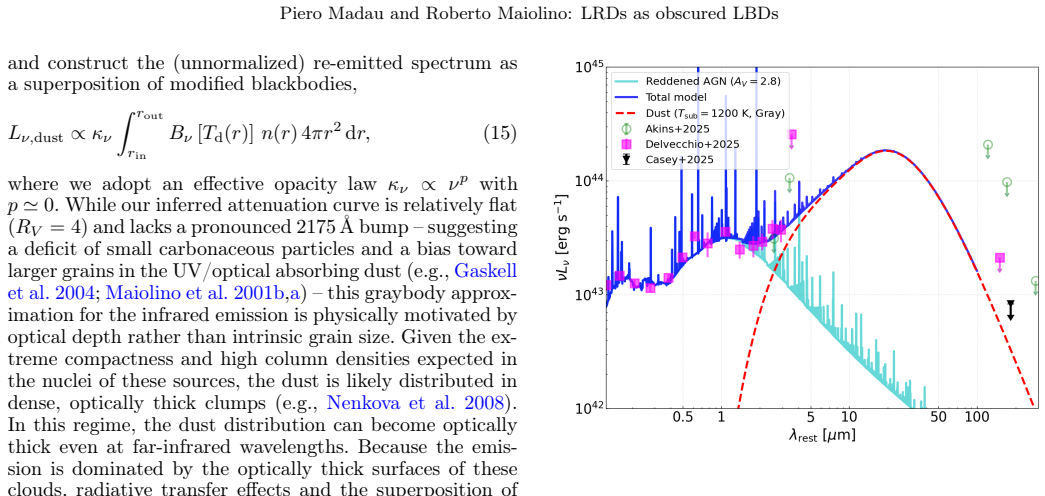
- The model predicts a modest near-IR hot-dust bump and far-IR/sub-mm emission consistent with current upper limits, with implied dust masses of 30–100 solar masses, resolving the 'dust budget crisis.'
- X-ray weakness is both intrinsic (a Compton-cooled corona) and orientation-enhanced, so even unreddened LBDs should be X-ray faint without requiring a fully enclosing gas cocoon.
Reading between the lines
- We would test the isotropy assumption directly: if spectropolarimetry or reverberation mapping shows the broad-line region is as anisotropic as the continuum, the high-EW tail that identifies LRDs would vanish, and the whole orientation map would need revision.
- A consequence we draw beyond the paper: if LRDs are dust-selected at high inclination, flux-limited samples should be biased toward intrinsically more luminous objects along obscured sightlines; comparing the LRD luminosity function to the LBD luminosity function after correcting for A_V≈2.8 would quantify this bias.
- The model implies that single-epoch virial black-hole masses for LRDs may be systematically underestimated because the flattened BLR breaks the isotropy assumed in the calibrations; we would test this by comparing single-epoch and reverberation masses in bright LBDs.
Editorial analysis
A structured set of objections, weighed in public.
Referee Report
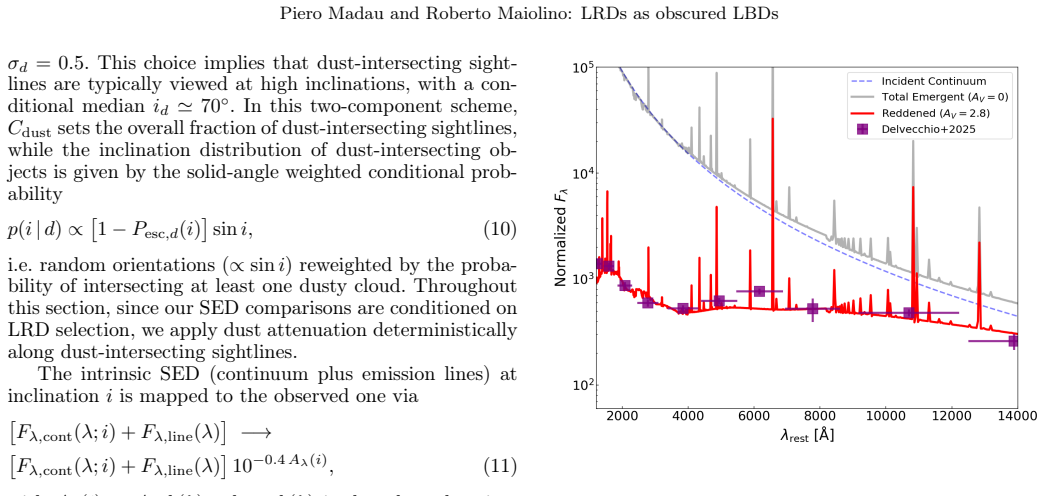
Summary. This paper proposes a unification model in which JWST Little Red Dots (LRDs) are the dust-obscured, high-inclination counterparts of compact, blue broad-line AGNs (Little Blue Dots, LBDs), both powered by super-Eddington accretion. The authors combine the anisotropic, radiation-pressure-supported thick-disk SEDs of Madau (2025) with Cloudy photoionization calculations of an equatorial, clumpy BLR and a flared dusty torus. They show that, after calibrating the global BLR covering factor so that the median broad H-alpha EW matches the observed 570 Å, covering factors C_BLR ~ 0.12-0.19 suffice; that high-inclination views produce a high-EW tail and weak high-ionization lines; that A_V ~ 2.8 along dust-intersecting sightlines reproduces the stacked V-shaped LRD SED (mean model/data ratio 1.05, rms 10%); and that an energy-conserving dust model yields H-alpha/H-beta ~ 10 and a small dust mass, avoiding an IR budget crisis. The paper argues that LRDs are not a distinct engine class but the obscured tail of the LBD population.
Significance. If correct, the model provides a single orientation-based framework connecting the defining LRD properties—extreme Balmer EWs, weak high-ionization lines, V-shaped continua, large Balmer decrements, and faint IR emission—without invoking a nearly 4pi 'cocoon.' The quantitative SED comparison to the Delvecchio et al. stack is genuinely good, and the energy-conserving dust treatment directly addresses the dust-budget crisis. The paper also makes falsifiable demographic predictions (e.g., LBD/LRD EW distributions and Balmer-decrement correlations). However, the main covering-factor result is calibrated rather than predicted, and the high-inclination EW tail relies on an untested assumption of isotropic BLR line emission. These issues must be resolved before the central unification claim can be considered established.
major comments (3)
- [Section 3, Eqs. (1)-(6), Fig. 3] The claim that 'large H-alpha EWs can be reproduced with C_BLR ~ 0.15' is partly a restatement of the calibration. The text explicitly normalizes C_BLR so that the probability-weighted median EW equals the observed 570 Å, then reports the resulting C_BLR as the 'required covering factor.' Because F_line is proportional to C_BLR and, when the nebular continuum is subdominant, the median EW is approximately linear in C_BLR, the quoted 0.12-0.19 is not an independent prediction. Please either derive C_BLR from an independent observable (e.g., L_H-alpha and the ionizing photon budget) or reframe this as a consistency check; ideally compare with the C_BLR required by a standard quasar SED under the same calibration.
- [Section 3, Eqs. (1)-(6), Fig. 4] The high-EW tail is generated by holding F_line independent of the observer's inclination while the direct continuum is attenuated by P_esc(i). But the same clumpy, equatorial BLR that produces P_esc(i) should also affect line radiation: line photons from BLR clouds along high-inclination sightlines can be absorbed by foreground clouds, and optically thick clouds emit preferentially from their illuminated faces. The paper does not model line transfer through the BLR; it simply scales one Cloudy run at i_BLR=80 by C_BLR. If line flux is suppressed toward high inclination as strongly as the continuum, the extreme-EW tail and the i>65-70 deg LRD assignment weaken or disappear, and matching LRD EWs would require larger covering. Please quantify this with an extended-emitter or anisotropic-line model, or justify why P_esc(i) applies only to the continuum.
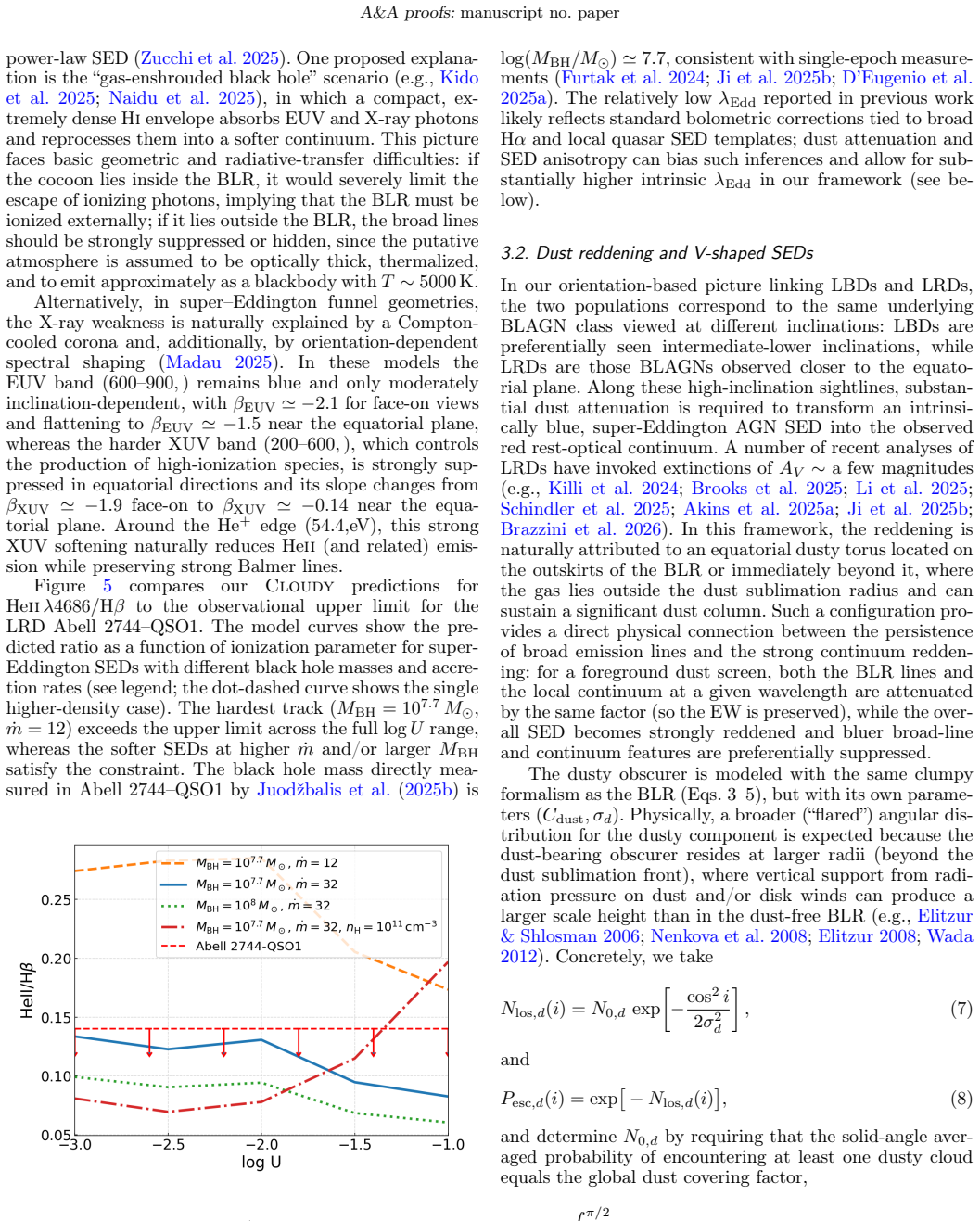
- [Section 2.1 and Section 3] All quantitative results inherit the specific Madau (2025) Model A SED (M_BH=10^7.5 Msun, mdot=32) without a sensitivity study. The required C_BLR, the high-EW tail, and the HeII suppression all depend on the EUV hardness and anisotropy of this SED. A softer or less anisotropic SED would shift C_BLR upward and reduce the contrast with the near-unity covering cocoon scenario. Please vary mdot/M_BH in the H-alpha-EW calculation, or at least show how C_BLR and the inclination boost scale with SED parameters.
minor comments (5)
- [Section 3, text below Eq. (1)] The BLR illumination angle is quoted as i_BLR = 85 deg in the text below Eq. (1), but later as i_BLR = 80 deg ('motivating our adoption of i_BLR = 80 deg'). Please harmonize.
- [Fig. 6 caption and Section 3.2] The Fig. 6 caption uses A_V = 2.9, while the text and Section 3.2 use A_V = 2.8. Unify the notation.
- [Fig. 4] The model curves are for broad-line EWs, while the Sun et al. stack values are total (broad+narrow) EWs. The caveat in the text is important and should also appear in the figure caption to avoid overinterpretation.
- [Section 3.3] The value r_in ~ 0.15 pc appears in the dust-mass estimate without derivation. State how it follows from T_sub = 1200 K and the assumed bolometric luminosity.
- [Eq. (5)] C_BLR is defined as a solid-angle average of the covering probability. The text notes this, but the distinction between angle-averaged covering and line-of-sight covering should be made explicit near Eq. (5) to avoid confusion with the 'modest covering factor' claim.
Circularity Check
C_BLR is calibrated to the observed median Hα EW and then quoted as the main result; the high-EW tail is built on the isotropic-BLR assumption.
-
fitted input called prediction
[Section 3 (Eqs. 1–6 and Fig. 3), repeated in Section 4]
"To translate Cloudy outputs into observables, we normalized the global BLR covering factor, CBLR, by scaling our fiducial model to match the median EW of 570Å reported by Maiolino et al. (2025). ... Matching the probability-weighted median of the models to the observed median implies global covering factors of CBLR ≃0.12–0.19."
The paper's headline 'extreme Hα EWs can be reproduced with global BLR covering factors of only CBLR ≃0.15' is the value of the parameter that was varied to force the model median to equal the observed 570 Å. The modest covering factor is therefore a restatement of the calibration, not an independent prediction. The value being below unity is not a mathematical tautology, but reporting it as a 'first key result' presents a fitted normalization as a derived conclusion.
-
self definitional
[Section 3, after Eq. (6), before Fig. 3; used again in Fig. 4]
"In the most edge-on tail of the orientation distribution, the model predicts very large EWs because the observed optical continuum decreases approximately geometrically, ∝cos i, while the broad-line luminosity is assumed to be isotropic."
Equation (1) defines EW(i) = Fline(i_BLR) / Fcont(i) with Fline independent of i by construction. The extreme high-EW tail is therefore a direct consequence of the definition plus the isotropy assumption, not a result derived from the physics of line emission. The later inference that LRDs require i ≳ 65–70° (Fig. 4) inherits this construction; if the BLR line flux were as inclination-dependent as the direct continuum, the tail would disappear and the LRD inclination assignment would not follow.
full rationale
The paper is partially circular in its headline numbers. Section 3 explicitly normalizes C_BLR so that the probability-weighted median Hα EW matches the observed 570 Å (Eq. 6, Fig. 3), and Section 4 then presents 'C_BLR ≃0.15' as the key result; that is a fitted value presented as a prediction. In addition, the extreme high-EW tail and the resulting assignment of LRDs to high inclinations are generated by the assumed isotropy of BLR line emission while the continuum is foreshortened (Eqs. 1–2), so that part of the LRD/LBD orientation story is built into the model's definitions. These two construction-level reductions justify a substantial circularity score. However, the paper does contain genuinely independent checks that prevent a fully circular score: the HeII/Hβ ratio is compared to the Abell 2744–QSO1 upper limit; the V-shaped SED is matched to the Delvecchio et al. stack with a mean model-to-data flux ratio of 1.05; the Balmer decrement of ~10 is obtained by applying the independently fitted A_V to a Cloudy intrinsic ratio; and the dust-reprocessed SED is checked against IR/sub-mm upper limits. The SED itself is inherited from same-author prior work (Madau 2025), which is a robustness caveat but not, by itself, a circular reduction because the mirror-funnel assumptions are stated and external GRMHD simulations are cited. Overall: partial circularity, score 6.
Assumptions & free parameters
free parameters (10)
- C_BLR (global BLR covering factor) =
0.12-0.19 (fiducial 0.15)
- A_V (dust attenuation along obscured sightlines) =
2.8-2.9 mag
- BLR angular thickness sigma_c =
0.26
- Dust angular thickness sigma_d =
0.5
- Ionization parameter logU =
-1.5 (fiducial; grid explored)
- BLR gas density n_H and column N_H =
10^10 cm^-3, 10^23 cm^-2
- Metallicity Z =
0.1 Z_sun
- Accretion parameters (M_BH, mdot) =
10^7.5 M_sun, mdot=32
- Dust torus parameters (T_sub, q, r_out/r_in, R_V, B) =
1200 K, q=0.5, r_out/r_in=100, R_V=4, B=0.15
- EW cap for H-alpha PDF =
2000 A
assumptions (8)
- domain assumption Radiation-pressure-supported thick disk with perfect-reflection 'mirror' funnel (Paczynski-Wiita, Sikora 1981, Madau 1988) gives the correct angle-dependent photosphere and SED.
- domain assumption Broad-line luminosity is isotropic while the direct continuum is foreshortened by cos(i).
- domain assumption BLR clouds form a clumpy, equatorially concentrated distribution with escape probability exp(-N_los) and sigma_c=0.26 (Nenkova formalism).
- domain assumption Dust is a foreground screen outside the BLR, so lines and continuum are attenuated by the same factor.
- domain assumption Random observer orientations p(i)=sin(i), and LRD-selected sightlines are those intersecting at least one dusty cloud with C_dust=C_BLR.
- domain assumption Dust-to-gas ratio scales as Z with Z~0.1 Z_sun, and gray dust emissivity kappa proportional to nu^0.
- ad hoc to paper The 2000 A cap on H-alpha EW does not materially affect the calibrated median.
- domain assumption Super-Eddington accretion is prevalent in z>6 nuclei.
Cite this review
Pith. "Pith review of Little Red Dots as Obscured Little Blue Dots: A Super-Eddington Unification Model." pith.science (2026). https://pith.science/paper/U46WLUJX
@misc{pith2026260222386,
  author       = {Pith},
  title        = {Pith review of: Little Red Dots as Obscured Little Blue Dots: A Super-Eddington Unification Model},
  year         = {2026},
  howpublished = {\url{https://pith.science/paper/U46WLUJX}},
  note         = {Machine review of arXiv:2602.22386}
}
read the original abstract
We investigate whether Little Red Dots (LRDs) are the dust-reddened, high-inclination counterparts of compact, blue broad-line AGNs (Little Blue Dots, LBDs) powered by super-Eddington accretion. We model the central engine as a geometrically thick, radiation-pressure supported accretion flow whose funnel produces strongly anisotropic, intrinsically blue ionizing continua, coupled to an equatorially concentrated BLR and dusty reprocessing clouds with modest covering factor. Using inclination-dependent spectral energy distributions (SEDs) as input to Cloudy, we show that the extreme broad Halpha EWs of JWST LRDs can be reproduced with global BLR covering factors of only 10%, fully consistent with standard Type~1 AGNs and far below unity. Large Balmer EWs arise because self-shadowing suppresses the high-inclination optical continuum while the BLR is illuminated by an ionizing-rich EUV SED. Weak high-ionization lines (e.g. HeII4686) follow from the orientation-dependent suppression of the XUV/soft X-ray continuum toward equatorial directions, without requiring a fully enclosing gaseous cocoon. Applying a gray dust attenuation law with AV~3 along high-inclination (LRD-selected) sightlines, our fiducial model reproduces the V-shaped UV-optical continua of LRDs and the large Balmer decrements; strong Balmer breaks arise only along the most obscured sightlines. A compact equatorial dust structure with modest global covering factor intercepts and reradiates only a small fraction of the bolometric luminosity, yielding a modest hot-dust bump and far-IR/sub-mm output consistent with current measurements and limits and implying small dust masses. This single-framework model links LRD and LBD observables through orientation, predicting correlated trends in Halpha EW, Balmer decrement, Balmer break, high-ionization line strengths, and IR emission.
Figures


Figures from the paper (5 more)


Forward citations
Cited by 3 Pith papers
-
Misaligned or chaotic? A strong break of axial symmetry in the local LRD J1025 revealed with VLT/FORS2 spectropolarimetry
The local Little Red Dot J1025 shows a 48° polarisation-angle offset between continuum and broad H-alpha, requiring broken axial symmetry.
-
Where did all the Little Red Dots go? The abundance of LRD analogues among objects with broad lines at $z < 0.35$
Only 0.08% of low-redshift broad-line objects have SEDs resembling high-redshift Little Red Dots, yielding nine candidates, one of which is the known analogue 'The Egg'.
-
NEXUS: Spectral Variability of Little Red Dots and Blue Active Galactic Nuclei at $2 \lesssim z \lesssim 6$
Little Red Dots at z=2-6 show less than 4% intrinsic H-alpha variability on 1-3 month rest-frame timescales, a flat white-noise pattern unlike normal AGNs, implying different broad-line production.
Reference graph
Works this paper leans on
-
[1]
T., Bogdán, Á., Kovács, O
Ananna, T. T., Bogdán, Á., Kovács, O. E., Natarajan, P., & Hickox, R. C. 2024, ApJ, 969, L18
2024
-
[2]
Baggen, J. F. W., Scoggins, M. T., van Dokkum, P., et al. 2026, arXiv e-prints, arXiv:2602.02702
arXiv 2026
-
[3]
Baggen, J. F. W., van Dokkum, P., Brammer, G., et al. 2024, ApJ, 977, L13
2024
-
[4]
Barro, G., Perez-Gonzalez, P. G., Kocevski, D., et al. 2025, arXiv e-prints, arXiv:2512.15853
arXiv 2025
-
[5]
2026, arXiv e-prints, arXiv:2601.22214
Brazzini, M., D’Eugenio, F., Maiolino, R., et al. 2026, arXiv e-prints, arXiv:2601.22214
arXiv 2026
-
[6]
C., Trump, J
Brooks, M., Simons, R. C., Trump, J. R., et al. 2025, ApJ, 986, 177
2025
-
[7]
A., Clayton, G
Cardelli, J. A., Clayton, G. C., & Mathis, J. S. 1989, ApJ, 345, 245
1989
-
[8]
M., Akins, H
Casey, C. M., Akins, H. B., Finkelstein, S. L., et al. 2025, ApJ, 990, L61
2025
Show all 69 references
-
[9]
2023, Rev
Chatzikos, M., Bianchi, S., Camilloni, F., et al. 2023, Rev. Mexicana Astron. Astrofis., 59, 327
2023
-
[10]
Chen, K., Li, Z., Inayoshi, K., & Ho, L. C. 2025, ApJ, 994, L42
2025
-
[11]
Conroy, C., Schiminovich, D., & Blanton, M. R. 2010, ApJ, 718, 184 de Graaff, A., Hviding, R. E., Naidu, R. P., et al. 2025, arXiv e-prints, arXiv:2511.21820 de Graaff, A., Rix, H.-W., Naidu, R. P., et al. 2025, Astron- omy & Astrophysics, 677, A56
2010
-
[12]
2025, arXiv e-prints [arXiv:2509.07100] D’Eugenio, F., Juodžbalis, I., Ji, X., et al
Delvecchio, I., Daddi, E., Magnelli, B., et al. 2025, arXiv e-prints [arXiv:2509.07100] D’Eugenio, F., Juodžbalis, I., Ji, X., et al. 2026, MNRAS, 545, staf2117 D’Eugenio, F., Maiolino, R., Perna, M., et al. 2025a, arXiv e-prints, arXiv:2503.11752 D’Eugenio, F., Nelson, E., Ji...
2025
-
[13]
C., Ding, Y., & Li, R
Du, R., Ho, L. C., Ding, Y., & Li, R. 2025, ApJ, 988, 3
2025
-
[14]
2008, New A Rev., 52, 274
Elitzur, M. 2008, New A Rev., 52, 274
2008
-
[15]
& Shlosman, I
Elitzur, M. & Shlosman, I. 2006, ApJ, 648, L101
2006
-
[16]
2006, MN- RAS, 366, 767
Fritz, J., Franceschini, A., & Hatziminaoglou, E. 2006, MN- RAS, 366, 767
2006
-
[17]
J., Labbé, I., Zitrin, A., et al
Furtak, L. J., Labbé, I., Zitrin, A., et al. 2024, Nature, 628, 57 García-Bernete, I., Pereira-Santaella, M., González-
2024
-
[18]
2026, arXiv e-prints, arXiv:2602.04967
Alfonso, E., et al. 2026, arXiv e-prints, arXiv:2602.04967
2026
-
[19]
Gaskell, C. M. 2009, New A Rev., 53, 140
2009
-
[20]
Whysong, D. H. 2004, ApJ, 616, 147 González-Alfonso, E., Fischer, J., Isaak, K., et al. 2010, A&A, 518, L43
2004
-
[21]
E., Labbe, I., Goulding, A
Greene, J. E., Labbe, I., Goulding, A. D., et al. 2024, ApJ, 964, 39
2024
-
[22]
N., Maiolino, R., Juodžbalis, I., et al
Hainline, K. N., Maiolino, R., Juodžbalis, I., et al. 2025, ApJ, 979, 138
2025
-
[23]
2023, ApJ, 959, 39 Hutsemékers, D., Sluse, D., Savić, D
Harikane, Y., Zhang, Y., Nakajima, K., et al. 2023, ApJ, 959, 39 Hutsemékers, D., Sluse, D., Savić, D. V., & Richards, G. T. 2023, A&A, 672, A45 Huško, F., Lacey, C. G., Roper, W. J., et al. 2025, MNRAS, 537, 2559
2023
-
[24]
E., de Graaff, A., Miller, T
Hviding, R. E., de Graaff, A., Miller, T. B., et al. 2025, A&A, 702, A57
2025
-
[25]
& Maiolino, R
Inayoshi, K. & Maiolino, R. 2025, ApJ, 980, L27
2025
-
[26]
2025a, MN- RAS[arXiv:2507.23774]
Ji, X., D’Eugenio, F., Juodžbalis, I., et al. 2025a, MN- RAS[arXiv:2507.23774]
-
[27]
M., & Davis, S
Jiang, Y.-F., Stone, J. M., & Davis, S. W. 2014, ApJ, 796, 106 Juodžbalis, I., Ji, X., Maiolino, R., et al. 2024, MNRAS, 535, 853 Juodžbalis, I., Maiolino, R., Baker, W. M., et al. 2025a, arXiv e-prints, arXiv:2504.03551 Juodžbalis, I., Marconcini, C., D’Eugenio, F., et al. 20...
2014
-
[28]
Kido, D., Ioka, K., Hotokezaka, K., Inayoshi, K., & Irwin, C. M. 2025, MNRAS, 544, 3407
2025
-
[29]
2024, A&A, 691, A52
Killi, M., Watson, D., Brammer, G., et al. 2024, A&A, 691, A52
2024
-
[30]
D., Finkelstein, S
Kocevski, D. D., Finkelstein, S. L., Barro, G., et al. 2025, ApJ, 986, 126
2025
-
[31]
E., Bezanson, R., et al
Labbe, I., Greene, J. E., Bezanson, R., et al. 2025, ApJ, 978, 92
2025
-
[32]
E., Matthee, J., et al
Labbe, I., Greene, J. E., Matthee, J., et al. 2024, arXiv e-prints, arXiv:2412.04557
2024 arXiv
-
[33]
2024, arXiv e-prints, arXiv:2409.13047
Lambrides, E., Garofali, K., Larson, R., et al. 2024, arXiv e-prints, arXiv:2409.13047
2024 arXiv
-
[34]
Leung, G. C. K., Finkelstein, S. L., Pérez-González, P. G., et al. 2025, ApJ, 992, 26 Article number, page 12 of 13 Piero Madau and Roberto Maiolino: LRDs as obscured LBDs
2025
-
[35]
Li, Z., Inayoshi, K., Chen, K., Ichikawa, K., & Ho, L. C. 2025, ApJ, 980, 36
2025
-
[36]
2026, ApJ, 997, 364
Lin, X., Fan, X., Cai, Z., et al. 2026, ApJ, 997, 364
2026
-
[37]
2016, MNRAS, 456, 2993
Lupi, A., Haardt, F., Dotti, M., et al. 2016, MNRAS, 456, 2993
2016
-
[38]
2024, A&A, 689, A128
Lupi, A., Trinca, A., Volonteri, M., Dotti, M., & Mazzuc- chelli, C. 2024, A&A, 689, A128
2024
-
[39]
2025, arXiv e-prints, arXiv:2501.09854
Madau, P. 2025, arXiv e-prints, arXiv:2501.09854
2025
-
[40]
& Haardt, F
Madau, P. & Haardt, F. 2024, ApJ, 976, L24
2024
-
[41]
2014, ApJ, 784, L38
Madau, P., Haardt, F., & Dotti, M. 2014, ApJ, 784, L38
2014
-
[42]
2025, MN- RAS, 538, 1921
Maiolino, R., Risaliti, G., Signorini, M., et al. 2025, MN- RAS, 538, 1921
2025
-
[43]
2024, A&A, 691, A145
Maiolino, R., Scholtz, J., Curtis-Lake, E., et al. 2024, A&A, 691, A145
2024
-
[44]
P., Brammer, G., et al
Matthee, J., Naidu, R. P., Brammer, G., et al. 2024, ApJ, 963, 129
2024
-
[45]
A., et al
Morishita, T., Stiavelli, M., Mason, C. A., et al. 2025, arXiv e-prints, arXiv:2508.01372
2025
-
[46]
P., Matthee, J., Katz, H., et al
Naidu, R. P., Matthee, J., Katz, H., et al. 2025, arXiv e- prints, arXiv:2503.16596
2025 arXiv
-
[47]
M., Ivezić, Ž., & Elitzur, M
Nenkova, M., Sirocky, M. M., Ivezić, Ž., & Elitzur, M. 2008, ApJ, 685, 147
2008
-
[48]
P., Watson, D., Sneppen, A., et al
Nikopoulos, G. P., Watson, D., Sneppen, A., et al. 2025, arXiv e-prints, arXiv:2510.06362
2025 arXiv
-
[49]
& Narayan, R
Pacucci, F. & Narayan, R. 2024, ApJ, 976, 96 Paczyńsky, B. & Wiita, P. J. 1980, A&A, 88, 23
2024
-
[50]
2023, A&A, 680, A102 Pérez-González, P
Pandey, A., Czerny, B., Panda, S., et al. 2023, A&A, 680, A102 Pérez-González, P. G., Barro, G., Rieke, G. H., et al. 2024, ApJ, 968, 4
2023
-
[51]
Peterson, B. M. 2006, in Physics of Active Galactic Nuclei at all Scales, ed. D. Alloin, Vol. 693, 77 Pozo Nuñez, F., Haas, M., Ramolla, M., et al. 2014, A&A, 568, A36 Savić, D. V., Hutsemékers, D., & Sluse, D. 2024, A&A, 687, A114
2006
-
[52]
F., Davies, F
Schindler, J.-T., Hennawi, J. F., Davies, F. B., et al. 2025, Nature Astronomy, 9, 1732
2025
-
[53]
J., Greene, J
Setton, D. J., Greene, J. E., Spilker, J. S., et al. 2025, ApJ, 991, L10
2025
-
[54]
1981, MNRAS, 196, 257
Sikora, M. 1981, MNRAS, 196, 257
1981
-
[55]
Stalevski, M., Fritz, J., Baes, M., Nakos, T., & Popović, L. Č. 2012, MNRAS, 420, 2756
2012
-
[56]
Q., Naidu, R
Sun, W. Q., Naidu, R. P., Matthee, J., et al. 2026, arXiv e-prints, arXiv:2601.20929
2026 arXiv
-
[57]
P., Plat, A., et al
Tang, M., Stark, D. P., Plat, A., et al. 2025, arXiv e-prints [arXiv:2505.06359]
2025 arXiv
-
[58]
J., Finkelstein, S
Taylor, A. J., Finkelstein, S. L., Kocevski, D. D., et al. 2025, ApJ, 986, 165
2025
-
[59]
2025, arXiv e-prints, arXiv:2510.00103
Torralba, A., Matthee, J., Pezzulli, G., et al. 2025, arXiv e-prints, arXiv:2510.00103
2025
-
[60]
2026, A&A, 705, A147
Torralba, A., Matthee, J., Pezzulli, G., et al. 2026, A&A, 705, A147
2026
-
[61]
2026, ApJ, 998, 60
Wada, K., Nagao, T., Shimizu, T., et al. 2026, ApJ, 998, 60
2026
-
[62]
L., et al
Wang, B., de Graaff, A., Davies, R. L., et al. 2025, ApJ, 984, 121
2025
-
[63]
2026, arXiv e-prints, arXiv:2602.06024
Wang, B., Leja, J., Labbe, I., et al. 2026, arXiv e-prints, arXiv:2602.06024
2026
-
[64]
Wang, J.-M., Qiu, J., Du, P., & Ho, L. C. 2014, ApJ, 797, 65
2014
-
[65]
& Shen, Y
Wu, Q. & Shen, Y. 2022, ApJS, 263, 42
2022
-
[66]
2025, arXiv e- prints, arXiv:2512.11050
Yan, Z., Inayoshi, K., Chen, K., & Guo, J. 2025, arXiv e- prints, arXiv:2512.11050
2025
-
[67]
T., et al
Yue, M., Eilers, A.-C., Ananna, T. T., et al. 2024, ApJ, 974, L26
2024
-
[68]
M., Mullen, P
Zhang, L., Stone, J. M., Mullen, P. D., et al. 2025, ApJ, 995, 26
2025
-
[69]
2025, arXiv e-prints, arXiv:2510.10772 Article number, page 13 of 13
Zucchi, G., Ji, X., Madau, P., et al. 2025, arXiv e-prints, arXiv:2510.10772 Article number, page 13 of 13
2025
Reviewed August 2, 2026 · model on record in the stance chip above.
Discussion (0). Continue with ORCID to comment.