REVIEW 3 major objections 3 minor 33 references
Relativistic interpretation and cosmological signature of Milgrom's acceleration
T0 review · 3 major / 3 minor · reviewed 2026-08-14 · deepseek-v4-flash
Pith's one-line read The paper claims the MOND acceleration scale $a_0$ is not an independent constant but is fixed by a conserved curvature-area product, giving $a_0 = \sqrt{1+q_0^2}/(4\sqrt{3})\,cH_0 \simeq cH_0/5.83$.
desk verdict The paper's central Milgrom relation does not follow from its own equations—the algebra gives a factor roughly 3.5 off—though the derived ODE's late-time fit to ΛCDM is a genuine curiosity. read the letter →
The pith
A machine-rendered reading of the paper's core claim, the machinery that carries it, and where it could break.
The reading
What carries the argument
The load-bearing object is $\kappa \equiv 4\pi\ell^2 K$, the product of the Kretschmann curvature invariant with the area of a 2-sphere of radius $\ell$; the paper postulates that it is conserved ($\dot\kappa = 0$) along the observer flows selected by the physics. The argument works by evaluating the same $\kappa$ on two extremal scales, $\ell = \alpha R_M$ for the weak-field Schwarzschild metric of a compact source and $\ell = R_H = c/H$ for a homogeneous FLRW cosmology, and equating the two, which transfers the cosmic values $H_0$ and $q_0$ into the local definition of $a_0$.
What would settle it
Over redshifts $0 < z < 0.2$, measure $H(z)$ and $q(z)$ from independent cosmological probes and test whether $H^2(1+q^2)$ is constant, as equation (9) demands; a significant drift would falsify the conserved-product assumption. A second, independent check is to compare $a_0$ measured from galaxy rotation curves or wide binaries against the predicted $\sqrt{1+q_0^2}/(4\sqrt{3})\,cH_0$ using current $H_0$ and $q_0$ values.
Extended reading notes
Core claim
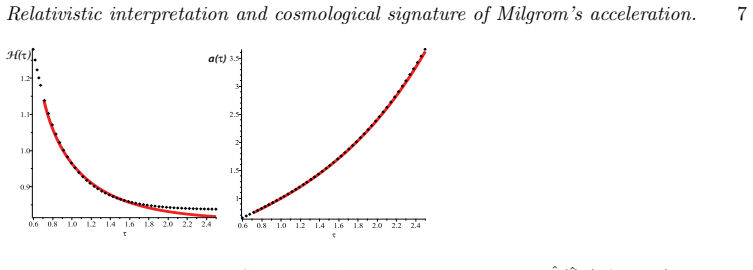
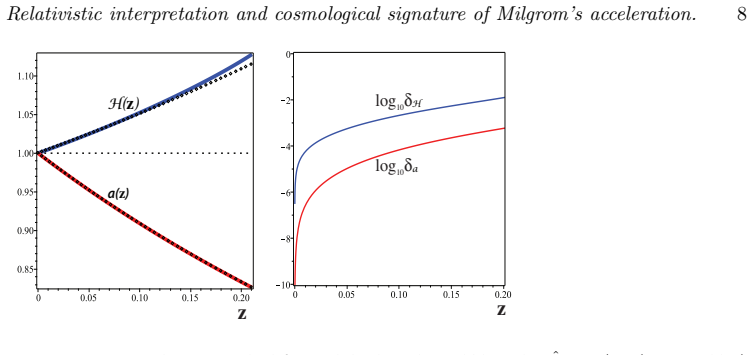
The central claim is that the (until now empirical) relation $a_0 \simeq cH_0/5.83$ is a consequence of a conserved scalar product built from curvature and area: $\kappa \equiv 4\pi\ell^2 K$ stays constant along observer congruences, where $K$ is the Kretschmann invariant and $\ell$ is a characteristic length. For an isolated source described by a weak-field Schwarzschild metric, evaluating $\kappa$ at $\ell = \alpha R_M$, with $R_M = (GM/a_0)^{1/2}$ the MOND radius, gives $\kappa = 192\pi\alpha^{-4}(a_0/c^2)^2$. For a spatially flat FLRW cosmology evaluated at the Hubble radius $\ell = R_H = c/H$, the same product is $\kappa = 48\pi(H^2/c^2)(1+q^2)$, and the conservation law $\dot\kappa = 0$ turns into $H^2(1+q^2) = H_0^2(1+q_0^2)$. Matching the two regimes fixes $\alpha \simeq 1.05 \simeq 1$ and gives $a_0 = \sqrt{1+q_0^2}/(4\sqrt{3})\,cH_0$, with $R_M = 2\cdot 3^{1/4}(1+q_0^2)^{-1/4}(GM/(cH_0))^{1/2}$. The same constraint on FLRW evolution produces a differential equation for $H$ whose late-time solution tracks $\Lambda$CDM closely, with relative differences below $10^{-3}$ in $H/H_0$ and about $10^{-5}$ in $a$ for $0 < z < 0.2$, and an effective dark-energy equation of state $w_0 \simeq -1.026$ near the present.
Load-bearing premise
The entire result rests on the assumption that a particular curvature-times-area quantity stays constant as the universe expands; the paper assumes this conservation law rather than proving it, and if it fails the derivation of $a_0$ from $H_0$ and $q_0$ collapses.
Editorial extensions
If this is right
- The MOND scale $a_0$ loses its status as a free parameter: once $H_0$ and $q_0$ are measured, both $a_0$ and the MOND radius $R_M$ are fixed by equation (11).
- Any metric gravity theory respecting the equivalence principle and reproducing the weak-field Schwarzschild and FLRW solutions is constrained by $\kappa = 4\pi\ell^2 K$, making the conserved product a test for modified-gravity realizations of MOND.
- The FLRW expansion produced by $\dot\kappa = 0$ agrees with the $\Lambda$CDM model to within about $0.1\%$ in $H/H_0$ and $10^{-5}$ in $a$ over $0 < z < 0.2$, so the constraint is compatible with present-day cosmological data.
- The effective dark-energy equation of state implied by the constrained Hubble rate is $w_0 \simeq -1.026$ for the calibration values, placing the model close to a cosmological constant but with a slight dynamical tilt.
- A Machian signature becomes possible: the current cosmic parameters $H_0$ and $q_0$ are imprinted on the dynamics of local self-gravitating systems near the MOND radius.
Reading between the lines
- A testable extension, not developed in the paper: if $\dot\kappa = 0$ is exact, independent measurements of $a_0$ from rotation curves or wide binaries can be compared with $\sqrt{1+q_0^2}/(4\sqrt{3})\,cH_0$; a mismatch beyond uncertainties would falsify the specific coefficient $1/5.83$.
- The paper only checks the $\Lambda$CDM match over $0 < z < 0.2$; pushing the same constraint to higher redshift, where the two models should diverge, would provide an observational discriminant between the geometric model and $\Lambda$CDM.
- Because $K$ contains both Ricci and Weyl curvature, one could impose the same conserved product on rotating or inhomogeneous metrics; the paper explicitly leaves galactic-scale and wide-binary tests as unfinished work, so this is an extension rather than a result.
- The product $4\pi\ell^2 K$ can be read as a curvature flux through a 2-sphere, hinting at a connection to thermodynamic or entropy-based pictures of gravity; the paper does not develop this link.
Signed reviews
Editorial analysis
A structured set of objections, weighed in public.
Referee Report
Summary. The paper proposes a coordinate-independent geometric constraint κ = 4πℓ²K, where K is the Kretschmann scalar and ℓ a characteristic length, and postulates that κ is conserved along observer congruences. Evaluating κ for a weak-field Schwarzschild metric at r = αR_M and for flat FLRW at the Hubble radius, the authors equate the two expressions and claim to obtain Eq. (10), a0 ≈ cH0/5.83, which they interpret as a derivation of Milgrom's acceleration. Imposing κ̇ = 0 on the FLRW expression gives Eq. (12), an ODE for H(t) whose solution is compared with the ΛCDM expansion, reporting agreement at the 10^-3 level in H and 10^-5 level in a for 0 < z < 0.2, and an effective equation of state w0 ≈ -1.026. The paper concludes that a0 may be determined by H0 and q0 and that the match is unlikely to be coincidental.
Significance. If Eq. (10) were a valid consequence of the proposed constraint, the paper would offer a notable new connection between local gravity phenomenology and cosmological parameters, with a falsifiable cosmic expansion history. The geometric constraint idea is original, and the authors are transparent about the idealized settings and about using q0 for calibration. However, the central numerical result does not follow from the manuscript's own equations: equating Eqs. (5) and (8) gives a0 = (α²/2)√(1+q0²)cH0, a factor 2√3 larger than the claimed value. The remaining derivation relies on a postulated conservation law and on a fitted O(1) constant α, and the ΛCDM comparison is partly calibrated with ΛCDM inputs. These issues are load-bearing, so the paper does not support its main claims as written.
major comments (3)
- [§3–§4.1, Eqs. (5), (8), (10)] Equation (10) does not follow from Eqs. (5) and (8). For flat FLRW the Kretschmann scalar is K = 12H⁴(q²+1)/c⁴, so Eq. (8) is κ = 48πH²(q²+1)/c². Equating with Eq. (5) at t0 gives 192π/α⁴ (a0²/c⁴) = 48πH0²(1+q0²)/c², hence a0 = (α²/2)√(1+q0²)cH0. With q0 = -0.5275 and α = 1.0511 this is ≈ 0.62cH0, a factor 2√3 larger than the claimed cH0/5.83. To obtain Eq. (10), Eq. (8) would have to be smaller by a factor of 12. The claimed derivation of Eq. (11) therefore fails.
- [§4.1, Eq. (9)] Equation (9) is a postulate, not a consequence of any field equations; the paper simply imposes u^a∇_aκ = 0. Moreover, α in Eq. (5) is not predicted: it is chosen a posteriori (α ≈ 1.0511) so that Eq. (10) reproduces the empirical value a0 ≈ cH0/5.83. The derivation of a0 is therefore not independent of the input it purports to explain.
- [§4.1.1, Eqs. (12)–(13)] The comparison with ΛCDM is partly calibrated with the model it is compared against. The input q0 = -0.5275 comes from a Planck 2015 ΛCDM fit, and the initial conditions of Eq. (12) fix H and its first derivative at t0; therefore the Taylor expansions of H(t) and a(t) around t0 agree with ΛCDM to first order by construction. The reported agreement for 0 < z < 0.2 is thus expected from the Taylor theorem and does not independently validate Eq. (9). A nontrivial test would require agreement (or a predicted deviation) over a much wider redshift range, or a demonstration that the match is not a truncation artifact.
minor comments (3)
- [§4.1.2, Eq. (14)] Equation (14) as printed yields w0 = -0.568 with the stated inputs, not -1.026; the intended expression appears to be w = -(2Ĥ√(1+q²-Ĥ²)+1)/(3(1-Ωm)). Please correct the formula and the numerical value.
- [Throughout] There are several typos: 'mimmic' (p. 9) should be 'mimic'; 'characateristic' (p. 3) should be 'characteristic'; 'within within' (p. 5); 'our our' (p. 9).
- [§4.1, Eq. (11)] The expression for RM in Eq. (11) should be re-derived after correcting Eq. (10); the current form is tied to the erroneous factor in Eq. (10).
Circularity Check
The claimed derivation of a0 ≈ cH0/5.83 is calibrated, not derived: α is fixed to the empirical value, Eq. (10) contains an algebraic factor error, and the ΛCDM-matched expansion is benchmarked against the same model that supplied q0 and Ωm0.
-
fitted input called prediction
[Section 4.1, Eq. (10) and preceding paragraph]
"Comparing (5) with (9) we obtain the following expression relating a0 with observable cosmological parameters a0 = α²√(1+q0²)/(4√3) × cH0 ≈ cH0/5.83 ... Considering the numerical value 1+q0²=1.277 that we have used to calibrate the solutions emerging from the constraint (9) through the latest observational data, we obtain for the proportionality constant α in (10) the appealing value: α=1.0511≈1, that accounts for inaccuracies in the determination of cosmological parameters and for the empiric numerical factor 1/5.83."
α is a free O(1) constant introduced in Eq. (5) via r=αRM. It is not determined by the geometric constraint; it is adjusted, using the empirical a0≈cH0/5.83 from Milgrom [3] and a ΛCDM-derived q0, so that Eq. (10) reproduces the input relation. Eq. (11) then presents a0=√(1+q0²)/(4√3)cH0 as a theoretical form, but this is the same empirical relation with the fitted value of α absorbed. Independently, equating Eq. (5) and Eq. (8) gives a0=(α²/2)√(1+q0²)cH0; the denominator 4√3 in Eq. (10) is what makes α≈1. The central numerical prediction therefore reduces to the fitted input, not to the conservation law.
-
fitted input called prediction
[Section 4.1.1, Eqs. (12)-(13), and calibration paragraph before Eq. (10)]
"To be able to use this constraint we consider q0 = −0.5275, which emerges from the Planck 2015 results [28] under the assumption of a fit to a ΛCDM model ... we use this value for the sole purpose of calibration ... we compare (for calibration purposes) the solutions of (12) with those of the ΛCDM Raychaudhuri equation ... for the parameters Ωm0=0.315, ΩΛ0=0.685."
The expansion history generated from the postulated conservation law (9) is initialised with Ĥ0=1, a0=1, t0=13.7 Gyr, and q0 taken from a Planck-2015 fit to ΛCDM. The benchmark is the same ΛCDM model with Ωm0=0.315, ΩΛ0=0.685. Normalisation forces agreement at t0, and q0 fixes dĤ/dτ at t0, so the close match for 0<z<0.2 is partly inherited from the shared calibration values rather than being an independent test of the constraint. The paper itself labels the uses as 'calibration purposes'.
full rationale
The paper's geometric ansatz κ=4πℓ²K and the conservation law κ˙=0 are original postulates, and the self-citations ([24], [25], [27]) are not load-bearing for the main formula; those citations are empirical or contextual and do not supply the central derivation. However, the central numerical relation a0≈cH0/5.83 is not derived from the constraint. The constant α in Eq. (5) is a free parameter, and the text explicitly fixes α=1.0511 so that Eq. (10) matches the empirical factor 1/5.83; Eq. (11) then presents the calibrated relation as a theoretical prediction. Moreover, the stated algebra leading to Eq. (10) is inconsistent with the paper's own Eqs. (5) and (8): solving them gives a0=(α²/2)√(1+q0²)cH0≈0.62cH0, not cH0/5.83, so the 4√3 denominator is an algebraic artifact that conveniently makes α≈1. The cosmological matching exercise is also calibrated against ΛCDM: q0, H0, t0 and Ωm0 come from a ΛCDM fit, and the solutions are compared to that same ΛCDM model, so the close agreement near the present epoch is partly by construction. These two issues affect the paper's central claims, so the circularity score is high, even though the paper honestly labels the uses as calibration.
Assumptions & free parameters
free parameters (2)
- α (proportionality constant in r = αR_M) =
≈1.0511 (paper states α=1.0511≈1, likely α²)
- q0 (present deceleration parameter) =
-0.5275
assumptions (5)
- ad hoc to paper κ = 4πℓ²K is conserved along observer congruences: u^a∇_a κ = 0.
- ad hoc to paper The local evaluation radius is r = αR_M with α of order one, and local and cosmic κ values can be equated.
- domain assumption q0=-0.5275 and Ωm0=0.315 from the Planck-LCDM fit are valid inputs.
- ad hoc to paper The '+' branch in Eq (12) is the physically relevant solution.
- domain assumption Spacetime geometry for local sources is the weak-field Schwarzschild metric and for cosmic scales is spatially flat FLRW.
invented entities (1)
-
κ ≡ 4πℓ²K, a conserved geometric quantity
Cite this review
Pith. "Pith review of Relativistic interpretation and cosmological signature of Milgrom's acceleration." pith.science (2026). https://pith.science/paper/U4BUTDVK
@misc{pith2026190805412,
  author       = {Pith},
  title        = {Pith review of: Relativistic interpretation and cosmological signature of Milgrom's acceleration},
  year         = {2026},
  howpublished = {\url{https://pith.science/paper/U4BUTDVK}},
  note         = {Machine review of arXiv:1908.05412}
}
abstract
We propose in this letter a relativistic coordinate independent interpretation for Milgrom's acceleration $a_{0}=1.2 \times 10^{-8} \hbox{cm/s}^{2}$ through a geometric constraint obtained from the product of the Kretschmann invariant scalar times the surface area of 2--spheres defined through suitable characteristic length scales for local and cosmic regimes, described by Schwarzschild and Friedman--Lema\^\i tre--Robertson--Walker (FLRW) geometries, respectively. By demanding consistency between these regimes we obtain an appealing expression for the empirical (so far unexplained) relation between the accelerations $a_0$ and $c H_0$. Imposing this covariant geometric criterion upon a FLRW model, yields a dynamical equation for the Hubble scalar whose solution matches, to a very high accuracy, the cosmic expansion rate of the $\Lambda$CDM concordance model fit for cosmic times close to the present epoch. We believe that this geometric interpretation of $a_0$ could provide relevant information for a deeper understanding of gravity
Figures

Reference graph
Works this paper leans on
-
[1]
1983, ApJ, 270, 365
Milgrom, M. 1983, ApJ, 270, 365
1983
- [2]
- [3]
-
[4]
Bekenstein J. D., 2004, Phys. Rev. D, 70, 083509; Capozziello, S., & de Laurentis, M. 2011, Phys. Rep., 509, 16 7; Mendoza S., Bernal T., Hernandez X., Hidalgo J. C., Torres L. A., 2013, MNRAS, 433, 1802; Moffat, J. W., & Toth, V. T. 2008, ApJ, 680, 1158; Zhao, H., & Famaey, B. 2010, PhRvD, 81, 087304; Capozziello S., Cardone V.F., Troisi A., 2007, MNRAS, ...
work page 2004
-
[5]
Dabringhausen, J., Kroupa, P., Famaey, B., Fellhauer, M. 2016, MNRAS, 463, 186
work page 2016
-
[6]
Durazo R., Hernandez X., Cervantes Sodi B., S´ anchez S. F., 2017, ApJ, 837, 179
work page 2017
-
[7]
Hernandez X., Mendoza S., Suarez T., Bernal T., 2010, A&A, 514, 101
work page 2010
-
[8]
Hernandez X., Jim´ enez M. A., Allen C., 2012, Eur. Phys. J. C, 72, 1884
work page 2012
Show all 33 references
-
[9]
Hernandez X., Cortes R. A. M., Scarpa R., 2017, MNRAS, 464, 2930
2017
-
[10]
A., Garcia, G., Hernandez, X., Nasser, L
Jim´ enez, M. A., Garcia, G., Hernandez, X., Nasser, L. 2013, ApJ, 768, 142
2013
-
[11]
S., Schombert J
Lelli F., McGaugh S. S., Schombert J. M., 2016, AJ, 152, 157
2016
-
[12]
S., Schombert, J
Lelli, F., McGaugh, S. S., Schombert, J. M., Pawlowski, M. S. 2017, ApJ, 836, 152
2017
-
[13]
L¨ ughausen F., Famaey B., Kroupa P., 2014, MNRAS, 441, 2497 Relativistic interpretation and cosmological signature of Milgrom’s acceleration. 10
2014
-
[14]
S., de Blok W
McGaugh S. S., de Blok W. J. G., 1998, ApJ, 499, 66
1998
-
[15]
Scarpa R., Marconi G., Gilmozzi R., 2003, A&A, 405, L15
2003
-
[16]
2016, MNRAS, 462, 1092
Tian, Y., Ko, C.-M. 2016, MNRAS, 462, 1092
2016
-
[17]
Barrientos and S
E. Barrientos and S. Mendoza, Phys. Rev. D 98 (2018) 084033
2018
-
[18]
Capozziello S., Jovanovic P., Borka Jovanovic V., Borka D., 2017, JCAP, 06, 044
2017
-
[19]
Verlinde, E., 2016, preprint arXiv:1611.02269
2016 arXiv
-
[20]
McCulloch M., 2017, Ap&SS, 362, 57
2017
-
[21]
C., Mendoza, S
Bernal, T., Capozziello, S., Hidalgo, J. C., Mendoza, S. Eur. Phys. J. C, 2011,71, 1794-1801
2011
-
[22]
Bernal, T., Capozziello, S., Cristofano, G., de Laurentis, M. Mod. Phys. Lett. A, 2011,26, 2677- 2687
2011
-
[23]
and Zanelli J., 1991, Class
Mardones A. and Zanelli J., 1991, Class. Quantum Grav., 8, 1545
1991
-
[24]
Hern´ andez, X., Sussman, R.A., Nasser, L., 2019, MNRAS, 483, 147
2019
-
[25]
Hern´ andez X., 2012, Entropy, 14, 848
2012
-
[26]
Pittordis C., Sutherland W., 2018, MNRAS, 480, 1778
2018
-
[27]
Hernandez X., Cortes R. A. M., Allen C., Scarpa R., 2019, International Journal of Modern Physics D, 28, 1950101
2019
-
[28]
Planck Contribution A&A 594, A13 (2016)
2016
-
[29]
D., 2006, Prog
Mannheim P. D., 2006, Prog. Part. Nuc. Phys.,56, 340
2006
-
[30]
K., Bagla J
de Felice A., Nesseris S., Tsujikawa S., 2012, JCAP, 05, 029; Jassal H. K., Bagla J. S., Padmanabhan T., 2005, MNRAS, 356, L11; Postnikov S., Dainotti M. G., Hernandez X., Capozziello S., 2014, ApJ, 783, 126
2012
-
[31]
Clifton and P
T. Clifton and P. G. Ferreira, Phys. Rev. D 80, 103503 (2009); Phys. Rev. D 84, 109902 (2011); T. Clifton and P. G. Ferreira, JCAP 0910, 26 (2009); T. Clifton, K. Rosquist and R. Tavakol, Phys. Rev. D 86, 043506 (2012); J.-P. Bruneton and J. Larena, Class. Quant. Grav. 29, 155...
2009
-
[32]
Bentivegna and M
E. Bentivegna and M. Korzynski, Class. Quant. Grav. 29, 165007 (2012); E. Bentivegna, Class. Quant. Grav. 31, 035004 (2014); E. Bentivegna and M. Korzynski, Class. Quant. Grav. 30, 235008 (2013); C.-M. Yoo, H. Abe, Y. Takamori and K.-i. Nakao, Phys. Rev. D 86, 044027 (2012); C...
2012
-
[33]
Bak and S
D. Bak and S. J Rey, Class. Quant. Grav.17, L83 (2000); R. G. Cai and L. M. Cao, Phys. Rev. D75, 064008 (2007); R. G. Cai and S P Kim, JHEP, 0502 050(2005); V. Faraoni, Phys. Rev. D84, 024003 (2011); D. W. Tian and I. Booth, Phys. Rev. D 92, 024001 (2015)
2000
Reviewed August 14, 2026 · model on record in the stance chip above.
Discussion (0). Continue with ORCID to comment.