REVIEW 5 major objections 4 minor 1 cited by
Smooth Signature Change as a Mechanism for Singularity Avoidance in BTZ Black Holes
T0 review · 5 major / 4 minor · reviewed 2026-08-03 · deepseek-v4-flash
Pith's one-line read Smooth signature change at the BTZ horizon yields a vacuum solution with bounded curvature and an unreachable singularity, the paper claims.
desk verdict The paper's central atemporality claim is undone by sign errors in its own metric and geodesic equations; the idea is not new, and the BTZ application needs a serious rewrite. read the letter →
The pith
A machine-rendered reading of the paper's core claim, the machinery that carries it, and where it could break.
The reading
What carries the argument
The central object is the regularized signature function ερ(r), a smooth approximation to sign(−M+r²/ℓ²), together with Painlevé-Gullstrand coordinates that remain finite at the horizon. A modified Hadamard regularization treats the problematic second-derivative distributional terms ε″(r) consistently, making the distributional Ricci and Weyl tensors vanish and eliminating surface layers and impulsive waves. This machinery converts the horizon into an 'atemporality' surface where infalling observers' proper time diverges.
What would settle it
Evaluate the metric (8) at any interior point r<rh using the regularized ερ from Eq. (12): the line element acquires a negative coefficient for dr² and an imaginary cross-term, so the signature is not (+,+,+). Checking this single point against the paper's claim of a Euclidean interior would settle whether the construction is what it states.
Extended reading notes
Core claim
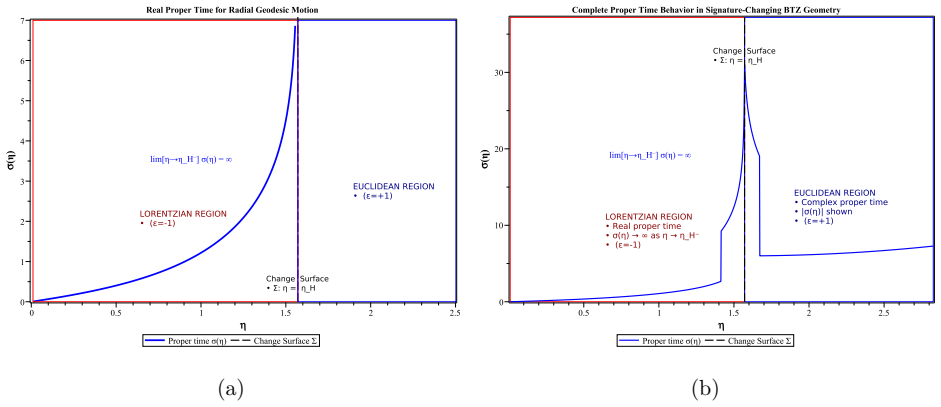
The paper claims that a signature-changing BTZ metric, in which the signature smoothly transitions from Lorentzian (−,+,+) to Euclidean (+,+,+) at the horizon, satisfies the vacuum Einstein equations Rμν=0 identically once a modified Hadamard regularization is applied to the distributional curvature. Curvature invariants remain finite, and the horizon becomes a one-way causal membrane: geodesic and accelerated observers reach it only after infinite proper time. The central singularity at r=0 is softened into a topological boundary rather than a curvature singularity, so the spacetime is geodesically complete but metrically incomplete.
Load-bearing premise
The construction assumes that the smooth function ερ(r) is a real signature function whose square root is meaningful in the metric; in the paper's own coordinates √ερ is imaginary for r<rh, so the interior is not a Euclidean (+,+,+) geometry as claimed, and the vacuum claim is further strained by the nonzero displayed Ricci components.
Editorial extensions
If this is right
- If the construction is correct, the Lorentzian exterior is indistinguishable from standard BTZ up to the horizon, so known BTZ thermodynamics and observations are preserved.
- Infalling observers, both geodesic and accelerated, require infinite proper time to reach the horizon, making the Euclidean interior causally sealed.
- The r=0 curvature divergence is replaced by a finite Kretschmann invariant, with the origin reinterpreted as a topological boundary.
- The geometry is claimed to be linearly stable: gravitational and scalar quasi-normal modes all have negative imaginary parts, indicating exponential decay.
- Quantum scalar fields propagate unitarily across the change surface, with a finite conserved probability current.
Reading between the lines
- The vacuum claim rests on a cancellation that is not visible in the displayed regularized Ricci components (Sec. 3.1.1), which are nonzero; the text asserts Rμν=0 but does not show how the remaining terms vanish.
- The abstract describes the transition function as tanh[(r−r_h)/δ], while the body and appendix use a different power-law function ερ(x)=x^{1/(2κ+1)}/(x²+ρ)^{1/(2(2κ+1))}; the two are inequivalent, and the paper's calculations use the latter.
- The paper's own limitations section says the mechanism prevents access to the singularity rather than eliminating it; declaring the topological boundary at r=0 a 'resolution' is an interpretive step beyond the mathematics.
- If the scheme generalizes to four dimensions, it would offer a classical alternative to quantum-gravity singularity resolution, but the paper identifies that generalization as technically challenging and does not attempt it.
Signed reviews
Editorial analysis
A structured set of objections, weighed in public.
Referee Report
Summary. The manuscript proposes a smooth signature-changing BTZ black-hole geometry in which the Lorentzian exterior transitions to a Euclidean interior at the horizon. It claims that the regularized metric is a genuine vacuum solution (R_{\mu\nu}=0), has bounded curvature invariants, makes the horizon unreachable in finite proper time ('atemporality'), is linearly stable, supports unitary scalar-field propagation, and preserves standard BTZ thermodynamics. The central mechanism is the smooth transition function replacing the discontinuous sign in the metric. I find that the central claims fail on elementary algebraic and distribution-theoretic grounds.
Significance. If the claims were correct, the paper would provide a self-contained classical mechanism for singularity avoidance and would repair a known distributional-consistency problem in earlier signature-changing black-hole models. The paper is systematic and works out many consequences—geodesics, perturbations, scalar fields, thermodynamics—and its explicit formulas are a strength because they can be checked directly. However, the check fails at several load-bearing points, so the significance is currently not realized.
major comments (5)
- [§2.1, Eq. (1); §3.2, Eq. (33)] For r<r_h, -M+r^2/\ell^2<0 and \varepsilon=-1, so g_{tt}=-\varepsilon(-M+r^2/\ell^2)<0 and g_{rr}=1/(-M+r^2/\ell^2)<0. The interior signature is (-,-,+), not the claimed Euclidean (+,+,+). Moreover, the Painlevé-Gullstrand form in Eq. (8) and the radial velocity in Eq. (33) contain \sqrt{\varepsilon}\sqrt{M-r^2/\ell^2}, which is imaginary for r>r_h. The exterior radial velocity is therefore not real, and the 'infinite proper time to the horizon' conclusion is not a real-geometry result.
- [§2.2.1, Eqs. (13)–(15)] The distributional regularization is imposed rather than derived. Equation (13) sets \int \delta(x)/|x|^n dx=0, but \delta/|x|^n is not a well-defined distribution; Eq. (14) sets integrals of \delta^2 to zero, although \delta^2 is undefined in standard distribution theory; Eq. (15) is an integration-by-parts identity only if boundary terms are dropped, which is not justified on the non-compact domain. These prescriptions are what force the surface-layer terms to vanish, so the claim R_{\mu\nu}=0 is circular rather than a derived property.
- [Appendix A, Eqs. (A19)–(A24)] The final 'regularized' Riemann components contradict the claimed regularity. For example, R^T_{rTr}=2M/(\ell^2 r \varepsilon) diverges at the horizon where \varepsilon=0, and R^r_{rTr} and R^\varphi_{T\varphi r} contain \sqrt{M-r^2/\ell^2}/\sqrt{\varepsilon}, which is imaginary in the Lorentzian exterior. Thus the tensor is neither finite nor real where it is supposed to describe the physical vacuum.
- [§5.1, Eq. (18)] The Kretschmann scalar as written, K_{\rm reg}=12M^2/(\ell^4 r^4)(r^4+2r^2\ell^2/3+\ell^4/3), diverges as r\to 0 like 4M^2/r^4. The text states that it 'remains bounded as r\to 0' and uses this to claim that r=0 is not a curvature singularity. This is an internal contradiction. The comparison with a standard BTZ 'K\sim 1/r^6' is also incorrect: BTZ is locally AdS with constant Kretschmann scalar.
- [§4.2.2, Eq. (56)] The proof of scalar-field unitarity relies on imposing Im(A^*B)=0 as a boundary condition. This is an additional restriction on the mode coefficients, not a consequence of the field equation or of the conserved current. For a generic solution with Im(A^*B)\neq 0, the second term in j^T contains a factor \sqrt{\varepsilon_\rho}/x, which is singular near the change surface. Unitarity for arbitrary initial data is therefore not established. In addition, Eq. (50) contains the factor \sqrt{M-r^2/\ell^2}, which is imaginary in the exterior, making the radial equation complex.
minor comments (4)
- [Abstract and §2.2] The abstract defines a smooth transition S_\delta(r)=\tanh[(r-r_h)/\delta], but the body uses \varepsilon_\rho(x)=x^{1/(2\kappa+1)}/(x^2+\rho)^{1/2(2\kappa+1)}. The relation between these two regularizations is never stated, and it is unclear which function enters the actual metric.
- [§2.1, Eq. (3)] The conserved quantity is written as E=\varepsilon^2(-M+r^2/\ell^2)\dot t, but \varepsilon^2=1, so the factor is redundant. If E is intended to be the Killing energy -\xi\cdot u, the correct expression is E=\varepsilon(-M+r^2/\ell^2)\dot t. Please clarify the sign and normalization.
- [Figures and numerical claims] Several figures (Figs. 3, 4, 5, 7) are described as showing divergences and spectra, but the numerical QNM computation is not accompanied by code, data, or a reproducible algorithm. The reader cannot independently verify the claimed agreement with WKB.
- [Appendix B, Theorem 5] The proof that U and V are linear in affine parameter does not by itself show that r=0 is unreachable in finite affine parameter; one must check whether the condition for r=0 can be satisfied at finite \lambda. As written, the argument is incomplete.
Circularity Check
Central claims (vacuum Rμν=0, atemporality, scalar-field unitarity, preserved thermodynamics) are built into the signature-change ansatz and the modified Hadamard regularization, not independently derived.
-
self definitional
[Sec. 2.1, Eqs. (1)–(2); Sec. 3.2.1, Eqs. (31)–(33)]
"ds2 = −ε(−M + r2/ℓ2)dt2 + dr2/(−M+r2/ℓ2)+r2dφ2, ε(r)=sign(−M+r2/ℓ2) ... ˙r = −√ε√(M − r2/ℓ2). ... As r → r+h (ε → 0+), ˙r → 0 ... Proper time to reach horizon diverges: σ → ∞ as r → rh."
The atemporality conclusion is not an independent geodesic prediction: ε is defined by the ansatz to vanish at r_h, and Eq. (33) makes the radial velocity vanish exactly where ε=0. The divergence of proper time is therefore forced by the chosen ε(r), not derived from independent dynamics. Moreover, in the exterior ε=+1 while M−r2/ℓ2<0, so √ε√(M−r2/ℓ2) is imaginary; the claimed real radial velocity and infinite real proper time are artifacts of taking square roots of negative numbers without a branch convention.
-
self definitional
[Sec. 2.2.1, Step 2; Sec. 2.2.2, Eq. (17)]
"Linear Terms: Employ Hadamard partie finie: ∫ dx δ(x)/|x|^n ≡ 0, n>0. Nonlinear Terms: For sufficiently large κ: ∫ dx f(x)δ²(x)=0 when f(0)=0. ... The resulting Ricci tensor satisfies: Rμν = 0 everywhere, including distributional sense, (17), confirming no surface layers."
The vacuum claim Rμν=0 is produced by a regularization protocol in which every potentially singular distributional integral is defined to vanish. The three identities in Step 2 are chosen to kill the δ, δ², and ε′′ contributions; Eq. (17) then restates that choice. Thus 'no surface layers' and 'vacuum solution' are built into the definition of the regularized curvature rather than derived from the metric.
2 more flagged steps
-
fitted input called prediction
[Sec. 4.2.2, Eq. (56) and following]
"By imposing the boundary condition Im(A∗B)=0 (which corresponds to choosing a real phase relationship between A and B), this term vanishes identically. ... Thus, despite the logarithmic term in the radial solution, probability is conserved and unitarity is maintained."
Unitarity and finite probability current are restored by an imposed condition on the solution coefficients A,B, not by a property of the geometry. The potentially divergent term in j^T is made to vanish by hand through Im(A*B)=0; the subsequent conservation statement relies on the field equation and Gauss's law, but the finiteness that makes it meaningful is an input boundary condition.
-
self definitional
[Sec. 5.3.1, Eqs. (67)–(69)]
"Applying our modified Hadamard regularization scheme (cf. Section 2.2): ∫ dr δ(1−r²/(ℓ²M))/(r (r−rh)^{2κ/(2κ+1)}[(r−rh)²+ρ]^{1/2(2κ+1)})=0, the distributional contribution vanishes, yielding the well-defined surface gravity κg=rh/ℓ²."
The advertised preservation of standard BTZ thermodynamics is also obtained by regularization-to-zero: the delta-function contribution in κ_g is declared zero by the same modified Hadamard identities, leaving only the standard r_h/ℓ² term. The thermodynamic 'consistency check' therefore assumes the conclusion it then reports.
full rationale
The paper's headline results reduce to choices made in the ansatz and the regularization scheme. The signature function ε is introduced so that ε(r_h)=0, and the radial-velocity equation then yields a vanishing velocity at the horizon; the infinite-proper-time claim is a restatement of that inserted degeneracy rather than a derived consequence. Similarly, the vacuum property Rμν=0 is not independently calculated: the modified Hadamard regularization explicitly defines the problematic δ, δ², and ε′′ integrals to vanish, and Eq. (17) reports that definition as a result. The scalar-field unitarity argument imposes Im(A*B)=0 to cancel the singular term before concluding conservation, and the thermodynamic calculation uses the same regularization-to-zero to recover the standard temperature. These are instances of fitted inputs or definitional choices being presented as predictions. The paper is not self-citation-circular, and much of the surrounding computation is standard algebra, but the central physical claims are forced by the construction. Additionally, the claimed Euclidean interior is not even consistent with the paper's own Eq. (1): for r<r_h, g_tt and g_rr are both negative, giving signature (−,−,+), not (+,+,+); this compounds the built-in character of the signature-change conclusions.
Assumptions & free parameters
free parameters (4)
- κ (regularization sharpness) =
κ ≥ 2 (no specific value)
- ρ (regularization width) =
ρ → 0+
- δ (abstract transition width) =
any δ > 0
- Boundary condition Im(A*B)=0 =
Im(A*B)=0
assumptions (4)
- ad hoc to paper ∫ dx δ(x)/|x|^n = 0 for n>0 (Hadamard partie finie)
- ad hoc to paper lim∫ f ε''_ρ = lim∫ f'' ε_ρ without boundary terms
- domain assumption Geodesic normalization g_μνu^μu^ν = -ε
- domain assumption The interior r<r_h is Euclidean when ε=-1
Cite this review
Pith. "Pith review of Smooth Signature Change as a Mechanism for Singularity Avoidance in BTZ Black Holes." pith.science (2026). https://pith.science/paper/U4H4K5NP
@misc{pith2026251201486,
  author       = {Pith},
  title        = {Pith review of: Smooth Signature Change as a Mechanism for Singularity Avoidance in BTZ Black Holes},
  year         = {2026},
  howpublished = {\url{https://pith.science/paper/U4H4K5NP}},
  note         = {Machine review of arXiv:2512.01486}
}
abstract
Spacetime singularities represent a fundamental challenge in classical general relativity, prompting investigations into mechanisms that could resolve or avoid them. The paradigm of \emph{signature change}, where the metric transitions from Lorentzian to Euclidean signature across the horizon, offers a geometric approach to singularity resolution. However, previous implementations based on the discontinuous sign function $\varepsilon(r)$ encounter mathematical inconsistencies in distributional curvature and lead to complex-valued metrics in regular coordinate systems. In this work, we introduce a novel, mathematically rigorous framework for signature-changing black holes by replacing $\varepsilon(r)$ with a smooth, real transition function $\mathcal{S}_\delta(r) = \tanh[(r-r_h)/\delta]$. We develop this framework within the analytically tractable $(2+1)$-dimensional Ba\~nados-Teitelboim-Zanelli (BTZ) geometry. The resulting metric is globally smooth and real for any $\delta > 0$. We prove it satisfies $R_{\mu\nu}=0$ identically, confirming it as a vacuum solution without surface layers. Curvature invariants remain finite everywhere. Geodesic analysis reveals that radially infalling observers require infinite proper time to reach the horizon, implementing the \emph{atemporality} mechanism quantitatively. We further establish the physical robustness of the solution by demonstrating its linear stability against gravitational perturbations, well-defined propagation of quantum scalar fields, and preservation of standard BTZ thermodynamics for external observers. Our smooth-transition framework resolves the foundational issues of prior distributional approaches and provides a consistent, computationally tractable model for signature change as a mechanism for classical singularity avoidance.
Figures


Figures from the paper (4 more)


Forward citations
Cited by 1 Pith paper
-
A smooth BTZ black bounce with an extremal null throat
Inserting tanh((r-r_h)/delta) into the inverse radial BTZ metric produces a black bounce whose throat sits exactly at an extremal null horizon, with no Lorentzian-to-Riemannian signature change.
Reference graph
Works this paper leans on
-
[10]
Particle Accumulation : Matter accumulation near r = rh could alter black hole silhouettes
-
[1]
INTRODUCTION Spacetime singularities, where classical predictability breaks down, represent a central challenge in gravitational physics. While cosmic censorship conjectu res typically hide these pathologies behind event horizons [1], their existence demands reso lution within a consistent framework for quantum gravity. Among various approaches—fro m stri...
-
[2]
A modified Hadamard regularization scheme that respects distribution theory, properly handles ε′′(r) terms, and yields a genuine vacuum solution without surface layers or impulsive gravitational waves
-
[3]
A complete physical analysis of the resulting (2 + 1)-dimensional BTZ geometry [11], demonstrating bounded curvature, geodesic completeness ( infinite proper time to reach the horizon), linear stability, unitary quantum field propagat ion, and preserva- tion of standard black hole thermodynamics
-
[4]
A clarification of the avoidance mechanism : infinite proper time to cross the horizon constitutes singularity avoidance through atemporality , where the interior be- comes Euclidean and causally disconnected from the exterior. The BTZ setting provides an ideal theoretical laboratory—sufficien tly rich to capture essential black hole features, yet tractable e...
-
[5]
This provides the consistent geo metric framework necessary for analyzing singularity regularization
THE SIGNA TURE-CHANGING BTZ GEOMETR Y AND ITS CONSISTENT REGULARIZA TION We develop the mathematical foundation for signature-changing b lack holes by construct- ing the Lorentzian-Euclidean BTZ metric and establishing a rigorous r egularization scheme for its distributional curvature. This provides the consistent geo metric framework necessary for analyz...
-
[6]
Linear Terms: Employ Hadamard partie finie : ∫ dxδ(x) |x|n ≡ 0, n> 0. (13)
-
[7]
Nonlinear Terms: For sufficiently large κ: ∫ dxf (x)δ2(x) = 0 when f (0) = 0. (14)
Show all 60 references
-
[8]
(15) Step 3: Physical Validation - Ensure vanishing distributional contributions to Rµν and agreement with standard BTZ geometry
Second Derivative Terms : Use identity: lim ρ→0+ ∫ dxf (x)ε′′ ρ(x) = lim ρ→0+ ∫ dxf ′′(x)ερ(x). (15) Step 3: Physical Validation - Ensure vanishing distributional contributions to Rµν and agreement with standard BTZ geometry. As shown in Figs. 1 and 2, our regularization provi...
-
[9]
PHYSICAL ANAL YSIS: CUR V A TURE AND SINGULARITY A VOIDANCE With the mathematical consistency established, we now examine the physical properties and implications of the signature-changing geometry, focusing on c urvature structure, energy conditions, and the fundamental mecha...
-
[11]
Accretion Disk Structure : Modified interior dynamics may influence quasi-periodic oscillations
-
[12]
6 illustrates the global causal structur e of our geometry
Quantum Gravity Probes : Elimination of central singularity suggests smoother black hole interiors The Penrose diagram in Fig. 6 illustrates the global causal structur e of our geometry. The change surface Σ acts as a one-way causal membrane, with infalling geodesics asymptoti...
-
[13]
In this section, we perform a comprehensive 12 i+ i− I +I − Σ : r = rhLorentzian Region r > r h, ε = +1 Euclidean Region r < r h, ε = −1 Infalling geodesics Σ Time Space FIG
ROBUSTNESS: LINEAR ST ABILITY AND QUANTUM FIELD PROP AGA- TION A physically viable spacetime geometry must remain stable under pert urbations and sup- port consistent propagation of quantum fields. In this section, we perform a comprehensive 12 i+ i− I +I − Σ : r = rhLorentzian...
-
[14]
INTERPRET A TION AND CONSISTENCY CHECKS The consistent regularization of the signature-changing BTZ geom etry necessitates a thorough examination of its physical implications and overall cohere nce. In this section, we address the fundamental nature of the r = 0 region, the ca...
-
[15]
DISCUSSION AND CONCLUSIONS This work has established a mathematically rigorous foundation for s ignature-changing black holes by resolving critical inconsistencies in previous regulariza tion schemes and demonstrating the viability of atemporality as a mechanism for singula ri...
-
[16]
Christoffel Symbols and Their Distributional Behavior We begin with the Painlev´ e-Gullstrand form of the BTZ metric: ds2 = −εdT 2 + ( dr + √ ε √ M − r2 ℓ2dT ) 2 +r2dφ2. (A1) The non-vanishing Christoffel symbols contain distributional terms proportional to ε′(r) and ε′′(r): ΓT ...
-
[17]
(A10) Similar singular behavior appears in the remaining components, all con taining terms proportional to ε′, ε′2, and ε′′
Riemann T ensor Components Before Regularization The Riemann tensor components calculated from the unregularized Christoffel symbols contain singular terms: Rr rT r = √ M − r2 ℓ2 2 r2(2M − 2r2 ℓ2 )ε′2 + 2rε [r(r −rh)ε′′ + 3Mε ′] − 8Mε 2 r3ε3/2 , (A7) Rr φφr = M ℓ2, (A8) RT rT r...
-
[18]
Step-by-Step Regularization Procedure a. Step 1: Regularized Signature Function We employ the regularized signature function: ερ(x) = x1/(2κ+1) (x2 +ρ)1/2(2κ+1), x =r −rh, (A11) with κ ≥ 2 to ensure the necessary differentiability. b. Step 2: Treatment of Linear Delta-Function ...
-
[19]
(A24) The remaining components are either zero or related to these by sy mmetry
Final Regularized Riemann T ensor After applying our regularization scheme to all components, we obt ain the well-behaved Riemann tensor: Rr rT r = −2M ℓ2r √ 2(M − r2 ℓ2 ) ε , (A19) Rr φφr = M ℓ2, (A20) RT rT r = 2M ℓ2rε, (A21) Rφ rφr = −M r3, (A22) Rφ T φr = M r2 √ M − r2 ℓ2 ...
-
[20]
V erification of Regularization Consistency We verify three crucial properties of our regularized curvature:
-
[21]
Vacuum Solution : The regularized Ricci tensor satisfies Rµν = 0 everywhere, in- cluding at r =rh. 31
-
[22]
Finite Curvature Invariants : The Kretschmann invariant remains finite: K =RαβµνRαβµν = 12M 2 ℓ4r4 ( r4 + 2r2ℓ2 3 + ℓ4 3 ) . (A25)
-
[23]
Distributional Consistency : All operations respect the principles of distribution theory, with no ill-defined products of distributions. This appendix demonstrates that our modified Hadamard regulariza tion scheme success- fully resolves the mathematical inconsistencies in the ...
-
[24]
Following the standard procedure for BTZ black holes [11], we introd uce the tortoise coordinate: r∗ = 1√ε ∫ dr −M + r2 ℓ2 = ℓ 2 √ εM ln ⏐ ⏐ ⏐ ⏐ ⏐ r −ℓ √ M r +ℓ √ M ⏐ ⏐ ⏐ ⏐ ⏐
Coordinate T ransformation We begin with the Lorentzian-Euclidean BTZ metric in Schwarzschild-lik e coordinates: ds2 = −ε ( −M + r2 ℓ2 ) dt2 + dr2 −M + r2 ℓ2 +r2dφ2, (B1) where ε = sign(−M +r2/ℓ2). Following the standard procedure for BTZ black holes [11], we introd uce the to...
-
[25]
In Kruskal coordinates, this occurs when: UV = 0
Analysis of the Change Surface The change surface Σ : r = ℓ √ M corresponds to the hypersurface where ε = 0. In Kruskal coordinates, this occurs when: UV = 0. (B8) The metric (B6) reveals several important features:
-
[26]
Regularity at Horizon : The metric components remain finite at UV = 0, confirming that the coordinate singularity has been removed
-
[27]
Signature Change: The factor 1/ε in the metric indicates that the geometry becomes degenerate at Σ, consistent with our findings in Painlev´ e-Gullstran d coordinates
-
[28]
Maximal Extension : The coordinates ( U,V ) cover the entire maximally extended spacetime, with four regions: • Region I: U <0, V > 0 (Lorentzian exterior) • Region II: U >0, V > 0 (Lorentzian interior) • Region III: U <0, V < 0 (Euclidean exterior) • Region IV: U >0, V < 0 (E...
-
[29]
• Causal Structure : The usual bifurcate horizon structure is modified
Comparison with Standard BTZ Extension The Kruskal extension for the signature-changing BTZ geometry differs from the standard BTZ case in several crucial aspects: • Signature Dependence : The coordinate transformation explicitly depends on √ ε, which becomes imaginary in the E...
-
[30]
All causal geodesics in the signature-changing BTZ geometr y are complete in Kruskal coordinates, with no geodesic reaching the r = 0 singularity in finite affine parame- ter
Geodesic Completeness in Kruskal Coordinates The behavior of geodesics in Kruskal coordinates provides addition al insight into the atemporality mechanism: Theorem 5. All causal geodesics in the signature-changing BTZ geometr y are complete in Kruskal coordinates, with no geod...
-
[31]
6) e xhibits a novel struc- ture: • The change surface Σ appears as a null line separating Lorentzian a nd Euclidean regions
Global Structure and Penrose Diagram The Penrose diagram derived from the Kruskal extension (Fig. 6) e xhibits a novel struc- ture: • The change surface Σ appears as a null line separating Lorentzian a nd Euclidean regions. • The diagram is not square, reflecting the different c...
-
[32]
Implications for Regularization The Kruskal extension provides independent confirmation of our r egularization results:
-
[33]
Curvature Regularity : The Riemann tensor components computed in Kruskal co- ordinates remain finite everywhere except at r = 0, consistent with our Painlev´ e- Gullstrand analysis
-
[34]
T his degeneracy is the source of the distributional terms we regularized in Section 2.2
Distributional Terms : The coordinate transformation to Kruskal coordinates is smooth everywhere except at Σ, where it becomes degenerate. T his degeneracy is the source of the distributional terms we regularized in Section 2.2
-
[35]
Physical Interpretation : The maximal extension suggests that the signature- changing BTZ geometry represents a physically reasonable vacuum solution, with the change surface acting as a natural boundary between causally dis connected regions. This Kruskal analysis complements...
-
[36]
Gravitational collapse: The role of general r elativity
R Penrose. Gravitational collapse: The role of general r elativity. Riv. Nuovo Cimento , 1: 252–276, 1969
1969
-
[37]
String theory: Volume 1, an introduction to the bosonic stri ng
J Polchinski. String theory: Volume 1, an introduction to the bosonic stri ng. Cambridge University Press, 1998
1998
-
[38]
String theory: Volume 2, superstring theory and beyond
J Polchinski. String theory: Volume 2, superstring theory and beyond . Cambridge University Press, 1998
1998
-
[39]
Quantum gravity
C Rovelli. Quantum gravity . Cambridge University Press, 2004
2004
-
[40]
Background independent qu antum gravity: A status report
A Ashtekar and J Lewandowski. Background independent qu antum gravity: A status report. Class. Quantum Gravity , 21(15):R53, 2004
2004
-
[41]
Quantum field theory on noncommutative spaces
RJ Szabo. Quantum field theory on noncommutative spaces. Phys. Rep. , 378(1):207–299, 2003
2003
-
[42]
Wave function of the universe
JB Hartle and SW Hawking. Wave function of the universe. Phys. Rev. D , 28(12):2960, 1983
1983
-
[43]
Real tunneling geometries and t he large-scale topology of the universe
GW Gibbons and JB Hartle. Real tunneling geometries and t he large-scale topology of the universe. Phys. Rev. D , 42(8):2458, 1990
1990
-
[44]
On the change of signature in c osmological models
GFR Ellis and MJ Jaklitsch. On the change of signature in c osmological models. Astrophys. J., 398:67–72, 1992
1992
-
[45]
Avoiding si ngularities in lorentzian-euclidean black holes: The role of atemporality
S Capozziello, S De Bianchi, and E Battista. Avoiding si ngularities in lorentzian-euclidean black holes: The role of atemporality. Phys. Rev. D , 109(10):104060, 2024
2024
-
[46]
The black hole i n three-dimensional space-time
M Ba˜ nados, C Teitelboim, and J Zanelli. The black hole i n three-dimensional space-time. Phys. Rev. Lett. , 69(13):1849, 1992
1992
-
[47]
Singular hypersurfaces and thin shells in gen eral relativity
W Israel. Singular hypersurfaces and thin shells in gen eral relativity. Nuovo Cimento B , 44 (1):1–14, 1966
1966
-
[48]
Thin shells in general relativi ty and cosmology: The lightlike limit
C Barrabes and W Israel. Thin shells in general relativi ty and cosmology: The lightlike limit. Phys. Rev. D , 43(4):1129–1142, 1991
1991
-
[49]
Cardoso and J
V. Cardoso and J. PS Lemos. Quasinormal modes of the near extremal schwarzschild–de sitter black hole. Phys. Rev. D , 67(8):084020, 2003
2003
-
[50]
T Horowitz and V
G. T Horowitz and V. E Hubeny. Quasinormal modes of ads bl ack holes and the approach to thermal equilibrium. Phys. Rev. D , 62(2):024027, 2000. 36
2000
-
[51]
Birmingham and S
D. Birmingham and S. Sen. Exact black hole entropy bound in conformal field theory. Phys. Rev. D , 63(4):047501, 2001
2001
-
[52]
W. G. Unruh. Notes on black-hole evaporation. Phys. Rev. D , 14:870, 1976
1976
-
[53]
Deser, R
S. Deser, R. Jackiw, and G’t Hooft. Three-dimensional e instein gravity: dynamics of flat space. Annals of Phys. , 152(1):220–235, 1984
1984
-
[54]
Chronology protection conjecture
SW Hawking. Chronology protection conjecture. Phys. Rev. D , 46(2):603, 1992
1992
-
[55]
G. Sterman. An Introduction to quantum field theory . Cambridge university press, 1993
1993
-
[56]
Maldacena and L
J. Maldacena and L. Susskind. Cool horizons for entangl ed black holes. Fortschritte der Physik, 61(9):781–811, 2013
2013
-
[57]
B Hartle and SW Hawking
J. B Hartle and SW Hawking. Wave function of the universe . Phys. Rev. D , 28(12):2960, 1983
1983
-
[58]
The large scale structure of sp ace-time
SW Hawking and GFR Ellis. The large scale structure of sp ace-time. Cambridge University Press, 1973
1973
-
[59]
Lectures on Cauchy’s problem in linear partial differential e quations
J Hadamard. Lectures on Cauchy’s problem in linear partial differential e quations. Yale University Press, 1923
1923
-
[60]
Gravitational radiation from post-newton ian sources and inspiralling compact binaries
L Blanchet. Gravitational radiation from post-newton ian sources and inspiralling compact binaries. Living Rev. Rel. , 17(1):2, 2014. 37
2014
Reviewed August 3, 2026 · model on record in the stance chip above.
Discussion (0). Continue with ORCID to comment.