REVIEW 4 major objections 5 minor 1 cited by
SlimRAG: Retrieval without Graphs via Entity-Aware Context Selection
T0 review · 4 major / 5 minor · reviewed 2026-08-07 · deepseek-v4-flash
Pith's one-line read SlimRAG claims that graph-free, entity-aware retrieval outperforms graph-based RAG on HotpotQA accuracy and F1 while using a far more compact index.
desk verdict A simple graph-free retrieval design worth discussing, but the efficiency metric (RITU) is internally inconsistent and the single-dataset evaluation doesn't support the abstract's claims. read the letter →
The pith
A machine-rendered reading of the paper's core claim, the machinery that carries it, and where it could break.
The reading
What carries the argument
The central object is the entity-to-chunk inverted map, a table that stores for every canonicalized entity the IDs of the chunks in which it appears. At query time, SlimRAG decomposes the question into sub-queries, extracts entities from them, retrieves the top $K$ index entities per query entity by cosine similarity, collects all chunks attached to the resulting hit-entity set, and scores each chunk $C_k$ as $\phi_q \cdot \mathrm{count}_k$, where $\phi_q$ is the query-chunk embedding similarity and $\mathrm{count}_k$ is the number of hit entities the chunk contains. The selected chunks are reordered by document position and merged under a token limit. The paper's efficiency metric RITU is the ratio of tokens used in index construction to total corpus tokens, and the reported 16.31 versus 56+ values are what carry the compactness argument.
What would settle it
On the same HotpotQA subset, replace the LLM-based entity extractor with an off-the-shelf NER tagger that does no coreference resolution. If retrieval accuracy stays near 57%, the paper's attribution of the gain to entity canonicalization is wrong; if it collapses toward the reported 38% no-module baseline, the entity-canonicalization machinery is confirmed as load-bearing. A second check: recompute RITU for all systems with a single tokenizer and index-construction definition; if SlimRAG's compactness advantage disappears, the efficiency claim is an artifact of metric normalization.
Extended reading notes
Core claim
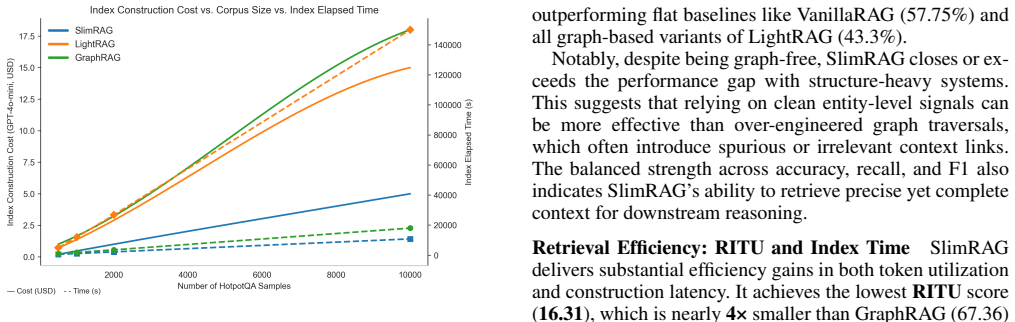
The central discovery claim is that discarding graph edges entirely does not hurt multi-hop retrieval; it helps. SlimRAG decouples the role of embeddings into two stages: similarity organizes the index (canonicalized entities mapped to chunks), and relevance drives retrieval (query entities are matched to index entities, and each candidate chunk is scored by its embedding similarity to the query times the number of matched entities it contains). On HotpotQA this reaches 57.41% retrieval accuracy and 58.36% F1, above the best compared baseline RAPTOR (55.32% accuracy, 58.66% F1) and far above GraphRAG and LightRAG variants, while the index uses only 16.31 RITU against 56.51 to 67.36 for those graph systems. The authors interpret this as evidence that clean entity-level signals matter more than relational edges for query-focused retrieval.
Load-bearing premise
The whole accuracy result rests on the assumption that the language model correctly extracts and canonically names the same entities in both the question and the stored chunks, even when the same thing is mentioned in different surface forms; the paper's own ablation shows that removing coreference resolution drops retrieval accuracy by about 16 points.
Editorial extensions
If this is right
- If the central claim is right, a graph-free entity-to-chunk table can replace graph construction in multi-hop QA retrieval while improving accuracy and cutting index tokens by roughly a factor of four.
- RITU gives systems a single index-compactness number to report, making retrieval efficiency comparable across flat, tree, and graph-based RAG pipelines.
- Coreference resolution is not a minor cleanup: the paper's own ablation shows removing it drops accuracy from 57.41% to 40.98%, so entity canonicalization is a primary determinant of this method's success.
- Query decomposition contributes about five accuracy points, meaning multi-hop questions lose targeted evidence when the query is matched as one undivided string.
- Because the index is an append-only entity-to-chunk table, corpus updates require adding entries rather than updating graph edges, which is the incremental-update advantage the paper claims.
Reading between the lines
- A natural extension the authors do not test is whether the same entity-overlap scoring transfers to retrieval domains where the salient units are numbers, dates, or claims rather than named entities; those settings are where an entity-centric inverted index could fail.
- The reported RITU values depend on what counts as index-construction tokens and on the tokenizer, so cross-system comparisons should be read as order-of-magnitude rather than exact arithmetic.
- The similarity-versus-relevance split is operationalized here as multiplying an embedding score by an entity-count term; the same correction could be applied to any dense retriever without building a graph.
- The method's cost is concentrated in LLM-based entity extraction, so the efficiency story would be stronger if a cheaper extractor could be distilled to match the coreference-resolved entity sets.
Editorial analysis
A structured set of objections, weighed in public.
Referee Report
Summary. The paper proposes SlimRAG, a retrieval-augmented generation framework that replaces graph-based indexing with a lightweight entity-to-chunk inverted index. At indexing time, entities are extracted from chunks (with coreference resolution) and linked to their chunks; at query time, the query is decomposed, entities are extracted, matched to corpus entities by embedding similarity, and chunks are scored by a product of query-chunk similarity and hit-entity count. The paper claims that this structure-free design achieves higher retrieval accuracy and F1 than flat, tree, and graph baselines on HotpotQA while using a much more compact index, as measured by the proposed Relative Index Token Utilization (RITU). An ablation shows that coreference resolution and query decomposition both contribute substantially. The claimed results are: 57.41% accuracy, 59.33% recall, 58.36% F1, RITU 16.31, and index time 2,164 seconds, compared with graph-based baselines with RITU 56.51–67.36.
Significance. If the method and metrics are sound, the contribution is useful: it is a simple, modular, and inexpensive alternative to graph-based RAG that decouples entity extraction from relation modeling, and the RITU metric, once properly defined, could become a standard measure of index compactness. The paper is open about the role of coreference resolution and provides an ablation study and a case study. However, the claimed significance rests on two pillars that need strengthening: the efficiency claim is currently undermined by an inconsistent definition of RITU, and the accuracy claim is supported by only a single benchmark with no error bars. The central retrieval idea is straightforward and potentially reproducible, but the experimental evidence as presented is not yet sufficient for a strong claim of superiority.
major comments (4)
- [Experiments (RITU definition, Table 1)]
- [Abstract vs. Experiments]
- [Experiments (Evaluation metrics and statistical reliability)]
- [Method (Entity matching and coreference sensitivity)]
minor comments (5)
- [Notation (Method, Algorithm 1, Appendix)]
- [Table 1 caption]
- [Table 1 and Figure 5]
- [Case study (Figure 6)]
- [Related Work]
Circularity Check
No significant circularity: SlimRAG's accuracy and efficiency claims are empirical comparisons against external baselines, with no fitted inputs renamed as predictions and no load-bearing self-citations.
full rationale
The central retrieval-accuracy claim (57.41% accuracy, 58.36% F1 on HotpotQA) is an experimental result measured against gold supporting facts with flat, tree, and graph baselines, not a quantity derived from SlimRAG's own definitions. The index/retrieval pipeline (entity extraction, inverted entity-to-chunk map, cosine entity matching, dual-factor scoring) is a proposed architecture rather than a derivation, and its ablation study is a controlled empirical test. No parameter is fit to the test set and then reported as a prediction; hyperparameters K=5 and H=10 are fixed and stated. The paper contains no self-citations that carry a load-bearing premise, and no uniqueness or ansatz is imported from the authors' prior work. The RITU metric is author-proposed, but its use is not circular: it does not enter the retrieval accuracy computation, and the efficiency comparison is an empirical measurement or estimate stated in the paper. A possible ambiguity between RITU's stated definition, 'total number of tokens processed during indexing,' and the reported value is a metric-consistency and validity concern, not a circularity, and therefore does not raise the circularity score.
Assumptions & free parameters
free parameters (4)
- K =
5
- H =
10
- Entity extraction model =
gpt-4o-mini
- Embedding model =
text-embedding-3-small
assumptions (3)
- domain assumption Cosine similarity in the chosen embedding space reliably matches query entities to corpus entities.
- domain assumption The LLM-based entity extraction with coreference resolution produces accurate and complete entity sets.
- domain assumption The HotpotQA evaluation protocol follows Zhou et al. 2025 and is fair across all baselines.
Cite this review
Pith. "Pith review of SlimRAG: Retrieval without Graphs via Entity-Aware Context Selection." pith.science (2026). https://pith.science/paper/U4K5EQZP
@misc{pith2026250617288,
  author       = {Pith},
  title        = {Pith review of: SlimRAG: Retrieval without Graphs via Entity-Aware Context Selection},
  year         = {2026},
  howpublished = {\url{https://pith.science/paper/U4K5EQZP}},
  note         = {Machine review of arXiv:2506.17288}
}
read the original abstract
Retrieval-Augmented Generation (RAG) enhances language models by incorporating external knowledge at inference time. However, graph-based RAG systems often suffer from structural overhead and imprecise retrieval: they require costly pipelines for entity linking and relation extraction, yet frequently return subgraphs filled with loosely related or tangential content. This stems from a fundamental flaw -- semantic similarity does not imply semantic relevance. We introduce SlimRAG, a lightweight framework for retrieval without graphs. SlimRAG replaces structure-heavy components with a simple yet effective entity-aware mechanism. At indexing time, it constructs a compact entity-to-chunk table based on semantic embeddings. At query time, it identifies salient entities, retrieves and scores associated chunks, and assembles a concise, contextually relevant input -- without graph traversal or edge construction. To quantify retrieval efficiency, we propose Relative Index Token Utilization (RITU), a metric measuring the compactness of retrieved content. Experiments across multiple QA benchmarks show that SlimRAG outperforms strong flat and graph-based baselines in accuracy while reducing index size and RITU (e.g., 16.31 vs. 56+), highlighting the value of structure-free, entity-centric context selection. The code will be released soon. https://github.com/continue-ai-company/SlimRAG
Figures


Figures from the paper (3 more)


Forward citations
Cited by 1 Pith paper
-
Collaborative Inference and Learning between Edge SLMs and Cloud LLMs: A Survey of Algorithms, Execution, and Open Challenges
A survey that builds a taxonomy of edge-cloud LLM-SLM collaboration for inference and training, claiming to be the first to unify both phases.
Reference graph
Works this paper leans on
-
[1]
, " * write output.state after.block = add.period write newline
ENTRY address archivePrefix author booktitle chapter edition editor eid eprint howpublished institution isbn journal key month note number organization pages publisher school series title type volume year label extra.label sort.label short.list INTEGERS output.state before.all mid.sentence after.sentence after.block FUNCTION init.state.consts #0 'before.a...
-
[2]
write newline
" write newline "" before.all 'output.state := FUNCTION n.dashify 't := "" t empty not t #1 #1 substring "-" = t #1 #2 substring "--" = not "--" * t #2 global.max substring 't := t #1 #1 substring "-" = "-" * t #2 global.max substring 't := while if t #1 #1 substring * t #2 global.max substring 't := if while FUNCTION word.in bbl.in capitalize " " * FUNCT...
-
[3]
Chen, H.; Shen, X.; Lv, Q.; Wang, J.; Ni, X.; and Ye, J. 2024 a . SAC-KG : Exploiting Large Language Models as Skilled Automatic Constructors for Domain Knowledge Graphs . arXiv:2410.02811
arXiv 2024
-
[4]
Chen, T.; Wang, H.; Chen, S.; Yu, W.; Ma, K.; Zhao, X.; Zhang, H.; and Yu, D. 2024 b . Dense X Retrieval : What Retrieval Granularity Should We Use ? arXiv:2312.06648
arXiv 2024
-
[5]
Dinan, E.; Roller, S.; Shuster, K.; Fan, A.; Auli, M.; and Weston, J. 2019. W izard of W ikipedia: Knowledge-Powered Conversational Agents. In International Conference on Learning Representations
work page 2019
-
[6]
Edge, D.; Trinh, H.; Cheng, N.; Bradley, J.; Chao, A.; Mody, A.; Truitt, S.; and Larson, J. 2024. From Local to Global: A Graph RAG Approach to Query-Focused Summarization. arXiv:2404.16130
arXiv 2024
-
[7]
Fan, W.; Ding, Y.; Ning, L.; Wang, S.; Li, H.; Yin, D.; Chua, T.-S.; and Li, Q. 2024. A survey on rag meeting llms: Towards retrieval-augmented large language models. In International Conference on Knowledge Discovery and Data Mining (KDD), 6491--6501
work page 2024
-
[8]
Gao, L.; Ma, X.; Lin, J.; and Callan, J. 2022. Precise zero-shot dense retrieval without relevance labels. arXiv preprint arXiv:2212.10496
arXiv 2022
Show all 37 references
-
[9]
Gao, Y.; Xiong, Y.; Gao, X.; Jia, K.; Pan, J.; Bi, Y.; Dai, Y.; Sun, J.; and Wang, H. 2023. Retrieval-augmented generation for large language models: A survey. arXiv preprint arXiv:2312.10997
2023 arXiv
-
[10]
Guo, Z.; Xia, L.; Yu, Y.; Ao, T.; and Huang, C. 2024. LightRAG : Simple and Fast Retrieval-Augmented Generation. arXiv:2410.05779
2024 arXiv
-
[11]
D.; Sugawara, S.; and Aizawa, A
Ho, X.; Nguyen, A.-K. D.; Sugawara, S.; and Aizawa, A. 2020. Constructing A Multi-hop QA Dataset for Comprehensive Evaluation of Reasoning Steps. In Proceedings of the 28th International Conference on Computational Linguistics, 6609--6625
2020
-
[12]
Huang, L.; Cao, S.; Parulian, N.; Ji, H.; and Wang, L. 2021. Efficient Attentions for Long Document Summarization. In 2021 Conference of the North American Chapter of the Association for Computational Linguistics: Human Language Technologies, NAACL-HLT 2021, 1419--1436. Associ...
2021
-
[13]
Huang, Y.; and Huang, J. 2024. A Survey on Retrieval-Augmented Text Generation for Large Language Models . arXiv:2404.10981
2024 arXiv
-
[14]
J.; Madotto, A.; and Fung, P
Ji, Z.; Lee, N.; Frieske, R.; Yu, T.; Su, D.; Xu, Y.; Ishii, E.; Bang, Y. J.; Madotto, A.; and Fung, P. 2023. Survey of hallucination in natural language generation. ACM Computing Surveys, 55(12): 1--38
2023
-
[15]
u ttler, H.; Lewis, M.; Yih, W.-t.; Rockt \
Lewis, P.; Perez, E.; Piktus, A.; Petroni, F.; Karpukhin, V.; Goyal, N.; K \"u ttler, H.; Lewis, M.; Yih, W.-t.; Rockt \"a schel, T.; Riedel, S.; and Kiela, D. 2020. Retrieval-Augmented Generation for Knowledge-Intensive NLP Tasks. In Advances in Neural Information Processing ...
2020
-
[16]
Li, M.; Miao, S.; and Li, P. 2024. Simple is Effective: The Roles of Graphs and Large Language Models in Knowledge-Graph-Based Retrieval-Augmented Generation. arXiv:2410.20724
2024 arXiv
-
[17]
Li, W.; Liu, K.; Zhang, X.; Lei, X.; Ma, W.; and Liu, Y. 2025. Efficient Dynamic Clustering-Based Document Compression for Retrieval-Augmented-Generation . arXiv:2504.03165
2025 arXiv
-
[18]
Liang, L.; Sun, M.; Gui, Z.; Zhu, Z.; Jiang, Z.; Zhong, L.; Qu, Y.; Zhao, P.; Bo, Z.; Yang, J.; Xiong, H.; Yuan, L.; Xu, J.; Wang, Z.; Zhang, Z.; Zhang, W.; Chen, H.; Chen, W.; and Zhou, J. 2024. KAG : Boosting LLMs in Professional Domains via Knowledge Augmented Generation . ...
2024 arXiv
-
[19]
Liu, J.; Li, L.; Xiang, T.; Wang, B.; and Qian, Y. 2023. TCRA-LLM: Token Compression Retrieval Augmented Large Language Model for Inference Cost Reduction. arXiv:2310.15556
2023 arXiv
-
[20]
Luo, K.; Liu, Z.; Xiao, S.; and Liu, K. 2024. BGE Landmark Embedding: A Chunking-Free Embedding Method For Retrieval Augmented Long-Context Large Language Models. arXiv:2402.11573
2024 arXiv
-
[21]
Qian, H.; Liu, Z.; Mao, K.; Zhou, Y.; and Dou, Z. 2024. Grounding Language Model with Chunking-Free In-Context Retrieval. arXiv:2402.09760
2024 arXiv
-
[22]
R.; Fard, R
Rezaei, M. R.; Fard, R. S.; Parker, J.; Krishnan, R. G.; and Lankarany, M. 2025. Adaptive Knowledge Graphs Enhance Medical Question Answering : Bridging the Gap Between LLMs and Evolving Medical Knowledge . arXiv:2502.13010
2025 arXiv
-
[23]
Sanmartin, D. 2024. Kg-rag: Bridging the gap between knowledge and creativity. arXiv preprint arXiv:2405.12035
2024 arXiv
-
[24]
Sarmah, B.; Hall, B.; Rao, R.; Patel, S.; Pasquali, S.; and Mehta, D. 2024. HybridRAG : Integrating Knowledge Graphs and Vector Retrieval Augmented Generation for Efficient Information Extraction. arXiv:2408.04948
2024 arXiv
-
[25]
Shuster, K.; Poff, S.; Chen, M.; Kiela, D.; and Weston, J. 2021. Retrieval Augmentation Reduces Hallucination in Conversation. In Findings of the Association for Computational Linguistics: EMNLP 2021, 3784--3803. Punta Cana, Dominican Republic: Association for Computational Li...
2021
-
[26]
W.; Morris, J
Soman, K.; Rose, P. W.; Morris, J. H.; Akbas, R. E.; Smith, B.; Peetoom, B.; Villouta-Reyes , C.; Cerono, G.; Shi, Y.; Rizk-Jackson , A.; Israni, S.; Nelson, C. A.; Huang, S.; and Baranzini, S. E. 2023. Biomedical Knowledge Graph-Enhanced Prompt Generation for Large Language M...
2023 arXiv
-
[27]
Steck, H.; Ekanadham, C.; and Kallus, N. 2024. Is Cosine-Similarity of Embeddings Really About Similarity ? In Companion Proceedings of the ACM Web Conference 2024 , 887--890
2024
-
[28]
A.; Waltman, L.; and van Eck , N
Traag, V. A.; Waltman, L.; and van Eck , N. J. 2019. From Louvain to Leiden: Guaranteeing Well-Connected Communities. Scientific Reports, 9: 5233
2019
-
[29]
Trivedi, H.; Balasubramanian, N.; Khot, T.; and Sabharwal, A. 2022. MuSiQue: Multihop Questions via Single-hop Question Composition. Transactions of the Association for Computational Linguistics, 10: 539--554
2022
-
[30]
R.; and Neubig, G
Wang, Z.; Araki, J.; Jiang, Z.; Parvez, M. R.; and Neubig, G. 2023. Learning to Filter Context for Retrieval-Augmented Generation. arXiv:2311.08377
2023 arXiv
-
[31]
Wu, S.; Xie, J.; Chen, J.; Zhu, T.; Zhang, K.; and Xiao, Y. 2024. How Easily Do Irrelevant Inputs Skew the Responses of Large Language Models ? arXiv:2404.03302
2024 arXiv
-
[32]
Xu, F.; Shi, W.; and Choi, E. 2023. RECOMP: Improving Retrieval-Augmented LMs with Compression and Selective Augmentation. arXiv:2310.04408
2023 arXiv
-
[33]
Xu, Y.; He, S.; Chen, J.; Wang, Z.; Song, Y.; Tong, H.; Liu, G.; Liu, K.; and Zhao, J. 2024. Generate-on- Graph : Treat LLM as Both Agent and KG in Incomplete Knowledge Graph Question Answering . arXiv:2404.14741
2024 arXiv
-
[34]
H.; Li, W.; Cheng, L.; Chen, Q.; Caverlee, J.; Matsuo, Y.; and Li, I
Yang, R.; Liu, H.; Marrese-Taylor , E.; Zeng, Q.; Ke, Y. H.; Li, W.; Cheng, L.; Chen, Q.; Caverlee, J.; Matsuo, Y.; and Li, I. 2024. KG-Rank : Enhancing Large Language Models for Medical QA with Knowledge Graphs and Ranking Techniques . arXiv:2403.05881
2024 arXiv
-
[35]
W.; Salakhutdinov, R.; and Manning, C
Yang, Z.; Qi, P.; Zhang, S.; Bengio, Y.; Cohen, W. W.; Salakhutdinov, R.; and Manning, C. D. 2018. HotpotQA : A Dataset for Diverse, Explainable Multi-Hop Question Answering. arXiv:1809.09600
2018 arXiv
-
[36]
Zhong, M.; Yin, D.; Yu, T.; Zaidi, A.; Mutuma, M.; Jha, R.; Hassan, A.; Celikyilmaz, A.; Liu, Y.; Qiu, X.; et al. 2021. QMSum: A New Benchmark for Query-based Multi-domain Meeting Summarization. In Proceedings of the 2021 Conference of the North American Chapter of the Associa...
2021
-
[37]
Zhou, Y.; Su, Y.; Sun, Y.; Wang, S.; Wang, T.; He, R.; Zhang, Y.; Liang, S.; Liu, X.; Ma, Y.; and Fang, Y. 2025. In-Depth Analysis of Graph-Based RAG in a Unified Framework. arXiv:2503.04338
2025 arXiv
Reviewed August 7, 2026 · model on record in the stance chip above.
Discussion (0). Sign in to comment.