Black Hole Thermodynamics Meets On-Shell Amplitudes: Local Detailed Balance and Thermal Spectrum from Spin Universality and Unitarity
Pith reviewed 2026-06-27 05:53 UTC · model grok-4.3
The pith
Black hole thermal spectra follow from on-shell amplitudes when spin universality enforces equal absorption and emission rates under unitarity.
A machine-rendered reading of the paper's core claim, the machinery that carries it, and where it could break.
Core claim
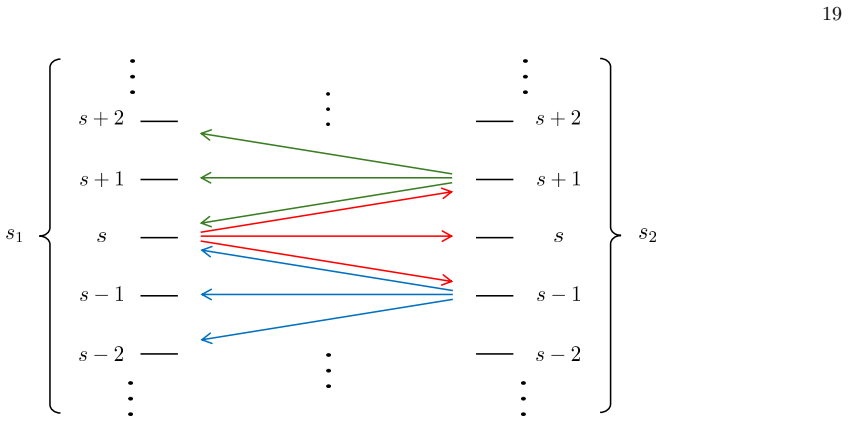
In the on-shell framework equilibrium asymptotic states are represented as particles while non-equilibrium processes appear as transition amplitudes; consistency with macroscopic symmetries then implies spin universality, so that a single universal coupling governs all spinning states and controls both absorption and emission probabilities, yielding local detailed balance from on-shell data alone. Applied to black holes this reproduces the thermal emission spectrum and relates the Hawking temperature to the condition of maximal absorption consistent with unitary time evolution.
What carries the argument
Spin universality: the single universal coupling that governs all spinning internal states of a macroscopic object once macroscopic symmetries are imposed.
If this is right
- Local detailed balance between absorption and emission emerges directly from the on-shell transition amplitudes without extra thermodynamic input.
- The same coupling constant fixes both absorption and emission probabilities.
- The thermal spectrum of black-hole emission is recovered from the amplitude framework.
- The Hawking temperature is fixed by the value of absorption that saturates the unitary limit on time evolution.
Where Pith is reading between the lines
- The same on-shell construction could be applied to other macroscopic objects whose internal degeneracy is described by entropy, such as neutron stars or condensed-matter systems with large state spaces.
- If spin universality holds, temperature-like parameters in other dissipative systems might be extractable from the unitary bound on absorption amplitudes.
- The link between maximal absorption and temperature supplies a direct route from scattering data to thermodynamic quantities in any system obeying the same symmetry constraints.
Load-bearing premise
Consistency with macroscopic symmetries forces every spinning state of a macroscopically non-rotating object to obey exactly the same coupling strength.
What would settle it
An explicit on-shell amplitude calculation for distinct spin states of a non-rotating black hole in which the extracted coupling constants differ between spins.
Figures
read the original abstract
We develop an on-shell framework for thermal dissipation and radiation by macroscopic objects, whose large degeneracy of internal states is encoded in their entropy. In this framework, equilibrium asymptotic states are represented as on-shell particles, while non-equilibrium processes are described by on-shell transition amplitudes between them. A central observation is that spinning states remain essential even for macroscopically non-rotating objects. Consistency with macroscopic symmetries then implies spin universality, whereby all spinning states are governed by a single universal coupling. A key consequence is that absorption and emission probabilities are controlled by the same coupling, yielding local detailed balance directly from on-shell data. Applied to black holes, our framework reproduces the thermal emission spectrum and relates the Hawking temperature to the condition of maximal absorption consistent with unitary time evolution.
Editorial analysis
A structured set of objections, weighed in public.
Referee Report
Summary. The manuscript develops an on-shell framework for thermal dissipation and radiation in macroscopic objects, representing equilibrium asymptotic states as on-shell particles and non-equilibrium processes via transition amplitudes. A central claim is that spinning states remain essential even for macroscopically non-rotating objects; consistency with macroscopic symmetries then implies spin universality (a single universal coupling for all spinning states). This yields local detailed balance directly from on-shell data. Applied to black holes, the framework reproduces the thermal emission spectrum and relates the Hawking temperature to the condition of maximal absorption consistent with unitary time evolution.
Significance. If the central claims hold, the work offers a novel route to black-hole thermodynamics grounded in on-shell amplitudes, unitarity, and macroscopic symmetries rather than semiclassical methods. The approach could connect QFT scattering techniques to gravitational thermodynamics in a manner that makes the thermal spectrum and temperature relation emergent from the same on-shell data.
major comments (1)
- [Abstract / central observation] Abstract (central observation paragraph): the claim that consistency with macroscopic symmetries implies spin universality (governing all spinning states by a single universal coupling, even for macroscopically non-rotating objects) is load-bearing for local detailed balance and the reproduction of the thermal spectrum. The manuscript asserts this implication but does not supply an explicit derivation showing why spin-dependent couplings are forbidden by the symmetries; without that step, absorption and emission probabilities are not demonstrably controlled by the same coupling, and the derivation of the thermal spectrum from on-shell data alone remains incomplete.
Simulated Author's Rebuttal
We thank the referee for their careful reading and constructive comments. The major comment identifies a point where the manuscript's central claim requires a more explicit derivation, which we address below.
read point-by-point responses
-
Referee: [Abstract / central observation] Abstract (central observation paragraph): the claim that consistency with macroscopic symmetries implies spin universality (governing all spinning states by a single universal coupling, even for macroscopically non-rotating objects) is load-bearing for local detailed balance and the reproduction of the thermal spectrum. The manuscript asserts this implication but does not supply an explicit derivation showing why spin-dependent couplings are forbidden by the symmetries; without that step, absorption and emission probabilities are not demonstrably controlled by the same coupling, and the derivation of the thermal spectrum from on-shell data alone remains incomplete.
Authors: We agree that the implication from macroscopic symmetries to spin universality requires an explicit derivation to be fully rigorous, as this step underpins the control of absorption and emission by the same coupling. The manuscript motivates the claim via the requirement that the effective on-shell description of a macroscopically non-rotating object must preserve isotropy and rotational invariance, such that any spin-dependent coupling would select a preferred axis and violate these symmetries. However, we acknowledge that a self-contained, step-by-step argument was not supplied. In the revised manuscript we will insert a new paragraph immediately after the central observation, deriving that spin-dependent couplings are forbidden because they would induce a net angular momentum direction inconsistent with the macroscopic rest frame; this forces a single universal coupling for all spinning states. With this addition, the equality of absorption and emission probabilities follows directly, completing the on-shell derivation of local detailed balance and the thermal spectrum. revision: yes
Circularity Check
No significant circularity detected
full rationale
The provided abstract and context describe a framework deriving local detailed balance from spin universality (implied by macroscopic symmetries) and then applying it to black holes. No equations, fitted parameters, or self-citations are exhibited that reduce the reproduced thermal spectrum or Hawking temperature to an input by construction. The reproduction is presented as a consequence of on-shell amplitudes, unitarity, and the universality premise rather than a renaming or self-definitional step. Without explicit reductions in the text, the derivation chain remains self-contained against external benchmarks.
Axiom & Free-Parameter Ledger
free parameters (1)
- universal coupling
axioms (2)
- standard math Unitarity of time evolution
- domain assumption Macroscopic symmetries imply spin universality
invented entities (1)
-
spin universality
no independent evidence
Reference graph
Works this paper leans on
-
[1]
S. W. Hawking, Breakdown of predictability in gravita- tional collapse, Phys. Rev. D14, 2460 (1976)
1976
-
[2]
’t Hooft, On the Quantum Structure of a Black Hole, Nucl
G. ’t Hooft, On the Quantum Structure of a Black Hole, Nucl. Phys. B256, 727 (1985). 6
1985
-
[3]
’t Hooft, The Scattering matrix approach for the quan- tum black hole: An Overview, Int
G. ’t Hooft, The Scattering matrix approach for the quan- tum black hole: An Overview, Int. J. Mod. Phys. A11, 4623 (1996), arXiv:gr-qc/9607022
Pith/arXiv arXiv 1996
-
[4]
Z. Bern, C. Cheung, R. Roiban, C.-H. Shen, M. P. Solon, and M. Zeng, Scattering Amplitudes and the Conservative Hamiltonian for Binary Systems at Third Post-Minkowskian Order, Phys. Rev. Lett.122, 201603 (2019), arXiv:1901.04424 [hep-th]
Pith/arXiv arXiv 2019
-
[5]
Z. Bern, E. Herrmann, R. Roiban, M. S. Ruf, A. V. Smirnov, S. Smith, and M. Zeng, Scattering Amplitudes and Conservative Binary Dynamics atO(G 5) without Self-Force Truncation, (2025), arXiv:2512.23654 [hep- th]
arXiv 2025
-
[6]
M. Driesse, G. U. Jakobsen, A. Klemm, G. Mogull, C. Nega, J. Plefka, B. Sauer, and J. Usovitsch, Emergence of Calabi–Yau manifolds in high-precision black-hole scattering, Nature641, 603 (2025), arXiv:2411.11846 [hep-th]
Pith/arXiv arXiv 2025
-
[7]
M. Driesse, G. U. Jakobsen, G. Mogull, J. Plefka, B. Sauer, and J. Usovitsch, Conservative Black Hole Scattering at Fifth Post-Minkowskian and First Self- Force Order, Phys. Rev. Lett.132, 241402 (2024), arXiv:2403.07781 [hep-th]
arXiv 2024
-
[8]
M. Driesse, G. U. Jakobsen, G. Mogull, C. Nega, J. Ple- fka, B. Sauer, and J. Usovitsch, Conservative Black Hole Scattering at Fifth Post-Minkowskian and Second Self- Force Order, (2026), arXiv:2601.16256 [hep-th]
arXiv 2026
-
[9]
C. Dlapa, G. K¨ alin, Z. Liu, and R. A. Porto, Nonlocal- in-time tail effects in gravitational scattering to fifth Post-Minkowskian and tenth self-force orders, (2026), arXiv:2604.25916 [hep-th]
Pith/arXiv arXiv 2026
-
[10]
D. Akpinar, F. Febres Cordero, M. Kraus, M. S. Ruf, and M. Zeng, Spinning black hole scattering atO(G 3S2): Casimir terms, radial action and hidden symmetry, JHEP 03, 126, arXiv:2407.19005 [hep-th]
-
[11]
D. Akpinar, F. Febres Cordero, M. Kraus, A. Smirnov, and M. Zeng, First Look at Quartic-in-Spin Binary Dy- namics at Third Post-Minkowskian Order, Phys. Rev. Lett.135, 041602 (2025), arXiv:2502.08961 [hep-th]
arXiv 2025
- [12]
-
[13]
L. Bohnenblust, L. Cangemi, H. Johansson, and P. Pichini, Binary Kerr black-hole scattering at 2PM from quantum higher-spin Compton, (2024), arXiv:2410.23271 [hep-th]
arXiv 2024
- [14]
-
[15]
Akpinar, Scattering gravitons off general spinning compact objects to O(G2S4), Phys
D. Akpinar, Scattering gravitons off general spinning compact objects to O(G2S4), Phys. Rev. D113, 045003 (2026), arXiv:2511.10280 [hep-th]
arXiv 2026
-
[16]
Y. F. Bautista, M. Driesse, K. Haddad, and G. U. Jakob- sen, Gravitational wave scattering in spinless WQFT, JHEP05, 252, arXiv:2602.06125 [hep-th]
-
[17]
N. E. J. Bjerrum-Bohr, G. Chen, C. Jordan Eriksen, and N. Shah, The gravitational Compton amplitude at third post-Minkowskian order, (2026), arXiv:2602.06947 [hep- th]
Pith/arXiv arXiv 2026
-
[18]
N. E. J. Bjerrum-Bohr, G. Chen, K. Papadimos, and Y. Zhang, Resumming Spinning Black Hole Dy- namics at Third Post-Minkowskian Order, (2026), arXiv:2603.04214 [hep-th]
arXiv 2026
- [19]
-
[20]
A. Ilderton and K. Rajeev, Tunnelling amplitudes and Hawking radiation from worldline QFT, JHEP10, 220, arXiv:2508.00997 [hep-th]
-
[21]
K. Aoki, A. Cristofoli, H. Jeong, M. Sergola, and K. Yoshimura, Quantum effects for black holes with on- shell amplitudes, JHEP12, 163, arXiv:2509.12111 [hep- th]
-
[22]
A. Ilderton, W. Lindved, and K. Rajeev, Hawking Radia- tion from the Double Copy, Phys. Rev. Lett.136, 081603 (2026), arXiv:2510.25852 [hep-th]
arXiv 2026
-
[23]
R. Aoude, D. O’Connell, M. Sergola, and C. D. White, Hawking Radiation meets the Double Copy, (2025), arXiv:2510.25866 [hep-th]
Pith/arXiv arXiv 2025
-
[24]
J. J. M. Carrasco and S. Zekioglu, The double copy ef- fective action: a quantum (chromodynamics) approach to space-time, JHEP03, 164, arXiv:2511.01799 [hep-ph]
-
[25]
J. J. M. Carrasco and Y. Chen, Double Copy Root of Hawking Thermality, Phys. Rev. Lett.136, 081604 (2026), arXiv:2511.01832 [hep-th]
arXiv 2026
- [26]
-
[27]
J. J. M. Carrasco, Y. Chen, N. H. Pavao, and A. Seifi, Nonperturbative double copy: worldline instantons, color thermality, and backreaction, JHEP05, 177, arXiv:2601.17884 [hep-th]
-
[28]
R. Aoude and A. Ochirov, Gravitational partial-wave absorption from scattering amplitudes, JHEP12, 103, arXiv:2307.07504 [hep-th]
-
[29]
C. R. T. Jones and M. S. Ruf, Absorptive effects and classical black hole scattering, JHEP03, 015, arXiv:2310.00069 [hep-th]
-
[30]
Y.-J. Chen, T. Hsieh, Y.-T. Huang, and J.-W. Kim, On- shell approach to (spinning) gravitational absorption pro- cesses, (2023), arXiv:2312.04513 [hep-th]
arXiv 2023
- [31]
-
[32]
Y. F. Bautista, Y.-T. Huang, and J.-W. Kim, Absorptive effects in black hole scattering, Phys. Rev. D111, 044043 (2025), arXiv:2411.03382 [hep-th]
arXiv 2025
-
[33]
J. P. Gatica and C. R. T. Jones, Classical Spin Transitions and Absorptive Scattering, (2025), arXiv:2511.19601 [hep-th]
arXiv 2025
-
[34]
Maes, Local detailed balance, SciPost Phys
C. Maes, Local detailed balance, SciPost Phys. Lect. Notes , 32 (2021)
2021
-
[35]
Scattering amplitudes are agnostic to theory-dependent descriptions. More precisely, information about the mi- croscopic theory is encoded in exclusive probabilities, while the macroscopic details are in inclusive probabil- ities, the latter of which corresponds to the notion of coarse-graining. See Appendix B for more details on this point
-
[36]
This type of completeness relation is used to model BHs and successfully describes horizon absorption, Hawking radiation, and even BH formations [21, 28–33, 73–75]
- [37]
-
[38]
R. Aoude and A. Ochirov, Classical observables from coherent-spin amplitudes, JHEP10, 008, arXiv:2108.01649 [hep-th]
-
[39]
This corresponds to neglecting the spin in the general- 7 relativistic sense, which we take for an illustrative pur- pose
-
[40]
M. J. G. Veltman, Unitarity and causality in a renormal- izable field theory with unstable particles, Physica29, 186 (1963)
1963
-
[41]
A. Denner and J.-N. Lang, The Complex-Mass Scheme and Unitarity in perturbative Quantum Field Theory, Eur. Phys. J. C75, 377 (2015), arXiv:1406.6280 [hep- ph]
Pith/arXiv arXiv 2015
-
[42]
N. Arkani-Hamed, T.-C. Huang, and Y.-t. Huang, Scat- tering amplitudes for all masses and spins, JHEP11, 070, arXiv:1709.04891 [hep-th]
-
[43]
To describe rotating clas- sical objects, one must instead employ spin-weighted spheroidal harmonics
We use spherical harmonics as the slow-rotation limit isolates the spin-monopole dynamics, which describes non-rotating classical objects. To describe rotating clas- sical objects, one must instead employ spin-weighted spheroidal harmonics
-
[44]
J. M. Deutsch, Quantum statistical mechanics in a closed system, Phys. Rev. A43, 2046 (1991)
2046
-
[45]
Chaos and Quantum Thermalization
M. Srednicki, Chaos and Quantum Thermalization, Phys. Rev. E50, 10.1103/PhysRevE.50.888 (1994), arXiv:cond-mat/9403051
work page internal anchor Pith review Pith/arXiv arXiv doi:10.1103/physreve.50.888 1994
-
[46]
J. M. Deutsch, Eigenstate thermalization hypothesis, Rept. Prog. Phys.81, 082001 (2018), arXiv:1805.01616 [quant-ph]
Pith/arXiv arXiv 2018
-
[47]
Srednicki, The approach to thermal equilibrium in quantized chaotic systems, J
M. Srednicki, The approach to thermal equilibrium in quantized chaotic systems, J. Phys. A32, 1163 (1999)
1999
-
[48]
M. Rigol and M. Srednicki, Alternatives to Eigenstate Thermalization, Phys. Rev. Lett.108, 110601 (2012), arXiv:1108.0928 [cond-mat.stat-mech]
Pith/arXiv arXiv 2012
-
[49]
Koekoek, P
R. Koekoek, P. A. Lesky, and R. F. Swarttouw,Hyperge- ometric Orthogonal Polynomials and Their q-Analogues, Springer Monographs in Mathematics (Springer, Heidel- berg, 2010)
2010
-
[50]
B. R. Holstein and A. Ross, Spin Effects in Long Range Electromagnetic Scattering, (2008), arXiv:0802.0715 [hep-ph]
Pith/arXiv arXiv 2008
-
[51]
B. R. Holstein and A. Ross, Spin Effects in Long Range Gravitational Scattering, (2008), arXiv:0802.0716 [hep- ph]
Pith/arXiv arXiv 2008
-
[52]
N. Siemonsen and J. Vines, Test black holes, scattering amplitudes and perturbations of Kerr spacetime, Phys. Rev. D101, 064066 (2020), arXiv:1909.07361 [gr-qc]
arXiv 2020
-
[53]
However, the spin universality leads to their transition probabilities being identical up to the spectral density
For example, the absorption process of a spin-sstate means the transition (M 1, s) to (M 2, s2) withs 2 = s, s±1,· · ·, s±ℓ, whereas the emission process is (M 2, s) to (M 1, s2) withs 1 =s, s±1,· · ·, s±ℓ, which is not the reverse process of the absorption. However, the spin universality leads to their transition probabilities being identical up to the s...
-
[54]
How- ever, the conservation law imposesω= (M 2 1 −M 2 2 )/2M2, so it is no longer a kinematical variable but a constant in the on-shell 3-point kinematics
The frequencyωhere is defined in the rest frame of parti- cle 2, and it can be covariantized asω=p 2 ·k/M 2. How- ever, the conservation law imposesω= (M 2 1 −M 2 2 )/2M2, so it is no longer a kinematical variable but a constant in the on-shell 3-point kinematics
-
[55]
Then, the emission probability (22) indeed pro- vides the spectrum of emitted particles
Note that, while (22) is the quantum probability of one particle absorption/emission, the number of emitted par- ticles is obtained by computing the expectation value of the number operator after time evolution governed by the S-matrix. Then, the emission probability (22) indeed pro- vides the spectrum of emitted particles. See Appendix B and Ref. [21] fo...
-
[56]
In fact, the low-frequency expansion of the greybody factor of the Schwarzschild BH is|T ℓ|2 =O(ω 2(ℓ+1)), which is much smaller than (23) [76–78]
Since gravitational interactions inevitably induce ad- ditional scattering channels, unitarity should imply a bound stronger than (23) in general frequencies. In fact, the low-frequency expansion of the greybody factor of the Schwarzschild BH is|T ℓ|2 =O(ω 2(ℓ+1)), which is much smaller than (23) [76–78]. This is understood by the fact that most of the wa...
-
[57]
V. P. Frolov and I. D. Novikov, eds.,Black hole physics: Basic concepts and new developments(Springer Science & Business Media, 1998)
1998
-
[58]
B. Raffaelli, A scattering approach to some aspects of the Schwarzschild Black Hole, JHEP01, 188, arXiv:1301.0108 [gr-qc]
-
[59]
D. N. Page, Average entropy of a subsystem, Phys. Rev. Lett.71, 1291 (1993), arXiv:gr-qc/9305007
Pith/arXiv arXiv 1993
-
[60]
D. N. Page, Information in black hole radiation, Phys. Rev. Lett.71, 3743 (1993), arXiv:hep-th/9306083
Pith/arXiv arXiv 1993
-
[61]
H. S. Hannesdottir and S. Mizera,What is the iεfor the S-matrix?, SpringerBriefs in Physics (Springer, 2023) arXiv:2204.02988 [hep-th]
arXiv 2023
-
[62]
Aoki, Unitarity and unstable-particle scatter- ing amplitudes, Phys
K. Aoki, Unitarity and unstable-particle scatter- ing amplitudes, Phys. Rev. D107, 065017 (2023), arXiv:2212.05670 [hep-th]
arXiv 2023
-
[63]
K. Aoki and Y.-t. Huang, Anomalous thresholds for the S-matrix of unstable particles, JHEP09, 045, arXiv:2312.13520 [hep-th]
-
[64]
M. Correia and C. Pasiecznik, Resonances: Univer- sality and Factorization on Higher Sheets, (2025), arXiv:2512.13775 [hep-th]
arXiv 2025
- [65]
- [66]
-
[67]
A. Guerrieri, K. H¨ aring, and N. Su, From data to the ana- lytic S-matrix: A Bootstrap fit of the pion scattering am- plitude, SciPost Phys.20, 034 (2026), arXiv:2410.23333 [hep-th]
arXiv 2026
- [68]
-
[69]
M. Correia, A. Georgoudis, and A. L. Guerrieri, Cross- Section Bootstrap: Unveiling the Froissart Amplitude, (2025), arXiv:2506.04313 [hep-th]
arXiv 2025
-
[70]
J. Elias Miro, A. Guerrieri, and M. A. Gumus, The Phases of the Scalar S-Matrix Island, (2026), arXiv:2605.06613 [hep-th]
Pith/arXiv arXiv 2026
-
[71]
S. Iso, S. Okazawa, and S. Zhang, Non-equilibrium fluc- tuations of black hole horizons and the generalized sec- ond law, Phys. Lett. B705, 152 (2011), arXiv:1008.1184 [gr-qc]
Pith/arXiv arXiv 2011
-
[72]
S. Iso and S. Okazawa, Stochastic Equations in Black Hole Backgrounds and Non-equilibrium Fluctuation The- orems, Nucl. Phys. B851, 380 (2011), arXiv:1104.2461 [hep-th]
Pith/arXiv arXiv 2011
-
[73]
S. B. Giddings and M. Srednicki, High-energy gravita- tional scattering and black hole resonances, Phys. Rev. D77, 085025 (2008), arXiv:0711.5012 [hep-th]
Pith/arXiv arXiv 2008
-
[74]
S. B. Giddings and R. A. Porto, The Gravitational S- matrix, Phys. Rev. D81, 025002 (2010), arXiv:0908.0004 [hep-th]
Pith/arXiv arXiv 2010
-
[75]
K. Aoki, A. Cristofoli, and Y.-t. Huang, On-shell approach to black hole mergers, JHEP01, 066, arXiv:2410.13632 [hep-th]. 8
-
[76]
A. A. Starobinskii, Amplification of waves during reflec- tion from a rotating ”black hole”, Sov. Phys. JETP64, 48 (1973)
1973
-
[77]
A. A. Starobinskil and S. M. Churilov, Amplification of electromagnetic and gravitational waves scattered by a rotating ”black hole”, Sov. Phys. JETP65, 1 (1974)
1974
-
[78]
D. N. Page, Particle Emission Rates from a Black Hole: Massless Particles from an Uncharged, Nonrotating Hole, Phys. Rev. D13, 198 (1976)
1976
-
[79]
D. A. Kosower, B. Maybee, and D. O’Connell, Ampli- tudes, Observables, and Classical Scattering, JHEP02, 137, arXiv:1811.10950 [hep-th]
-
[80]
A. Cristofoli, R. Gonzo, D. A. Kosower, and D. O’Connell, Waveforms from amplitudes, Phys. Rev. D106, 056007 (2022), arXiv:2107.10193 [hep-th]
arXiv 2022
discussion (0)
Sign in with ORCID, Apple, or X to comment. Anyone can read and Pith papers without signing in.