REVIEW 4 major objections 5 minor 42 references
On-chip microwave sensing of quasiparticles in tantalum superconducting circuits on silicon for scalable quantum technologies
T0 review · 4 major / 5 minor · reviewed 2026-08-15 · deepseek-v4-flash
Pith's one-line read α-tantalum superconducting resonators show measurable non-equilibrium quasiparticle loss at millikelvin temperatures, and the quasiparticle density is roughly one-third that of NbN at equivalent normalized temperatures.
desk verdict Solid raw data on Ta resonators, but the central quasiparticle-density claim lacks the parameters and error bars needed to support it. read the letter →
The pith
A machine-rendered reading of the paper's core claim, the machinery that carries it, and where it could break.
The reading
What carries the argument
The carrying mechanism is on-chip microwave spectroscopy of quarter-wavelength coplanar waveguide resonators operated in the single-photon regime. The temperature- and power-dependent internal quality factor $Q_i$ is decomposed into two-level-system loss, quasiparticle loss, and residual loss, using the TLS model of Eq. (9) and the quasiparticle loss of Eq. (5). Quasiparticle dissipation is modelled through the Mattis–Bardeen complex conductivity $\sigma = \sigma_1 - j\sigma_2$, which converts low-temperature loss into a quasiparticle density $n_\mathrm{qp} \propto \sigma_1 \propto e^{-\Delta/k_B T}$. The material benchmark compares different superconductors at equal $T/T_c$, which is what allows the α-Ta versus NbN comparison to be stated independently of each film's critical temperature.
What would settle it
Perform the same microwave loss measurement on a second resonator from the same film while deliberately varying the quasiparticle population with a known pair-breaking source, such as a small heater or an above-gap photon pulse; if the extracted $n_\mathrm{qp}$ does not track the injected quasiparticle rate, the attribution of residual loss to non-equilibrium quasiparticles fails. Alternatively, characterise the two-level-system loss on the identical 40 nm film and geometry; if the TLS fit does not account for the full zero-quasiparticle loss, the reported densities are overestimated.
Extended reading notes
Core claim
In the paper's own terms, the central discovery is that high-Q α-Ta microwave resonators host a finite quasiparticle population even at millikelvin temperatures. This shows up as a persistent gap between the measured internal quality factor and the value predicted from thermal quasiparticles plus two-level-system loss, across the whole 0.77–1 K range. When the residual loss is converted to a quasiparticle density through the Mattis–Bardeen relations, the density stays finite at low temperature instead of falling to zero as the thermal formula predicts. The material benchmark is placed on a thermodynamic footing by comparing at the same fractional distance from each film's transition temperature, $T/T_c$: α-Ta reaches a quasiparticle density around $0.3\times 10^3\ \mu\mathrm{m}^{-3}$, about one-third of the $1\times 10^3\ \mu\mathrm{m}^{-3}$ reported for NbN, and the normalized conductivity traces agree with Mattis–Bardeen theory over the measured range.
Load-bearing premise
The load-bearing premise is that every bit of loss left over after accounting for temperature-activated quasiparticles and the two-level-system model comes from non-equilibrium quasiparticles, and that the two-level-system model taken from an earlier tantalum device still describes this 40 nm film with no other loss channels contributing.
Editorial extensions
If this is right
- If the reported density holds, α-Ta resonators should exhibit lower microwave dissipation than NbN at the same $T/T_c$, making them preferable for qubit readout resonators and kinetic-inductance detectors.
- The persistent quasiparticle floor sets a limit on $Q_i$ at millikelvin temperatures, so further coherence gains will require quasiparticle trapping or mitigation rather than only surface preparation.
- The normalized-temperature protocol gives a quantitative route for comparing quasiparticle densities across any superconducting material, not just Ta and NbN.
- The extraction procedure of Eqs. (7)–(8) turns a standard resonator loss measurement into an on-chip quasiparticle sensor in the single-photon regime.
- Because lower quasiparticle density directly reduces dissipation and charge noise, the comparison supports choosing α-Ta over NbN for coherence-limited circuit architectures.
Reading between the lines
- A direct test at the same absolute temperature (rather than the same $T/T_c$) could show whether Ta's advantage persists at typical qubit operating points near 10–20 mK, where both densities are very low but the Ta benefit may change or vanish.
- If non-equilibrium quasiparticles are indeed the residual loss source, adding quasiparticle traps or a gap-engineered layer to the Ta film should raise $Q_i$ toward the TLS-limited value; that is an implied design route not tested in the paper.
- The method could be extended to other low-loss films such as aluminium or niobium and connected to qubit coherence measurements, since $Q_i$ suppression and qubit $T_1$ degradation share the same quasiparticle mechanism.
- The normalized comparison suggests that a material's critical temperature alone is not the decisive figure of merit; the density of non-equilibrium quasiparticles at the fractional operating temperature matters, which reframes how new superconducting materials are screened.
Signed reviews
Editorial analysis
A structured set of objections, weighed in public.
Referee Report
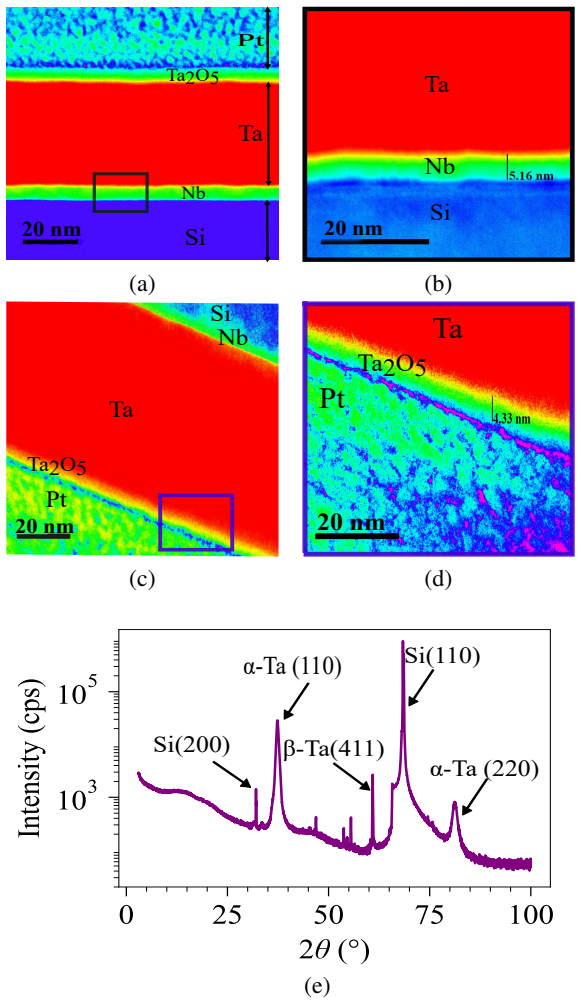
Summary. The manuscript reports fabrication and cryogenic microwave characterization of α-tantalum coplanar waveguide resonators on silicon with a niobium seed layer, including TEM, XRD, and EELS structural analysis. The authors measure the internal quality factor Qi as a function of temperature in the single-photon regime, compare it with a theoretical model combining two-level-system (TLS) loss and Mattis–Bardeen quasiparticle loss, and attribute the residual loss to persistent non-equilibrium quasiparticles at millikelvin temperatures. They extract a quasiparticle density from the residual loss and claim that α-Ta has a quasiparticle density roughly one-third that of NbN at equivalent normalized temperatures, based on a comparison with prior work.
Significance. If the residual-loss attribution is validated, the paper would provide a useful material-level study of quasiparticle loss in α-Ta resonators and a practical comparison platform for superconducting quantum circuits. The structural characterization is careful, the resonator quality factors are competitive, and the temperature- and power-dependent data set is valuable. The paper's main quantitative claims, however, depend on several unreported parameters and on a subtraction procedure that is not currently falsifiable. The material benchmarking claim against NbN is not traceable to the cited source. These issues are central to the abstract and conclusions, so the manuscript needs substantial revision before the claims can be accepted.
major comments (4)
- [§2.2, Eqs. (5) and (7)–(9)] The central extraction of nqp,measured is not reproducible as reported. The kinetic inductance fraction α appears in Eq. (5) and is carried through Eq. (8), but no value or measurement of α is given anywhere in the manuscript. Likewise, the TLS parameters 1/Q0_TLS, nc, and β that determine QTLS,derived in Eq. (7) are said to be 'obtained [9]' but no values or uncertainties are reported for the 40 nm device. Since nqp,measured scales as 1/α and depends directly on the subtracted TLS loss, the claimed absolute quasiparticle density and the factor-of-three comparison with NbN cannot be checked without these inputs.
- [§2.2, Eqs. (6)–(8)] The residual-loss attribution silently sets δ_other to zero. Equation (6) defines total loss as δTLS + δqp + δ_other, but Eq. (7) equates δqp,measured directly to 1/Qi,measured − 1/QTLS,derived. No bound is placed on magnetic, radiation, interface, or TLS-model-mismatch losses, and no uncertainty is reported for Qi. The paper itself notes (Fig. 4(e)) that for T ≲ 0.5 K the system is coupling limited and Qi is only weakly constrained by the resonance lineshape; in that regime the inferred residual loss is particularly sensitive to fitting systematics. Without uncertainty propagation or an explicit upper bound on δ_other, the conclusion that the residual is a persistent quasiparticle population is not yet falsifiable.
- [Fig. 6(c,d) and Eqs. (8)–(12)] The claimed agreement between experiment and Mattis–Bardeen theory is partly circular. The 'measured' nqp values are generated by inverting Eq. (8), which is an algebraic rearrangement of the same loss formula (Eq. 5) used to produce the theoretical curves, and the conductivity components come from Eqs. (1)–(2) with the same nqp–T relation. Therefore the red circles and blue lines in Figs. 6(c,d) are not independent measurements of the same relation; they test internal consistency of the inversion rather than validating the electrodynamic model. An independent validation would require comparing the measured complex conductivity or Qi to a model with independently determined nqp.
- [Abstract and §2.2 (final paragraph)] The quantitative benchmark against NbN is not traceable. The text states that Ta has nqp = 0.3×10^3 µm^-3 at T/Tc = 200 and that NbN has 1×10^3 µm^-3, citing [24]; however, [24] is an analytical theory paper (Fischer and Catelani) and does not report a measured NbN quasiparticle density. The value T/Tc = 200 is also physically impossible, suggesting a typographical error, and no uncertainty or temperature is given for either number. This comparison should either be removed or replaced with a direct, referenced experimental comparison.
minor comments (5)
- [Introduction and §2] The stated measurement temperature range is inconsistent: the Introduction says 0.77–1 K, while the experimental section and Fig. 4 use 77 mK to 1 K; please clarify whether 0.77 K is a typo or the actual base temperature used for the analysis.
- [§2.1, page 7] The phrase 'beak a significant number' should read 'break a significant number.'
- [Eq. (4)] Equation (4) writes '1.76×K_B×Tc'; this should use the conventional notation 1.76 k_B T_c for consistency with the rest of the text.
- [§2.2] The sentence 'the values of 1/Q0_TLS, nc, and β are obtained [9]' should state explicitly that the values are taken from the prior work and should list them in a table or appendix, since they are central to the subtraction.
- [Figure 6 and §2.2] The caption and text do not report the units of nqp on the axes of Fig. 6 or the calibration used to define ⟨nph⟩ ∼ 1; please add this information so that the quantitative claims can be interpreted.
Circularity Check
The σ–n_qp 'agreement' is enforced by inverting the same Mattis–Bardeen loss formula, and the residual n_qp extraction rests on an unreported self-cited TLS subtraction; the excess-loss observation itself is not circular.
-
self definitional
[Sec. 2.2, Eqs. (5)-(8) and Fig. 6(c,d)]
"We can rewrite the Eq.7 to obtain nqp,theory: nqp,measured(T)≈δqp,measured(T)N0∆(T)π/α sqrt(hfr/2∆(T)) (8) ... Excellent agreement over the measured range is observed when the experimental results (red circles) are compared with the Mattis-Bardeen theoretical predictions (blue lines)."
Equation (8) is the algebraic inverse of the loss formula Eq. (5), so n_qp,measured is just a constant rescaling of the residual loss in Eq. (7). Plotting this same rescaled quantity against red σ1/σn and σ2/σn data while generating the blue curves from the same Mattis–Bardeen relations forces the reported 'excellent agreement' in Fig. 6(c,d); it is a consistency check of the conversion, not an independent confirmation of the inferred quasiparticle density. The qualitative excess-loss observation survives, but the quantitative n_qp values and the σ–n_qp concordance reduce by construction to the input loss residual.
-
self citation load bearing
[Sec. 2.2, Eqs. (6)-(9)]
"δqp,measured(T) = 1/Qi,measured − 1/QTLS,derived (7). ... By plotting Qi versus the photon number and fitting using [Eq. 9], the values of 1/Q0 TLS, nc, and β are obtained [9], which facilitates the derivation of δTLS. Then, by substituting Eqs. (7) and (8), δqp,measured(T) and nqp,measured(T) are obtained ..."
The central residual is obtained by subtracting a TLS term whose parameters are taken from the authors' previous paper [9]; no values, error bars, or re-fits for the present 40 nm device are given. The δ_other term in Eq. (6) is silently discarded in Eq. (7), so any residual after the self-cited TLS subtraction—including TLS-model mismatch or unmodeled magnetic/radiation loss—is automatically defined as non-equilibrium quasiparticle loss. The 'persistent quasiparticle' inference is therefore load-bearing on an unverified self-citation rather than on an independent measurement or prediction in this paper.
full rationale
Step 1 is the main circularity: Eq. 8 is the algebraic inverse of Eq. 5, so 'n_qp,measured' is a fixed rescaling of the measured loss residual. The blue σ–n_qp curves in Fig. 6(c,d) are generated from the same Mattis–Bardeen relations, and the red circles use Eq. 8 for the horizontal coordinate, so the reported 'excellent agreement' is largely enforced by construction. The underlying observation that Qi,measured lies below Qi,theory at low temperature is not circular and may indicate real excess loss; however, the quantitative n_qp values and the material comparison inherit the model. Step 2 identifies that the residual is defined after subtracting a TLS term whose parameters come from the authors' prior work [9] and whose uncertainty is not propagated, with δ_other silently dropped from Eq. 6 to Eq. 7; any error in that self-cited TLS model is automatically relabeled as non-equilibrium quasiparticles. Separately, the NbN benchmark in the text (n_qp = 1×10^3 µm^-3 for NbN, cited to [24], and 'T/Tc = 200') is not traceable to data: [24] is an analytical theory paper and the stated normalized temperature is nonphysical; this is a correctness or traceability issue rather than a circularity. On balance, the central qualitative claim has independent content, but the quantitative quasiparticle-density results and the validation plots are partially self-referential, giving a score of 6.
Assumptions & free parameters
free parameters (3)
- kinetic inductance fraction alpha =
not stated
- TLS fitting parameters (1/Q0_TLS, n_c, beta) =
not reported in this paper
- Critical temperature Tc for 40 nm Ta =
4.06 K
assumptions (4)
- domain assumption Mattis-Bardeen theory describes the complex conductivity of the thin Ta film in the local limit.
- ad hoc to paper The TLS loss model of Eq. 9 with parameters from [9] applies to the current 40 nm device.
- domain assumption All residual loss after subtracting TLS and thermal quasiparticle loss is due to non-equilibrium quasiparticles.
- domain assumption The kinetic inductance fraction alpha is constant over the measured temperature range.
Cite this review
Pith. "Pith review of On-chip microwave sensing of quasiparticles in tantalum superconducting circuits on silicon for scalable quantum technologies." pith.science (2026). https://pith.science/paper/U5A2PB7K
@misc{pith2026250907669,
  author       = {Pith},
  title        = {Pith review of: On-chip microwave sensing of quasiparticles in tantalum superconducting circuits on silicon for scalable quantum technologies},
  year         = {2026},
  howpublished = {\url{https://pith.science/paper/U5A2PB7K}},
  note         = {Machine review of arXiv:2509.07669}
}
read the original abstract
The performance and scalability of superconducting quantum circuits are fundamentally constrained by non-equilibrium quasiparticles, which induce microwave losses that limit resonator quality factors and qubit coherence times. Understanding and mitigating these excitations is therefore central to advancing scalable quantum technologies. Here, we demonstrate on-chip microwave sensing of quasiparticles in high-Q {\alpha}-tantalum coplanar waveguide resonators on silicon, operated in the single-photon regime. Temperature-dependent measurements reveal persistent non-equilibrium quasiparticles at millikelvin temperatures, producing a measurable suppression of the internal quality factor (Qi) relative to theoretical expectations. By benchmarking across materials, we find that the quasiparticle density in {\alpha}-Ta is approximately one-third that of NbN at equivalent normalised temperatures (T/Tc), directly correlating with reduced microwave loss. Our methodology establishes a scalable platform for probing quasiparticle dynamics and points towards new routes for engineering superconducting circuits with improved coherence, with impact on qubit readout resonators, kinetic-inductance detectors, and emerging quantum processors and sensors.
Figures


Figures from the paper (4 more)


Reference graph
Works this paper leans on
-
[9]
S. Poorgholam-Khanjari, V . Seferai, P. Foshat, C. Rose, H. Feng, R. H. Hadfield, M. Weides, and K. Delfanazari, “Engineering high-q superconducting tantalum microwave coplanar waveguide resonators for compact coherent quantum circuit,” Scientific Reports, vol. 15, no. 1, p. 27113, 2025
work page 2025
-
[24]
Nonequilibrium quasiparticle distribution in superconducting resonators: An analytical approach,
P. Fischer and G. Catelani, “Nonequilibrium quasiparticle distribution in superconducting resonators: An analytical approach,”Physical Review Applied, vol. 19, no. 5, p. 054087, 2023. 13
work page 2023
-
[8]
P. Foshat, P. Baity, S. Danilin, V . Seferai, S. Poorgholam-Khanjari, H. Feng, O. A. Mukhanov, M. Hutchings, R. H. Hadfield, M. Weides,et al., “Characterizing niobium nitride-based superconducting coplanar waveguide resonators for microwave hybrid circuit quantum electrodynamics,”IEEE Transactions on Applied Superconductivity, 2025
work page 2025
-
[1]
J. Clarke and F. K. Wilhelm, “Superconducting quantum bits,”Nature, vol. 453, no. 7198, pp. 1031–1042, 2008
work page 2008
-
[2]
Compact nbn resonators with high kinetic inductance,
X.-Y . Wei, J.-Z. Pan, Y .-P. Lu, J.-L. Jiang, Z.-S. Li, S. Lu, X.-C. Tu, Q.-Y . Zhao, X.-Q. Jia, L. Kang,et al., “Compact nbn resonators with high kinetic inductance,”Chinese Physics B, vol. 29, no. 12, p. 128401, 2020
work page 2020
-
[3]
J. G. Kroll, F. Borsoi, K. Van Der Enden, W. Uilhoorn, D. De Jong, M. Quintero-P ´erez, D. Van Woerkom, A. Bruno, S. Plissard, D. Car,et al., “Magnetic-field-resilient superconducting coplanar-waveguide resonators for hybrid circuit quantum electrodynamics experiments,”Physical Review Applied, vol. 11, no. 6, p. 064053, 2019
work page 2019
-
[4]
Low-loss single-photon nbn microwave resonators on si,
F. W. Carter, T. Khaire, C. Chang, and V . Novosad, “Low-loss single-photon nbn microwave resonators on si,”Applied Physics Letters, vol. 115, no. 9, 2019
work page 2019
-
[5]
Loss mechanisms in superconducting thin film microwave resonators,
J. Goetz, F. Deppe, M. Haeberlein, F. Wulschner, C. W. Zollitsch, S. Meier, M. Fischer, P. Eder, E. Xie, K. G. Fedorov,et al., “Loss mechanisms in superconducting thin film microwave resonators,”Journal of Applied Physics, vol. 119, no. 1, 2016
work page 2016
Show all 42 references
-
[6]
Coplanar waveguide resonators for circuit quantum electrodynamics,
M. G ¨oppl, A. Fragner, M. Baur, R. Bianchetti, S. Filipp, J. M. Fink, P. J. Leek, G. Puebla, L. Steffen, and A. Wallraff, “Coplanar waveguide resonators for circuit quantum electrodynamics,”Journal of Applied Physics, vol. 104, no. 11, 2008
2008
-
[7]
Sputtered tin films for superconducting coplanar waveguide resonators,
S. Ohya, B. Chiaro, A. Megrant, C. Neill, R. Barends, Y . Chen, J. Kelly, D. Low, J. Mutus, P. O’Malley,et al., “Sputtered tin films for superconducting coplanar waveguide resonators,”arXiv preprint arXiv:1306.2966, 2013
2013 arXiv
-
[10]
High-q trenched aluminum coplanar resonators with an ultrasonic edge microcutting for superconducting quantum devices,
E. Zikiy, A. Ivanov, N. Smirnov, D. Moskalev, V . Polozov, A. Matanin, E. Malevannaya, V . Echeistov, T. Konstantinova, and I. Rodionov, “High-q trenched aluminum coplanar resonators with an ultrasonic edge microcutting for superconducting quantum devices,” Scientific Reports,...
2023
-
[11]
Manufacturing high-q superconducting{\alpha}-tantalum resonators on silicon wafers,
D. Lozano, M. Mongillo, X. Piao, S. Couet, D. Wan, Y . Canvel, A. Vadiraj, T. Ivanov, J. Verjauw, R. Acharya,et al., “Manufacturing high-q superconducting{\alpha}-tantalum resonators on silicon wafers,”arXiv preprint arXiv:2211.16437, 2022
2022 arXiv
-
[12]
A high-q sapphire loaded superconducting cavity resonator,
D. Blair and S. Jones, “A high-q sapphire loaded superconducting cavity resonator,” Journal of Physics D: Applied Physics, vol. 20, no. 12, p. 1559, 1987. 12
1987
-
[13]
Strong quantum computational advantage using a superconducting quantum processor,
Y . Wu, W.-S. Bao, S. Cao, F. Chen, M.-C. Chen, X. Chen, T.-H. Chung, H. Deng, Y . Du, D. Fan,et al., “Strong quantum computational advantage using a superconducting quantum processor,”Physical review letters, vol. 127, no. 18, p. 180501, 2021
2021
-
[14]
Demonstration of quantum volume 64 on a superconducting quantum computing system,
P. Jurcevic, A. Javadi-Abhari, L. S. Bishop, I. Lauer, D. F. Bogorin, M. Brink, L. Capelluto, O. G ¨unl¨uk, T. Itoko, N. Kanazawa,et al., “Demonstration of quantum volume 64 on a superconducting quantum computing system,”Quantum Science and Technology, vol. 6, no. 2, p. 025020, 2021
2021
-
[15]
On-chip hybrid superconducting-semiconducting quantum circuit,
K. Delfanazari, R. K. Puddy, P. Ma, T. Yi, M. Cao, C. Richardson, I. Farrer, D. A. Ritchie, H. J. Joyce, M. J. Kelly,et al., “On-chip hybrid superconducting-semiconducting quantum circuit,”IEEE Transactions on Applied Superconductivity, vol. 28, no. 4, pp. 1–4, 2018
2018
-
[16]
Quantized conductance in hybrid split-gate arrays of superconducting quantum point contacts with semiconducting two-dimensional electron systems,
K. Delfanazari, J. Li, Y . Xiong, P. Ma, R. K. Puddy, T. Yi, I. Farrer, S. Komori, J. W. Robinson, L. Serra,et al., “Quantized conductance in hybrid split-gate arrays of superconducting quantum point contacts with semiconducting two-dimensional electron systems,”Physical Revie...
2024
-
[17]
Cross coupling of a solid-state qubit to an input signal due to multiplexed dispersive readout,
D. Pitsun, A. Sultanov, I. Novikov, E. Mutsenik, B. Ivanov, A. Matanin, V . Polozov, E. Malevannaya, A. Ivanov, G. Fedorov,et al., “Cross coupling of a solid-state qubit to an input signal due to multiplexed dispersive readout,”Physical Review Applied, vol. 14, no. 5, p. 054059, 2020
2020
-
[18]
Large-scale on-chip integration of gate-voltage addressable hybrid superconductor–semiconductor quantum wells field effect nano-switch arrays,
K. Delfanazari, J. Li, P. Ma, R. K. Puddy, T. Yi, Y . Xiong, I. Farrer, S. Komori, J. W. Robinson, D. A. Ritchie,et al., “Large-scale on-chip integration of gate-voltage addressable hybrid superconductor–semiconductor quantum wells field effect nano-switch arrays,”Advanced Ele...
2024
-
[19]
On-chip andreev devices: Hard superconducting gap and quantum transport in ballistic nb–in0. 75ga0. 25as-quantum-well–nb josephson junctions,
K. Delfanazari, R. K. Puddy, P. Ma, T. Yi, M. Cao, Y . Gul, I. Farrer, D. A. Ritchie, H. J. Joyce, M. J. Kelly,et al., “On-chip andreev devices: Hard superconducting gap and quantum transport in ballistic nb–in0. 75ga0. 25as-quantum-well–nb josephson junctions,” Advanced Mater...
2017
-
[20]
Evidence for majorana phases in the magnetoconductance of topological junctions based on two-dimensional electron gases,
L. Serra and K. Delfanazari, “Evidence for majorana phases in the magnetoconductance of topological junctions based on two-dimensional electron gases,”Physical Review B, vol. 101, no. 11, p. 115409, 2020
2020
-
[21]
Number fluctuations of sparse quasiparticles in a superconductor,
P. J. de Visser, J. Baselmans, P. Diener, S. Yates, A. Endo, and T. Klapwijk, “Number fluctuations of sparse quasiparticles in a superconductor,”Physical review letters, vol. 106, no. 16, p. 167004, 2011
2011
-
[22]
Hot nonequilibrium quasiparticles in transmon qubits,
K. Serniak, M. Hays, G. De Lange, S. Diamond, S. Shankar, L. Burkhart, L. Frunzio, M. Houzet, and M. Devoret, “Hot nonequilibrium quasiparticles in transmon qubits,” Physical review letters, vol. 121, no. 15, p. 157701, 2018
2018
-
[23]
Equivalence of the effects on the complex conductivity of superconductor due to temperature change and external pair breaking,
J. Gao, J. Zmuidzinas, A. Vayonakis, P. Day, B. Mazin, and H. Leduc, “Equivalence of the effects on the complex conductivity of superconductor due to temperature change and external pair breaking,”Journal of Low Temperature Physics, vol. 151, no. 1, pp. 557–563, 2008
2008
-
[25]
Using materials for quasiparticle engineering,
G. Catelani and J. P. Pekola, “Using materials for quasiparticle engineering,”Materials for Quantum Technology, vol. 2, no. 1, p. 013001, 2022
2022
-
[26]
Active quasiparticle suppression in a non-equilibrium superconductor,
M. Mar ´ın-Su´arez, J. T. Peltonen, and J. P. Pekola, “Active quasiparticle suppression in a non-equilibrium superconductor,”Nano Letters, vol. 20, no. 7, pp. 5065–5071, 2020
2020
-
[27]
Non-poissonian quantum jumps of a fluxonium qubit due to quasiparticle excitations,
U. V ool, I. M. Pop, K. Sliwa, B. Abdo, C. Wang, T. Brecht, Y . Y . Gao, S. Shankar, M. Hatridge, G. Catelani,et al., “Non-poissonian quantum jumps of a fluxonium qubit due to quasiparticle excitations,”Physical review letters, vol. 113, no. 24, p. 247001, 2014
2014
-
[28]
Theoretical model to explain excess of quasiparticles in superconductors,
A. Bespalov, M. Houzet, J. S. Meyer, and Y . V . Nazarov, “Theoretical model to explain excess of quasiparticles in superconductors,”Physical review letters, vol. 117, no. 11, p. 117002, 2016
2016
-
[29]
Nonequilibrium quasiparticles and 2 e periodicity in single-cooper-pair transistors,
J. Aumentado, M. W. Keller, J. M. Martinis, and M. H. Devoret, “Nonequilibrium quasiparticles and 2 e periodicity in single-cooper-pair transistors,”Physical review letters, vol. 92, no. 6, p. 066802, 2004
2004
-
[30]
A stress-induced source of phonon bursts and quasiparticle poisoning,
R. Anthony-Petersen, A. Biekert, R. Bunker, C. L. Chang, Y .-Y . Chang, L. Chaplinsky, E. Fascione, C. W. Fink, M. Garcia-Sciveres, R. Germond,et al., “A stress-induced source of phonon bursts and quasiparticle poisoning,”Nature Communications, vol. 15, no. 1, p. 6444, 2024
2024
-
[31]
Low-lossα-tantalum coplanar waveguide resonators on silicon wafers: fabrication, characterization and surface modification,
D. Lozano, M. Mongillo, X. Piao, S. Couet, D. Wan, Y . Canvel, A. Vadiraj, T. Ivanov, J. Verjauw, R. Acharya,et al., “Low-lossα-tantalum coplanar waveguide resonators on silicon wafers: fabrication, characterization and surface modification,”Materials for Quantum Technology, v...
2024
-
[32]
Reversing hydrogen-related loss inα-ta thin films for quantum device fabrication,
D. Lozano, M. Mongillo, B. Raes, Y . Canvel, S. Massar, A. Vadiraj, T. Ivanov, R. Acharya, J. V . Damme, J. V . de V ondel,et al., “Reversing hydrogen-related loss inα-ta thin films for quantum device fabrication,”Advanced Science, p. e09244, 2025
2025
-
[33]
Low-loss superconducting resonators fabricated from tantalum films grown at room temperature,
G. Marcaud, D. Perello, C. Chen, E. Umbarkar, C. Weiland, J. Gao, S. Diez, V . Ly, N. Mahuli, N. D’Souza,et al., “Low-loss superconducting resonators fabricated from tantalum films grown at room temperature,”Communications Materials, vol. 6, no. 1, p. 182, 2025
2025
-
[34]
Disentangling losses in tantalum superconducting circuits,
K. D. Crowley, R. A. McLellan, A. Dutta, N. Shumiya, A. P. Place, X. H. Le, Y . Gang, T. Madhavan, M. P. Bland, R. Chang,et al., “Disentangling losses in tantalum superconducting circuits,”Physical Review X, vol. 13, no. 4, p. 041005, 2023
2023
-
[35]
Microwave characterization of tantalum superconducting resonators on silicon substrate with niobium buffer layer,
Y . Urade, K. Yakushiji, M. Tsujimoto, T. Yamada, K. Makise, W. Mizubayashi, and K. Inomata, “Microwave characterization of tantalum superconducting resonators on silicon substrate with niobium buffer layer,”APL Materials, vol. 12, no. 2, 2024
2024
-
[36]
Investigation of the deposition ofα-tantalum (110) films on a-plane sapphire substrate by molecular beam epitaxy for superconducting circuit,
H. Jia, T. Wang, Y . Wu, L. Yang, Z. Ding, S. Li, X. Cai, K. Xiong, J. Feng,et al., “Investigation of the deposition ofα-tantalum (110) films on a-plane sapphire substrate by molecular beam epitaxy for superconducting circuit,”Journal of Vacuum Science & Technology B, vol. 41,...
2023
-
[37]
Two level system loss in superconducting microwave resonators,
D. P. Pappas, M. R. Vissers, D. S. Wisbey, J. S. Kline, and J. Gao, “Two level system loss in superconducting microwave resonators,”IEEE Transactions on Applied Superconductivity, vol. 21, no. 3, pp. 871–874, 2011. 14
2011
-
[38]
Theory of the anomalous skin effect in normal and superconducting metals,
D. C. Mattis and J. Bardeen, “Theory of the anomalous skin effect in normal and superconducting metals,”Physical Review, vol. 111, no. 2, p. 412, 1958
1958
-
[39]
Conductivity of superconducting films for photon energies between 0.3 and 4 0 k t c,
R. Glover III and M. Tinkham, “Conductivity of superconducting films for photon energies between 0.3 and 4 0 k t c,”Physical Review, vol. 108, no. 2, p. 243, 1957
1957
-
[40]
Gao,The physics of superconducting microwave resonators
J. Gao,The physics of superconducting microwave resonators. California Institute of Technology, 2008
2008
-
[41]
Guruswamy,Nonequilibrium behaviour and quasiparticle heating in thin film superconducting microwave resonators
T. Guruswamy,Nonequilibrium behaviour and quasiparticle heating in thin film superconducting microwave resonators. PhD thesis, 2018
2018
-
[42]
The microscopic theory of superconductivity–verifications and extensions,
T. Claeson and S. Lundqvist, “The microscopic theory of superconductivity–verifications and extensions,”Physica Scripta, vol. 10, no. 1-2, p. 5, 1974. 15 5 Appendix: S.1: Microwave spectroscopy setup VNA Sample Amplifier Circulator Attenuator RT 55 K 4 K 0.1 K 0.04 K +45 dB +4...
1974
Reviewed August 15, 2026 · model on record in the stance chip above.
Discussion (0). Continue with ORCID to comment.