REVIEW 3 major objections 3 minor 2 cited by
The $\beta$-decay spectrum of Tritiated graphene: combining nuclear quantum mechanics with Density Functional Theory
T0 review · 3 major / 3 minor · reviewed 2026-08-16 · deepseek-v4-flash
Pith's one-line read Tens of eV shift tritium's beta endpoint on graphene and replace the smooth vacuum spectrum with discrete helium-state peaks.
desk verdict The ~29 eV substrate endpoint shift is a robust qualitative result worth taking seriously; the discrete bound-state lines in the spectrum are not yet established. read the letter →
The pith
A machine-rendered reading of the paper's core claim, the machinery that carries it, and where it could break.
The reading
What carries the argument
The load-bearing machinery is a single-particle Schrödinger equation for the decaying nucleus moving in a potential obtained from density-functional theory, combined with an electron-response model for the daughter helium. The sudden approximation freezes the pre-decay electron density when computing the helium potential, producing a deep attractive well; the semi-sudden approximation keeps the density frozen but allows one electron to follow the helium, producing a shallower well; the adiabatic approximation uses the relaxed ground-state density, producing a repulsive potential. The decay rate is then computed from Fermi's golden rule as an overlap integral of the initial tritium wave function, the final helium wave function, and the outgoing electron and neutrino plane waves, and a small-momentum expansion makes the near-endpoint rate analytically tractable.
What would settle it
A measurement of the beta-electron spectrum from tritium chemisorbed on graphene, with resolution of a few eV near the endpoint, would settle the claim: if no discrete helium-bound-state peaks and no endpoint shift of tens of eV appear, the predicted spectrum is wrong. A complementary check is the charge state of the emitted helium: the sudden prescription predicts He++, the semi-sudden predicts He+, and the adiabatic predicts neutral He, so measuring that branching would discriminate among the schemes.
Extended reading notes
Core claim
The central discovery is that the substrate cannot be treated as a spectator: the final-state interaction between the daughter helium and graphene reshapes the near-endpoint beta spectrum. In the sudden approximation, where the electronic density is frozen from before the decay, the helium potential well is about 58.5 eV deep and its minimum is roughly 29 eV below the tritium minimum; the endpoint for a helium bound final state therefore shifts by tens of eV relative to vacuum, and each helium bound state contributes its own partial endpoint. The paper also finds that the semi-sudden scheme, in which one electron follows the helium, moves the continuum onset close to the endpoint, while the fully adiabatic, relaxed-electron potential is repulsive and gives no bound final states. All three schemes yield spectra whose shapes differ from the vacuum decay, and the paper quantifies those differences as a first measure of theory systematics.
Load-bearing premise
The single most load-bearing premise is that the entire many-body decay problem can be reduced to one nucleus moving in a fixed single-particle potential; the paper itself notes there is no genuinely large hierarchy of masses or time scales that rigorously justifies that separation.
Editorial extensions
If this is right
- An experiment resolving about 100 meV near the endpoint should detect an endpoint tens of eV away from the vacuum value, so the substrate spectrum, not the vacuum one, is the relevant template for neutrino-mass extraction.
- The near-endpoint spectrum contains discrete helium-bound-state features with separations set by the shape of the sudden well; the number and spacing of these peaks carry information about the electronic response.
- The continuum onset depends on the electron-response scheme: with one electron following the helium it sits close to the endpoint, whereas with fully frozen electrons it lies far away, changing where a smooth tail begins.
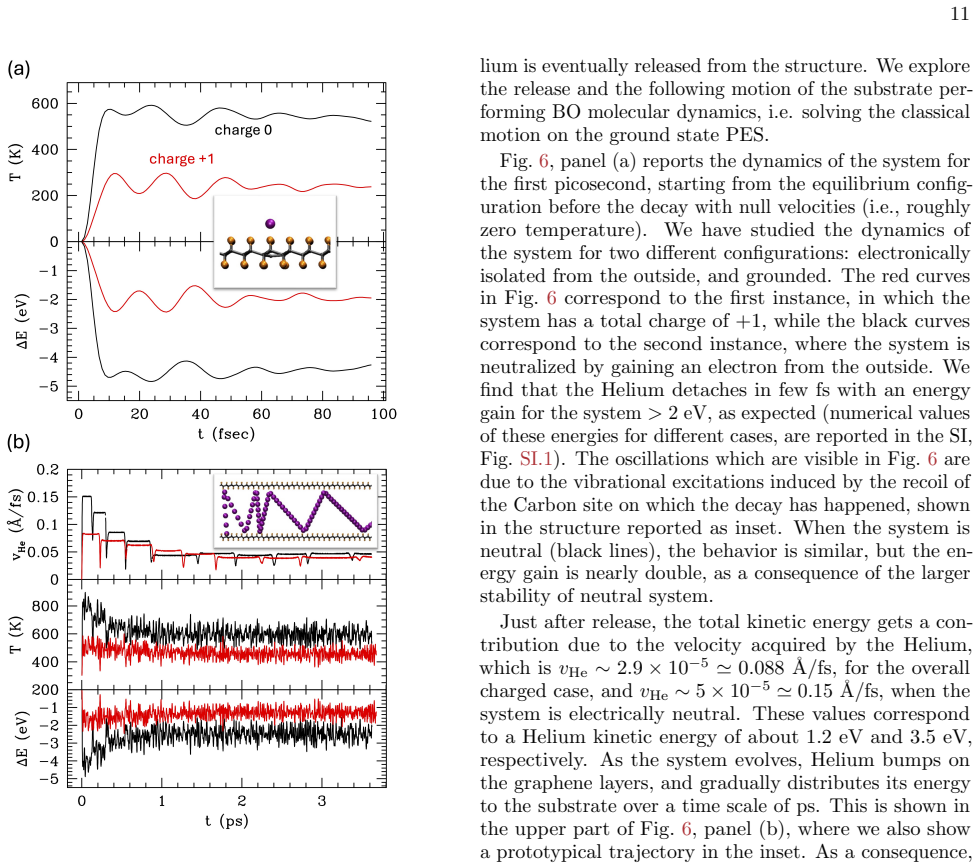
- After the decay the helium is expelled from the graphene within femtoseconds with roughly 1-4 eV of kinetic energy, and periodic releases heat the layer by a few eV; the simulations find no structural damage except in rare head-on collisions at weak bonds.
Reading between the lines
- Extending beyond the paper: if the discrete helium peaks are real, their measured positions and intensities could be inverted to extract the substrate's electron-relaxation time scale, turning a neutrino experiment into a condensed-matter probe.
- Extending beyond the paper: the sudden-to-adiabatic family of potentials suggests a continuous electron-response parameter; a non-adiabatic calculation could show how the peaks broaden into a continuum and shrink the current spread between schemes.
- Extending beyond the paper: the same DFT-plus-nuclear-Schrödinger machinery should transfer to tritium on other two-dimensional hosts, where the endpoint shift would encode the host's electronic structure and could in principle be engineered.
- Extending beyond the paper: measuring the helium charge-state branching after decay, He++, He+, or neutral He, would be a comparatively cheap decisive test of the three response schemes before a full high-resolution spectrum is built.
Signed reviews
Editorial analysis
A structured set of objections, weighed in public.
Referee Report
Summary. The paper develops a combined DFT and single-particle nuclear quantum mechanics framework to compute the β-decay electron spectrum of tritium chemisorbed on graphene. The authors compute the tritium binding potential and, within sudden, semi-sudden, and adiabatic schemes, the potential felt by the helium daughter nucleus immediately after decay. They solve a single-particle Schrödinger equation for the decaying tritium and the final helium, compute decay matrix elements, and predict that the endpoint is shifted by roughly 29 eV relative to vacuum and that the spectrum contains discrete features from helium bound states. They also perform Born-Oppenheimer molecular dynamics to study the post-decay fate of the helium and the substrate. The central claim is that these effects are large compared with the 100 meV target resolution of PTOLEMY and thus constitute a measurable signature of the condensed-matter environment.
Significance. If the quantitative predictions hold, this work would be an important contribution to the planning and interpretation of future tritium-on-substrate neutrino experiments, particularly PTOLEMY, by showing that solid-state effects cannot be ignored at the stated energy resolution. The paper's strength lies in its explicit multi-scheme treatment of the electronic response (sudden, semi-sudden, adiabatic), its systematic exploration of tritium loading and magnetization states, and its unusually candid discussion of the limitations of the approximations. The prediction of a tens-of-eV endpoint shift is a concrete, falsifiable statement that can be tested once a tritiated-graphene source is operated. However, the quantitative spectrum and the discrete-line structure in particular rest on a single-nuclear-coordinate reduction whose validity is not established, as discussed in the major comments.
major comments (3)
- [Section VII, Eq. (5), Eq. (12)] The central spectral predictions in Fig. 5 are computed from single-particle wave functions for one tritium/helium nucleus with all other nuclei frozen. The paper explicitly concedes in Section VII that there is no large hierarchy of masses or time scales that rigorously justifies this reduction. This matters because the discrete bound-state features shown in Fig. 5 are, in a many-body treatment, zero-phonon lines: the T-to-He charge change will, as shown by the paper's own Born-Oppenheimer molecular dynamics in Fig. 6, displace the carbon and neighboring tritium/helium coordinates, producing Franck-Condon sums over substrate vibrational excitations. If the zero-phonon weight is small or the phonon sidebands are broad, the discrete structure claimed to be visible with PTOLEMY's resolution is not what an experiment would observe. The authors should either provide an estimate of the no-phonon Franck-Condon factor within a tractable many-body model, or substantially soften the claim that the discrete spectral features are robust predictions.
- [Section V, Eq. (16), SI Section SI.I.F] The 29 eV endpoint shift, which is the paper's headline quantitative result, follows from the difference U_T^0 - U_He^0 obtained by aligning the tritium and helium potentials using a displaced-point-charge model with parameters (notably the 0.7 Å displacement between the carbon nucleus and the bond charge) that are not varied and carry no quoted uncertainty. Because the comparison target is a 100 meV energy resolution, even a few eV of systematic uncertainty in the alignment would not destroy the qualitative claim, but an unquantified alignment error is material to the precise value. The authors should provide a sensitivity study or a conservative estimate of the alignment uncertainty, for example by varying the Coulomb model parameters within physically reasonable ranges or by cross-checking with an independent alignment method.
- [SI Section SI.II, Eq. (SI.6), Table SI.4] The effective potential U(r,z) is fitted to DFT data at only three values of z (1.11, 1.61, 1.95 Å) and then extrapolated throughout the region where the nuclear wave functions are localized. The bound-state spectrum, the wave-function overlaps, and hence the discrete line separations in Fig. 5 depend sensitively on the shape of the potential near its minimum, especially for the narrow sudden potential. No convergence test with respect to the number of z grid points or a direct comparison against additional DFT points is reported. The authors should demonstrate that the discrete spectral features are not artifacts of the three-point interpolation.
minor comments (3)
- [SI Section SI.I.F] The phrase 'for large enough distances (≳ 10−15 Å)' appears to contain a typo; 10−15 Å is one femtometer and cannot be the regime where the Coulomb tail is valid. The intended scale is presumably a few Å or more.
- [Section II, footnote 2] The neglect of the Coulomb distortion of the outgoing electron wave function is stated but not quantified. Since the paper emphasizes a 100 meV resolution, a brief estimate of the size of this effect near the endpoint would help the reader judge whether it is negligible at the target precision.
- [Section V] The spectrum in Fig. 5 is computed only for the 100% loading case with a specific relaxation prescription, while Section III documents a strong dependence of the potential parameters on loading and configuration. A sentence clarifying how the curves in Fig. 5 would change under the other prescriptions, or why the chosen case is representative, would improve the readability.
Circularity Check
No significant circularity: the β-decay spectrum is computed from DFT-derived potentials via Fermi's golden rule, and no predicted quantity is used as a fit input.
full rationale
The paper's derivation chain is self-contained rather than circular. The initial and final nuclear wave functions are obtained by solving the single-particle Schrödinger equation (Eq. 12) with potentials U_T and U_He computed from DFT energy surfaces (Section III and IV). The beta spectrum is then obtained from Fermi's golden rule (Eqs. 4-5) using these wave functions. The endpoint shift in Eq. (16) is expressed in terms of potential minima and harmonic frequencies, which are DFT-derived inputs; it is not fitted to the beta spectrum or to any endpoint observable. The analytic potential in Eq. (SI.6) is fitted to DFT data, not to the predicted decay rate, so this is standard input modeling, not circularity. The paper explicitly contrasts its treatment with the earlier PTOLEMY assumption in Ref. [17], and the self-citations in Refs. [23,31,32,34,57] are background, methodological pointers, or pointers to complementary work; none is invoked as a uniqueness theorem or as the sole justification for the central claim. The limitations stated in Section VII, including the absence of 'any truly large hierarchy between masses and/or time scales to rigorously justify this separation,' are honest validity caveats about the single-nuclear-coordinate factorization and the sudden approximation; they do not mean any output was assumed in the inputs. The spectrum is not benchmarked against external data, but that is a correctness and calibration concern, not a circularity concern. Consequently, no load-bearing circular step is present.
Assumptions & free parameters
free parameters (3)
- P (interpolation constant in Eq. SI.6) =
2.8, 3.6, 3.6 Å^-2 for sudden He, semi-sudden He, adiabatic T
- Potential model parameters k(z), S(z), Uz(z), W(z) at z = 1.11, 1.61, 1.95 Å =
Reported in Table SI.4 for three schemes
- Coulomb alignment displacement between carbon nucleus and bond charge =
approx. 0.7 Å
assumptions (6)
- standard math Fermi's golden rule with a local weak Hamiltonian and plane-wave lepton wave functions
- domain assumption Born-Oppenheimer approximation for the initial and long-time final electronic states
- domain assumption Sudden approximation: electron density frozen at the pre-decay configuration during the decay
- domain assumption Reduction of the many-nucleus problem to a single-particle potential for tritium/helium
- domain assumption Cylindrical symmetry of the potential near its minimum
- domain assumption Time-scale separation t_beta << t_relax for the electron cloud
Cite this review
Pith. "Pith review of The $\beta$-decay spectrum of Tritiated graphene: combining nuclear quantum mechanics with Density Functional Theory." pith.science (2026). https://pith.science/paper/U5RRKSRG
@misc{pith2026250413259,
  author       = {Pith},
  title        = {Pith review of: The $\beta$-decay spectrum of Tritiated graphene: combining nuclear quantum mechanics with Density Functional Theory},
  year         = {2026},
  howpublished = {\url{https://pith.science/paper/U5RRKSRG}},
  note         = {Machine review of arXiv:2504.13259}
}
abstract
We present the results of a multi-methodological study aimed at investigating the interaction between graphene and Tritium during its $\beta$-decay to Helium, under different levels of loading and geometrical configurations. We combine Density Functional Theory (DFT), to evaluate the interaction potentials, with calculations of the decay rate, in order to study the consequences that the presence of the substrate has on the $\beta$-decay spectrum of Tritium. We determine the shape of the event rate, accounting for the effects of (part of) the corresponding condensed matter degrees of freedom. In the context of future neutrino experiments, our results provide important information aimed at the optimization of hosting material, as well as the determination of the physics reach. Furthermore, our work outlines a novel theoretical and computational scheme to address a question at the boundary between high and low energy physics. This requires non-conventional declinations of DFT combined with full quantum treatments of the nuclear configuration involved in the decay process.
Figures


Figures from the paper (3 more)


Forward citations
Cited by 2 Pith papers
-
Hydrogenated carbon structures as directional sub-GeV dark matter detectors
Hydrogenated carbon sheets and nanotube arrays could detect dark matter as light as ~1 MeV by counting protons knocked loose from hydrogen atoms.
-
Pathways and impediments towards a detection of the relic neutrino wind
Detecting the cosmic neutrino background's dipole anisotropy via tritium capture requires ~10^5 times the exposure needed for flux detection, with Majorana neutrinos suffering an additional (m_ν/T_ν)^2 suppression.
Reference graph
Works this paper leans on
-
[1]
Evidence for os- cillation of atmospheric neutrinos,
Y. Fukuda et al. (Super-Kamiokande), “Evidence for os- cillation of atmospheric neutrinos,” Phys. Rev. Lett. 81, 1562–1567 (1998) , arXiv:hep-ex/9807003
arXiv 1998
-
[2]
Q. R. Ahmad et al. (SNO), “Measurement of the rate of νe + d → p + p + e− interactions produced by 8B solar neutrinos at the Sudbury Neutrino Observatory,” Phys. Rev. Lett. 87, 071301 (2001) , arXiv:nucl-ex/0106015
arXiv 2001
-
[3]
Q. R. Ahmad et al. (SNO), “Direct evidence for neutrino flavor transformation from neutral current interactions in the Sudbury Neutrino Observatory,” Phys. Rev. Lett. 89, 011301 (2002) , arXiv:nucl-ex/0204008
arXiv 2002
-
[4]
2020 global reassessment of the neutrino oscillation 14 picture,
P. F. de Salas, D. V. Forero, S. Gariazzo, P. Mart ´ ınez- Mirav´ e, O. Mena, C. A. Ternes, M. T´ ortola, and J. W. F. Valle, “2020 global reassessment of the neutrino oscillation 14 picture,” JHEP 02, 071 (2021) , arXiv:2006.11237 [hep- ph]
arXiv 2021
-
[5]
The fate of hints: updated global analysis of three-flavor neutrino oscilla- tions,
Ivan Esteban, M. C. Gonzalez-Garcia, Michele Maltoni, Thomas Schwetz, and Albert Zhou, “The fate of hints: updated global analysis of three-flavor neutrino oscilla- tions,” JHEP 09, 178 (2020) , arXiv:2007.14792 [hep-ph]
arXiv 2020
-
[6]
Unfinished fabric of the three neu- trino paradigm,
Francesco Capozzi, Eleonora Di Valentino, Eligio Lisi, Antonio Marrone, Alessandro Melchiorri, and An- tonio Palazzo, “Unfinished fabric of the three neu- trino paradigm,” Phys. Rev. D 104, 083031 (2021) , arXiv:2107.00532 [hep-ph]
arXiv 2021
-
[7]
Limit on anti-electron-neutrino mass from observation of the beta decay of molecular tritium,
R. G. H. Robertson, T. J. Bowles, G. J. Stephenson, D. L. Wark, John F. Wilkerson, and D. A. Knapp, “Limit on anti-electron-neutrino mass from observation of the beta decay of molecular tritium,” Phys. Rev. Lett. 67, 957–960 (1991)
1991
-
[8]
New upper bound on the electron anti-neutrino mass,
H. Kawakami et al. , “New upper bound on the electron anti-neutrino mass,” Phys. Lett. B 256, 105–111 (1991)
1991
Show all 68 references
-
[9]
Measure- ment of the electron-neutrino mass from tritium beta decay,
E. Holzschuh, M. Fritschi, and W. Kuendig, “Measure- ment of the electron-neutrino mass from tritium beta decay,” Phys. Lett. B 287, 381–388 (1992)
1992
-
[10]
Anomalous Structure in the Beta Decay of Gaseous Molecular Tri- tium,
Wolfgang Stoeffl and Daniel J. Decman, “Anomalous Structure in the Beta Decay of Gaseous Molecular Tri- tium,” Phys. Rev. Lett. 75, 3237–3240 (1995)
1995
-
[11]
Improved Upper Limit on the Neutrino Mass from a Direct Kinematic Method by KATRIN,
M. Aker et al. (KATRIN), “Improved Upper Limit on the Neutrino Mass from a Direct Kinematic Method by KATRIN,” Phys. Rev. Lett. 123, 221802 (2019) , arXiv:1909.06048 [hep-ex]
2019
-
[12]
Direct neutrino-mass mea- surement with sub-electronvolt sensitivity,
M. Aker et al. (KATRIN), “Direct neutrino-mass mea- surement with sub-electronvolt sensitivity,” Nature Phys. 18, 160–166 (2022) , arXiv:2105.08533 [hep-ex]
2022 arXiv
-
[13]
Direct neutrino-mass measurement based on 259 days of KATRIN data,
M. Aker et al. , “Direct neutrino-mass measurement based on 259 days of KATRIN data,” Science 388, 180–185 (2025), arXiv:2406.13516 [nucl-ex]
2025
-
[14]
A design for an electromagnetic filter for precision energy measurements at the tritium end- point,
M. G. Betti et al. , “A design for an electromagnetic filter for precision energy measurements at the tritium end- point,” Prog. Part. Nucl. Phys. 106, 120–131 (2019) , arXiv:1810.06703 [astro-ph.IM]
2019 arXiv
-
[15]
Neutrino physics with the PTOLEMY project: active neutrino proper- ties and the light sterile case,
M. G. Betti et al. (PTOLEMY), “Neutrino physics with the PTOLEMY project: active neutrino proper- ties and the light sterile case,” JCAP 07, 047 (2019) , arXiv:1902.05508 [astro-ph.CO]
2019 arXiv
-
[16]
Implementation and optimization of the PTOLEMY transverse drift electromagnetic filter,
A. Apponi et al. , “Implementation and optimization of the PTOLEMY transverse drift electromagnetic filter,” JINST 17, P05021 (2022) , arXiv:2108.10388 [physics.ins- det]
2022 arXiv
-
[17]
Heisenberg’s uncertainty principle in the PTOLEMY project: A theory update,
A. Apponi et al. (PTOLEMY), “Heisenberg’s uncertainty principle in the PTOLEMY project: A theory update,” Phys. Rev. D 106, 053002 (2022) , arXiv:2203.11228 [hep- ph]
2022 arXiv
-
[18]
A Demonstration of Slowed Electron E × B Drift for PTOLEMY,
M. Farino et al. (PTOLEMY), “A Demonstration of Slowed Electron E × B Drift for PTOLEMY,” JINST 20, P08025 (2025) , arXiv:2503.10025 [physics.ins-det]
2025 arXiv
-
[19]
The Project 8 Neutrino Mass Experiment,
A. Ashtari Esfahani et al. (Project 8), “The Project 8 Neutrino Mass Experiment,” in Snowmass 2021 (2022) arXiv:2203.07349 [nucl-ex]
2022 arXiv
-
[20]
Tritium Beta Spectrum Measurement and Neutrino Mass Limit from Cyclotron Radiation Emission Spectroscopy,
A. Ashtari Esfahani et al. (Project 8), “Tritium Beta Spectrum Measurement and Neutrino Mass Limit from Cyclotron Radiation Emission Spectroscopy,” Phys. Rev. Lett. 131, 102502 (2023) , arXiv:2212.05048 [nucl-ex]
2023 arXiv
-
[21]
Universal Neutrino Degeneracy,
Steven Weinberg, “Universal Neutrino Degeneracy,” Phys. Rev. 128, 1457–1473 (1962)
1962
-
[22]
Probing low energy neutrino backgrounds with neutrino capture on beta decaying nuclei,
Alfredo G. Cocco, Gianpiero Mangano, and Marcello Messina, “Probing low energy neutrino backgrounds with neutrino capture on beta decaying nuclei,” JCAP 06, 015 (2007), arXiv:hep-ph/0703075
2007 arXiv
-
[23]
Hydrogen storage in rippled graphene: perspec- tives from multi-scale simulations,
Vito Dario Camiola, Riccardo Farchioni, Tommaso Cav- allucci, Antonio Rossi, Vittorio Pellegrini, and Valentina Tozzini, “Hydrogen storage in rippled graphene: perspec- tives from multi-scale simulations,” Frontiers in materials 2, 3 (2015)
2015
-
[24]
Gap open- ing in double-sided highly hydrogenated free-standing graphene,
M G Betti, E Placidi, C Izzo, E Blundo, A Polimeni, M Sbroscia amd J A P Dudin, K Hu, Y Ito, D Prezzi, M Bonacci, E Molinari, and Carlo Mariani, “Gap open- ing in double-sided highly hydrogenated free-standing graphene,” Nano Lett. 22, 2971–2977 (2022)
2022
-
[25]
Transmission through graphene of electrons in the 30–900 ev range,
Alice Apponi, Domenica Convertino, Neeraj Mishra, Camilla Coletti, Mauro Iodice, Franco Frasconi, Federico Pilo, Narcis Silviu Blaj, Daniele Paoloni, Ilaria Rago, et al. , “Transmission through graphene of electrons in the 30–900 ev range,” Carbon 216, 118502 (2024)
2024
-
[26]
Navigating the pitfalls of relic neutrino detection,
Yevheniia Cheipesh, Vadim Cheianov, and Alexey Bo- yarsky, “Navigating the pitfalls of relic neutrino detection,” Phys. Rev. D 104, 116004 (2021) , arXiv:2101.10069 [hep- ph]
2021 arXiv
-
[27]
Quantum in- duced broadening: A challenge for cosmic neutrino back- ground discovery,
Shmuel Nussinov and Zohar Nussinov, “Quantum in- duced broadening: A challenge for cosmic neutrino back- ground discovery,” Phys. Rev. D 105, 043502 (2022) , arXiv:2108.03695 [hep-ph]
2022 arXiv
-
[28]
Importance of the X-ray edge singularity for the detection of relic neutrinos in the PTOLEMY project,
Zhiyang Tan and Vadim Cheianov, “Importance of the X-ray edge singularity for the detection of relic neutrinos in the PTOLEMY project,” SciPost Phys. 17, 022 (2024) , arXiv:2202.07406 [physics.ins-det]
2024 arXiv
-
[29]
Relativistic corrections to polarized-tritium β decay,
Gianluca Cavoto, Angelo Esposito, Guglielmo Papiri, and Antonio Davide Polosa, “Relativistic corrections to polarized-tritium β decay,” Phys. Rev. C 107, 064603 (2023), arXiv:2211.13247 [hep-ph]
2023 arXiv
-
[30]
Quantized nuclear recoil in the search for sterile neutrinos in tritium beta decay with ptolemy,
Wonyong Chung, Mark Farino, Andi Tan, Christopher G. Tully, and Shiran Zhang, “Quantized nuclear recoil in the search for sterile neutrinos in tritium beta decay with ptolemy,” Universe 11 (2025), 10.3390/universe11090297
2025 doi
-
[31]
Computer modeling across energy scales: Tritiated graphene for neutrinos investigation,
G Menichetti, A Casale, A Esposito, and V Tozzini, “Computer modeling across energy scales: Tritiated graphene for neutrinos investigation,” Nuovo Cimento 48 C (2025), 10.1393/ncc/i2025-25211-2
2025 doi
-
[32]
Multi- methodological analysis of hydrogen desorption from graphene,
Francesco Delfino, Carles Ros, Sidney M Palardonio, Nina M Carretero, Sebasti´ an Murcia-L´ opez, Juan Ram´ on Morante, Jordi Martorell, Zacharias G Fthenakis, Mauro Francesco Sgroi, Valentina Tozzini, et al. , “Multi- methodological analysis of hydrogen desorption from graphen...
2024
-
[33]
Engineering 3d graphene-based materials: State of the art and perspectives,
L Bellucci and V Tozzini, “Engineering 3d graphene-based materials: State of the art and perspectives,” Molecules 25, 339 (2020)
2020
-
[34]
Nano-scale corrugations in graphene: A density functional theory study of structure, electronic properties and hydrogena- tion,
Antonio Rossi, Simone Piccinin, Vittorio Pellegrini, Ste- fano de Gironcoli, and Valentina Tozzini, “Nano-scale corrugations in graphene: A density functional theory study of structure, electronic properties and hydrogena- tion,” J. Phys. Chem. C 119, 7900–7910 (2015)
2015
-
[35]
Unraveling localized states in quasi free standing monolayer graphene by means of density func- tional theory,
T Cavallucci, Y Murata, M Takamura, H Hibino, S Heun, and V Tozzini, “Unraveling localized states in quasi free standing monolayer graphene by means of density func- tional theory,” Carbon 130, 466–474 (2019)
2019
-
[36]
Self-consistent equa- tions including exchange and correlation effects,
Walter Kohn and Lu Jeu Sham, “Self-consistent equa- tions including exchange and correlation effects,” Physical review 140, A1133 (1965)
1965
-
[37]
Phonons and related crystal properties from 15 density-functional perturbation theory,
S Baroni, S de Gironcoli, A Dal Corso, and P Gi- annozzi, “Phonons and related crystal properties from 15 density-functional perturbation theory,” Rev Mod Phys 73, 515–562 (2001)
2001
-
[38]
Sudden approximation in pho- toemission and beyond,
Lars Hedin and JD Lee, “Sudden approximation in pho- toemission and beyond,” Journal of electron spectroscopy and related phenomena 124, 289–315 (2002)
2002
-
[39]
Exact relativistic tritium beta-decay endpoint spectrum in a hadron model,
Fedor Simkovic, Rastislav Dvornicky, and Amand Faessler, “Exact relativistic tritium beta-decay endpoint spectrum in a hadron model,” Phys. Rev. C 77, 055502 (2008), arXiv:0712.3926 [hep-ph]
2008 arXiv
-
[40]
Generalized gradient approximation made simple,
John P. Perdew, Kieron Burke, and Matthias Ernzerhof, “Generalized gradient approximation made simple,” Phys. Rev. Lett. 77, 3865–3868 (1996)
1996
-
[41]
Reproducibility in density functional theory calculations of solids,
Kurt Lejaeghere, Gustav Bihlmayer, Torbj¨ orn Bj¨ orkman, Peter Blaha, Stefan Bl¨ ugel, Volker Blum, Damien Caliste, Ivano E Castelli, Stewart J Clark, Andrea Dal Corso, et al., “Reproducibility in density functional theory calculations of solids,” Science 351, aad3000 (2016)
2016
-
[42]
Semiempirical gga-type density func- tional constructed with a long-range dispersion correc- tion,
Stefan Grimme, “Semiempirical gga-type density func- tional constructed with a long-range dispersion correc- tion,” Journal of Computational Chemistry 27, 1787–1799 (2006)
2006
-
[43]
Special points for brillouin-zone integrations,
Hendrik J. Monkhorst and James D. Pack, “Special points for brillouin-zone integrations,” Phys. Rev. B 13, 5188– 5192 (1976)
1976
-
[44]
Weinberg, Lectures on Quantum Mechanics (Cam- bridge University Press, 2013)
S. Weinberg, Lectures on Quantum Mechanics (Cam- bridge University Press, 2013)
2013
-
[45]
Born and K
M. Born and K. Huang, Dynamical Theory of Crystal Lattices, International series of monographs on physics (Clarendon Press, 1988)
1988
-
[46]
Highly hydro- genated monolayer graphene with wide band gap opening,
Alice Apponi, Orlando Castellano, Daniele Paoloni, Domenica Convertino, Neeraj Mishra, Camilla Coletti, Carlo Mariani, and Alessandro Ruocco, “Highly hydro- genated monolayer graphene with wide band gap opening,” (2025), arXiv:2504.10238 [cond-mat.mtrl-sci]
2025
-
[47]
Feliciano Giustino, Materials modelling using density func- tional theory: properties and predictions (Oxford Univer- sity Press, 2014)
2014
-
[48]
Intrinsic structural and electronic properties of the buffer layer on silicon carbide unraveled by density functional theory,
T Cavallucci and V Tozzini, “Intrinsic structural and electronic properties of the buffer layer on silicon carbide unraveled by density functional theory,” Sci. Rep. 8, 13097 (2018)
2018
-
[49]
The influence of graphene curvature on hydrogen adsorption: Towards hydrogen storage devices,
Sarah Goler, Camilla Coletti, Valentina Tozzini, Vincenzo Piazza, Torge Mashoff, Fabio Beltram, Vittorio Pellegrini, and Stefan Heun, “The influence of graphene curvature on hydrogen adsorption: Towards hydrogen storage devices,” J Phys Chem C 117, 11506–11513 (2013)
2013
-
[50]
Advanced capabilities for materials modelling with quantum espresso,
Paolo Giannozzi, Oliviero Andreussi, Thomas Brumme, Oana Bunau, M Buongiorno Nardelli, Matteo Calandra, Roberto Car, Carlo Cavazzoni, Davide Ceresoli, Matteo Cococcioni, et al. , “Advanced capabilities for materials modelling with quantum espresso,” Journal of physics: Condens...
2017
-
[51]
Xcrysden—a new program for displaying crystalline structures and electron densities,
Anton Kokalj, “Xcrysden—a new program for displaying crystalline structures and electron densities,” Journal of Molecular Graphics and Modelling 17, 176–179 (1999)
1999
-
[52]
Vmd - vi- sual molecular dynamics,
W. Humphrey, A. Dalke, and K. Schulten, “Vmd - vi- sual molecular dynamics,” J. Molec. Graphics 14, 33–38 (1996)
1996
-
[53]
Electron correlation driven non- adiabatic relaxation in molecules excited by an ultrashort extreme ultraviolet pulse,
A Marciniak, V Despr´ e, Vincent Loriot, G Karras, M Herv´ e, L Quintard, F Catoire, C Joblin, Eric Con- stant, AI Kuleff, et al. , “Electron correlation driven non- adiabatic relaxation in molecules excited by an ultrashort extreme ultraviolet pulse,” Nature communications 10,...
2019
-
[54]
Identifying vibra- tions that control non-adiabatic relaxation of polaritons in strongly coupled molecule–cavity systems,
Ruth H Tichauer, Dmitry Morozov, Ilia Sokolovskii, J Jussi Toppari, and Gerrit Groenhof, “Identifying vibra- tions that control non-adiabatic relaxation of polaritons in strongly coupled molecule–cavity systems,” J. Phys. Chem. Lett. 13, 6259–6267 (2022)
2022
-
[55]
Jun John Sakurai and Jim Napolitano, Modern Quan- tum Mechanics , Quantum physics, quantum information and quantum computation (Cambridge University Press, 2020)
2020
-
[56]
Effect of final-state interactions in allowed beta decays. 2. Reliability of the beta-decay spectrum for T-2,
Alejandro Saenz and Piotr Froelich, “Effect of final-state interactions in allowed beta decays. 2. Reliability of the beta-decay spectrum for T-2,” Phys. Rev. C 56, 2162– 2184 (1997)
1997
-
[57]
Stability of highly hydrogenated monolayer graphene in ultra-high vacuum and in air,
Alice Apponi, Orlando Castellano, Daniele Paoloni, Domenica Convertino, Neeraj Mishra, Camilla Co- letti, Andrea Casale, Luca Cecchini, Alfredo G. Cocco, Benedetta Corcione, Nicola D’Ambrosio, Angelo Espos- ito, Marcello Messina, Francesco Pandolfi, Francesca Pofi, Ilaria Rago, ...
2025
-
[58]
The- oretical analysis of spectral lineshapes from molecular dynamics,
A Cupo, D Tristant, K Rego, and V Meunier, “The- oretical analysis of spectral lineshapes from molecular dynamics,” npj Comput Mat 5 (2019)
2019
-
[59]
706 (Springer, 2006)
Miguel AL Marques, Carsten A Ullrich, Fernando Nogueira, Angel Rubio, Kieron Burke, and Eberhard KU Gross, Time-dependent density functional theory , Vol. 706 (Springer, 2006)
2006
-
[60]
Ab initio ehrenfest dynamics,
X. Li, J. C. Tully, H. B. Schlegel, and M. J. Frisch, “Ab initio ehrenfest dynamics,” J. Chem. Phys. 123 (2005)
2005
-
[61]
The quan- tum dynamics of interfacial hydrogen: Path integral max- imum entropy calculation of adsorbate vibrational line shapes for the h/ni (111) system,
Dongsup Kim, JD Doll, and JE Gubernatis, “The quan- tum dynamics of interfacial hydrogen: Path integral max- imum entropy calculation of adsorbate vibrational line shapes for the h/ni (111) system,” J. Chem. Phys. 106, 1641–1645 (1997)
1997
-
[62]
Time- dependent self-consistent harmonic approximation: An- harmonic nuclear quantum dynamics and time correlation functions,
Lorenzo Monacelli and Francesco Mauri, “Time- dependent self-consistent harmonic approximation: An- harmonic nuclear quantum dynamics and time correlation functions,” Phys Rev B 103, 104305 (2021)
2021
-
[63]
Beta decay of molec- ular tritium,
Y. T. Lin et al. (TRIMS), “Beta decay of molec- ular tritium,” Phys. Rev. Lett. 124, 222502 (2020) , arXiv:2001.11671 [nucl-ex]
2020 arXiv
-
[64]
In silico design, building and gas adsorption of nano-porous graphene scaffolds,
L Bellucci, F Delfino, and V Tozzini, “In silico design, building and gas adsorption of nano-porous graphene scaffolds,” Nanotechnology 32 (2021)
2021
-
[65]
Evaluating the performance of reaxff potentials for sp2 carbon systems (graphene, carbon nanotubes, fullerenes) and a new reaxff potential,
ZG Fthenakis, ID Petsalakis, V Tozzini, and NN Lath- iotakis, “Evaluating the performance of reaxff potentials for sp2 carbon systems (graphene, carbon nanotubes, fullerenes) and a new reaxff potential,” Front Chem 10 (2022)
2022
-
[66]
A ma- chine learning empirical potential for c-o-h interactions,
L Bellucci, V Tozzini, G Fisicaro, and S Piccinin, “A ma- chine learning empirical potential for c-o-h interactions,” in preparation. The β-decay spectrum of Tritiated graphene: combining nuclear quantum mechanics with Density Functional Theory Andrea Casale, 1, ∗ Angelo Espos...
2026
-
[67]
Baroni, S
S. Baroni, S. de Gironcoli, A. D. Corso, and P. Giannozzi, Rev Mod Phys 73, 515 (2001)
2001
-
[68]
Cube Toolz, https://github.com/funkymunkycool/ Cube-Toolz
Reviewed August 16, 2026 · model on record in the stance chip above.
Discussion (0). Continue with ORCID to comment.