REVIEW 3 major objections 5 minor 59 references
Pervasive symmetry-lowering nanoscale structural fluctuations in the cuprate La$_{2-x}$Sr$_{x}$CuO$_{4}$
T0 review · 3 major / 5 minor · reviewed 2026-08-09 · deepseek-v4-flash
Pith's one-line read Nanoscale lattice disorder in a cuprate persists to 970 K, beyond previous limits.
desk verdict A careful, incremental extension of the prior LTO-fluctuation work, but the missing high-T Debye-Waller correction makes the headline T0 numbers insecure. read the letter →
The pith
A machine-rendered reading of the paper's core claim, the machinery that carries it, and where it could break.
The reading
What carries the argument
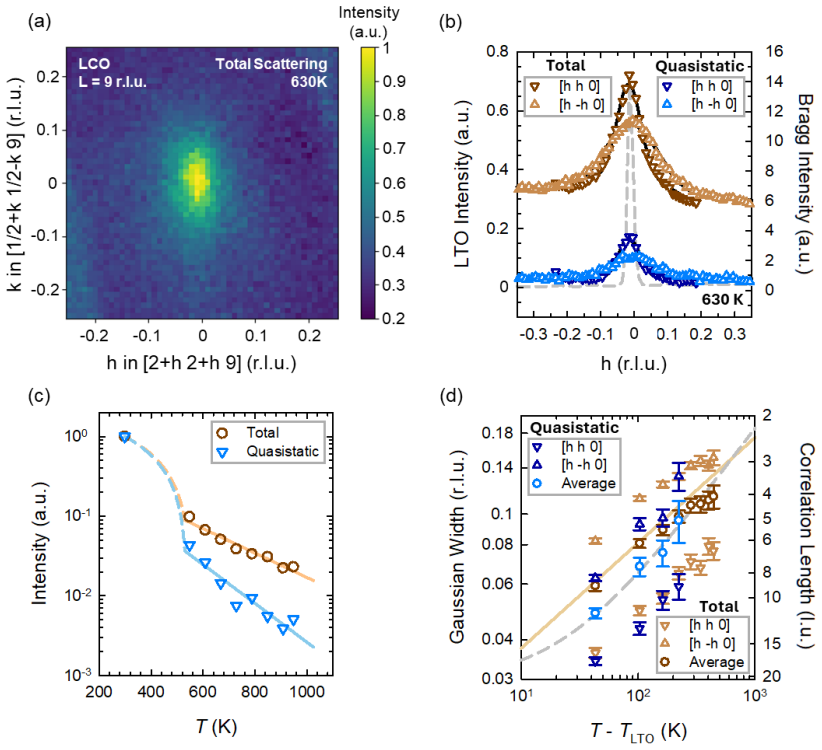
The load-bearing object is the diffuse scattering at LTO superstructure reflections such as (5/2 3/2 9), measured with time-of-flight neutron spectroscopy that separates the quasistatic response (energy transfers $\lesssim 2$ meV) from the total energy-integrated response ($\lesssim 10$ meV), and with high-energy x-rays for energy-integrated data. The argument turns on two empirical regularities: the integrated intensity follows $I \propto e^{-T/T_0}$ over a wide temperature range, and the Gaussian width of the peak follows a power law in $T - T_{\mathrm{LTO}}$. These are compared with rare-region theory, in which exponentially rare ordered puddles above a transition produce exponential scaling, and with the analogous exponential onset of superconducting fluctuations.
What would settle it
Re-measure the integrated intensity at (5/2 3/2 9) in undoped La2CuO4 from 700 K to 970 K, applying a measured Debye-Waller correction; if the corrected intensity deviates from a single exponential or yields a $T_0$ outside the reported uncertainty, the quantitative scaling claim fails.
Extended reading notes
Core claim
The central claim is that short-range orthorhombic (LTO) fluctuations exist throughout the high-temperature tetragonal phase of La2-xSrxCuO4 and obey an exponential temperature scaling, $I \propto e^{-T/T_0}$, that persists to the highest temperatures measured rather than dying out at the structural transition. In undoped La2CuO4 the total-scattering intensity follows this law up to 970 K with $T_0 = 286 \pm 25$ K and the quasistatic channel with $T_0 = 179 \pm 26$ K, so the response becomes more dynamic as temperature rises. Correlation lengths follow a power law in $T - T_{\mathrm{LTO}}$ and at 970 K remain near three lattice constants. The exponential slope is nearly doping independent and, in an optimally doped sample, unchanged by uniaxial stress up to 500 MPa along [110], even though the same stress enhances Bragg intensity below $T_{\mathrm{LTO}}$ and shifts $T_{\mathrm{LTO}}$ upward by about 20 K. The paper reads these observations as support for a rare-region picture in which an underlying, growth-born structural inhomogeneity couples to order parameters and is insensitive to in-plane strain.
Load-bearing premise
The reported exponential decay constants rest on assuming the Debye-Waller thermal factor is negligible up to 970 K and at the high momentum transfer of the measured reflection, even though the check of that assumption only reached 700 K.
Editorial extensions
If this is right
- If the fluctuations persist to 970 K in undoped La2CuO4, they cannot be blamed on strontium substitution; they must originate in the growth process or in the intrinsic perovskite structure.
- Since 0.5 GPa strain barely changes the exponential slope, the mechanism setting the fluctuation scale is not the strain order parameter that drives the LTO transition, but something more hidden.
- The similarity between the extracted energy scale near 100 meV and electronic scales such as magnetic superexchange and the superconducting gap implies structural and electronic inhomogeneity may share a common origin.
- The rod-like scattering at (0 -3 4) in overdoped LSCO, if bulk in origin, would mean the local symmetry is lower than orthorhombic; if defect-related, it offers a way to probe dislocations or stacking faults through diffuse scattering.
Reading between the lines
- A testable extension is to measure LTO diffuse scattering in crystals grown under different floating-zone conditions or with different post-growth annealing; if the exponential $T_0$ changes, that would directly confirm the growth-born inhomogeneity claim.
- The quasistatic versus total scattering difference could be used to estimate the lifetime of the dynamic fluctuations; mapping that lifetime versus temperature would show whether they freeze into a glassy state on cooling or remain critical.
- The apparent upward shift of $T_{\mathrm{LTO}}$ under strain, together with an unchanged $T_0$, suggests the energy scale of the hidden inhomogeneity is set by local lattice properties rather than by the bulk transition; comparing with hydrostatic pressure experiments would separate volume effects from symmetry-strain effects.
Signed reviews
Editorial analysis
A structured set of objections, weighed in public.
Referee Report
Summary. This paper reports neutron and x-ray diffuse scattering measurements of La2-xSrxCuO4. The authors show that LTO structural fluctuations in the tetragonal phase of undoped La2CuO4 persist to 970 K, with integrated intensities decaying approximately exponentially with temperature (T0 = 179 +/- 26 K for the quasistatic channel and T0 = 286 +/- 25 K for the total channel) and with correlation lengths following a power law in T - TLTO. Quasistatic scattering is found to decay faster than the total scattering while exhibiting somewhat larger correlation lengths, indicating an increasingly dynamic response at high temperatures. For optimally doped samples, the authors combine neutron and x-ray data and find consistency with prior results, and they report that in situ uniaxial stress up to 500 MPa suppresses the fluctuation intensity by 30-40% but does not significantly change the exponential temperature scale. The paper also reports rod-like diffuse scattering at a nominally forbidden reflection in an overdoped sample. The authors interpret the results as evidence for an underlying nanoscale structural inhomogeneity that forms during crystal growth and that is insensitive to in-plane stress, with an energy scale of roughly 100 meV comparable to electronic scales.
Significance. If the quantitative claims hold, this is a valuable extension of prior work: the high-temperature neutron data uniquely separate quasistatic and total responses, and the in situ strain experiment addresses the robustness of the exponential scaling in a direct way. The paper is commendable for using multiple instruments, multiple doping levels, and energy-discriminated detection, and for reporting clear limitations of the large-volume x = 0.155 neutron sample. The central quantitative conclusion, however, currently rests on a Debye-Waller assertion that is not demonstrated at the highest temperatures, and the rare-region consistency check uses an adjustable transition-temperature shift. These issues are fixable with additional analysis and should be addressed before the quantitative scaling claim is accepted.
major comments (3)
- [Section II (Experimental Methods), Fig. 2(c)] The exponential decay constants T0 for undoped La2CuO4 are extracted from integrated intensities at the (5/2 3/2 9) reflection, |Q| ~ 15.6 A^-1, without applying a Debye-Waller correction. The text states that this factor was 'investigated elsewhere and determined to be negligible [15]', but the cited check extended only to 700 K, whereas the exponential fit in Fig. 2(c) spans to 970 K. At this momentum transfer, exp(-Q^2 <u^2>) is strongly temperature dependent in the relevant range: even a modest increase of <u^2> from about 0.01 A^2 to 0.03 A^2 between 530 K and 970 K changes the cross section by roughly two orders of magnitude. Consequently, the reported values T0 = 179 +/- 26 K and 286 +/- 25 K, their comparison with the x-ray value T0 = 155 +/- 8 K, and the inferred ~100 meV energy scale are not secure. I ask the authors to provide a quantitative Debye-Waller estimate (for example, from high-temperature Bragg-peak intensities or a phonon model), apply it to the integrated intensities, and either quote corrected T0 values with systematic uncertainties or restrict the quantitative exponential-scaling claim to a temperature range where the correction is demonstrably negligible.
- [Section IV and Fig. 4(b)] The purported consistency with the theoretically expected correlation-length exponent of 1/2 is obtained by invoking an effective transition temperature T'_LTO = TLTO - 25 K. Since this shift is not independently constrained, it functions as an adjustable parameter that can always improve agreement; as stated, the comparison is not a test of rare-region theory. Moreover, the sign of the effect appears to be described incorrectly: if the actual transition temperature lies below TLTO, plotting the correlation length against T - TLTO should make the apparent power-law exponent smaller than the true exponent (with magnitude less than 1/2), not larger. Please either fit the model with T'_LTO as a free parameter and report its fitted value and uncertainty, or present the comparison as qualitative only.
- [Section III, Fig. 5] The central conclusion that uniaxial stress does not alter the exponential scaling should be supported by more explicit analysis. The strain-cell data yield T0 = 222 +/- 31 K, but there is no zero-stress measurement in the same experimental setup; the 25 MPa data are used as the baseline, even though the paper notes that the extracted correlation lengths at 25 MPa are already systematically smaller than ambient-pressure values. To substantiate the claim that the exponential slope is unchanged, please report fits of T0 and TLTO for each stress value, state the confidence intervals, and provide a formal test of slope equality across stresses. This is important because the abstract's 'insensitive to in-plane stress' claim rests on this comparison.
minor comments (5)
- [Fig. 4(a) caption] The caption states that intensities were scaled to match the prior results; please specify the scaling procedure and state explicitly that the T0 fits are unaffected by the free scale factor.
- [Section III] The phrase 'already at at 25 MPa stress' contains a duplicated 'at'.
- [References] Reference [8] is missing its opening bracket: it reads '[8 A. N. Pasupathy' and should be '[8] A. N. Pasupathy'.
- [Fig. 2(d) and Fig. 4(b)] The power-law fits (exponent 1/3) and the T'_LTO-shifted 1/2 line should be accompanied by fit ranges, uncertainties, and the number of points used; as presented, the solid and dashed lines cannot be evaluated quantitatively.
- [Section IV and Fig. 6] For the rod-like scattering at the forbidden reflection, the energy windows used for the total and quasistatic channels should be given explicitly, since the comparison between the two channels is central to the claim that the response is primarily inelastic.
Circularity Check
No significant circularity: the T0 values and correlation lengths are direct fits to new neutron and x-ray data, and the central claims do not reduce to the paper's inputs or to the authors' prior work.
full rationale
The paper is an empirical scattering study. The central quantitative outputs—T0 = 179 ± 26 K and 286 ± 25 K for undoped La2CuO4, and T0 = 222 ± 31 K under uniaxial stress—are obtained by least-squares fits to measured integrated diffuse intensities, while correlation lengths are extracted from measured Gaussian peak widths. These quantities are not derived from a model that already contains them, and no fitted parameter is renamed as a prediction. The rare-region/inhomogeneity interpretation is qualitative and is not used to generate the quoted scales. The paper does rely on ref. [15] for prior data, the correlation-length extraction procedure, and an earlier Debye-Waller check, and several authors overlap with that reference; however, the new measurements independently extend the temperature, doping, and strain phase space, and no central claim reduces to a self-citation chain. The T'_LTO = TLTO – 25 K adjustment in Fig. 2(d) and Section IV is a post-hoc consistency check rather than a load-bearing derivation, and it does not determine the main results about persistence to 970 K, increasingly dynamic character, or stress insensitivity. The unquantified Debye-Waller contribution at high Q and 970 K is a legitimate quantitative correctness risk, but it is not a circularity because the correction is an external experimental check, not an input to the fitting model. Overall, the derivation chain is self-contained with respect to the paper's principal claims; the low score reflects only the presence of minor non-circular self-citation usage.
Assumptions & free parameters
free parameters (7)
- T0 (exponential intensity decay constant) - x=0 quasistatic =
179 ± 26 K
- T0 (exponential intensity decay constant) - x=0 total =
286 ± 25 K
- T0 (exponential intensity decay constant) - x=0.155 strained =
222 ± 31 K
- Power-law exponent for correlation length =
1/3 (solid line); mean-field 1/2 assumed with adjusted TLTO
- Effective transition temperature shift T'_LTO = TLTO - 25 K =
-25 K
- Trapezoidal oxygen distortion parameter r =
not fitted (r > 0)
- Intensity scaling factor for Fig. 4a =
not stated
assumptions (7)
- domain assumption The Debye-Waller factor contribution to the temperature dependence of the diffuse intensity is negligible up to 970 K.
- domain assumption The structural transition temperature TLTO(x) is known from prior literature (TLTO = 530 K for x=0, ~150 K for x=0.155).
- domain assumption The diffuse scattering at the LTO positions is dominated by orthorhombic octahedral-rotation fluctuations, with background adequately removed by a nearby-box subtraction.
- domain assumption Gaussian profiles provide a faithful measure of the diffuse peak width; the correlation length is extracted from the HWHM as in ref. [15].
- domain assumption The quasistatic channel (<= ~2 meV) and total channel (<= ~10 meV) at CORELLI reliably separate static from dynamic fluctuations.
- domain assumption Rare-region theory (Vojta [49]) provides a valid framework for interpreting the exponential scaling.
- domain assumption Atomic coordinates from Decroux et al. [60] are representative of LSCO for the structure-factor calculation.
invented entities (2)
-
Trapezoidal distortion of in-plane oxygen atoms (parameter r)
-
Underlying nanoscale structural inhomogeneity
Cite this review
Pith. "Pith review of Pervasive symmetry-lowering nanoscale structural fluctuations in the cuprate La$_{2-x}$Sr$_{x}$CuO$_{4}$." pith.science (2026). https://pith.science/paper/U5XDL5S7
@misc{pith2026250202947,
  author       = {Pith},
  title        = {Pith review of: Pervasive symmetry-lowering nanoscale structural fluctuations in the cuprate La$_2-x$Sr$_x$CuO$_4$},
  year         = {2026},
  howpublished = {\url{https://pith.science/paper/U5XDL5S7}},
  note         = {Machine review of arXiv:2502.02947}
}
abstract
The cuprate superconductors are among the most widely studied quantum materials, yet there remain fundamental open questions regarding their electronic properties and the role of the structural degrees of freedom. Recent neutron and x-ray scattering measurements uncovered exponential scaling with temperature of the strength of orthorhombic fluctuations in the tetragonal phase of $La_{2-x}Sr_xCuO_4$ and $Tl_2Ba_2CuO_{6+y}$, unusual behavior that closely resembles prior results for the emergence of superconducting fluctuations, and that points to a common origin rooted in inherent correlated structural inhomogeneity. Here we extend the measurements of $La_{2-x}Sr_xCuO_4$ to higher temperatures in the parent compound (x=0) and to optimal doping (x=0.155), and we furthermore investigate the effects of in-situ in-plane uniaxial stress. Our neutron scattering result for undoped $La_2CuO_4$ complement prior x-ray data and reveal that the structural fluctuations persist to the maximum experimental temperature of nearly 1000K, i.e., to a significant fraction of the melting point. At this temperature, the spatial correlation length extracted from the momentum-space data is still about three lattice constants. The neutron scattering experiment enables quasistatic discrimination and reveals that the response is increasingly dynamic at higher temperatures. We also find that uniaxial stress up to 500 MPa along the tetragonal [110] direction, which corresponds to a strain of about 0.2%, does not significantly alter this robust behavior. Overall, these results support the notion that subtle, underlying inhomogeneity underpins the cuprate phase diagram. Finally, we uncover (for x=0.2) low-energy structural fluctuations at a nominally forbidden reflection. While the origin of these fluctuations is not clear, they might be related to the presence of extended defects such as dislocations or stacking faults.
Figures


Figures from the paper (2 more)


Reference graph
Works this paper leans on
-
[15]
D. Pelc, R. J. Spieker, Z. W. Anderson, M. J. Krogstad, N. Biniskos, N. G. Bielinski, B. Yu, T. Sasagawa, L. Chauviere, P . Dosanjh, R. Liang, D. A. Bonn, A. Damascelli, S. Chi, Y . Liu, R. Osborn, and 18 M. Greven, Unconventional short-range structural fluctuations in cuprate superconductors, Sci. Reports 12, 20483 (2022)
work page 2022
- [1]
-
[2]
J. A. Krumhansl, Fine scale mesostructures in superconducting and other materials, Proceedings of the conference on the lattice effects in high-Tc superconductors, Santa Fe, New Mexico (World Scientific, 1992)
work page 1992
-
[3]
T. Egami and S. J. L. Billinge, Lattice effects in high-temperature superconductors, Prog. Mater. Sci. 38, 359 (1994)
work page 1994
-
[4]
J. W. Alldredge, K. Fujita, H. Eisaki, S. Uchida, and K. McElroy, Universal disorder in Bi2Sr2CaCu2O8+x, Phys. Rev. B 87, 104520 (2013)
work page 2013
-
[5]
Dagotto, Complexity in strongly correlated electronic systems, Science 309, 257 (2005)
E. Dagotto, Complexity in strongly correlated electronic systems, Science 309, 257 (2005)
2005
-
[6]
J. C. Phillips, A. Saxena, and A. R. Bishop, Pseudogaps, dopants, and strong disorder in cuprate high- temperature superconductors, Rep. Prog. Phys. 66, 2111 (2003)
work page 2003
-
[7]
O. Fischer, M. Kugler, I. Maggio-Aprile, C. Berthod, and C. Renner, Scanning tunneling microscopy of high-temperature superconductors, Rev. Mod. Phys. 79, 353 (2007). [8 A. N. Pasupathy, A. Pushp, K. K. Gomes, C. V . Parker, J. Wen, Z. Xu, G. Gu, S. Ono, Y . Ando, and A. Yazdani, Electronic origin of the inhomogeneous pairing interaction in the high-Tc su...
work page 2007
Show all 59 references
-
[9]
Fratini, N
M. Fratini, N. Poccia, A. Ricci, G. Campi, M. Burghammer, G. Aeppli, and A. Bianconi, Scale-free structural organization of oxygen interstitials in La2CuO4+y, Nature 466, 841 (2010)
2010
-
[10]
Z. W. Anderson, M. Spaić, N. Biniskos, L. Thompson, B. Yu, J. Zwettler, Y . Liu, F. Ye, G. E. Granroth, M. Krogstad, R. Osborn, D. Pelc, and M. Greven, Nanoscale structural correlations in a model cuprate superconductor, Phys. Rev. B 110, 214519 (2024)
2024
-
[11]
Yu, D.-D
G. Yu, D.-D. Xia, D. Pelc, R.-H. He, N.-H. Kaneko, T. Sasagawa, Y . Li, X. Zhao, N. Barišić, and M. Greven, Universal precursor of superconductivity in the cuprates, Phys. Rev. B 99, 214502 (2019)
2019
-
[12]
Popčević, D
P. Popčević, D. Pelc, Y . Tang, K. Velebit, Z. Anderson, V . Nagarajan, G. Yu, M. Požek, N. Barišić, and M. Greven, Percolative nature of the direct current paraconductivity in the cuprate superconductors, npj Quant. Mat. 3, 42 (2018)
2018
-
[13]
D. Pelc, M. Vučković, M. S. Grbić, M. Požek, G. Yu, T. Sasagawa, M. Greven, and N. Barišić, Emergence of superconductivity in the cuprates via a universal percolation process, Nat. Commun. 9, 4327 (2018)
2018
-
[14]
D. Pelc, Z. Anderson, B. Yu, C. Leighton, and M. Greven, Universal superconducting precursor in three classes of unconventional superconductors, Nat. Commun. 10, 2729 (2019)
2019
-
[16]
J. D. Axe and M. K. Crawford, Structural instabilities in lanthanum cuprate superconductors, J. Low Temp. Phys. 95, 271 (1994)
1994
-
[17]
Wakimoto, H
S. Wakimoto, H. Kimura, M. Fujita, K. Yamada, Y . Noda, G. Shirane, G. Gu, H. Kim, and R. J. Birgeneau, Incommensurate lattice distortion in the high temperature tetragonal phase of La2-x(Sr, Ba)xCuO4, J. Phys. Soc. Jpn. 75, 074714 (2006)
2006
-
[18]
E. S. Božin, S. J. L. Billinge, and G. H. Kwei, Re-examination of the second-order structural phase transition in La2-xAxCuO4 (A = Ba, Sr), Physica B 241–243, 795 (1998)
1998
-
[19]
Haskel, E
D. Haskel, E. A. Stern, D. G. Hinks, A. W. Mitchell, J. D. Jorgensen, and J. I. Budnick, Dopant and temperature induced structural phase transitions in La2-xSrxCuO4, Phys. Rev. Lett. 76, 439 (1996)
1996
-
[20]
D. C. Peets, R. Liang, M. Raudsepp, W. N. Hardy, and D. A. Bonn, Encapsulated single crystal growth and annealing of the high-temperature superconductor Tl-2201, J. Cryst. Growth 312, 344 (2010)
2010
-
[21]
K. B. Lyons, P . A. Fleury, J. P. Remeika, A. S. Cooper, and T. J.Negran, Dynamics of spin fluctuations in lanthanum cuprate, Phys. Rev. B 37, 3453 (1988)
1988
-
[22]
Honma and P
T. Honma and P. H. Hor, Unified electronic phase diagram for hole-doped high-Tc cuprates, Phys. Rev. B 77, 184520 (2008)
2008
-
[23]
G. Yu, Y . Li, E. M. Motoyama, and M. Greven, A universal relationship between magnetic resonance and superconducting gap in unconventional superconductors, Nat. Phys. 5, 873-875 (2009)
2009
-
[24]
D. Pelc, P. Popčević, M. Požek, M. Greven, and N. Bari šić, Unusual behavior of cuprates explained by heterogeneous charge localization, Sci. Adv. 5, 1 (2019)
2019
-
[25]
D. Pelc, M. J. Veit, C. J. Dorow, Y . Ge, N. Barišić, and M. Greven, Resistivity phase diagram of cuprates revisited, Phys. Rev. B 102, 075114 (2020)
2020
-
[26]
Singh, J
A. Singh, J. Schefer, R. Sura, K. Conder, R. F. Sibille, M. Ceretti, M. Frontzek, and W. Paulus, Evidence for monoclinic distortion in the ground state phase of underdoped La1.95Sr0.05CuO4: A single crystal neutron diffraction study, J. Appl. Phys. 119, 123902 (2016)
2016
-
[27]
Sapkota, T
A. Sapkota, T. C. Sterling, P. M. Lozano, Y . Li, H. Cao, V . O. Garlea, D. Reznik, Q. Li, I. A. Zaliznyak, G. D. Gu, and J. M. Tranquada, Reinvestigation of crystal symmetry and fluctuations in La 2CuO4, Phys. Rev. B 104, 014304 (2021)
2021
-
[28]
Keimer, N
B. Keimer, N. Belk, R. J. Birgeneau, A. Cassanho, C. Y . Chen, M. Greven, M. A. Kastner, A. Aharony, Y . Endoh, R. W. Erwin, and G. Shirane, Magnetic excitations in pure, lightly doped, and weakly metallic La2CuO4, Phys. Rev. B 46, 14034 (1992)
1992
-
[29]
S. Ono, S. Komiya, and Y . Ando, Strong charge fluctuations in the high-temperature Hall coefficient of high-Tc cuprates, Phys. Rev. B 75, 024515 (2007)
2007
-
[30]
Yamada, C
K. Yamada, C. H. Lee, K. Kurahashi, J. Wada, S. Wakimoto, S. Ueki, H. Kimura, and Y . Endoh, Doping dependence of the spatially modulated dynamical spin correlations and the superconducting- transition temperature in La2-xSrxCuO4, Phys. Rev. B 57 10 (1998). 19
1998
-
[31]
Gugenberger, C
R. Gugenberger, C. Meingast, G. Roth, K. Grube, V . Breit, T. Weber, and H. Wühl, Uniaxial pressure dependence of Tc from high-resolution dilatometry of untwinned La 2-xSrxCuO4 single crystals, Phys. Rev. B 49, 13137 (1994)
1994
-
[32]
J. L. Sarrao, D. Mandrus, A. Migliori, Z. Fisk, I. Tanaka, H. Kojima, P. C. Canfield, and P.D. Kodali, Complete elastic moduli of La 2-xSrxCuO4 (x = 0.00 and 0.14) near the tetragonal -orthorhombic structural phase transition, Phys. Rev. B 50, 13125 (1994)
1994
-
[33]
M. J. Krogstad, S. Rosenkranz, J. M. Wozniak, G. Jennings, J. P. C. Ruff, J. T. Vaughey, and R. Osborn Reciprocal space imaging of ionic correlations in intercalation compounds, Nat. Mater. 19, 63 (2020)
2020
-
[34]
Hameed, D
S. Hameed, D. Pelc, Z. W. Anderson, A. Klein, R. J. Spieker, L. Yue, B. Das, J. Ramberger, M. Lukas, Y . Liu, M. J. Krogstad, R. Osborn, Y . Li, C. Leighton, R. M. Fernandes, and M. Greven, Enhanced superconductivity and ferroelectric quantum criticality in plastically deforme...
2022
-
[35]
Najev, S
S. Najev, S. Hameed, D. Gatreau, Z. Wang, J. Joe, M. Požek, T. Birol, R. M. Fernandes, M. Greven, and D. Pelc, Uniaxial strain control of bulk ferromagnetism in rare -earth titanates, Phys. Rev. Lett. 128, 167201 (2022)
2022
-
[36]
C. W. Hicks, S. Ghosh, M. E. Barber, and H.-H. Klauss, Piezoelectric-driven uniaxial stress apparatus for muon spin rotation, JPS Conf. Proc. 21, 011040 (2018)
2018
-
[37]
J. J. Sanchez, P . Malinowski, J. Mutch, J. Liu, J.-W. Kim, P . J. Ryan, and J.-H. Chu, The transport - structural correspondence across the nematic phase transition probed by elasto x-ray diffraction, Nat. Mater. 20, 1519 (2021)
2021
-
[38]
Khayr, S
I. Khayr, S. Hameed, J. Budić, X. He, R. Spieker, A. Najev, Z. Zhao, L. Yue, M. Krogstad, F. Ye, Y . Liu, R. Osborn, S. Rosenkranz, Y . Li, D. Pelc, and M. Greven, Structural Properties of Plastically Deformed SrTiO3 and KTaO3, Phys. Rev. Materials 8, 124404 (2024)
2024
-
[39]
Tanaka, K
I. Tanaka, K. Yamane, and H. Kojima, Single Crystal Growth of Superconducting La2-xSrxCuO4 by the TSFZ Method, J. Crystal Growth 96, 711 (1989)
1989
-
[40]
J. G. Bednorz and K. A. Müller, Possible high -Tc superconductivity in the Ba -La-Cu-O system, Z. Phys. Cond. Mat. 64, 189 (1986)
1986
-
[41]
M. Oda, N. Momono, and M. Ido, Electronic phase diagram of La 2-xSrxCuO4, J. Phys. Chem. Solids 65, 1381 (2004)
2004
-
[42]
Katano, J
S. Katano, J. A. Fernandez-Baca, S. Funahashi, N. Môri, Y . Ueda, and K. Koga, Crystal structure and superconductivity of La2-xBaxCuO4 (0.03 ≤ x ≤ 0.24), Physica C 214, 64 (1993)
1993
-
[43]
J. M. Tranquada , B. J. Sternlieb, J. D. Axe, Y . Nakamura, and S. Uchida, Evidence for stripe correlations of spins and holes in copper oxide superconductors, Nature 375, 561 (1995)
1995
-
[44]
M. K. Crawford, R. L. Harlow, E. M. McCarron, and W. E. Farneth, Lattice instabilities and the effect of copper-oxygen-sheet distortions on superconductivity in doped La 2CuO4, Phys. Rev. B 44, 7749(R) (1991). 20
1991
-
[45]
Sears, Y
J. Sears, Y . Shen, M. J. Krogstad, H. Miao, J. Yan, S. Kim, W. He, E. S. Bozin, I. K. Robinson, R. Osborn, S. Rosenkranz, Y .-J. Kim, and M. P. M. Dean, Stacking disorder in α-RuCl3 investigated via x-ray three-dimensional difference pair distribution function analysis, Phys....
2023
-
[46]
A. R. Moodenbaugh, Y . Xu, M. Suenaga, T. J. Folkerts, and R. N. Shelton, Superconducting properties of La2-xBaxCuO4, Phys. Rev. B 38, 4596 (1988)
1988
-
[47]
Fujita, H
M. Fujita, H. Goka, K. Yamada, J. M. Tranquada, and L. P. Regnault, Stripe order, depinning, and fluctuations in La1.875Ba0.125CuO4 and La1.875Ba0.075Sr0.050CuO4, Phys. Rev. B 70, 104517 (2004)
2004
-
[48]
T. R. Thurston, R. J. Birgeneau, D. R. Gabbe, H. P . Jenssen, M. A. Kastner, P . J. Picone, N. W. Preyer, J. D. Axe, P. Böni, G. Shirane, M. Sato, K. Fukuda, and S. Shamoto, Neutron scattering study of soft optical phonons in La2-xSrxCuO4-y, Phys. Rev. B 39, 4328 (1989)
1989
-
[49]
V ojta, Rare region effects at classical, quantum and nonequilibrium phase transitions, J
T. V ojta, Rare region effects at classical, quantum and nonequilibrium phase transitions, J. Phys. A: Math. Gen. 39, R143 (2006)
2006
-
[50]
Urbach, The long-wavelength edge of photographic sensitivity and of the electronic absorption of solids, Phys
F. Urbach, The long-wavelength edge of photographic sensitivity and of the electronic absorption of solids, Phys. Rev. 92, 1324 (1953)
1953
-
[51]
Osborn, D
R. Osborn, D. Pelc, M. Krogstad, S. Rosenkranz, and M. Greven, Diffuse scattering from correlated electron systems, arXiv:2410.02877 (2024)
2024 arXiv
-
[52]
Wang, X.-G
Z. Wang, X.-G. Zhao, R. Koch, S. J. L. Billinge, and A. Zunger, Understanding electronic peculiarities in tetragonal FeSe as local structural symmetry breaking, Phys. Rev. B 102, 235121 (2020)
2020
-
[53]
A. W. Sleight, Bismuthates: BaBiO3 and related superconducting phases, Physica C 514, 152 (2015)
2015
-
[54]
Putti, I
M. Putti, I. Pallecchi, E. Bellingeri, M. R. Cimberle, M. Tropeano, C. Ferdeghini, A. Palenzona, C. Tarantini, A. Yamamoto. J. Jiang, J. Jaroszynski, F. Kametani, D. Abraimov, A. Polyanskii, J. D. Weiss, E. E. Hellstrom, A. Gurevich, D. C. Larbalestier, R. Jin, B. C. Sales, A....
2010
-
[55]
A. P. Mackenzie and Y . Maeno, The superconductivity of Sr2RuO4 and the physics of spin-triplet pairing, Rev. Mod. Phys. 75, 658 (2003)
2003
-
[56]
Leitner, D
A. Leitner, D. Olaya, C. T. Rogers, and J. C. Price, Upper critical field and fluctuation conductivity in Nb-doped Strontium titanate thin films, Phys Rev. B 62, 1408 (2000)
2000
-
[57]
Wesche, Physical properties of high-temperature superconductors (Wiley, 2015)
R. Wesche, Physical properties of high-temperature superconductors (Wiley, 2015)
2015
-
[58]
C. Gang, H. Zhao, B. Hu, N. Pellatz, D. Reznik, P. Schlottmann, and I. Kimchi, Quest for quantum states via field-altering technology, npj Quantum Mater. 5, 83 (2020)
2020
-
[59]
S. V . Dordevic and C. C. Homes, Superfluid density in overdoped cuprates: Thin films versus bulk samples, Phys. Rev. B 105, 214514 (2022)
2022
-
[60]
Decroux, A
M. Decroux, A. Junod, A. Bezinge, D. Cattani, J. Cors, J. L. Jorda, A. Stettler, M. François, K. Yvon, Ø. Fischer, and J. Muller, Structure, resistivity, critical field, specific-heat jump at Tc, Meissner effect, a.c. and d.c. susceptibility of the high-temperature superconduc...
1987
Reviewed August 9, 2026 · model on record in the stance chip above.
Discussion (0). Continue with ORCID to comment.