REVIEW 5 major objections 5 minor 73 references
The paper proves the Snake optimizer is block coordinate descent and that a traveling-salesman block order cuts cost without sacrificing optimization quality.
Reviewed by Pith at T0; open to challenge. T0 means a machine referee read the full paper against a public rubric. the ladder, T0–T4 →
T0 review · deepseek-v4-flash
2026-08-03 10:20 UTC pith:U6KLS4OV
load-bearing objection A plausible SD-TSP ordering idea and a correct but standard BCD convergence theorem, undercut by the central cost function F(x,S_k,R_k) never being defined—so the method cannot be implemented or tested from the paper. the 5 major comments →
Topology-Aware Block Coordinate Descent for Qubit Frequency Allocation of Superconducting Quantum Processors
The pith
A machine-rendered reading of the paper's core claim, the machinery that carries it, and where it could break.
Core claim
The central claim is that the Snake optimizer is not a separate algorithm but an instance of BCD: parameters are partitioned into qubit-centered blocks, each is optimized against a reduced local objective G' built on a minimal crosstalk footprint, and the loop updates one block at a time while holding the rest fixed. The paper formalizes when such a reduced experiment is faithful—Eq. (1) requires G' to be a strictly increasing function of the full objective G for every block—and proves that under this condition plus regularity, the BCD sequence has non-increasing G and converges. It then makes block ordering a key design variable: the incremental cost of moving between blocks is the expansio
What carries the argument
The load-bearing object is the reduced local objective G'(B|f\B) with the order-preservation condition G' = h(G) for a strictly increasing h—this is what lets a small experiment stand in for the full-chip objective during a block update. A second piece is the SD-TSP ordering cost C(i,j,H), which measures how much choosing block j after i expands the reduced-objective footprint given the current history H; the multi-start nearest-neighbor algorithm greedily minimizes this history-dependent cost. The third piece is the BCD loop itself, with qubit-centered blocks, each optimized by a derivative-free local search over a 3^{|B|}-point direction set with diminishing step size, so per-epoch cost is
Load-bearing premise
The argument hinges on the order-preservation condition G'(B|f\B) = h(G(B|f\B)) holding for every block—if the crosstalk model is incomplete this fails and the monotone-decrease proof collapses—and, separately, on the SD-TSP incremental cost F being well-defined, which the paper never specifies; fail either premise and the convergence claim or the ordering rule is unsupported.
What would settle it
Extract the update rule of the original Snake optimizer and check each step against a BCD block update on the same local objective: if any Snake move is not a minimizer of the reduced block objective with other coordinates frozen, the claimed equivalence is false. Alternatively, on a simulator with a nonlocal term strong enough to reverse the ordering in Eq. (1), record the full objective G at every BCD step; a single increase falsifies the monotone-decrease guarantee.
If this is right
- Any calibration loop satisfying the order-preservation condition inherits classical BCD convergence guarantees, so practitioners can reason about convergence and stopping for Snake-style optimizers.
- Because per-epoch complexity is O(N) under local crosstalk and bounded block size, the structural result transfers to larger processors as long as locality holds.
- Block order becomes an optimizable object rather than a fixed graph heuristic; better SD-TSP solvers than NNA could yield further cost reductions.
- Noisy objective evaluations degrade quality only gradually, so the method is usable with finite-shot estimates, and moderate nonlocal crosstalk mismatch is tolerated.
- Under the search-space complexity model, ordering gives a much larger cost reduction than under the empirical model, so the benefit grows when inner subproblems use expensive exhaustive search.
Where Pith is reading between the lines
- If the equivalence is taken seriously, the entire BCD literature—adaptive block choices, parallel updates, inexact variants—becomes directly applicable to qubit calibration, which the paper only begins to exploit.
- Because the SD-TSP cost is defined through footprint expansion, a device-specific order could be computed offline from the measured crosstalk map and reused across drift cycles, turning expensive online ordering into a one-time preprocessing step.
- The paper leaves the incremental cost F(x,S_k,R_k) undefined; a natural extension is to define it concretely from gate counts or measured terms and benchmark whether NNA's greedy choice actually minimizes per-epoch cost on real hardware.
- For fault-tolerant operation, the same locality-aware BCD could retune logical patches or modules, but only if the surrogate objective is redefined at the logical-error level rather than circuit-level gate error.
Editorial analysis
A structured set of objections, weighed in public.
Referee Report
Summary. The paper proposes a topology-aware Block Coordinate Descent (BCD) framework for qubit frequency allocation on superconducting processors. It claims three main contributions: (1) a mathematical equivalence between the widely used Snake optimizer and BCD; (2) a block-ordering method formulated as a Sequence-Dependent Traveling Salesman Problem (SD-TSP) and solved with a Nearest Neighbor Algorithm (NNA); and (3) an O(N) per-epoch complexity analysis under a local-crosstalk assumption, supported by simulations on a physics-motivated error simulator. The manuscript formalizes a block-local reduced objective, states a validity condition (Eq. (1)) under which a local update preserves the global ordering, proves monotone decrease and convergence of the BCD objective under that condition, and reports numerical comparisons of BCD-NNA against random orders, BFS/DFS heuristics, and a genetic algorithm.
Significance. If the central claims were fully established, the paper would provide a useful theoretical frame for Snake-like calibration and a principled way to reduce per-epoch calibration cost. The paper does contain a correct, if elementary, convergence proof conditional on Eq. (1), and it is transparent about the distinction between an empirical algorithmic cost proxy and the search-space complexity model. The simulator description is unusually detailed, and the robustness experiments honestly explore the regime where the assumed local-crosstalk model is misspecified. However, the significance is currently undercut by two load-bearing gaps: the key ordering cost F is never defined, so the headline algorithm is not implementable from the manuscript; and the claimed Snake-BCD equivalence is asserted but not proved. These issues prevent independent verification of the central efficiency claim.
major comments (5)
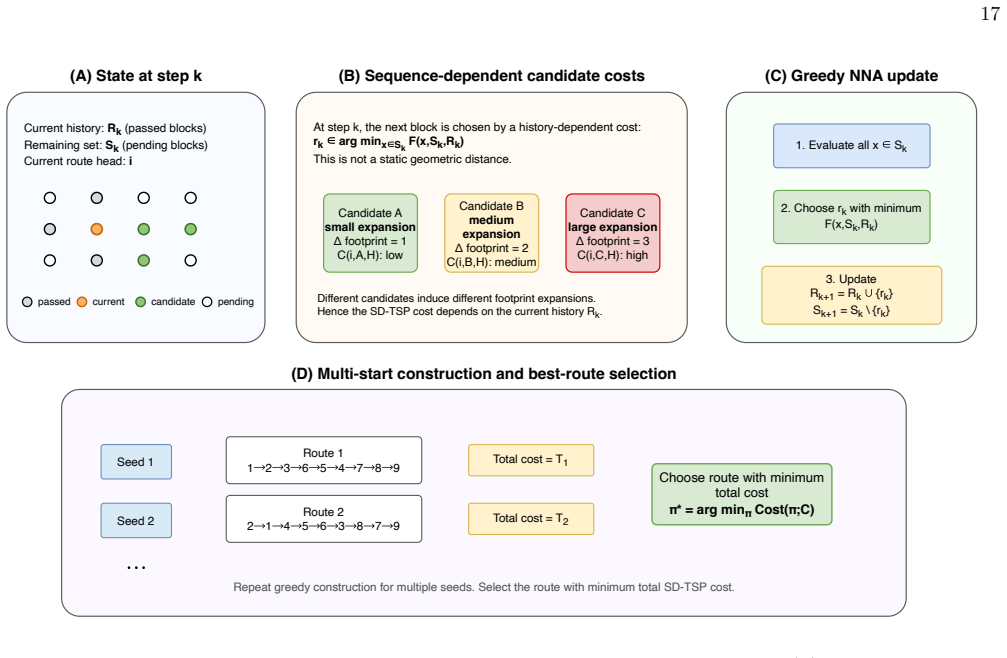
- [II.G, Algorithm 2, Fig. 6] The block-ordering rule in Algorithm 2, line 4, selects r_k in argmin_{x in S_k} F(x,S_k,R_k), but F(x,S_k,R_k) is never defined. The text and Fig. 6 describe it only qualitatively as 'how selecting x next would expand the reduced-objective footprint.' Similarly, N_term(B_i) in Eqs. (22)-(23) is not defined as a function of block history or reduced footprint, so the cost ratio in Fig. 4b cannot be independently computed. This is not a stylistic issue: the paper's main algorithmic improvement is attached to an unspecified object. Please supply an explicit equation for F (and for N_term) in terms of the block footprint, visited history, and remaining set, or revise the central claim accordingly.
- [Introduction and Section II] The abstract and introduction claim a 'mathematical equivalence' between the Snake optimizer and BCD, but no theorem or detailed mapping is provided. Section II formalizes BCD, defines local objectives, and proves convergence of BCD under Eq. (1), but it never analyzes the original Snake pseudocode or shows that Snake's graph-traversal update rule corresponds exactly to a particular BCD instance. This leaves the first stated contribution unsubstantiated. A formal equivalence statement with proof, or a clear downgrade of the claim, is needed.
- [II.C, Eq. (1), Fig. 3] Theorem 1 depends on Assumption 2, especially Eq. (1), which requires the reduced objective to be a strictly increasing transform of the global objective for every block. The paper's own nonlocal-crosstalk experiments in Fig. 3 deliberately violate this condition. Thus, the theoretical convergence guarantee does not cover the robustness regime that the abstract highlights ('tolerant to moderate non-local crosstalk mismatch'). Moreover, the abstract's phrase 'analyze convergence of the resulting inexact BCD with noisy measurements' is stronger than what Section II.C delivers: the noisy and mismatched cases are treated by numerical experiments, not by convergence analysis. Please either add a formal inexact/robust convergence result or temper these claims.
- [II.B versus II.G] There is an apparent inconsistency about whether the blocks are fixed before ordering. Section II.B says the paper employs a non-overlapping block strategy centered around each qubit, with each block containing one single-qubit parameter and adjacent two-qubit-gate parameters. Section II.G states that 'the order in which all single-qubit gate parameters are traversed determines the block set B.' If the block partition is order-dependent, then the BCD update and the SD-TSP ordering are coupled in a way not reflected in Algorithm 1; if the blocks are fixed, the statement in Section II.G is incorrect. This needs clarification because the block definition affects both the objective decomposition and the meaning of the ordering optimization.
- [II.F, Fig. 4b] The numerical evidence for the efficiency benefit of the NNA ordering is based on the empirical cost proxy in Eq. (22)-(23), which is exactly the type of quantity (N_term-based footprint cost) that the ordering is designed to minimize. This is not an independent validation of reduced runtime. The abstract claims 'markedly lower runtime,' but Section II.F explicitly states that the comparisons use algorithmic cost proxies, not wall-clock time. Please provide a comparison against wall-clock runtime or a separately validated cost model, and revise the abstract wording to match what is actually measured.
minor comments (5)
- [Abstract / II.F] The abstract says 'markedly lower runtime,' while the main text and Fig. 4 caption state that reported costs are algorithmic proxies, not wall-clock runtime. The abstract should be aligned with the main text.
- [II.C, Theorem 1 proof] The proof invokes the Bolzano-Weierstrass theorem for the sequence {f_j,k} in a closed set, but the theorem requires boundedness. The feasible sets F_i are assumed closed and convex, not necessarily bounded. Please add a boundedness assumption or otherwise justify existence of a convergent subsequence.
- [II.B] The text refers to 'Section IIG' in the discussion of block strategies; this should be 'Section II.G.'
- [II.F, Eq. (20)] The sentence 'Considering also that the total number of measurement samples is S times' appears incomplete or misphrased; it likely should refer to the number of samples S. Please rewrite for clarity.
- [General] The symbol S is used both for the number of local-search iterations (Eq. (9)) and for the remaining candidate set S_k in Algorithm 2. This notational collision can confuse the reader; consider renaming one of them.
Circularity Check
The reported efficiency gain of BCD-NNA is measured with the same footprint-expansion cost used to define the SD-TSP ordering, making the main 'lower complexity' result true by construction; the optimization-quality claims remain independent.
specific steps
-
fitted input called prediction
[Section II.F Eq. (22)-(23), Section II.G Fig. 6/Algorithm 2, and Fig. 4b]
"For each candidate next block x∈S_k, the algorithm evaluates a history-dependent incremental cost F(x,S_k,R_k), which serves as the SD-TSP selection criterion. In the present calibration setting, this cost is not a static geometric distance; rather, it reflects how selecting x next would expand the reduced-objective footprint and thereby increase the effective per-step evaluation cost. ... Nterm(Bi) increases when the chosen block ordering induces a larger effective local footprint, and decreases when the ordering keeps successive block objectives spatially compact. ... Temp ∝ Σ S3^{|Bi|}Nterm"
Algorithm 2 selects r_k ∈ argmin_{x∈S_k} F(x,S_k,R_k), and F is described as the footprint expansion that selecting x would cause. The reported efficiency result (Fig. 4b) is the ratio Temp(random)/Temp(NNA), where Temp ∝ Σ 3^{|B_i|}Nterm(B_i) and Nterm grows with exactly that footprint. A route chosen stepwise to minimize footprint expansion is therefore, by construction, a route with lower Nterm-sum; the 'markedly lower complexity' claim restates the ordering objective rather than testing it against an independent cost measure. F is never given by an equation, so the claimed cost reduction cannot be checked against any distinct quantity. The paper's own caveat that the comparison is 'not wall-clock runtime' reinforces that no external runtime validation is provided. The optimization-qual
full rationale
The theoretical derivation is largely conditional and non-circular: Eq. (1) is an explicitly stated surrogate assumption, and Theorem 1 is a valid monotone-convergence argument under that assumption. The Snake=BCD equivalence is a reinterpretation, not a fitted prediction. The quality comparisons (Figs. 2, 4a, 4c) and the robustness tests are measured on a separate noiseless average-gate-error metric and do not reduce to the ordering cost. However, the paper's headline efficiency claim is evaluated with the same Nterm-based footprint cost that the SD-TSP ordering is defined to minimize: F(x,S_k,R_k) is described only as the reduced-objective footprint expansion, while Temp is a sum of Nterm terms, and Nterm is stated to increase with that footprint. Thus the 'lower per-epoch algorithmic cost' of BCD-NNA versus random ordering is substantially true by construction rather than by independent empirical validation. Because the central quality claim and the convergence analysis remain independent, this is partial circularity.
Axiom & Free-Parameter Ledger
free parameters (3)
- Simulator coefficient ranges for error terms =
unspecified; sampled uniformly
- Local search iteration budget S =
not stated in text
- G (effective gate count) =
not stated
axioms (4)
- standard math Assumption 1: G is proper, lower bounded, and continuously differentiable; each F_i is closed convex.
- domain assumption Assumption 2: Local crosstalk so T(G_Bi) is O(1) in N; and Eq. (1) holds: G' preserves the global objective's ordering.
- domain assumption Assumption 3: KL property and unique subproblem solutions.
- ad hoc to paper Existence of a well-defined SD-TSP incremental cost F(x,S_k,R_k).
read the original abstract
Pre-execution calibration is a major bottleneck for operating superconducting quantum processors, and qubit frequency allocation is especially challenging due to crosstalk-coupled objectives. We establish that the widely-used Snake optimizer is mathematically equivalent to Block Coordinate Descent (BCD), providing a rigorous theoretical foundation for this strategy for qubit frequency allocation. Building on this formalization, we present a topology-aware block ordering obtained by casting order selection as a Sequence-Dependent Traveling Salesman Problem (SD-TSP) and solving it efficiently with a nearest-neighbor heuristic. The SD-TSP cost reflects how a given block choice expands the reduced-circuit footprint required to evaluate the block-local objective, enabling orders that minimize per-epoch evaluation time. Under local crosstalk/bounded-degree assumptions, the method achieves linear complexity in qubit count per epoch, while maintaining comparable optimization performance. We formalize the calibration objective, clarify when reduced experiments are equivalent or approximate to the full objective, and analyze convergence of the resulting inexact BCD with noisy measurements. Simulations based on a physics-motivated error simulator show that the proposed BCD-NNA ordering attains the same optimization accuracy at markedly lower runtime than graph-based heuristics (BFS, DFS) and random orders, while also achieving optimization quality comparable to a genetic-algorithm baseline. This method is robust to noisy objective-function evaluations and tolerant to moderate non-local crosstalk mismatch. These results provide a scalable, implementation-ready workflow for frequency calibration in near-term superconducting processors and, more broadly, for locality-structured calibration tasks in future scalable architectures.
Figures


Reference graph
Works this paper leans on
-
[1]
To avoid overemphasizing implementation details, we describe the simulator at the level of effective error terms rather than code-level realization
General structure of the simulator The numerical simulations employ a physics-motivated error simulator for qubit frequency allocation in supercon- ducting quantum processors. To avoid overemphasizing implementation details, we describe the simulator at the level of effective error terms rather than code-level realization. The simulator first produces a c...
-
[2]
Choose rk with minimum F(x,Sk,Rk)
-
[3]
travel cost
Update Rk+1 = Rk ∪ {rk} Sk+1 = Sk \ {rk} (D) Multi-start construction and best-route selection Seed 1 Seed 2 ⋯ Route 1 1 → 2 → 3 → 6 → 5 → 4 → 7 → 8 → 9 Route 2 2 → 1 → 4 → 5 → 6 → 3 → 8 → 7 → 9 Total cost = T1 Total cost = T2 Choose route with minimum total cost π* = arg minπ Cost(π;C) Repeat greedy construction for multiple seeds. Select the route with ...
-
[4]
Its frequency dependence reflects the fact that flux-tunable superconducting qubits become more sensitive to flux noise in some operating regions than in others
Single-body terms The single-body contribution for qubitiis decomposed as Esingle i (f) =E (ϕ) i (fi) +E (T1) i (fi).(A2) The termE(ϕ) i describes one-qubit dephasing-related error. Its frequency dependence reflects the fact that flux-tunable superconducting qubits become more sensitive to flux noise in some operating regions than in others. The termE(T1)...
-
[5]
In physical terms, if two nearby transitions become too close in frequency, unwanted hybridization or parasitic interaction can increase the effective gate error
Nearest-neighbor multi-body terms The nearest-neighbor contribution is written schematically as Enear ij (f) =E (coll) ij (fi,fj) +E (2q,ϕ) ij (f) +E (2q,T1) ij (f) +E (fluxXT) ij (f).(A3) The termE (coll) ij models frequency-collision or near-collision errors between coupled computational elements. In physical terms, if two nearby transitions become too ...
-
[6]
This term is used only in the robustness experiments associated with Fig
Nonlocal multi-body correction terms To test the robustness of the method against model mismatch, we further consider a nonlocal contribution Efar ij (f),(i,j)∈P far,(A4) whereP far contains qubit pairs or gate pairs that are not nearest neighbors in the chip topology. This term is used only in the robustness experiments associated with Fig. 3. Its role i...
-
[7]
It is therefore introduced at the level of objective-function evaluation, not by directly modifying the underlying physical device instance
Noisy objective evaluations and stochastic measurement noise The stochastic noise used during optimization is intended to mimic uncertainty from finite experimental measure- ments. It is therefore introduced at the level of objective-function evaluation, not by directly modifying the underlying physical device instance. IfEcirc(f)is the noiseless simulato...
-
[8]
22 2.Random initial points:for a fixed simulator instance, the optimization starts from different initial frequency allocations within the feasible domain
Meaning of random instances, random initial points, and plotted distributions The numerical experiments involve three distinct sources of randomness: 1.Random simulator instances:the coefficients and characteristic parameters of the physical error terms are sampled to generate different device instances. 22 2.Random initial points:for a fixed simulator in...
-
[9]
Definition of the reported average gate error rate For self-contained reference, we restate the conversion from the simulator’s circuit-level output to the reported gate-level metric. The quantity directly produced by the simulator and used during optimization is the circuit-level error estimatorE circ(f), obtained by summing the relevant single-body, nea...
-
[10]
The first is an empirical algorithmic cost proxy used to characterize the implemented block-wise optimizer
Definition of the complexity metrics used in the numerical figures For the numerical comparisons of traversal strategies, we distinguish between two complexity notions. The first is an empirical algorithmic cost proxy used to characterize the implemented block-wise optimizer. For a blockBi, this proxy combines the local search cost of the inner derivative...
-
[11]
P. W. Shor, Polynomial-time algorithms for prime factorization and discrete logarithms on a quantum computer, SIAM Journal on Computing26, 1484 (1997)
1997
-
[12]
Y. Cao, J. Romero, J. P. Olson, M. Degroote, P. D. Johnson, M. Kieferova, I. D. Kivlichan, T. Menke, B. Peropadre, N. P. D. Sawaya, S. Sim, L. Veis, and A. Aspuru-Guzik, Quantum chemistry in the age of quantum computing, CHEMICAL REVIEWS119, 10856 (2019)
2019
-
[13]
Bauer, S
B. Bauer, S. Bravyi, M. Motta, and G. K.-L. Chan, Quantum algorithms for quantum chemistry and quantum materials science, CHEMICAL REVIEWS120, 12685 (2020)
2020
-
[14]
S. McArdle, S. Endo, A. Aspuru-Guzik, S. Benjamin, and X. Yuan, Quantum computational chemistry, REVIEWS OF MODERN PHYSICS92, 10.1103/RevModPhys.92.015003 (2020)
-
[15]
Tilly, H
J. Tilly, H. Chen, S. Cao, D. Picozzi, K. Setia, Y. Li, E. Grant, L. Wossnig, I. Rungger, G. H. Booth, and J. Tennyson, The variational quantum eigensolver: A review of methods and best practices, PHYSICS REPORTS-REVIEW SECTION OF PHYSICS LETTERS986, 1 (2022)
2022
-
[16]
A. Di Meglio, K. Jansen, I. Tavernelli, C. Alexandrou, S. Arunachalam, C. W. Bauer, K. Borras, S. Carrazza, A. Crippa, V. Croft, R. de Putter, A. Delgado,et al., Quantum computing for high-energy physics: State of the art and challenges, PRX QUANTUM5, 10.1103/PRXQuantum.5.037001 (2024)
-
[17]
B. Fauseweh, Quantum many-body simulations on digital quantum computers: State-of-the-art and future challenges, NATURE COMMUNICATIONS15, 10.1038/s41467-024-46402-9 (2024)
-
[18]
Santagati, A
R. Santagati, A. Aspuru-Guzik, R. Babbush, M. Degroote, L. Gonzalez, E. Kyoseva, N. Moll, M. Oppel, R. M. Parrish, et al., Drug design on quantum computers, NATURE PHYSICS20, 549 (2024)
2024
-
[19]
Cerezo, A
M. Cerezo, A. Arrasmith, R. Babbush, S. C. Benjamin, S. Endo, K. Fujii, J. R. McClean, K. Mitarai, X. Yuan, L. Cincio, and P. J. Coles, Variational quantum algorithms, NATURE REVIEWS PHYSICS3, 625 (2021)
2021
-
[20]
Pan, G.-L
D. Pan, G.-L. Long, L. Yin, Y.-B. Sheng, D. Ruan, S. X. Ng, J. Lu, and L. Hanzo, The evolution of quantum secure direct communication: On the road to the qinternet, IEEE COMMUNICATIONS SURVEYS AND TUTORIALS26, 1898 (2024)
2024
-
[21]
Arute, K
F. Arute, K. Arya, R. Babbush, D. Bacon, J. C. Bardin, R. Barends, R. Biswas, S. Boixo,et al., Quantum supremacy using a programmable superconducting processor, Nature574, 505 (2019)
2019
-
[22]
M. Gong, S. Wang, C. Zha, M.-C. Chen, H.-L. Huang, Y. Wu, Q. Zhu, Y. Zhao, S. Li, S. Guo, H. Qian,et al., Quantum walks on a programmable two-dimensional 62-qubit superconducting processor, Science372, 948 (2021)
2021
-
[23]
Wu, W.-S
Y. Wu, W.-S. Bao, S. Cao, F. Chen, M.-C. Chen, X. Chen, T.-H. Chung, H. Deng, Y. Du, D. Fan, M. Gong, C. Guo, et al., Strong quantum computational advantage using a superconducting quantum processor, Physical Review Letters 127, 180501 (2021), pRL
2021
-
[24]
Q. Zhu, S. Cao, F. Chen, M.-C. Chen, X. Chen, T.-H. Chung, H. Deng, Y. Du, D. Fan, M. Gong, C. Guo, C. Guo, S. Guo, L. Han, L. Hong, H.-L. Huang,et al., Quantum computational advantage via 60-qubit 24-cycle random circuit sampling, Science Bulletin67, 240 (2022)
2022
-
[25]
P. V. Klimov, A. Bengtsson, C. Quintana, A. Bourassa, S. Hong, A. Dunsworth, K. J. Satzinger, W. P. Livingston, V. Sivak, et al., Optimizing quantum gates towards the scale of logical qubits, Nature Communications15, 2442 (2024)
2024
-
[26]
Acharya, D
R. Acharya, D. A. Abanin, L. Aghababaie-Beni, I. Aleiner, T. I. Andersen, M. Ansmann, F. Arute, K. Arya, A. Asfaw, N. Astrakhantsev, J. Atalaya,et al., Quantum error correction below the surface code threshold, Nature638, 920 (2025)
2025
-
[27]
D. Gao, D. Fan, C. Zha, J. Bei, G. Cai, J. Cai, S. Cao, F. Chen, J. Chen, K. Chen, X. Chen,et al., Establishing a new benchmark in quantum computational advantage with 105-qubit zuchongzhi 3.0 processor, Physical Review Letters134, 090601 (2025), pRL
2025
-
[28]
Z. Chen, W. Liu, Y. Ma, W. Sun, R. Wang, H. Wang, H. Xu, G. Xue, H. Yan, Z. Yang, J. Ding, Y. Gao, F. Li, Y. Zhang, Z. Zhang, Y. Jin, H. Yu, J. Chen, and F. Yan, Efficient implementation of arbitrary two-qubit gates using unified control, Nature Physics21, 1489 (2025)
2025
-
[29]
Preskill, Quantum computing in the nisq era and beyond, QUANTUM2, 10.22331/q-2018-08-06-79 (2018)
J. Preskill, Quantum computing in the nisq era and beyond, QUANTUM2, 10.22331/q-2018-08-06-79 (2018)
-
[30]
S. Endo, Z. Cai, S. C. Benjamin, and X. Yuan, Hybrid quantum-classical algorithms and quantum error mitigation, JOURNAL OF THE PHYSICAL SOCIETY OF JAPAN90, 10.7566/JPSJ.90.032001 (2021)
-
[31]
G. P. Fedorov and A. V. Ustinov, Automated analysis of single-tone spectroscopic data for cqed systems, Quantum Science and Technology4, 045009 (2019)
2019
-
[32]
Kliesch and I
M. Kliesch and I. Roth, Theory of quantum system certification, PRX Quantum2, 010201 (2021)
2021
-
[33]
Knill, D
E. Knill, D. Leibfried, R. Reichle, J. Britton, R. B. Blakestad, J. D. Jost, C. Langer, R. Ozeri, S. Seidelin, and D. J. Wineland, Randomized benchmarking of quantum gates, Physical Review A77, 012307 (2008)
2008
-
[34]
Magesan, J
E. Magesan, J. M. Gambetta, B. R. Johnson, C. A. Ryan, J. M. Chow, S. T. Merkel, M. P. da Silva, G. A. Keefe, M. B. Rothwell, T. A. Ohki, M. B. Ketchen, and M. Steffen, Efficient measurement of quantum gate error by interleaved randomized benchmarking, Physical Review Letters109, 080505 (2012)
2012
-
[35]
Helsen, X
J. Helsen, X. Xue, L. M. K. Vandersypen, and S. Wehner, A new class of efficient randomized benchmarking protocols, 24 npj Quantum Information5, 71 (2019)
2019
-
[36]
T. J. Proctor, A. Carignan-Dugas, K. Rudinger, E. Nielsen, R. Blume-Kohout, and K. Young, Direct randomized bench- marking for multiqubit devices, Physical Review Letters123, 030503 (2019)
2019
-
[37]
Helsen, I
J. Helsen, I. Roth, E. Onorati, A. H. Werner, and J. Eisert, General framework for randomized benchmarking, PRX Quantum3, 020357 (2022)
2022
-
[38]
Boixo, S
S. Boixo, S. V. Isakov, V. N. Smelyanskiy, R. Babbush, N. Ding, Z. Jiang, M. J. Bremner, J. M. Martinis, and H. Neven, Characterizing quantum supremacy in near-term devices, Nature Physics14, 595 (2018)
2018
-
[39]
A.Erhard, J.J.Wallman, L.Postler, M.Meth, R.Stricker, E.A.Martinez, P.Schindler, T.Monz, J.Emerson,andR.Blatt, Characterizing large-scale quantum computers via cycle benchmarking, Nature Communications10, 5347 (2019)
2019
-
[40]
Gu, W.-F
Y. Gu, W.-F. Zhuang, X. Chai, and D. E. Liu, Benchmarking universal quantum gates via channel spectrum, Nature Communications14, 5880 (2023)
2023
-
[41]
Eisert, D
J. Eisert, D. Hangleiter, N. Walk, I. Roth, D. Markham, R. Parekh, U. Chabaud, and E. Kashefi, Quantum certification and benchmarking, Nature Reviews Physics2, 382 (2020)
2020
-
[42]
Resch and U
S. Resch and U. R. Karpuzcu, Benchmarking quantum computers and the impact of quantum noise, ACM Comput. Surv. 54, Article 142 (2021)
2021
-
[43]
Proctor, K
T. Proctor, K. Rudinger, K. Young, E. Nielsen, and R. Blume-Kohout, Measuring the capabilities of quantum computers, Nature Physics18, 75 (2022)
2022
-
[44]
Proctor, K
T. Proctor, K. Young, A. D. Baczewski, and R. Blume-Kohout, Benchmarking quantum computers, Nature Reviews Physics7, 105 (2025)
2025
-
[45]
M. Bal, A. A. Murthy, S. Zhu, F. Crisa, X. You, Z. Huang, T. Roy, J. Lee, D. v. Zanten,et al., Systematic improve- ments in transmon qubit coherence enabled by niobium surface encapsulation, NPJ QUANTUM INFORMATION10, 10.1038/s41534-024-00840-x (2024)
-
[46]
C. Wang, X. Li, H. Xu, Z. Li, J. Wang, Z. Yang, Z. Mi, X. Liang, T. Su, C. Yang, G. Wang, W. Wang, Y. Li,et al., Towards practical quantum computers: transmon qubit with a lifetime approaching 0.5 milliseconds, NPJ QUANTUM INFORMATION8, 10.1038/s41534-021-00510-2 (2022)
-
[47]
A. P. M. Place, L. V. H. Rodgers, P. Mundada, B. M. Smitham, M. Fitzpatrick, Z. Leng, A. Premkumar, J. Bryon, A. Vrajitoarea,et al., New material platform for superconducting transmon qubits with coherence times exceeding 0.3 milliseconds, NATURE COMMUNICATIONS12, 10.1038/s41467-021-22030-5 (2021)
-
[48]
J. J. Burnett, A. Bengtsson, M. Scigliuzzo, D. Niepce, M. Kudra, P. Delsing, and J. Bylander, Decoherence benchmarking of superconducting qubits, NPJ QUANTUM INFORMATION5, 10.1038/s41534-019-0168-5 (2019)
-
[49]
M. A. Rol, L. Ciorciaro, F. K. Malinowski, B. M. Tarasinski, R. E. Sagastizabal, C. C. Bultink, Y. Salathe, N. Haandbaek, J. Sedivy, and L. DiCarlo, Time-domain characterization and correction of on-chip distortion of control pulses in a quantum processor, Applied Physics Letters116, 054001 (2020)
2020
-
[50]
Krantz, M
P. Krantz, M. Kjaergaard, F. Yan, T. P. Orlando, S. Gustavsson, and W. D. Oliver, A quantum engineer’s guide to superconducting qubits, Applied Physics Reviews6, 021318 (2019)
2019
-
[51]
J. Koch, T. M. Yu, J. Gambetta, A. A. Houck, D. I. Schuster, J. Majer, A. Blais, M. H. Devoret, S. M. Girvin, and R. J. Schoelkopf, Charge-insensitive qubit design derived from the cooper pair box, Physical Review A76, 042319 (2007)
2007
-
[52]
Ai and Y.-x
H. Ai and Y.-x. Liu, Scalable parameter design for superconducting quantum circuits with graph neural networks, Physical Review Letters135, 040601 (2025), pRL
2025
-
[53]
P. Klimov, J. Kelly, J. M. Martinis, and H. Neven, The snake optimizer for learning quantum processor control parameters, ArXivabs/2006.04594(2020)
Pith/arXiv arXiv 2006
-
[54]
Ghadimi and G
S. Ghadimi and G. Lan, Stochastic first- and zeroth-order methods for nonconvex stochastic programming, SIAM Journal on Optimization23, 2341 (2013)
2013
-
[55]
Arjevani, Y
Y. Arjevani, Y. Carmon, J. C. Duchi, D. J. Foster, N. Srebro, and B. Woodworth, Lower bounds for non-convex stochastic optimization, Mathematical Programming199, 165 (2023)
2023
-
[56]
A. Khaled and P. Richtárik, Better theory for sgd in the nonconvex world, arXiv e-prints , arXiv:2002.03329 (2020)
Pith/arXiv arXiv 2002
-
[57]
Agarwal, P
A. Agarwal, P. L. Bartlett, P. Ravikumar, and M. J. Wainwright, Information-theoretic lower bounds on the oracle complexity of stochastic convex optimization, IEEE Transactions on Information Theory58, 3235 (2012)
2012
-
[58]
Razaviyayn, M
M. Razaviyayn, M. Hong, and Z. Q. Luo, A unified convergence analysis of block successive minimization methods for nonsmooth optimization, SIAM JOURNAL ON OPTIMIZATION23, 1126 (2013)
2013
-
[59]
Woodworth and N
B. Woodworth and N. Srebro, Tight complexity bounds for optimizing composite objectives (2016)
2016
-
[60]
H. Lyu, Convergence and complexity of block coordinate descent with diminishing radius for nonconvex optimization, arXiv e-prints , arXiv:2012.03503 (2020)
Pith/arXiv arXiv 2012
-
[61]
M. J. D. Powell, On search directions for minimization algorithms, Mathematical Programming4, 193 (1973)
1973
-
[62]
Tseng, Convergence of a block coordinate descent method for nondifferentiable minimization, Journal of Optimization Theory and Applications109, 475 (2001)
P. Tseng, Convergence of a block coordinate descent method for nondifferentiable minimization, Journal of Optimization Theory and Applications109, 475 (2001)
2001
-
[63]
Attouch, J
H. Attouch, J. Bolte, and B. F. Svaiter, Convergence of descent methods for semi-algebraic and tame problems: proximal algorithms, forward–backward splitting, and regularized gauss–seidel methods, Mathematical Programming137, 91 (2013)
2013
-
[64]
J. Nutini, I. Laradji, and M. Schmidt, Let’s make block coordinate descent converge faster: Faster greedy rules, message- passing, active-set complexity, and superlinear convergence, arXiv e-prints , arXiv:1712.08859 (2017)
Pith/arXiv arXiv 2017
-
[65]
Held and R
M. Held and R. M. Karp, A dynamic programming approach to sequencing problems (1961)
1961
-
[66]
Lin, Computer solutions of the traveling salesman problem, The Bell System Technical Journal44, 2245 (1965)
S. Lin, Computer solutions of the traveling salesman problem, The Bell System Technical Journal44, 2245 (1965)
1965
-
[67]
Dorigo and L
M. Dorigo and L. M. Gambardella, Ant colonies for the travelling salesman problem, Biosystems43, 73 (1997)
1997
-
[68]
Helsgaun, An effective implementation of the lin–kernighan traveling salesman heuristic, European Journal of Opera- 25 tional Research126, 106 (2000)
K. Helsgaun, An effective implementation of the lin–kernighan traveling salesman heuristic, European Journal of Opera- 25 tional Research126, 106 (2000)
2000
-
[69]
C. Rego, D. Gamboa, F. Glover, and C. Osterman, Traveling salesman problem heuristics: Leading methods, implemen- tations and latest advances, European Journal of Operational Research211, 427 (2011)
2011
-
[70]
D. J. Rosenkrantz, R. E. Stearns, and P. M. Lewis, Approximate algorithms for the traveling salesperson problem, in15th Annual Symposium on Switching and Automata Theory (swat 1974)(1974) pp. 33–42
1974
-
[71]
D. S. Johnson, Local optimization and the traveling salesman problem, inAutomata, Languages and Programming, edited by M. S. Paterson (Springer Berlin Heidelberg) pp. 446–461
-
[72]
Pedro, R
O. Pedro, R. Saldanha, and R. Camargo, A tabu search approach for the prize collecting traveling salesman problem, Electronic Notes in Discrete Mathematics41, 261 (2013)
2013
-
[73]
Hansen and N
P. Hansen and N. Mladenović, Variable neighborhood search, inHandbook of Heuristics, edited by R. Martí, P. M. Pardalos, and M. G. C. Resende (Springer International Publishing, Cham, 2018) pp. 759–787
2018
discussion (0)
Sign in with ORCID, Apple, or X to comment. Anyone can read and Pith papers without signing in.