REVIEW 3 major objections 5 minor 71 references
Open-ended Multi-agent Autocurricula via Visual Inspection of Policies with Multi-modal LLMs
T0 review · 3 major / 5 minor · reviewed 2026-07-10 · grok-4.5
Pith's one-line read Watching policy videos lets a lightweight VLM build better multi-agent training curricula than win rates or text summaries alone.
desk verdict Clean first empirical win for raw policy videos in multi-agent open-ended curricula on SMAC; the text-only ablation is the real control and it holds. read the letter →
The pith
A machine-rendered reading of the paper's core claim, the machinery that carries it, and where it could break.
The reading
What carries the argument
Visual Inspection of Policies (VIP): after each training segment, one or more episode videos plus a win-rate summary are given to a VLM; the model proposes the next interesting task; a sentence-similarity sanitizer maps the free-form answer onto a valid map-difficulty pair.
What would settle it
Replace the video input with pure noise or with a non-informative static frame while keeping every other component identical; if fine-tuning win rates on the held-out maps then fall to the level of the text-only ablation, the claimed advantage of visual inspection disappears.
Extended reading notes
Core claim
Direct visual inspection of policy episode videos by a Video Language Model yields open-ended multi-agent curricula that are more effective, measured by fine-tuning win rates on held-out SMAC maps, than both the identical pipeline without video and established scalar-score curriculum methods.
Load-bearing premise
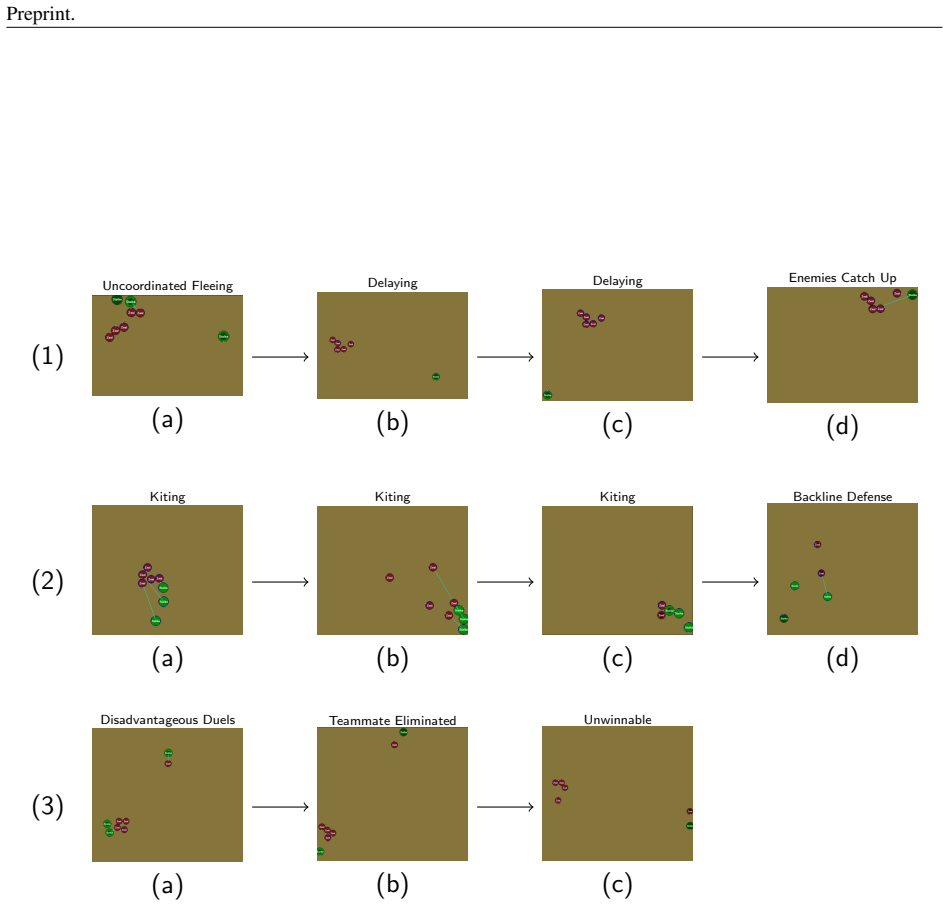
That a single short video of SMAC's minimal rendering (colored circles with abbreviated labels and monochrome attack lines) already supplies the VLM with enough behavioral signal to judge progress better than the win rate alone.
Editorial analysis
A structured set of objections, weighed in public.
Referee Report
Summary. The paper proposes Visual Inspection of Policies (VIP), an open-ended autocurriculum method that feeds episode videos of the current multi-agent policy (plus a short textual summary such as win rate and task history) to a Video Language Model, which then recommends the next interesting task. After sanitization via sentence similarity, the recommended task is used for further MAPPO training. Empirically, VIP is evaluated on SMAC with a lightweight open VLM (VideoLLaMa2-7B). On held-out maps and on frequently seen maps, fine-tuning win rates after curriculum training are higher for VIP than for a text-only ablation, two PLR score variants (PVL, MaxMC), random curricula, and training from scratch (Tables 1–2, Figures 3–4). A secondary comparison to supervised grid-search MAPPO* contextualizes sample efficiency. Qualitative frame analyses (Figure 1, Appendix D) illustrate cases where videos appear to capture near-miss strategies invisible to scalar scores.
Significance. If the result holds, VIP offers a simple, agent-count-agnostic route to open-ended multi-agent curricula that exploits visual behavior rather than only scalar learning signals or text summaries. The clean text-only ablation, use of an openly accessible 7B VLM whose inference cost is ~1% of training time, and first unsupervised-autocurriculum results on SMAC are concrete strengths. The work is timely given the rise of multi-modal LLMs and the known limitations of regret/score-based UED in sparse or deceptive multi-agent settings. Credit is due for reporting 95% CIs over five seeds, both held-out and in-distribution fine-tuning, and explicit qualitative case studies. The contribution is primarily empirical and methodological rather than theoretical.
major comments (3)
- [§5.1, §5.2, Appendix A.3, F.3] The central claim that policy videos supply usable learning-progress signal beyond win rate and task history (Q1; Table 1 / Figure 3 gaps on 3s vs 4z and 3s5z) rests on a single short (1–10 s), low-fidelity SMAC rendering (colored circles, abbreviated labels, same-color attack lines; §5.1, Appendix A.3, Figure 5) fed once per curriculum step to a 7B VLM. The system/task prompts already encode explicit win-rate thresholds for difficulty/map changes (Appendix F.3: “if win rate >70% … if <30% …”). The text-only ablation is necessary but not fully sufficient to isolate visual contribution: a control with scrambled/blank/random videos (or attention/saliency analysis) is needed to rule out that the VLM is largely ignoring pixels and reacting to the scalar thresholds and history already present in text. Without such a control the multi-modal superiority remains under-supported.
- [§5.2–5.3, Appendix G] PLR-PVL/MaxMC curricula exhibit extremely low map diversity and erratic non-adjacent repeats (Appendix G, Table 6), while VIP produces more progressive sequences. The paper attributes PLR’s poor fine-tuning results to scalar-score limitations, which is plausible, yet the comparison would be stronger if PLR were given the same task-space enumeration and a curriculum-length / replay-buffer budget matched to VIP’s 16 tasks, or if an additional UED baseline better suited to cooperative multi-agent settings were included. As written, it is hard to separate “scalar scores are insufficient” from “these particular PLR instantiations were poorly tuned for SMAC’s discrete map space.”
- [§5.1–5.2, Table 4] Generalization claims rely on fine-tuning for another 10^7 steps with shared default MAPPO hyperparameters (Table 5) on only three held-out maps (Table 4). While the unsupervised protocol is correctly motivated, three maps (two of which share stalker/zealot composition) and a fixed 80/20 split leave open whether the advantage transfers to other SMAC compositions, difficulties, or non-SMAC multi-agent domains. A sensitivity analysis on the train/test split or at least one additional domain would substantially strengthen the “open-ended multi-agent” claim.
minor comments (5)
- [§5.1 / Appendix A.3] Figure 5 and the accompanying text note that same-color fire lines make shooter/target identity ambiguous; this limitation should be flagged earlier (e.g., in §5.1) when the reader first encounters the rendering assumption.
- [Algorithm 1] Algorithm 1 uses non-standard notation (A^i_t, ϕ^video_t, ϑ_t). A short glossary or alignment with standard multi-agent POMDP notation would improve readability.
- [§4.1, Appendix F.2] The sentence-similarity sanitization is reported to recover all hallucinations (5.6% rate; Appendix F.2), yet the similarity threshold and embedding model are only lightly described. Reporting the exact threshold and a few recovered vs. unrecovered examples would aid reproducibility.
- [Title / References] Typos / formatting: “OPEN-ENDEDMULTI-AGENT…” missing spaces in the title block; “Franc ¸ois-Lavet” and similar accent artifacts; “PLR ⊥” rendering inconsistency.
- [§5.4, Table 3] Table 3 correctly notes that MAPPO* is supervised; the main text could more explicitly state that the 100× interaction gap is the intended takeaway rather than raw win-rate superiority.
Circularity Check
No circular derivation: VIP is an empirical curriculum method whose claims rest on held-out fine-tuning comparisons, not on quantities defined in terms of their own predictions.
full rationale
The paper introduces Visual Inspection of Policies (VIP) as a simple VLM-driven curriculum loop (Algorithm 1): train MAPPO on the current SMAC task, record one episode video plus win rate and task history, prompt VideoLLaMa2-7B for a next-task recommendation, and sanitize via off-the-shelf sentence similarity. The central claims (VIP outperforms its text-only ablation and PLR-PVL/MaxMC on fine-tuning win rates for held-out maps 10m vs 11m, 3s vs 4z, 3s5z; Tables 1–2, Figures 3–4) are purely empirical comparisons under a fixed MAPPO hyper-parameter set. No parameter is fitted to a subset of data and then re-presented as a prediction; no uniqueness theorem or ansatz is imported from the authors’ prior work; the only self-reference is the ordinary prompt context of previously selected tasks (Appendix F.3), which does not force the reported win-rate gaps by construction. The text-only ablation and PLR baselines are independent controls, and the VLM weights are frozen external models. Consequently the derivation chain contains no self-definitional, fitted-input-as-prediction, or load-bearing self-citation circularity. Score 0 is the correct outcome.
Assumptions & free parameters
free parameters (4)
- VLM temperature / top_p =
0.4 / 0.8
- Curriculum length (number of tasks) =
16
- MAPPO default hyper-parameters =
lr=5e-4, hidden=256, etc.
- Train/test map split =
12 train / 3 test maps
assumptions (4)
- domain assumption A single short episode video plus win rate is a sufficient statistic of learning progress for a VLM to recommend the next task.
- ad hoc to paper Sentence-similarity sanitization recovers all VLM hallucinations without introducing systematic bias toward particular maps.
- domain assumption Fine-tuning win rate after 1e7 steps on held-out maps is a valid proxy for open-ended generalization.
- standard math Standard multi-agent PPO (MAPPO) with shared policy and GRU is an adequate low-level learner for all compared curricula.
invented entities (1)
-
Visual Inspection of Policies (VIP)
Cite this review
Pith. "Pith review of Open-ended Multi-agent Autocurricula via Visual Inspection of Policies with Multi-modal LLMs." pith.science (2026). https://pith.science/paper/U6NDDREU
@misc{pith2026260708193,
  author       = {Pith},
  title        = {Pith review of: Open-ended Multi-agent Autocurricula via Visual Inspection of Policies with Multi-modal LLMs},
  year         = {2026},
  howpublished = {\url{https://pith.science/paper/U6NDDREU}},
  note         = {Machine review of arXiv:2607.08193}
}
read the original abstract
Open-ended curricula in Reinforcement Learning (RL) aim to train generally-capable agents by identifying tasks that facilitate learning increasingly complex skills. A major challenge when designing such curricula is assessing task difficulty relative to the agent's current learning progress. While previous work has explored using scalar task scores or textual summaries of the agent's behavior, here we study a different approach: directly inspecting policy behavior via recorded episode videos. We introduce a simple yet effective instantiation of this approach which leverages a Video Language Model (VLM) to both process these videos and provide curriculum recommendations, which we call Visual Inspection of Policies (VIP). Since videos can naturally contain any number of controllable agents, we empirically study VIP on the StarCraft Multi-Agent Challenge (SMAC). We show that even with a lightweight and openly accessible VLM (VideoLLaMa2-7B), VIP can use policy videos to generate more effective curricula than both its text-only ablation and methods that rely on scalar task scores.
Figures


Figures from the paper (5 more)


Reference graph
Works this paper leans on
-
[1]
Rutherford, Alex and Beukman, Michael and Willi, Timon and Lacerda, Bruno and Hawes, Nick and Foerster, Jakob , title =. Proceedings of the 38th International Conference on Neural Information Processing Systems , articleno =. 2024 , isbn =
work page 2024
-
[2]
Replay-Guided Adversarial Environment Design , url =
Jiang, Minqi and Dennis, Michael and Parker-Holder, Jack and Foerster, Jakob and Grefenstette, Edward and Rockt\". Replay-Guided Adversarial Environment Design , url =. Advances in Neural Information Processing Systems , editor =
-
[3]
Faldor, Maxence and Zhang, Jenny and Cully, Antoine and Clune, Jeff , booktitle =. OMNI-EPIC: Open-endedness via Models of human Notions of Interestingness with Environments Programmed in Code , volume =
-
[4]
Dharna, Aaron and Lu, Cong and Clune, Jeff , journal=. Foundation Model Self-Play:
-
[5]
Proceedings of the AAAI Conference on Artificial Intelligence , author=
Deep Reinforcement Learning That Matters , volume=. Proceedings of the AAAI Conference on Artificial Intelligence , author=. 2018 , month=. doi:10.1609/aaai.v32i1.11694 , abstractNote=
- [6]
-
[7]
A Definition of Continual Reinforcement Learning , volume =
Abel, David and Barreto, Andre and Van Roy, Benjamin and Precup, Doina and van Hasselt, Hado P and Singh, Satinder , booktitle =. A Definition of Continual Reinforcement Learning , volume =
-
[8]
Proceedings of The 2nd Conference on Lifelong Learning Agents , pages =
Augmenting Autotelic Agents with Large Language Models , author =. Proceedings of The 2nd Conference on Lifelong Learning Agents , pages =. 2023 , editor =
work page 2023
Show all 71 references
-
[9]
Proceedings of the 38th International Conference on Machine Learning , pages =
Prioritized Level Replay , author =. Proceedings of the 38th International Conference on Machine Learning , pages =. 2021 , editor =
2021
-
[10]
Reinforcement Learning in Economics and Finance , year =
Charpentier, Arthur and \'. Reinforcement Learning in Economics and Finance , year =. doi:10.1007/s10614-021-10119-4 , journal =
-
[11]
Castañón R., Campos F.A., Villar J. et al. , year =. A reinforcement learning approach to explore the role of social expectations in altruistic behavior , journal =
-
[12]
Intrinsically-Motivated and Open-Ended Learning Workshop @NeurIPS2023 , year=
Voyager: An Open-Ended Embodied Agent with Large Language Models , author=. Intrinsically-Motivated and Open-Ended Learning Workshop @NeurIPS2023 , year=
-
[13]
2024 , eprint=
Mastering Diverse Domains through World Models , author=. 2024 , eprint=
2024
-
[14]
Mehdi and Crump, Trafford and Far, Behrouz , title =
Afsar, M. Mehdi and Crump, Trafford and Far, Behrouz , title =. ACM Comput. Surv. , month = dec, articleno =. 2022 , issue_date =. doi:10.1145/3543846 , abstract =
2022 doi
-
[15]
Proceedings of the AAAI Conference on Artificial Intelligence , author=
Deep Reinforcement Learning for Robotics: A Survey of Real-World Successes , volume=. Proceedings of the AAAI Conference on Artificial Intelligence , author=. 2025 , month=. doi:10.1609/aaai.v39i27.35095 , abstractNote=
2025 doi
-
[16]
Kaufmann E., Bauersfeld L., Loquercio A. et al. , year =. Champion-level drone racing using deep reinforcement learning , journal =
-
[17]
Proceedings of the 39th International Conference on Machine Learning , pages =
Evolving Curricula with Regret-Based Environment Design , author =. Proceedings of the 39th International Conference on Machine Learning , pages =. 2022 , editor =
2022
-
[18]
ACM Trans
Naveed, Humza and Khan, Asad Ullah and Qiu, Shi and Saqib, Muhammad and Anwar, Saeed and Usman, Muhammad and Akhtar, Naveed and Barnes, Nick and Mian, Ajmal , title =. ACM Trans. Intell. Syst. Technol. , month = aug, articleno =. 2025 , issue_date =. doi:10.1145/3744746 , abstract =
2025 doi
-
[19]
2024 , eprint=
Large Language Models: A Survey , author=. 2024 , eprint=
2024
-
[20]
ArXiv , year=
Reinforcement Learning in the Era of LLMs: What is Essential? What is needed? An RL Perspective on RLHF, Prompting, and Beyond , author=. ArXiv , year=
-
[21]
Large Language Model Guided Reinforcement Learning Based Six-Degree-of-Freedom Flight Control , year=
Han, Yanqiao and Yang, Menglong and Ren, Yang and Li, Weizheng , journal=. Large Language Model Guided Reinforcement Learning Based Six-Degree-of-Freedom Flight Control , year=
-
[22]
2024 , eprint=
War and Peace (WarAgent): Large Language Model-based Multi-Agent Simulation of World Wars , author=. 2024 , eprint=
2024
-
[23]
Sutton, Andrew Barto
Richard S. Sutton, Andrew Barto. Reinforcement Learning: An Introduction
-
[24]
and Pineau, Joelle , year=
François-Lavet, Vincent and Henderson, Peter and Islam, Riashat and Bellemare, Marc G. and Pineau, Joelle , year=. An Introduction to Deep Reinforcement Learning , volume=. Foundations and Trends® in Machine Learning , publisher=. doi:10.1561/2200000071 , number=
-
[25]
Proceedings of the 37th International Conference on Machine Learning , pages =
Leveraging Procedural Generation to Benchmark Reinforcement Learning , author =. Proceedings of the 37th International Conference on Machine Learning , pages =. 2020 , editor =
2020
-
[26]
2020 , eprint=
Emergent Tool Use From Multi-Agent Autocurricula , author=. 2020 , eprint=
2020
-
[27]
Proceedings of the 40th International Conference on Machine Learning , pages =
Human-Timescale Adaptation in an Open-Ended Task Space , author =. Proceedings of the 40th International Conference on Machine Learning , pages =. 2023 , editor =
2023
-
[28]
Proceedings of the Twenty-Ninth International Joint Conference on Artificial Intelligence,
Automatic Curriculum Learning For Deep RL: A Short Survey , author =. Proceedings of the Twenty-Ninth International Joint Conference on Artificial Intelligence,. 2020 , month =. doi:10.24963/ijcai.2020/671 , url =
2020 doi
-
[29]
Emergent Complexity and Zero-shot Transfer via Unsupervised Environment Design , url =
Dennis, Michael and Jaques, Natasha and Vinitsky, Eugene and Bayen, Alexandre and Russell, Stuart and Critch, Andrew and Levine, Sergey , booktitle =. Emergent Complexity and Zero-shot Transfer via Unsupervised Environment Design , url =
-
[30]
and Stanley, Kenneth O
Brant, Jonathan C. and Stanley, Kenneth O. , title =. Proceedings of the Genetic and Evolutionary Computation Conference , pages =. 2017 , isbn =. doi:10.1145/3071178.3071186 , abstract =
2017 doi
-
[31]
, title =
Wang, Rui and Lehman, Joel and Clune, Jeff and Stanley, Kenneth O. , title =. Proceedings of the Genetic and Evolutionary Computation Conference , pages =. 2019 , isbn =. doi:10.1145/3321707.3321799 , abstract =
2019 doi
-
[32]
Survey on Large Language Model-Enhanced Reinforcement Learning: Concept, Taxonomy, and Methods , ISSN=
Cao, Yuji and Zhao, Huan and Cheng, Yuheng and Shu, Ting and Chen, Yue and Liu, Guolong and Liang, Gaoqi and Zhao, Junhua and Yan, Jinyue and Li, Yun , year=. Survey on Large Language Model-Enhanced Reinforcement Learning: Concept, Taxonomy, and Methods , ISSN=. doi:10.1109/tn...
2024 doi
-
[33]
ArXiv , year=
CoreInfer: Accelerating Large Language Model Inference with Semantics-Inspired Adaptive Sparse Activation , author=. ArXiv , year=
-
[34]
Proceedings of the Thirty-Third International Joint Conference on Artificial Intelligence,
Large Language Model Based Multi-agents: A Survey of Progress and Challenges , author =. Proceedings of the Thirty-Third International Joint Conference on Artificial Intelligence,. 2024 , month =. doi:10.24963/ijcai.2024/890 , url =
2024 doi
-
[35]
OMNI: Open-endedness via Models of human Notions of Interestingness , volume =
Zhang, Jenny and Lehman, Joel and Stanley, Kenneth and Clune, Jeff , booktitle =. OMNI: Open-endedness via Models of human Notions of Interestingness , volume =
-
[36]
Evolving Complex Environments in Evolution Gym using Large Language Models , year=
Aki, Fuma and Ikeda, Riku and Saito, Takumi and Regan, Ciaran and Oka, Mizuki , booktitle=. Evolving Complex Environments in Evolution Gym using Large Language Models , year=
-
[37]
ArXiv , year=
A Survey of Prompt Engineering Methods in Large Language Models for Different NLP Tasks , author=. ArXiv , year=
-
[38]
ArXiv , year=
A Systematic Survey of Prompt Engineering in Large Language Models: Techniques and Applications , author=. ArXiv , year=
-
[39]
Journal of Machine Learning Research , year =
Siyi Hu and Yifan Zhong and Minquan Gao and Weixun Wang and Hao Dong and Xiaodan Liang and Zhihui Li and Xiaojun Chang and Yaodong Yang , title =. Journal of Machine Learning Research , year =
-
[40]
ArXiv , year=
VideoLLaMA 2: Advancing Spatial-Temporal Modeling and Audio Understanding in Video-LLMs , author=. ArXiv , year=
-
[41]
Proceedings of the 41st International Conference on Machine Learning , pages =
Position: Open-Endedness is Essential for Artificial Superhuman Intelligence , author =. Proceedings of the 41st International Conference on Machine Learning , pages =. 2024 , editor =
2024
- [42]
-
[43]
2019 , eprint=
The StarCraft Multi-Agent Challenge , author=. 2019 , eprint=
2019
-
[44]
2017 , eprint=
StarCraft II: A New Challenge for Reinforcement Learning , author=. 2017 , eprint=
2017
-
[45]
The StarCraft Multi-Agent Exploration Challenges: Learning Multi-Stage Tasks and Environmental Factors Without Precise Reward Functions , year=
Kim, Mingyu and Oh, Jihwan and Lee, Yongsik and Kim, Joonkee and Kim, Seonghwan and Chong, Song and Yun, Seyoung , journal=. The StarCraft Multi-Agent Exploration Challenges: Learning Multi-Stage Tasks and Environmental Factors Without Precise Reward Functions , year=
-
[46]
The Surprising Effectiveness of PPO in Cooperative Multi-Agent Games , volume =
Yu, Chao and Velu, Akash and Vinitsky, Eugene and Gao, Jiaxuan and Wang, Yu and Bayen, Alexandre and WU, YI , booktitle =. The Surprising Effectiveness of PPO in Cooperative Multi-Agent Games , volume =
-
[47]
, title =
Wu, Jizhou and Yang, Tianpei and Hao, Xiaotian and Hao, Jianye and Zheng, Yan and Wang, Weixun and Taylor, Matthew E. , title =. Proceedings of the 2023 International Conference on Autonomous Agents and Multiagent Systems , pages =. 2023 , isbn =
2023
-
[48]
ArXiv , year=
Trust Region Policy Optimisation in Multi-Agent Reinforcement Learning , author=. ArXiv , year=
-
[49]
2023 , eprint=
Multi-Agent Interplay in a Competitive Survival Environment , author=. 2023 , eprint=
2023
-
[50]
Adaptive Agents and Multi-Agent Systems , year=
Value-Decomposition Networks For Cooperative Multi-Agent Learning Based On Team Reward , author=. Adaptive Agents and Multi-Agent Systems , year=
-
[51]
Nature Machine Intelligence , year=
Densing law of LLMs , author=. Nature Machine Intelligence , year=
-
[52]
Proceedings of the 63rd Annual Meeting of the Association for Computational Linguistics (Volume 1: Long Papers). 2025. doi:10.18653/v1/2025.acl-long.0
2025 doi
-
[53]
Understanding the Capabilities and Limitations of Large Language Models for Cultural Commonsense
Shen, Siqi and Logeswaran, Lajanugen and Lee, Moontae and Lee, Honglak and Poria, Soujanya and Mihalcea, Rada. Understanding the Capabilities and Limitations of Large Language Models for Cultural Commonsense. Proceedings of the 2024 Conference of the North American Chapter of ...
2024 doi
-
[54]
ArXiv , year=
A Comprehensive Survey of LLM Alignment Techniques: RLHF, RLAIF, PPO, DPO and More , author=. ArXiv , year=
-
[55]
Attention is All you Need , url =
Vaswani, Ashish and Shazeer, Noam and Parmar, Niki and Uszkoreit, Jakob and Jones, Llion and Gomez, Aidan N and Kaiser, ukasz and Polosukhin, Illia , booktitle =. Attention is All you Need , url =
-
[56]
2023 IEEE High Performance Extreme Computing Conference (HPEC) , year=
From Words to Watts: Benchmarking the Energy Costs of Large Language Model Inference , author=. 2023 IEEE High Performance Extreme Computing Conference (HPEC) , year=
2023
-
[57]
2024 , eprint=
Optimizing Large Language Models with an Enhanced LoRA Fine-Tuning Algorithm for Efficiency and Robustness in NLP Tasks , author=. 2024 , eprint=
2024
-
[58]
2024 , eprint=
A Survey on Transformers in NLP with Focus on Efficiency , author=. 2024 , eprint=
2024
-
[59]
Optimize Vision Transformer Architecture via Efficient Attention Modules: A Study on the Monocular Depth Estimation Task , isbn =
Schiavella, Claudio and Cirillo, Lorenzo and Papa, Lorenzo and Russo, Paolo and Amerini, Irene , year =. Optimize Vision Transformer Architecture via Efficient Attention Modules: A Study on the Monocular Depth Estimation Task , isbn =
-
[60]
Proceedings of the 38th International Conference on Machine Learning , pages =
DFAC Framework: Factorizing the Value Function via Quantile Mixture for Multi-Agent Distributional Q-Learning , author =. Proceedings of the 38th International Conference on Machine Learning , pages =. 2021 , editor =
2021
-
[61]
STAR-MARL: LLM-based Sub-task Curricula Design , author=
-
[62]
2024 , eprint=
Game On: Towards Language Models as RL Experimenters , author=. 2024 , eprint=
2024
-
[63]
The Eleventh International Conference on Learning Representations , year=
Mikayel Samvelyan and Akbir Khan and Michael D Dennis and Minqi Jiang and Jack Parker-Holder and Jakob Nicolaus Foerster and Roberta Raileanu and Tim Rockt. The Eleventh International Conference on Learning Representations , year=
-
[64]
Proceedings of the AAAI Conference on Artificial Intelligence , author=
From Few to More: Large-Scale Dynamic Multiagent Curriculum Learning , volume=. Proceedings of the AAAI Conference on Artificial Intelligence , author=. 2020 , month=. doi:10.1609/aaai.v34i05.6221 , abstractNote=
2020 doi
-
[65]
2021 , howpublished =
all-MiniLM-L6-v2 , author =. 2021 , howpublished =
2021
-
[66]
and Lin, Kevin and Hewitt, John and Paranjape, Ashwin and Bevilacqua, Michele and Petroni, Fabio and Liang, Percy
Liu, Nelson F. and Lin, Kevin and Hewitt, John and Paranjape, Ashwin and Bevilacqua, Michele and Petroni, Fabio and Liang, Percy. Lost in the Middle: How Language Models Use Long Contexts. Transactions of the Association for Computational Linguistics. 2024. doi:10.1162/tacl_a_00638
2024 doi
-
[67]
The Revolution of Multimodal Large Language Models: A Survey
Caffagni, Davide and Cocchi, Federico and Barsellotti, Luca and Moratelli, Nicholas and Sarto, Sara and Baraldi, Lorenzo and Baraldi, Lorenzo and Cornia, Marcella and Cucchiara, Rita. The Revolution of Multimodal Large Language Models: A Survey. Findings of the Association for...
2024 doi
-
[68]
Language Models are Few-Shot Learners , url =
Brown, Tom and Mann, Benjamin and Ryder, Nick and Subbiah, Melanie and Kaplan, Jared D and Dhariwal, Prafulla and Neelakantan, Arvind and Shyam, Pranav and Sastry, Girish and Askell, Amanda and Agarwal, Sandhini and Herbert-Voss, Ariel and Krueger, Gretchen and Henighan, Tom a...
-
[69]
Scaling Learning Algorithms Towards
Bengio, Yoshua and LeCun, Yann , booktitle =. Scaling Learning Algorithms Towards
-
[70]
and Osindero, Simon and Teh, Yee Whye , journal =
Hinton, Geoffrey E. and Osindero, Simon and Teh, Yee Whye , journal =. A Fast Learning Algorithm for Deep Belief Nets , volume =
-
[71]
2016 , publisher=
Deep learning , author=. 2016 , publisher=
2016
Reviewed July 10, 2026 · model on record in the stance chip above.
Discussion (0). Continue with ORCID to comment.